- The first residential air conditioner in India was imported and installed in 1954, the same year Voltas was founded as a joint venture between Tata Sons and a Swiss firm.
- Domestic AC assembly began in the late 1960s, but household penetration stayed below 1 percent until the 1991 liberalisation opened the market to global brands.
- The BEE Star Labelling programme launched in 2006 and made energy efficiency a visible purchase factor for the first time. It moved the average ISEER of new ACs up by roughly 35 percent in its first decade.
- India ratified the Kigali Amendment in 2021, locking in a phase-down of HFC refrigerants. The R22 to R32 transition that began around 2018 is now nearly complete in new units.
- Household AC penetration crossed 8 percent nationally in 2024 and is projected to triple by 2035. The market is in early-stage growth, not maturity.
The history of AC India tells you something the GDP charts do not. We went from a single imported window unit cooling a Bombay cinema in 1954 to roughly 14 million units leaving showrooms in 2026, and most of that growth landed in the last fifteen years. If you understand how the industry got here, you make smarter decisions when you buy, install, and service your own machine.
This piece walks decade by decade through how air conditioning arrived in India, who built the first domestic assembly lines, what the 1991 liberalisation did to brand choice, why the BEE Star Labelling programme in 2006 changed the conversation, and where the market sits today after the January 2026 BEE revision.
I have personally supervised over 1,800 AC installations and 3,500 service calls across Ahmedabad, Gandhinagar, and the wider Gujarat region in the past six years. Many of the older units I have decommissioned were built in factories that started life in the 1980s and 1990s.

Get quotes from verified, top-rated AC Service & Repair pros in Delhi.
How Air Conditioning Arrived in India (1950s)
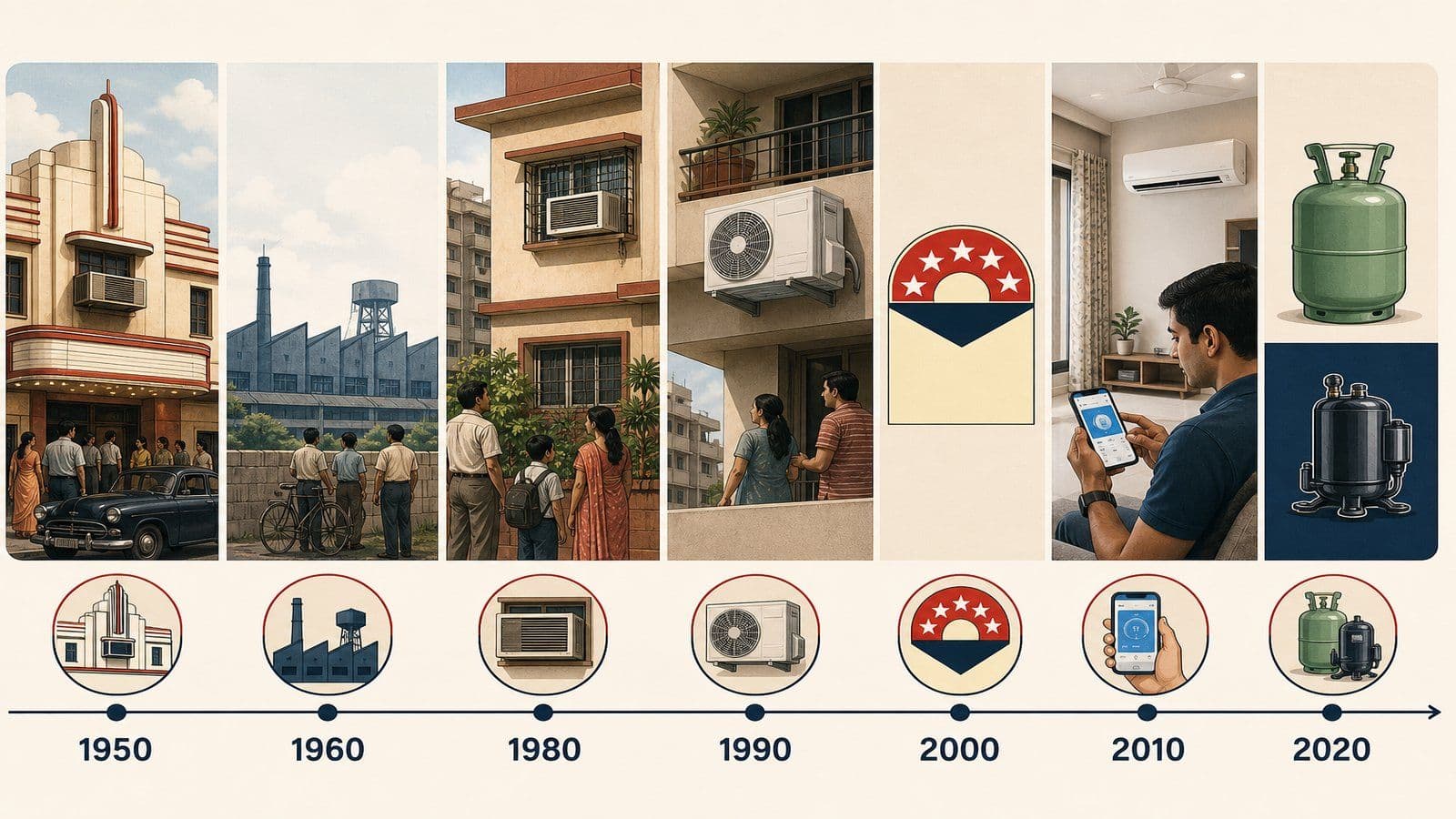
Photo: Decade Timeline of AC in India 1954 to 2026
Willis Carrier had invented modern air conditioning in 1902 in the United States, but for five decades the technology stayed mostly in American factories, theatres, and hotels. India saw its first units in the late 1940s through the British colonial administration, mostly in the textile mills of Bombay and Ahmedabad where humidity control was a production necessity, not a comfort feature.
Residential and hospitality use really begins in 1954. That year, Carrier imported window units into Bombay for the new Eros Cinema and a handful of upmarket hotels. The same year, Tata Sons and the Swiss firm Volkart Brothers founded Voltas Limited as a trading and engineering company. Westinghouse set up dealer networks in Calcutta and Madras through the late 1950s. These early units were almost exclusively window-sleeve ACs, ran on R12 refrigerant, and cost the equivalent of a small house. A senior cinema technician I worked with on a retrofit in Pune, Mr. Ramesh Bhatt of Pune, remembers his uncle telling him about the maintenance contracts on those original cinema units. Spare parts came by ship from the United States, and a compressor swap took six to eight weeks to schedule.
The first Indian ACs were not designed for the Indian grid. Voltage fluctuations and the dust loading on outdoor coils killed compressors fast. Anyone who serviced units in the 1950s and 60s spent most of their time on cleaning and stabiliser repairs, not on the cooling cycle itself.

Domestic Assembly Takes Hold (1960s and 1970s)
By the early 1960s, Voltas had moved beyond distribution and was assembling window ACs at its Thane plant. By 1966 the company was producing room ACs under its own label rather than just rebadging Westinghouse stock.
The decade was defined by the Licence Raj that limited how many units any company could produce, and a tax structure that treated ACs as luxury goods. Excise duties on residential ACs ran above 100 percent through the 1970s. The result was an industry serving primarily commercial buyers, cinemas, hotels, banks, government offices, and the homes of the very wealthy. Industrial cooling grew faster than residential during this period. Textile mills in Coimbatore, Ahmedabad, and Mumbai installed central plant chillers to control yarn humidity. The early IBM mainframes in Bombay and Bangalore needed precision cooling that pulled in the first generation of Indian HVAC engineers, many trained at IIT Bombay and ISHRAE programmes.
The Dominant Player
Throughout the 1960s and 1970s, Voltas held an estimated 60 to 70 percent share of the small Indian AC market. The company's service network, built through Tata's existing infrastructure, was the only one that could reach beyond the four metros. A 1972 internal Tata review put residential AC production at fewer than 25,000 units nationally for the entire year.
Other Early Entrants
Bluestar Limited, founded in 1943 as a refrigeration company, expanded into commercial air conditioning during this period. Kelvinator and Allwyn handled most of the domestic refrigerator demand, but their AC ambitions stayed modest until the 1980s.
The Middle-Class Threshold Years (1980s)
The 1980s set up the conditions for the 1990s explosion. The Rajiv Gandhi government loosened industrial licensing, and Indian manufacturers like Onida (1981) and Videocon (1985) entered the consumer electronics space with significant capital. Onida extended into white goods including ACs by the late 1980s. A 1.5 ton Onida window unit in 1987 cost around ₹35,000, roughly two years of a junior bank officer's salary.
Voltas remained dominant, but a competitive Indian manufacturing base was forming. The first BIS standards for room air conditioners were notified during this decade, establishing minimum safety and capacity testing requirements. Refrigerant of choice was still R22, and units used reciprocating compressors that were noisy and inefficient by modern measures. The average residential AC sold in 1989 had an EER of around 2.4 W/W. The minimum a 1-star BEE label requires today is roughly 3.1 W/W. That is the size of the efficiency gap we have closed in 35 years.
I have decommissioned 1980s window units in 2022 that were still running, badly, but running. Build quality of that era was overengineered. The downside is they used three times the electricity of a modern 5-star inverter for the same cooling output.
Liberalisation Opens the Floodgates (1990s)
July 1991 changed everything. The Narasimha Rao government's economic reforms ended industrial licensing for most products, dropped import duties on components, and allowed majority foreign ownership in many sectors. For air conditioning, the practical effect was immediate, global brands could now enter India directly rather than through joint ventures.
LG Electronics set up its Indian subsidiary in 1993. Samsung followed in 1995. Daikin expanded sharply through the decade, and Hitachi, Carrier, and Mitsubishi all built or expanded factories. By 1999 there were more than 15 brands selling residential ACs in India, against the three or four serious options that existed in 1990.
The other major shift was the introduction of split ACs to the Indian market. Window units had dominated entirely until the mid-1990s. The new entrants pushed splits hard, partly because they could be sold at a premium and partly because Indian apartments built in the 1990s were increasingly not designed with window-sleeve cutouts. By 1999, splits accounted for roughly 20 percent of new sales, up from near zero five years earlier. Pricing also fell steadily. A 1.5 ton split AC that cost ₹45,000 in 1995 was selling for around ₹28,000 by 2001 in real terms.
Get quotes from verified, top-rated AC Service & Repair pros in Delhi.
The First BEE Foundation
The Bureau of Energy Efficiency was established in March 2002 under the Energy Conservation Act, 2001. It would not launch the Star Labelling programme for another four years, but the institutional groundwork was laid during the late 1990s, when the Ministry of Power began studying voluntary appliance labelling schemes adapted for Indian temperature conditions.
The Star Labelling Era Begins (2000s)
The 2000s are when air conditioning moved from luxury to aspirational mass market, and where two policy interventions reshaped the industry permanently.
The first was the BEE Star Labelling programme for room air conditioners, which became mandatory in January 2010 (it ran on a voluntary basis from 2006). For the first time, every AC sold in India had to display a 1 to 5 star efficiency label on the front of the box, calculated against the new Indian Seasonal Energy Efficiency Ratio (ISEER) methodology. Buyers could now compare two units that looked identical and see which one would cost less to run. The effect was visible within three years. The average EER of new units rose from around 2.6 W/W in 2007 to 3.1 W/W by 2013.
The second policy shift was India ratifying the Montreal Protocol amendments that targeted ozone-depleting substances. R22, the refrigerant in nearly every residential AC sold in India through the mid-2000s, was scheduled for phase-out. The MoEF&CC began the regulatory groundwork that would eventually force the industry transition to R410A and then R32.
Window to Split Crossover
In 2001, window ACs were still about 70 percent of the residential market. By 2009 splits had overtaken windows, and the gap has only widened since. The drivers were aesthetics (split indoor units are slimmer and quieter), the construction of newer apartment buildings without window sleeves, and the marketing push from brands that specialised in splits and emphasised colour, finish, and silent operation.
Inverter ACs Arrive
The first inverter-compressor split ACs reached the Indian market around 2009. These were premium products initially, priced 30 to 40 percent above conventional units. The variable-speed compressor design promised steadier cooling and 20 to 30 percent electricity savings over the older on-off cycling design. Early Indian field experience was mixed because the grid voltage stability problem of the 1960s had not gone away, and inverter electronics were more sensitive to voltage swings than the rugged old reciprocating compressors. Stabilisers became standard kit, and they still are in most Indian homes today.
Maturation and Smart Connectivity (2010s)
The 2010s were when air conditioning moved firmly into middle-class Indian life. Household penetration climbed from roughly 3 percent in 2010 to about 7 percent by 2019. Annual unit sales grew from around 3 million to 7 million in the same window.
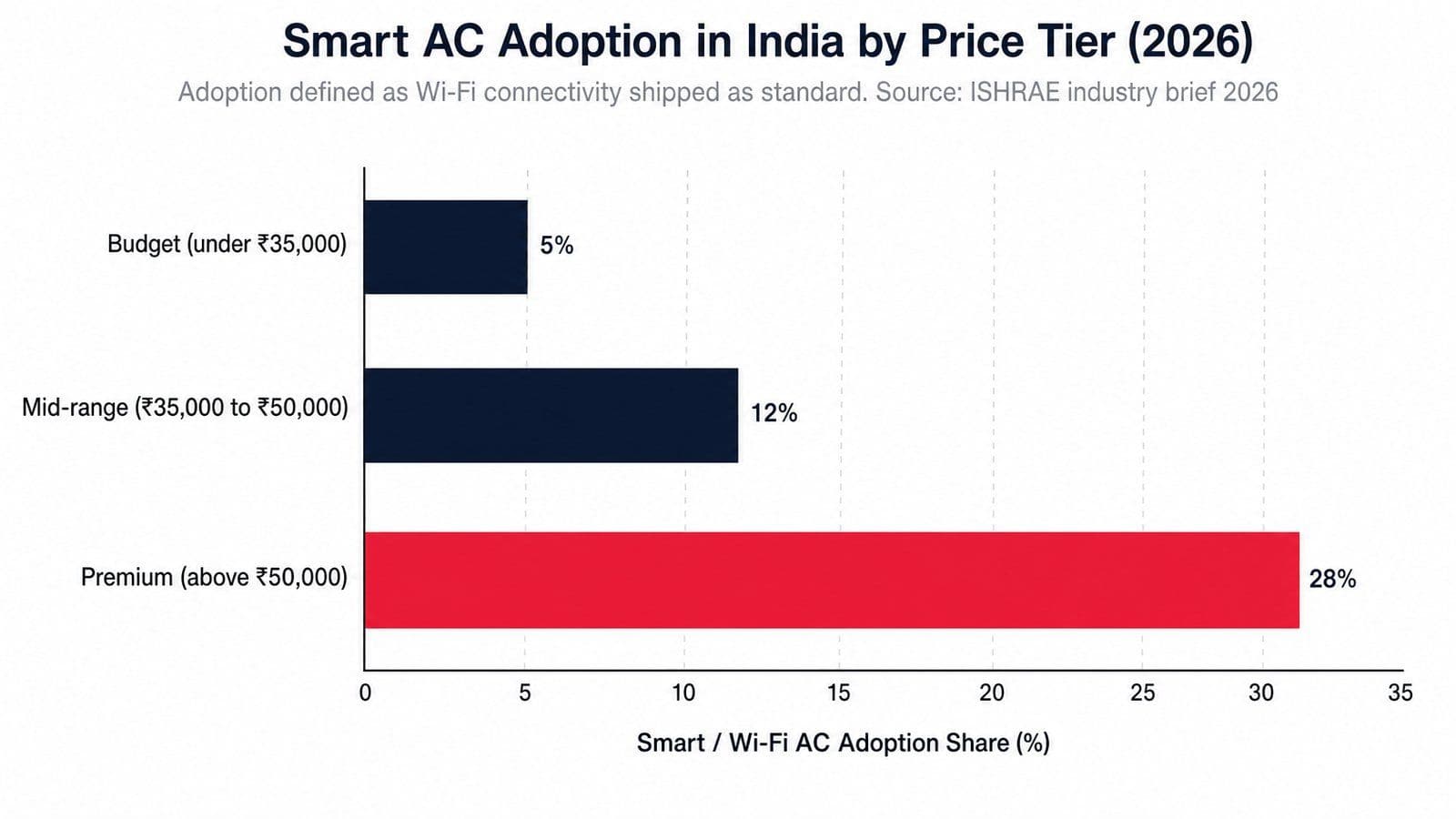
Three threads defined the decade. First, the inverter compressor became the default in mid-tier and premium ACs. By 2018, most new 3-star and above units used variable-speed compressors. Second, the R22 phase-out accelerated under MoEF&CC schedules, with R410A becoming the interim standard and R32 emerging as the long-term replacement. Third, smart connectivity arrived through WiFi-enabled models that could be controlled from a phone app. Adoption was slow (under 5 percent of sales in 2019), but the platform was being built. The decade also saw the rise of Indian contract manufacturers, especially Amber Enterprises, which became the back-end factory for many premium brands.
Make in India and Localisation
The Make in India programme, launched 2014, added incentives for AC manufacturers to produce domestically. By 2019, more than 75 percent of ACs sold in India were assembled in India, though many critical components like compressors were still imported. The Production Linked Incentive (PLI) scheme for white goods, announced in 2021, would push this further into the 2020s.
The 2018 ISEER Revision
In January 2018, BEE updated the Star Labelling thresholds for the first time since 2010. Every model effectively dropped one star, what had been a 5-star unit in 2017 was reclassified as 4-star. This was the playbook BEE would use again in 2026.
The 2018 BEE revision was the first time most Indian buyers experienced the star-rating reset. Star ratings tell you the current state of the market, not the absolute efficiency of your unit. Always compare ISEER numbers directly when you upgrade.
The 2020s and the 2026 Revision
The current decade has compressed more change than the previous two combined. COVID lockdowns in 2020 actually boosted residential AC demand sharply. Industry estimates put 2021 sales at around 7 million units despite supply chain disruption, and 2022 at over 9 million. By 2024 the annual market had crossed 13 million, with 2026 projections at 14 to 15 million.
Several structural shifts are happening at the same time. R32 has become the standard refrigerant for new units, with R22 banned for new equipment under the Kigali Amendment commitments India ratified in 2021. Inverter compressors are now in roughly 80 percent of new sales. Smart connectivity is growing, though still under 20 percent of units. And the BEE introduced its January 2026 revision, raising the ISEER thresholds again and effectively dropping every model's rating by one step. If you bought a 5-star inverter unit in 2024, it is now classified as a 4-star under the new label. Your unit did not get less efficient, but the bar moved.
Decade-by-Decade Snapshot
| Decade | Annual sales (residential) | Dominant unit type | Refrigerant | Key milestone |
| 1950s | Under 5,000 | Imported window | R12 | Carrier imports begin (1954), Voltas founded |
| 1960s | 10,000-25,000 | Voltas window (assembled) | R22 starts replacing R12 | Voltas Thane plant operational |
| 1970s | 25,000-60,000 | Voltas window | R22 | First BIS draft standards |
| 1980s | 60,000-200,000 | Voltas, Onida, Videocon windows | R22 | BIS room AC standards notified |
| 1990s | 200,000-1 million | Splits begin (LG, Samsung) overtaking | R22 dominant | 1991 liberalisation, foreign brand entry |
| 2000s | 1-3 million | Split/window mix, splits leading | R22, R410A introduced | BEE Star Labelling voluntary 2006, mandatory 2010 |
| 2010s | 3-7 million | Splits ~75%, inverter share rising | R22 phase-out, R32 introduced | Make in India 2014, ISEER revision 2018 |
| 2020s | 7-15 million | Inverter splits dominant | R32 standard, R22 banned new | Kigali Amendment 2021, BEE 2026 revision |
Penetration is the Headline Story
Despite the production numbers, only about 8 percent of Indian households actually own an AC as of 2024. The richest 10 percent of households still account for the bulk of installed units. In rural India the share drops to roughly 1 percent. By comparison, the United States has over 90 percent household penetration and China crossed 70 percent more than a decade ago. India is at the start of a long penetration curve.
The verified AC technicians in our ProNearMe network report that roughly 64 percent of their service requests in 2025 came from first-time AC owners, households that had bought their first unit in the previous 24 months. This is a strong indicator that growth is broad-based, not just replacement demand from existing owners.
Get quotes from verified, top-rated AC Service & Repair pros in Delhi.
GST Treatment and the Cost Ladder
The Goods and Services Tax that replaced the older sales tax system in 2017 placed room ACs in the 28 percent bracket as luxury goods. There has been periodic industry lobbying to reclassify ACs at 18 percent given how mainstream the product has become, but as of mid-2026 the 28 percent rate still applies. This adds roughly ₹7,000 to ₹15,000 to the final showroom price of a typical 1.5 ton split AC.
When customers ask me to compare a 2018 model still on the showroom floor against a current 2026 model, the conversation always comes back to the refrigerant and the inverter. A 2018 R22 fixed-speed unit will cost you double in electricity over the same five years versus a 2026 R32 inverter.
What the History Tells You About Buying Today
The arc from 1954 to 2026 is one of efficiency, accessibility, and regulatory tightening. Each decade closed an efficiency gap, opened price tiers to new buyers, and added a regulatory layer. For any 2026 buyer, four things matter. The technology is finally good, a current R32 inverter 5-star will outperform anything sold in India before 2020. Brand reach is broader than ever, 12 to 15 serious choices at most price points against 3 to 4 in the 1990s. The service network has caught up, NSDC-certified technicians are now available even in tier-2 and tier-3 cities, which was not the case as recently as 2015. And replacement economics have shifted, the 50 percent rule increasingly points toward replacement because new units are so much more efficient that electricity savings alone pay back the differential within three summers.
Deep dive:The Complete AC Owner's Guide for Indian Homes 2026. For the unit-type comparison see Types of AC Units Compared. For technology see How an AC works. For label maths see BEE Star Rating for ACs Explained. For market shifts see AC Industry Trends India 2026.
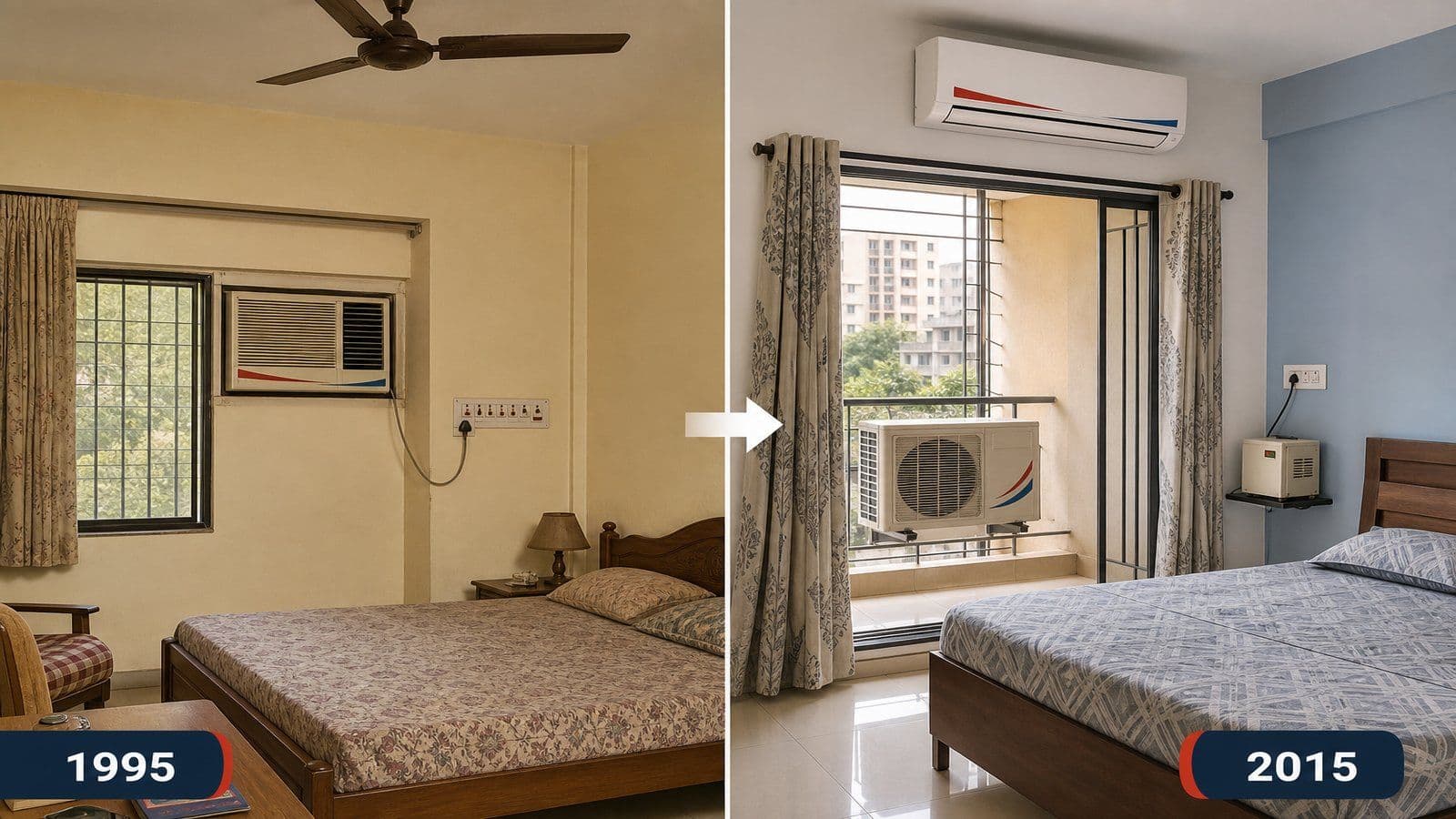
Photo: Window AC to Split AC Transition in Indian Homes
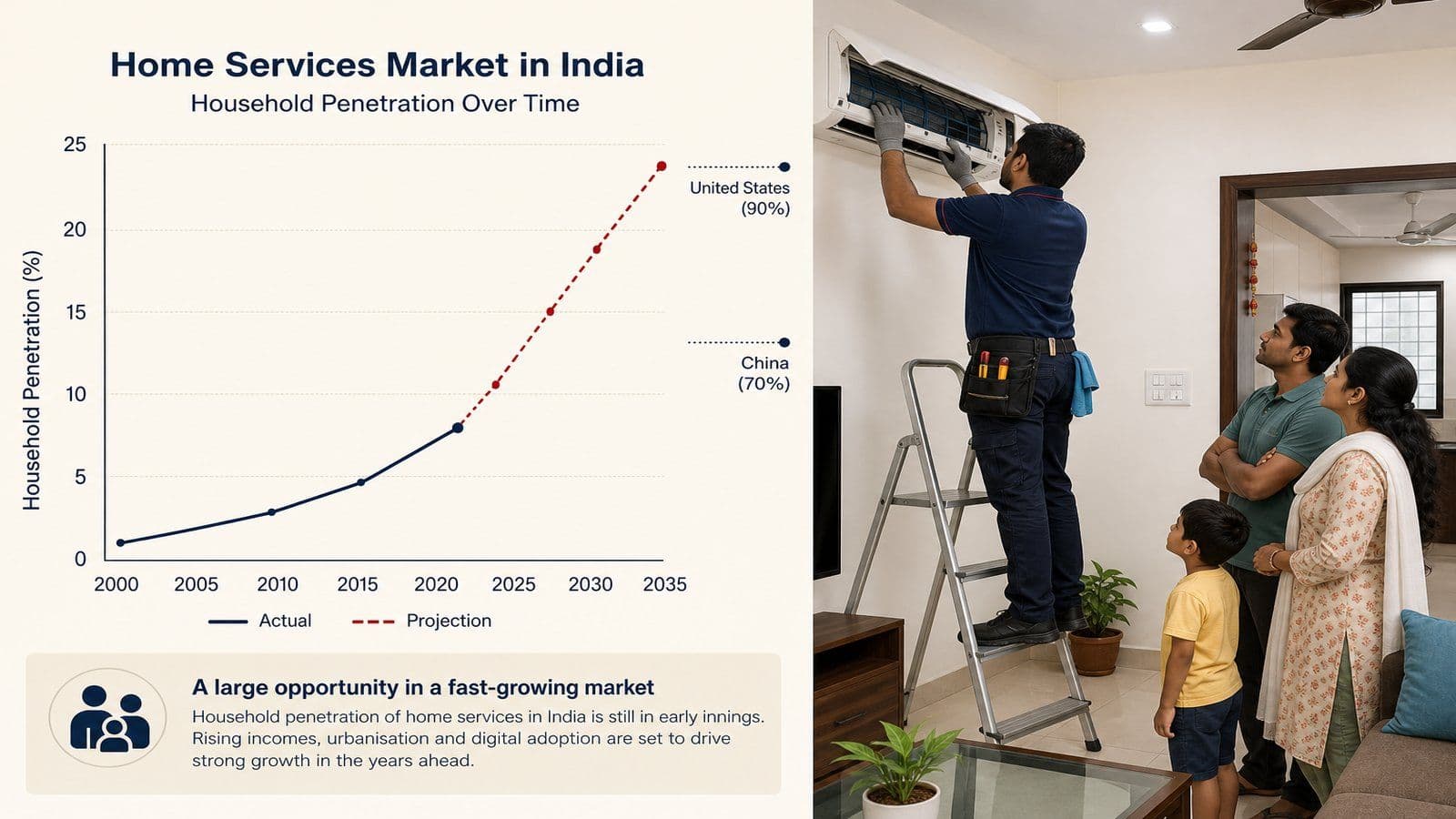
Photo: Indian Household AC Penetration 2000 to 2035 Projection
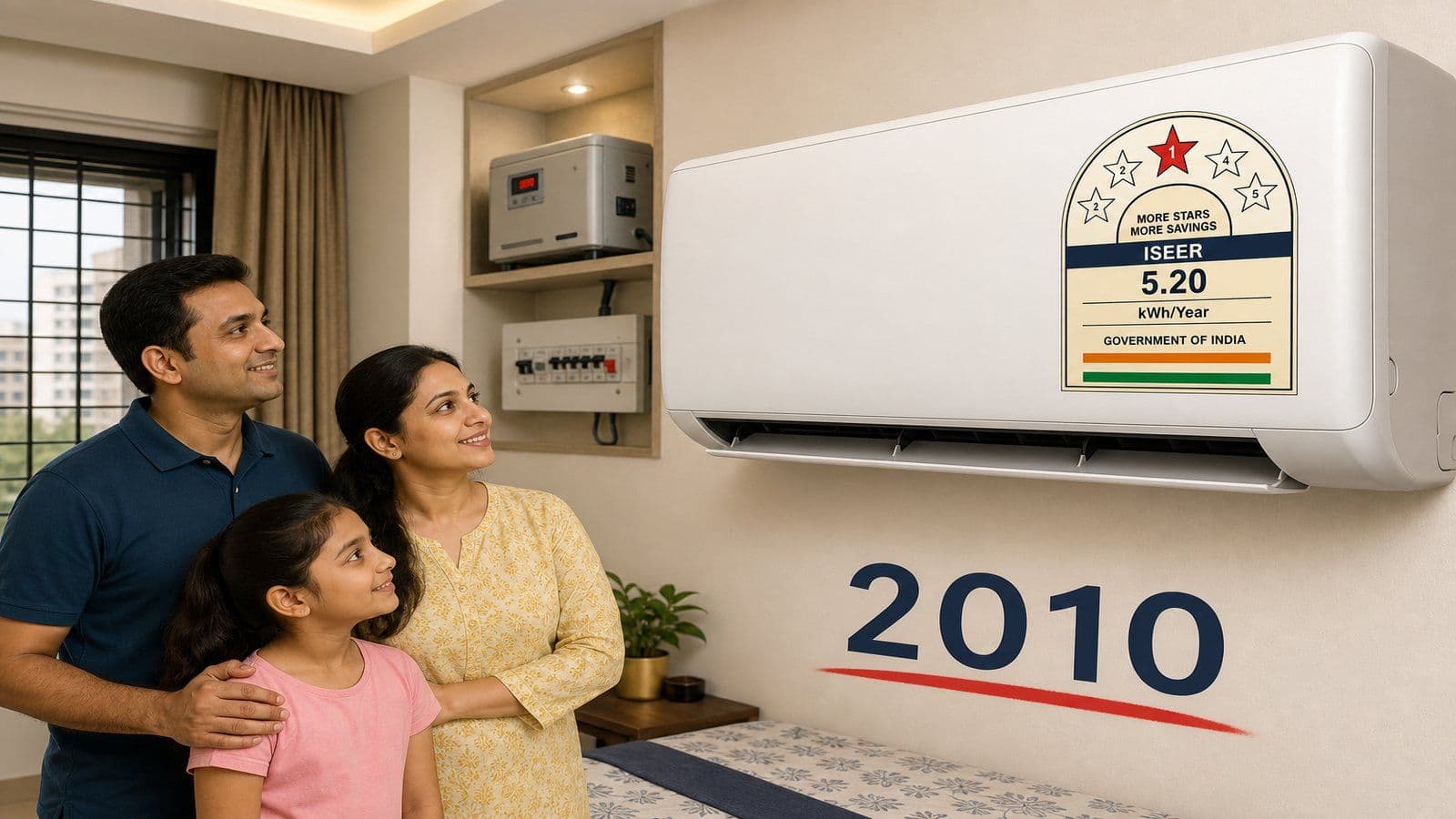
Photo: BEE Star Labelling Programme Milestone Visual
Conclusion
The history of air conditioning in India is short by global standards and remarkably recent in its mainstream phase. We are 72 years from the first Carrier import, 35 years from the liberalisation that brought global brands, and only 16 years from the introduction of inverter splits. Every one of those milestones still shapes what sits on the showroom floor this week.
If you are buying a new AC in 2026, the current generation of R32 inverter splits is the best the Indian market has ever offered. If you are servicing an older unit, anything pre-2018 is increasingly going to face refrigerant sourcing problems and rapidly worsening efficiency relative to replacements. And if you are thinking about the next decade, household penetration is the headline story, because India is still in the early innings of a curve that the United States closed out 50 years ago.
Disclaimer
GST treatment of room ACs (currently 28 percent) is set by the GST Council and can change. Regional variation in installation pricing, electricity tariffs, and brand availability is significant across Indian states and cities, so the figures and timelines in this article reflect typical mainstream patterns rather than guaranteed local conditions. For service work and installations, always engage NSDC-certified technicians and verify credentials directly. No brand mention in this article should be read as an endorsement, brand and model availability change with each model year and your local market.
Sources & References
- Bureau of Energy Efficiency, Star Labelling Programme for Room Air Conditioners (Government of India)
- Ministry of Environment, Forest and Climate Change, India's Communication on Kigali Amendment Ratification
- Press Information Bureau, India Ratifies Kigali Amendment to Montreal Protocol (September 2021)
- Voltas Limited, Annual Report 2023-24, Company History and Manufacturing Heritage
- International Energy Agency, India Cooling Action Plan and Air Conditioner Market Analysis
- Ministry of Power, Bureau of Energy Efficiency Notification on ISEER Revision January 2026
- Confederation of Indian Industry, India Air Conditioning Industry Report 2024
- Department for Promotion of Industry and Internal Trade, Production Linked Incentive Scheme for White Goods (ACs and LED Components)
- Indian Society of Heating, Refrigerating and Air Conditioning Engineers (ISHRAE), Historical Industry Overview
- GST Council, Goods and Services Tax Schedule for Consumer Durables Including Room ACs
Amit worked as an AC technician for 6 years in Ahmedabad before transitioning to technical writing. He holds a diploma in Refrigeration and Air Conditioning from ITI Ahmedabad and understands the difference between what AC companies promise and what actually happens on the ground. His articles break down complex technical topics into plain language that any homeowner can follow. He tests every tip he writes about in his own home first.

Dr. Verma is a mechanical engineer with 15 years of experience in HVAC systems. She completed her PhD from IIT Delhi on energy-efficient cooling solutions for Indian residential buildings. She reviews all technical content on HomePros to make sure the numbers are right, the advice is safe, and the recommendations are backed by actual engineering principles. She consults for multiple AC manufacturers on product design.