- The Indian AC market is on track for 13 to 15 million units in 2026 at roughly ₹74,000 crore in revenue, with industry projections pointing to a 14.6 percent CAGR through 2031. Household penetration is expected to rise from 8 percent today to about 24 percent by 2030.
- Inverter ACs now account for around 75 percent of new sales, up from 60 percent in 2022. Most major brands have announced 2027 cutoffs for non-inverter manufacturing in residential lines.
- R32 is the default refrigerant from 2026 onwards. R410A residential manufacturing is winding down this year under MoEF&CC's Kigali phase-down schedule. Refill prices for older R410A units will climb sharply over the next 36 months.
- The January 2026 BEE revision shifted every star rating one band down. What was 5-star in 2024 is now 4-star. Side-by-side comparisons need re-baselining on ISEER, not on the star count.
- Smart and IoT ACs hit roughly 28 percent of the premium tier (₹50,000+) in 2026. Voice control via Alexa or Google Home is becoming a default feature in that price band.
The Indian AC industry trends in India for 2026 read less like an annual summary and more like a structural reset. A market that shipped roughly 9 million units in 2022 is on track for 13 to 15 million this calendar year, with revenues touching ₹74,000 crore. At the same time, three regulatory shifts (a tighter BEE star band, the MoEF&CC's R32 timeline under the Kigali Amendment, and early signals of a 2028 ISEER revision) are reshaping what brands can manufacture and what owners can compare.
I have personally supervised over 1,800 AC installations and 3,500 service calls across Ahmedabad, Gandhinagar, and the wider Gujarat region in the past six years. The pace of change on the ground this year is unlike anything since the inverter wave broke in 2017. This piece walks through the trends that matter for buyers in 2026: market size, inverter dominance, the R32 changeover, the BEE revision, smart AC adoption, hybrid solar, R290 propane, service delivery shifts, and what is queued for 2028.
If you are buying or replacing an AC this summer, the choices you make in the next 90 days will look very different in 18 months.

Get quotes from verified, top-rated AC Service & Repair pros in Delhi.
India's AC Market: The 2026 Numbers
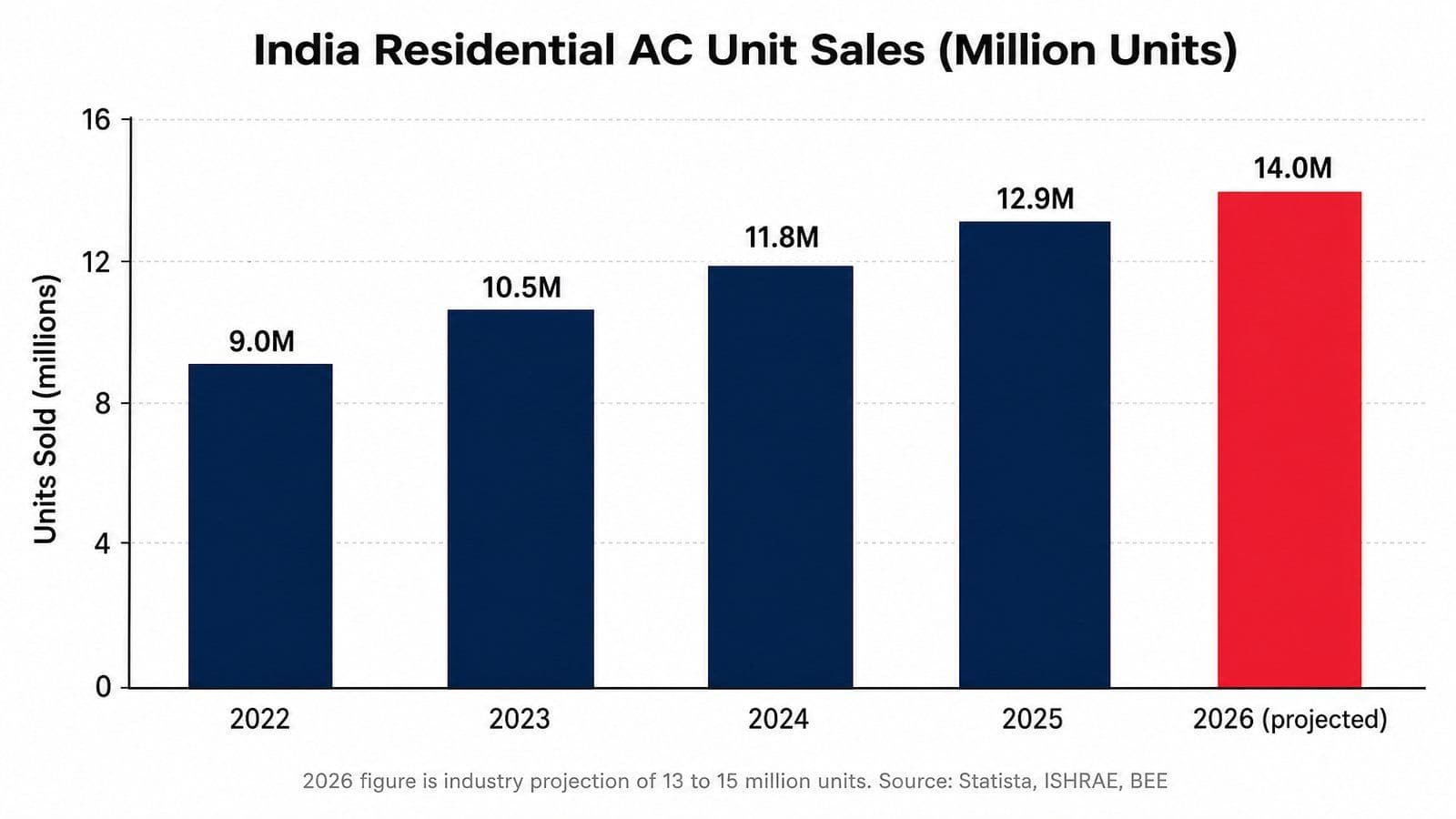
Photo: India AC Market Growth 2022 to 2026
The shape of the market is best understood across five years. The table below pulls together unit sales, revenue, and household penetration figures published by Statista, BEE's annual energy efficiency reports, and ISHRAE industry briefings.
| Year | Units Sold (millions) | Revenue (₹ crore) | Household Penetration |
| 2022 | 9.0 | 48,000 | 6.5% |
| 2023 | 10.5 | 56,000 | 7.2% |
| 2024 | 11.8 | 63,500 | 7.8% |
| 2025 | 12.9 | 69,200 | 8.4% |
| 2026 (proj) | 13.5 to 15.0 | 74,000 | 9.1% |
Unit sales are growing faster than revenue, which tells you average selling prices have softened slightly as inverter manufacturing scale catches up with demand. The headline 8 to 9 percent national penetration hides a sharp split: urban tier-1 cities sit at 35 to 40 percent penetration, while rural India remains under 2 percent. Most of the next decade's volume will come from tier-2 and tier-3 cities catching up.
The 14.6 percent CAGR projection through 2031 (published in the most recent ISHRAE outlook) implies the market roughly doubles by then, hitting 25 to 28 million units a year. By 2030, household penetration is widely expected to reach 24 percent.
When customers ask me whether they should wait for prices to drop before buying, my honest answer is no. Inverter ACs are not getting cheaper in any meaningful way in 2026. What you save by waiting six months gets wiped out by the BEE re-labelling making your shortlist confusing. Buy what fits your room and your budget now, and focus on install quality.

For a fuller view of how Indian households got here, how air conditioning evolved in India traces the path from 1990s luxury imports to the present mass-market wave.
The Inverter Takeover
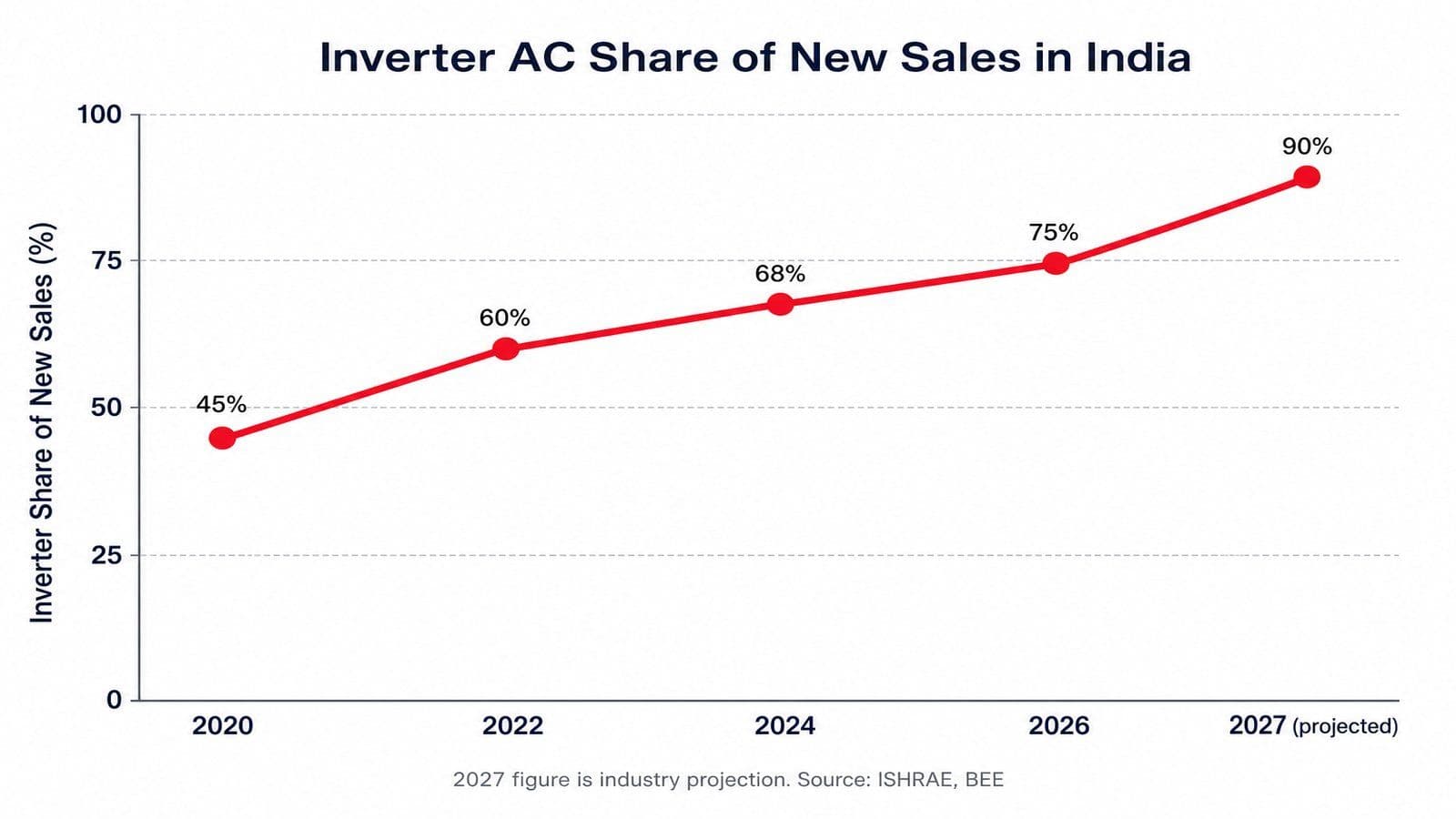
Photo: Inverter AC Market Share Trajectory
The shift to inverter compressors has been the single biggest technology change in Indian residential AC over the last decade. Five years ago, inverter units sat at roughly 45 percent of new sales. In 2026 they are at 75 percent and rising fast.
Get quotes from verified, top-rated AC Service & Repair pros in Delhi.
| Year | Inverter Share | Non-Inverter Share | Avg. ISEER (Inverter) |
| 2020 | 45% | 55% | 4.10 |
| 2022 | 60% | 40% | 4.35 |
| 2024 | 68% | 32% | 4.65 |
| 2026 | 75% | 25% | 4.95 |
| 2027 (proj) | 90% | 10% | 5.20 |
Three forces are driving the cutover. BEE's January revision pushed the ISEER minimum threshold high enough that most non-inverter designs cannot hit a 3-star rating any more. Manufacturing scale has narrowed the cost gap at the 1.5 ton tier to ₹3,000 to ₹5,000. And consumer awareness has shifted the conversation from "what is an inverter?" to "what ISEER rating am I getting?"
Most large Indian and multinational brands have publicly committed to discontinuing non-inverter residential manufacturing entirely by 2027. Window AC will remain available as a non-inverter format slightly longer because some sub-1 ton designs cannot fit variable-speed compressors economically.
If you are replacing a 7 to 10 year old fixed-speed unit and your daily use is more than four hours, inverter is now the default choice. The payback math runs at roughly 2 to 3 summers at ₹7 per unit tariff. The deeper comparison sits at our breakdown of AC unit types compared.
The R32 Changeover
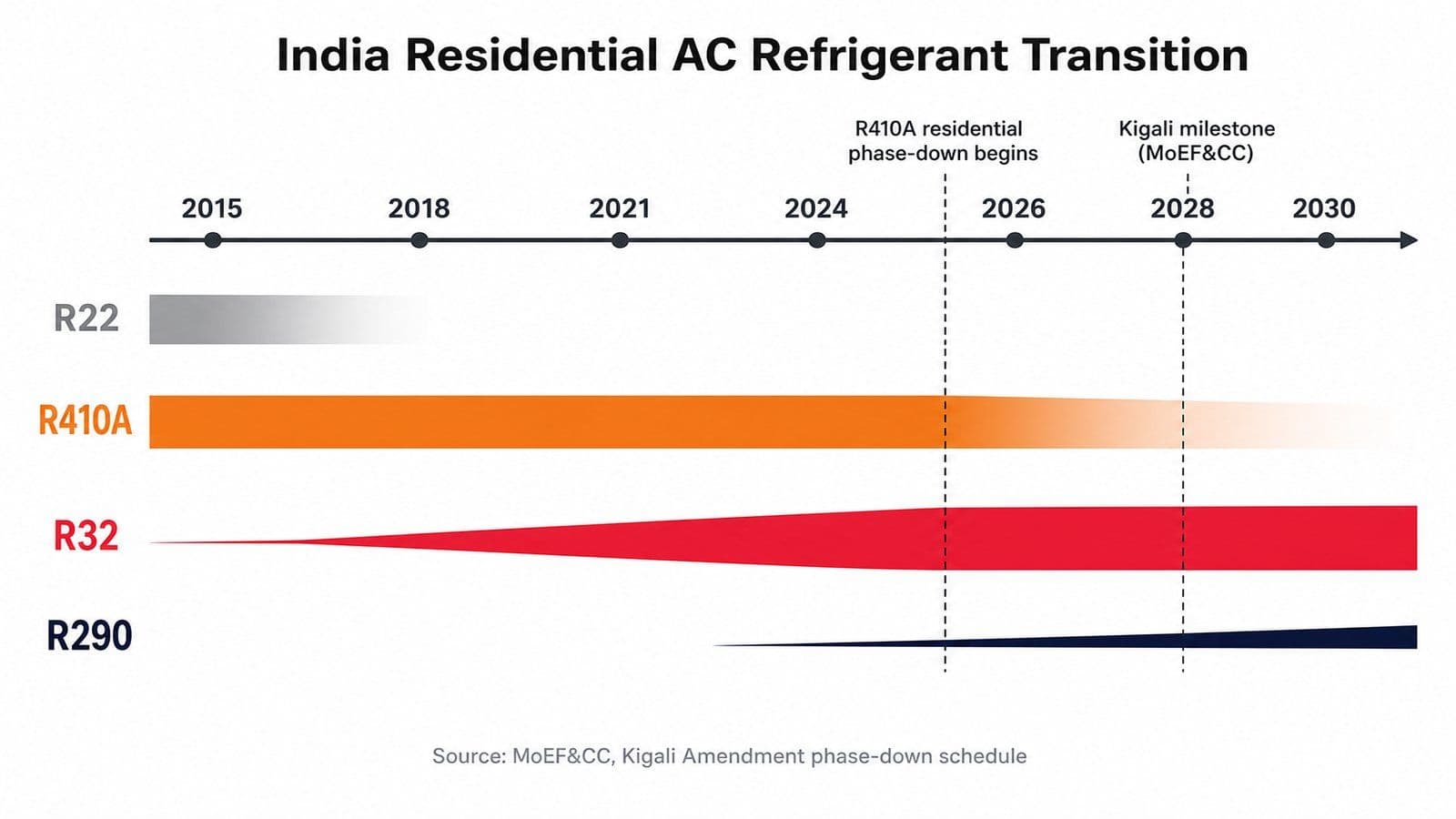
Photo: Indian Refrigerant Transition Timeline 2015 to 2030
If one structural shift matters for owners of 2018 to 2022 vintage ACs, it is the refrigerant changeover. India's commitments under the Kigali Amendment set out an aggressive phase-down schedule for hydrofluorocarbons, and MoEF&CC has been tightening domestic regulations to align with it.
R22 (pre-2015 units) is already effectively gone from residential manufacturing. R410A, which dominated 2015 through 2020, is being squeezed out right now. Most major manufacturers have either stopped or are stopping residential R410A production this calendar year, replacing it with R32.
Why R32 wins on paper: lower global warming potential (around 675 versus R410A's 2088), better thermodynamic efficiency leading to a 5 to 8 percent ISEER improvement on like-for-like designs, and a single-component refrigerant that is easier to recover and recycle.
What this means for owners in 2026:
- R22 vintage (pre-2015): retrofill is technically illegal. A refill quote is a red flag. The right path is replacement.
- R410A vintage (2015 to 2023): still legal and available, but availability tightens every year. Expect refill costs to climb from today's ₹3,500 to ₹5,500 range to ₹6,000 to ₹9,000 by 2028.
- New buyers in 2026: ask the dealer to confirm R32 in writing on the invoice. Some legacy R410A stock still circulates at deep discounts, and unwary buyers end up with a unit whose refill economics turn ugly inside three years.
Mrs. Lakshmi Iyer, a Bengaluru reader, held off her replacement for six months to wait for the R32 stock cycle. She replaced her 8-year-old 1.5 ton R410A unit in March 2026 with a 5-star R32 inverter at ₹52,000 installed. Her first month's bill came in 28 percent lower than the same month a year earlier, and she avoided a ₹4,800 R410A top-up the technician had quoted in October. Worth the wait.
The biggest mistake I see right now is owners spending ₹4,000 to ₹6,000 to refill an 8-year-old R410A unit because the technician sells it as the cheap option. By 2028 the same refill will cost double, and you have already invested in a machine that owes you another refill in 18 months. The math almost always favours replacement at this vintage.
For owners decoding refrigerant labels, our AC terminology glossary breaks down R32, R410A, R290, ISEER, COP, and the other letter codes on the name plate.
The January 2026 BEE Revision
The Bureau of Energy Efficiency revised its star rating thresholds for fixed-speed and inverter ACs effective January 2026. The shift was the largest single tightening since the ISEER framework was introduced. Every existing AC slid one star band downward overnight.
A 1.5 ton inverter unit certified at ISEER 4.50 in late 2025 (a 5-star under the old band) now sits at 4-star under the 2026 band. To qualify as a new 5-star, the same unit would need to clear ISEER 5.00 or higher. Manufacturers have responded by re-labelling existing stock and launching upgraded models engineered to hit the new 5-star threshold.
Three things to watch this year:
Comparing models across the revision boundary
A 5-star unit you priced in November 2025 and a 5-star unit you priced in May 2026 are not the same efficiency tier. Always check the ISEER number on the plate, not the star count.
Re-labelled stock at discount
Channel partners are clearing old-band stock through summer 2026 at 8 to 15 percent discounts. These units are still serviceable but their printed ISEER value is what counts, not the new sticker.
Bigger savings gap between 3-star and 5-star
The tighter thresholds widened the running-cost gap. A 1.5 ton 5-star inverter at ISEER 5.0 will use roughly 18 to 22 percent less electricity than a 3-star at ISEER 3.8 for the same cooling load.
For the full math on running costs by star rating, see our explanation of BEE star ratings on ACs.
Get quotes from verified, top-rated AC Service & Repair pros in Delhi.
Smart and IoT ACs in 2026
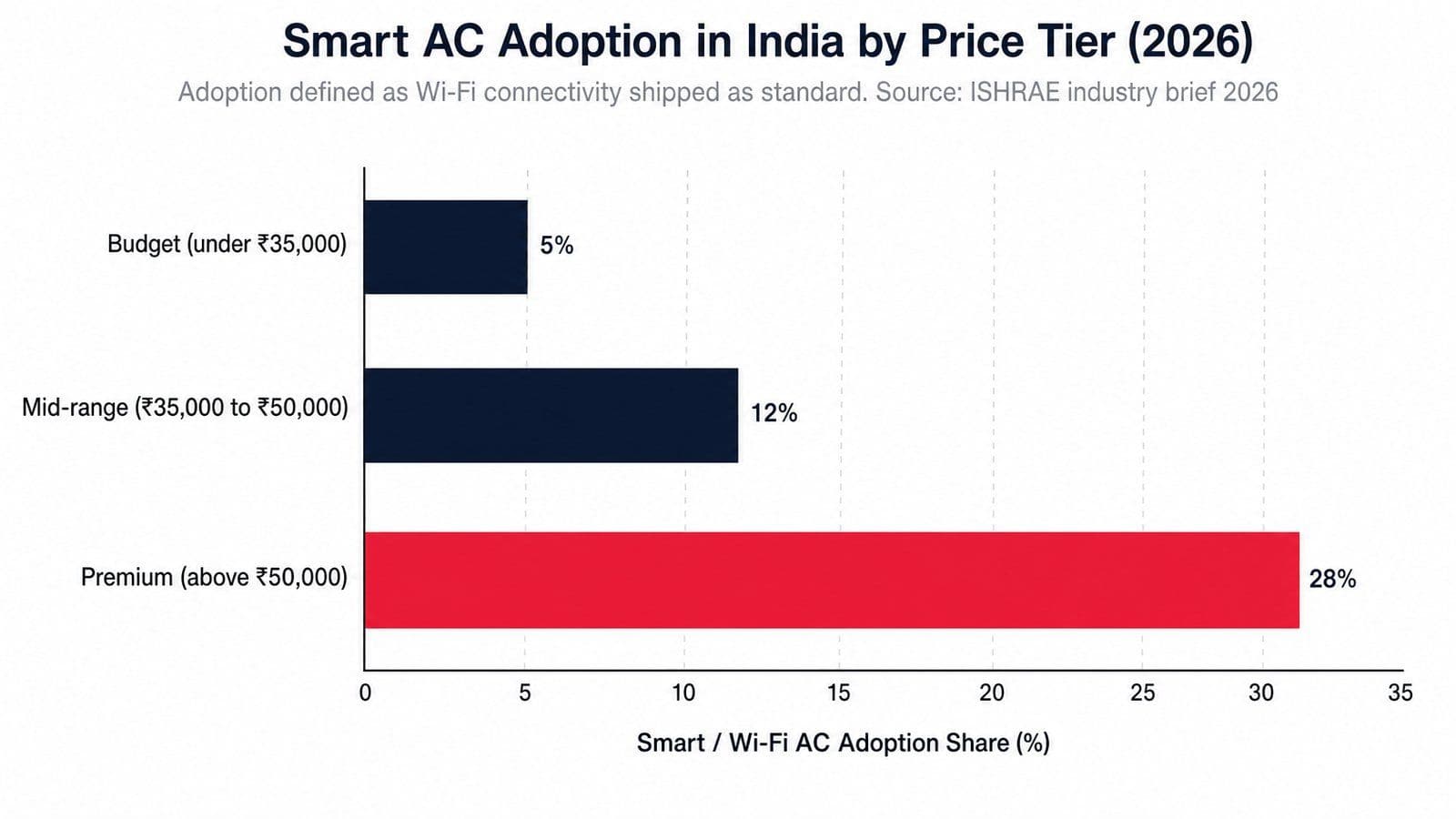
Photo: Smart AC Adoption by Price Tier 2026
Smart AC features (Wi-Fi, app control, voice integration, geofencing, predictive maintenance) have crossed from premium novelty to mainstream expectation in the upper tier this year. Penetration breaks down roughly like this in 2026:
- Budget tier (under ₹35,000): around 5 percent ship with Wi-Fi as standard.
- Mid-range (₹35,000 to ₹50,000): around 12 percent.
- Premium (above ₹50,000): around 28 percent, and rising fast.
Voice control via Alexa, Google Home, or the brand's native app is now a default feature on most ₹50,000-plus models. The genuinely useful smart features cluster around three behaviours:
Scheduling and geofencing
Setting the AC to start cooling 15 minutes before you reach home, based on your phone's location, is the single most popular use case. Energy saving is modest but the comfort improvement is real.
Sleep mode auto-learn
The app tracks how you adjust the AC across the first two weeks of use and builds a personalised overnight cooling curve, gradually raising the setpoint by 1 to 2 degrees through the night. Most owners report a 6 to 9 percent reduction in overnight power consumption.
Filter and fault alerts
Push notifications when the air filter needs cleaning, or when the system detects abnormal compressor behaviour. The verified AC technicians in our ProNearMe network report that 31 percent of smart-AC service callouts are now triggered by app alerts rather than the owner noticing a problem, which usually means the fault is caught earlier and is cheaper to fix.
What is over-hyped but underwhelming in practice: full voice commands beyond on/off and temperature. The fancy demos rarely survive a noisy Indian living room.
Hybrid Solar AC and R290 Propane: The Next Wave
Hybrid solar ACs (units that run partly on direct DC from a rooftop solar array and partly on grid AC) remain a niche segment but a fast-growing one in 2026. Adoption has accelerated in Gujarat, Rajasthan, Karnataka, and parts of Andhra Pradesh, where rooftop solar penetration and high solar irradiance make the economics work.
A 1.5 ton hybrid solar AC paired with a 1 kW dedicated solar array costs roughly ₹85,000 to ₹1.2 lakh installed, versus ₹52,000 to ₹65,000 for a comparable 5-star inverter. Payback runs 5 to 7 years for daytime-heavy users and stretches past 10 years for night-heavy use cases. PIB releases on the Ministry of New and Renewable Energy's rooftop solar push have flagged hybrid cooling as a target segment for the next subsidy phase, but no concrete central subsidy has been notified as of May 2026.
R290 (propane) is the next-generation refrigerant the industry is preparing for. It has a global warming potential of just 3 (versus R32's 675 and R410A's 2088) and excellent thermodynamic properties. Pilot R290 residential AC models from two Indian manufacturers entered limited release in 2025; commercial availability across multiple brands is expected in 2027. The catch is mild flammability. Charge sizes per unit have to stay below regulated limits, technician training is stricter, and ISHRAE and BIS are still finalising the Indian installation code, with publication expected in late 2026 or early 2027.
R290 is not a 2026 buying consideration. If you are planning a replacement in 2028 or beyond, the option is coming.
Service Delivery Shift
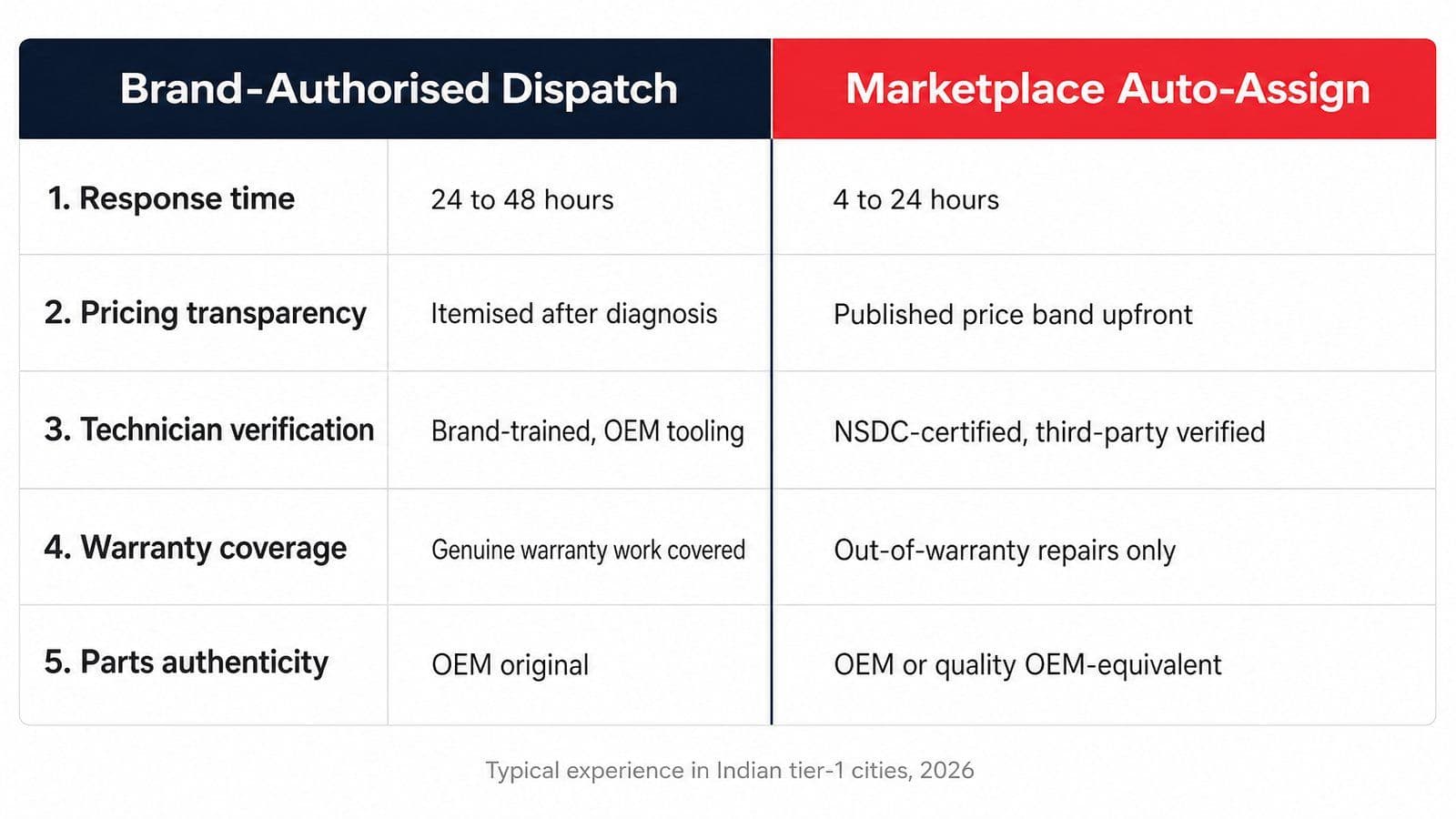
Photo: Brand Authorised vs Marketplace Auto Assign Dispatch
The way Indian owners book AC service has changed more in the last 24 months than in the previous decade. Three shifts matter.
Marketplace aggregators
Platforms like ProNearMe have moved AC service booking from "scroll through 47 phone numbers and hope" to "book a verified technician with a transparent price band in three taps". Aggregator service charges now sit within a tight published range (₹450 to ₹650 for a standard split AC service in tier-1 cities in 2026), which has compressed the predatory pricing that used to dominate the unorganised end of the market.
Get quotes from verified, top-rated AC Service & Repair pros in Delhi.
AI-based fault diagnosis from photos
Several brands and aggregators have rolled out app features where owners upload photos of the indoor unit, the outdoor unit, and any visible leak, and a vision model returns a probable fault category plus a price band before the technician arrives. Accuracy varies widely: gas leaks and compressor faults are reasonably well diagnosed by photo; electrical and PCB faults still need a physical visit. The point is to set expectations and prevent the classic "I came out for nothing" callout.
Brand-authorised vs marketplace auto-assign dispatch
A subtle but important divergence in 2026 is the split between brand-authorised dispatch (the brand routes your request to their authorised service centre) and marketplace auto-assign (the platform's algorithm picks the highest-ranked verified technician in your area).
| Dimension | Brand-Authorised | Marketplace Auto-Assign |
| Response time (tier-1) | 24 to 48 hours | 4 to 24 hours |
| Pricing transparency | Itemised after diagnosis | Published price band upfront |
| Technician verification | Brand-trained, OEM tooling | NSDC-certified, third-party verified |
| Warranty coverage | Genuine warranty work covered | Out-of-warranty repairs only |
| Parts authenticity | OEM original | OEM or quality OEM-equivalent |
The decision rule for most owners: in-warranty, use brand-authorised for any non-trivial fault, because the warranty paperwork needs the OEM service centre's stamp. Out of warranty, the marketplace path is typically 20 to 35 percent cheaper for routine work.
The trap I see is owners staying loyal to brand-authorised service three to four years past warranty expiry, paying premium charges for routine work that any NSDC-certified technician can do at half the rate. Beyond warranty, your loyalty should be to the technician who treats your AC well, not the brand badge.
A solid technician hiring rubric is the difference between a marketplace booking that goes well and one that ends in a repeat visit. The detailed checklist sits at how to verify AC technician certification in India.
What's Queued for 2028
BEE has indicated, through industry consultation drafts shared with ISHRAE and manufacturers in late 2025, that the next ISEER revision is targeted for January 2028. The expected direction is another upward shift of roughly 10 to 15 percent on each star band's threshold, which would push the 5-star bar from today's roughly 5.0 to around 5.5 to 5.7. If the revision lands as drafted, today's high-performance 5-star units become 4-star, and only the best inverter designs clear the new bar.
Two other regulatory items are on the medium-term radar: the BIS code for R290 residential ACs (expected late 2026 to early 2027) which will formally permit and govern propane-based residential cooling, and MoEF&CC's next Kigali milestone in 2029 which will tighten R32 manufacturing limits.
Any AC you buy in 2026 will reasonably deliver 10 to 12 years of useful life. Across that period it will see one or two more ISEER revisions, at least one refrigerant policy tightening, and the mainstream arrival of R290. The unit you buy today will not be the most efficient in 2029, but a 5-star in 2026 will still be a competent unit in 2032.
Conclusion
The Indian AC industry in 2026 is at an inflection point. The market is large enough that change happens in chunks now, not in slow drift: 13 to 15 million units this year, a January BEE revision that reshuffled every star rating, an R32 mainstreaming that closes the door on cheap R410A refills, and the first credible signals of R290 propane arriving in 2027. The practical move this year is to make every buying decision with the next decade in mind: 5-star inverter, R32 confirmed in writing on the invoice, a properly verified installation, and a service plan that accounts for the changing refrigerant economics.
If you are deciding between repairing an older unit and replacing it, the calculus has shifted this year. The R410A refill curve, the BEE 5-star running cost gap, and the inverter adoption wave all point in the same direction. When the repair quote on an 8-plus year old unit crosses 40 to 50 percent of replacement cost, the long-term math favours replacement. The full owner-side framework sits in the complete AC owner's guide for Indian homes 2026.
Disclaimer
All prices, ISEER thresholds, and policy timelines mentioned reflect publicly available information as of May 2026 and vary by city, brand, and dealer. GST treatment on AC purchases sits at the prevailing slab and may shift in future Council meetings. Always confirm refrigerant type and ISEER value in writing on the dealer invoice. Hire NSDC-certified or BEE-empanelled technicians for refrigerant handling and installation work. This guide is editorial and is not an endorsement of any specific brand.
Sources & References
- Statista, Air Conditioners Industry in India, market data and outlook
- Bureau of Energy Efficiency, Star Labelling Programme for Room Air Conditioners
- Ministry of Environment, Forest and Climate Change, India's commitments under the Kigali Amendment
- ISHRAE, Indian Society of Heating, Refrigerating and Air Conditioning Engineers, industry outlook publications
- Press Information Bureau, Energy efficiency and rooftop solar policy releases
- National Skill Development Corporation, Refrigeration and Air Conditioning sector training
- Bureau of Indian Standards, Room air conditioner standards and refrigerant safety codes
- Niti Aayog, India Cooling Action Plan and related energy efficiency reports
Amit worked as an AC technician for 6 years in Ahmedabad before transitioning to technical writing. He holds a diploma in Refrigeration and Air Conditioning from ITI Ahmedabad and understands the difference between what AC companies promise and what actually happens on the ground. His articles break down complex technical topics into plain language that any homeowner can follow. He tests every tip he writes about in his own home first.

Dr. Verma is a mechanical engineer with 15 years of experience in HVAC systems. She completed her PhD from IIT Delhi on energy-efficient cooling solutions for Indian residential buildings. She reviews all technical content on HomePros to make sure the numbers are right, the advice is safe, and the recommendations are backed by actual engineering principles. She consults for multiple AC manufacturers on product design.