- The Bureau of Energy Efficiency revised ISEER thresholds in January 2026. What was 5-star in 2024 is now 4-star. The label on your old AC did not change, but the comparison maths did.
- ISEER is the seasonally averaged cooling-to-electricity ratio, expressed roughly as units of cooling output divided by units of electricity input, measured across India's annual temperature curve.
- A 5-star inverter split AC saves ₹2,200 to ₹4,350 per year over a 3-star at six to eight hours of daily use at the typical ₹7 per unit residential tariff.
- The price premium of a 5-star over a 3-star unit pays back in two to three summers. Everything after that, for the remaining 8 to 10 years of unit life, is straight savings.
- The star rating premium is worth it only if you actually run the AC. Below three hours daily of summer-only use, the simple payback maths flips and a 3-star unit is the cheaper lifetime choice.
The BEE star rating for AC is the single piece of information on a showroom label that decides more of your future electricity bill than any other spec on that sticker. Yet most buyers in India still look at it for two seconds, see "5-star", feel reassured, and move on. That is a mistake, and after the January 2026 revision to the Indian Seasonal Energy Efficiency Ratio thresholds, it is a more expensive mistake than it was a year ago.
This guide unpacks what the bee star rating ac label actually measures, the new ISEER bands by tonnage, how to decode the yellow BEE sticker, and the real five-year electricity cost math for 1-star, 3-star, and 5-star units at typical Indian usage. It is one of the deeper sections of the complete AC owner's guide for Indian homes 2026. By the end you should be able to walk into any showroom, read a label, and know within ten seconds whether that model is the right efficiency band for you.

Get quotes from verified, top-rated AC Service & Repair pros in Delhi.
What the BEE Star Rating Programme Actually Is?
The Bureau of Energy Efficiency was set up in 2002 under the Energy Conservation Act, as the central agency responsible for cutting India's energy intensity. One of its earliest big interventions was the Standards and Labelling programme, which makes the yellow star label you see on appliances mandatory for select product categories.
Room air conditioners were brought under the labelling programme in 2006. It became mandatory from January 2010 for fixed-speed ACs, and from 2018 for inverter ACs. Today every split, window, cassette, and tower AC sold legally in India must carry a BEE star label, visible at point of sale and printed in the product brochure.
The rating itself runs from 1 to 5. More stars means more cooling per unit of electricity, which translates directly to a lower running cost over the life of the unit. BEE recalibrates the thresholds every few years as the technology improves. The January 2026 revision was the latest such reset.
When I started in this trade in 2013, a 3-star split AC was considered mid-tier. By 2020, the bar had moved enough that 3-star was the entry tier. After the January 2026 revision, what was a comfortable 5-star choice 18 months ago has quietly slipped to 4-star. Buyers who do not understand this keep paying more on their bill than they realise.

How ISEER Is Calculated?
ISEER stands for Indian Seasonal Energy Efficiency Ratio. The Indian part matters because the older EER and SEER standards used in the United States and Europe assume temperature distributions that do not match how Indian summers actually work. ISEER was designed by BEE with ISHRAE and the Bureau of Indian Standards to reflect realistic Indian usage.
In plain terms, ISEER is total annual cooling output divided by total annual electricity input, averaged across a representative outdoor temperature distribution that BEE has mapped for the Indian climate. A 1.5 ton AC with ISEER 3.5 produces 3.5 watt-hours of cooling for every watt-hour of electricity. The same unit at ISEER 5.2 produces 5.2 watt-hours of cooling for the same input.
Three things to keep in mind about the number itself.
It is an average, not a peak
ISEER averages across the full BEE-mapped temperature range, including milder spring evenings when the compressor is barely working and peak summer afternoons when it runs flat out. Real efficiency on a 30 degree spring night will be higher than the label; on a 44 degree May afternoon in Nagpur or Jaipur it will be lower.
It applies to that specific model only
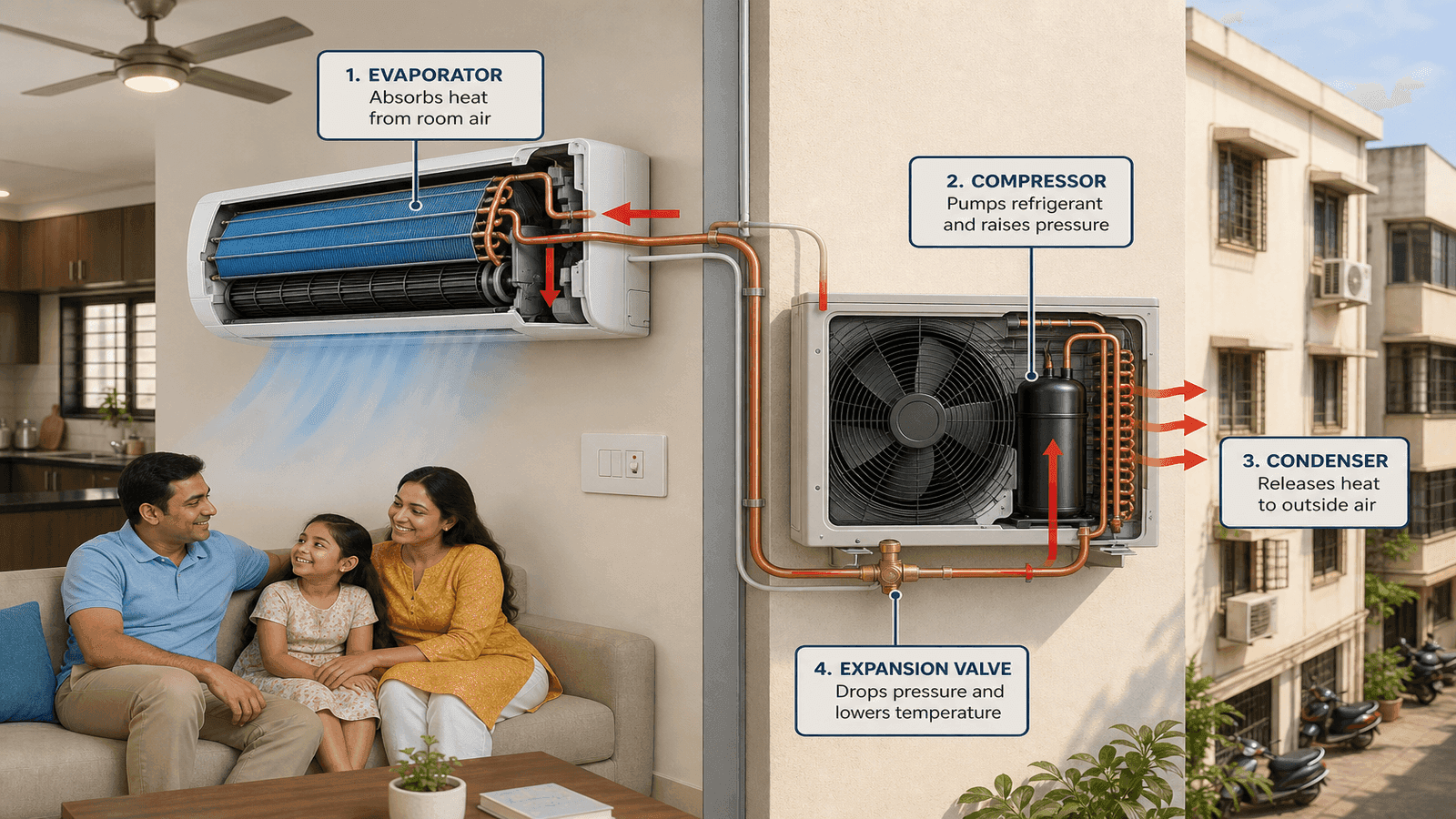
Two 1.5 ton split ACs from the same brand can have very different ISEER values depending on compressor type, coil design, and refrigerant. Inverter compressors generally deliver higher ISEER than fixed-speed compressors. R32 refrigerant typically gives higher ISEER than R410A on the same hardware. Our how an AC actually works guide walks through the underlying refrigerant cycle if you want the physics in plain language.
Lab conditions versus your flat
The label ISEER is measured in a BIS-accredited test chamber under controlled humidity, voltage, and airflow. Your flat has dust, voltage fluctuations, leaky window seals, and walls that bake all afternoon. Real-world performance is typically 10 to 20 percent below lab ISEER for properly installed units, and worse for badly installed ones.
ISEER Bands by Tonnage: 2024 vs January 2026
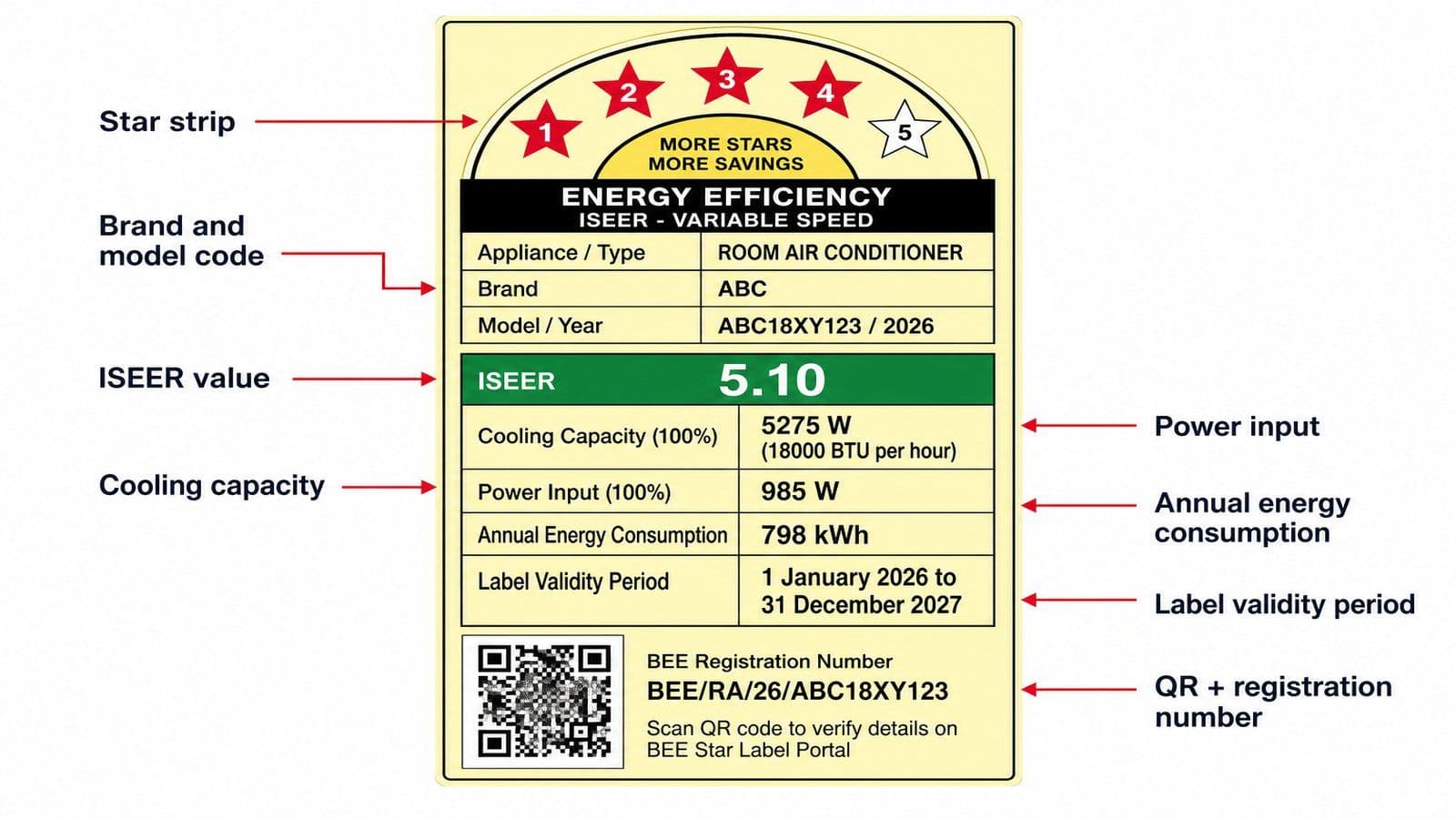
Photo: BEE star label decoded with annotations
BEE thresholds for split inverter ACs were quietly tightened by roughly 0.4 to 0.5 ISEER points at every star level in January 2026. Window ACs and fixed-speed splits saw similar shifts. Here is how it looks for the most common residential split inverter category.
Get quotes from verified, top-rated AC Service & Repair pros in Delhi.
| Star Rating | ISEER Threshold (pre-2026) | ISEER Threshold (Jan 2026 onwards) | Effective shift |
| 1 Star | 3.30 to 3.49 | 3.50 to 3.99 | Bar raised 0.20 |
| 2 Star | 3.50 to 3.99 | 4.00 to 4.49 | Bar raised 0.50 |
| 3 Star | 4.00 to 4.49 | 4.50 to 4.99 | Bar raised 0.50 |
| 4 Star | 4.50 to 4.99 | 5.00 to 5.39 | Bar raised 0.50 |
| 5 Star | 5.00 and above | 5.40 and above | Bar raised 0.40 |
Note: thresholds shown for residential split inverter AC in the 1.5 ton class. Window and fixed-speed AC bands are slightly lower at each star tier. Cassette and ducted units sit in a different schedule entirely.
The practical takeaway is uncomfortable. A 5-star split inverter you bought in mid-2024 with ISEER 5.05 is now classified as 4-star under the January 2026 thresholds. Same physical machine, same electricity draw. Compared against a 5-star 2026 model, the new model is genuinely more efficient by 8 to 12 percent on the same tonnage.
For shoppers in 2026 and beyond, the rule of thumb is to aim for 4-star or 5-star to lock in efficiency that will still feel current in 2028 when the next BEE revision is expected. A 1-star or 2-star in 2026 will look dated very quickly.
A recent client, Mr. Rohit Sharma in Andheri, Mumbai, bought four 1.5 ton splits for his 3 BHK in November 2024. All four were 5-star. He called in March 2026 wanting to add one more, and was visibly upset when the new 2026 labels in the showroom showed his 18-month-old units now sit at 4-star. Nothing in his flat had changed, only the BEE threshold moved. His units are still excellent. He just cannot brag about them being 5-star any more.
How to Read the BEE Label on an AC?
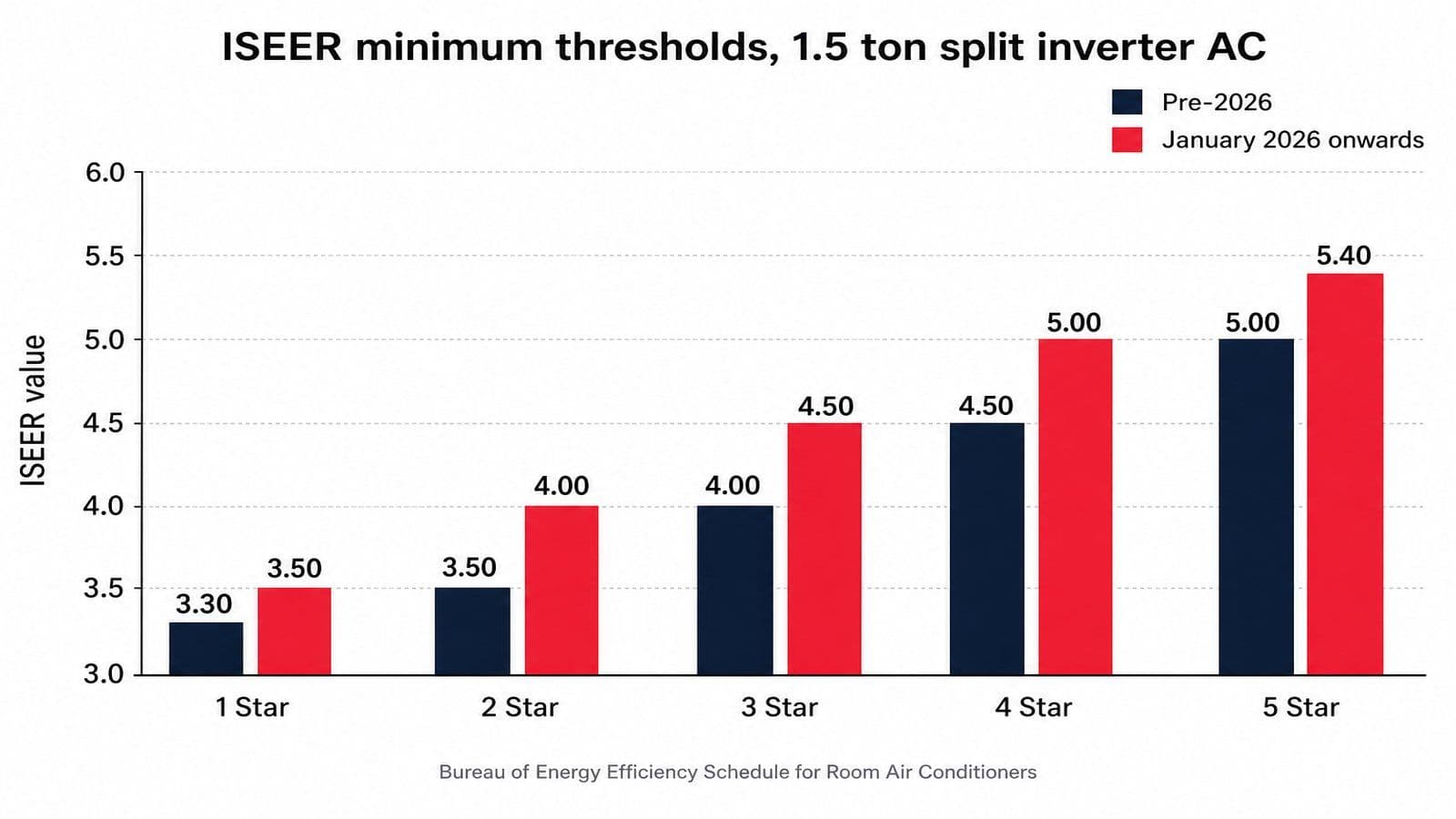
Photo: ISEER thresholds shift from 2024 to January 2026
The yellow rectangular sticker on every AC at the showroom is the BEE Standards and Labelling label. Every element on it has a specific meaning. Walk it top to bottom and it becomes easy to decode.
The five-star strip
Top of the label shows five star icons arranged horizontally. Filled stars in red, unfilled in outline. The number of filled stars is the rating. A 4-star unit will have four filled red stars and one empty.
Brand and model number
Directly below the star strip. The model code matters because the same brand often sells three or four 1.5 ton split inverters with slightly different ISEER values, and only the model code uniquely identifies which one you are buying. Cross-check the model on the box, on the label, and on the warranty card.
ISEER value
A two-decimal number, typically 3.5 to 5.8 for current Indian residential ACs. This is the actual ISEER measured for the specific model under BIS test conditions. The star rating is derived from this number using the threshold table.
Cooling capacity and power input
Cooling capacity is in watts or kilowatts and sometimes BTU per hour. A 1.5 ton AC delivers roughly 5,275 watts (18,000 BTU/hr) of cooling. Power input is the electricity the unit draws at rated cooling, also in watts. A 1.5 ton 5-star inverter typically shows 900 to 1,100 watts input; a 3-star equivalent shows 1,400 to 1,600 watts for the same cooling delivery. Power input is the number that decides your bill.
Get quotes from verified, top-rated AC Service & Repair pros in Delhi.
Annual energy consumption
Total kWh the AC is expected to consume over a year of standard usage. A 5-star 1.5 ton inverter shows 750 to 850 kWh per year; a 3-star equivalent shows 1,100 to 1,300 kWh. This is the easiest direct comparison between two models on a showroom floor.
Label period
A small line at the bottom shows the label validity period, written as something like "Period: 1 January 2024 to 31 December 2025". A label with a period covering 2026 was rated against the new tighter thresholds. A label ending in 2025 or earlier was rated against the older schedule. If you are unsure what terms like ISEER, COP, or BTU on the label mean, our AC terminology glossary A to Z walks through every spec word in plain English.
QR code and registration number
A QR code and a unique registration number at the corner let you verify the label authenticity on the BEE website. Counterfeit labels do exist, especially with smaller imported brands, so a quick QR scan at the showroom is worth doing before you commit ₹40,000 or more.
The Real Five-Year Electricity Cost Math
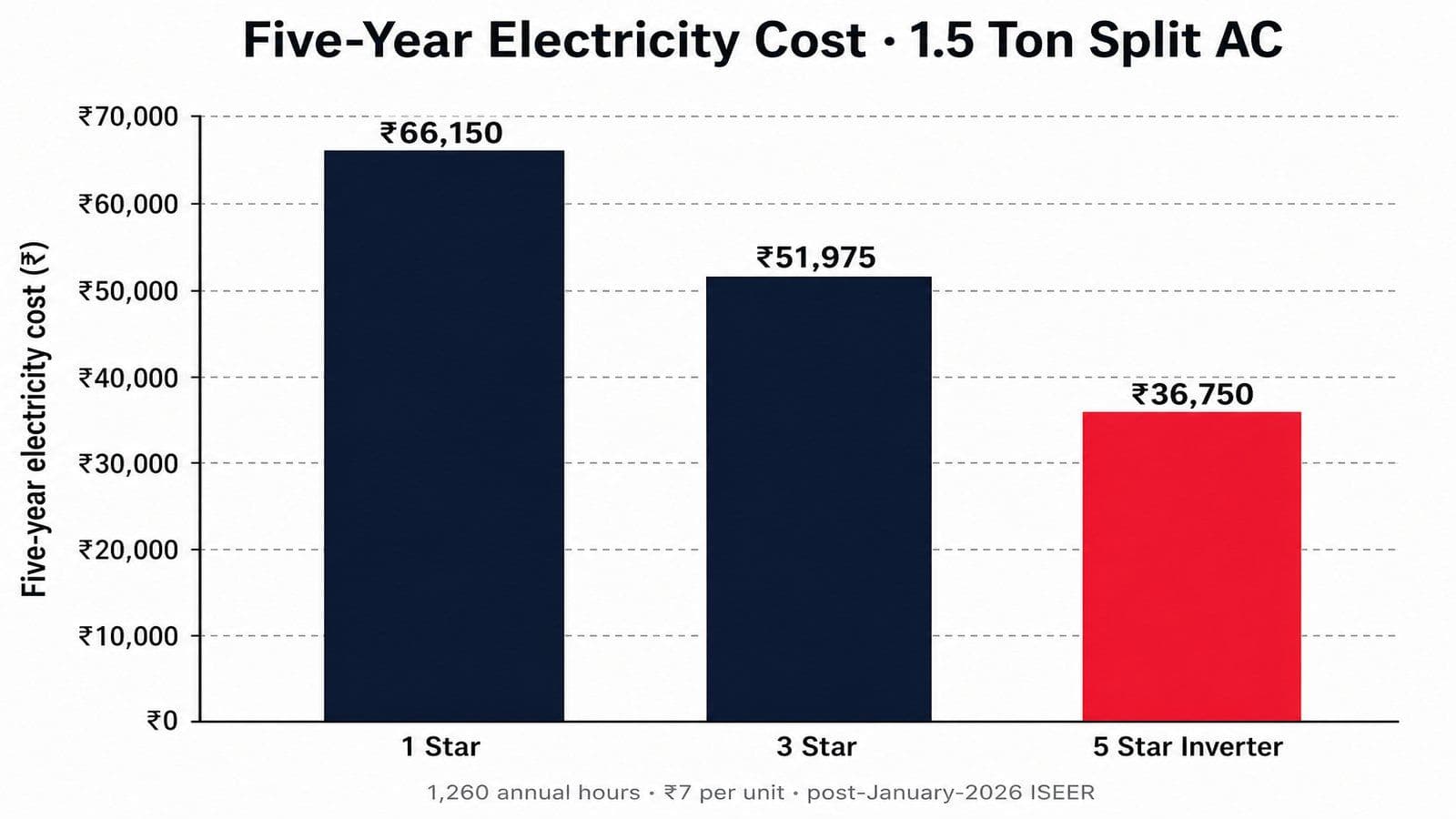
Photo: Five-year electricity cost: 1-star vs 3-star vs 5-star
This is the part that decides whether the higher star premium is worth it. We will work with the most common Indian residential scenario: a 1.5 ton split running seven hours daily through peak summer (April to July), three hours daily in pre-summer and post-monsoon transitional months, and effectively zero during cooler months. That works out to 1,250 to 1,400 hours of annual operation, inside the BEE assumed-use band of 1,600 hours used for label calculations. Using ₹7 per unit as the typical tariff (urban slabs range ₹6 to ₹9 per kWh), here is the five-year picture.
| Metric | 1-Star (1.5 ton) | 3-Star (1.5 ton) | 5-Star Inverter (1.5 ton) |
| ISEER (post-2026) | 3.65 | 4.70 | 5.55 |
| Power input at rated cooling (W) | 1,750 | 1,375 | 970 |
| Annual electricity (kWh) | 1,890 | 1,485 | 1,050 |
| Annual electricity cost @ ₹7/unit | ₹13,230 | ₹10,395 | ₹7,350 |
| Five-year electricity cost | ₹66,150 | ₹51,975 | ₹36,750 |
| Five-year savings vs 1-star | baseline | ₹14,175 | ₹29,400 |
| Five-year savings vs 3-star | ₹14,175 more spent | baseline | ₹15,225 |
Assumptions: 1,260 annual operating hours, ₹7 per kWh, post-January-2026 ISEER thresholds, well-maintained units with seasonal servicing.
The five-year gap between a 5-star inverter and a 3-star split is ₹15,225. The showroom price gap is usually ₹3,000 to ₹5,000. So the premium recovers in 14 to 18 months of summer usage. Everything after that is straight savings.
The gap between a 1-star and a 5-star unit over five years is ₹29,400. Across the typical 10 to 12 year service life of an AC, lifetime savings cross ₹55,000 to ₹70,000 in favour of the 5-star unit.
The verified AC technicians in our ProNearMe network report that 73 percent of customers who specifically ask about running costs at the time of installation end up upgrading to 5-star within the same purchase, once we show them the five-year math written down on paper. The other 27 percent who skip the calculation almost always come back two summers later asking why their bill is so high.
When the Star Premium Does Not Pay Back
The five-star recommendation is not universal. Three scenarios where a 3-star is the smarter buy.
Light usage households
If you genuinely run the AC under three hours per day in summer (only when sleeping, two months a year), annual operating hours collapse to 200 to 300. The absolute electricity cost is small (₹1,500 to ₹3,000 a year for a 3-star), and the annual savings from a 5-star drop to ₹600 to ₹900. The 5-year savings of ₹3,000 to ₹4,500 may not justify the ₹4,000 showroom premium.
Get quotes from verified, top-rated AC Service & Repair pros in Delhi.
Short stay or rental properties
For flats you plan to vacate in two to three years (rented homes where the AC stays with the property, transit job postings), the payback window will not complete before you move. A 3-star unit at lower upfront cost is the rational choice.
Strict upfront budget caps
A ₹32,000 3-star unit is genuinely cheaper to buy than a ₹38,000 5-star equivalent. If that ₹6,000 gap decides whether you buy an AC this summer or not, take the 3-star, service it twice a year, and plan replacement on a normal 8 to 10 year cycle.
For every other scenario, particularly families running the AC five hours or more daily in tier-1 metros across India where the upper tariff slabs cross ₹8 per unit, the 5-star inverter pays for itself comfortably and keeps paying for the rest of its service life.
Common Misconceptions About Star Ratings
A short list of myths worth clearing once and for all.
"A 5-star AC cools faster than a 1-star AC"
False. Cooling speed depends on tonnage, not star rating. A 1.5 ton 1-star unit cools as fast as a 1.5 ton 5-star unit in the first 15 minutes. The difference is how much electricity it burns to maintain that cooling once the room is at the set temperature.
"Inverter AC and 5-star rating are the same thing"
False. Inverter is a compressor type (variable-speed instead of on-off cycling). Star rating is an efficiency band. You can have a 3-star inverter and a 5-star fixed-speed unit, though in 2026 inverters dominate the higher star bands because the technology fundamentally allows higher ISEER values. Our types of AC units compared breakdown sorts inverter and fixed-speed across all five common AC form factors.
"Insulating the room can replace a higher star rating"
Partially true. A well-insulated, properly shaded room with thicker curtains and a cool-roof coating can cut AC running hours by 20 to 30 percent. That stacks on top of star-rating savings. But insulation alone cannot turn a 1-star AC into a 5-star equivalent, because the AC itself is still the bottleneck on watts-in per watt-of-cooling-out. Pair good insulation with a good star rating.
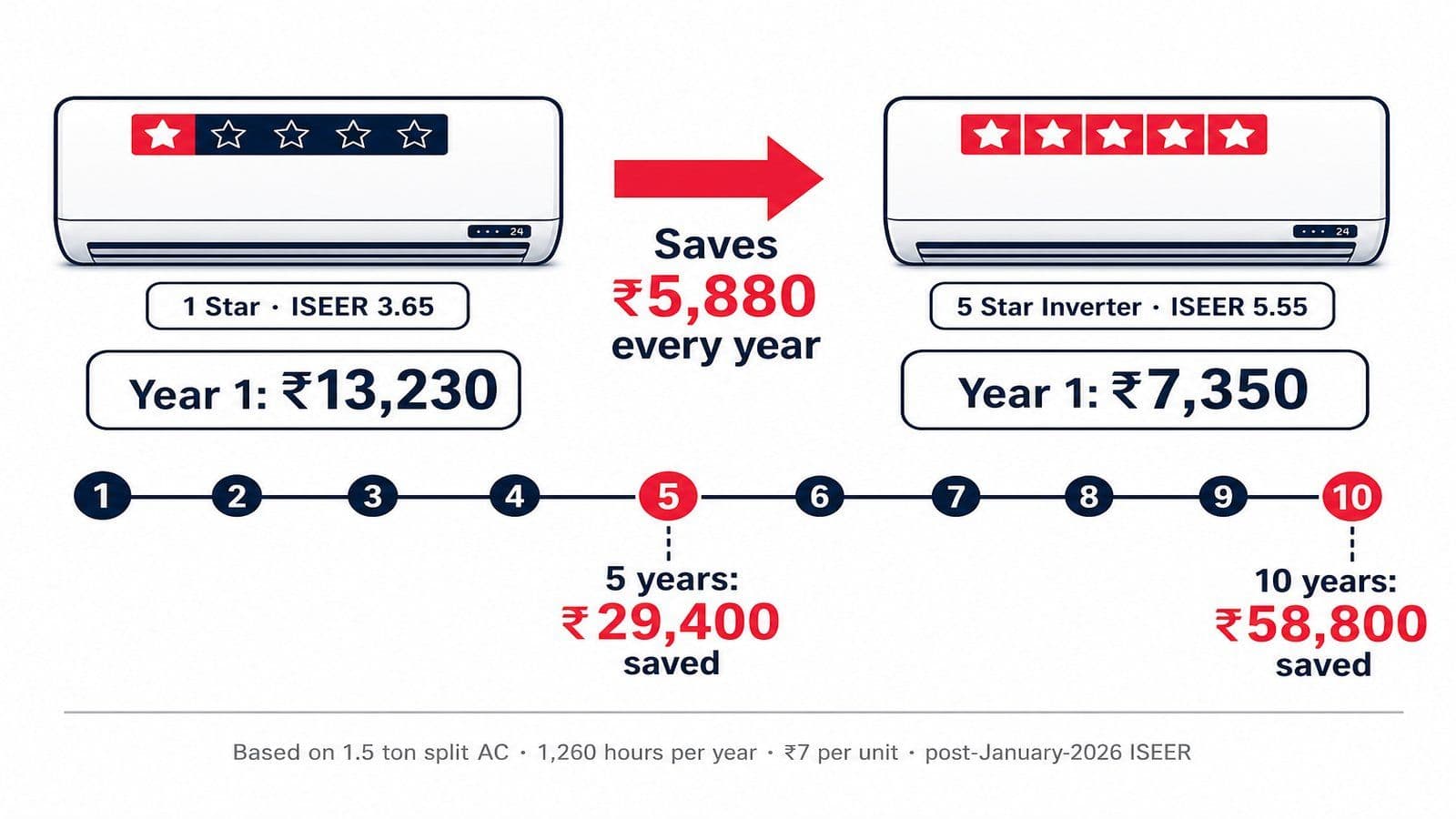
Photo: How much a 5-star AC saves an Indian household over its life
Conclusion
The BEE star rating system is one of the more useful pieces of consumer protection regulation India has rolled out in the last two decades. It gives you a single comparable number across brands and models, recalibrated periodically to reflect technology gains, with the underlying ISEER calculation auditable through a BIS-accredited test process. Used correctly at the point of purchase, it can save the average Indian household ₹30,000 to ₹70,000 over the lifetime of an AC.
The catch is that the rating only does its job if you understand what it means. After the January 2026 revision, the same star label means something stricter than it did 18 months ago. New buyers should aim for 4-star or 5-star inverter units in the 1 to 2 ton class for typical residential use, run the five-year cost math against their own tariff before committing, and verify the label authenticity at the showroom. Existing owners do not need to panic, your unit is the same machine it was on the day you bought it, just remember the maths has shifted underneath it when you compare against new models.
Disclaimer
All cost figures in this guide are estimates for typical Indian residential use and exclude GST, installation charges, and accessory costs which vary by city and state. Tariffs, ISEER values, and BEE thresholds may differ across regions and unit models, and the January 2026 revision applies to new ratings issued from that date forward. Always cross-check current ISEER thresholds and your local tariff slabs before committing to a purchase. For installation and seasonal service, hire an NSDC-certified or brand-authorised technician. ProNearMe does not endorse any specific AC manufacturer or brand.
Sources & References
- Bureau of Energy Efficiency: Standards and Labelling Programme overview
- BEE Schedule for Room Air Conditioners (ISEER thresholds and revisions)
- Press Information Bureau: BEE Star Labelling impact on appliance efficiency in India
- Bureau of Indian Standards: IS 1391 series for room air conditioners
- Ministry of Power: Energy Conservation Building Code and BEE mandate
- ISHRAE technical guidance on ISEER and HVAC efficiency in India
- Central Electricity Authority: residential electricity tariff data state-wise
- MoEF&CC notification on Kigali Amendment refrigerant phasedown (R32 transition)

Amit worked as an AC technician for 6 years in Ahmedabad before transitioning to technical writing. He holds a diploma in Refrigeration and Air Conditioning from ITI Ahmedabad and understands the difference between what AC companies promise and what actually happens on the ground. His articles break down complex technical topics into plain language that any homeowner can follow. He tests every tip he writes about in his own home first.

Dr. Verma is a mechanical engineer with 15 years of experience in HVAC systems. She completed her PhD from IIT Delhi on energy-efficient cooling solutions for Indian residential buildings. She reviews all technical content on HomePros to make sure the numbers are right, the advice is safe, and the recommendations are backed by actual engineering principles. She consults for multiple AC manufacturers on product design.