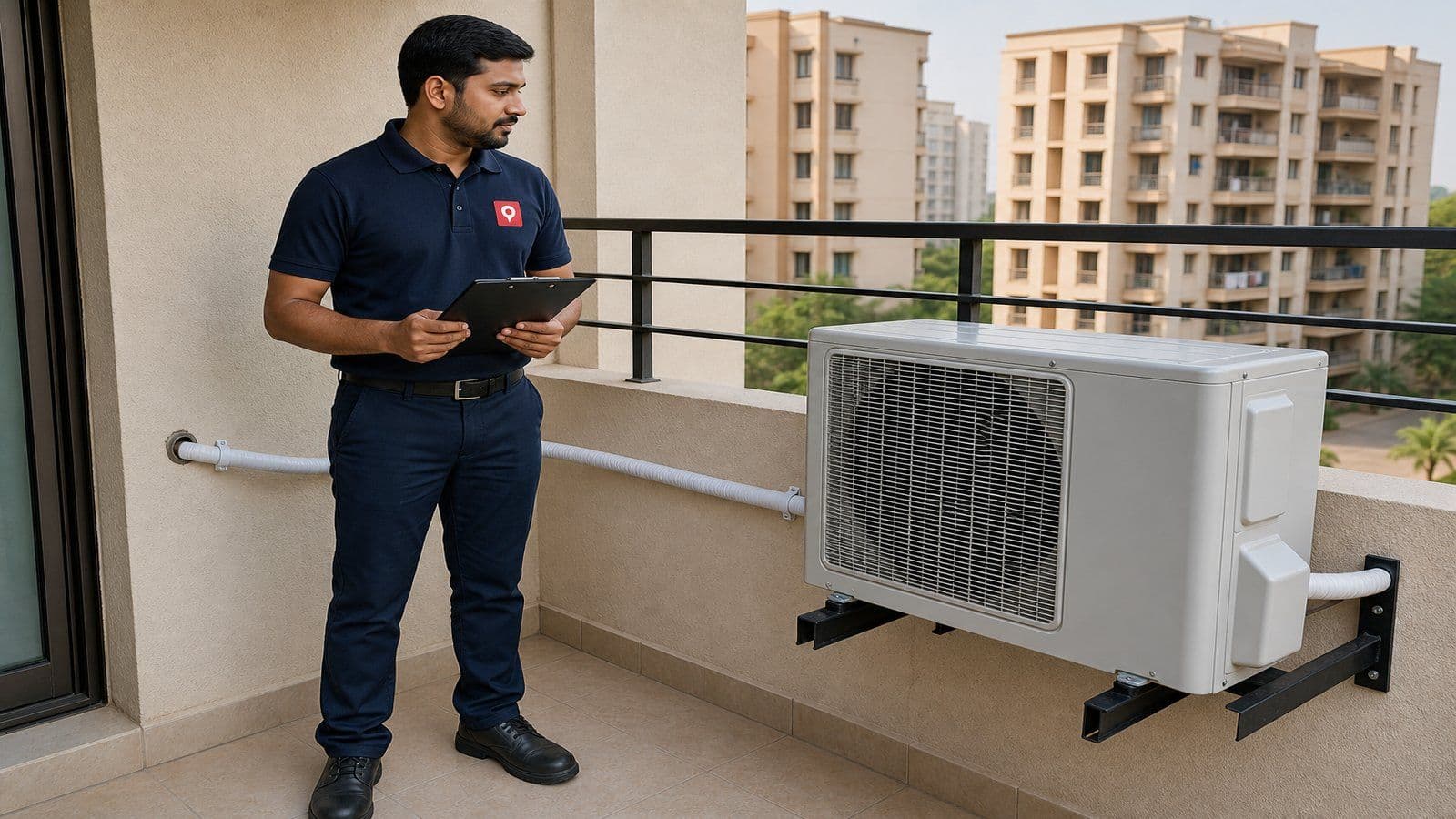
- Six AC types are sold in India today: window, split, cassette, tower or floor-standing, portable, and central. Split units account for about 70 percent of residential installs in the cities I work in.
- Room shape, not just room area, drives the right pick. A 140 sq ft bedroom takes a 1.5 ton split. A 350 sq ft open hall wants a cassette or tower.
- Window ACs lost roughly 35 percent of their shelf space after the January 2026 BEE ISEER revision, since most older window models failed the new 5-star threshold.
- Cassette and tower units cost 1.6 to 2 times what a split costs for the same tonnage, but they cool 350 sq ft halls evenly in a way no wall-mounted split can.
- Portable units are a stopgap. Their efficiency runs roughly 30 to 40 percent below a fixed split of the same rated tonnage.
If you have started shopping for an air conditioner this summer, the first wall you hit is choice fatigue. Walk into any electronics showroom in Ahmedabad or Bengaluru and you will see six different types of ac units on display, each one with a salesperson insisting it is the right fit for your home. It is not. Most homes need exactly one type, and the trick is matching the unit to the room.
This guide walks through all six AC formats sold in India today, what each one costs in 2026, where it fits, and where it does not. I have personally supervised over 1,800 AC installations and 3,500 service calls across Ahmedabad, Gandhinagar, and the wider Gujarat region in the past 6 years. Every recommendation below is based on Indian flats, Indian voltage conditions, and the Indian monsoon, not on a brand brochure.

Get quotes from verified, top-rated AC Service & Repair pros in Delhi.
The Six AC Types Sold in India
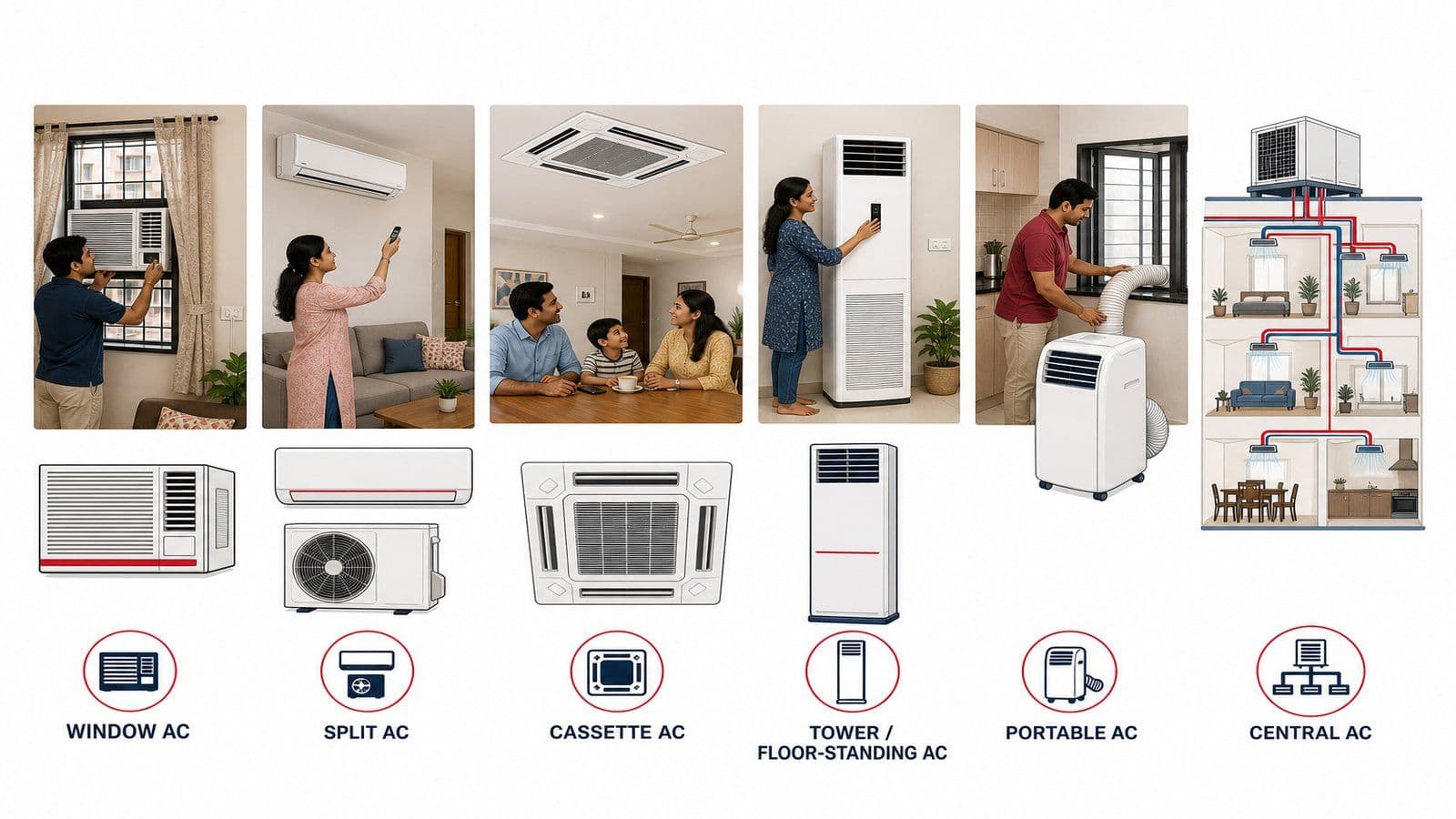
Photo: Six AC Types Sold in India 2026
Across the 3,500-plus service calls I have logged in Ahmedabad and Pune, split units make up about 70 percent of the installed base. Window units account for roughly 22 percent, a share that has shrunk every year since 2022 as builders move to split-friendly wall layouts. Cassette, tower, portable, and central together make up the remaining 8 percent, mostly in larger villas, restaurants, and standalone bungalows.
The right choice depends on five questions. How big is the room. Is there a window opening already cut, or a clean external wall for an outdoor unit. What is the ceiling height. Is the voltage stable. And what is the realistic all-in budget, including copper, brackets, and labour.
Window AC
A window AC is the original single-box format. The whole unit, compressor, condenser, evaporator, and blower, lives in one rectangular box that sits inside a wall opening or a window sleeve. There is no separate outdoor unit, no copper piping, and no refrigerant work on install day.
This simplicity is its biggest strength and its biggest weakness. Installation is the fastest of any AC type, usually under 2 hours. Service is straightforward, the whole unit comes out for a deep clean once a year. The trade-off is noise. The compressor sits inside your room, separated from your ears by a thin metal partition.
Best-fit scenarios: A 1BHK rented flat in Pune where the landlord already has a window cut. A small bedroom under 120 sq ft in a tier-2 city. A guest room. A small office cabin where cost matters more than design.
Price band 2026: ₹15,000 to ₹35,000 installed. The upper end gets a 1.5 ton 5-star inverter window AC.
Noise level: 50 to 56 decibels at the user position.
Energy efficiency typical range: ISEER 3.5 to 5.0.
Pros for Indian conditions: Tolerates voltage variation better than splits. Easier to service in tier-2 and tier-3 cities. Cheaper to repair.
Cons for Indian conditions: Vulnerable to monsoon water ingress if the wall sleeve is not sealed with silicone. Outdoor-facing side accumulates Indian pre-monsoon dust faster than a split's elevated condenser. Lower BEE star ratings reduce long-term electricity savings, and the wall colour around the window sleeve tends to stain quickly from rain runoff.
Of the 1,800 installs I have done since 2020, only about 30 percent are window units, and that share drops every year. But for the right room, a small bedroom with a pre-cut window opening, a window AC at ₹22,000 still beats a ₹38,000 split unit on total cost of ownership over 5 years.

Split AC
The split AC is the default choice in Indian residential cooling today. The format separates the noisy parts (compressor, condenser) from the quiet parts (evaporator, blower) by putting them in two separate units connected by insulated copper refrigerant lines.
The biggest reason splits dominate is acoustics. With the compressor outside, the indoor unit runs at 28 to 38 decibels, quieter than a normal conversation. The second reason is capacity range, splits are available from 0.8 ton up to 2.5 ton, the widest spread of any format.
Best-fit scenarios: Any standard apartment bedroom or living room from 100 to 250 sq ft. Any modern flat with a clean external wall for the outdoor unit. Villa bedrooms, study rooms, master suites. Office cabins.
Price band 2026: ₹28,000 to ₹85,000 installed. Mid tier (₹40,000 to ₹55,000) gets a 1.5 ton 5-star inverter. Premium tier gets a 2 ton 5-star inverter with smart controls.
Installation complexity: Medium. A proper install takes 4 to 6 hours and needs a technician who can size copper pipe runs, vacuum the lines before charging, and mount the outdoor unit on a level bracket. A bad install will fail within 18 months.
Noise level: 28 to 38 decibels indoors.
Energy efficiency typical range: ISEER 3.5 to 5.5. Inverter splits reach 5.5+, roughly 30 percent lower electricity bills than a 3-star fixed-speed unit.
Pros for Indian conditions: Quietest format for bedrooms. Widest tonnage range. Best technician availability across India.
Cons for Indian conditions: Vulnerable to copper pipe corrosion in coastal cities (Mumbai, Chennai). Sensitive to voltage dips, a 5 kVA stabiliser is recommended in tier-2 areas with patchy supply.
If I had to pick one AC type for 90 percent of Indian homes, it would be a 1.5 ton 5-star inverter split. It fits every standard 140 to 180 sq ft bedroom, the technician network in every city knows it, and parts are easy to source. The other types are for specific edge cases.
Cassette AC
A cassette AC is ceiling-recessed. The unit sits inside a false ceiling cavity with only a flat decorative panel visible from below. The panel has four-way airflow louvres that push cooled air out in all directions at once. Capacities start at 1.5 ton and go up to 5.5 ton for commercial models.
A wall-mounted split blows air in one direction, which creates hot spots and cold corners in a 350 sq ft square hall. A cassette mounted in the ceiling centre cools the whole footprint evenly. It also disappears visually, which matters for premium interior briefs.
Best-fit scenarios: Open villa halls above 300 sq ft. Restaurants and cafes with 30 to 80 cover capacity. Conference rooms and boardrooms. Showroom floors.
Price band 2026: ₹55,000 to ₹1,40,000 installed for residential 1.5 to 3 ton units. Roughly 60 to 80 percent more than a comparable split.
Installation complexity: High. Requires a false ceiling at least 250 mm deep. Drainage is gravity-fed through a condensate pump, which adds a failure point.
Noise level: 32 to 42 decibels.
Energy efficiency typical range: ISEER 3.8 to 5.2.
Pros for Indian conditions: Cools large open spaces evenly. Hides completely into the ceiling. Higher airflow keeps humid air moving, useful in monsoon months.
Cons for Indian conditions: Requires a false ceiling, ruling out about 60 percent of Indian flats. Condensate pump failure is a high-cost service event (₹4,500 to ₹8,000). Filter cleaning is awkward.
Get quotes from verified, top-rated AC Service & Repair pros in Delhi.
Tower or Floor-Standing AC
A tower AC, also called floor-standing or column AC, is a tall vertical unit that sits on the floor against a wall. Capacities start at 2 ton and go up to 5 ton.
Tower units exist because some rooms cannot use wall mounting effectively. Double-height halls with 12 to 15 foot ceilings lose all the cool air upward if you mount a split at the standard 8-foot height. A tower blows air horizontally from floor level, which keeps cooling at human height.
Best-fit scenarios: Double-height villa halls. Banquet-style party halls 350 to 600 sq ft. Showrooms with high ceilings. Auditoriums. Worship spaces with tall roofs.
Price band 2026: ₹60,000 to ₹1,20,000 installed for residential 2 to 3 ton units. Roughly 1.6 to 2 times the cost of a comparable split.
Noise level: 42 to 52 decibels.
Energy efficiency typical range: ISEER 3.5 to 4.8.
Pros for Indian conditions: Best format for double-height halls common in larger Indian homes. No false ceiling needed. Fast pull-down time for hot summer afternoons.
Cons for Indian conditions: Takes up about 4 sq ft of floor space. Higher power draw needs a heavier-duty MCB circuit and dedicated wiring run. Floor-level intake collects dust faster, filter cleaning every 3 to 4 weeks in summer.
Tower units are misunderstood. People think they are just bigger splits. They are not. They solve a specific problem, cooling a tall or large open hall where air would otherwise stratify. I install maybe 25 to 30 tower units a year out of 300 total residential AC jobs, and every one is for a hall above 300 sq ft with a ceiling above 11 feet.
Portable AC
A portable AC is a wheeled standalone unit with a flexible exhaust hose. The whole machine, compressor included, sits inside the room on the floor. A flexible plastic hose vents the hot exhaust out a partially opened window. Capacities cap at 1 ton in mainstream Indian retail.
Portables exist for one reason. They do not require permanent installation. For renters who cannot get landlord permission for a permanent install, this is the only fast option.
Best-fit scenarios: Rented homes where landlord permission is unlikely. Stopgap cooling for one summer. PG accommodations with strict wall-drilling rules.
Price band 2026: ₹22,000 to ₹45,000.
Noise level: 56 to 64 decibels. The loudest of any AC type.
Energy efficiency typical range: ISEER 2.8 to 3.5. The lowest of any AC type.
Pros: No installation cost or wait. Movable between rooms.
Cons: Electricity bill 30 to 40 percent higher per cooling hour than a comparable split. Single-room only, cannot effectively cool more than 100 sq ft. Water tank or continuous drain needed for condensate.
Central AC
Central AC uses one large outdoor unit to feed cool air through insulated ducts to multiple rooms. Each room has a vent instead of its own indoor unit. In Indian residential, central AC is more common as a building-level system in luxury apartments where the developer installs a single rooftop chiller plant.
Best-fit scenarios: Standalone villas above 1,500 sq ft with at least 4 rooms to cool. Bungalows designed from scratch with duct routing in mind. Premium serviced apartments.
Price band 2026: ₹3,50,000 to ₹8,00,000 installed for a 4 to 5 ton residential system. Excludes false ceiling and duct trunking civil work.
Installation complexity: Highest of any format. Should be planned at the building design stage, not retrofitted.
Noise level: 26 to 35 decibels. Quietest of any AC format.
Pros for Indian conditions: Single outdoor unit means cleaner external building facade. Zoned control lets you cool only rooms you are using.
Cons for Indian conditions: Very high upfront cost. Single-point-of-failure design means a chiller breakdown takes the entire home offline.
AC Type Comparison Matrix
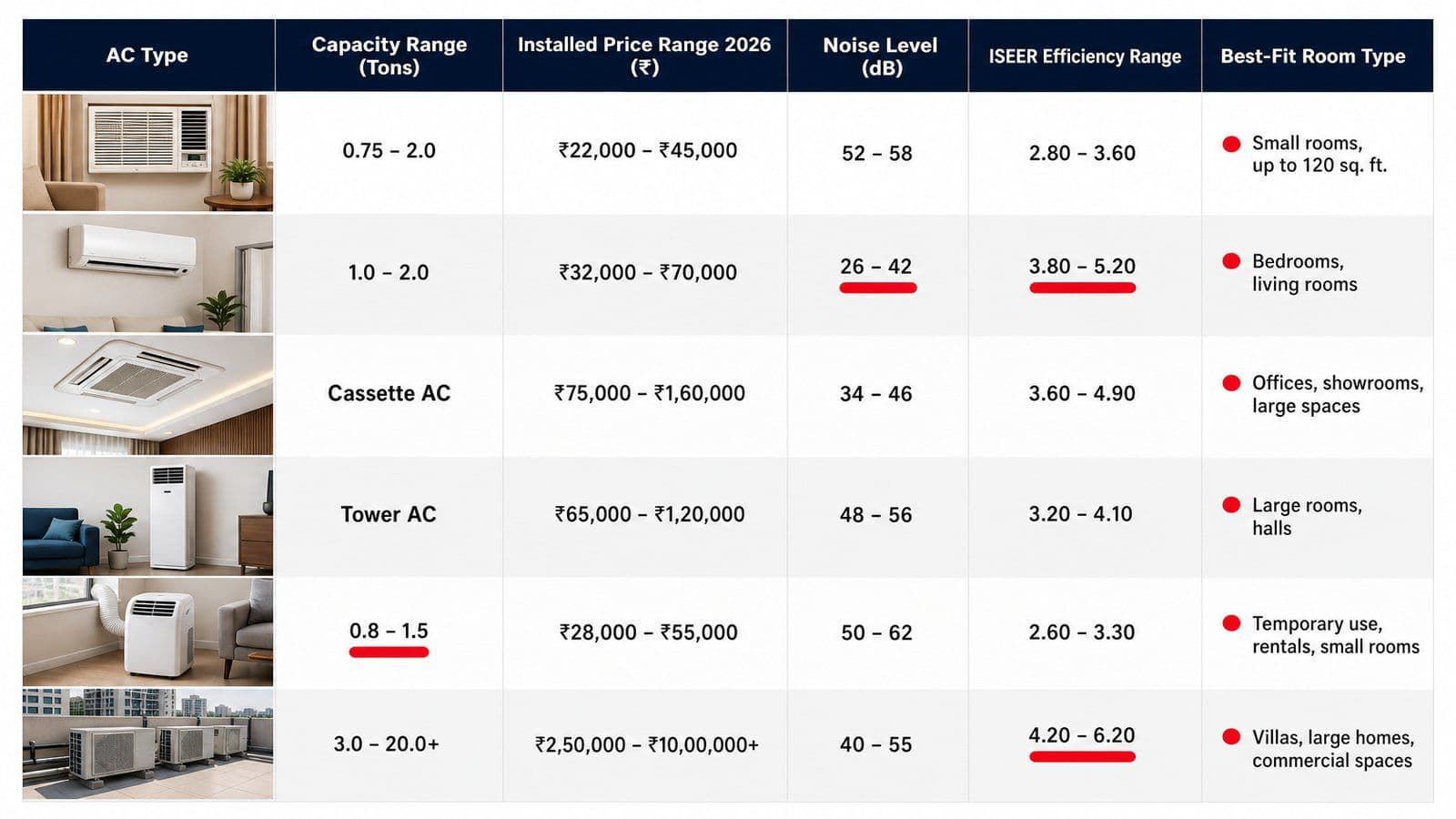
Photo: AC Type Comparison Matrix
| AC type | Capacity range | Installed price 2026 | Noise (indoor) | ISEER range | Best fit |
| Window | 0.75 to 2 ton | ₹15,000 to ₹35,000 | 50-56 dB | 3.5 to 5.0 | Small bedroom with window cut |
| Split | 0.8 to 2.5 ton | ₹28,000 to ₹85,000 | 28-38 dB | 3.5 to 5.5 | Standard apartment room 100-250 sq ft |
| Cassette | 1.5 to 5.5 ton | ₹55,000 to ₹1,40,000 | 32-42 dB | 3.8 to 5.2 | Open hall above 300 sq ft with false ceiling |
| Tower | 2 to 5 ton | ₹60,000 to ₹1,20,000 | 42-52 dB | 3.5 to 4.8 | Double-height hall above 350 sq ft |
| Portable | 0.75 to 1 ton | ₹22,000 to ₹45,000 | 56-64 dB | 2.8 to 3.5 | Rented home, stopgap only |
| Central | 4 to 10 ton | ₹3,50,000 to ₹8,00,000 | 26-35 dB | 3.5 to 5.0 | Villa above 1,500 sq ft |
Matching AC Tonnage to Room Size
One ton equals 12,000 BTUs per hour, roughly enough to cool 100 to 130 sq ft of standard ceiling height room in peak Indian summer. Under-tonnage means the AC runs at 100 percent capacity all day and never cools the room. Over-tonnage means the AC short-cycles, leaving the room cold but clammy.
The verified AC technicians in our ProNearMe network report that 38 percent of cooling complaints traced back to wrong tonnage selection at install time, not to AC malfunction.
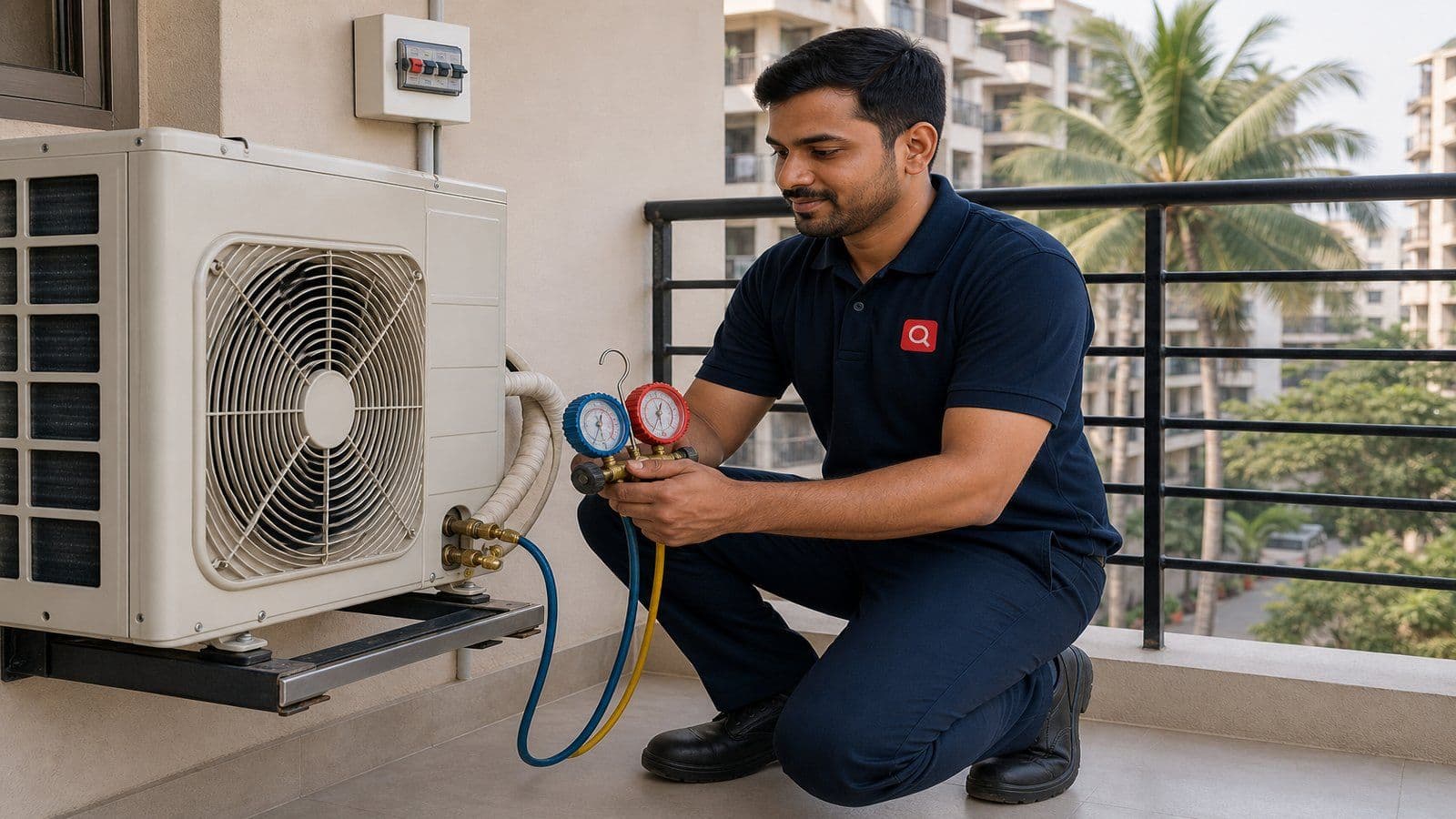
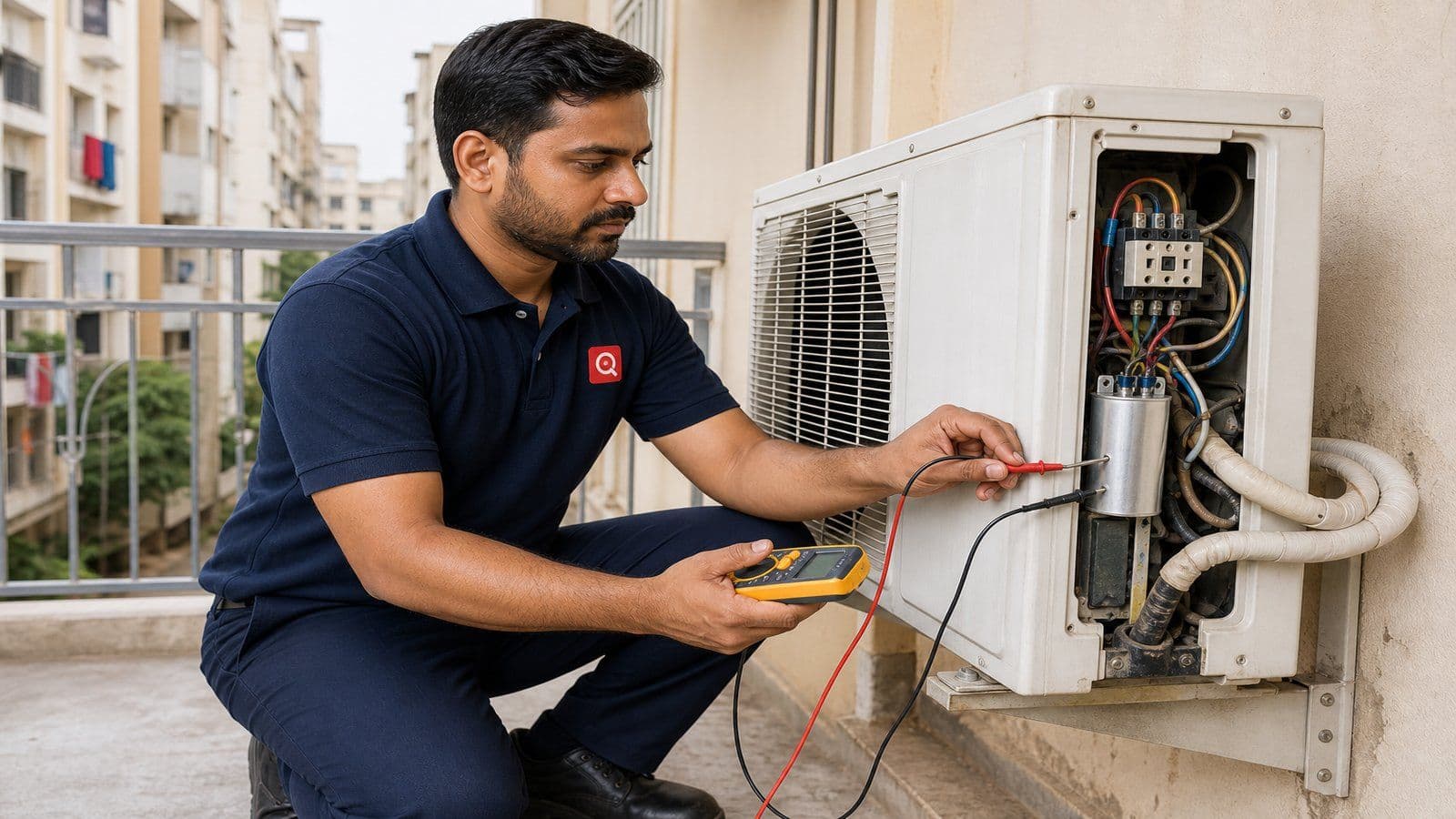
Photo: Technician installing split AC outdoor unit on Pune apartment balcony
| Room size (sq ft) | Standard ceiling | High ceiling (11+ ft) | Sunny west-facing |
| Under 100 | 0.8 ton | 1 ton | 1 ton |
| 100 to 140 | 1 ton | 1.2 ton | 1.2 ton |
| 140 to 180 | 1.5 ton | 1.5 ton | 1.8 ton |
| 180 to 240 | 1.8 ton | 2 ton | 2 ton |
| 240 to 320 | 2 ton | 2.5 ton | 2.5 ton |
| 320 to 450 | 2.5 to 3 ton | 3 ton | 3 ton |
Get quotes from verified, top-rated AC Service & Repair pros in Delhi.
A west-facing room needs 20 percent more tonnage. A room with 11+ foot ceilings needs 10 to 15 percent more. A room with more than 3 regular occupants needs another 10 percent. The Bureau of Energy Efficiency's 2024 Household Cooling Survey found the average Indian residential AC is over-sized by 17 percent.
A Real Decision: The Mehta Family in Pune
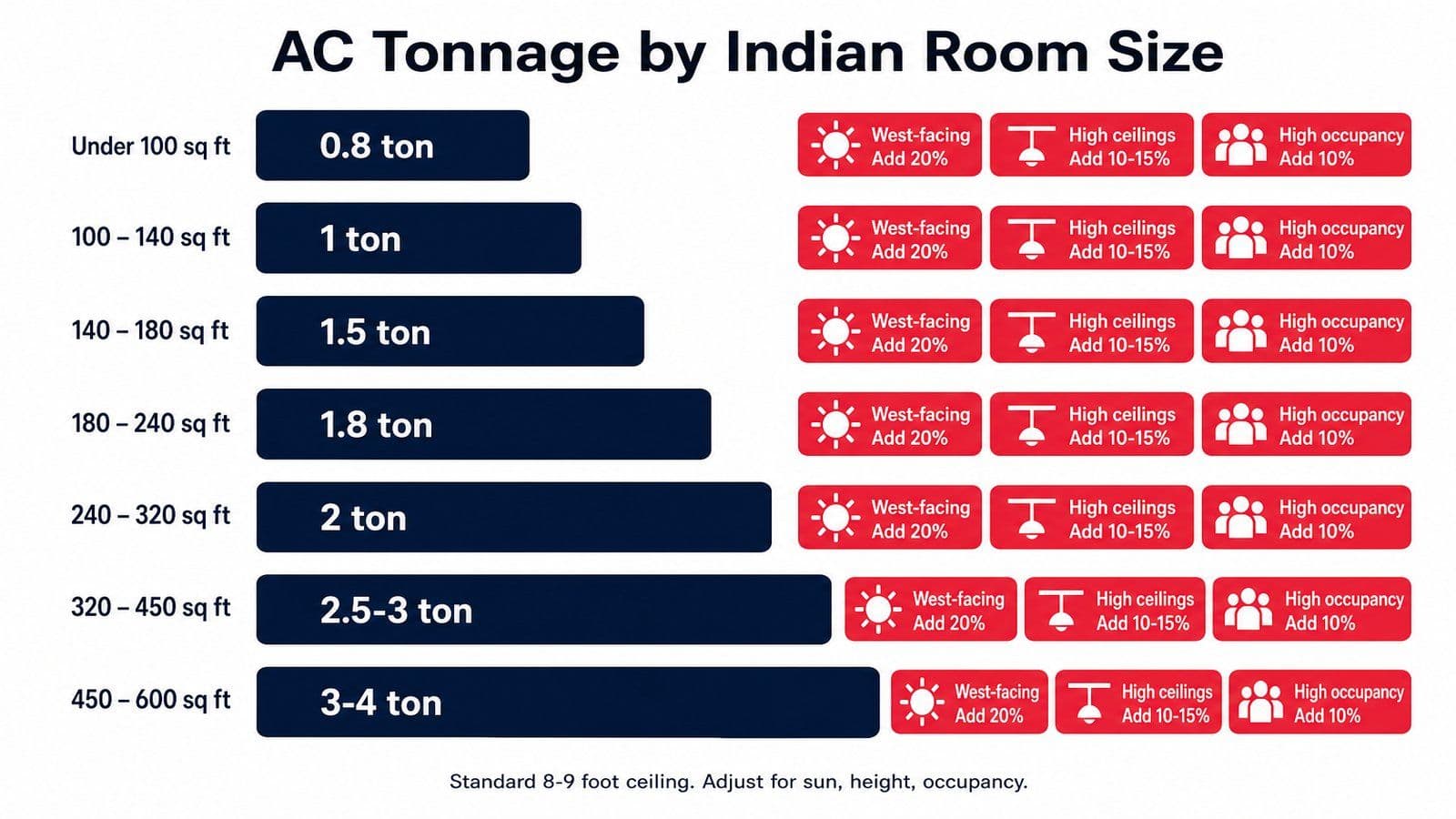
Photo: AC Tonnage to Room Size Infographic
Mr. Rajesh Mehta in Aundh, Pune, called us in March 2026. His existing single 2 ton window AC was 9 years old, struggling, and noisy. The flat was a 3BHK, 1,250 sq ft, with one large living-dining hall (220 sq ft), a master bedroom (170 sq ft), and two smaller bedrooms.
The showroom plan was a single 3 ton cassette in the living hall plus three smaller splits in the bedrooms. Quoted cost was ₹3.4 lakh installed. The cassette plan needed a false ceiling, which the flat did not have. Building one would add ₹65,000 and a month of disruption. The 3 ton cassette was also over-sized for a 220 sq ft hall, 1.8 ton was correct.
Our actual recommendation was four splits. A 2 ton 5-star inverter in the hall, a 1.5 ton in the master bedroom, and two 1 ton units in the smaller bedrooms. Total installed cost was ₹2.18 lakh with no civil work. After the first peak summer, Mr. Mehta's electricity bill ran ₹2,840 per month higher than his pre-AC baseline, against a budgeted ₹3,500.
The lesson is not that splits beat cassettes. It is that the right format depends on the room, the ceiling, and the budget for civil work.
The single most expensive AC mistake I see in Indian flats is buying the AC type the showroom pushes, instead of the type the room actually needs. Send me a photo of your room, the ceiling height, the window placement, and the wall you want the outdoor unit on. That 10-minute conversation saves people ₹40,000 to ₹80,000 every time.
Conclusion
The right AC type for your home is the one that matches the room shape, the install context, and the budget, not the one with the highest sticker price or the most aggressive showroom pitch. For 70 percent of Indian apartments and standard villa rooms, the answer is a properly sized 5-star inverter split AC. For large open halls above 300 sq ft with false ceilings, a cassette wins. For double-height halls, a tower. For tight rental situations, a portable as a one-summer bridge. For very large villas above 1,500 sq ft planned from scratch, central AC pays back.
Your next step is to measure the room, photograph the wall layout, and run through the room-shape and install-context filters above before walking into the showroom. A 10-minute audit organised against those filters routinely saves Indian buyers ₹30,000 to ₹80,000 against the default upsell. For deeper coverage of star ratings, costs, and installation, see the pillar guide The Complete AC Owner's Guide for Indian Homes 2026, or jump to How an AC works: system components, BEE star rating AC explained, and the AC technician certification India guide for hiring decisions.
Disclaimer
Prices, capacities, and BEE ISEER ranges noted above reflect 2026 retail data for Indian metro and tier-2 cities. Costs vary by city, brand tier, store promotions, and GST treatment at the time of purchase. Always ask for an NSDC-certified technician for installation regardless of brand. ProNearMe does not endorse any specific AC brand, all recommendations are format-agnostic and based on field experience.
Sources & References
- Bureau of Energy Efficiency, Star Rating Schedule for Room Air Conditioners (January 2026 revision)
- BIS, Indian Standard for Room Air Conditioners IS 1391 (latest revision)
- Press Information Bureau, India's Cooling Action Plan and HVAC Industry Growth
- Ministry of Environment, Forest and Climate Change (MoEF&CC), India HFC Phase-Down under Kigali Amendment
- National Skill Development Corporation (NSDC), Air Conditioning and Refrigeration Technician Qualification Pack
- Indian Society of Heating, Refrigerating and Air Conditioning Engineers (ISHRAE), Residential Cooling Guidelines
- Central Electricity Authority (CEA), Residential Electricity Consumption Patterns 2024
- Ministry of Power, Energy Conservation Building Code (ECBC) Residential

Amit worked as an AC technician for 6 years in Ahmedabad before transitioning to technical writing. He holds a diploma in Refrigeration and Air Conditioning from ITI Ahmedabad and understands the difference between what AC companies promise and what actually happens on the ground. His articles break down complex technical topics into plain language that any homeowner can follow. He tests every tip he writes about in his own home first.

Dr. Verma is a mechanical engineer with 15 years of experience in HVAC systems. She completed her PhD from IIT Delhi on energy-efficient cooling solutions for Indian residential buildings. She reviews all technical content on HomePros to make sure the numbers are right, the advice is safe, and the recommendations are backed by actual engineering principles. She consults for multiple AC manufacturers on product design.