- Roughly 65 percent of "compressor failure" calls our verified technicians attend are actually capacitor or. start-relay faults, fixable for ₹1,200 to ₹2,400 instead of the ₹18,000 to ₹35,000 a full compressor swap would cost.
- A humming compressor that will not start is the cheapest and most common fault. A loud knocking or clanking is almost always fatal.
- Inverter compressors fail differently from rotary or reciprocating units, the failure mode is usually the. inverter PCB or the IPM module, not the compressor head itself.
- Compressor warranties in India typically run 5 to 10 years on the part, but exclude. labour, gas and consequential damage, and are void if a non-NSDC-certified technician has opened the system.
- The 50 percent rule is the working benchmark, if a repair quote crosses half the. cost of a new equivalent AC and the unit is over 7 years old, replacement is usually the better call.
When an air conditioner suddenly stops cooling in the middle of a 43 degree May afternoon, the owner's first instinct is to blame the gas. In nine cases out of ten across the ProNearMe technician network, the real story is in the outdoor box.
AC compressor problems are the single most expensive class of fault any owner will face, but most of them start as a small, cheap signal that gets ignored for two or three weeks.
The compressor itself is a sealed, oil-bathed pump that pressurises refrigerant so the cooling cycle can run. When it struggles, the symptoms range from a low hum to a tripped MCB to dead silence.
This guide walks through the seven fault patterns that account for almost every compressor service call we see, how to tell them apart, what each one costs to fix in 2026, and when the economics tip from repair to replacement.

Get quotes from verified, top-rated AC Service & Repair pros in Delhi.
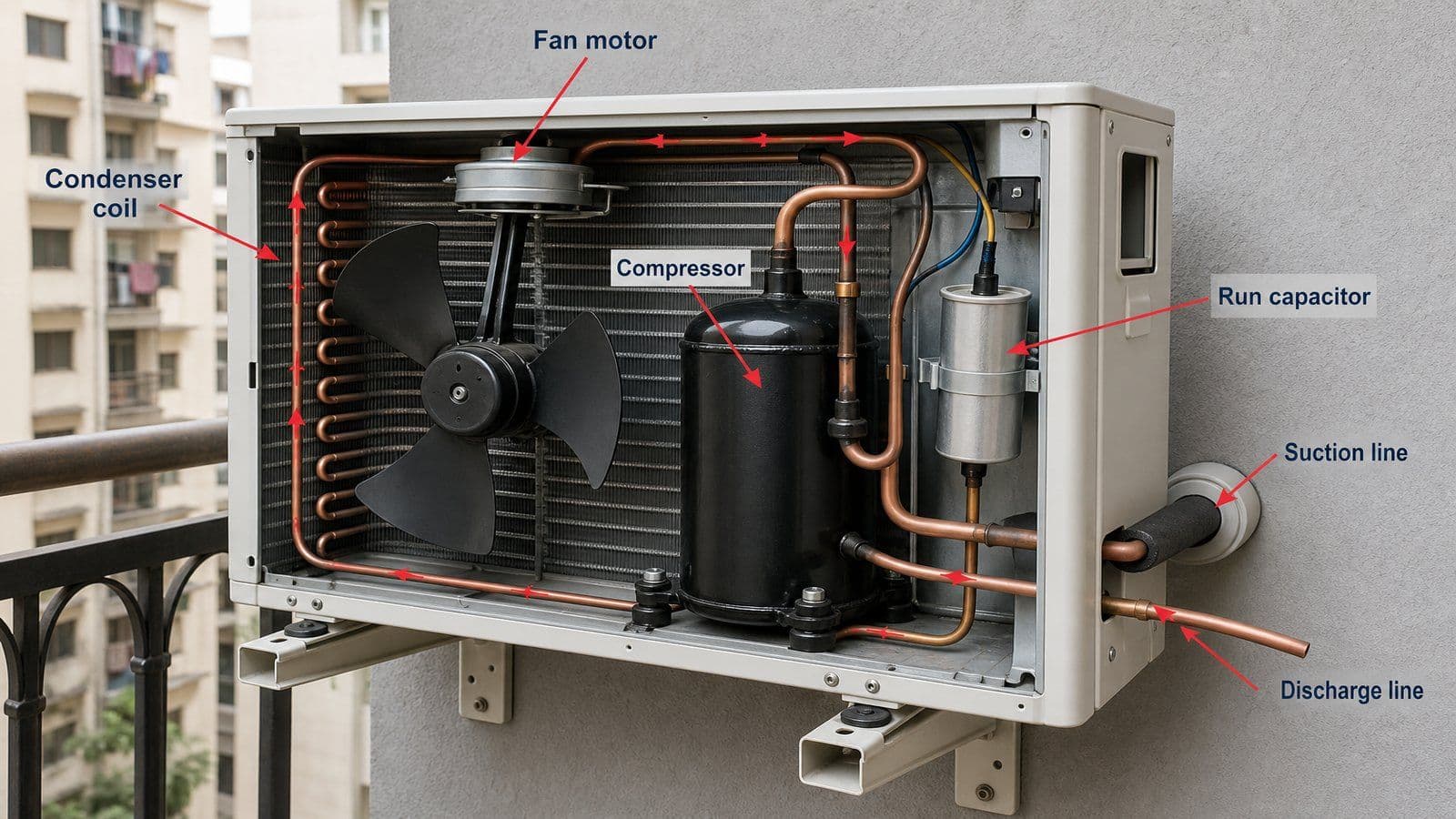
Photo: AC outdoor unit compressor cutaway diagram
What the AC Compressor Actually Does
The compressor sits inside the outdoor unit, sealed in a black or grey welded metal shell, and it is the single most expensive component in any split or window AC. Its job is mechanical, it takes low-pressure, low-temperature refrigerant vapour returning from the indoor coil and squeezes it into high-pressure, high-temperature vapour that then dumps its heat through the outdoor coil before condensing back to liquid.
Without the compressor, there is no pressure differential, no phase change, and no cooling.The fan spins, the lights glow, but the air stays warm.
Three compressor families dominate the Indian residential market, and each one fails in its own signature way. Reciprocating compressors, common in older window ACs and entry-level splits up to 2010, use a piston driven by a crankshaft.
They tend to fail loudly, with knocking and metal-on-metal noise as bearings wear out. Rotary compressors, the workhorse of fixed-speed splits from 2010 onwards, use a roller spinning eccentrically inside a cylinder.
They usually fail quietly, the head simply stops drawing pressure even though the motor still turns. Inverter compressors, now the dominant design in any star-rated AC sold after 2018, use a variable-speed BLDC motor controlled by an outdoor PCB. They rarely fail mechanically, instead the inverter board or the IPM module gives up, and the symptom looks identical to a compressor failure.
The Bureau of Energy Efficiency (BEE) tracks compressor type in its star-rating database, and the shift to inverter compressors is the single biggest reason new ACs in India are 25 to 35 percent more efficient than units sold a decade ago, a transition the Press Information Bureau (PIB) has flagged in its annual residential energy-use bulletins.
Compressor refrigerant work itself sits under the MoEF&CC Ozone Cell registry, which controls R22 phase-out timelines and refrigerant recovery rules every certified technician is expected to follow. It is also the reason a 2026 service technician needs to carry an inverter PCB diagnostic clamp, not just a refrigerant manifold.
For a primer on the broader cooling cycle and where the compressor sits in the loop, see our companion piece on how an AC actually cools a room.
The Seven Most Common Compressor Fault Patterns
Across the verified ProNearMe technician network, seven fault patterns cover roughly 95 percent of all compressor-related service calls. Five of them are cheap to fix. Two are not. The first job at any service visit is to tell them apart before anyone opens the gas line.
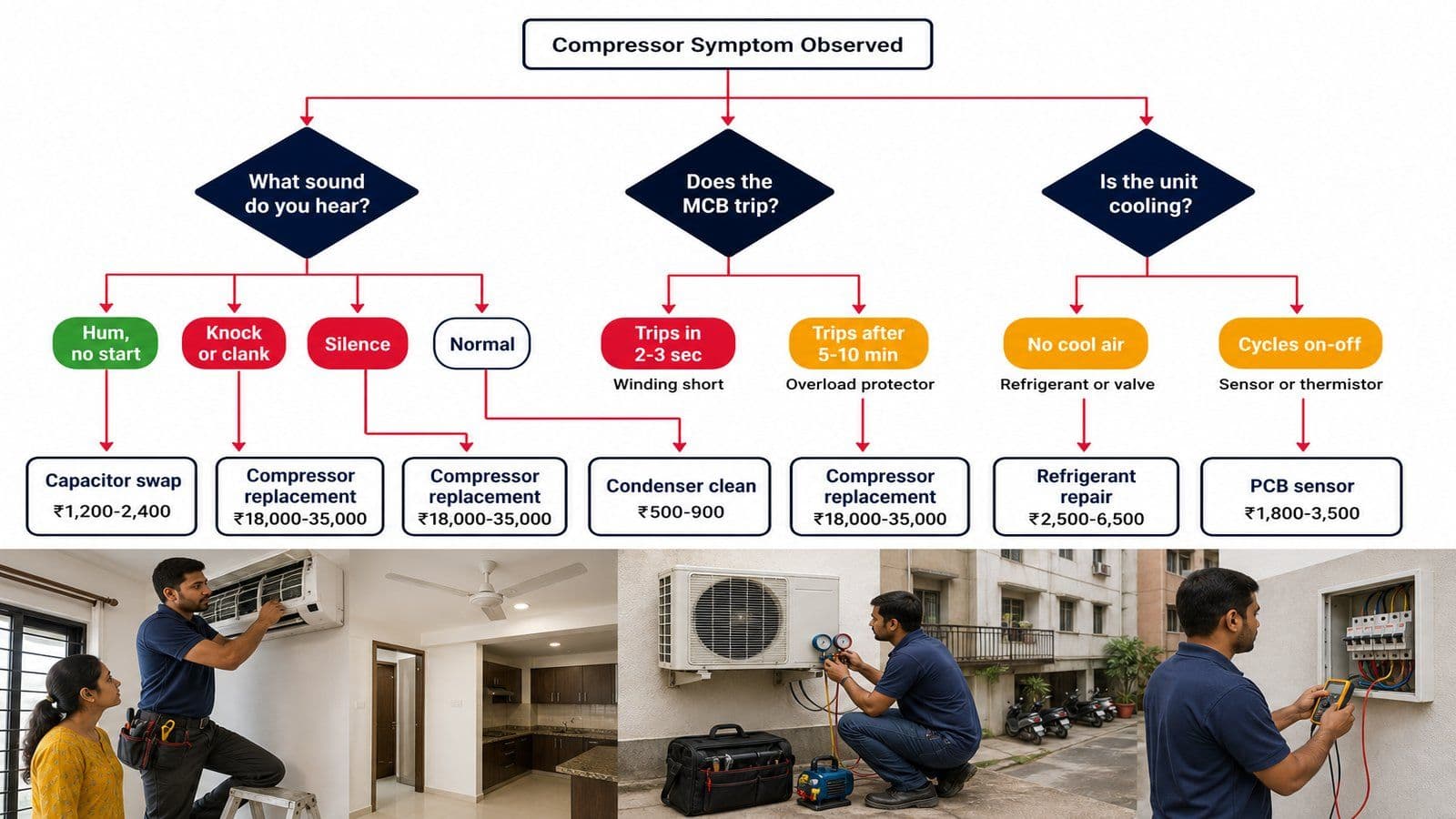
Photo: Compressor symptom-to-fault decision flowchart
Humming But Not Starting
The outdoor unit comes on, the indoor blower runs, and from outside you hear a steady low hum from the outdoor box, but no compressor whoosh and no cool air. This is the single most common compressor complaint and almost always the cheapest fix.
The compressor motor is trying to start but does not have the rotational torque to break free. In nearly every case, the run capacitor has lost capacitance, dropping from its rated 35 or 45 microfarads to under 20, and the motor stalls in the start position.
A capacitor test is a 30 second job for a technician with a multimeter, and the swap takes 15 minutes. Less commonly, the start relay has failed, or the compressor windings are damaged and drawing locked-rotor current. The crucial diagnostic step is reading capacitor microfarads before condemning the compressor.
Eight out of ten humming compressor calls we attend turn into a capacitor swap under ₹2,000. The customer was quoted ₹22,000 by the previous technician who skipped the capacitor reading. We tell every owner to insist on a microfarad value on the service slip before approving any work on the compressor itself.

Urgency tag: Call within 48 hours. Each failed start attempt heats the windings and damages them permanently.
Typical fix cost: ₹1,200 to ₹2,400 for capacitor swap. ₹800 to ₹1,500 for start relay. ₹18,000 to ₹35,000 if the compressor windings are genuinely shorted.
For the dedicated diagnosis flow on this exact symptom, see AC not cooling troubleshooting.
Tripping the Breaker Immediately
The unit switches on, the compressor tries to start, and the MCB trips within two or three seconds. Resetting the breaker and trying again produces the same result. This is a high-current event and a serious one.
The most likely cause is a short circuit in the compressor windings, where the enamelled copper insulation has broken down and the motor is now drawing locked-rotor current that pulls 60 to 80 amps for the instant it lasts. Less commonly, the start capacitor has failed shorted (rather than open), or a wire has chafed against the chassis.
This is a stop-and-diagnose moment. Repeatedly resetting the MCB stresses the breaker contacts and risks welding them shut, which then leaves the circuit unprotected. The Central Electricity Authority's wiring regulations explicitly flag repeated reset cycles on a tripping breaker as a fire-risk pattern.
Urgency tag: Urgent. Do not reset more than twice. Call within 24 hours.
Typical fix cost: ₹1,200 to ₹2,400 for capacitor or relay if those are the cause. ₹18,000 to ₹35,000 if compressor windings are shorted and the unit is out of warranty. Free under brand warranty if the compressor is within the 5 to 10 year window and a certified technician has not voided it.
For the full breaker-tripping decision flow, see AC tripping circuit breaker fixes.
Running Hot, Cutting Off After Five to Ten Minutes
The unit starts and cools normally for the first 5 to 10 minutes, then the outdoor compressor switches off while the indoor blower keeps running warm air. After 15 to 20 minutes the compressor restarts, runs another short stretch, and cuts off again.
This pattern is the overload protector doing its job. Every modern compressor has a thermal cutout, a small bimetallic disc bolted to the shell, that opens when the casing temperature crosses about 110 degrees Celsius. Once it cools back down, it resets automatically.
The protector tripping repeatedly is a symptom, not the disease. Five common causes feed into it: an undersized or weakening run capacitor forcing the motor to pull extra current, a dirty condenser coil so heat cannot escape the outdoor unit, low refrigerant raising the discharge temperature, an outdoor fan motor running slow because of a failing capacitor, or simply an outdoor unit installed in a hot enclosed balcony with no airflow. The fix is to find which one and address it.
A clean condenser plus correct refrigerant charge plus a fresh capacitor solves most of these calls.
Urgency tag: Call within 7 days. Running with the protector tripping is the most common precursor to a winding burnout.
Typical fix cost: ₹500 to ₹900 for a condenser deep clean. ₹1,200 to ₹2,400 for capacitor work. ₹2,500 to ₹6,500 for a refrigerant top-up plus leak repair.
Loud Knocking, Clanking or Grinding
A new mechanical noise from the outdoor unit, especially a rhythmic knock that speeds up with compressor RPM or a continuous metallic grind, is almost always fatal. It means internal mechanical damage, broken valves, snapped connecting rods on reciprocating units, or a scored cylinder wall on rotary units.
The compressor may keep running for days or weeks after the noise starts, but every minute of operation grinds metal into the oil charge, contaminating the refrigerant loop and damaging the expansion valve and capillary downstream.
The verified technicians in our network are trained to switch the unit off immediately on hearing this signature and quote replacement, not repair. Attempting a refrigerant top-up or a capacitor swap on a knocking compressor is a waste of money, the unit will fail completely inside a month and the metallic debris will have spread through the system.
Get quotes from verified, top-rated AC Service & Repair pros in Delhi.
A knocking compressor is the only fault we never try to nurse along. We switch it off at the wall, brief the owner that the unit needs a compressor swap or a full replacement, and walk away rather than charge them for a gas top-up that will not last a week. Owners often resist, but every nursed knock we have followed up on has come back within the month for double the cost.
Urgency tag: Switch off immediately. Call within 24 hours.
Typical fix cost: ₹18,000 to ₹35,000 for compressor replacement on a 1 to 1.5 ton split. ₹35,000 to ₹55,000 on a 2 ton inverter. Often the moment to consider replacing the whole unit if it is over 7 years old.
For the noise-specific diagnostic flow, see AC making loud noise diagnosis.
Compressor Runs But No Cooling
The outdoor compressor switches on normally with no humming or breaker trip, the fan spins, the unit sounds healthy, but the indoor air stays warm. This is the third most common pattern after capacitor failure and overload tripping. The compressor is mechanically intact and electrically sound, but the refrigerant cycle has broken down somewhere else.
The four common causes are: refrigerant charge has dropped below the threshold needed for the cycle to develop pressure (usually a slow leak that has been progressing for months), the expansion valve or capillary tube is stuck or blocked, the reversing valve on a heat-pump model is stuck mid-position, or the suction or discharge service valve is partially closed.
A technician with a manifold gauge set can diagnose this in 10 minutes by reading high-side and low-side pressures. Low pressure on both sides points to a refrigerant charge issue. High discharge pressure with low suction points to a blocked expansion valve. The Ministry of Environment, Forest and Climate Change requires any refrigerant handling to be done by NSDC-certified technicians, and the Kigali Amendment phasedown of HFC refrigerants makes this scrutiny tighter every year.
Urgency tag: Call within 48 hours. Running with low refrigerant is the fastest way to burn the compressor windings.
Typical fix cost: ₹2,500 to ₹6,500 for a leak detection plus repair plus recharge. ₹3,200 to ₹5,500 for an expansion valve replacement. ₹2,800 to ₹4,500 for a reversing valve service.
Frequent On-Off Cycling
The compressor switches on, runs for two or three minutes, switches off for another two, then back on. The pattern repeats through the afternoon. Unlike the overload-protector cycle, the off period here is short and the on period is short too. The unit appears to cool but the room temperature swings widely.
This is short cycling and it triples electricity bills while halving compressor life. Three causes dominate: the thermostat sensor has slipped out of its clip and is reading the supply-air temperature instead of the room temperature, the indoor unit PCB has a sensor fault, or the unit is over-sized for the room and reaches setpoint too quickly.
Less commonly, low refrigerant is tripping the low-pressure cut-out, or an oversized outdoor capacitor is causing the compressor to draw too much torque at start. Each start cycle on a compressor consumes a tiny fraction of its rated life, manufacturers design the unit for around 100,000 to 150,000 start cycles. A short-cycling unit can burn through that in two summers.
Urgency tag: Call within 7 days. The unit will continue to cool but compressor life is shortening rapidly.
Typical fix cost: ₹350 to ₹700 for thermistor or sensor reseat. ₹1,800 to ₹3,500 for a PCB sensor replacement. ₹2,500 to ₹6,500 if refrigerant turns out to be the cause.
Compressor Seizure
The outdoor unit makes no noise at all when the AC is switched on. No hum, no click, no breaker trip. The fan may or may not run depending on the wiring. This is the worst outcome, the compressor motor has seized completely, either through bearing failure, oil starvation, or a complete winding burnout. There is no diagnostic to perform beyond confirming the compressor is drawing no current despite the contactor closing. Replacement is the only option.
A seized compressor often follows months of warning signs that were ignored, repeated overload trips, occasional humming starts, gradually weakening cooling. The case study below shows how the timeline usually plays out in real Indian homes.
Case study: Mr. Rajesh Krishnan, a customer in Indiranagar, Bengaluru, called us in April 2025 about his five-year-old 1.5 ton split AC which had suddenly stopped cooling. The unit was completely silent at the outdoor end. His service history showed three previous calls in the past 18 months for "low cooling", each resolved with a small refrigerant top-up. The actual problem had been a slow leak on the indoor coil that no one had hunted down. After running on chronic low refrigerant for nearly two summers, the compressor had finally seized through oil dilution. Our technician confirmed zero current draw and quoted ₹26,500 for a rotary compressor swap plus full refrigerant recharge and oil change. The owner instead opted for a new 5-star inverter unit at ₹42,000 since the AC was already five years into a typical 9-year life. The lesson he repeats to neighbours is that the third refrigerant top-up was the warning sign he should have acted on.
Urgency tag: Already failed. Call within 7 days to plan repair-vs-replace.
Typical fix cost: ₹18,000 to ₹35,000 for rotary compressor replacement on a 1 to 1.5 ton split. ₹35,000 to ₹55,000 on a 2 ton inverter compressor. Add ₹2,500 to ₹4,000 for refrigerant recharge and oil change.
2026 Compressor Repair Cost Ranges by Capacity
Compressor work is the highest-ticket residential AC repair, and the spread between a capacitor fix and a full compressor swap is roughly 20x. The table below covers the working ranges our network sees across major Indian cities. All figures exclude GST, which is 18 percent on most AC parts and labour.
| Capacity | Capacitor Swap | Compressor Replacement (Part + Labour) | Full Refrigerant Recharge | Outdoor PCB / IPM Module (Inverter) |
| 1 ton split | ₹1,200 to ₹2,000 | ₹16,000 to ₹26,000 | ₹2,200 to ₹3,500 | ₹4,500 to ₹8,500 |
| 1.5 ton split | ₹1,400 to ₹2,400 | ₹18,000 to ₹32,000 | ₹2,800 to ₹4,500 | ₹5,500 to ₹10,000 |
| 2 ton split | ₹1,600 to ₹2,800 | ₹28,000 to ₹45,000 | ₹3,500 to ₹6,000 | ₹7,500 to ₹14,000 |
| 1 to 1.5 ton window | ₹900 to ₹1,800 | ₹14,000 to ₹22,000 | ₹2,000 to ₹3,200 | Not applicable |
| 1.5 to 2 ton inverter split | ₹1,500 to ₹2,800 | ₹32,000 to ₹55,000 | ₹3,500 to ₹6,500 | ₹6,500 to ₹12,000 |
Coastal cities with salt-corrosion damage on the original compressor terminals can add ₹800 to ₹1,500 in cleanup and terminal replacement. Cities with limited inverter parts availability (smaller towns in Bihar, Odisha, the North East) can add ₹2,000 to ₹4,000 in part transport and 5 to 10 days of waiting.
For the full diagnostic-to-cost map across every AC fault, see AC repair cost breakdown India 2026.
What Owners Can Safely Check vs What Needs a Technician
The single most useful DIY check is also the safest, listen and look. Switch the AC on, walk to the outdoor unit, and pay attention for the first 90 seconds. Is the compressor humming without starting, tripping the breaker, running but warm, knocking, or simply silent? That observation alone narrows the diagnosis to one of the seven patterns above, and lets the owner brief the technician accurately on the phone before a visit. A specific symptom report is the single biggest defence against being upsold to a compressor swap that was never needed.
Beyond that, almost everything is technician-only. A run capacitor stores enough voltage to deliver a serious shock for several minutes after the unit is switched off, the Indian Society of Heating, Refrigerating and Air Conditioning Engineers training material lists capacitor discharge as one of the top three injury causes for new technicians. Refrigerant handling is regulated under the Ozone Depleting Substances Rules and requires NSDC certification. Opening the compressor terminal box without isolating the circuit can void brand warranty in one move.
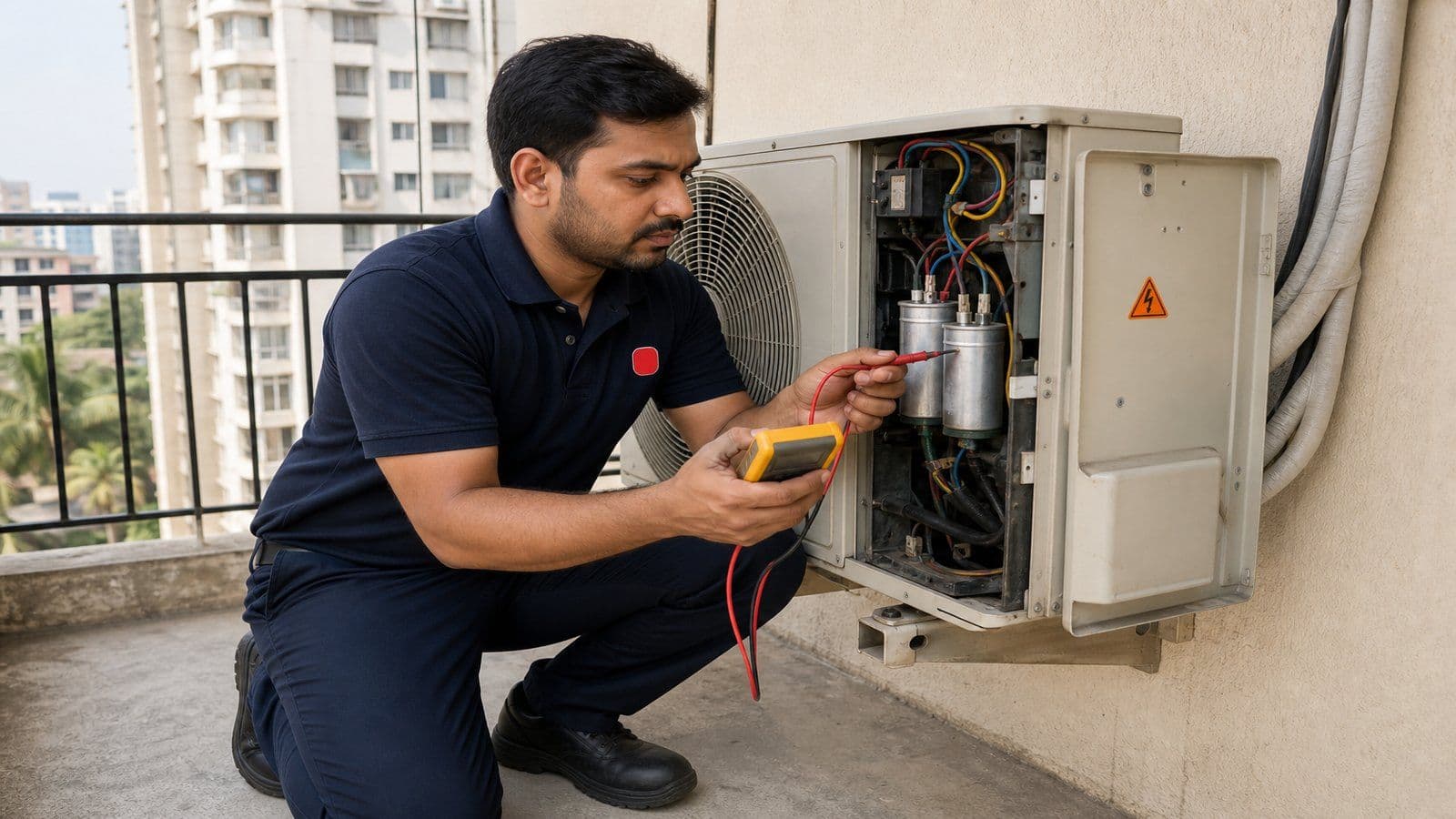
Photo: ProNearMe technician testing AC capacitor on Indian apartment balcony
Two things owners can legitimately do without a technician are clean the outdoor coil with a soft brush and water (with the unit fully isolated at the MCB), and make sure the outdoor unit has at least 30 centimetres of clear airflow on every side. Both of these prevent the overload-protector pattern from developing in the first place.
Get quotes from verified, top-rated AC Service & Repair pros in Delhi.
Compressor Warranty Rules in India
Compressor warranties are the single biggest line item on any AC warranty card and they vary widely. Most major brands offer 5 years on the compressor as standard, with several offering 10 years on inverter models as a competitive feature. The warranty card or product page on the manufacturer's website is the authoritative source. The Consumer Protection Act 2019 makes any printed warranty term enforceable, but the brand can refuse the claim if any of four conditions are not met.
First, the customer must produce the original purchase invoice with date and dealer stamp. Second, the AC must have been installed by a brand-authorised technician or under a documented installation receipt. Third, the unit must have been serviced as per the brand schedule, usually annually, with service records. Fourth, the system must not have been opened or repaired by anyone other than a brand-authorised or NSDC-certified technician. That fourth clause is the one that catches most owners. The moment a local technician opens the gas line for a top-up, the brand can argue the warranty is void.
Three things almost universally void compressor warranty: voltage damage from running without a stabiliser when the brand mandated one, refrigerant top-up by an uncertified technician, and any DIY work on the outdoor unit beyond a basic external clean. The National Skill Development Corporation maintains a public list of certified HVAC technicians at every level, and the verified pros in the ProNearMe network are NSDC-aligned for this exact reason.
Repair Versus Replace: The 50 Percent Rule
When a compressor quote crosses ₹18,000, every owner asks the same question. Should I repair this AC or buy a new one? The working benchmark across the industry is the 50 percent rule. If the total repair cost (parts plus labour plus gas plus GST) crosses 50 percent of the cost of a comparable new AC, replacement is usually the better economic call. A second filter is age, units over 7 years are running on aged copper, aged insulation, and outdated efficiency standards. Even a successful compressor repair often delays the next failure by only 18 to 24 months on a 7-plus year old unit.
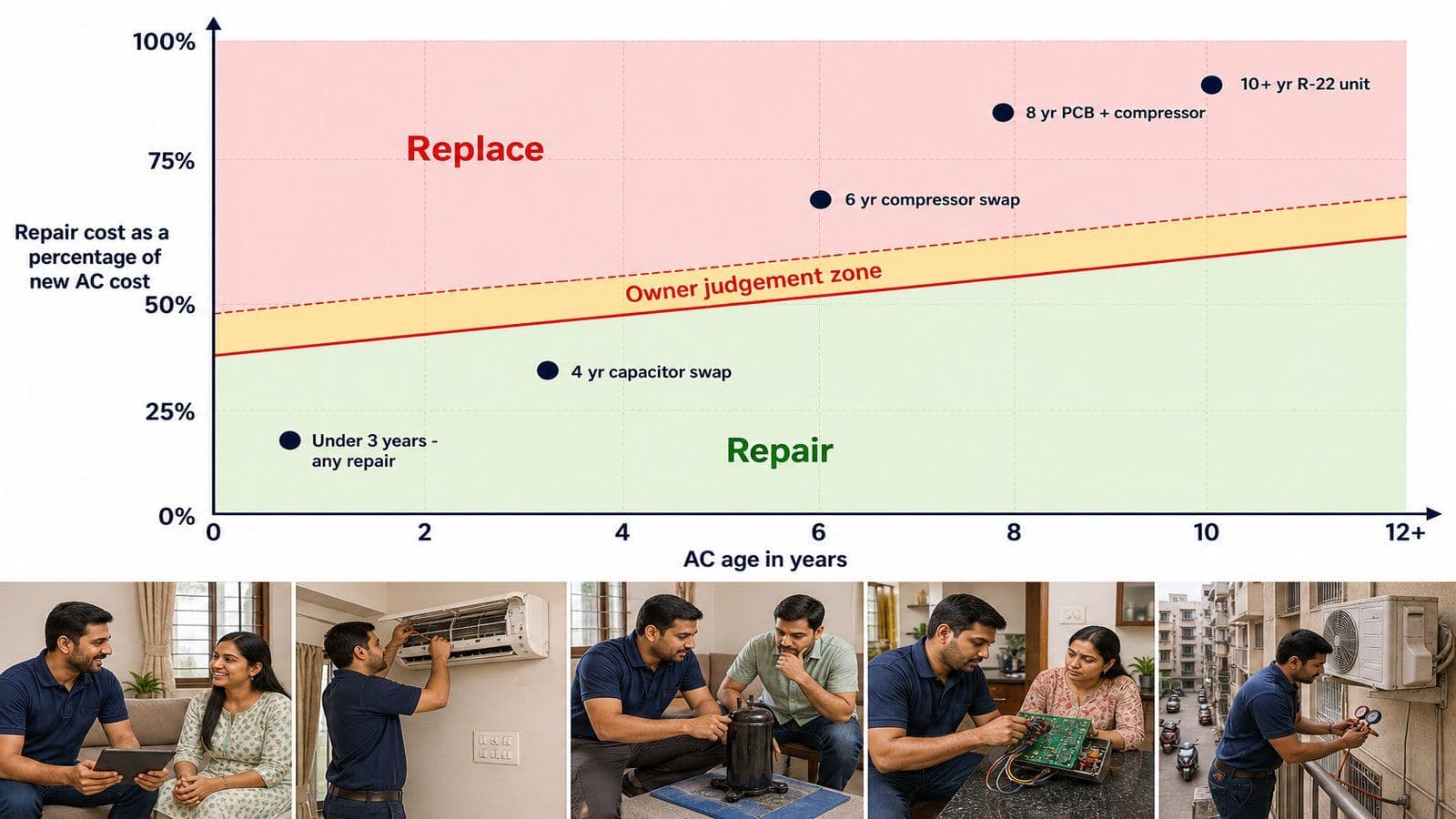
Photo: Repair-vs-replace decision matrix visual reference
The table below gives the typical decision matrix our network technicians use as a starting point. Final calls depend on coil condition, copper integrity, and how the owner uses the unit.
| Unit Age | Repair Quote vs New AC Cost | Likely Right Call |
| Under 3 years | Any amount, often under warranty | Repair |
| 3 to 5 years | Under 50% | Repair |
| 3 to 5 years | Over 50% | Repair if other components are healthy, replace if multiple symptoms |
| 5 to 7 years | Under 40% | Repair |
| 5 to 7 years | Over 40% | Replace, especially if shifting to 5-star inverter |
| Over 7 years | Almost any major repair | Replace, factor in 30%+ electricity savings on a new 5-star unit |
| Over 10 years | Any compressor work | Replace, refrigerant phasedown means R-22 units cannot be serviced affordably anyway |
For a longer treatment of the decision economics, see AC repair vs replace decision.
Why Monsoon Surfaces Compressor Failures
Service-call data across our network shows a clear monsoon spike in compressor complaints, usually starting in late June and peaking through August. Three factors stack up. Humidity above 75 percent stresses the winding insulation, especially on older units where the enamel has degraded with age, and condensation inside the terminal box can short the windings. Voltage fluctuations are more frequent during monsoon thunderstorm season, and inverter PCBs are particularly sensitive to surges, the Central Electricity Authority data shows monsoon months have 2.3x the voltage-anomaly incidence of dry months. And the simple fact that ACs run their hardest in May and June often pushes a marginal compressor over the edge by July.
The single best preventive measure is a pre-monsoon service in late May or early June, focusing on outdoor terminal box waterproofing, capacitor reading, condenser cleaning, and stabiliser confirmation. Owners on AMCs typically get this as their second service of the year. The Bureau of Energy Efficiency star-rating programme also recommends twice-yearly servicing for any star-rated AC to maintain rated efficiency.
Owners assume the 10-year inverter compressor warranty is a free replacement, but in practice almost 4 out of 10 monsoon-season claims we file get rejected for missing AMC servicing records or no stabiliser on the line. We tell every customer to keep every service receipt and a photo of the stabiliser nameplate in a folder, because the brand service centre will ask for both before honouring the warranty on a humidity-related winding failure.
Conclusion
Compressor problems frighten owners because of the headline cost, but most of what gets labelled "compressor failure" is actually a ₹1,500 to ₹3,500 capacitor, relay, or condenser problem in disguise. The single most valuable habit is to listen to the unit for 90 seconds at the first sign of trouble, match the symptom to one of the seven patterns covered above, and insist on a capacitor microfarad reading and a refrigerant pressure reading before approving any major work. Owners who do this consistently across our ProNearMe network report repair bills that average 60 percent lower than owners who give technicians a blank brief.
Two preventive habits cover most of what is preventable. Get a pre-summer service in February or March and a pre-monsoon service in late May or early June. Install a stabiliser sized for the AC's full load. Together they cost less than ₹6,000 across a year on a typical 1.5 ton split, and they push the median compressor life past 10 years even on inverter units that ran daily through three Indian summers. When the day finally comes that the compressor does need replacement, apply the 50 percent rule honestly, and a new 5-star inverter often beats a ₹28,000 repair on a 7-year-old fixed-speed unit on pure electricity savings alone.
Disclaimer
All cost ranges in this guide are typical residential figures across major Indian cities and exclude GST, which is currently 18 percent on most AC service, parts and refrigerant in India. Actual costs vary by city, brand, part availability and the specific technician's labour rate. Refrigerant handling, electrical work on the outdoor unit, and any opening of the sealed compressor circuit must be done only by NSDC-certified or brand-authorised technicians. Capacitors can deliver high-voltage shocks for several minutes after the unit is switched off and should not be handled by owners. Compressor warranty claim eligibility depends on the manufacturer's terms in force at the time of purchase and on adherence to all installation and servicing conditions printed on the warranty card. ProNearMe does not endorse any specific AC brand and the patterns described apply across all manufacturers serving the Indian market.
Sources & References
- Bureau of Energy Efficiency Air Conditioner Star Rating Programme
- Bureau of Indian Standards IS 1391 Room Air Conditioner Specification
- Ministry of Environment, Forest and Climate Change Ozone Depleting Substances Rules and Kigali Amendment Implementation
- Central Electricity Authority Measures Relating to Safety and Electric Supply Regulations
- National Skill Development Corporation HVAC Technician Qualification Pack
- Indian Society of Heating, Refrigerating and Air Conditioning Engineers Residential HVAC Guidelines
- Press Information Bureau Advisory on Energy Efficient Air Conditioning
- Consumer Protection Act 2019 Provisions on Product Warranty Enforcement
- Ministry of Power National Programme on Energy Efficiency in Air Conditioning

Amit worked as an AC technician for 6 years in Ahmedabad before transitioning to technical writing. He holds a diploma in Refrigeration and Air Conditioning from ITI Ahmedabad and understands the difference between what AC companies promise and what actually happens on the ground. His articles break down complex technical topics into plain language that any homeowner can follow. He tests every tip he writes about in his own home first.

Dr. Verma is a mechanical engineer with 15 years of experience in HVAC systems. She completed her PhD from IIT Delhi on energy-efficient cooling solutions for Indian residential buildings. She reviews all technical content on HomePros to make sure the numbers are right, the advice is safe, and the recommendations are backed by actual engineering principles. She consults for multiple AC manufacturers on product design.