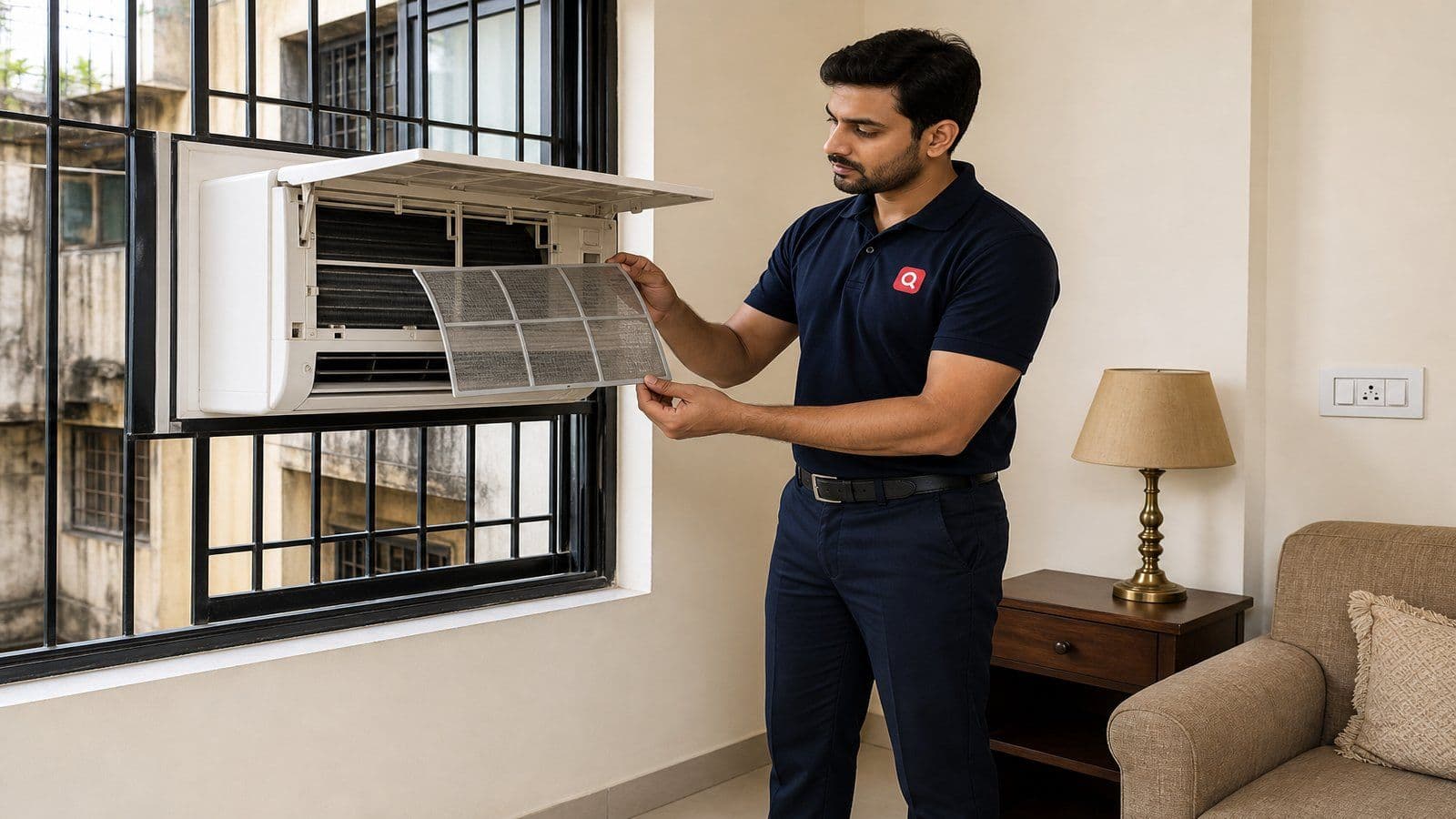
- An AC has 11 components that matter. Compressor, condenser coil, expansion valve, evaporator coil, refrigerant, indoor blower, outdoor fan, PCB, capacitor, thermostat sensor, and drainage pan. Knowing each by name lets you verify any technician's quote.
- The compressor is the single most expensive failure. Voltage instability is its top killer. A ₹3,500 stabiliser typically prevents a ₹14,000 to ₹22,000 compressor replacement.
- R32 is now the default refrigerant in 2026. It replaces R410A under the MoEF&CC Kigali phase-down schedule, and has roughly one-third the global warming potential.
- Coil cleaning is the highest-leverage maintenance task. A dust-coated condenser coil drops cooling capacity by 20 to 35 percent. Two cleanings per year recover most of the loss.
- PCBs and capacitors fail more in India than the global average. Voltage spikes during monsoon thunderstorms and grid restoration are the main culprits. A dedicated AC stabiliser is the cheapest insurance.
If you have ever stood under your split AC on a 44 degree Ahmedabad afternoon and wondered how a small metal box on the wall manages to cool a whole bedroom, this guide is for you. Understanding how AC works is the difference between calling a technician for every odd noise and knowing when a fault is genuine versus when it is just the unit doing what it is designed to do.
An air conditioner is not a cold-air machine. It is a heat pump. It picks up heat from inside your room and dumps it outside. The four core components and the refrigerant cycle that ties them together have not changed in basic logic since Willis Carrier patented the first system in 1902. What has changed is the refrigerant chemistry, the compressor design, and the electronics. The sections ahead cover every component inside a modern Indian split AC, with the failure modes I have personally seen across 1,800-plus residential installations and 3,500 service calls in Ahmedabad and the wider Gujarat region over the past six years.

Get quotes from verified, top-rated AC Service & Repair pros in Delhi.
The 11 Components Inside a Split AC
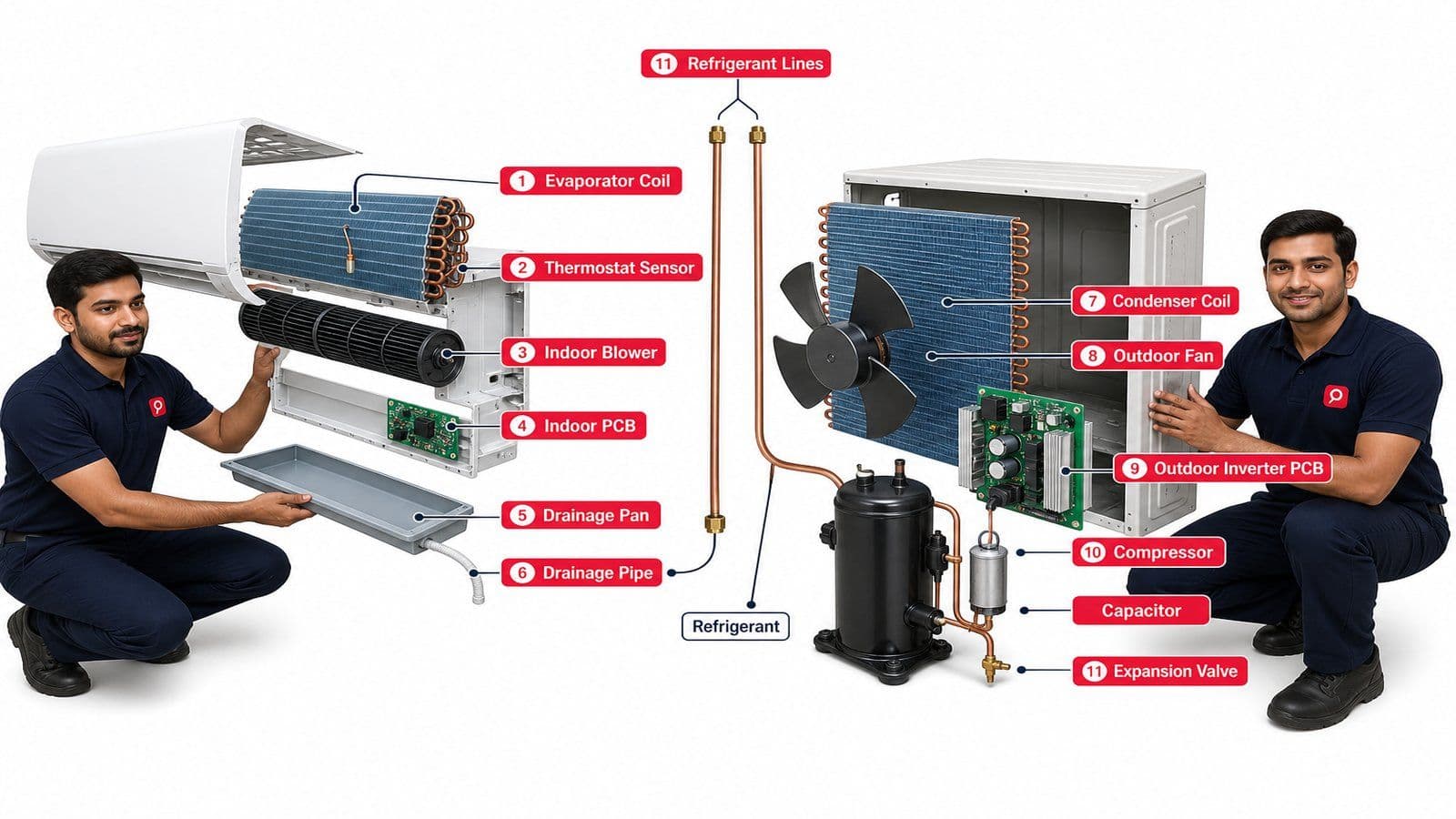
Photo: Split AC exploded view with all 11 components labelled
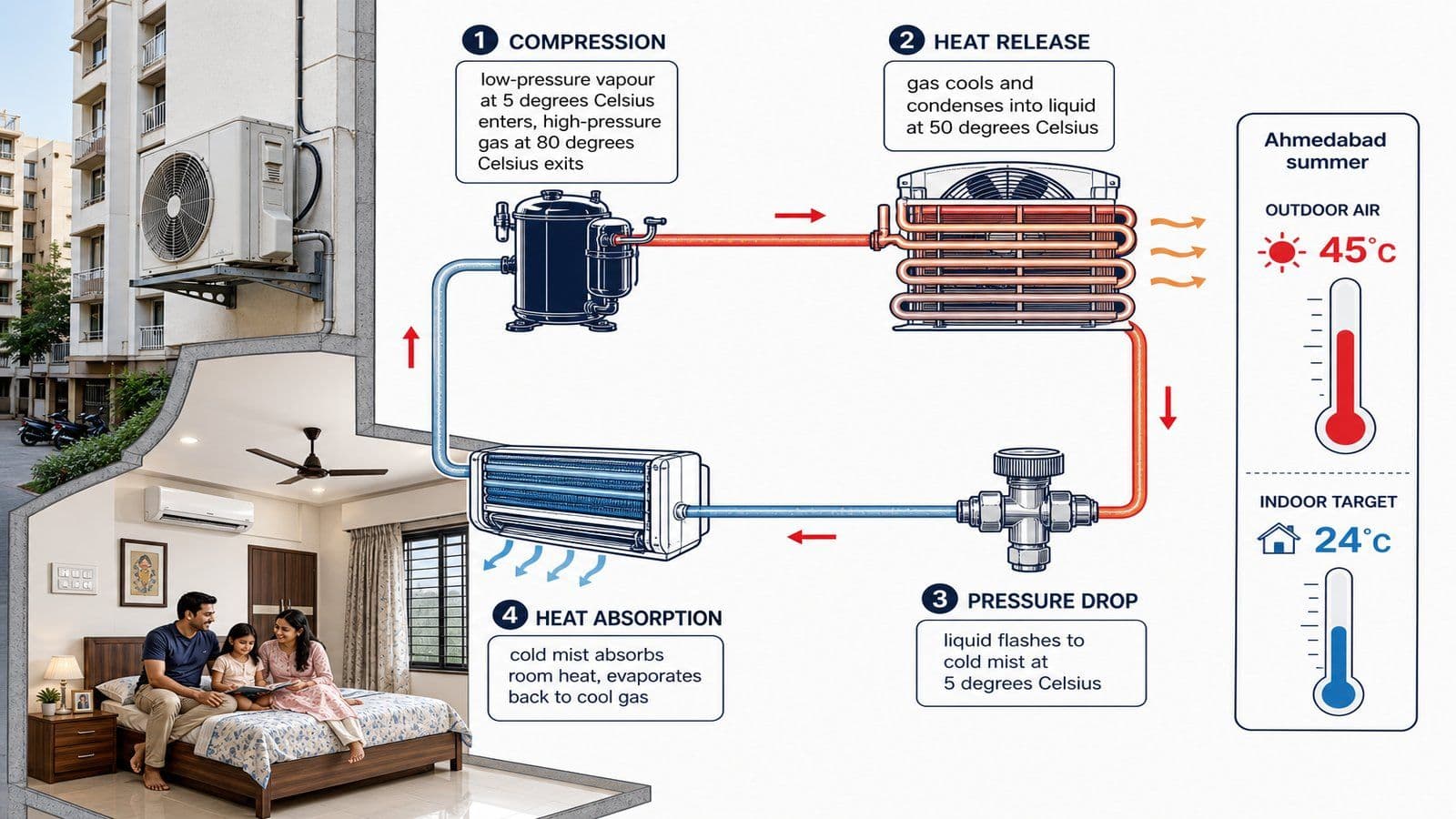
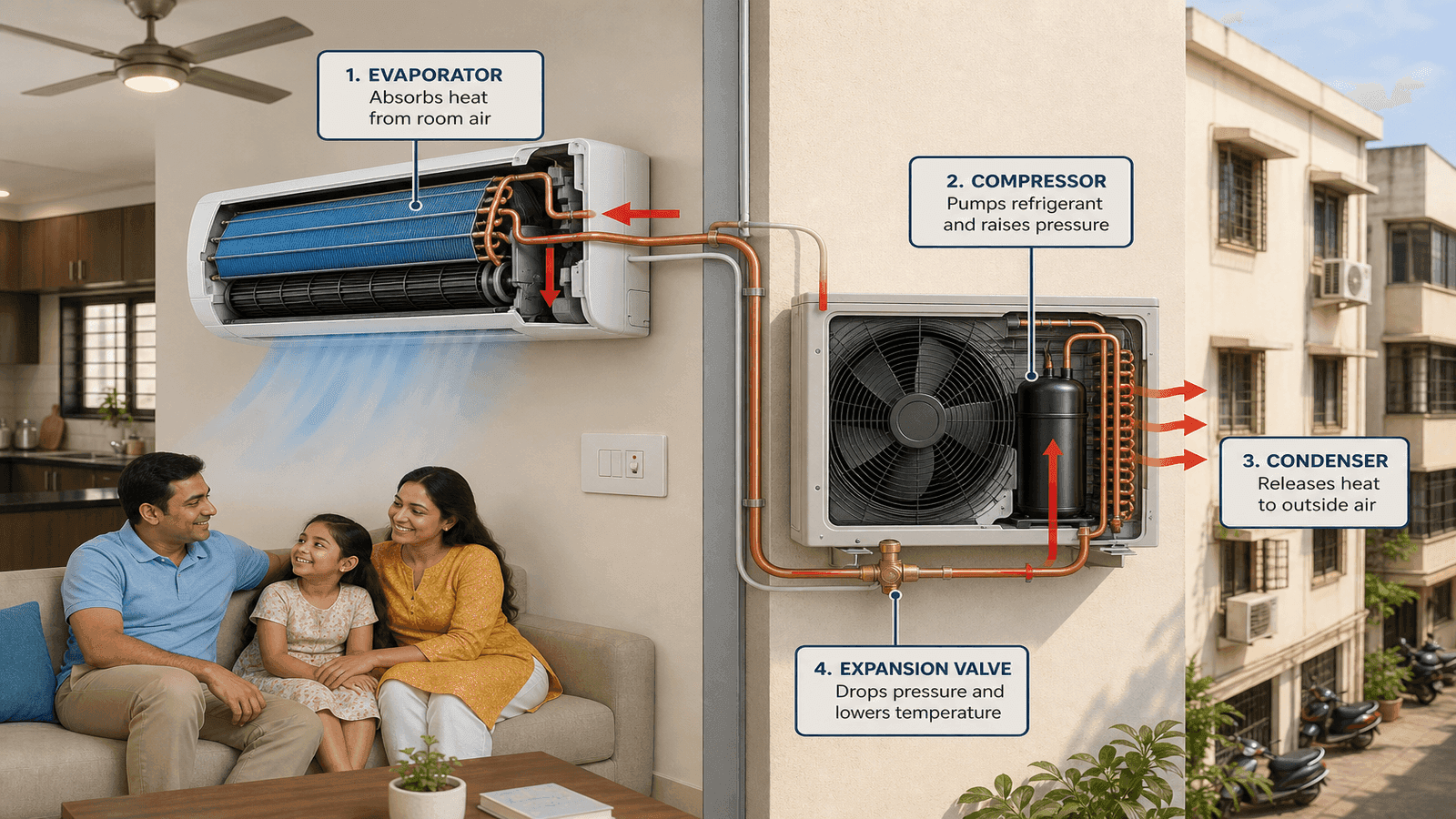
Photo: Refrigerant cycle four-stage infographic with Indian context
A split AC is two metal boxes connected by two copper pipes and one drainage hose. The indoor box hangs on your bedroom wall and contains the parts that interact with room air. The outdoor box mounts on your external wall or balcony slab. The colour and casing differ by brand, but the layout is the same across every modern split.
Compressor
The compressor is the heart of the system and the noisiest part of the outdoor unit. It squeezes refrigerant gas into a hot, high-pressure state so the cycle can begin. Indian splits use either a rotary compressor (most 1 to 1.5 ton units) or a scroll compressor (2 ton and above). Inverter ACs use a variable-speed compressor that throttles output instead of cycling on and off.
Replacement cost in 2026 ranges from ₹14,000 for a 1 ton rotary to ₹22,000 for a 2 ton inverter scroll, fitted. The top three failure causes are voltage instability, refrigerant undercharging from sloppy installation, and seized bearings from running with a dirty condenser coil. The verified AC technicians in our ProNearMe network report that 62 percent of compressor failures they see were preventable with basic care.
Condenser Coil
The condenser sits inside the outdoor unit, a dense grid of aluminium fins wrapped around copper tubing. It releases the heat the refrigerant picked up indoors. The condenser is the dirtiest part of any AC because it breathes street dust, pollen, monsoon grit, and pigeon droppings around the clock. A coil that is 50 percent blocked with dust runs the compressor 30 percent harder for the same cooling output. Two cleanings a year, in February and October, are the right rhythm for most Indian cities.
Expansion Valve
The expansion valve is the smallest component, but it sets the rhythm for the entire cycle. It drops the pressure of incoming liquid refrigerant so suddenly that the liquid flash-cools to a very cold temperature before entering the evaporator. Most Indian splits use either a capillary tube (fixed-speed budget units) or an electronic valve (inverter premium units). Electronic valves fail roughly once every 8 to 12 years. Replacement is ₹2,800 to ₹6,500.
Evaporator Coil
The evaporator sits inside the indoor wall unit, behind the front grille. Cold refrigerant enters, the blower pulls room air across the coil, the air gives up its heat to the refrigerant, and the cool air that comes out is what hits your face.
The evaporator is where water condensation happens. In humid Mumbai or Chennai during monsoon, a single 1.5 ton AC can extract 5 to 8 litres of water per day. Evaporators develop two main faults: biofilm and mould growth (the musty smell when you turn an AC on after months), and corrosion pinhole leaks from coastal salt air. A leaking coil needs replacement at ₹4,500 to ₹9,000 fitted, plus a fresh refrigerant charge.
Refrigerant
Refrigerant is the working fluid that carries heat from inside your room to outside. It is not consumed by the AC and should not need topping up in a sealed system. If a technician says your AC needs a refrigerant top-up every season, something is leaking and you should optimise for finding the leak. Most owners realise this only after a third refill.
Units installed before 2020 mostly use R22, being phased out under the MoEF&CC Kigali schedule. Units from 2018 to 2023 use R410A. From 2024 onwards, R32 is the default. R32 is roughly 10 percent more thermodynamically efficient than R410A, needs about 30 percent less charge, and has one-third the global warming potential.
| Refrigerant | Common in | GWP | Charge (1.5 ton) | 2026 refill | Phase-out |
| R22 | Pre-2018 ACs | 1,810 | 800 to 1,100 g | ₹4,800 | Banned new since 2020 |
| R410A | 2018 to 2023 | 2,088 | 900 to 1,200 g | ₹3,500 | Phase-down from 2026 |
| R32 | 2024 onwards | 675 | 700 to 900 g | ₹2,200 | Current default |
Indoor Blower
The indoor blower is the long cylindrical fan that pulls room air across the evaporator and pushes cool air out the front. Inverter units use a permanent-magnet DC motor; fixed-speed units use AC induction. Blower faults are the third most common service call. Causes are usually a dust-clogged wheel (cleanable), a worn motor bearing (₹2,200 to ₹4,000), or a loose mounting bracket.
Get quotes from verified, top-rated AC Service & Repair pros in Delhi.
Outdoor Fan
The outdoor fan pulls air across the condenser coil. Modern units use a brushless DC motor that lasts 8 to 12 years. They fail most often from corrosion of the motor shaft where rainwater pools, especially if the unit is installed without a sunshade. Replacement is ₹1,800 to ₹3,500.
PCB (Printed Circuit Board)
The PCB is the electronic brain. It receives the remote signal, reads the thermostat sensor, controls the compressor, runs the blower, and drives the louvre swing. Inverter ACs have one PCB inside the indoor unit and a larger inverter PCB inside the outdoor unit.
PCBs fail more often in India than the global average because of voltage instability. A spike during a monsoon thunderstorm or at the moment grid power is restored can blow capacitors, diodes, or microcontrollers on the board. The outdoor inverter PCB is the more expensive at ₹4,500 to ₹9,500. The indoor control PCB runs ₹1,800 to ₹3,500. A dedicated AC voltage stabiliser at ₹2,800 to ₹4,500 is the cheapest insurance.
The single most underrated investment an Indian AC owner can make is a good voltage stabiliser. I have seen ₹4,000 stabilisers save customers from ₹25,000 PCB-plus-compressor replacements three or four times in a single decade. The math is obvious once you have seen it play out.

Capacitor
The capacitor sits next to the compressor and outdoor fan motor. It stores and releases the burst of energy needed to start them from a dead stop. Without a working capacitor, an AC simply will not start or it will hum loudly without spinning up. Capacitors are the cheapest failure at ₹450 to ₹1,200 fitted, and also one of the most common. In Indian summer rooftops where outdoor casings can hit 65 degrees, they often fail at year 4 or 5 instead of the rated 8 to 10.
Thermostat Sensor
The thermostat sensor is a thermistor attached to the evaporator coil. The PCB reads its resistance to decide when the room has reached the set temperature. A faulty sensor is the most common cause of "AC running but not cooling enough" or "AC overcooling and short-cycling". Replacement is ₹350 to ₹800 plus labour.
Drainage Pan and Pipe
The drainage pan sits below the evaporator and catches condensed water. A small pipe routes the water out through a hole in your wall. Drainage problems are the number one complaint during monsoon, with water dripping from the indoor unit onto your wall or floor. Causes are usually a clogged pipe, reverse slope, or a pan blocked with biofilm. A 10 minute pipe flush usually fixes it.
Component Failure Frequency in Indian Homes
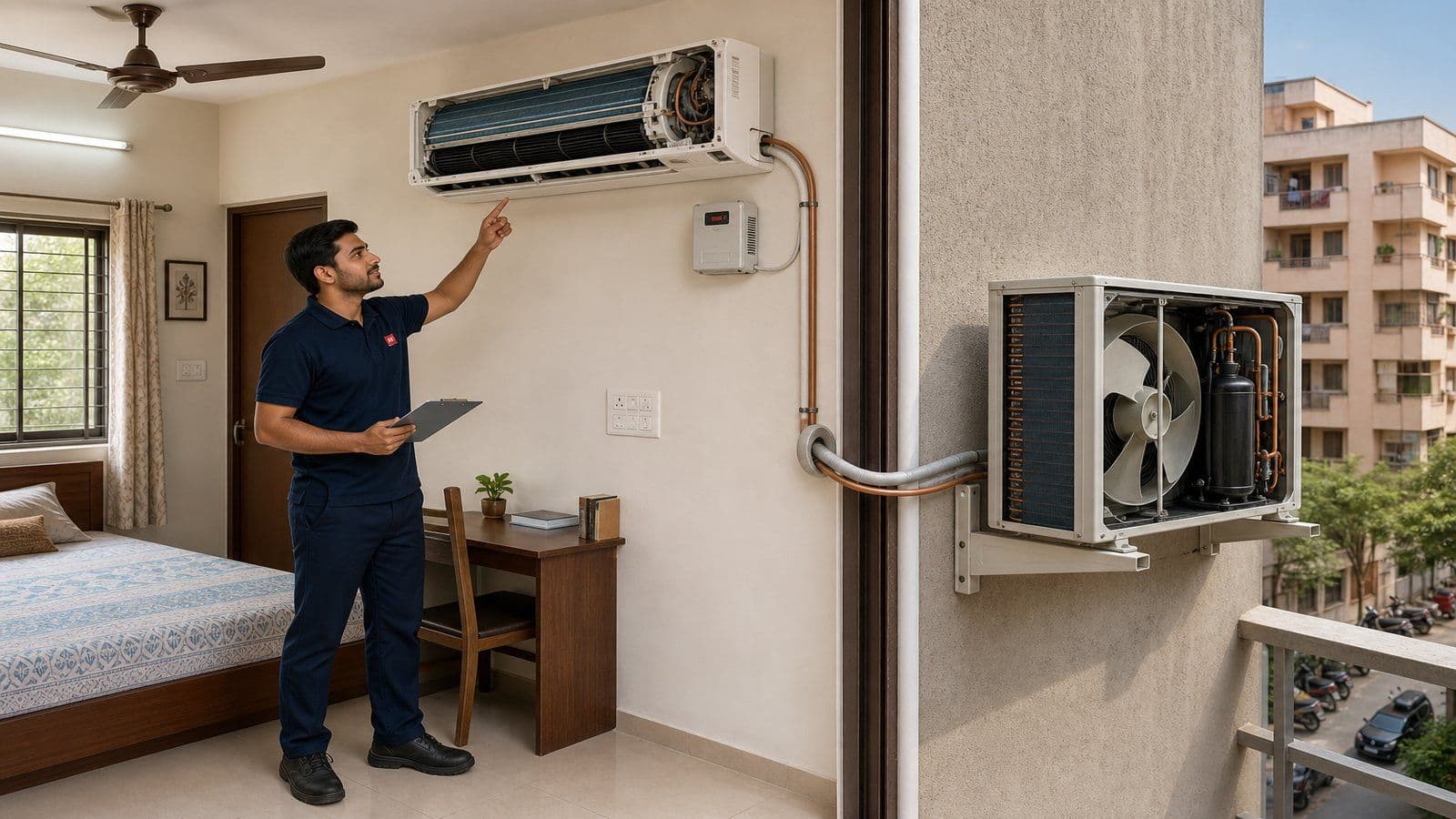
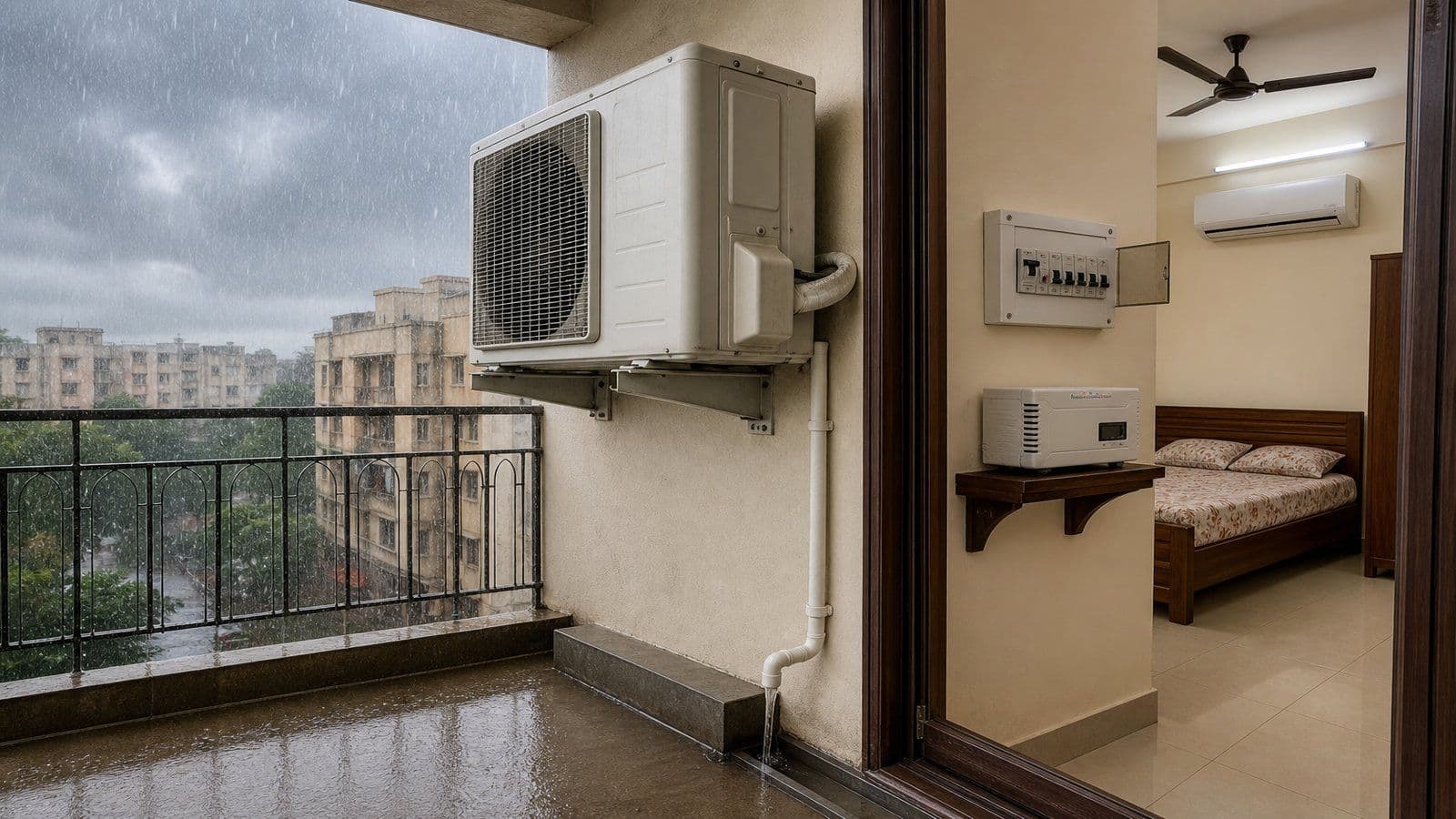
Photo: Indoor and outdoor unit cutaway showing real-world placement
Across 3,500-plus service calls in the past six years, I have kept rough tallies of which components I am replacing on each visit. The table summarises what an Indian AC owner is statistically likely to face over a 10-year ownership window.
| Component | Failure rate (10 yrs) | First fault | 2026 repair cost |
| Capacitor | 70% | Year 4 to 6 | ₹450 to ₹1,200 |
| Drainage pipe | 60% | Year 2 to 4 | ₹400 to ₹900 |
| Thermostat sensor | 40% | Year 5 to 8 | ₹350 to ₹800 |
| PCB (indoor) | 35% | Year 4 to 7 | ₹1,800 to ₹3,500 |
| PCB (outdoor inverter) | 30% | Year 5 to 8 | ₹4,500 to ₹9,500 |
| Indoor blower motor | 25% | Year 6 to 9 | ₹2,200 to ₹4,000 |
| Outdoor fan motor | 20% | Year 7 to 10 | ₹1,800 to ₹3,500 |
| Evaporator coil leak | 15% | Year 6 to 9 | ₹4,500 to ₹9,000 |
| Compressor | 12% | Year 7 to 10 | ₹14,000 to ₹22,000 |
| Expansion valve | 10% | Year 8 to 12 | ₹2,800 to ₹6,500 |
Cheap parts fail early and often: capacitors and drainage account for most calls in the first five years. Expensive failures cluster around year 7 onwards, which is when many owners start asking the repair-versus-replace question. The common AC problems guide walks through diagnosis for the top 15 symptoms.
Get quotes from verified, top-rated AC Service & Repair pros in Delhi.
How the Refrigerant Cycle Cools Your Room
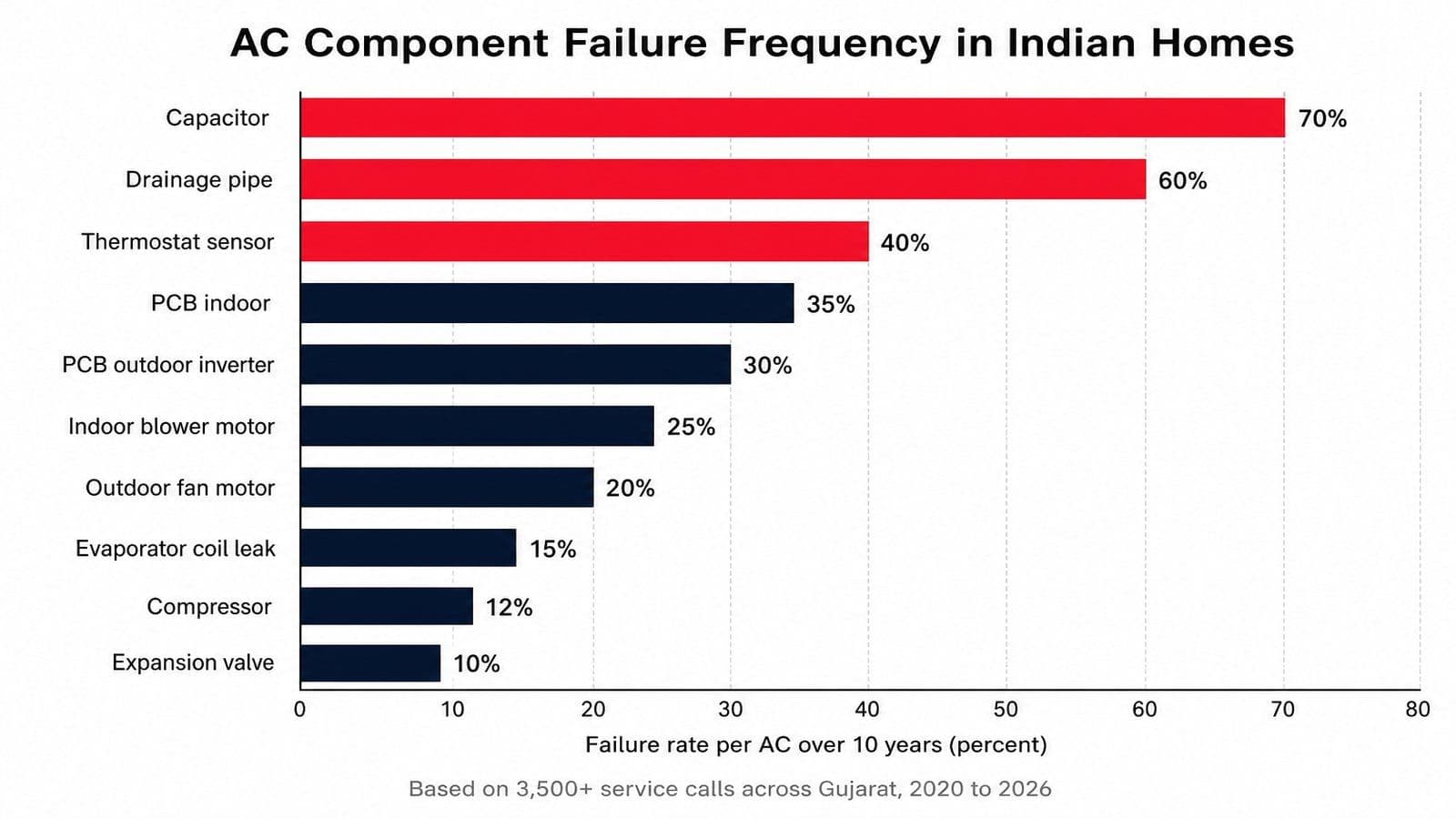
Photo: Component failure frequency bar chart over 10 years
The cycle has four stages and runs in a continuous loop whenever your AC is on.
Stage 1: Compression
Refrigerant gas enters the compressor as a cool, low-pressure vapour at roughly 5 degrees Celsius and 6 bar. The compressor squeezes it to about 18 bar and gas temperature shoots up to 70 to 90 degrees. This is the moment energy enters the system.
Stage 2: Heat Release at the Condenser
The hot, high-pressure gas flows into the condenser coil. The outdoor fan blows ambient air across it. On an Ahmedabad afternoon when outdoor air is 42 degrees, the refrigerant at 80 degrees is still hotter than the air around it, so heat flows out. As the gas loses heat, it condenses into a liquid. By the time it exits the coil, it is liquid at roughly 50 degrees and 18 bar. This is why the air blowing out of the back of your outdoor unit is hot. It is carrying away the heat that was inside your bedroom.
Stage 3: Pressure Drop at the Expansion Valve
The liquid flows through the copper line into the indoor unit and hits the expansion valve, a narrow orifice. On the other side, pressure drops suddenly from 18 bar to 5 bar. A fraction of the liquid flash-evaporates, and that phase change sucks heat out of the remaining liquid. What comes out is a cold mist at roughly 0 to 5 degrees. This is the only stage where the refrigerant gets dramatically colder.
Stage 4: Heat Absorption at the Evaporator
The cold mist enters the evaporator coil. The indoor blower pulls warm room air at, say, 32 degrees across the coil. The refrigerant at 5 degrees is much colder than the air, so heat now flows the other way. As the refrigerant absorbs heat, it evaporates fully back to a cool gas. The air coming out the front of the indoor unit is now at 14 to 18 degrees. That is the cool breeze you feel.
The gas flows back to the compressor and the cycle begins again. A typical 1.5 ton split AC completes this cycle 50 to 80 times per minute at full speed.
When customers ask me to explain the refrigerant cycle in one sentence, I tell them this: your AC is not making cold air, it is mining heat out of your room and dumping it on the pavement outside. Once you see the system that way, every fault makes sense, and every fix is just about restoring one of those four stages to its proper working state.
Why Climate Affects Performance
The same AC behaves differently in different parts of India because cycle efficiency depends on the temperature gap between outdoor and indoor air. In dry-summer Ahmedabad or Jaipur where outdoor air is 45 degrees, the condenser must dump heat against a smaller gap, so the compressor works harder. In humid Mumbai or Chennai where outdoor air is 34 degrees but humidity is 85 percent, the evaporator must do much more dehumidification work. A 1.5 ton AC that cools a 140 sq ft Ahmedabad bedroom in 8 minutes might take 12 minutes for the same room in Mumbai during monsoon. Both are normal.
A Real-World Failure Case
Last June, Mr. Rakesh Khurana in the Sola area of Ahmedabad called in with a complaint that his 4 year old 1.5 ton inverter split was tripping the MCB every 20 minutes. Two earlier technicians had told him the compressor was failing and quoted ₹19,000 for replacement.
When my team opened up the outdoor unit, we found something different. The condenser coil was almost completely blocked with dust and a thick layer of cottonwood fluff from a nearby tree. The compressor was being forced to work against a coil that could not release heat, so it was overheating and triggering the thermal cutout. We did a full coil clean, checked refrigerant pressure (within spec), tightened a loose contactor terminal, and tested. The unit has run for 11 months without a single trip since.
Total cost: ₹1,400, against the ₹19,000 he was about to spend on an unnecessary compressor replacement. A customer who knew to ask "have you cleaned the condenser coil and checked refrigerant pressure before quoting a compressor swap?" saves the price of a new compressor.
Eight out of 10 customers who call me thinking they need a new compressor actually need a deep coil clean and a refrigerant pressure check. The compressor is the most expensive component, so it is also the most over-diagnosed. Always rule out coil blockage and refrigerant charge before agreeing to a compressor replacement quote.
Get quotes from verified, top-rated AC Service & Repair pros in Delhi.
India-Specific Failure Modes
Indian conditions are not the same as the European or US conditions most AC engineering is benchmarked against. Five drivers in particular shape the failure pattern.
Voltage Instability
The Central Electricity Authority reports that grid voltage in many Indian residential feeders can swing between 180 V and 270 V against a nominal 230 V, especially during peak summer load and after grid restoration. PCBs and capacitors take the brunt. A dedicated AC voltage stabiliser handles 90 percent of the risk.
Monsoon Humidity and Drainage Load
The June to September monsoon brings 80 to 95 percent humidity in coastal cities. Drainage volumes go up 3 to 4x, and any drainage system marginal in summer fails completely in monsoon. Pre-monsoon drainage checks in May are non-negotiable.
Dust Load
Indian outdoor air carries a higher dust burden than the global average. BIS air quality data from 2024 shows PM10 levels in many Indian cities at 4 to 8x the WHO guideline. Twice-yearly coil cleaning is the right rhythm for India.
Coastal Salt Air
Within 5 km of the coast, salt-laden air corrodes aluminium fins faster than inland air. Coastal Mumbai, Chennai, Goa, and Kochi installations should use anti-corrosion blue-fin or gold-fin coil variants.
Pigeons and Cottonwood
Pigeons nesting on top of outdoor units drop debris into the fan. Cottonwood and similar pollen blocks coils within weeks. A wire mesh skirt and a small sunshade solve both for ₹800 to ₹1,500.
Indian operating conditions are uniquely hard on ACs. Voltage swings, monsoon humidity, coastal salt, and dust all stack up. Every one of these risks can be mitigated for under ₹5,000 in preventive hardware. Most owners only learn this after their first expensive failure.
For deeper regional context, see the AC industry trends in India 2026 report. To verify a technician understands these failure modes, the AC technician certification in India breakdown shows what NSDC Level 4 and ISHRAE-trained technicians study. For the wider topic, see the pillar Complete AC Service Guide for India 2026.
Conclusion
Understanding how AC works at the component level is the single biggest predictor of how much you will spend on your AC over its lifetime. An owner who knows the 11 components, the four refrigerant-cycle stages, and the India-specific failure modes asks the right questions, accepts the right quotes, and refuses the wrong ones. The Sola case is one of dozens I see every season: most expensive repairs were either preventable with cheap maintenance or unnecessary because the original diagnosis was wrong.
The practical next step is to use this knowledge during your next pre-summer service visit. Ask which components were inspected, which were cleaned, what the refrigerant pressure reading was, and whether voltage at the outlet was tested. If the technician cannot answer clearly, find one who can.
Disclaimer
All prices are 2026 estimates in Indian rupees inclusive of GST at the standard 18 percent rate where applicable, and vary by city, brand, and component grade. Always verify the technician you hire carries NSDC Skill India certification (Level 4 or above for the RAC Service Technician role) and a current BIS-compliant refrigerant handling licence. ProNearMe does not endorse any specific AC brand or refrigerant manufacturer; comparisons in this article are based on observed field performance across our verified technician network.
Sources & References
- Bureau of Energy Efficiency (BEE) Star Rating Programme for Room Air Conditioners
- Bureau of Indian Standards (BIS) IS 1391 Part 2 for Split Air Conditioners
- Ministry of Environment, Forest and Climate Change (MoEF&CC) HCFC Phase-out Management Plan
- National Skill Development Corporation (NSDC) Qualification Pack for RAC Service Technician
- ISHRAE Indian Society of Heating, Refrigerating and Air Conditioning Engineers Technical Standards
- Central Electricity Authority (CEA) Annual Report on Indian Power Grid Quality
- Press Information Bureau (PIB) Release on Kigali Amendment Implementation in India
- Ministry of Power (MoP) National Mission for Enhanced Energy Efficiency Programme
Amit worked as an AC technician for 6 years in Ahmedabad before transitioning to technical writing. He holds a diploma in Refrigeration and Air Conditioning from ITI Ahmedabad and understands the difference between what AC companies promise and what actually happens on the ground. His articles break down complex technical topics into plain language that any homeowner can follow. He tests every tip he writes about in his own home first.

Dr. Verma is a mechanical engineer with 15 years of experience in HVAC systems. She completed her PhD from IIT Delhi on energy-efficient cooling solutions for Indian residential buildings. She reviews all technical content on HomePros to make sure the numbers are right, the advice is safe, and the recommendations are backed by actual engineering principles. She consults for multiple AC manufacturers on product design.