- India added an estimated 13 to 15 million AC units in 2026 alone. Service capacity and parts availability are improving every year as a result.
- The January 2026 BEE revision shifted every rating one step down. What you bought as a 5-star in early 2024 is effectively a 4-star under the new ISEER threshold. Re-check before you compare or upgrade.
- A 5-star inverter AC saves you roughly ₹2,200 to ₹4,350 per year over a 3-star at six to eight hours of daily use, ₹7 per unit tariff. The ₹3,000 to ₹5,000 price premium pays for itself in two to three summers.
- Pre-summer (Feb to Apr) and post-monsoon (Oct) are the only two service windows that really matter. Skip them and you will pay for it in unscheduled repairs.
- The 50 percent rule for repair versus replace: if the repair quote exceeds half the price of an equivalent new unit, and the AC is over eight years old, replacement is the smarter long-term call. Below eight years, repair usually still wins.
This complete AC service guide for India 2026 is for the owner who wants the whole picture in one place, not a brand pitch and not a buzzword checklist, just the practical knowledge you need to buy, run, and fix an air conditioner in an Indian home over the next three to five years. If you own an AC today, you are part of a small minority. Roughly 8 percent of our 300 million households have one installed. By the end of this decade that share is expected to triple, and the conversations around buying, running, and fixing these machines are getting messier than ever.
The sections ahead cover the market context, the unit types you can buy, how the machine actually works, what the January 2026 BEE star rating revision means for your electricity bill, what a proper installation looks like, the seasonal service rhythm you should follow, the most common faults you will run into, when to repair versus replace, how to choose a technician, and what each line item should reasonably cost in 2026.
I have personally supervised over 1,800 AC installations and 3,500 service calls across Ahmedabad, Gandhinagar, and the wider Gujarat region in the past six years. Everything below is grounded in what actually happens on Indian rooftops, in Indian flats, and in Indian electrical panels, not in brand brochures.

Get quotes from verified, top-rated AC Service & Repair pros in Delhi.
India's AC Market in 2026
India crossed an unusual threshold in 2024. For the first time, a single domestic brand sold more than 2 million AC units in a financial year. The combined market hit roughly ₹74,000 crore in revenue, with industry projections pointing to 13 to 15 million units sold in 2026 and a compound annual growth rate of around 14.6 percent into the early 2030s.
But here is what those numbers do not show. Only about 8 percent of Indian households actually own an AC, and that figure collapses to roughly 1 percent in rural India. The richest 10 percent of households still hold the majority of installed units. So what looks like a saturated, mature market in the news is, on the ground, an industry in the early innings of penetration.
For owners, that growth has a practical benefit. Service networks are getting denser, spare parts are easier to source, and the gap between authorised brand service centres and good independent technicians has narrowed sharply. Five years ago, if you lived outside the top eight cities, your only realistic option for a tricky compressor fault was the brand service centre at premium rates. Today, in any tier-2 city, you can find independent technicians who handle the same job with NSDC-certified credentials at 30 to 40 percent lower charges.
The downside, of course, is that the same growth has brought in plenty of underqualified operators. The 8-point hiring checklist later in this guide exists for exactly this reason.
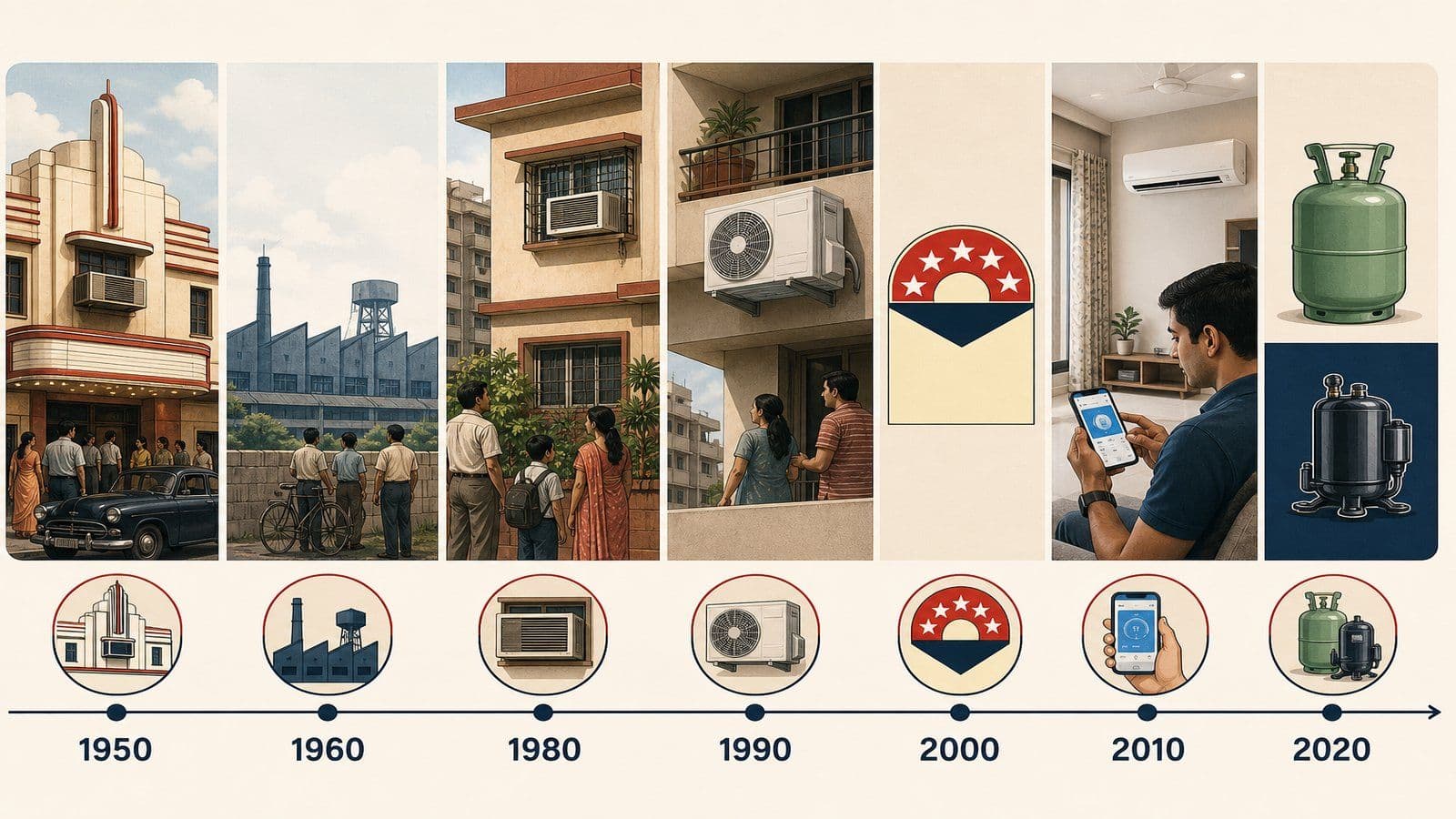
Deep dive: History of air conditioning in India traces how we went from a luxury for the top 1 percent in the 1990s to today's 13-million-units-a-year mainstream market.

Photo: India AC Market Snapshot 2026
Types of AC Units Used in Indian Homes
There are five AC types you will run into when you start shopping or comparing options. Across the 3,500-plus residential installations I have supervised in Mumbai and Pune, split units account for about 70 percent of what we install, window ACs another 22 percent, and cassette, tower, and portable variants making up the remaining 8 percent.
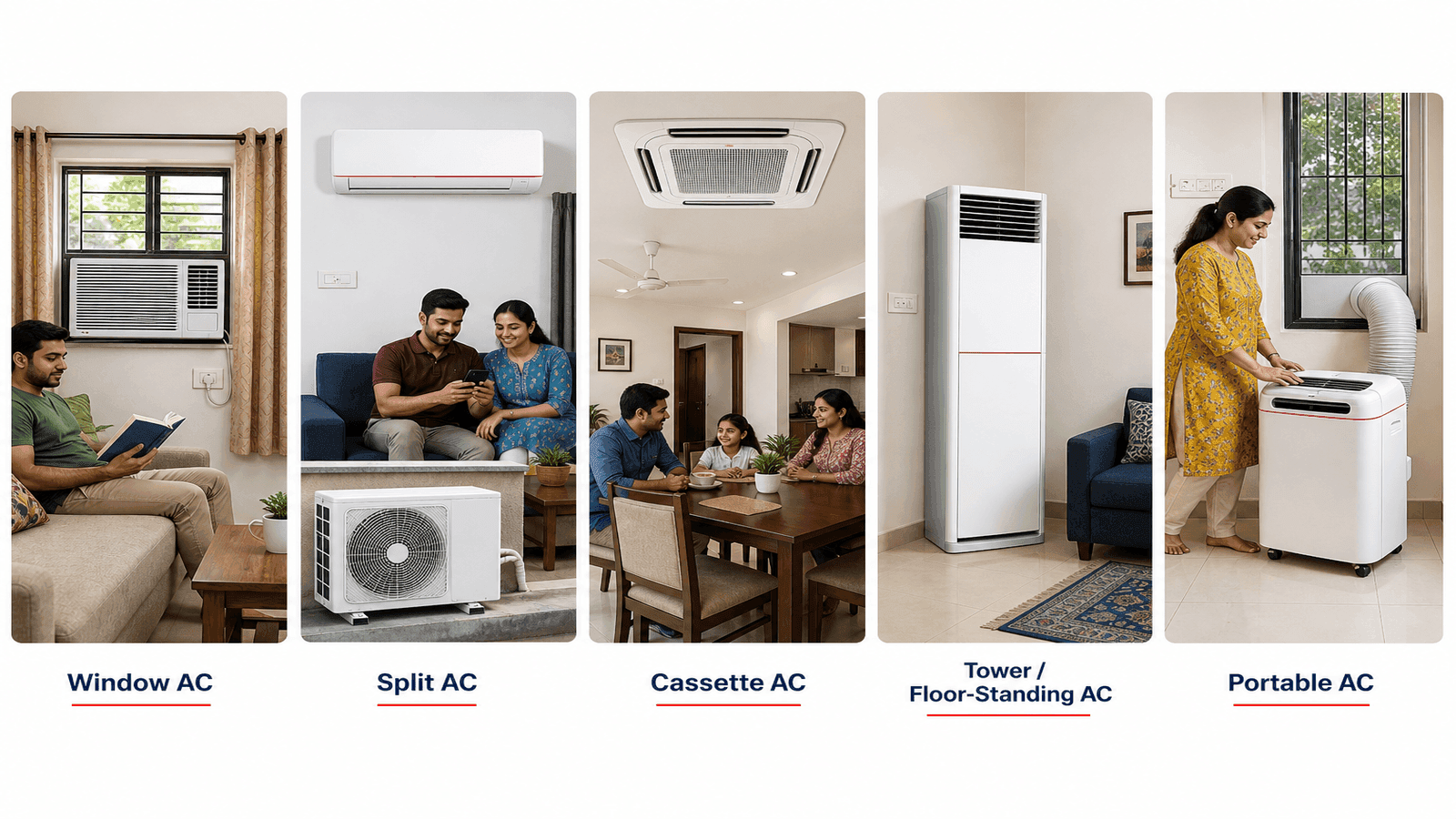
Photo: Five AC types compared
Window AC
A single rectangular unit that sits inside a wall opening or a window sleeve. Both the cooling components and the compressor live in the same box, with one side facing the room and the other facing outdoors. Best price band is ₹15,000 to ₹35,000. Suits small bedrooms (under 120 sq ft) and works well in homes that already have a window cut to the right size. Noise levels are higher than splits because the compressor is right there in the room, but installation is the simplest of any AC type. Stock options shrank significantly after the BEE 2026 revision, since many window models could not meet the stricter ISEER thresholds.
Split AC
The default choice in Indian apartments and villas today. An indoor blower unit mounts on a wall inside, connected via copper refrigerant lines to a separate outdoor condenser unit. Available in 0.8, 1, 1.5, 2, and 2.5 ton capacities. Price ranges from ₹28,000 at the entry tier to ₹85,000 for premium inverter models. The single biggest advantage over window units is acoustics, the compressor is outside so the room stays quiet. The catch is installation complexity, you need a competent technician for refrigerant handling, copper pipe sizing, and outdoor unit mounting.
Cassette AC
Ceiling-recessed unit with a flat front and four-way airflow louvres. Common in commercial spaces, restaurants, conference rooms, and larger villa living halls. Capacities start at 1.5 ton and go up to 4 ton. Installed prices land between ₹55,000 and ₹1.4 lakh depending on tonnage and brand tier. The 360-degree airflow gives more even cooling across a large open area than a wall-mounted split.
Tower or Floor-Standing AC
Vertical floor-mounted units, usually 2 ton or larger, intended for halls above 250 sq ft. They cost more than equivalent splits and consume more power, but they suit double-height living rooms or banquet-style spaces where wall mounting at the right height is impractical.
Portable AC
A wheeled standalone unit with a flexible exhaust hose that vents hot air out a window. No installation, no copper pipes, no outdoor unit. Capacities mostly cap at 1 ton. Useful for rented homes where landlord permission is uncertain, or as a stopgap during a summer when the main AC has failed. The trade-offs are real though, energy efficiency is much lower than a fixed split, noise is loud, and the exhaust hose itself loses cooling efficiency.
Inverter versus non-inverter
A separate axis that cuts across all the above types. An inverter AC has a variable-speed compressor that throttles up and down based on demand, instead of the older on-off cycling design. The result is steadier temperatures, lower noise, and electricity savings of 20 to 30 percent for typical Indian use patterns.
Deep dive: Types of AC Units Compared walks through each AC type's strengths, weaknesses, and best-fit room scenarios.
AC type quick comparison
| AC type | Best for | Capacity | Installed price (2026) | Noise inside room |
| Window AC | Small bedroom, existing window cut | 0.75 to 2 ton | ₹15,000 to ₹35,000 | High |
| Split AC | Apartment bedroom or living room | 0.8 to 2.5 ton | ₹28,000 to ₹85,000 | Low |
| Cassette AC | Open hall, restaurant, conference | 1.5 to 4 ton | ₹55,000 to ₹1,40,000 | Low |
| Tower AC | Double-height halls above 250 sq ft | 2 to 4 ton | ₹60,000 to ₹1,20,000 | Medium |
| Portable AC | Rented home, stopgap unit | 0.75 to 1 ton | ₹22,000 to ₹45,000 | High |
How an AC Actually Works
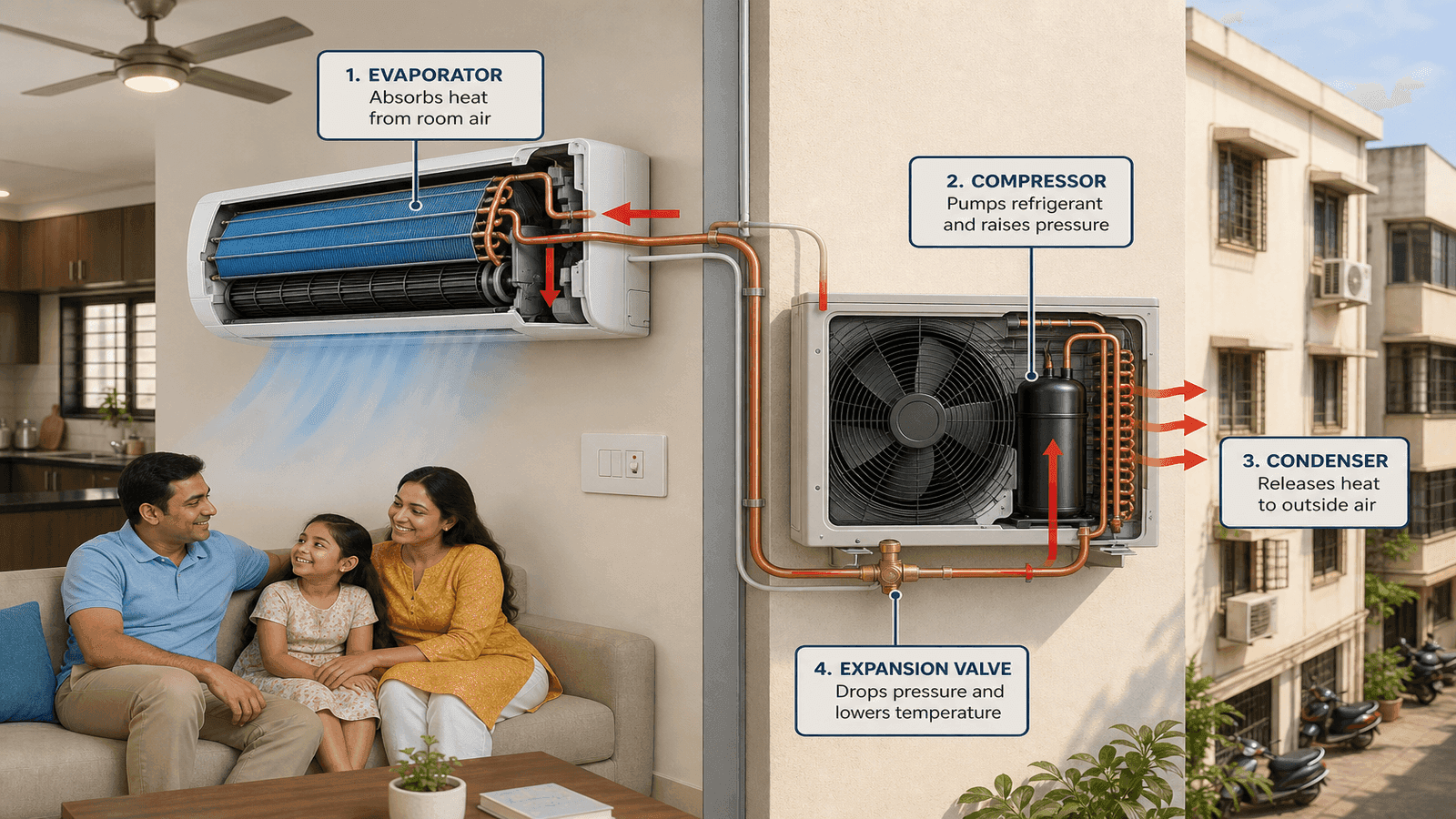
Photo: How an AC refrigerant cycle works
Most people think an AC creates cold air. It does not. What it actually does is move heat out of your room and dump it outside. The room gets cooler because the heat is being transported away, not because cold is being manufactured.
Four components do this work. The compressor (the loud part outside) pumps a refrigerant gas through the system. The condenser coil (also outside) releases the heat the gas is carrying into the outside air. The expansion valve drops the refrigerant pressure suddenly, which cools it dramatically. The evaporator coil (inside your room) absorbs heat from the room air as the cold refrigerant flows through it.
The refrigerant itself cycles round and round, picking up heat indoors, releasing it outdoors, then coming back. This is why your outdoor unit gets hot to the touch on a summer afternoon. It is doing exactly what it is supposed to do.
A note on refrigerant choice. The Indian market is in the middle of a transition from R410A to R32, driven by the MoEF&CC phase-down schedule under the Kigali Amendment. R32 is more thermodynamically efficient (you need less of it to cool the same room) and has a much lower global warming potential. Most ACs sold from 2024 onwards use R32. If you are buying new in 2026, R32 should be your default choice. Brand support and refill pricing favour it now.
Deep dive: How an AC works: system components breaks down each part with diagrams. If you want the full glossary of HVAC terms used in this guide, see the AC terminology glossary A-Z.
Get quotes from verified, top-rated AC Service & Repair pros in Delhi.
Decoding the BEE Star Rating in 2026
The BEE star rating is the single most useful piece of information on an AC label, and it changed materially in January 2026. If you bought your AC before then, the rating on the sticker no longer means what it used to. Here is what actually happened and what you should do about it.
What ISEER Actually Measures
ISEER stands for Indian Seasonal Energy Efficiency Ratio. It is the ratio of cooling output you get (in BTUs over the season) divided by the electricity you put in (in watt-hours), averaged across India's real annual temperature range. A higher ISEER means you get more cooling per unit of electricity, which translates directly to a lower bill.
The Bureau of Energy Efficiency revises the ISEER thresholds periodically as the market and technology improve. When a 5-star threshold goes up, the same physical AC that earned 5 stars last year might only earn 4 this year.
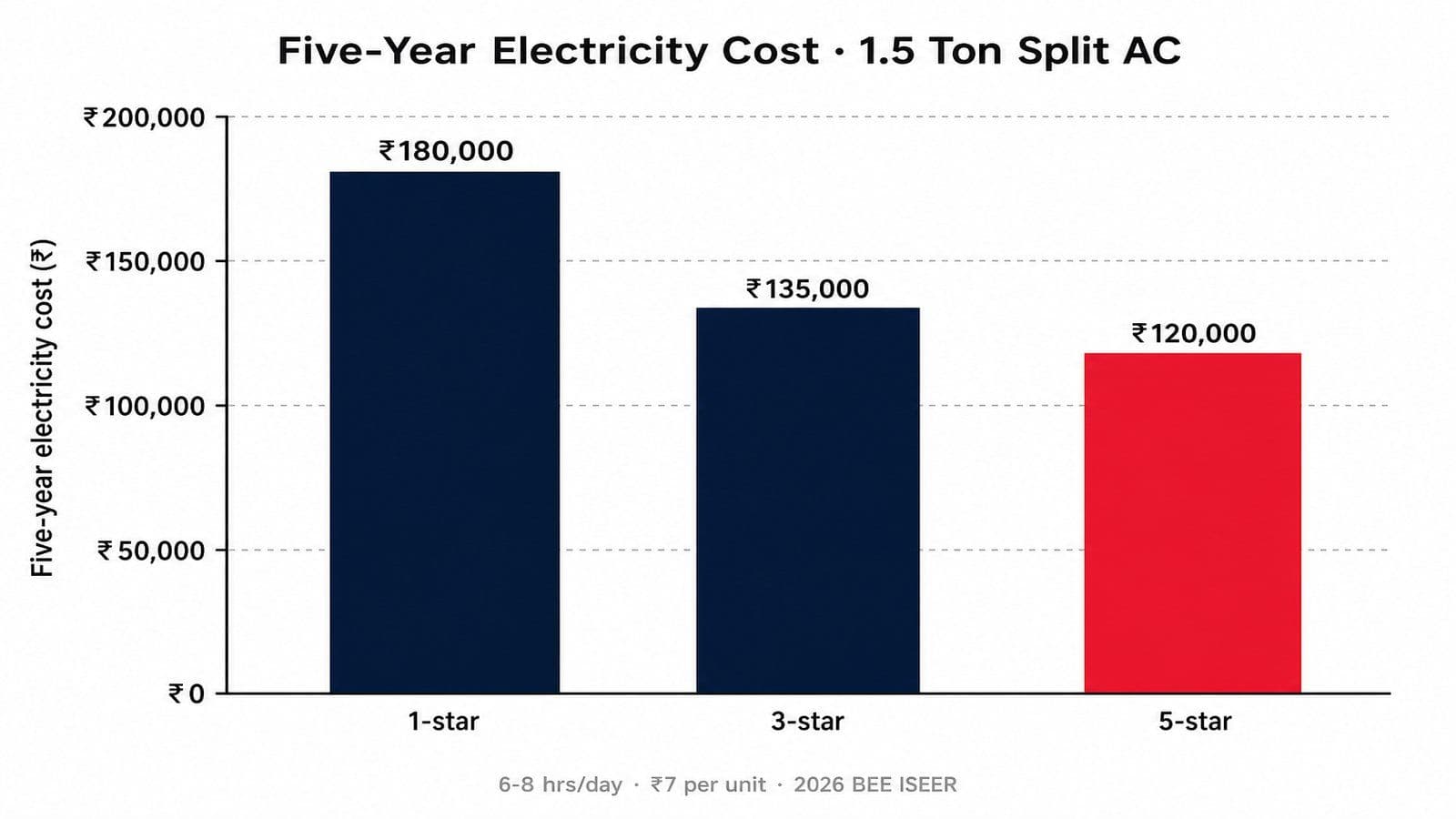
Photo: BEE star rating five-year electricity savings
The January 2026 Revision and What It Means for You
The January 2026 revision raised every threshold. A 5-star split AC now needs ISEER of at least 5.0, up from 4.5 in the previous schedule. The rating ladder effectively shifted down by one step:
- What used to be 5-star is now 4-star
- What used to be 4-star is now 3-star
- What used to be 3-star is now 2-star
So if you bought a 5-star inverter AC in late 2024 or 2025, it is still a good machine, but in 2026 terms it is a 4-star. The label on the unit does not change retroactively, but anyone comparing your AC against a 2026 model needs to do the mental translation.
For shoppers buying in 2026 and beyond, the practical implication is simple. Aim for 4-star or 5-star to lock in efficiency that will still feel relevant in 2028 when the next revision is expected. A 1-star or 2-star unit today will look ancient very quickly.
Real-World Savings Math
Here is the part that actually pays for itself. A 5-star inverter AC saves roughly ₹2,200 to ₹4,350 per year compared to a 3-star unit of the same capacity, assuming six to eight hours of daily use during the summer at the typical Indian residential tariff of ₹7 per kWh. The premium you pay for the 5-star unit at the showroom is usually ₹3,000 to ₹5,000.
Do the arithmetic. The premium recovers in two to three summers. Everything after that is pure savings, and most ACs run for 10 to 12 years.
Zoom out further and the BEE Star Labelling programme has improved 1-star split AC efficiency by 43 percent since launch, and 5-star units by 61 percent. This is not marketing language from a brand, it is government data from the Press Information Bureau measuring actual ISEER improvements over time. Customers who use AC six or more hours daily and skimp on star rating are quietly burning money every summer.
Six years of installs in Ahmedabad has taught me one rule. If your daily run-time is six hours or more, the 5-star inverter pays back in two summers and saves you another seven years of bills. The owners who push back on the ₹4,000 premium are the same ones who pay ₹18,000 in higher electricity bills over the unit's life. The maths is not close.

Deep dive: BEE star rating for AC explained and decoded walks through what each star label actually measures, how the January 2026 ISEER revision changed the thresholds, and why the same physical unit can now be a different star count.
Installation: What a Good Install Looks Like
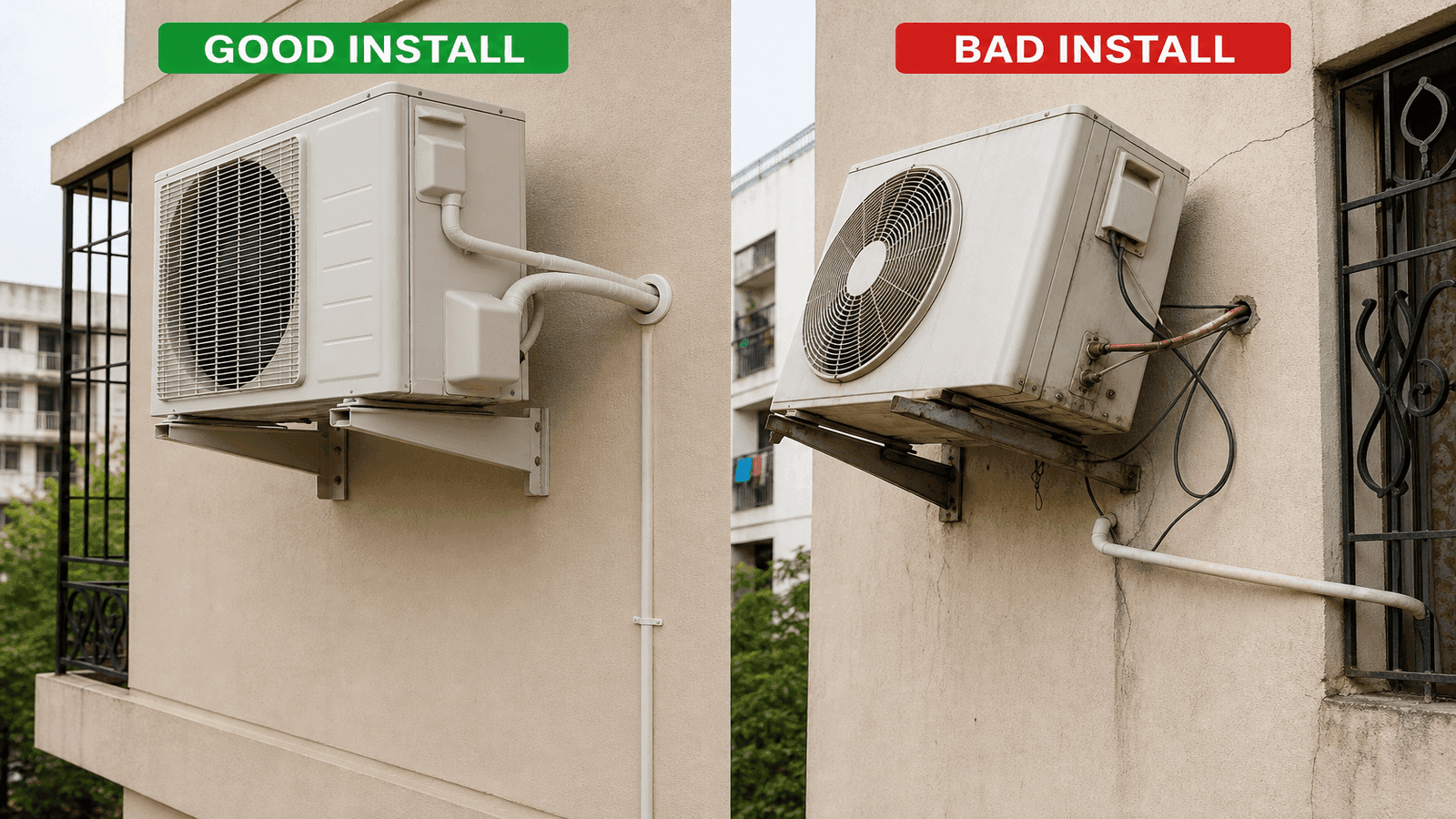
Photo: Good versus bad AC installation comparison
This is the section most owners wish they had read before paying their installer. A bad installation can cost you 15 to 20 percent of the AC's rated efficiency, and it is almost impossible to detect without knowing what to look for. Here is what to verify.
Copper pipe specs
A 1.5-ton split needs 1/4-inch suction line and 3/8-inch discharge line copper pipe, with insulation thickness of at least 9 millimetres. Shortcuts on either dimension show up as cooling loss six months later. Insist on the pipe gauge being printed on the wrapping when the installer brings materials.
Outdoor unit placement
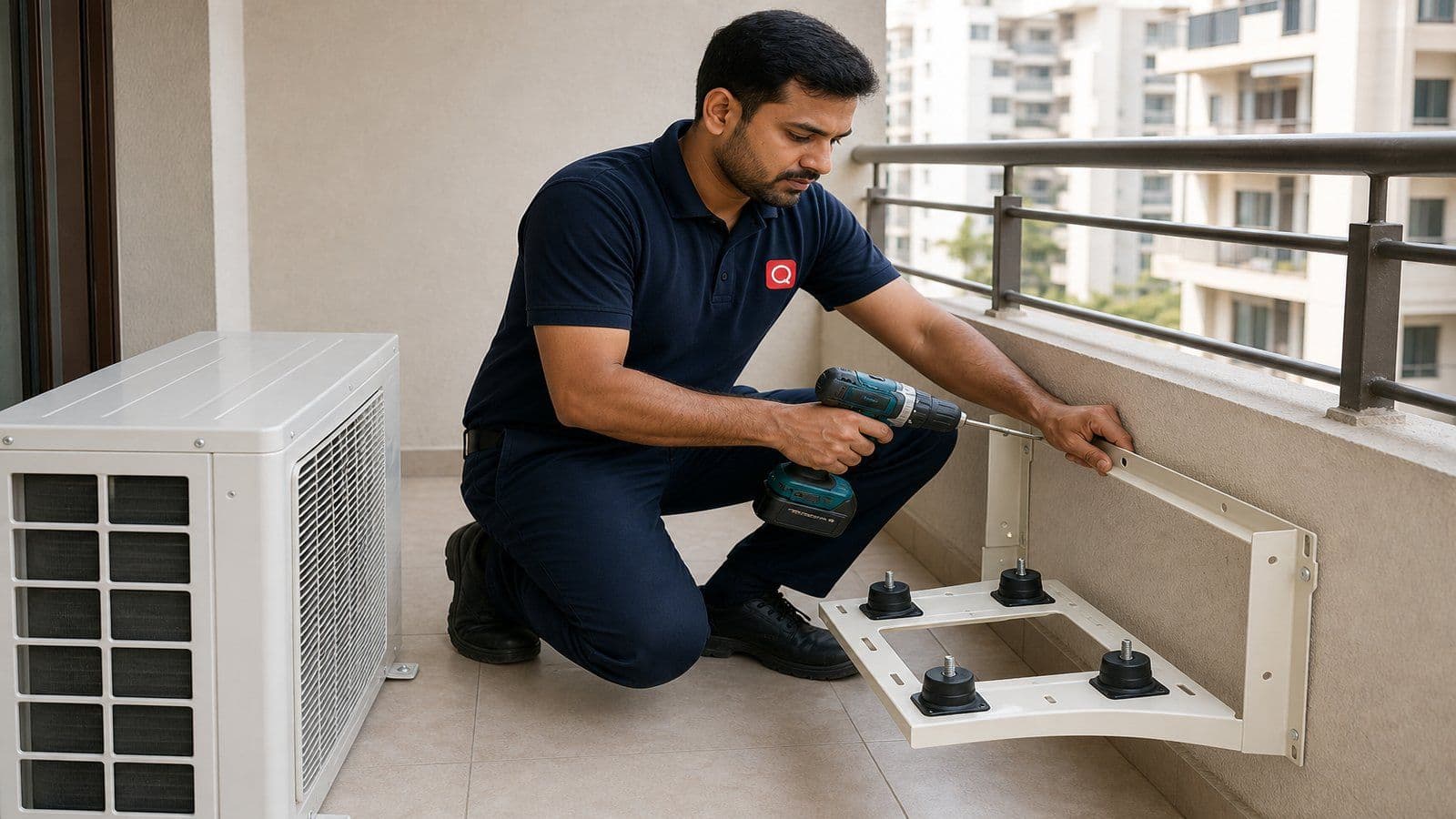
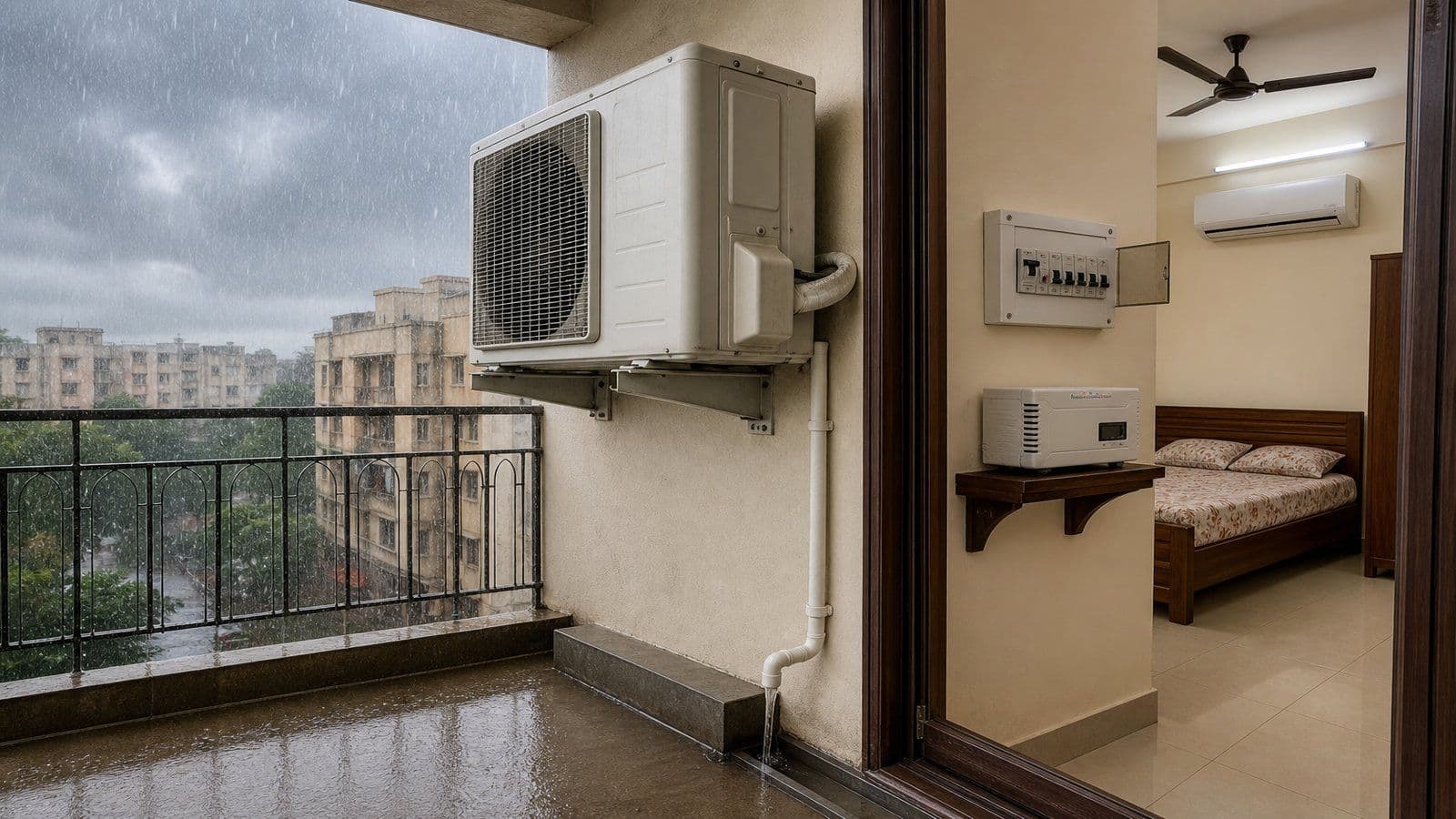
The condenser needs at least 30 centimetres of clearance on three sides for airflow. It should sit on a level mounting bracket or pad, ideally shaded from direct afternoon sun, and well above the monsoon water run-off line. We see a lot of outdoor units in Mumbai installed too close to the wall or in pockets where monsoon water collects, both of which shorten the unit's life considerably.
Get quotes from verified, top-rated AC Service & Repair pros in Delhi.
Tilt angle
The indoor unit must tilt about 3 degrees toward the drain side so condensate water flows out properly. The outdoor unit should sit perfectly level on its bracket. These are basic checks, but skipping them is the single most common cause of water leakage complaints in the first year.
Electrical setup
Your AC needs a dedicated MCB rated for its peak amperage, not a shared circuit with other appliances. Most older Indian apartments still see voltage fluctuations of 15 to 20 percent, so a voltage stabiliser is strongly recommended even for inverter models that have wider input tolerance.
What a bad install looks like
Exposed copper without insulation, undersized pipe (1/8-inch suction line is a classic shortcut), wiring run loose across walls without conduit, no drainage slope, outdoor unit mounted on a cheap angle iron bracket that vibrates when the compressor runs. If you see any of these on install day, do not pay the final invoice until they are fixed.
Day-of verification
Before the installer leaves, demand four things. A pressure leak test on the refrigerant lines. A cooling check (room temperature should drop 7 to 10 degrees Celsius from the supply air temperature). A drainage flow test with a glass of water poured into the indoor unit's tray. And all warranty documentation, brand registration, and the installer's own work warranty in writing.
Mr. Ramesh Pillai, a homeowner in Bandra West, learned this the hard way before our team took over his project. The previous installer had used undersized copper pipe and no surge protection. Over three summers Ramesh paid out ₹18,000 in repeated PCB repairs and gas top-ups before he understood what was actually wrong. We replaced the wiring, upgraded the copper, and added a stabiliser. He has now run two full summers without a single service call. The cost of doing it right the first time would have been about ₹4,500.
I have seen a 1.5-ton split lose 18 percent of its rated capacity simply because the outdoor unit was tilted two degrees off level. The compressor oil pools wrong, the bearing wears out three years early, and the owner blames the brand. None of that is the AC's fault. Spend 15 minutes verifying the bracket level with a spirit level on install day and you save yourself a ₹14,000 compressor replacement in year four.
Deep dive: Before any install day, also verify your technician's credentials. See AC technician certification in India for what NSDC and ITI labels actually mean and how to validate them.
Service & Maintenance Schedule for Indian Climate
The Indian climate is brutal on air conditioners. Coastal humidity rusts outdoor units. Inland summers push compressors to their thermal limits. Monsoon water finds every gap in the drainage and electrical work. The good news is that almost all of this is preventable on a predictable schedule.
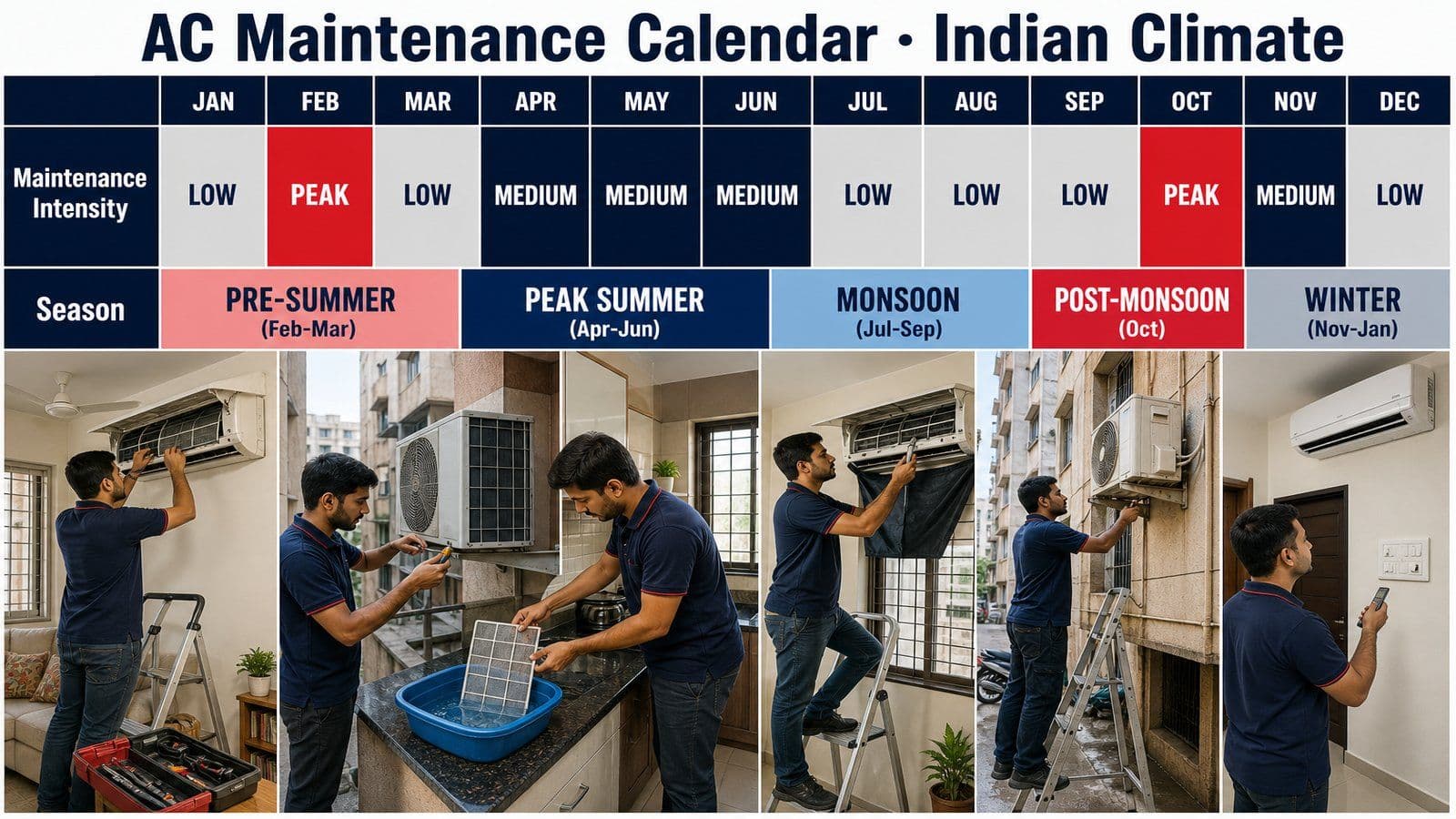
Photo: AC maintenance calendar for Indian climate
Pre-Summer Checkup (Feb to Apr)
This is the single most important service of the year. Book it before the heat arrives, ideally in February or early March, while technicians still have open slots. By April, every reputable service company in your city is overbooked.
What a proper pre-summer service covers. Filter wash and replacement if needed. Refrigerant pressure check (not a refill unless the pressure is genuinely low, more on this scam below). Electrical inspection including the capacitor, MCB, and stabiliser. Coil cleaning, both indoor evaporator and outdoor condenser. Drainage line flush. Functional check at multiple temperature settings.
Typical price: ₹400 to ₹800 per AC for a basic dry service, ₹800 to ₹1,500 for a deep wet service with jet wash.
Mid-Season Care (May to June)
This is mostly your job, not the technician's. Clean the filter yourself once a month, takes five minutes per AC, no tools needed. Run a quick check that condensate is draining properly. Listen for any new noises and address them early.
The verified AC technicians in our ProNearMe network report that roughly 62 percent of mid-summer breakdowns trace back to dirty filters that should have been cleaned weeks earlier. A monthly filter wash is the cheapest, simplest habit that extends AC life by years.
Post-Monsoon Recovery (Oct)
After the monsoon, your outdoor unit has spent three to four months exposed to rain, humidity, and in coastal cities, salt-laden air. The October service is where you catch problems before they compound into expensive failures over the next year.
A proper post-monsoon service includes corrosion inspection of the outdoor unit (especially the condenser fins and the chassis bolts), drainage pipe cleaning since algae and silt build up over the wet season, electrical re-inspection because moisture often degrades wiring connections, and an anti-rust treatment on exposed metal parts where corrosion has started.
Typical price: ₹500 to ₹1,200 per AC.
Annual Deep Clean
Once a year, ideally aligned with either the pre-summer or post-monsoon service, your AC needs a proper deep clean. Jet wash of both coils, coil descaling if you have hard water in your area, blower wheel cleaning, antibacterial spray of the indoor unit, and a comprehensive electrical safety check.
Typical price: ₹800 to ₹1,500 per AC.
If you live in Mumbai, Chennai, Visakhapatnam, or any other coastal city, take this seriously. Outdoor unit corrosion can knock three to four years off your AC's lifespan if you ignore it.
62 percent of the mid-summer no-cooling calls I have responded to since 2020 trace back to a single skipped pre-summer service. February to April is the only window that matters. If you wait until the unit fails in May, you are paying emergency rates, sitting in a hot house for two days, and competing with every other AC owner in your area for a technician. Booking a ₹800 service in February is the cheapest insurance you can buy.
Deep dive: Clean filters and a well-maintained indoor coil also protect the air you breathe. See indoor air quality and AC health impact for what a neglected unit does to PM2.5 and humidity inside your home.
Get quotes from verified, top-rated AC Service & Repair pros in Delhi.
The 15 Most Common AC Problems
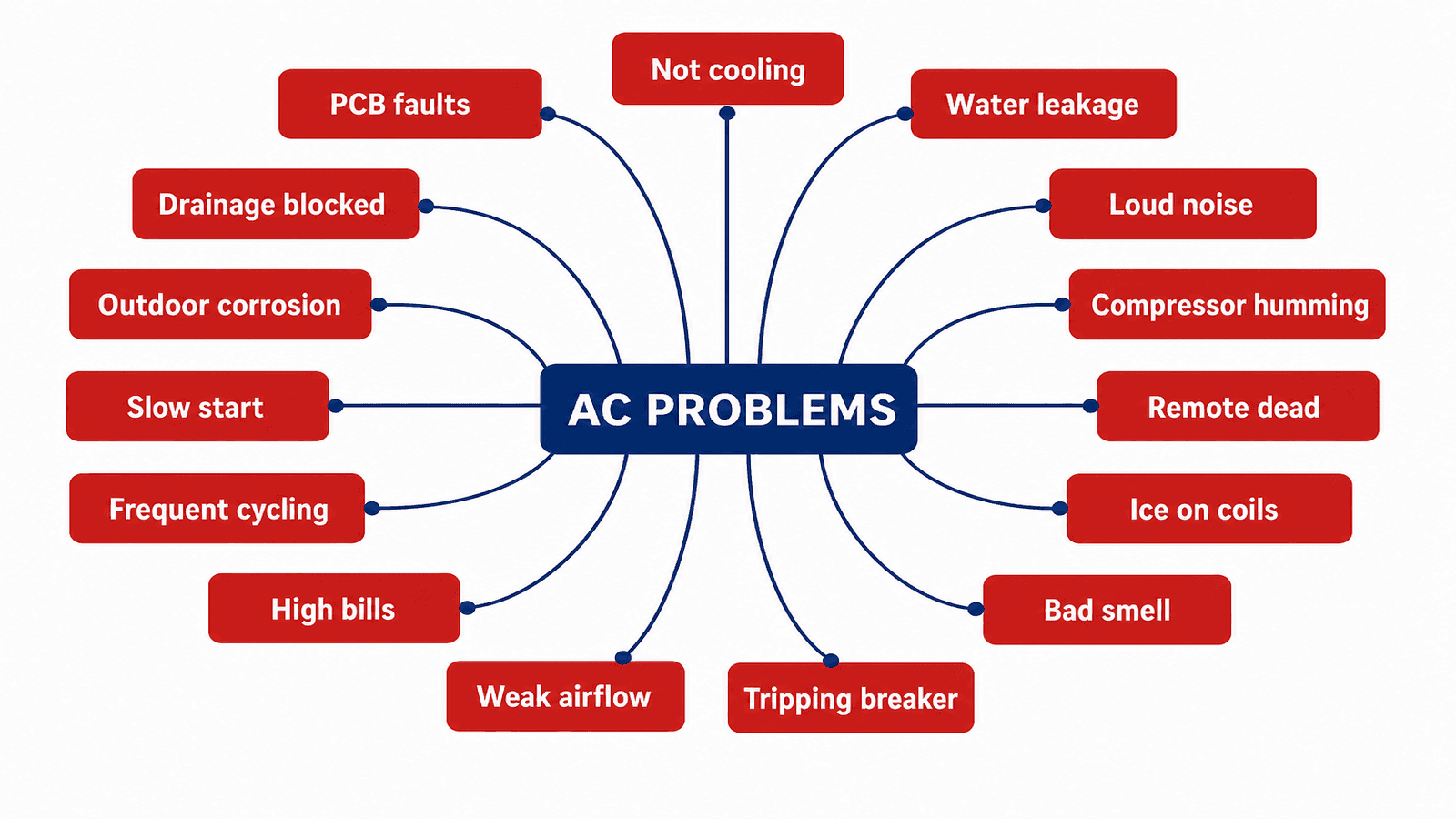
Photo: Fifteen common AC problems mind map
These are the issues we see across the ProNearMe network most often. Each one has a dedicated diagnosis and fix guide in our AC Repair Faults & Diagnosis hub.
- AC running but not cooling
- Water leaking from the indoor unit
- Loud noise from the indoor or outdoor unit
- Compressor humming, tripping, or refusing to start
- Remote not responding or pairing issues
- Ice formation on the evaporator coil
- Musty or chemical smell when the AC runs
- AC tripping the MCB or circuit breaker
- Weak airflow even at maximum fan speed
- Electricity bills suddenly spiking
- Frequent on-off cycling without reaching set temperature
- Slow start or delayed cooling when switched on
- Outdoor unit corrosion after monsoon
- Drainage line blockage causing water backup
- PCB faults causing erratic behaviour or display errors
Each of these has a specific cause, a typical fix, and a reasonable price band.
Deep dive: Common AC problems: top 15 issues and symptoms covers each fault's cause, fix, and typical price band in a single reference.
Repair vs Replace: The 50% Rule
This is the question every AC owner faces eventually. Your unit is acting up, the technician quotes you a repair amount, and you have to decide whether to spend the money or buy new. Use this rule.
If the repair quote exceeds 50 percent of the price of a comparable new AC, AND the unit is older than 8 years, replace it. Below either threshold, repair usually wins.
There are three reasons the rule works. First, ACs older than eight years have most of their wear ahead of them, so a single big repair often signals more on the way. Second, pre-2018 non-inverter ACs consume 1.5 to 2 times the electricity of a current 5-star inverter at the same tonnage, so the replacement pays for itself in electricity savings within four to six years. Third, the compressor warranty on most ACs ends between year 5 and year 10. Out-of-warranty compressor replacement runs ₹15,000 to ₹25,000, often more than half the price of a new entry-tier 1.5 ton split. At that point the math swings hard toward replacement.
One nuance for inverter ACs. If your inverter compressor fails out of warranty but the unit is under six years old, replacement is usually NOT the answer, since inverter compressor swaps cost less proportionally and the rest of the unit (PCB, coils, fans) still has good life left. Get a second quote before paying anyone.
Deep dive:AC buying decisions: 30 frequently asked questions covers the repair-vs-replace question alongside every other major AC buying-stage decision Indian owners face.
Choosing a Technician: 8-Point Checklist
You have called a number from a flyer, a friend's recommendation, or your housing society's WhatsApp group. Before you let anyone touch your AC, run through these eight checks. They take five minutes and they will save you a lot of grief.
- NSDC Mechanic-RAC certification or ITI Refrigeration & Air Conditioning trade certificate. Ask to see it. A genuine technician will not hesitate, and you can verify the NSDC registration number online if you want to.
- Brand-authorised credential when the work involves a unit still under brand warranty. Unauthorised service voids the warranty in most cases, so this matters even for routine annual service.
- Itemised written quote before any work starts. Should break out parts, labour, and GST separately. Verbal quotes that change after the work is done are the single biggest source of complaints we hear.
- Pre-work diagnosis with you watching. A trustworthy technician explains what they have found, shows you the failed component if possible, and gets your approval before doing anything beyond the diagnostic.
- Genuine spare parts with the original packaging and bill. Compatible generic parts can be 40 to 60 percent cheaper but routinely fail within months. If a technician pushes you toward generic, ask for both prices in writing and you decide.
- Warranty on work. Minimum 30 days on routine repairs, 90 days on significant repairs like PCB or capacitor replacement, and one year on full installations. Get this in writing on the invoice.
- References or online verification. A good technician has reviewable work history, either through aggregator platforms (with itemised reviews, not five-star strings), or referrals from people you can actually call.
- Insurance and liability cover for any installation work in a multi-storey building. Outdoor unit drops do happen, and you do not want to be liable for property damage to the flat below yours.
I have a personal rule on this. I would not hire a technician who fails any two of these eight checks. The first failure can sometimes be explained, two failures means the operation is not professional enough to trust with your equipment.
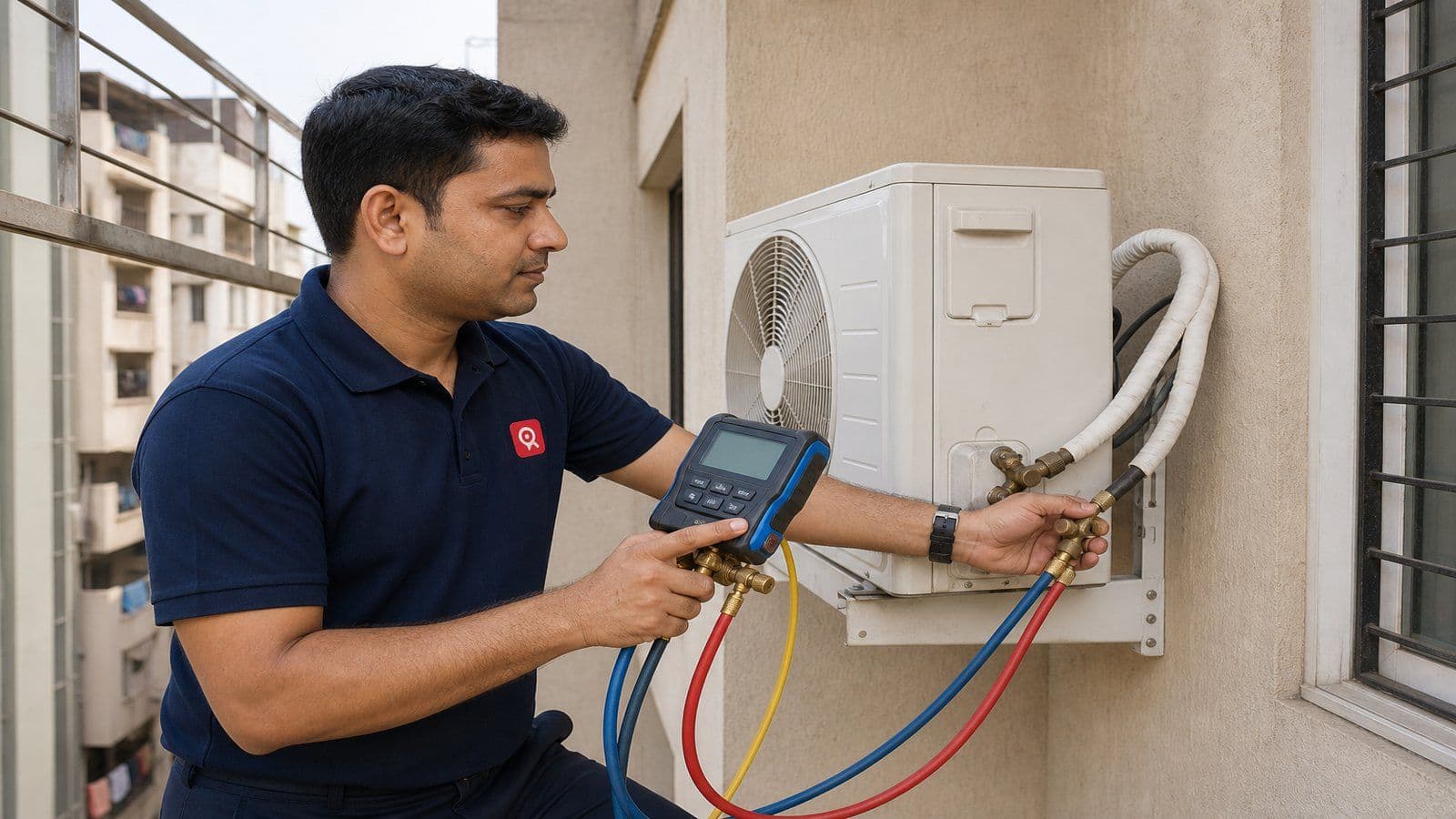
The single biggest red flag is the technician who diagnoses your fault from the door without opening the unit. Real diagnosis needs a clamp meter on the compressor draw, a manifold gauge on the refrigerant pressure, and an infrared thermometer on the supply air. That takes 20 minutes minimum. If the verdict arrives in two minutes, the verdict is wrong and the bill will be inflated. Walk away. The good technicians in our ProNearMe network never quote without measuring.
Deep dive: AC technician certification in India: NSDC and ITI guide covers exactly which certificates a real technician should be carrying and how to verify them on the spot.
Cost Bands for Indian Homes (2026)
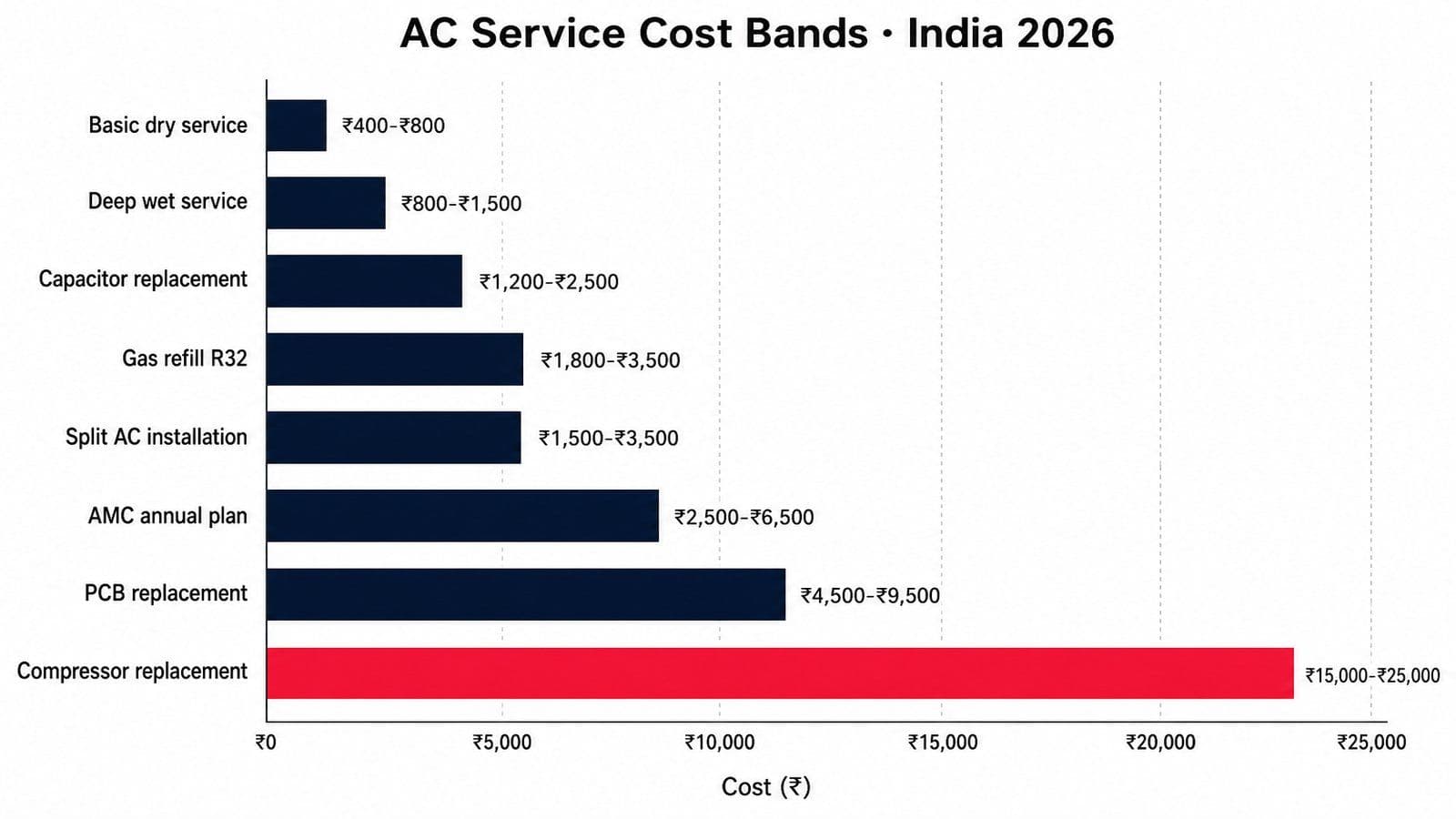
Photo: AC service cost bands India 2026
These are the typical price ranges across India in 2026. Tier-1 metros tend to sit at the higher end, tier-2 and tier-3 cities at the lower end, and authorised brand service centres are generally 20 to 30 percent more expensive than reputable independent technicians for the same work.
| Service item | Typical range (2026) |
| Basic dry service per visit | ₹400 to ₹800 |
| Deep wet service with jet wash | ₹800 to ₹1,500 |
| Gas refill (R32) | ₹1,800 to ₹3,500 |
| Gas refill (R410A) | ₹2,200 to ₹4,000 |
| Capacitor replacement | ₹600 to ₹1,200 (part) + labour |
| Compressor repair (in-warranty parts, labour billed) | ₹3,000 to ₹6,500 |
| Compressor replacement (out-of-warranty, full cost) | ₹15,000 to ₹25,000 |
| PCB replacement | ₹4,500 to ₹9,500 |
| Split AC installation (labour only, with copper) | ₹1,500 to ₹3,500 |
| Window AC installation | ₹800 to ₹1,800 |
| Annual AMC plan per AC, basic tier | ₹2,500 to ₹4,000 |
| Annual AMC plan per AC, comprehensive tier | ₹4,500 to ₹6,500 |
Brand-specific pricing varies meaningfully across Daikin, Voltas, LG, Blue Star, Lloyd, Carrier, and Hitachi.
Deep dive: AC industry trends India 2026: what's changing tracks the brand-level pricing shifts, the R32 transition impact on refill costs, and the dispatch policy changes affecting service rates this year.
Conclusion
Owning an AC in India in 2026 is fundamentally a long-term decision, not a one-time purchase. The unit itself is maybe 40 percent of the lifetime cost. The other 60 percent is installation quality, seasonal maintenance, electricity tariff exposure, and the technician you trust over the years.
The owners who get the most out of their ACs share three habits. They pick a 4-star or 5-star inverter from a brand with a real service network in their city. They book pre-summer and post-monsoon service every year without fail. And they verify their technician's credentials before the work starts, not after the AC has been opened up. None of these habits is expensive, but together they account for the difference between an AC that lasts 7 years and one that lasts 12.
Disclaimer
The cost ranges and service intervals in this guide reflect typical Indian-market data as of May 2026. Actual prices vary by city, AC capacity, brand, GST treatment, and the individual technician. Always obtain an itemised written quote with parts, labour, and GST shown separately before authorising any AC repair, installation, or annual maintenance contract. For decisions specific to your unit and home, consult a licensed AC technician with NSDC Mechanic-RAC certification. ProNearMe does not endorse specific brands; brand mentions in this article are illustrative of the Indian market context and reflect typical buyer-side considerations, not partnerships or affiliations.
Sources & References
- Statista, India Air Conditioners market revenue and unit forecast 2026
- The Hindu Business Line, Voltas crosses 2 million AC units milestone in FY24, industry coverage
- Bureau of Energy Efficiency (BEE), Revised ISEER thresholds notification effective January 2026
- BEE, Insights from the 2024 Household Survey on Residential Energy (published May 2026)
- Bureau of Energy Efficiency, AC star rating savings calculator and methodology
- Press Information Bureau (PIB), Government's Star Labelling Programme efficiency improvements: split AC by 43 percent at 1-star and 61 percent at 5-star
- Indian Society of Heating, Refrigerating and Air Conditioning Engineers (ISHRAE), COOL Conclave 2025 industry presentations and brand participation data
- MoEF&CC (Ministry of Environment, Forest and Climate Change), Refrigerant phase-down schedule under the Kigali Amendment, R410A to R32 transition
- Central Electricity Authority (CEA), Indian residential electricity tariff bands and average per-unit costs by state
- National Skill Development Corporation (NSDC), Mechanic-RAC (Refrigeration and Air Conditioning) certification framework and registry
- National Building Code of India (NBC 2016), Part 8 on Building Services and Part 4 on Fire and Life Safety, installation provisions for residential air conditioning systems
Amit worked as an AC technician for 6 years in Ahmedabad before transitioning to technical writing. He holds a diploma in Refrigeration and Air Conditioning from ITI Ahmedabad and understands the difference between what AC companies promise and what actually happens on the ground. His articles break down complex technical topics into plain language that any homeowner can follow. He tests every tip he writes about in his own home first.

Dr. Verma is a mechanical engineer with 15 years of experience in HVAC systems. She completed her PhD from IIT Delhi on energy-efficient cooling solutions for Indian residential buildings. She reviews all technical content on HomePros to make sure the numbers are right, the advice is safe, and the recommendations are backed by actual engineering principles. She consults for multiple AC manufacturers on product design.