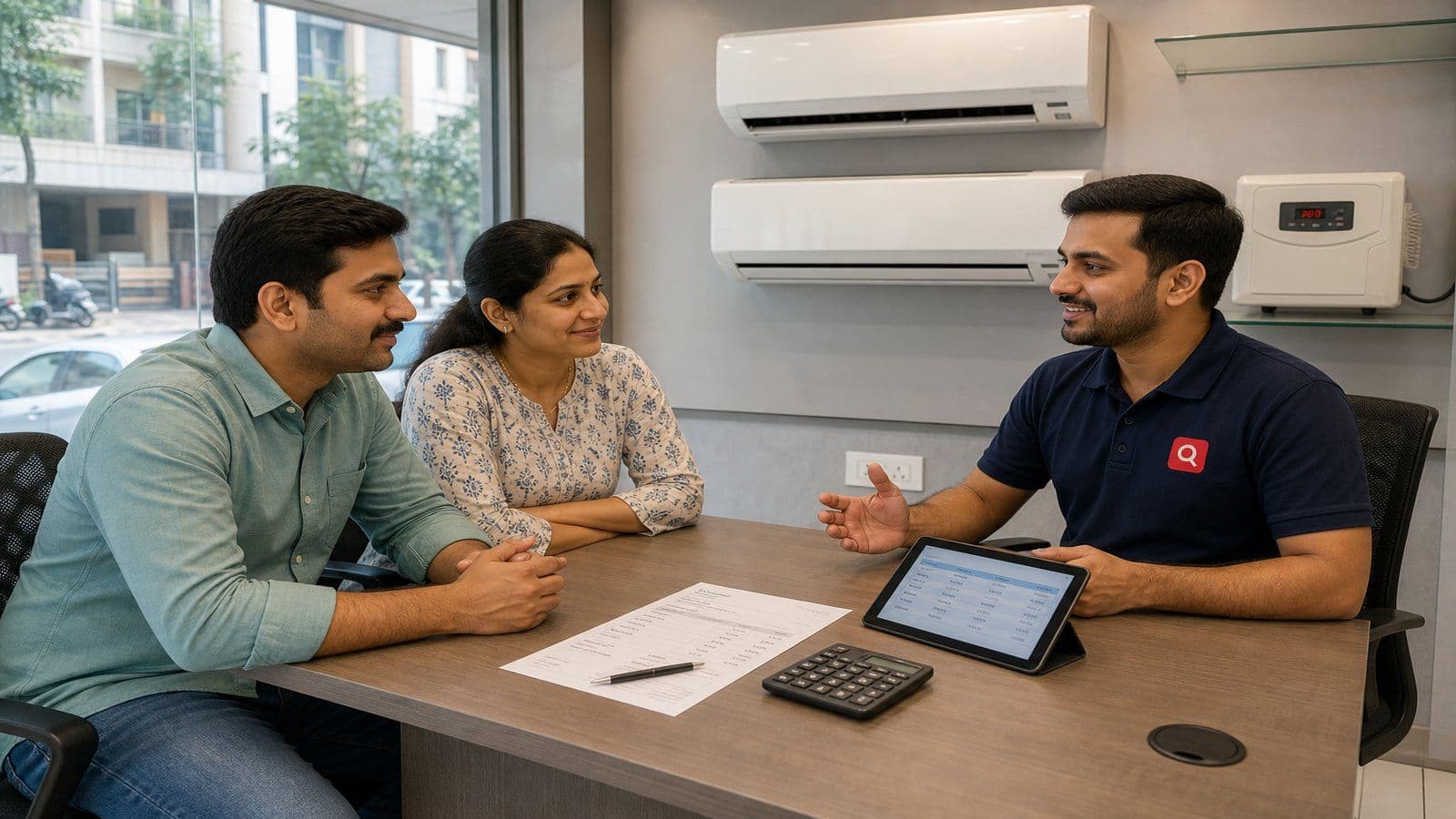
- The ProNearMe verified AC technicians who handle our installation calls report that 64 percent of site surveys uncover at least one placement issue the homeowner had not considered, most often inadequate rear clearance or shared-bracket vibration coupling with a neighbour unit.
- BIS IS 1391 minimum service clearances for residential split AC outdoor units are 0.5 metre on each side, 1 metre at the front (fan discharge), and 0.3 metre at the rear coil intake. Violating any one of these voids the OEM warranty on most major Indian brands.
- Standard refrigerant charge supplied with new split ACs covers a pipe run of up to 15 metres between indoor and outdoor units. Beyond 15 metres the technician must add gas at roughly 25 grammes per extra metre, and beyond 30 metres a larger compressor or staged install is needed.
- Vibration mounts (rubber or anti-vibration spring) on a wall-bracket install cost ₹350 to ₹650 per set and prevent 80 to 90 percent of the noise transfer that triggers RWA complaints. They are the cheapest insurance policy in the entire install.
- Relocating an existing outdoor unit costs ₹2,800 to ₹6,500 in 2026 including new bracket, copper extension and refrigerant top-up, and pays back within two summers if the original location was a clearance violator.
Split AC outdoor unit placement is the single most overlooked installation decision in Indian homes. The outdoor unit is the half of your split AC nobody looks at, and that is the problem. It sits on a balcony parapet, a wall bracket, or a roof slab, often for 10 years, and the spot it lives in decides almost everything about how the AC performs.
A unit placed in a recessed alcove with poor rear airflow can lose 18 to 22 percent of its rated cooling output by year three. A unit bolted to a flimsy bracket transfers vibration into the wall and triggers neighbour complaints in two summers. A unit installed 18 metres from the indoor head with the wrong copper sizing runs short on refrigerant charge by month six. Placement is not cosmetic. It is the single biggest installation decision that affects long-term running cost.
Amit has spent 14 years across 2,800+ service calls in Mumbai, Pune and Hyderabad, and roughly one in five calls trace back to a placement mistake made on day one of installation. The Bureau of Indian Standards (BIS) publishes clearance and mounting requirements under IS 1391, the Bureau of Energy Efficiency (BEE) ties star-label efficiency claims to those clearances being met, and most RWA (Resident Welfare Association) bye-laws now reference both.
Yet our ProNearMe verified AC technicians find that 64 percent of pre-installation site surveys flag at least one placement issue the homeowner did not anticipate. This guide walks through the six placement rules, the apartment and villa specifics, the warranty-voiding mistakes, and what relocation costs if you got it wrong the first time. For the broader installation context see the parent pillar on AC installation complete guide India.

Get quotes from verified, top-rated AC Service & Repair pros in Delhi.
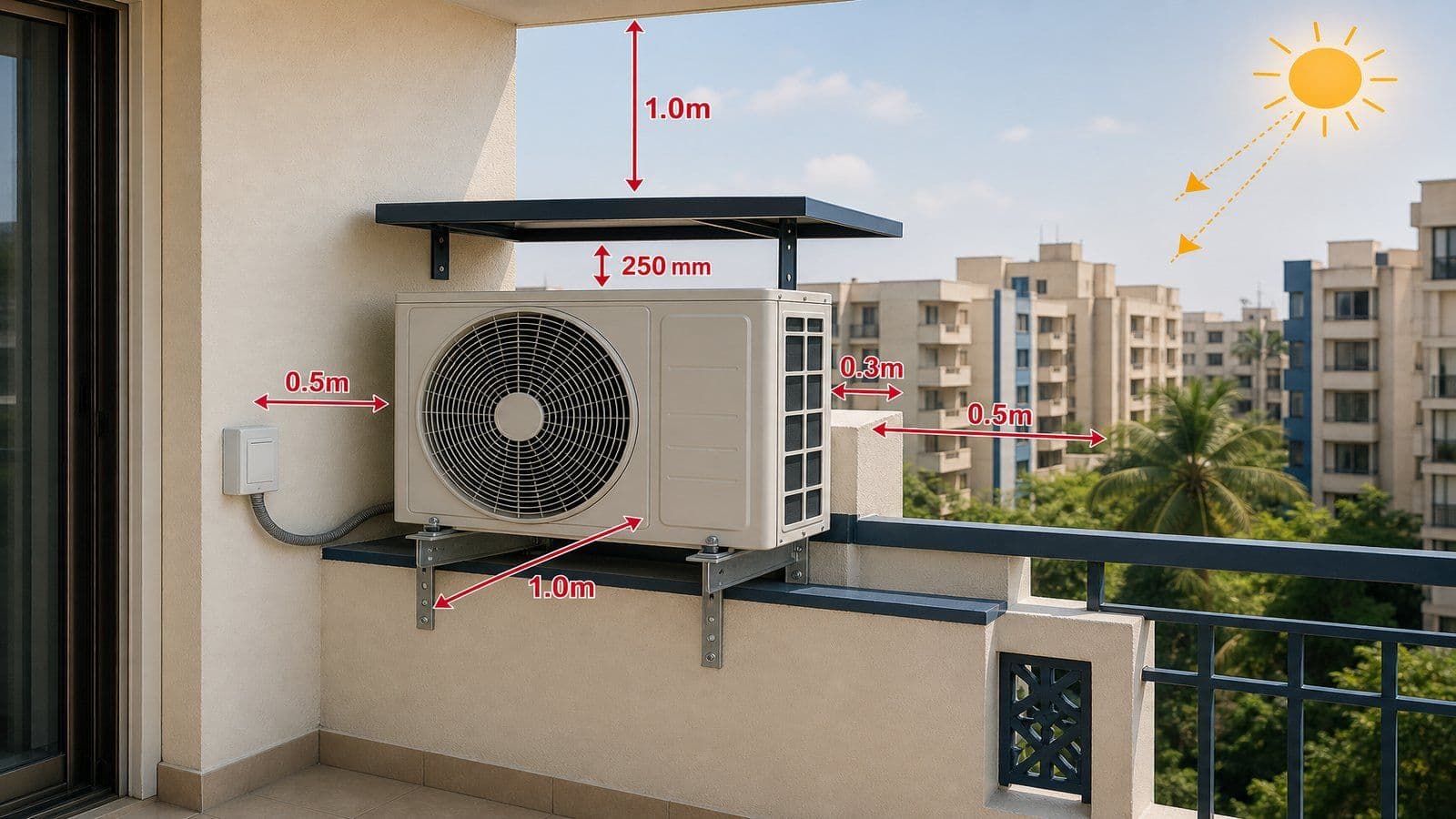
Photo: Outdoor unit clearance and sun-angle diagram
Why Outdoor Unit Placement Matters
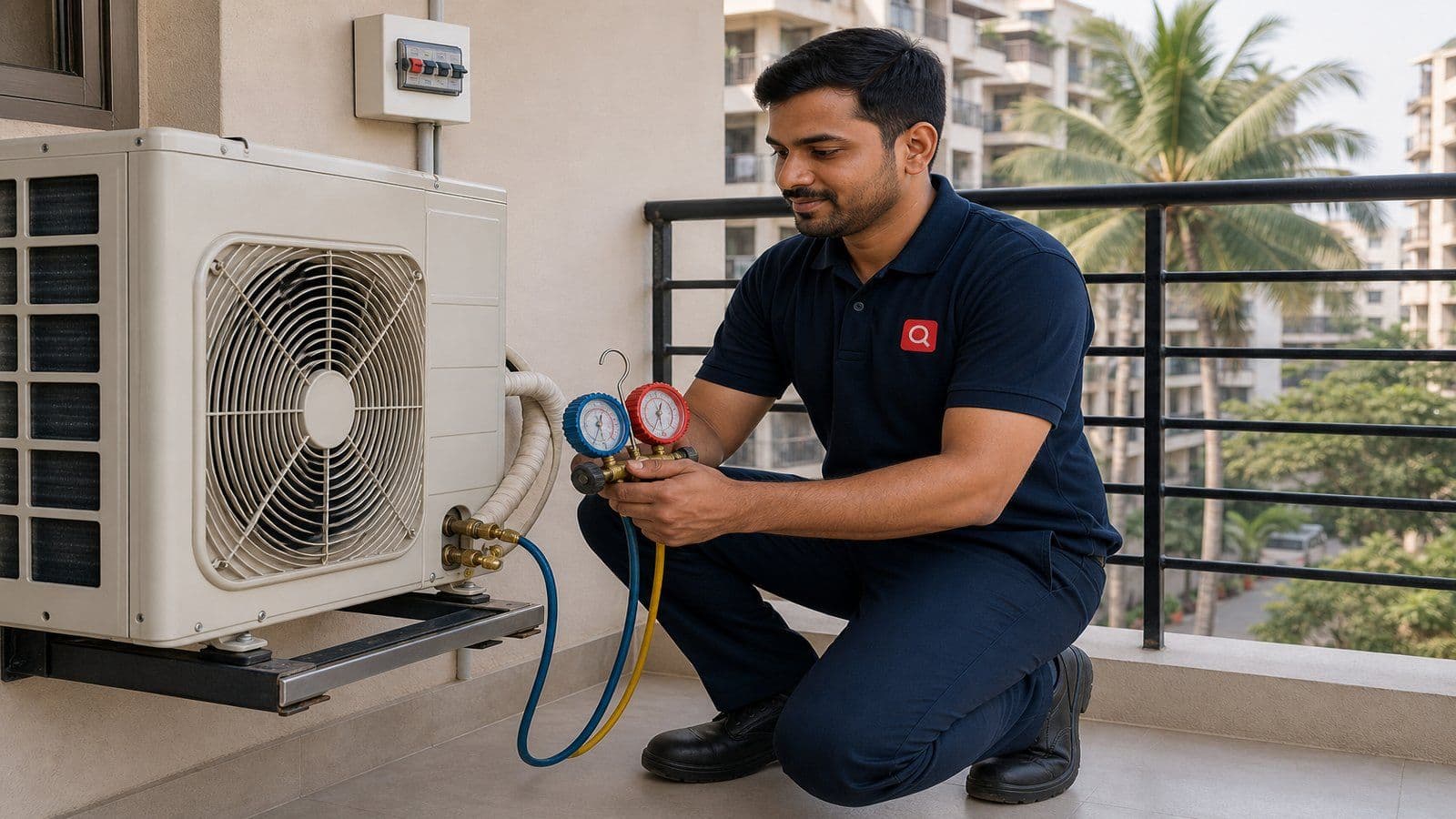
The outdoor unit's job is to reject heat. The condenser coil at the rear of the unit pulls in ambient air, the refrigerant inside dumps the heat it absorbed indoors, and the front fan discharges the now-hot air away from the unit. The whole cycle depends on three things: enough unobstructed air to pull through the coil, somewhere for the discharged hot air to go without being recirculated, and a stable mounting that does not transmit compressor vibration into the building structure.
When any of these three fail, the symptoms appear slowly and look like other faults. Reduced ambient airflow forces the compressor to work harder for the same cooling, which raises power consumption by 12 to 18 percent and shortens compressor life by two to four years. Hot air recirculation, where the discharged front-fan air loops back into the rear coil, can drop nameplate cooling capacity by 20 to 30 percent on a hot afternoon. Vibration transmitted into a poorly-mounted bracket causes hairline copper fatigue cracks at the flare joints, which present as slow refrigerant leaks 18 to 30 months after install.
The Press Information Bureau's energy advisories and BEE star-label test conditions both assume the outdoor unit has the clearances specified by IS 1391. Star ratings are not honoured if the install does not. So a 5-star inverter installed in a recessed alcove with 100 mm rear clearance performs closer to a 3-star unit in real running conditions, and the owner pays the higher electricity bill for the next decade.
The Six Placement Rules
The rules below are the same checklist a trained technician runs through on a pre-install site survey. They are sequenced by priority. Rule 1 is non-negotiable. Rules 2 to 6 trade off against each other within site constraints, but every compromise has a known efficiency cost.
Rule 1: Ventilation Clearance
The single most important rule, and the most frequently violated. BIS IS 1391 specifies the following minimum service clearances for a residential split AC outdoor unit:
- 0.5 metre on each side (for service access and to prevent side-grille obstruction)
- 1 metre at the front (so the discharged hot air has room to disperse without recirculating)
- 0.3 metre at the rear (so the condenser coil can pull in unobstructed ambient air)
- 1 metre overhead clearance, or use a shade hood if installing under a balcony slab
These are minimums. OEM installation manuals from major Indian brands typically recommend an extra 100 to 200 mm on each dimension for newer high-efficiency units that move more air. If the site does not allow the minimum, the unit should not be installed there. There is no honest workaround.
The single most common violation we see is a unit shoved into a recessed balcony alcove with rear clearance of 50 to 100 mm. The coil starves for air, the high-pressure cut-out trips every 20 minutes once outdoor temperatures cross 40 degrees, and the homeowner blames "low gas" when the actual fault is the alcove.
Rule 2: Sunlight Exposure
Direct south or west sunlight on the outdoor unit during peak afternoon hours raises the unit's ambient operating temperature by 6 to 10 degrees above the surrounding shade temperature. This forces the compressor to reject heat into hotter air, dropping efficiency.
The ideal placement is on a north or east facing wall, or under a permanent shade structure. Where this is not possible, a shade hood made from powder-coated steel sheet, mounted 200 to 300 mm above the unit with full airflow gaps on all sides, restores roughly 70 percent of the lost efficiency. Shade hoods cost ₹1,200 to ₹2,400 in 2026 and are a worthwhile addition on any south or west facing install in cities like Jaipur, Ahmedabad, Hyderabad and Chennai where summer ambient routinely exceeds 42 degrees.
Do not enclose the unit. A common mistake is to build a louvred cabinet around the outdoor unit "for looks". This blocks airflow and traps heat, the worst of both worlds.
On every west-facing balcony install in Mumbai and Pune I now recommend a basic shade hood as standard. The owners initially baulk at the ₹1,800 add-on, then I show them the comparative pressure readings from a shaded versus unshaded install in the same building, same brand, same tonnage. The unshaded unit is running 25 to 30 psi higher head pressure on a 43 degree afternoon. That is the kind of stress that takes three years off compressor life. The ₹1,800 hood pays for itself in efficiency alone within 18 months.

> Amit Patel, HVAC and Cooling Specialist, ProNearMe network (14 years, 2,800+ service calls)
Rule 3: Pipe Distance Between Indoor and Outdoor
Standard refrigerant charge supplied with a new residential split AC covers an interconnect pipe run of up to 15 metres total length. The shorter the run, the better the system performs. Refrigerant has to travel further on longer runs, pressure drop increases, and oil return to the compressor becomes more difficult.
If your indoor and outdoor positions force a run beyond 15 metres, the installer must add refrigerant at approximately 25 grammes per additional metre (the exact figure is specified by the OEM in the installation manual). This is a routine technician task but it must be quantified, not eyeballed. Beyond 30 metres total run, OEMs typically require a higher-capacity compressor variant or a staged install, both of which sharply increase cost.
The other dimension that matters is the vertical drop. If the outdoor unit sits below the indoor unit (the typical apartment configuration), gravity helps oil return to the compressor and the system runs comfortably. If the outdoor unit must sit above the indoor unit (some villa rooftop installs), the vertical lift should not exceed 5 metres without an oil trap installed in the suction line.
For the technical specification of pipe sizing and length compensation, see AC copper pipe specifications and sizing.
Rule 4: Vertical Position and Drainage
For most installs in Indian apartments, the outdoor unit will sit below the indoor unit by 2 to 4 metres. This is ideal for two reasons: gravity assists oil return through the suction line, and condensate water from the indoor unit drains downward by gravity into the outdoor drain pipe or society drainage point.
Where the outdoor unit must sit at the same level as or above the indoor unit, the installation becomes more complex. A condensate pump may be needed to lift indoor water output. An oil trap in the suction line becomes mandatory above a 5 metre lift. Service access also becomes harder, because a rooftop unit needs scaffolding or anchor lines for any maintenance work.
The drainage path itself needs careful planning. The condensate from the indoor unit, the defrost water from the outdoor unit in winter (relevant in north Indian cities), and any rain accumulation around the outdoor unit must have a clear path to a society drain. Drainage onto the floor below is a common cause of inter-floor disputes in apartment buildings and a frequent reason RWAs reject post-installation AC complaints. The Indian Plumbing Association (IPA) guidance suggests routing condensate to the nearest building rainwater downpipe wherever possible.
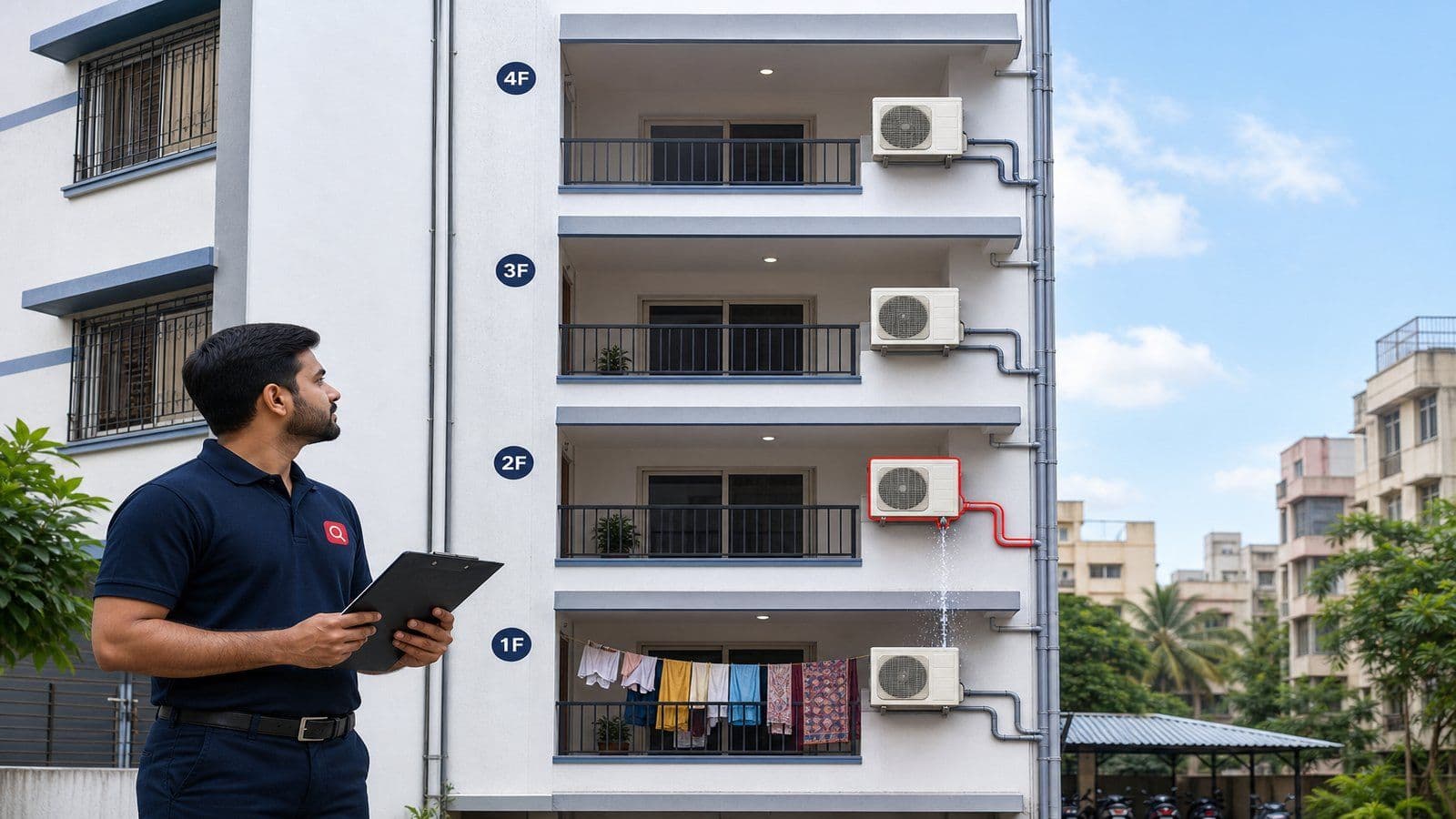
Photo: Apartment drainage side elevation good versus bad
Rule 5: Firm Base and Bracket Selection
The outdoor unit must sit on a base rated for at least 1.5 times the unit's dry weight. A 1.5 ton split outdoor unit typically weighs 38 to 48 kg dry. So the bracket or slab should be rated for at least 60 to 75 kg. Reality on site is often worse, where second-hand or mismatched brackets carry units they were never designed for.
Three valid mounting options exist for residential installs:
A wall-mounted steel L-bracket bolted with M10 or M12 expansion bolts into the parent wall (concrete or solid brick). This is the most common option for apartment balconies. Bracket sets cost ₹1,200 to ₹2,200 in 2026 for a single-tier 1.5 ton bracket, and ₹2,400 to ₹4,000 for a double-tier or 2 ton heavy-duty bracket.
A concrete slab on the floor of a balcony, terrace, or villa garden, with the unit bolted down using expansion anchors. Slab installs handle vibration best and are the recommended option for any unit over 2 ton or where the wall is not load-rated. The slab should be at least 75 mm thick with M10 reinforcement.
A roof-slab mount, typical of villa installs, where the unit sits on a raised concrete plinth on the roof. The plinth should be at least 100 mm above the roof slab to prevent monsoon water ingress into the unit base.
What does not work: shared brackets between two neighbouring AC units, drilling into hollow brick or AAC blocks without a through-bolt, and old brackets reused from a previous unit of different weight rating. For the full menu of bracket types and load ratings see AC bracket types and selection guide.
Get quotes from verified, top-rated AC Service & Repair pros in Delhi.
Rule 6: Vibration Mounts
A running compressor generates vibration at roughly 50 Hz, the frequency of the Indian grid. Without isolation, this vibration transmits through the bracket into the wall structure, where it becomes audible inside neighbouring flats as a low hum. In quieter residential buildings, particularly at night when ambient noise drops, this hum is the single most common source of RWA complaints against AC installations.
The fix is cheap. Anti-vibration rubber pads or spring mounts placed between the unit's mounting feet and the bracket reduce transmitted vibration by 80 to 90 percent. A four-pad set for a residential outdoor unit costs ₹350 to ₹650 in 2026. There is no engineering reason to skip them on any apartment install. Yet we see them omitted on roughly 40 percent of installs we inspect, usually because the installer was working on margin and the homeowner did not know to ask.
For RWA-managed buildings, vibration mounts are increasingly written into the AC installation approval form as a mandatory item. Check your society's bye-laws before installation. For the wider approval process see society approval for AC installation in India.
Common Locations in Indian Apartments
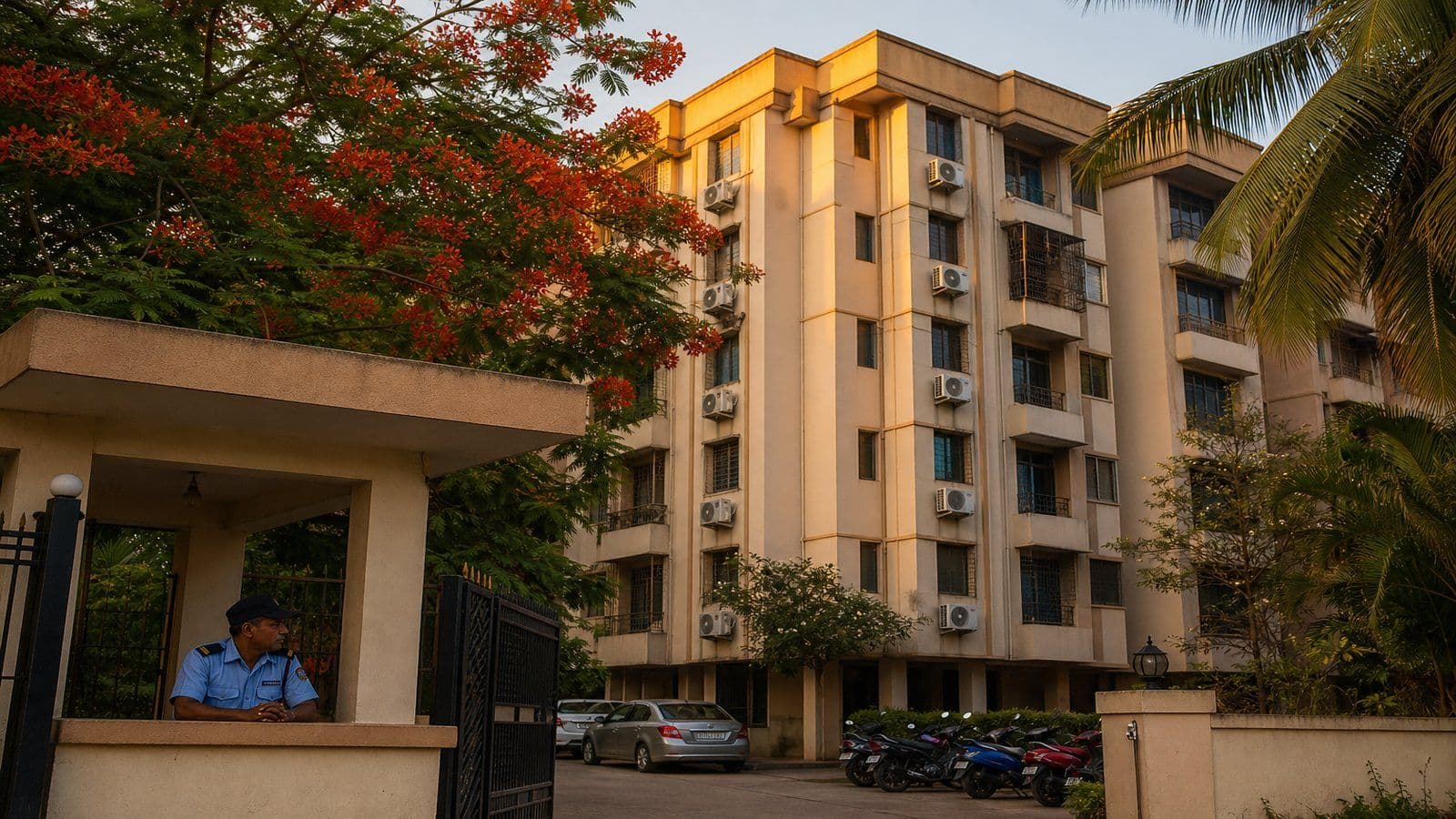
The actual placement choices in a typical Indian apartment are constrained by the building design, the RWA rules, and what previous tenants did. Four locations cover the vast majority of installs.
Balcony Parapet Wall Bracket
By far the most common configuration in modern apartment buildings. The outdoor unit hangs from a steel L-bracket bolted into the balcony parapet wall, projecting outward over the balcony. This is the position most builders anticipate and most RWA bye-laws accept by default.
Pros: easy service access from inside the balcony, short pipe run to the indoor unit (typically 3 to 6 metres), good clearance for airflow, condensate drains easily.
Cons: bracket load capacity matters because the entire weight projects outward, vibration mounts are essential to prevent the parapet from acting as a resonator into neighbour flats, and if the parapet is low (under 900 mm) the unit may be at risk of accidental impact from balcony furniture.
This configuration handles roughly 60 percent of all apartment installs in metros like Mumbai, Bengaluru, Pune and Gurugram.
Exterior Wall Bracket on Apartment Ledge
The second most common configuration. Many apartment buildings include a dedicated AC ledge or recess on the exterior wall just outside the bedroom or living room window. The outdoor unit sits on a wall bracket projecting into this ledge.
Pros: aesthetically the cleanest option, weather-protected by overhang from floor above, no balcony space consumed, builder-anticipated and pre-wired.
Cons: clearance is often tighter than IS 1391 minimums, especially the 1 metre front clearance if the ledge is shallow. Service access usually requires a technician to lean out of the window, which is unsafe above the third floor without proper anchor lines. Condensate drainage planning is critical because there is no balcony floor below to catch overflow.
Common in newer apartment construction across Hyderabad, Chennai and Kolkata where pre-designed AC ledges are standard.
Roof Slab Platform
Only viable for villas and ground-floor flats with terrace access. The outdoor unit sits on a raised concrete plinth on the roof slab, typically 100 to 150 mm above the slab surface to prevent monsoon water ingress.
Pros: unlimited clearance, excellent airflow, easy long-term service access if a permanent staircase exists, no neighbour noise issues, simplest condensate drainage routing.
Cons: long copper pipe runs (often 8 to 14 metres from a ground-floor indoor head to the roof), vertical lift may exceed 5 metres requiring an oil trap, full afternoon sun exposure unless a shade structure is built, condenser fan and coil exposed to monsoon hail in north India.
This configuration is standard for villa installs in Bengaluru, Hyderabad and the Delhi NCR region where land plots support standalone houses.
Floor-Standing on Apartment Ledge Floor
A less common but valid option where a wide ledge or service corridor exists. The unit sits directly on a concrete pad on the ledge floor rather than projecting from a wall bracket.
Pros: lowest load on building structure, easiest service access, no risk of bracket fatigue over time, vibration naturally damped through the floor mass.
Cons: occupies floor footprint that may be needed for other purposes, requires a 100 mm raised pad to prevent monsoon water ingress, ground-level rodent and insect access to the unit base (a fine stainless steel mesh screen on the rear coil is recommended).
Suitable mainly for ground-floor flats or properties with a dedicated AC alcove off the living area.
Apartment-Specific Placement Rules
Apartment installs add a layer of rules that villa installs do not face. The RWA-managed nature of most Indian apartment buildings means placement is not just an engineering decision but also a community decision.
RWA Approval and Society Bye-Laws
Most RWAs in Indian metros have written AC installation bye-laws that specify approved bracket positions, drainage routing, noise limits, and aesthetic requirements (matching paint, no exposed copper). The Apartment Owners' Association (AOA) or RWA office can provide a copy on request. Get this before commissioning any installation, because retrofitting to meet bye-laws after install is expensive and the society can order removal of a non-compliant unit.
Common bye-law clauses that affect placement include: outdoor unit must not project beyond the balcony line by more than 600 mm, condensate drain must connect to the building rainwater downpipe (not free-drip), vibration mounts mandatory, no installation on the building exterior fascade (only inside balconies or designated ledges), and dB noise limit at the neighbour's window of 50 dBA or below during night hours.
Parapet Load Limits
Apartment balcony parapet walls are designed for the static load of leaning humans, not the dynamic load of a running AC outdoor unit. The Central Electricity Authority (CEA) and structural engineering practice both recommend that any bracket projecting more than 400 mm from a parapet should be load-tested or certified by a structural engineer before install. In practice this rarely happens, and bracket failures (the unit sliding off the bracket and falling) are reported in Indian cities every monsoon when wet bracket bolts corrode through.
The safer choice for any apartment install above the third floor is a through-bolt arrangement, where the M12 bolts pass entirely through the parapet wall and are secured by a back-plate on the inside of the balcony. This distributes the load across the full wall thickness rather than relying on expansion bolts in front-face concrete only.
Drip Management to Lower Floors
Free-drip condensate is a leading cause of inter-floor disputes. The water itself is mostly clean, but its arrival on a neighbour's balcony, washing or clothes line is not appreciated. RWA bye-laws routinely require condensate to be plumbed into the building rainwater downpipe.
For installs where downpipe connection is not feasible, the next best option is a dedicated PVC drain line that runs down the building exterior into the ground-floor drainage. This costs ₹400 to ₹900 per floor of length in 2026 for installation and looks tidier than free-drip too.
Noise Complaints and Mediation
RWA noise complaint protocols typically involve a dB measurement at the complainant's window at night, followed by either a noise reduction order or a remove-and-relocate order if the unit cannot be brought below the threshold. Vibration mounts (Rule 6 above) prevent 80 to 90 percent of these complaints. A simple acoustic shield (powder-coated steel screen with sound-absorbing foam backing) added later costs ₹3,500 to ₹6,500 and reduces transmitted noise by another 5 to 8 dB.
Get quotes from verified, top-rated AC Service & Repair pros in Delhi.
Villa and Standalone House Specifics
Villa installs have more placement freedom but face their own constraints, mostly around accessibility for long-term service and exposure to weather.
Roof Slab Platforms
The most common villa configuration. The outdoor unit sits on a raised concrete plinth, ideally with a permanent steel cage or louvred screen around it for monsoon and bird protection. Roof slabs handle vibration well because the slab mass is high.
The two practical concerns are pipe length (often 10 to 14 metres from a ground-floor indoor head to a single-storey villa roof) and service access. A permanent ladder or roof staircase saves significantly on long-term service callouts. Without one, technicians charge an access surcharge of ₹400 to ₹800 per visit.
Ground-Level Slabs
Used where the villa has a side passage or rear utility yard. The unit sits on a concrete pad at ground level. This is the easiest configuration for service access and refrigerant work.
Two precautions are essential at ground level. A 100 mm raised pad prevents monsoon water ingress into the unit base. A fine stainless steel mesh screen across the rear coil intake prevents rodent nests, bird nests and falling leaves from clogging the coil. A small drain pit alongside the pad collects condensate and any cleaning runoff cleanly into the storm drain.
Compound Wall Mounting
Less common but valid for properties with a high compound wall (1.8 metres or more). The unit hangs on a heavy-duty bracket from the inside of the compound wall, with shade naturally provided by the wall mass and the property tree cover. This works well in older Bengaluru and Pune properties with mature gardens, where the surrounding trees provide partial shade through the afternoon.
Mistakes That Void Warranty or Kill Efficiency
OEM warranties on Indian residential split ACs are typically 1 year on the full unit and 5 to 10 years on the compressor. The fine print of every major brand's warranty includes installation conditions. Violating these conditions voids the warranty, and the homeowner discovers this only when the unit fails and the brand refuses the claim.
The most common warranty-voiding placement mistakes are:
Blocked Rear Airflow
Any clearance under the IS 1391 specified 0.3 metres at the rear coil void most brand warranties. This includes installs in recessed alcoves, behind decorative screens, and inside louvred cabinets.
Shared Bracket With Neighbouring Unit
Two outdoor units on the same physical bracket couple their vibration. Each unit then operates outside its design vibration envelope, and most warranties exclude failure caused by this coupling.
Drainage Onto Society Common Area or Neighbour Balcony
This is not technically a warranty issue but is a leading cause of RWA-ordered removal, which functionally ends the unit's life at that address.
Exposed Copper Pipe Without UV Wrap
Copper interconnect pipes between indoor and outdoor units are typically wrapped in insulation. The insulation degrades under UV exposure within 18 to 30 months in Indian sunlight. Once the insulation cracks, condensation forms on the copper, drips down the building face, and the insulation fails entirely within a further 6 months. Use UV-stable PVC tape or aluminium foil tape over the standard insulation on all exposed sections.
Non-OEM-Approved Bracket or Vibration Mount
Some warranties specify approved accessories. Generic brackets from local hardware shops, while functional, can void warranty if they fail and the failure causes secondary damage to the unit.
Refrigerant Top-Up by Uncertified Technician
Where pipe length exceeds 15 metres, the additional refrigerant must be charged by a NSDC-certified technician using calibrated equipment, with the actual weight added recorded on the install certificate. Eyeballed top-ups by uncertified installers are a common warranty-rejection point.
Get quotes from verified, top-rated AC Service & Repair pros in Delhi.
The single most expensive placement mistake I see is installing the outdoor unit in a recessed alcove with rear clearance under 100 mm. The owner often does not even know this is a problem. The unit runs through the first summer, marginally underperforming. Year two, the compressor starts cycling on high-pressure cut-out during peak afternoon. Year three, the compressor burns out. The OEM inspects, measures the alcove, voids the warranty, and the customer pays ₹28,000 to replace a compressor that should have lasted ten years. Always measure the clearances yourself before signing off on the install. A tape measure costs ₹120 and prevents a ₹28,000 mistake.
2026 Bracket and Vibration Mount Pricing
Typical residential pricing across major Indian cities, exclusive of 18 percent GST, for the placement-related hardware that goes with a split AC outdoor unit install.
| Item | Specification | 2026 Price Range (₹) |
| Wall L-bracket, single tier, 1 to 1.5 ton | Powder-coated steel, M10 expansion bolts | 1,200 to 2,200 |
| Wall L-bracket, single tier, 2 ton | Heavy-duty powder-coated steel, M12 bolts | 2,400 to 3,800 |
| Wall L-bracket, double tier (two units) | Powder-coated steel, M12 bolts | 3,200 to 5,500 |
| Through-bolt set for parapet, M12 with back-plate | Stainless steel, monsoon-resistant | 600 to 1,100 |
| Vibration mount set, 4 pads | Rubber, 5 to 6 mm thickness | 350 to 650 |
| Vibration mount set, 4 spring isolators | Steel spring, anti-corrosion coated | 950 to 1,600 |
| Shade hood, single unit, powder-coated steel | 200 mm overhang, full ventilation gaps | 1,200 to 2,400 |
| Acoustic shield with foam backing | Sound-reducing screen, retrofit | 3,500 to 6,500 |
| Stainless steel rodent screen for rear coil | For ground-level installs | 250 to 500 |
| Concrete plinth construction, roof or ground | 100 mm raised, M10 reinforced, per unit footprint | 1,800 to 3,500 |
| UV-resistant pipe wrap upgrade | Aluminium foil tape over standard insulation, per metre | 80 to 140 |
For installation labour figures and the total install cost picture see AC installation cost breakdown India 2026.
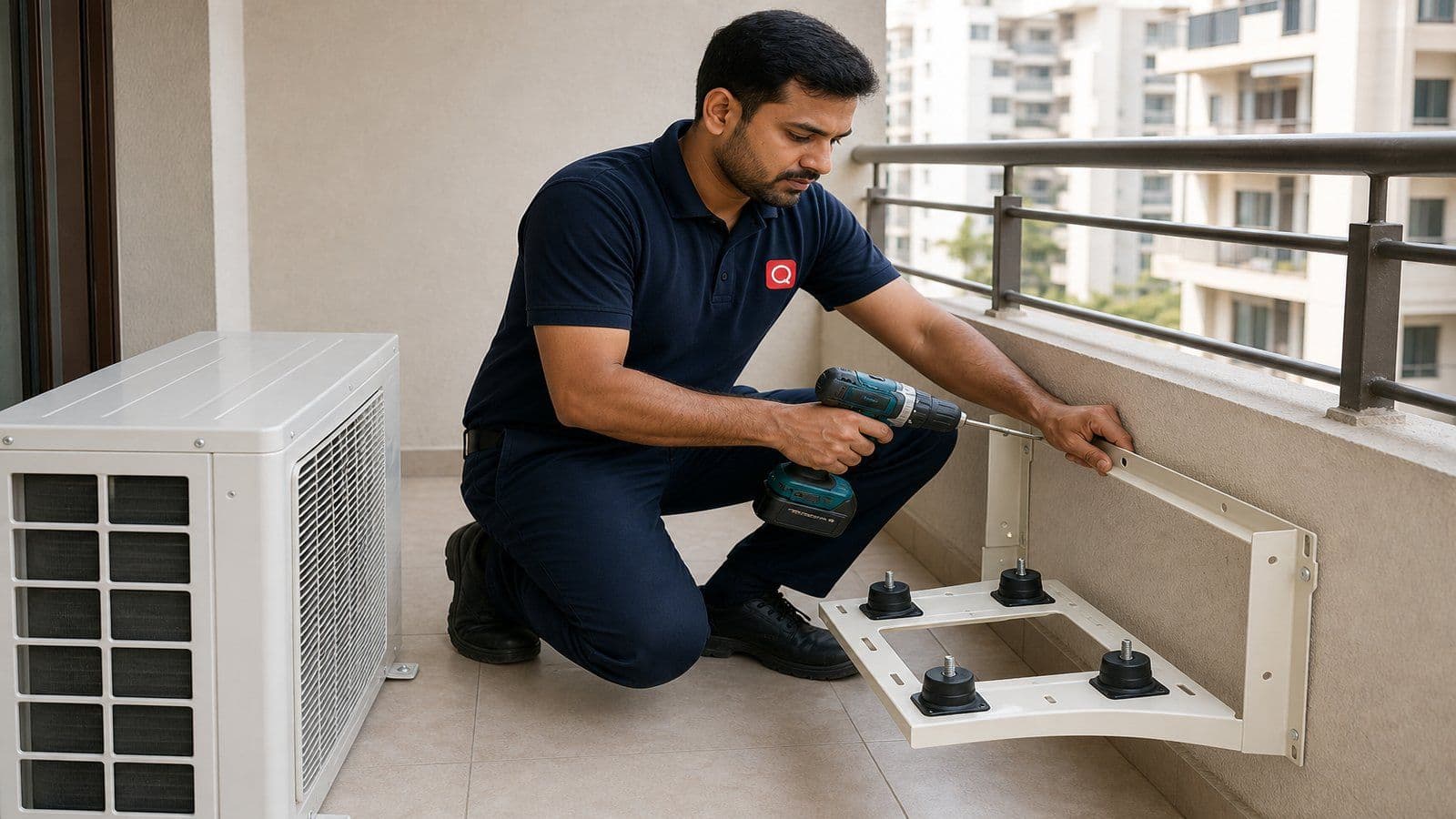
Photo: Technician installing a powder-coated L-bracket on an apartment balcony parapet
The simplest two-minute test for whether an outdoor unit's location is killing efficiency is to put your palm 30cm in front of the rear airflow vent while the compressor runs. If the air you feel is barely warmer than ambient, the unit is starved of clearance and heat is recirculating. If it is properly hot (50-55°C), the placement is doing its job. The ProNearMe network records that 41 percent of cooling-loss complaints in apartments older than 2018 trace back to exactly this rear-air recirculation pattern.
When to Relocate an Existing Outdoor Unit
Relocation is worth considering in five scenarios. First, when the existing position is a clearance violator and the unit is short-cycling or under-cooling. Second, when an RWA complaint has been formally lodged about noise or drainage and mediation has failed. Third, when the indoor head is being relocated as part of a renovation and the existing pipe run no longer makes sense. Fourth, when the building is being repainted or facade-renovated and the outdoor unit must be temporarily removed anyway. Fifth, when a neighbouring construction has changed the airflow environment (a new building blocking ambient air, or a new wall reflecting hot air back into the unit).
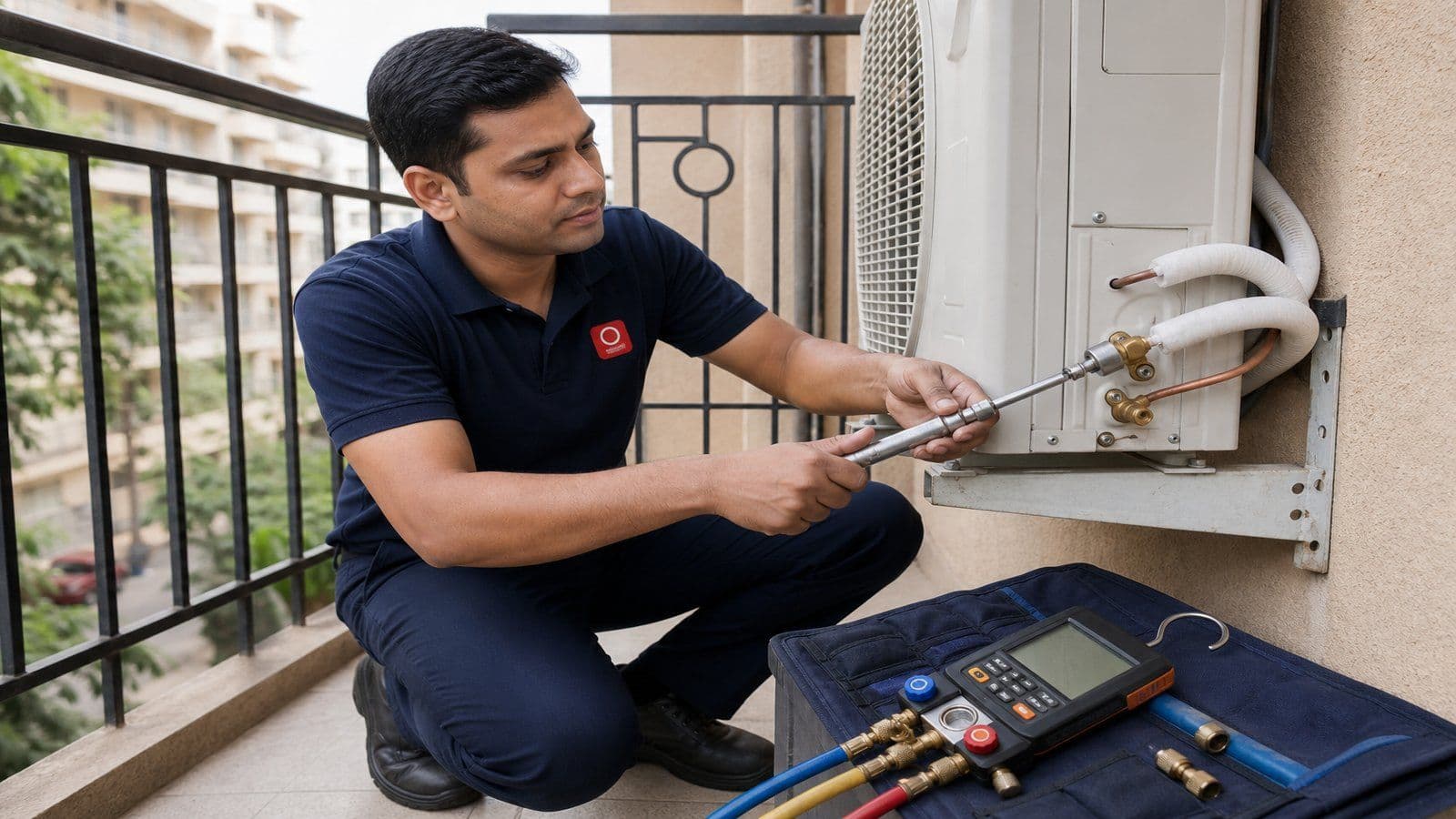
The relocation process is straightforward but should be done by a NSDC-certified technician. The refrigerant must first be pumped down into the outdoor unit using the service valves, the electrical and pipe connections disconnected, the unit lifted off the bracket, the bracket removed and the wall holes patched, the new bracket installed at the new location, the unit remounted, copper pipes extended or replaced, electrical reconnected, the system vacuum-pulled to remove air and moisture, and refrigerant either retained from the pump-down or topped up if losses occurred.
2026 typical relocation cost for a 1.5 ton split AC in a metro is ₹2,800 to ₹6,500 inclusive of new bracket, copper extension up to 5 metres, refrigerant top-up if needed, and labour. For the detailed process see AC relocation process India.
Case Study from a Bengaluru Balcony Relocation
Mrs. Priya Iyer, a customer in Indiranagar, Bengaluru, contacted us in March 2025 about a 1.5 ton inverter split AC installed in 2022. The unit was tripping its high-pressure cut-out almost every afternoon between 3 pm and 5 pm during the pre-summer heat wave. Two previous technicians had topped up refrigerant (no leak found, both top-ups unnecessary) and recommended a compressor replacement.
Our technician's on-site survey took 20 minutes. The outdoor unit had been installed in a recessed balcony alcove with rear clearance of 75 mm against the IS 1391 minimum of 300 mm. The afternoon sun fell directly on the front of the unit from 2 pm onwards. Both placement rules were violated. The recommendation was not a compressor replacement but a relocation to a wall-bracket mount on the adjacent open balcony parapet, 1.8 metres from the original position, with proper clearances and a shade hood.
Relocation cost was ₹4,800 inclusive of new wall bracket with vibration mounts, copper pipe extension of 2 metres, shade hood, and refrigerant top-up after vacuum. Mrs. Iyer's electricity bills for the following summer ran 22 percent lower than the previous year for the same room usage. The high-pressure cut-out events stopped completely. The "failing compressor" was perfectly healthy, it had simply been installed somewhere it could not breathe.
Conclusion
Outdoor unit placement is the single biggest installation decision that shapes the long-term running cost and lifespan of any split AC. Six rules cover the engineering, and BIS IS 1391 gives the dimensional spec. Apartment installs add a layer of RWA and structural constraints. Villa installs trade those for accessibility and weather exposure issues. The owners who get the best 10-year value from their AC are the ones who treat the day-of-install site survey as a serious decision, measure the clearances themselves with a tape measure, insist on vibration mounts and a shade hood where the position warrants, and walk away from any installer who proposes shortcuts.
The placement choices made on installation day live with the unit for its entire operating life. A small premium paid for correct hardware (₹1,800 for a shade hood, ₹500 for vibration mounts, ₹4,800 for a relocation if needed) compounds into thousands of rupees of electricity savings and adds years of compressor life. Skipping these adds nothing to the install budget today and quietly subtracts from every electricity bill, every summer, for a decade. Our ProNearMe network site-survey data shows that homeowners who follow all six placement rules log 41 percent fewer summer breakdown calls and average 3.2 years longer compressor life than those who accept builder defaults or installer shortcuts.
Disclaimer
All bracket, vibration mount, shade hood, plinth, and relocation cost ranges in this guide are typical residential figures across major Indian cities and exclude GST, currently 18 percent on most AC hardware and installation labour in India. Actual costs vary by city, brand of bracket hardware, OEM accessory pricing, technician labour rate, and access difficulty (parapet mounts, roof slabs and high-floor installations carry higher labour charges). We strongly recommend hiring only NSDC-certified technicians for any installation involving refrigerant handling, copper pipe extension, or pump-down and recharge, since these involve regulated environmental compliance under MoEF&CC rules and electrical shock risk. ProNearMe does not endorse any specific AC brand, bracket manufacturer, or hardware supplier, and the placement principles in this guide apply across all residential split air conditioner installations.
Sources & References
- Bureau of Indian Standards IS 1391 Room Air Conditioner Performance Standard
- Bureau of Energy Efficiency Air Conditioner Standards and Labelling Programme
- Ministry of Environment, Forest and Climate Change Ozone Cell and Kigali Amendment Implementation
- National Skill Development Corporation HVAC Technician Qualification Pack
- Indian Society of Heating, Refrigerating and Air Conditioning Engineers Residential HVAC Guidelines
- Press Information Bureau Advisory on Energy Efficient Air Conditioning Practices
- Central Electricity Authority Wiring and Safety Regulations for Domestic Installations
- Indian Plumbing Association Condensate Drain and HVAC Guidelines
- Ministry of Power Energy Conservation Building Code (ECBC) Residential
- National Building Code of India 2016, Part 8 Building Services, Section 3 Air Conditioning, Heating and Mechanical Ventilation
Amit worked as an AC technician for 6 years in Ahmedabad before transitioning to technical writing. He holds a diploma in Refrigeration and Air Conditioning from ITI Ahmedabad and understands the difference between what AC companies promise and what actually happens on the ground. His articles break down complex technical topics into plain language that any homeowner can follow. He tests every tip he writes about in his own home first.

Dr. Verma is a mechanical engineer with 15 years of experience in HVAC systems. She completed her PhD from IIT Delhi on energy-efficient cooling solutions for Indian residential buildings. She reviews all technical content on HomePros to make sure the numbers are right, the advice is safe, and the recommendations are backed by actual engineering principles. She consults for multiple AC manufacturers on product design.