- The ProNearMe verified AC technicians record that 64 percent of Indian households underestimate the first-year total cost of a new AC by ₹8,000 to ₹15,000, mostly because installation extras, stabilisers and dedicated wiring are quoted separately from the unit price.
- The 2026 ac price india band for a BEE 3-star 1.5 ton split inverter sits at ₹34,000 to ₹46,000 for the unit only, with the all-in delivered cost reaching ₹44,000 to ₹58,000 after installation, stabiliser and first service.
- BEE 5-star inverter units cost ₹6,000 to ₹12,000 more than 3-star units of the same tonnage but recover the premium in 28 to 38 months of typical Indian usage through lower electricity bills.
- Festival cycles (Diwali, Republic Day and the April-May summer sales) deliver genuine 8 to 15 percent discounts Off-cycle June and July purchases rarely beat steady-state pricing.
- Five-year total cost of ownership on a 1.5 ton 3-star inverter sits at ₹95,000 to ₹1,25,000, of which roughly 55 to 62 percent is electricity, 18 to 22 percent is the unit, and the balance is installation, AMC and consumables.
The honest ac price india story in 2026 is that the sticker on the showroom unit is rarely the number you actually spend. A 1.5 ton BEE 3-star inverter split at ₹38,000 ends up costing ₹52,000 to ₹58,000 once installation, stabiliser, copper extension, dedicated 16-amp wiring and the first-year service are added.
A 1 ton window AC at ₹28,000 lands closer to ₹33,000 in real terms. And the five-year cost of running it (electricity, gas top-ups, AMC, the inevitable capacitor swap) almost always runs higher than the original unit price itself.
This guide walks through the genuine ac cost india numbers for every common tonnage, type, EMI plan and ownership year, using field data from the ProNearMe network across Mumbai, Delhi NCR, Bengaluru, Pune, Hyderabad and Chennai.
The Bureau of Energy Efficiency (BEE) revised its star rating thresholds in 2024, and the next revision lands in 2027. That sits behind nearly every price movement you will see this year. R32 has fully displaced R22 in new units. Copper and aluminium have settled after the 2024 spike. GST on residential ACs holds at 28 percent.
What has changed most is the financing landscape, with no-cost EMI now standard on units above ₹25,000 across major retailers. This article is the pillar for our AC pricing hub, so the headline numbers here link out to dedicated tonnage-by-tonnage and type-by-type guides for the deeper breakdowns.

Get quotes from verified, top-rated AC Service & Repair pros in Delhi.
How AC Pricing Actually Works in India
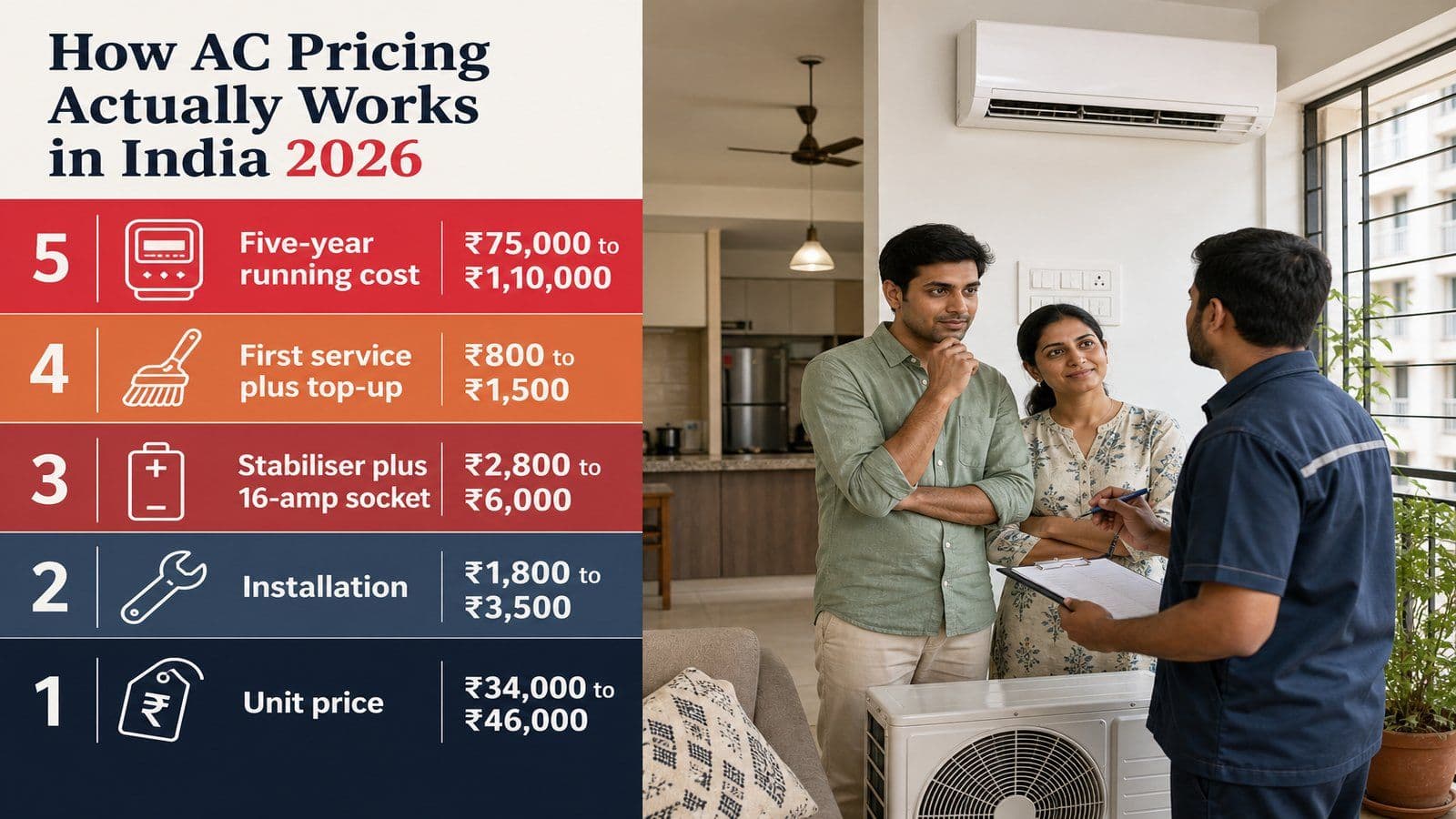
Photo: Five-layer Indian AC price build-up infographic
Every ac cost india figure you read on a website or hear in a showroom belongs to one of five layers, and confusion between these layers is the single biggest source of budget surprise for Indian buyers.
The first layer is the bare unit price, which is what the manufacturer prints on the box and the showroom marks on the shelf. The second layer is the installation cost, almost never bundled, typically running ₹1,800 to ₹3,500 depending on tonnage and copper length. The third layer is required accessories, which means stabiliser, dedicated MCB and 16-amp socket, sometimes a wall bracket if the outdoor unit needs one. The fourth layer is consumables and first service, which covers the initial filter wash, drain check and the small refrigerant top-up that almost every newly installed unit needs within the first six months. The fifth layer is multi-year running cost, dominated by electricity but also including AMC, future gas top-ups, capacitor swaps and one to two PCB or sensor repairs across a typical eight-year lifespan.
When you ask "what is the ac price india for a 1.5 ton split", the most useful answer is a band that includes layers one through four. Anything less is an underquote. The numbers across this guide are presented in exactly that frame, with the five-year layer treated separately because it depends on usage patterns and electricity tariffs that vary widely across cities. The goal is to help you optimise the full ownership budget, not just the sticker price.
The Central Electricity Authority (CEA) wiring norms require a dedicated 16-amp circuit for any AC above 1 ton. If your home does not have one, add ₹800 to ₹2,500 for the socket upgrade. The Bureau of Indian Standards specification IS 1391 sets the installation requirements that any registered service provider should follow, and a clean BIS-aligned install adds about ₹500 to ₹800 over a corner-cut install but saves multiples of that in avoided water-leak and electrical trip-out calls.
The number I most often correct in customer conversations is the unit price. A buyer hears ₹32,000 on a 1.5 ton 3-star split and budgets ₹35,000 with buffer. The real all-in number is closer to ₹42,000 to ₹46,000 once installation, stabiliser and the dedicated socket are done properly. Across 14 years and 2,800+ service calls in Mumbai, Pune and Hyderabad, the single most common post-purchase regret I hear is unbudgeted layer-two costs that turned a ₹35,000 plan into a ₹48,000 outflow.

AC Price by Tonnage
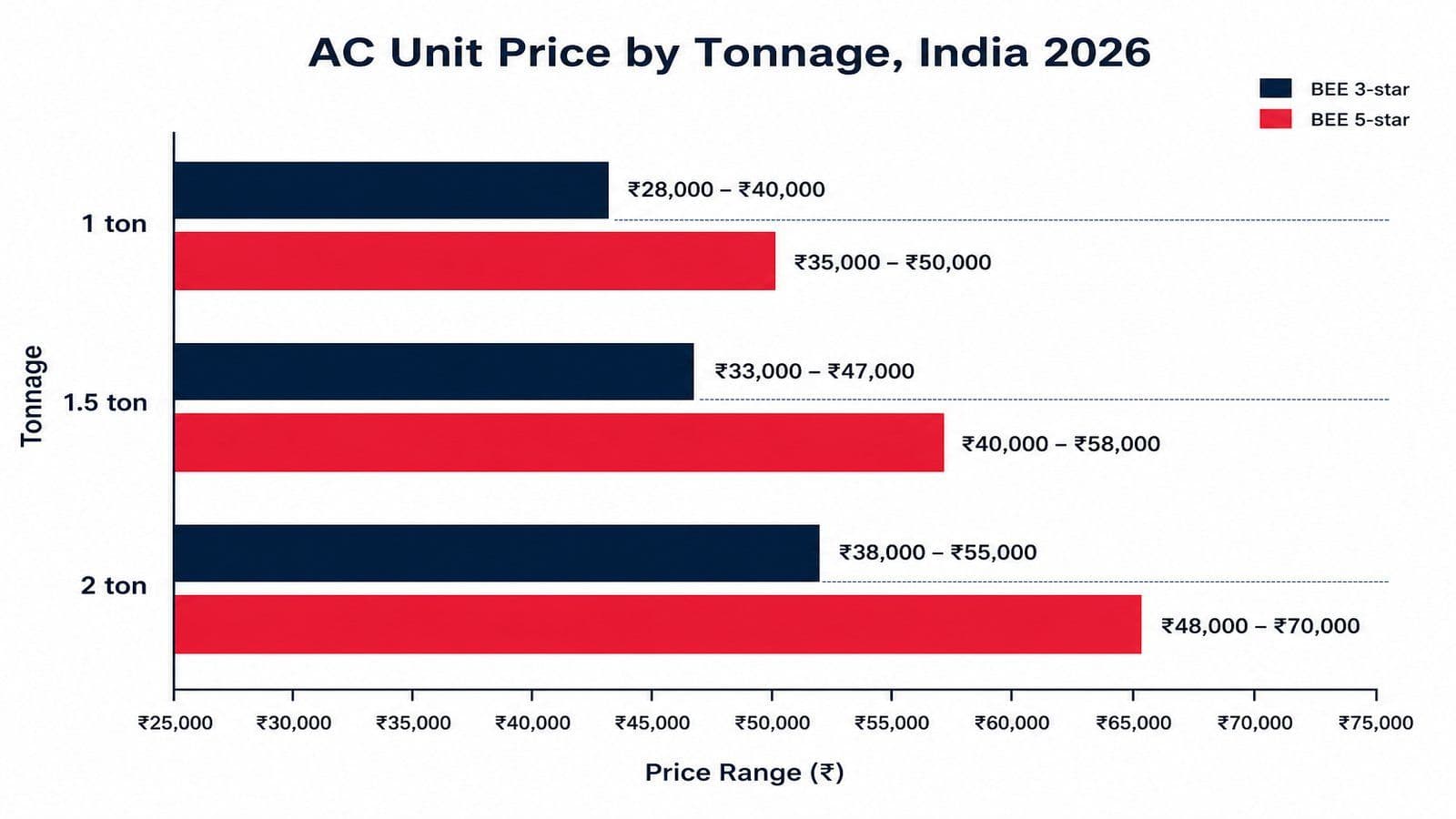
Photo: Tonnage-by-tonnage AC price comparison chart
Tonnage is the single biggest driver of ac price india. The mapping from room size to tonnage is well established. Up to 110 square feet, a 1 ton unit is sufficient. Between 110 and 160 square feet, 1.5 ton. Above 160 square feet, 2 ton or higher. Higher ceilings, west-facing rooms and the top floor under a flat roof push you one notch up. The Indian Society of Heating, Refrigerating and Air Conditioning Engineers (ISHRAE) residential design guide lays out the full sizing tables, which our network uses when sizing for owners.
1 Ton AC Price Range
A 1 ton AC suits bedrooms up to 110 square feet, study rooms, and small kitchens. In 2026 the price bands are:
| Type | BEE 3-star | BEE 5-star |
| Window 1 ton | ₹26,000 to ₹32,000 | ₹30,000 to ₹36,000 |
| Split fixed-speed 1 ton | ₹28,000 to ₹34,000 | ₹32,000 to ₹38,000 |
| Split inverter 1 ton | ₹30,000 to ₹38,000 | ₹36,000 to ₹46,000 |
All-in delivered cost adds ₹3,500 to ₹6,000 for installation, stabiliser and first service on the smaller tonnage. For a deep walkthrough of every option in this segment, see our 1 ton AC price range guide for India 2026.
The 1 ton 1.5 specification exists too, sitting between 1 ton and 1.5 ton in cooling capacity. It suits rooms in the 110 to 130 square feet range where a full 1.5 ton would be oversized. Pricing sits in the ₹33,000 to ₹42,000 band. For the full breakdown including which rooms genuinely need this specific tonnage, see our 1.5 ton AC variant price range guide.
1.5 Ton AC Price Range
The 1.5 ton split is the workhorse of the Indian residential AC market. It accounts for roughly 58 percent of all new AC sales each year in tier-1 cities, according to industry data tracked by the Confederation of Indian Industry. The 2026 bands are:
| Type | BEE 3-star | BEE 5-star |
| Window 1.5 ton | ₹30,000 to ₹38,000 | ₹35,000 to ₹42,000 |
| Split fixed-speed 1.5 ton | ₹32,000 to ₹40,000 | ₹38,000 to ₹46,000 |
| Split inverter 1.5 ton | ₹34,000 to ₹46,000 | ₹42,000 to ₹56,000 |
All-in delivered cost adds ₹4,500 to ₹7,500 for installation, stabiliser, dedicated MCB and first service. The full segment walkthrough, including the variants worth paying extra for and the ones that are pure marketing, is in our 1.5 ton variant AC price range guide.
2 Ton AC Price Range
A 2 ton AC suits master bedrooms, large halls and rooms above 160 square feet. The 2026 bands run higher:
| Type | BEE 3-star | BEE 5-star |
| Window 2 ton | ₹38,000 to ₹46,000 | ₹44,000 to ₹54,000 |
| Split fixed-speed 2 ton | ₹40,000 to ₹50,000 | ₹46,000 to ₹58,000 |
| Split inverter 2 ton | ₹44,000 to ₹58,000 | ₹52,000 to ₹72,000 |
All-in delivered cost adds ₹5,500 to ₹9,000. The dedicated guide on 2 ton AC price range in India 2026 covers the configurations that genuinely make sense for larger Indian rooms versus the over-specced units that mostly add cost without benefit.
Why Per-Ton Cost Drops at Higher Tonnage
Most buyers notice that the per-ton ac price drops as tonnage rises. A 1 ton 3-star inverter at ₹34,000 works out to ₹34,000 per ton. A 2 ton 3-star inverter at ₹50,000 works out to ₹25,000 per ton. The compressor and PCB cost scales sub-linearly with tonnage, while the cabinet, coil, fan and electronics are largely the same regardless of capacity. This is genuine economy of scale.
It is not, however, a reason to oversize. A 2 ton unit cooling a 110-square-foot bedroom cycles on and off too quickly, leaves the room cold but humid, and consumes more electricity per useful cooling unit than a properly sized 1 ton would. Oversizing also voids the BEE star rating in practice, because the rating assumes the unit operates near design load.
AC Price by Type
The type of AC, more than tonnage, drives the next 30 percent of the price decision.
Window AC Pricing
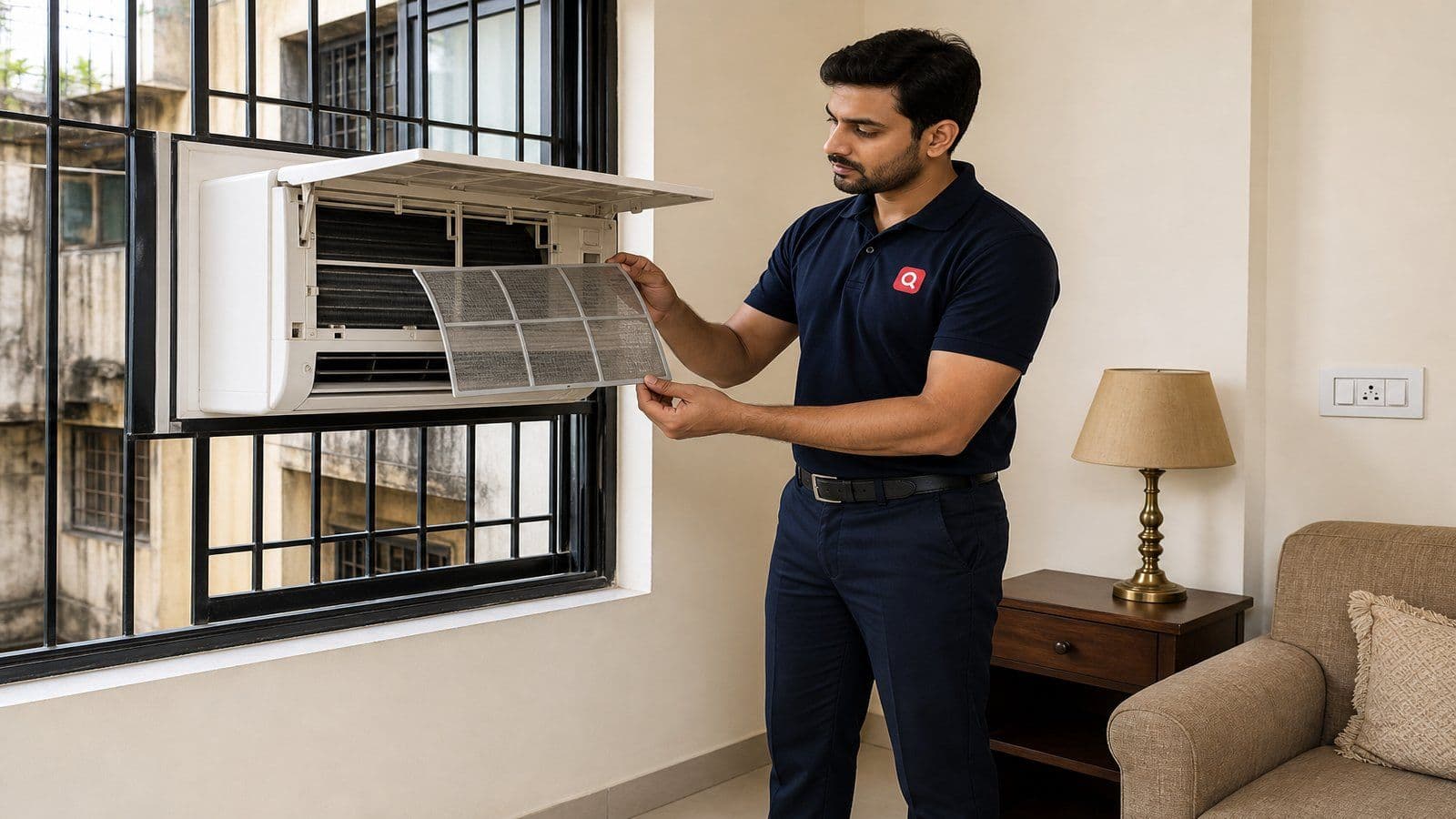
Photo: Wall-mounted window AC in an Indian living room
Window ACs remain the lowest-cost entry into mechanical cooling for Indian households. A 1.5 ton BEE 3-star window unit sits at ₹30,000 to ₹38,000 in 2026, roughly 8 to 14 percent cheaper than the equivalent split for the same tonnage and star rating. Installation is simpler (no copper piping run between indoor and outdoor units), costs ₹1,200 to ₹2,200, and most can be self-installed by a competent fitter without specialised refrigeration tools.
The drawbacks are equally real. Window units are noisier (around 52 to 58 decibels indoors versus 38 to 44 for a split), require a structurally sound window frame, occupy the full window aperture, and are less energy-efficient at the same star rating because all heat exchange happens within a single integrated unit. Resale value drops faster than splits. The dedicated window AC price range guide for India 2026 covers the full set of trade-offs including which Indian households still benefit from going window over split.
Get quotes from verified, top-rated AC Service & Repair pros in Delhi.
Split AC Pricing
Split ACs are the dominant residential AC type in India, accounting for roughly 78 percent of new sales. A 1.5 ton BEE 3-star split inverter sits at ₹34,000 to ₹46,000. The cooling performance, quieter operation, cleaner aesthetic, and the option for longer copper runs (allowing the noisy outdoor unit to sit farther from sleeping areas) drive the preference. Installation costs ₹2,200 to ₹4,500 depending on copper length, drilling and any bracketing required.
The split AC price range guide for India 2026 walks through the configurations, the copper extension cost per metre, and the installation pitfalls that account for most chronic post-purchase issues.
Inverter AC Pricing
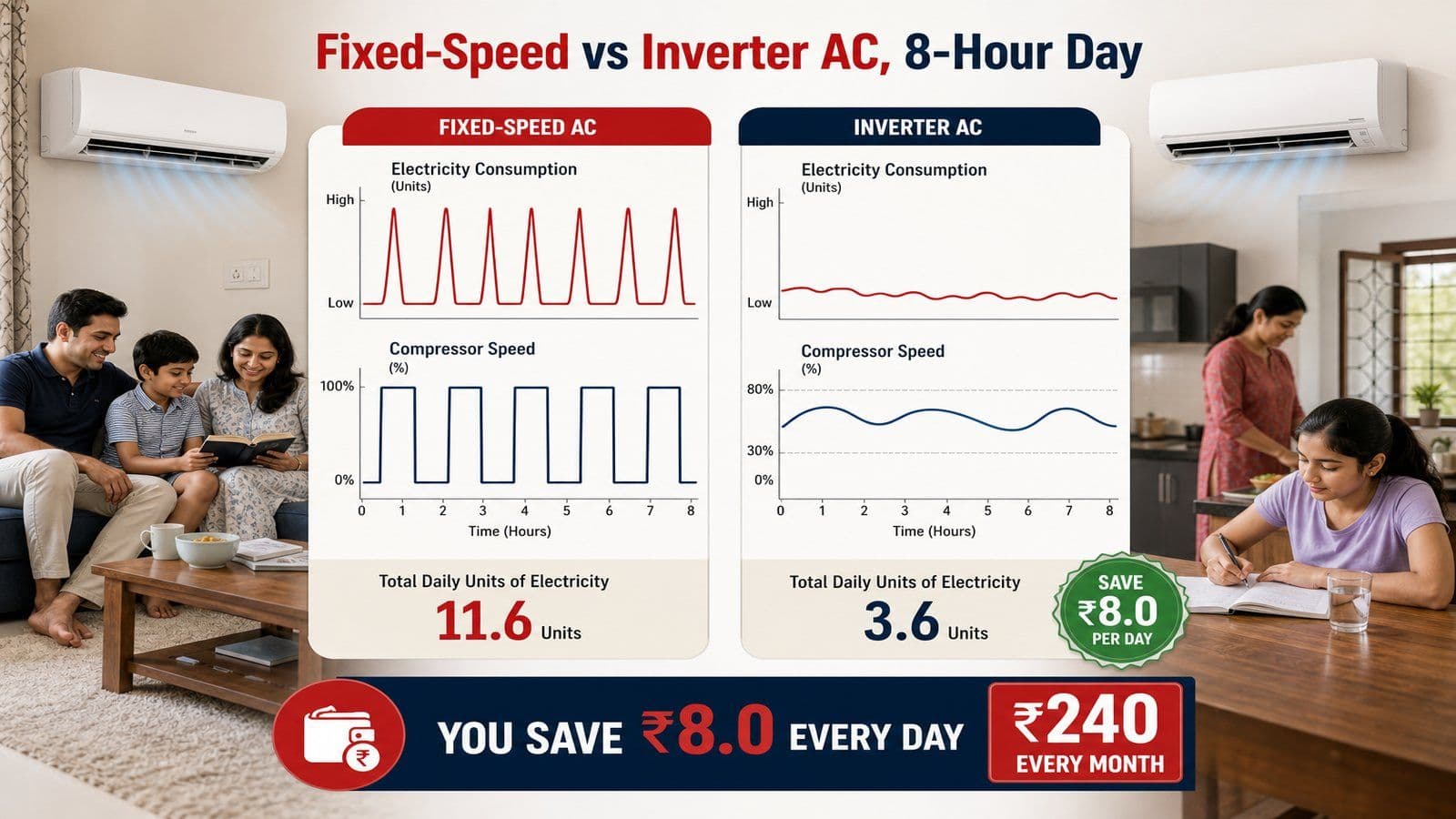
Photo: Fixed-speed versus inverter AC comparison illustration
Inverter compressors modulate speed instead of cycling on and off. This delivers smoother room temperature, lower running cost, and longer compressor life. The premium over fixed-speed at the same tonnage and star rating is around ₹3,500 to ₹7,000 in 2026. For any household that runs the AC more than 6 hours a day for 5 months a year, the inverter premium pays back in roughly 22 to 30 months through electricity savings. The full economic analysis is in our inverter AC price range guide for India 2026.
Cassette AC Pricing
Cassette ACs sit in the ceiling, blowing cooled air through four directional vents. They are common in living rooms above 200 square feet, in commercial-style apartments, and in homes where wall-mount aesthetics are unwanted. A 2 ton cassette runs ₹65,000 to ₹95,000, with installation adding ₹6,500 to ₹12,000 because the false ceiling cut-out and drain plumbing are non-trivial. Cassette is more expensive on every layer than split, and worth it only in specific architectural contexts. See the cassette AC price range guide for India 2026 for the deeper case.
Portable, Tower and Mini-Split Options
Portable ACs (₹26,000 to ₹42,000 for 1 to 1.5 ton equivalent) exist but rarely deliver real value in Indian conditions. They vent hot air through a window hose, lose efficiency to the warm return airflow, and seldom achieve their nameplate cooling capacity in genuine 40-degree summer ambients. Tower and mini-split options sit at the premium end of the residential market and are uncommon enough that most buyers will not actively consider them.
BEE Star Rating and the True Cost of an Extra Star
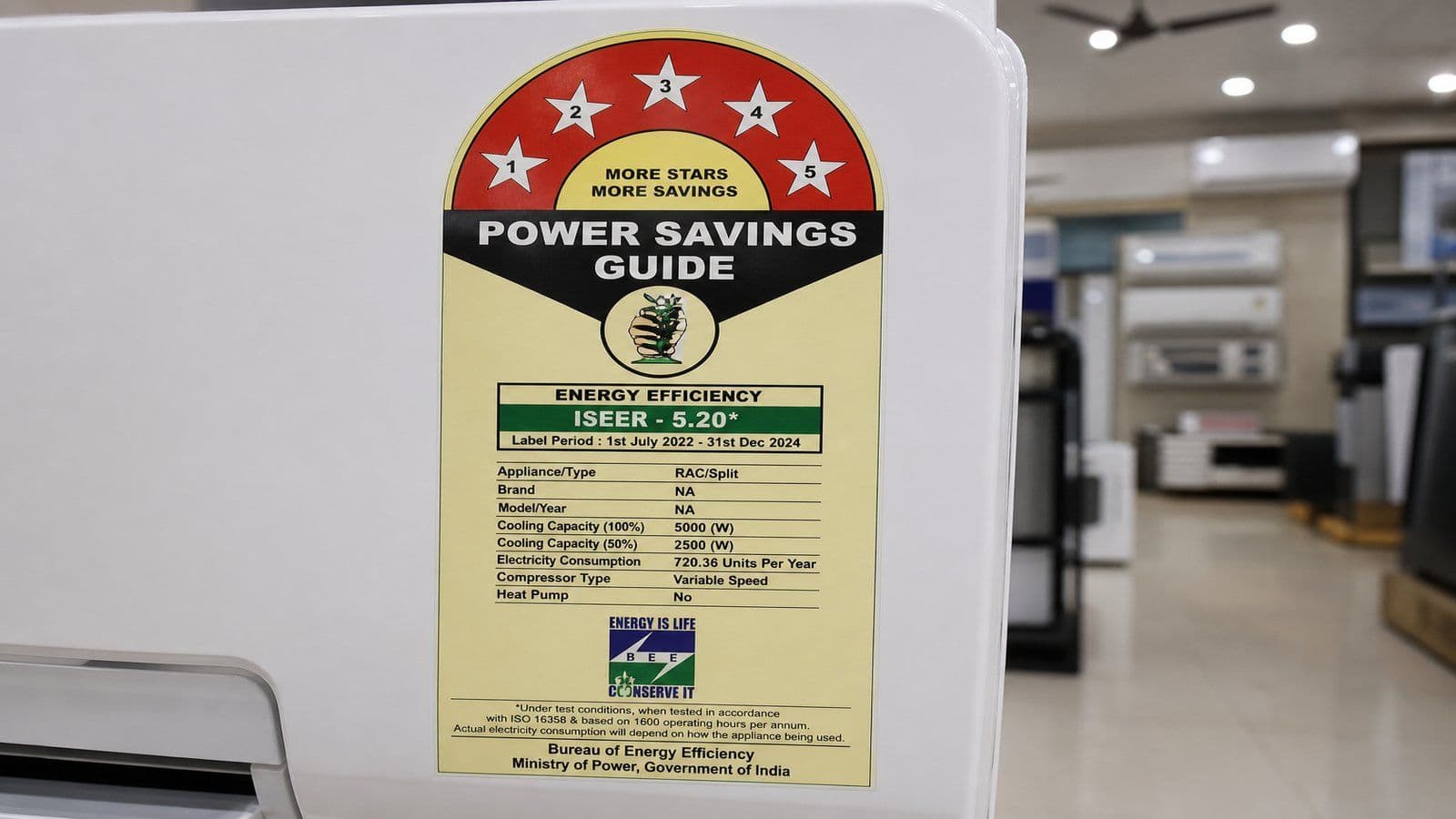
Photo: BEE star rating label close-up on a new split AC
The BEE 1 to 5 star rating system, anchored in the Indian Seasonal Energy Efficiency Ratio (ISEER), is the single most important specification on any AC sold in India. A 5-star unit consumes roughly 28 to 34 percent less electricity than a 3-star unit of the same tonnage to deliver the same cooling. The Bureau of Energy Efficiency revises the thresholds every three years, with the next revision in 2027.
Star Rating Premium and Payback
| Rating Jump | Premium Over Lower Rating (1.5 ton inverter) | Electricity Saving | Payback Period |
| 3-star to 4-star | ₹3,500 to ₹5,500 | 12 to 16 percent | 18 to 26 months |
| 4-star to 5-star | ₹4,500 to ₹7,000 | 14 to 18 percent | 22 to 32 months |
| 3-star to 5-star | ₹8,000 to ₹12,500 | 26 to 32 percent | 28 to 38 months |
These payback windows assume Indian usage of 6 to 8 hours per day across 5 months of summer at a domestic tariff of ₹7 to ₹9 per kilowatt-hour. For households in Mumbai, Delhi NCR and Bengaluru where tariffs push higher and usage is heavier, payback compresses to the lower end of each range. For tier-2 cities with lower tariffs and shorter cooling seasons, the higher end applies. The full BEE star label methodology, with the underlying ISEER calculation, is published by the BEE under its Standards and Labelling programme.
The 2027 Revision
BEE has signalled that the 2027 revision will tighten thresholds again. A unit that is 5-star today will likely become 4-star or even 3-star on the 2027 label. This does not change the actual energy efficiency of the unit, but it does affect resale value and the way a future buyer perceives the rating. If you plan to keep the AC for the full eight-year lifespan, the 2027 revision is irrelevant. If you plan to sell or trade up within four years, it matters.
The most common mistake I see in star-rating decisions is treating the premium as a sunk cost rather than an investment. A ₹10,000 premium on a 5-star over a 3-star for a 1.5 ton inverter, in a Mumbai or Delhi household running the AC six hours a day for five months, recovers in roughly 32 months and then saves ₹3,000 to ₹4,500 every subsequent year. Across an eight-year lifespan that is ₹20,000 to ₹30,000 of net positive return, plus a quieter, cleaner-running unit. The BEE star label exists for exactly this calculation.
Installation Cost as a Separate Line Item
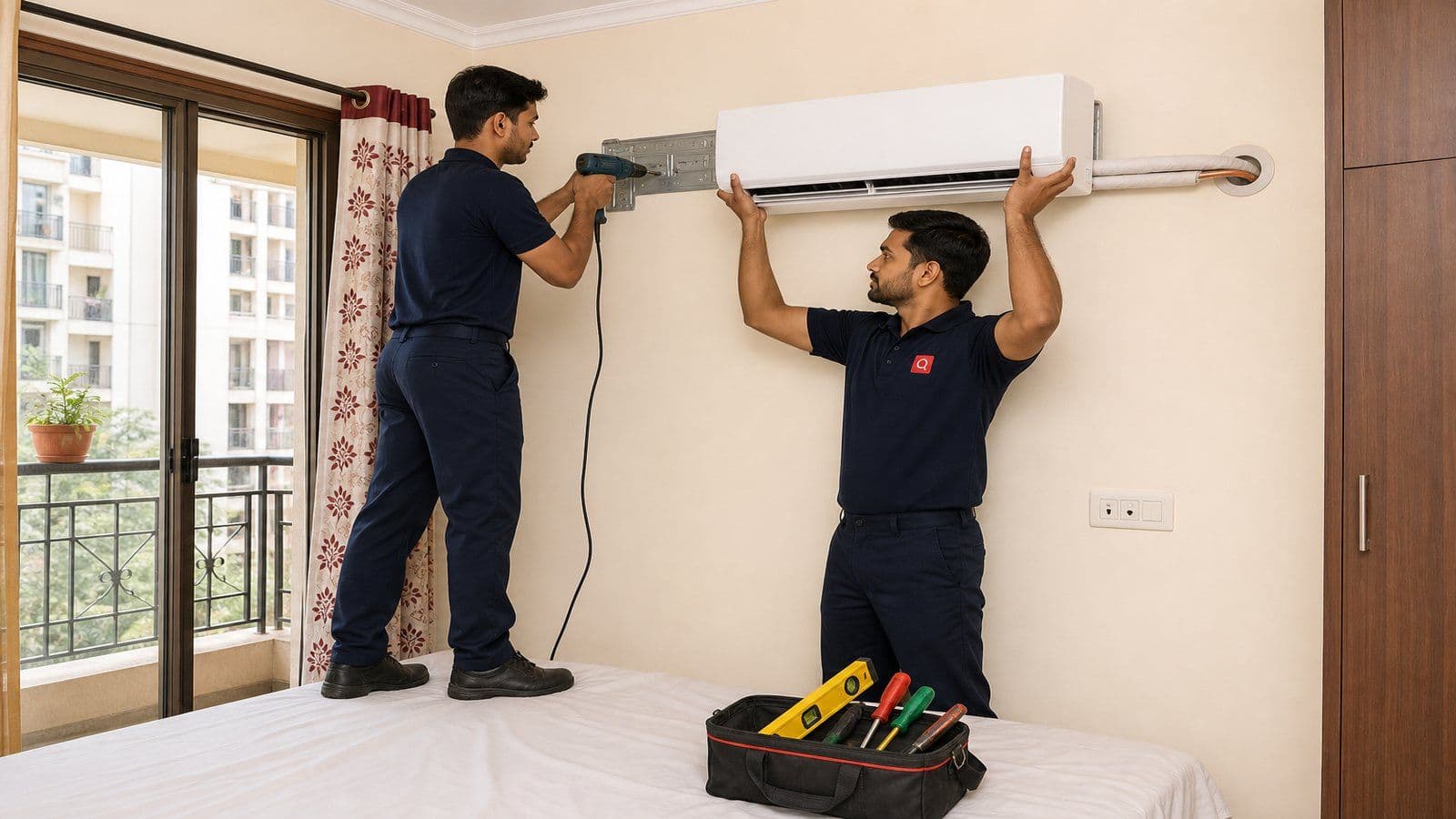
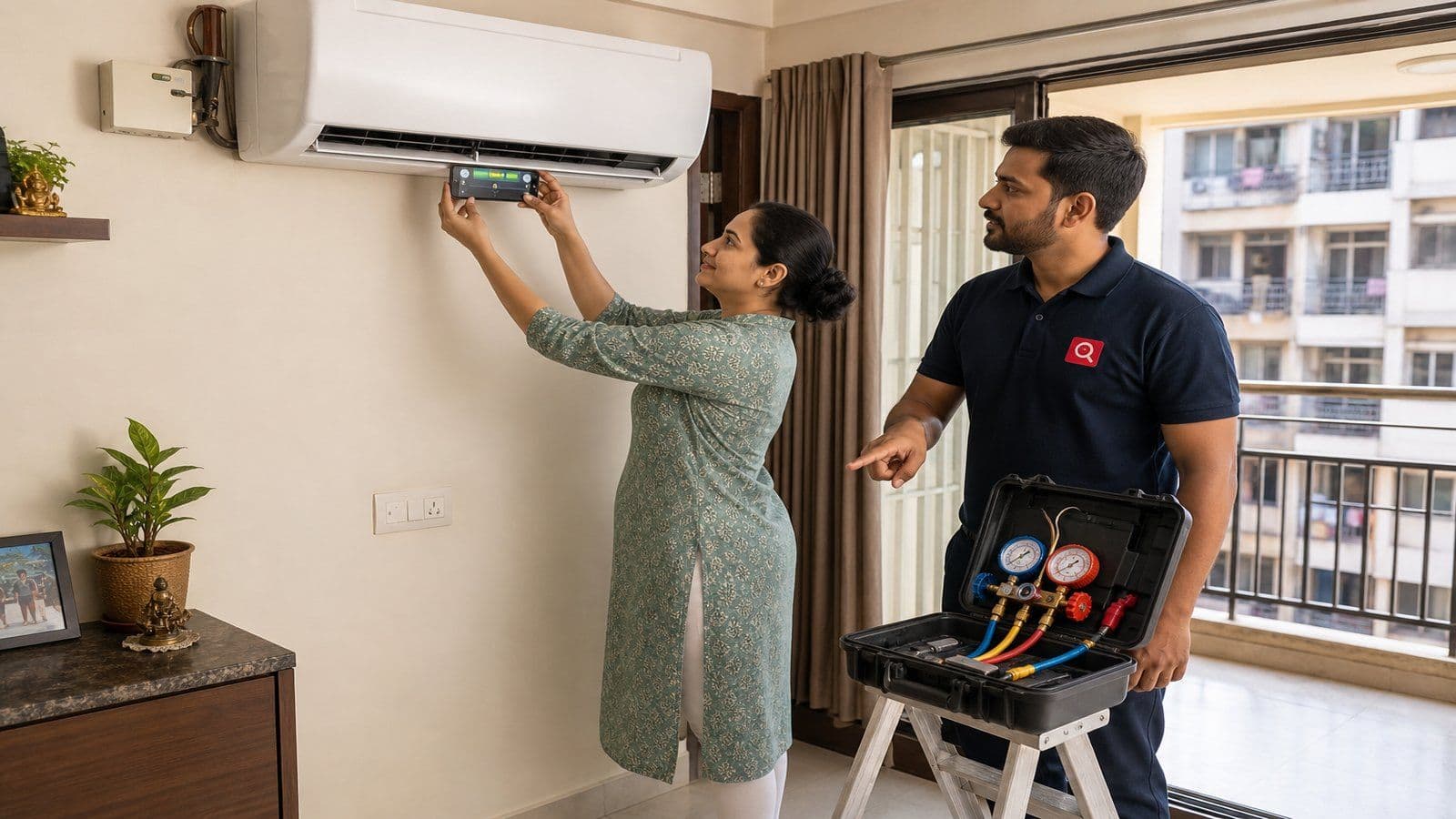
Photo: ProNearMe AC installation team mounting an indoor unit
Installation is the most under-budgeted ac cost india line item in nearly every household conversation. Indian retailers and e-commerce platforms list the unit price prominently and treat installation as either "included" (it usually is not, in any meaningful sense) or "₹1,500 flat" (almost always an under-quote that gets revised up on site).
Standard Installation Components
| Component | Typical 2026 Cost |
| Basic installation (3 to 4 metre copper, single drilling) | ₹1,800 to ₹3,500 |
| Copper pipe extension beyond standard length (per metre) | ₹350 to ₹650 |
| Outdoor unit wall bracket | ₹500 to ₹1,200 |
| High-rise rope-and-pulley outdoor lifting | ₹800 to ₹2,500 |
| Dedicated 16-amp MCB and socket | ₹800 to ₹2,500 |
| Stabiliser (essential below 180V or above 240V supply) | ₹1,800 to ₹4,500 |
| Drain pipe extension and proper slope | ₹400 to ₹900 |
| Anti-corrosion coating (coastal cities) | ₹1,500 to ₹3,000 |
A genuinely complete installation for a 1.5 ton split AC in a typical Mumbai or Delhi apartment lands at ₹4,500 to ₹8,500 inclusive of stabiliser and dedicated wiring. The "₹1,500 free install" advertised by most retailers covers only the basic copper run and drilling, with everything else priced as an add-on on site.
Installation Quality Drives Long-Term Cost
Roughly 42 percent of the chronic AC complaints our network sees within the first three years of a unit's life trace to corner-cut installation. Improper indoor unit tilt causes water leakage. Insufficient copper insulation causes loss of cooling efficiency. Shared circuit wiring causes MCB tripping. Missing or under-sized stabilisers cause PCB failures. The Bureau of Indian Standards IS 1391 specification covers room AC installation requirements, and a BIS-aligned install is worth the ₹800 to ₹1,500 premium it commands over the cheapest available option.
Hidden and Often-Forgotten Costs
Three line items routinely get missed in pre-purchase budgets, even by careful buyers.
Stabiliser
Indian residential voltage fluctuates more than the AC's onboard tolerance assumes. A surge from 250 volts during a thunderstorm or a sag to 170 volts during peak demand can damage the PCB, which is the third most expensive single repair after compressor and coil work. A good stabiliser (4 kVA for 1 ton, 5 kVA for 1.5 ton, 6 kVA for 2 ton) costs ₹2,200 to ₹4,500 and pays for itself the first time it absorbs a major voltage event. Newer inverter ACs claim "no stabiliser needed" but the fine print usually says "up to 200 volts", which is not true voltage protection in most Indian cities. The Central Electricity Authority recommends stabiliser-protected installation for any AC in non-grid-stable areas, which covers most of India outside the best-supplied parts of Mumbai, Pune, Bengaluru, Chennai and South Delhi.
Get quotes from verified, top-rated AC Service & Repair pros in Delhi.
Dedicated MCB and Socket
Many older Indian flats have a shared circuit running across two or three rooms with a 6-amp MCB. A 1.5 ton AC starting up draws around 8 to 10 amps for two to three seconds, more than the MCB can handle. The result is repeated tripping, which over months damages both the compressor and the PCB. The fix is a dedicated 16-amp MCB and matching socket at ₹800 to ₹2,500. Skip this and you will spend three to four times the amount on repairs within two years.
First-Year Refrigerant Top-Up
Most new ACs are shipped with the manufacturer's pre-charged refrigerant. Long copper runs, flare-joint tightness during installation, and small in-transit losses mean roughly 30 percent of newly installed units need a small top-up (50 to 100 grams of R32) within the first six months. This typically costs ₹600 to ₹1,200 if your installation included a one-time complimentary top-up. If not, add it to the year-one budget.
Festival Cycle Pricing and When to Buy
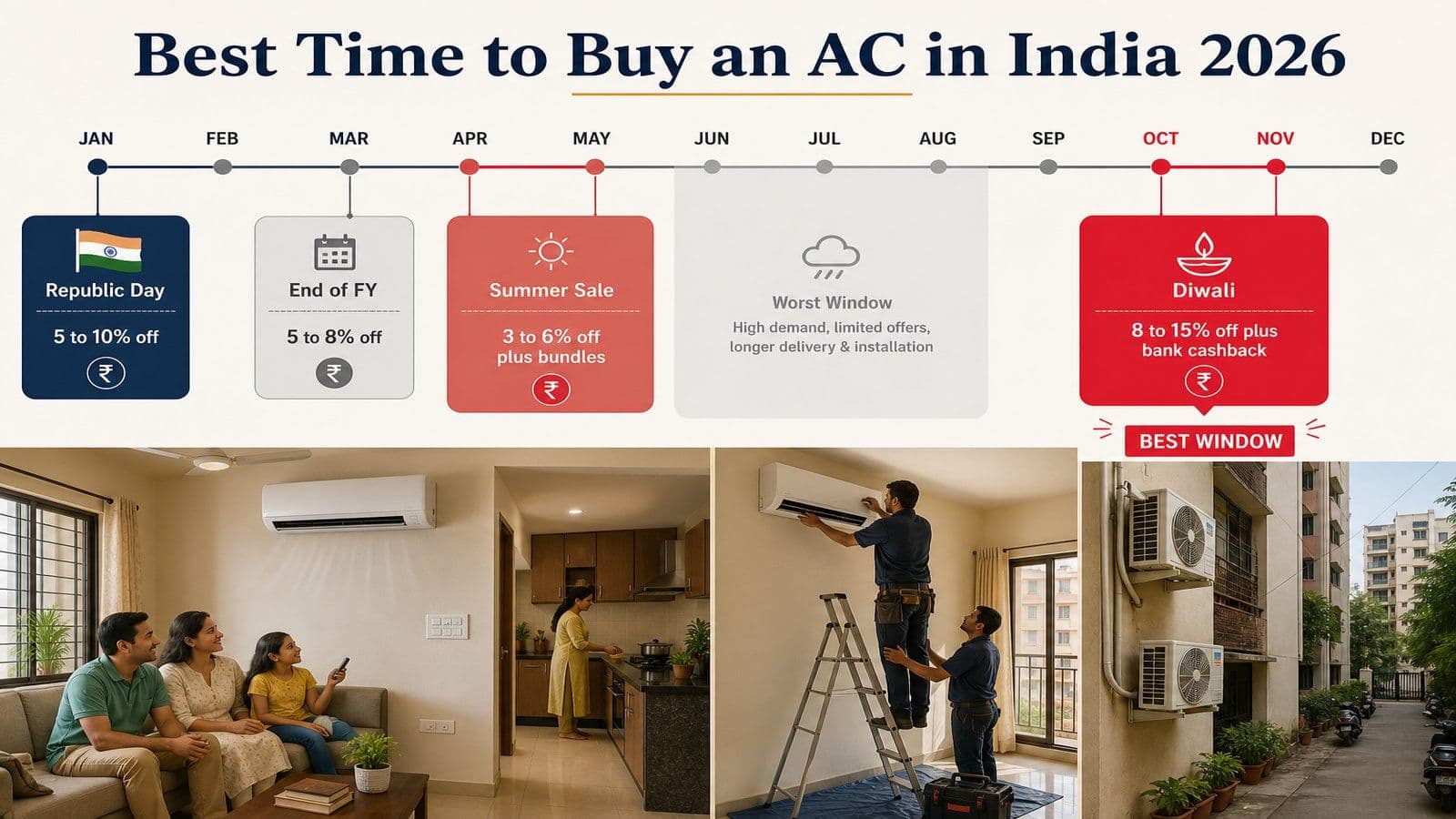
Photo: Indian AC festival discount calendar infographic
The Indian retail year has four meaningful AC discount windows.
Diwali (October to November)
The biggest single discount window. New model year inventory clears, and the genuine off-list discount runs 8 to 15 percent on most AC models. Bank cashback adds another 5 to 10 percent on top. Online platforms (and large multi-brand retailers like Croma and Reliance Digital) typically offer no-cost EMI on all units above ₹25,000. Diwali pricing is genuine but the unit you receive is the previous model year, which is fine for almost every buyer because residential AC technology moves slowly.
Republic Day (January)
A medium-sized discount window, 5 to 10 percent off. New model year units have just arrived, so the discount is on the same unit you would pay full price for in March. Worth it for buyers who plan ahead and can install before peak summer.
Summer Sale (March to May)
A demand-side rather than supply-side discount. Retailers extend EMI tenures, throw in installation bundles, and add small accessory packs. Headline discounts are smaller (3 to 6 percent), but the bundling can deliver ₹2,000 to ₹4,000 in real value once installation and stabiliser are factored in. This is the worst window for outright price discounts, but the best window for installation slot availability.
End of Financial Year (March)
A small window driven by corporate target-meeting at major retail chains. Sporadic 5 to 8 percent discounts appear on slower-moving inventory. Hit or miss but worth checking if you are buying in March.
Off-Cycle Windows
June, July and August deliver the worst pricing of the year for AC buyers. Inventory is depleted from summer demand, model year transition has not started, and there is no festival hook. If you can defer a purchase past August, do.
Buyers often ask whether the Diwali discount is real or marketing. It is real but the unit is last year's model, which is a feature not a bug because residential AC technology moves slowly. The buyers who realise this in September and book early in the Diwali window pay 8 to 14 percent less and get installation done before the next summer rush. Across the ProNearMe network we see buyers who walk in cold during May pay roughly 18 percent more all-in than buyers who planned the same purchase six months earlier.
EMI and Financing Options
No-cost EMI on ACs has become standard in India over the past three years. The "no cost" branding describes the consumer experience (₹40,000 unit divided into 12 equal monthly payments of around ₹3,333 with no extra interest visible) but the retailer is funded by the bank or the manufacturer through a discount that offsets the interest. The headline price often goes up by 2 to 5 percent on no-cost EMI purchases compared to outright cash.
Common EMI Configurations
| Plan | Tenure | Monthly Outflow (₹40,000 unit) | Total Paid |
| No-cost 6 months | 6 months | ₹6,667 | ₹40,000 |
| No-cost 9 months | 9 months | ₹4,444 | ₹40,000 |
| No-cost 12 months | 12 months | ₹3,333 | ₹40,000 |
| Standard 18 months at 13 percent | 18 months | ₹2,477 | ₹44,587 |
| Standard 24 months at 14 percent | 24 months | ₹1,920 | ₹46,073 |
The full set of options including credit-card EMI versus consumer-loan EMI, the differences between major retailer programmes, and the soft-cost trade-offs is covered in our AC EMI options India 2026 comparison. The short version, take no-cost EMI up to 12 months if your cash flow benefits, take outright cash and negotiate a 3 to 6 percent discount if it does not.
EMI Eligibility
Most major banks (HDFC, ICICI, SBI, Axis, Kotak) and consumer-finance firms (Bajaj Finserv, Home Credit, ZestMoney) offer no-cost EMI on ACs above ₹25,000. Eligibility requires either a credit card from the partner bank, a debit card with a sanctioned EMI limit, or a quick consumer-loan approval at the point of sale. Most approvals take under 10 minutes. Buyers without bank credit history can usually finance through Bajaj Finserv or Home Credit with a documented income proof.
Five-Year Total Cost of Ownership
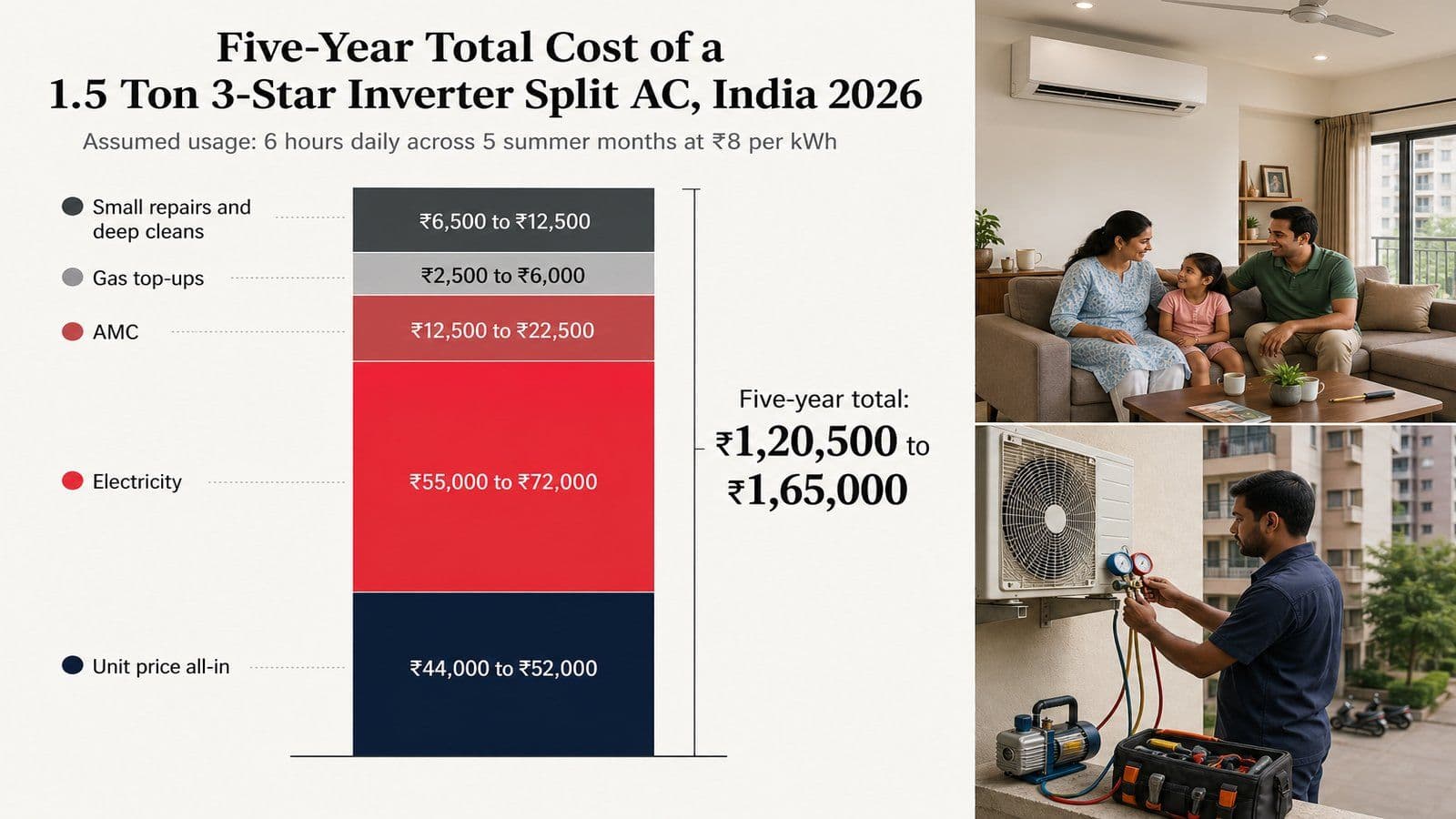
Photo: Five-year AC total cost of ownership stacked-bar chart
The unit price is only 18 to 22 percent of the genuine cost of owning an AC across its first five years. The rest is electricity, AMC, gas top-ups and repairs. The five-year frame is the right one for almost every purchase decision.
Typical Five-Year Breakdown (1.5 ton 3-star Inverter Split)
| Cost Component | Five-Year Total | Annual Average |
| Unit price (all-in installed) | ₹44,000 to ₹52,000 | One-time |
| Electricity (6 hours daily, 5 months, ₹8 per kWh) | ₹55,000 to ₹72,000 | ₹11,000 to ₹14,400 |
| AMC (standard plan) | ₹12,500 to ₹22,500 | ₹2,500 to ₹4,500 |
| Gas top-up (1 to 2 over five years) | ₹2,500 to ₹6,000 | ₹500 to ₹1,200 |
| Capacitor / sensor / small repair (1 to 2) | ₹1,500 to ₹4,000 | ₹300 to ₹800 |
| Deep chemical cleans (annual) | ₹5,000 to ₹8,500 | ₹1,000 to ₹1,700 |
| Five-year total | ₹1,20,500 to ₹1,65,000 | ₹24,100 to ₹33,000 |
Electricity is the single largest line. A BEE 5-star inverter unit drops the electricity component by 26 to 32 percent, which is why the 5-star premium pays back so reliably. The full breakdown of every variable that affects this calculation, plus a downloadable five-year planner, is in our AC total cost of ownership 5 years India guide.
Get quotes from verified, top-rated AC Service & Repair pros in Delhi.
Cost of Gas Refills Across Ownership
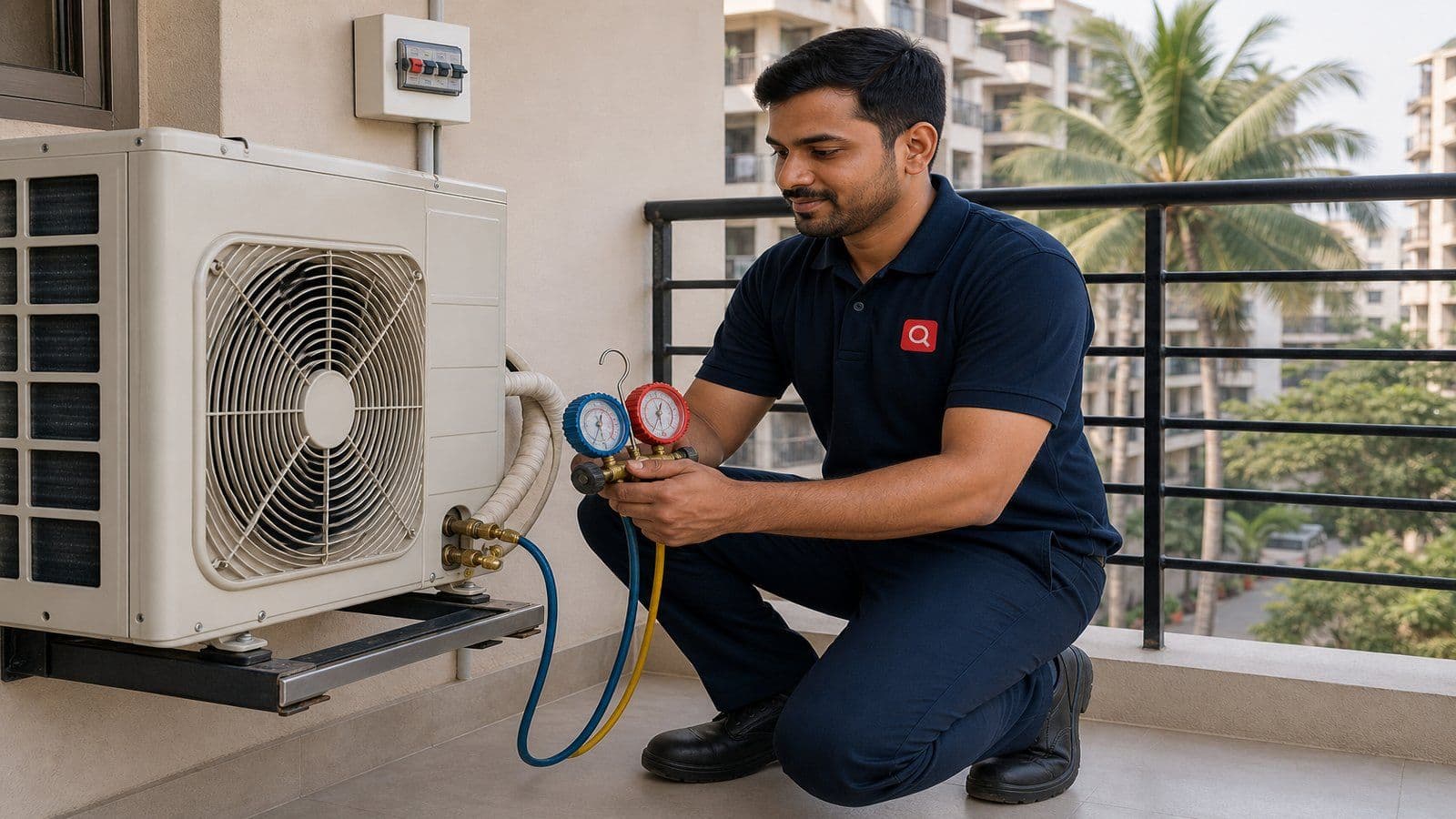
Refrigerant is not a consumable but it does leak slowly even in well-installed systems. A 1.5 ton split typically needs one full gas refill (₹2,200 to ₹3,800 on R32) or two top-ups (₹900 to ₹1,800 each) across a five-year window. Units in coastal cities or with sub-par installation need more frequent work. The dedicated AC gas refill cost India 2026 guide covers every refrigerant type, the regulator-compliant handling requirements under the MoEF&CC Ozone Cell rules, and the warning signs that you have a leak rather than a routine top-up.
AMC Pricing Tiers
Almost every brand-authorised service and most ProNearMe network technicians offer annual maintenance contracts. The 2026 bands are:
| AMC Type | Annual Cost (1.5 ton) | Coverage |
| Basic AMC | ₹1,800 to ₹2,800 | 2 to 3 general cleanings, filter wash, drain flush |
| Standard AMC | ₹2,500 to ₹4,500 | 3 to 4 visits, 1 chemical clean, capacitor + sensor + remote covered, 10 percent parts discount |
| Comprehensive AMC | ₹4,500 to ₹7,500 | Standard plus PCB + fan motor coverage, gas top-up included, unlimited visits |
The break-even on a standard AMC is two paid service visits per year, which most AC units older than three years easily exceed in tier-1 cities. For households running two or more ACs, the comprehensive plan almost always wins. For a single unit still under warranty, basic AMC or per-visit is usually cheaper.
The AMC question often gets framed wrong. Owners ask whether it is cheaper than per-visit service. The better question is whether they will actually book preventive service without an AMC reminder. In our data, owners without an AMC book preventive service in February or March only 18 percent of the time. With an AMC, it goes to 84 percent because the service provider schedules it. That preventive visit prevents the May breakdown that costs five times the AMC.
Premium Versus Value Tier Positioning
The Indian AC market splits broadly into three brand tiers, although the specific brand names sit outside the scope of this guide because positioning shifts quickly.
The value tier (₹26,000 to ₹38,000 for 1.5 ton 3-star) competes on outright price. Build quality, after-sales network coverage and software polish are basic but adequate. For first-time buyers, rental properties, or any setting where the AC will be replaced rather than repaired at end of life, the value tier delivers genuine value.
The mid-tier (₹34,000 to ₹48,000 for 1.5 ton 3-star) is where most Indian households buy. Build quality is good, the service network is wide, parts availability is reliable for at least eight years, and resale value holds reasonably. This is the recommended default for the typical owner-occupied apartment.
The premium tier (₹46,000 to ₹72,000 for 1.5 ton 3-star) competes on quietness, design, smart features, anti-corrosion coatings as standard, and longer parts-availability guarantees. The premium pays back for owners who value the soft attributes or who live in coastal cities where the corrosion resistance becomes a structural advantage. It does not pay back through electricity savings, because BEE 5-star efficiency is achievable across all three tiers.
Refurbished and Second-Hand Pricing
The Indian second-hand AC market is real but small and uneven. A genuine three-year-old 1.5 ton 3-star split in working order sells in the ₹14,000 to ₹22,000 band, against ₹34,000 to ₹46,000 new. The discount is steep but so is the risk. Refrigerant top-up needed, a worn capacitor, a near-end-of-life compressor, or undisclosed water damage can absorb the entire saving and more.
Refurbished units from established sellers (with a documented 6 to 12 month warranty) sit at ₹18,000 to ₹28,000 for the same specification. The warranty changes the maths. For renters, second properties, or short-term cooling needs, refurbished is a defensible choice. For a primary home where you will live with the unit for years, the new-unit warranty and the predictable failure profile usually justify the premium. The Press Information Bureau has covered the e-waste handling implications of second-hand appliance trade under the broader Ministry of Environment, Forest and Climate Change e-waste rules, which apply to any commercial seller.
Regional Variance in Ac Price India
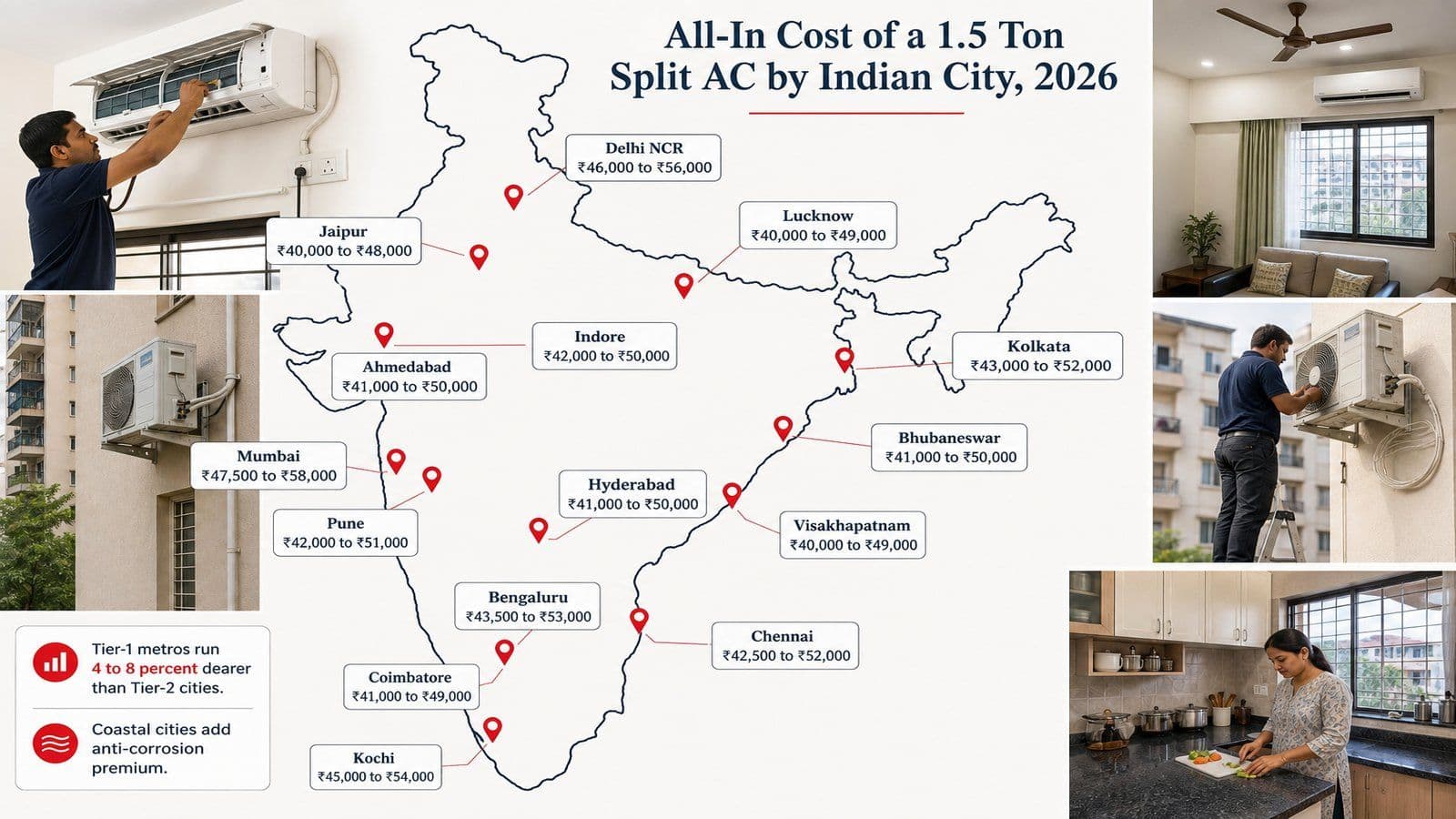
Photo: Indian city-by-city AC pricing map
The same AC unit does not cost the same in every Indian city. Three patterns hold.
Metro Versus Tier-2 Cities
Tier-1 metros (Mumbai, Delhi NCR, Bengaluru, Hyderabad, Chennai, Kolkata, Pune) carry a 4 to 8 percent premium on the unit price itself, mainly through dealer margin and logistics. Installation in metros runs 15 to 25 percent dearer than tier-2 cities (Jaipur, Indore, Lucknow, Coimbatore, Visakhapatnam, Bhubaneswar). Combined, the all-in price gap between Mumbai and Indore for the same 1.5 ton split inverter is ₹3,500 to ₹6,500.
Coastal Premium
Coastal cities (Mumbai, Chennai, Kochi, Visakhapatnam, Mangaluru) push installation higher because anti-corrosion coating (₹1,500 to ₹3,000) is essential rather than optional on outdoor units. The unit price itself is the same, but the all-in is 6 to 10 percent dearer.
Hill Stations and Cold Climates
Hill cities (Shimla, Manaali, Darjeeling, parts of Sikkim) buy heat-pump-capable AC units that cost ₹4,500 to ₹9,500 more than standard cooling-only units. The premium is justified because the unit doubles as a heater in winter, which is genuinely useful in these climates. Standard cooling-only AC units are over-specced for hill stations and rarely a good purchase.
A Real Powai Case Study
Mrs. Priya Deshmukh in Powai, Mumbai, contacted our ProNearMe network in March 2026 after receiving three quotes for a new 1.5 ton AC for her 130-square-foot master bedroom. The lowest quote (a brand-direct service partner) was ₹38,500 for a 3-star inverter split with "free installation and stabiliser". The middle quote (an established multi-brand retailer) was ₹42,800 for the same unit with itemised installation at ₹2,500 and a separate 4 kVA stabiliser at ₹2,800. The highest (an authorised dealer with a premium-tier suggestion) was ₹51,500 for a 5-star inverter from the mid-tier with full installation.
She picked the middle quote after we walked her through the actual numbers. The "free installation" on the lowest quote turned out to mean basic 3 metre copper only, with the 6 metre run her flat needed adding ₹2,400, and the "free stabiliser" was a 3 kVA underspecced for a 1.5 ton load. The corrected all-in on the lowest quote landed at ₹43,700, ₹900 dearer than the middle quote that already included the right stabiliser, BIS-aligned install and a one-year complimentary AMC visit. Twelve months on the unit is running clean, no warranty issues, and the dedicated 16-amp MCB her electrician added during the install has been triggered once during a monsoon voltage event, exactly the protection it was meant to deliver. Net advice the network gave her, the headline number is not the budget number, and a properly itemised quote almost always beats a "free everything" pitch.
What 2026 Brings That Buyers Should Budget For
Three industry shifts will affect ac price india across the next 12 to 18 months.
Refrigerant Transition Completion
R32 is now the standard refrigerant on every new residential AC sold in India. R410A inventory still appears occasionally but is being phased out. R22 is gone from new units and is restricted on the import side under the MoEF&CC Kigali Amendment timeline. Buyers should not consider any new unit that does not use R32.
Tariff and Component Cost Stability
Copper prices have stabilised after the 2024 spike. Aluminium is steady. PCBs have come down 4 to 6 percent year-on-year as Indian manufacturing capacity has expanded under the Production Linked Incentive scheme administered by the Ministry of Heavy Industries. Net effect, residential AC pricing is broadly stable in 2026 with most movement now driven by festival cycles rather than underlying cost.
Smart Diagnostics on Inverter PCBs
More inverter PCBs now log fault history. A small premium of ₹500 to ₹1,500 over basic units buys an AC that can self-diagnose intermittent issues, often saving the cost of a misdiagnosed service call. This is the most worthwhile feature add in the 2026 model year.
BEE Star Rating Revision
The BEE 2027 revision will tighten thresholds. A 5-star unit bought in 2026 will likely show as 4-star on the 2027 label. Performance does not change but resale value does. For buyers who plan to keep the AC for the full lifespan, this is irrelevant. For frequent upgraders, factor a small additional depreciation hit.
Conclusion
The ac price india story in 2026 rewards buyers who plan in layers. The unit price is one number, the all-in delivered cost is another, the five-year total cost of ownership is the most important one. Most household disappointment comes from optimising for layer one and discovering layers two through five later. A buyer who organises the quote into all five layers before any showroom visit consistently lands a better deal than one chasing the lowest headline number. Take the time to add installation, stabiliser, dedicated wiring and first-year service to your budget before you walk into a showroom. Compare the BEE 5-star premium against your actual hours of use. Pick the festival window if you can plan ahead. Choose an itemised quote over a "free everything" pitch every time.
The biggest single lever for keeping ac cost india under control is matching the unit to the room, not over-specifying. A right-sized 1 ton 5-star inverter beats an over-sized 2 ton 3-star unit on both upfront cost and five-year electricity. Combined with a BIS-aligned install, a quality stabiliser, NSDC-certified service, and a standard AMC, this is the formula that consistently delivers the lowest lifetime cost across the households in our ProNearMe network. Use the cluster guides linked throughout this article for the deeper breakdowns on each tonnage, type and financing option.
Disclaimer
All cost ranges in this guide are typical 2026 residential figures across major Indian cities and reflect both unit pricing and all-in delivered cost where noted. GST at 28 percent is built into the displayed retail prices used here. Actual costs vary by city, brand, retailer, festival cycle, financing programme and seasonal demand. We strongly recommend hiring only NSDC-certified or OEM-authorised technicians for installation, refrigerant handling, electrical work and any subsequent repair. Refrigerant work performed by uncertified personnel is illegal under the Ozone Depleting Substances Rules and the Kigali Amendment commitments and voids most manufacturer warranties. ProNearMe does not endorse any specific AC brand or retailer, and all cost ranges should be treated as planning guidance, not a fixed quote.
Sources & References
- Bureau of Energy Efficiency (BEE) Star Rating Programme for Room Air Conditioners
- Bureau of Indian Standards IS 1391 Room Air Conditioner Specifications
- Ministry of Environment, Forest and Climate Change Ozone Cell and Kigali Amendment Implementation
- Central Electricity Authority Regulations for Domestic Electrical Installations
- National Skill Development Corporation HVAC Technician Qualification Pack
- Indian Society of Heating, Refrigerating and Air Conditioning Engineers Residential HVAC Design Guidelines
- Press Information Bureau Energy Efficient Air Conditioning and PLI Scheme Coverage
- Department of Consumer Affairs Jago Grahak Jago Consumer Awareness Programme
- Goods and Services Tax Council Rate Schedule for White Goods
- Ministry of Power Energy Conservation Building Code and Residential Cooling Guidance

Amit worked as an AC technician for 6 years in Ahmedabad before transitioning to technical writing. He holds a diploma in Refrigeration and Air Conditioning from ITI Ahmedabad and understands the difference between what AC companies promise and what actually happens on the ground. His articles break down complex technical topics into plain language that any homeowner can follow. He tests every tip he writes about in his own home first.

Dr. Verma is a mechanical engineer with 15 years of experience in HVAC systems. She completed her PhD from IIT Delhi on energy-efficient cooling solutions for Indian residential buildings. She reviews all technical content on HomePros to make sure the numbers are right, the advice is safe, and the recommendations are backed by actual engineering principles. She consults for multiple AC manufacturers on product design.