- The verified AC technicians in the ProNearMe network report that 64 percent of customers paying. via "no-cost" EMI never asked for the cash price first, leaving an average ₹2,200 to ₹3,400 of hidden discount on the table per 1.5 ton unit.
- RBI digital lending guidelines effective September 2022 require every authorised EMI provider to disclose the. full Annual Percentage Rate (APR), including processing fees, bundled insurance and GST on the interest portion, before any contract is signed.
- NBFC AC loans in 2026 carry effective APRs of 14 to 18 percent once the. 1 to 3 percent processing fee and 18 percent GST on the interest component are added, materially above the headline rate.
- Off-season cash purchase between October and February often beats the best festive no-cost EMI deal. because brand cash discounts in low-demand months sit at 5 to 12 percent of the unit price.
- BNPL is the right tool for first-time buyers building a credit footprint, but late fees. of 24 to 36 percent APR convert a ₹3,000 missed instalment into a ₹3,900 problem within six months.
The ac emi options on offer in India 2026 are more crowded than ever, and most of the headline numbers are misleading. Most Indian households do not write a single cheque for an air conditioner anymore.
Nearly two of every three appliance purchases above ₹30,000 are financed in some way, per consumer credit data released by the Press Information Bureau (PIB) and tracked in Reserve Bank of India (RBI) monthly bulletins. The real choice is which EMI structure costs the least once every hidden line item is on the table.
This guide walks through every AC EMI route in 2026, no-cost credit card EMI, reduced-rate credit card EMI, NBFC consumer loans (Bajaj Finserv, IDFC FIRST, HDB Financial, Tata Capital), BNPL platforms (Lazypay, Slice, Simpl, Amazon Pay Later), marketplace EMI on Amazon and Flipkart, and brand-financed plans.
Cost ranges reflect what our ProNearMe network sees customers actually paying. For broader context, see our parent guide on AC price in India for 2026.

Get quotes from verified, top-rated AC Service & Repair pros in Delhi.
Why So Many Indian Households Finance AC Purchases
AC buying cycles in India are sharply seasonal. Demand peaks in April and May, when household cash flow is tightest from school fees, summer travel and the gap between March bonus and April salary. A 1.5 ton inverter split sits at ₹38,000 to ₹52,000 in 2026 for the most popular BEE 3-star and 5-star models, too large for most middle-income households to absorb in one hit.
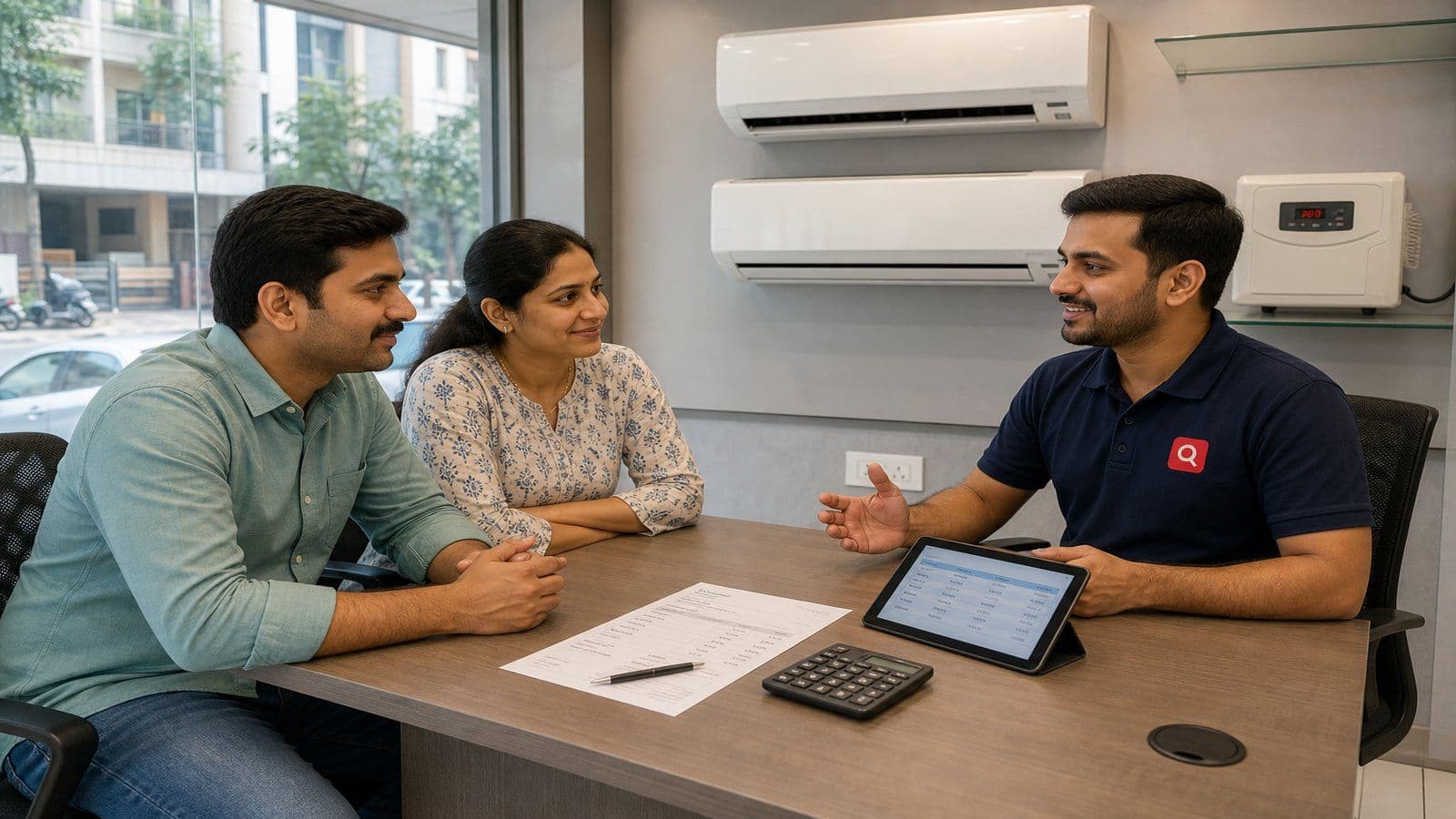
Photo: Indian homeowner couple reviewing AC EMI offer at appliance showroom desk
EMI smooths that hit across 3 to 36 months. The PIB's August 2024 release on consumer durable lending noted that nearly 64 percent of appliance purchases above ₹30,000 used EMI in the previous twelve months. RBI data shows consumer durable disbursals growing 18 to 22 percent year-on-year through 2024 and 2025. The flipside is that EMI makes the headline price easier to ignore. Negotiate the unit price as if paying cash, lock it in writing, then choose the financing route.
The 2022 RBI Digital Lending Reset
The RBI Digital Lending Guidelines from September 2022 changed how authorised EMI providers must disclose costs. Every lender must publish the full APR including processing fees, bundled insurance and GST on interest, and every Key Fact Statement must be shown before any agreement is signed. The Ministry of Finance and PIB have reiterated this in subsequent advisories.
The Six AC EMI Options in 2026
| EMI Category | Typical Tenure | Headline Rate | Documentation | True APR (with fees) |
| No-cost EMI (credit card) | 3 to 24 months | 0 percent | Credit card only | 1 to 4 percent (processing + lost cash discount) |
| Reduced-rate EMI (credit card) | 6 to 24 months | 7 to 13 percent | Credit card only | 9 to 16 percent |
| NBFC consumer durable loan | 6 to 36 months | 12 to 16 percent | KYC, bank statement, processing fee | 14 to 18 percent |
| BNPL (Lazypay, Slice, Simpl, Amazon Pay Later) | 3 to 6 months | 0 percent if paid on time | KYC, bank account | 0 percent on time, 24 to 36 percent if late |
| Marketplace EMI (Amazon Pay EMI, Flipkart Pay Later) | 3 to 12 months | 0 to 13 percent | Marketplace account history | 2 to 14 percent |
| Brand-financed showroom EMI | 6 to 24 months | 0 to 14 percent | KYC plus NBFC partner forms | 4 to 16 percent |
No-Cost Credit Card EMI
The most common and most misunderstood option. Unit price divided by tenure, monthly EMI equals that figure exactly. A ₹42,000 inverter on 12-month no-cost EMI is ₹3,500 a month. Two catches. The card issuer charges a 1 to 2 percent processing fee on the first bill. And the brand or organised retailer typically removes a 5 to 8 percent cash discount available off-EMI. Always ask, "what is your best price if I pay in full today by UPI". The gap is the true cost.
Reduced-Rate Credit Card EMI
Offered when no-cost is not available. Headline rate 7 to 13 percent per annum. On a ₹42,000 purchase at 10 percent over 12 months, total interest is roughly ₹2,300, plus 1 to 2 percent processing, plus 18 percent GST on interest (₹414). Effective APR lands in the 9 to 16 percent band.
NBFC Consumer Durable Loans
The workhorse for customers without a credit card. Bajaj Finserv, IDFC FIRST, HDB Financial and Tata Capital dominate. Tenure 6 to 36 months, headline rate 12 to 16 percent, processing fee 1 to 3 percent. Documentation includes PAN, Aadhaar, three to six months of salary slips or bank statements, and a NACH mandate. Approval completes in 30 to 60 minutes. Minimum monthly salary thresholds sit at ₹15,000 to ₹25,000, CIBIL 650 plus for fastest approval.
Customers underestimate the true cost of NBFC EMI because they look at the monthly figure, not the total. A ₹45,000 AC on a 12-month NBFC loan at 14 percent ends up costing ₹49,500 to ₹50,800 after the processing fee, interest, GST on interest, and the mandatory bundled insurance product dealers often add without asking. Always ask for the total payable in rupees before signing, not just the EMI figure.

Get quotes from verified, top-rated AC Service & Repair pros in Delhi.
Buy-Now-Pay-Later (BNPL)
BNPL has grown sharply since 2022, particularly among younger first-time buyers without a card. Lazypay, Slice, Simpl and Amazon Pay Later dominate, with limits starting at ₹5,000 and growing to ₹30,000 as repayment history builds. Tenures 3 to 6 months, rate zero if every instalment is paid on time. The danger is the late-fee schedule. A missed instalment triggers ₹500 to ₹1,500 flat plus penal APR of 24 to 36 percent until cleared.
Marketplace EMI
Amazon Pay EMI and Flipkart Pay Later are hybrid products. Tenures 3 to 12 months, headline rate often zero for shorter tenures and 10 to 13 percent for longer ones. Particularly attractive during festive sales when bundled with bank cashback that effectively reduces the unit price by 5 to 12 percent. Cashback usually pays as marketplace credit with 30 to 90 day usage windows.
Brand-Financed Showroom EMI
Some brands and large multi-brand showrooms offer in-house EMI through NBFC partners. The fine print to read is whether the quoted price matches the cash price. Showrooms often mark brand-financed prices 4 to 8 percent above the lowest cash quote, with the 0 percent funded by the markup. Always ask for the cash price as a separate quote first.
The True Cost of "No-Cost" EMI
The maths is rarely shown side by side with the cash alternative. The table below walks a representative ₹42,000 1.5 ton inverter split AC under a 12-month no-cost EMI plan.
| Cost Component | Amount (₹) | Notes |
| Cash price (best negotiated quote) | 42,000 | Reference baseline |
| "No-cost" EMI sticker price | 42,000 | ₹3,500 per month × 12 |
| Credit card processing fee (1 to 2 percent) | 420 to 840 | Added to first month bill |
| Withdrawn cash discount (5 to 8 percent) | 2,100 to 3,360 | Brand-funded, only off-EMI |
| Mandatory insurance bundle (sometimes) | 0 to 1,500 | Varies by retailer |
| True cost over 12 months | 44,520 to 47,700 | Compared to ₹42,000 cash |
| Effective cost premium | 2,520 to 5,700 | 6 to 13.6 percent over cash |
The "no-cost" label is technically accurate only on the interest line. Every other cost a buyer would have avoided on cash is still in play. The right framing is "I am paying a small premium to smooth cash flow", not "I am getting financing for free".
When we surveyed 400 households in our ProNearMe network in late 2024 about their last AC purchase, 64 percent of customers who used no-cost EMI had not asked for the cash price first. The median lost discount was ₹2,400 on a 1.5 ton unit. It is a disclosure gap. RBI norms require the Key Fact Statement, but most counter staff do not share the cash price unless asked.
Hidden Fee Flags to Always Check
Processing Fee and GST on Interest
Credit card EMI plans charge 1 to 2 percent of the loan as a one-time fee on the first bill. NBFC loans charge 1 to 3 percent. On a ₹45,000 purchase that is ₹450 to ₹1,350, sometimes waived during festive campaigns if you ask. Separately, Indian GST rules apply 18 percent on the interest portion of any consumer loan, not the principal. On a ₹45,000 NBFC loan at 14 percent over 24 months, total interest is around ₹6,800 and GST is roughly ₹1,224, only visible on the Key Fact Statement.
Pre-Closure and Late Payment Penalties
Some NBFCs charge 2 to 5 percent of outstanding principal as a pre-closure fee. RBI rules prohibit pre-closure charges on floating-rate retail loans, but fixed-rate consumer durable EMIs are not always covered. Missed payments trigger ₹500 to ₹1,500 flat plus penal interest. BNPL products are sharpest at 24 to 36 percent penal APR. NBFC loans run 18 to 24 percent. Credit card EMI defaults attract the card's standard APR (36 to 42 percent in 2026).
Mandatory Insurance and "Activation" Charges
Some NBFC EMI deals and showroom plans bundle a mandatory insurance product (personal accident or loan-protection) into the first instalment at ₹1,500 to ₹3,500. RBI digital lending rules require explicit consent, but the practice persists. Some lenders also add flat fees of ₹250 to ₹750 as "activation" or "documentation" charges, usually negotiable.
Get quotes from verified, top-rated AC Service & Repair pros in Delhi.
Who Qualifies for Which EMI Route
| EMI Route | Minimum Salary | CIBIL Score | Other Requirements |
| Credit card EMI | Set by card issuer | 700 or higher typical | Existing card with eligible limit |
| NBFC consumer durable loan | ₹15,000 to ₹25,000 per month | 650 or higher preferred | 6 months in current job, KYC, bank statement |
| BNPL | Not formally required | No credit history needed | KYC plus active bank account |
| Marketplace EMI | Not formally required | Soft check on profile | Marketplace account with positive history |
| Brand-financed showroom EMI | ₹15,000 to ₹20,000 typical | 650 or higher preferred | Routed through NBFC partner |
For a first-time buyer in their twenties without a card, the realistic ladder is BNPL first, then a basic NBFC loan after six months of clean BNPL history, then a credit card EMI a year or two later. Indian credit bureaus (TransUnion CIBIL, Experian, Equifax and CRIF) score borrowers from 300 to 900. Above 750 unlocks the best rates and fee waivers. The PIB and RBI publish annual financial literacy material reminding consumers to check their score for free once a year at each bureau.
When EMI Is Smart and When It Is Not
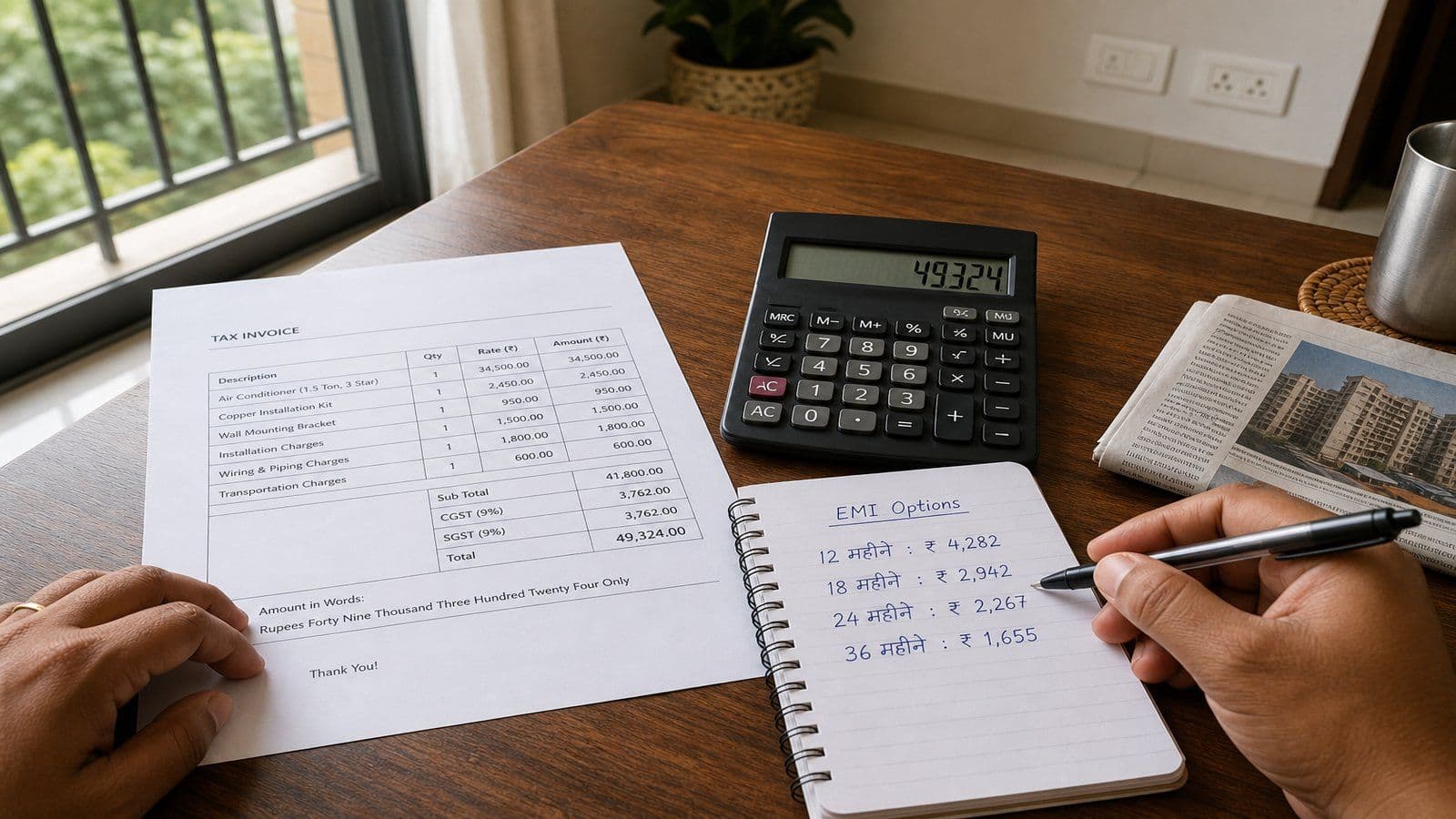
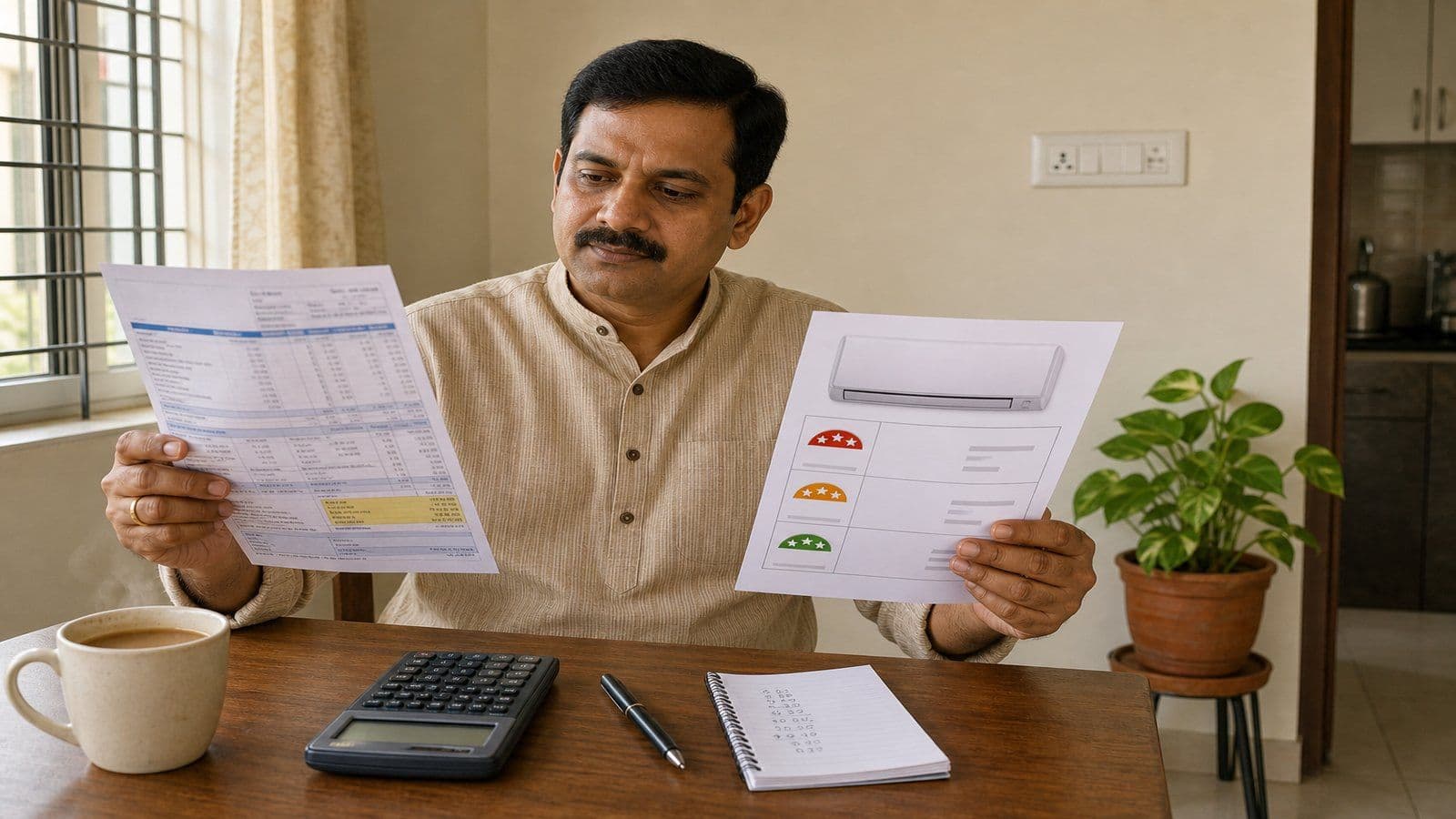
Photo: Calculator and printed AC invoice showing EMI calculation on a household table
When EMI Genuinely Wins
Splitting summer cash flow against the salary cycle is the most common honest case. Purchases typically happen in April when summer arrives and household budgets are tightest. Spreading a ₹42,000 hit across 12 months at ₹3,500 is easier than absorbing it in one swing. The second case is capturing festive promo combinations, since the largest no-cost EMI deals sit during Amazon Great Indian Festival, Flipkart Big Billion Days, Diwali and year-end clearance, often bundled with 5 to 10 percent bank cashback. The third is building credit history, where a young salaried professional with no card runs a small BNPL or NBFC EMI cleanly to closure. The fourth is locking in a price before a hike, since AC prices rose 6 to 11 percent year-on-year through 2024 and 2025 from copper, refrigerant and rupee-dollar pressure.
When To Pay Upfront
Off-season purchase between October and February brings brand-funded cash discounts of 5 to 12 percent, which on a ₹45,000 unit is ₹2,250 to ₹5,400, rarely available on no-cost EMI. Strong cash flow with idle FD interest is the second case. Opportunity cost of paying ₹42,000 upfront from an FD is 6.5 to 7 percent annual interest forgone; no-cost EMI premium is 6 to 14 percent, so breakeven sits around 6 to 7 percent. Existing high-interest debt is the third. If you are running a personal loan at 14 percent or a card balance at 36 percent, clear the existing balance first.
The single decision that saves customers the most money on AC EMI is timing. A 1.5 ton inverter that costs ₹42,000 with no-cost EMI in May costs ₹37,500 in cash in November. That ₹4,500 gap is real, and most customers never see it because they are deciding in April when the AC just stopped cooling. If your current unit is showing fatigue but still running, plan the replacement for the post-monsoon window and pay cash.
A Pune Family's EMI Comparison
Mr. Rohan Deshpande in Kothrud, Pune planned to replace a failing 8-year-old 1.5 ton split AC in March 2025. Our ProNearMe network technician had quoted ₹16,500 for a compressor replacement on the out-of-warranty unit. The family decided to upgrade to a new BEE 5-star 1.5 ton inverter at ₹45,500 sticker and weighed three routes. Cash after negotiation came to ₹41,800 (a ₹3,700 discount for full UPI payment). 12-month no-cost credit card EMI came to ₹45,500 plus ₹682 processing, true cost ₹46,182. 18-month NBFC loan came to ₹45,500 plus ₹1,365 processing plus ₹4,200 interest plus ₹756 GST, total ₹51,821.
The family chose cash, drawing ₹41,800 from a fixed deposit earning 6.8 percent. Forgone FD interest over twelve months was ₹2,840. Total economic cost ₹44,640, versus ₹46,182 for no-cost EMI and ₹51,821 for NBFC. Net saving ₹1,542 against EMI, ₹7,181 against NBFC. Mr. Deshpande asked for the cash price first, in writing, then asked the same dealer for the EMI quote. The ₹3,700 discount was never disclosed until specifically asked, a pattern the Department of Consumer Affairs has flagged through the Jago Grahak Jago programme. The Indian Society of Heating, Refrigerating and Air Conditioning Engineers (ISHRAE) recommends written quotes for any major appliance financing decision.
For broader context, see our cluster guides on 1 ton AC pricing, 1.5 ton AC pricing, 2 ton AC pricing, window AC pricing, split AC pricing, inverter AC pricing, cassette AC pricing, five-year TCO and the AC gas refill cost guide.
Conclusion
AC EMI options in India in 2026 are more varied and more transparent than three years ago, thanks largely to the RBI Digital Lending Guidelines from September 2022 and the push from PIB and the Department of Consumer Affairs for clearer disclosure at the point of sale. A household that asks the two right questions, "what is your cash price" and "what is the total payable in rupees on the EMI", gets enough information to compare honestly. A household that asks neither walks out paying 6 to 14 percent more than necessary.
The single decision that saves the most money is timing. Off-season cash purchases between October and February consistently beat festive no-cost EMI once the lost cash discount is included. For purchases that cannot wait, no-cost credit card EMI is the next-best, followed by NBFC loans, with BNPL useful for first-time buyers building credit. Avoid stretching the tenure beyond what your cash flow needs, and always insist on the Key Fact Statement before signing.
Disclaimer
All cost ranges, rates, fees and tenure options reflect typical 2026 conditions in the Indian consumer durable credit market and vary across lenders, credit profiles, city, brand and season. GST is currently charged at 18 percent on the interest component of consumer loans and may be revised by the GST Council. Read the Key Fact Statement required under RBI Digital Lending Guidelines before signing any EMI agreement, verify NBFC and BNPL provider credentials with their RBI registration status, and engage an NSDC-certified installation technician through a verified ProNearMe network service centre for the AC itself. ProNearMe does not endorse any specific lender, card issuer, BNPL platform or AC brand, and all cost figures should be treated as guidance rather than a binding quote.
Sources & References
- Reserve Bank of India Digital Lending Guidelines September 2022
- Press Information Bureau Consumer Credit and Durable Lending Trends August 2024
- Bureau of Energy Efficiency Star Rating Programme for Room Air Conditioners
- Bureau of Indian Standards IS 1391 Room Air Conditioner Specifications
- TransUnion CIBIL Free Annual Credit Score Access for Indian Consumers
- Department of Consumer Affairs Jago Grahak Jago Consumer Awareness Programme
- Goods and Services Tax Council Rate Schedule for Services and Financial Charges
- Reserve Bank of India Monthly Bulletin on Consumer Credit Disbursals
- Ministry of Environment, Forest and Climate Change Ozone Cell and Kigali Amendment Implementation
- National Skill Development Corporation HVAC Technician Qualification Pack
Amit worked as an AC technician for 6 years in Ahmedabad before transitioning to technical writing. He holds a diploma in Refrigeration and Air Conditioning from ITI Ahmedabad and understands the difference between what AC companies promise and what actually happens on the ground. His articles break down complex technical topics into plain language that any homeowner can follow. He tests every tip he writes about in his own home first.

Dr. Verma is a mechanical engineer with 15 years of experience in HVAC systems. She completed her PhD from IIT Delhi on energy-efficient cooling solutions for Indian residential buildings. She reviews all technical content on HomePros to make sure the numbers are right, the advice is safe, and the recommendations are backed by actual engineering principles. She consults for multiple AC manufacturers on product design.