- Tonnage by room size is the single biggest under-spec error. About 38 percent of the homes we audit in the ProNearMe network have an AC sized at least half a ton smaller than the room actually needs, which is why the compressor runs flat out and the bill is high.
- The January 2026 BEE revision shifted every rating down one step. A 5-star bought in early 2024 is now equivalent to a 4-star under the new ISEER thresholds. Always re-check before you compare or upgrade.
- The ₹3,000 to ₹5,000 premium for a 5-star inverter pays back in two to three summers for typical six to eight hour daily use. Below three hours a day, a 3-star non-inverter can still be the rational choice.
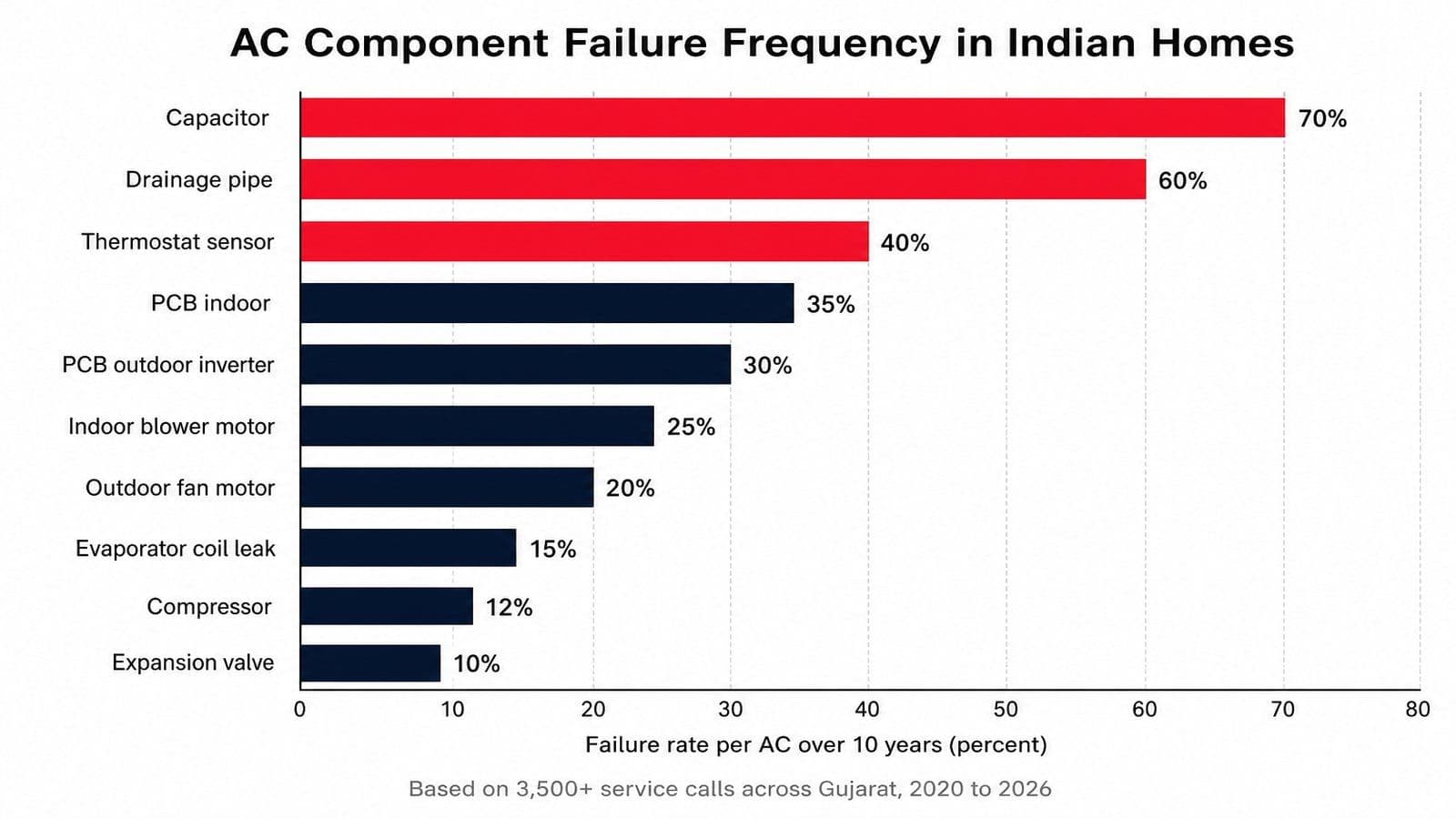
- Brand-authorised installation matters more than the brand of the unit itself. Around 60 percent of compressor failures we attend in year two trace back to an under-trained dealer installer, not a manufacturing defect.
- AMC under warranty is a waste of money in year one. Skip it, hold the brand to its own warranty, and revisit AMC in month 13 with an NSDC-certified independent technician.
This ac buying faq pulls together the 30 questions our team gets asked most often before someone walks into a showroom or clicks Add to Cart. The list is not a brochure summary, it is the same Q and A I run through when a friend or relative messages me asking whether to pick the 3-star or 5-star, whether to trust the dealer's installer, or whether the extended warranty is a fair trade.
The 2026 air conditioner market in India is messy. The Bureau of Energy Efficiency (BEE) revised the ISEER thresholds in January 2026 and quietly demoted every model by one star. Tariffs have gone up in most state DISCOMs, which the Ministry of Power (MoP) tracks in its monthly dashboards. R32 refrigerant has become the default and R410A models are being phased out faster than dealers admit, following the schedule set by MoEF&CC under the Kigali Amendment. New entrants are crowding the entry tier with aggressive pricing and uneven service networks. None of this is in the average buying guide.
For a wider walkthrough of how the AC works, what the seasonal rhythm looks like, and how to hire a technician, see the Complete AC Owner's Guide for Indian Homes, the pillar this FAQ sits under.
I have personally supervised over 1,800 AC installations and 3,500 service calls across Ahmedabad, Gandhinagar, and the wider Gujarat region in the past six years. The answers below are the ones that actually save people money or save them from a bad install. Every question is short. Every answer is grounded in what I see on Indian rooftops, in Indian flats, and in Indian electricity bills.

Get quotes from verified, top-rated AC Service & Repair pros in Delhi.
Tonnage and Capacity
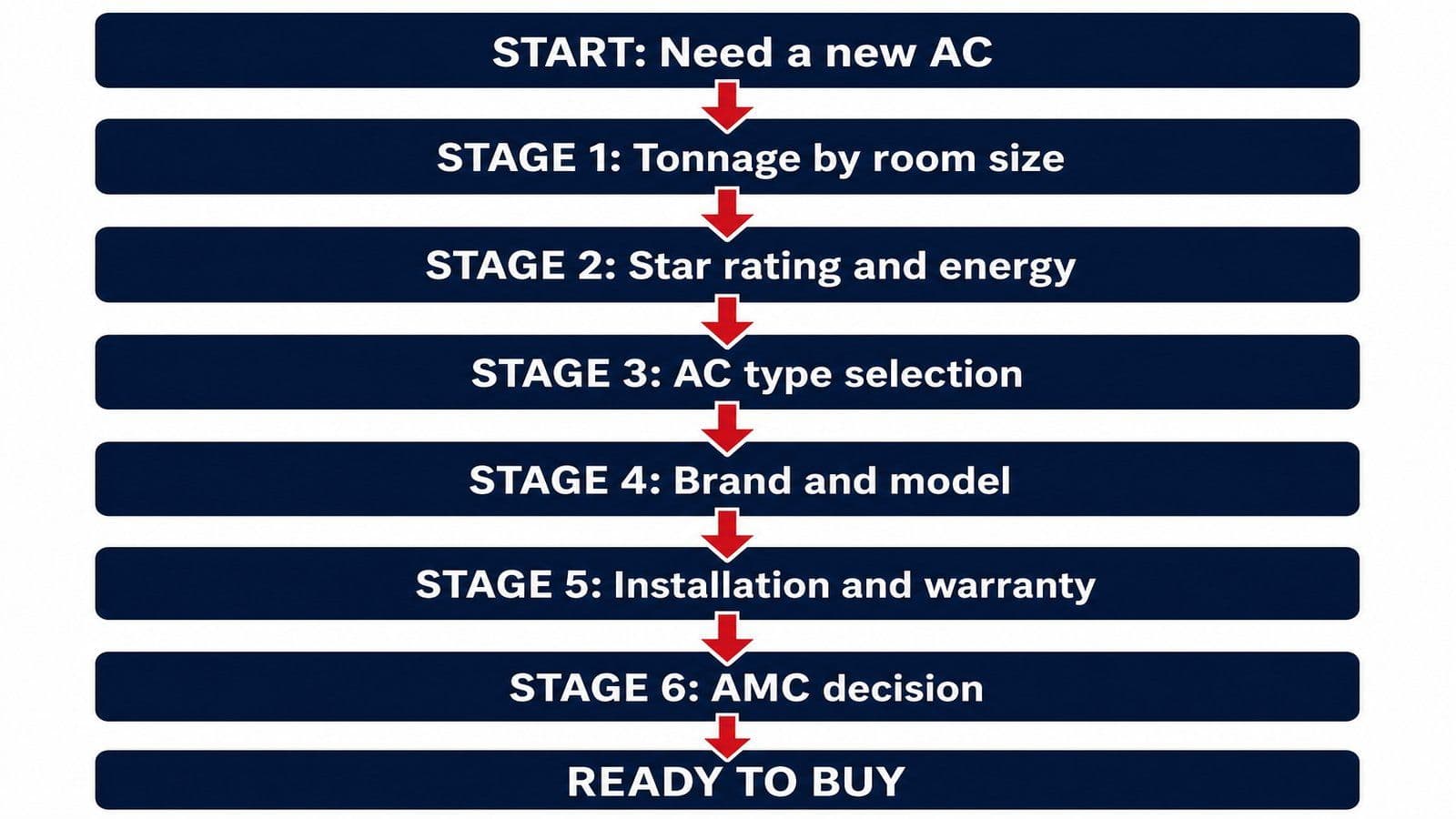
Photo: AC buying decision flowchart for Indian homes
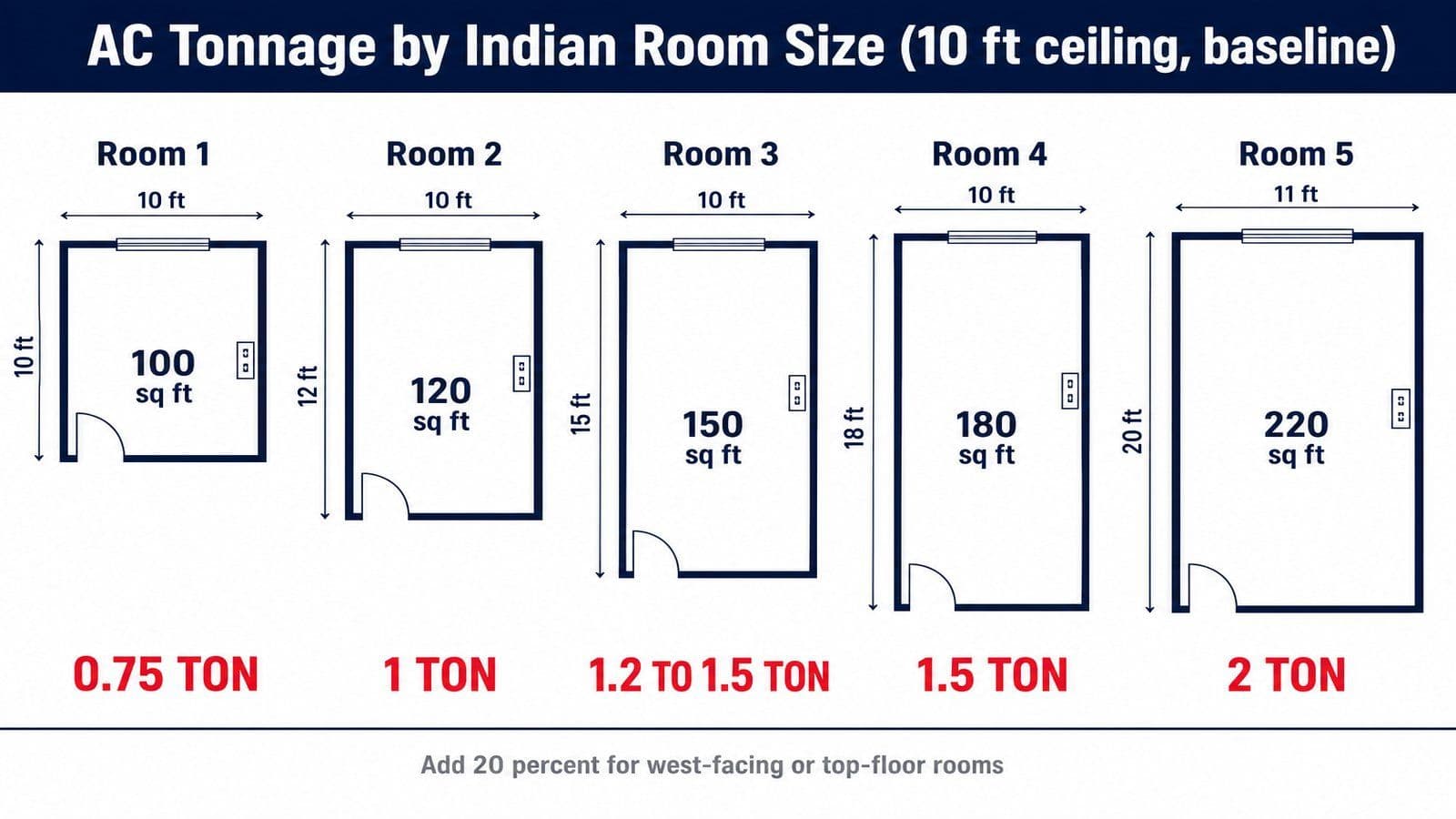
Photo: AC tonnage by Indian room size
This is the first decision and the one most people get wrong. The general rule for Indian climate is 0.1 ton per 10 sq ft for a standard 10 ft ceiling room with one external wall, no west-facing window, and moderate occupancy. Everything below adjusts from that baseline.
What tonnage AC do I need for a 120 sq ft bedroom?
A 1 ton split is the right answer for a 120 sq ft bedroom in most of India, assuming a 10 ft ceiling, one external wall, and standard occupancy of two adults. If the room sits above a hot kitchen or under a sun-baked terrace, step up to 1.2 ton. A 0.8 ton can also work in cooler climates like Bengaluru or Pune for the same room size, but never go below that. An under-sized AC runs the compressor at 100 percent duty cycle through every summer afternoon, which doubles your wear on the compressor and drives the bill up.
What about 150 sq ft / 180 sq ft / 220 sq ft rooms?
For a 150 sq ft room go 1.2 to 1.5 ton. For 180 sq ft pick 1.5 ton as the default and 1.8 to 2 ton if the room is poorly insulated. For 220 sq ft you need 2 ton, no shortcuts. The temptation to fit a single 1.5 ton in a 220 sq ft hall to save ₹8,000 is real, but the compressor will never catch up on a 42 degree Delhi or Ahmedabad afternoon and the room temperature will plateau at 28 degrees no matter what you set on the remote.
| Room size | Standard load | Hot orientation or top floor | Open hall or kitchen attached |
| Under 100 sq ft | 0.75 ton | 1 ton | 1 ton |
| 100 to 140 sq ft | 1 ton | 1.2 ton | 1.5 ton |
| 140 to 180 sq ft | 1.2 to 1.5 ton | 1.5 ton | 1.8 ton |
| 180 to 240 sq ft | 1.5 to 2 ton | 2 ton | 2.5 ton |
| 240 to 320 sq ft | 2 ton | 2.5 ton | 2.5 ton plus second unit |
Does ceiling height change the tonnage?
Yes, and most buying guides ignore this. The baseline assumes a 10 ft ceiling. If your room is 11 to 12 ft, add about 15 percent to the calculated tonnage. Old construction in cities like Kolkata and Chennai often runs 12 to 14 ft, and a 1 ton in a 120 sq ft room with a 13 ft ceiling will struggle the same way a 1 ton would in a 160 sq ft room with a normal ceiling. For double-height living rooms above 14 ft, do not try to solve it with a single split. Either install two splits at opposite walls or move to a cassette or tower unit.
How does west-facing vs north-facing affect choice?
A west-facing wall absorbs heat from roughly 11 am until sunset and re-radiates it into the room well past 8 pm. A north-facing room with no afternoon sun is the easiest case in India. The practical rule:
- North or east-facing room: use baseline tonnage from the table
- South-facing room: add 10 percent to baseline
- West-facing room or top floor: add 20 percent to baseline
- West-facing top-floor room with no insulation on the roof: add 30 percent, or invest in roof insulation first and stick with baseline tonnage
I have seen too many people buy an under-spec AC because the dealer quoted them on square footage alone. The room orientation, the floor, and the wall material change the load by 20 to 30 percent. Always do the heat-load calculation properly before you sign the invoice.

Should I oversize my AC to cool faster?
No. Oversizing is the second most common mistake after undersizing, and it costs you more in the long run. A 2 ton AC in a 120 sq ft room will cool the air down in eight minutes flat, then short-cycle on and off all afternoon. Short cycling chews up the compressor's start capacitor, gives you uneven humidity (the room feels clammy because the coil never runs long enough to dehumidify), and burns extra electricity on every startup. A correctly sized AC runs longer cycles at lower power and gives a more comfortable room. Cool fast is a marketing line, not a comfort goal.
Star Rating and Energy
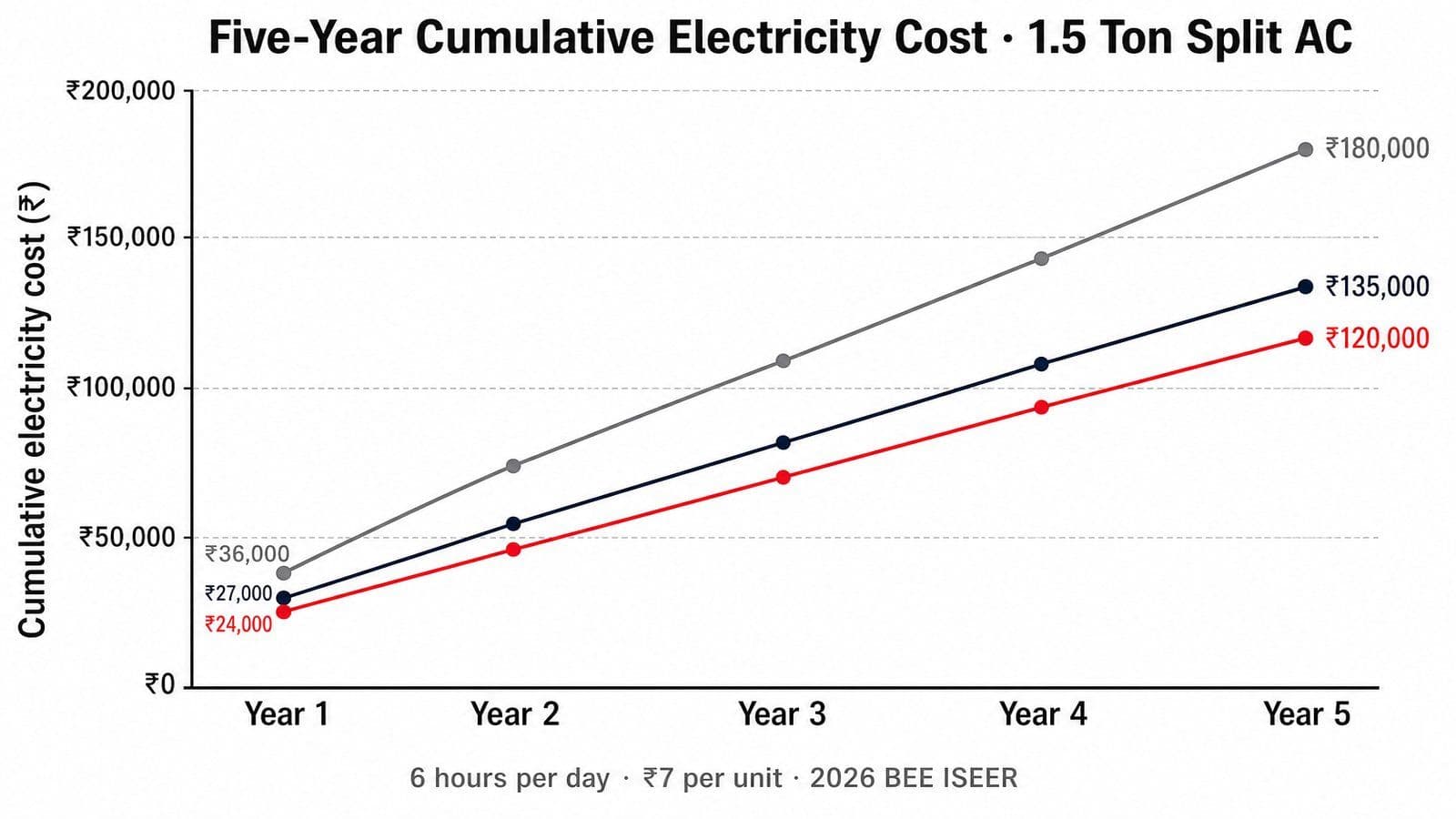
Photo: Star rating five-year cost curve
The star rating system is genuinely useful, but only if you understand what it measures and how it changed in January 2026. Half the confusion in showrooms today comes from the gap between old labels and new thresholds. For the full mechanics of the rating scheme, see our companion explainer on the BEE star rating for ACs.
Get quotes from verified, top-rated AC Service & Repair pros in Delhi.
Is a 5-star AC always worth the price premium?
Not always. The premium runs ₹3,000 to ₹5,000 over an equivalent 3-star inverter for the same brand and tonnage. The payback works out roughly like this:
- Daily use over 6 hours through the four hot months (Apr to Jul): yes, 5-star pays back in two to three summers
- Daily use 3 to 6 hours: 5-star pays back in four to five summers, still worth it for the 10 to 12 year life of the unit
- Daily use under 3 hours, mostly evening cooling: a 3-star inverter is the more rational pick, payback on 5-star slips past seven years
What's the real-world ISEER vs label gap?
ISEER is a lab number measured at controlled conditions over a 1,600-hour test cycle. Real-world ISEER in a Mumbai or Delhi summer typically lands 10 to 15 percent below the label, because room conditions are hotter, dustier, and the unit cycles differently than the test rig. A label ISEER of 5.0 in practice gives you something closer to 4.3 to 4.5. This is not a scam, it is the normal physics of any test-rig to field-condition gap, and the gap is consistent across brands.
Does the January 2026 BEE revision change my buying decision?
It changes what you compare against, not the decision itself. After the revision, a 5-star split AC needs ISEER 5.0 (up from 4.5). A 4-star needs 4.5 (up from 4.0). What you should do:
- If you bought an AC in 2023 or earlier and the sticker says 5-star, treat it as effectively 4-star for any comparison with new units.
- If you are buying new in 2026, the 5-star label is genuinely more efficient than the old 5-star. The price premium also reflects the genuine engineering improvement, not just a label refresh.
- Do not let dealers clear out old 5-star stock at a discount by promising it is the same as new 5-star. It is not.
Inverter or non-inverter for daily use under 6 hours?
For under 6 hours of daily use, the inverter advantage shrinks. An inverter shines when the AC runs for 4 to 6 hour stretches, because it can throttle down once the room hits set temperature and hold it there at low power. For short 1 to 2 hour bursts, the unit barely gets out of the high-power startup phase and you do not see the full inverter benefit. The price gap is around ₹4,000 to ₹6,000 between equivalent inverter and non-inverter models. If your usage is genuinely under 3 hours a day, the non-inverter saves you money upfront and the lifetime cost difference is small. Above 4 hours daily, inverter every time. For the full mechanism of how compressor speed control works, see our companion piece on how AC works and its components.
Will a 5-star AC actually cut my bill by 30%?
Compared to a 1-star, yes, roughly. Compared to a 3-star, no, the saving is more like 15 to 20 percent. The 30 percent number you see in brand adverts almost always compares against the lowest possible reference (a 1-star non-inverter from five years ago). Against the realistic comparison point of a current 3-star inverter, you save about ₹1,800 to ₹2,500 per year for six hours of daily use at ₹7 per unit. Worth it, but the maths is honest at 15 to 20 percent, not 30.
Star ratings are useful but they are not magic. A 5-star AC with a dirty filter, a leaky duct, and a 28 degree thermostat setting will use more electricity than a 3-star AC that is well maintained and set to 25 degrees. Maintenance matters as much as the label.
AC Type Selection
The five AC types each fit a specific scenario. Most Indian homes default to split for the bedroom and that is usually correct, but the edge cases below come up often enough to be worth thinking through. For a deeper breakdown of each unit format, see Types of AC Units Compared.
Window or split for a small Mumbai 1BHK?
For a small Mumbai 1BHK with rooms under 120 sq ft and existing window cuts, window AC is genuinely the smarter pick. Lower installed cost (₹18,000 to ₹28,000 versus ₹30,000 to ₹45,000 for an equivalent split), zero copper-pipe complications, and no outdoor unit to negotiate with the building society. The noise penalty is real but in a small bedroom with a single occupant, most people stop noticing within a week. The catch: many of the 2026 BEE-compliant window models are out of stock in Mumbai dealers and you may need to special-order or wait. If you can wait two to three weeks, window is the right call. If you cannot, go split.
When does a cassette AC make sense?
Cassette makes sense for open halls above 250 sq ft, especially in independent houses or villa-style layouts where the ceiling is solid concrete and accepts a recessed mount. The 360-degree airflow gives much better coverage than a single wall-mounted split aimed across a large room. The catch is the install cost, expect ₹15,000 to ₹20,000 in additional electrical, civil, and ducting work beyond the unit price. Cassette also needs a false-ceiling depth of at least 12 inches, which rules it out for most modern flats where the false ceiling is only 6 to 8 inches deep.
Is portable AC worth it for rented homes?
For a renter who genuinely cannot get landlord permission for a split install, yes. For everyone else, no. Portable units lose about 30 percent of their stated cooling capacity to the exhaust hose itself, run noisily at 55 to 60 decibels (a normal split is 22 to 26 decibels indoors), and cost ₹25,000 to ₹45,000 for what is effectively a 0.8 ton equivalent unit. If you will be in the same rented flat for two or more summers, it is cheaper to negotiate a window AC install with the landlord (offer to leave it for the next tenant) than to buy a portable.
What's the difference between cassette and tower?
A cassette is a ceiling-recessed unit with four-way overhead vents. A tower (also called floor-standing) is a tall vertical unit that sits on the floor against a wall, around 5 to 6 feet high. Cassettes give better airflow distribution in square or rectangular halls. Towers are easier to install (no ceiling work) and are the right pick for double-height halls above 14 ft where ceiling-mounted units are too far from the seating area to be effective. Tower units also work well in shop fronts and reception areas where the unit's vertical presence is acceptable.
Should I go for a hybrid solar AC?
Hybrid solar ACs are starting to get serious attention in 2026 but the economics still need scrutiny. A hybrid system pairs the AC with a small DC-coupled solar panel array (1.5 to 3 kWp typical) and a hybrid inverter that runs the AC on solar during peak generation hours and grid electricity at night. The unit price is roughly 2.5 to 3 times an equivalent regular 5-star inverter. Payback works out to seven to ten years depending on your electricity tariff. If you already have rooftop solar, do not buy a hybrid AC, just run your regular 5-star inverter off the existing solar through your normal grid-tied inverter. If you have no solar yet and live in a city with high tariffs (above ₹9 per unit) and high daytime cooling load, the hybrid math starts to look interesting around year five.
Brand and Model
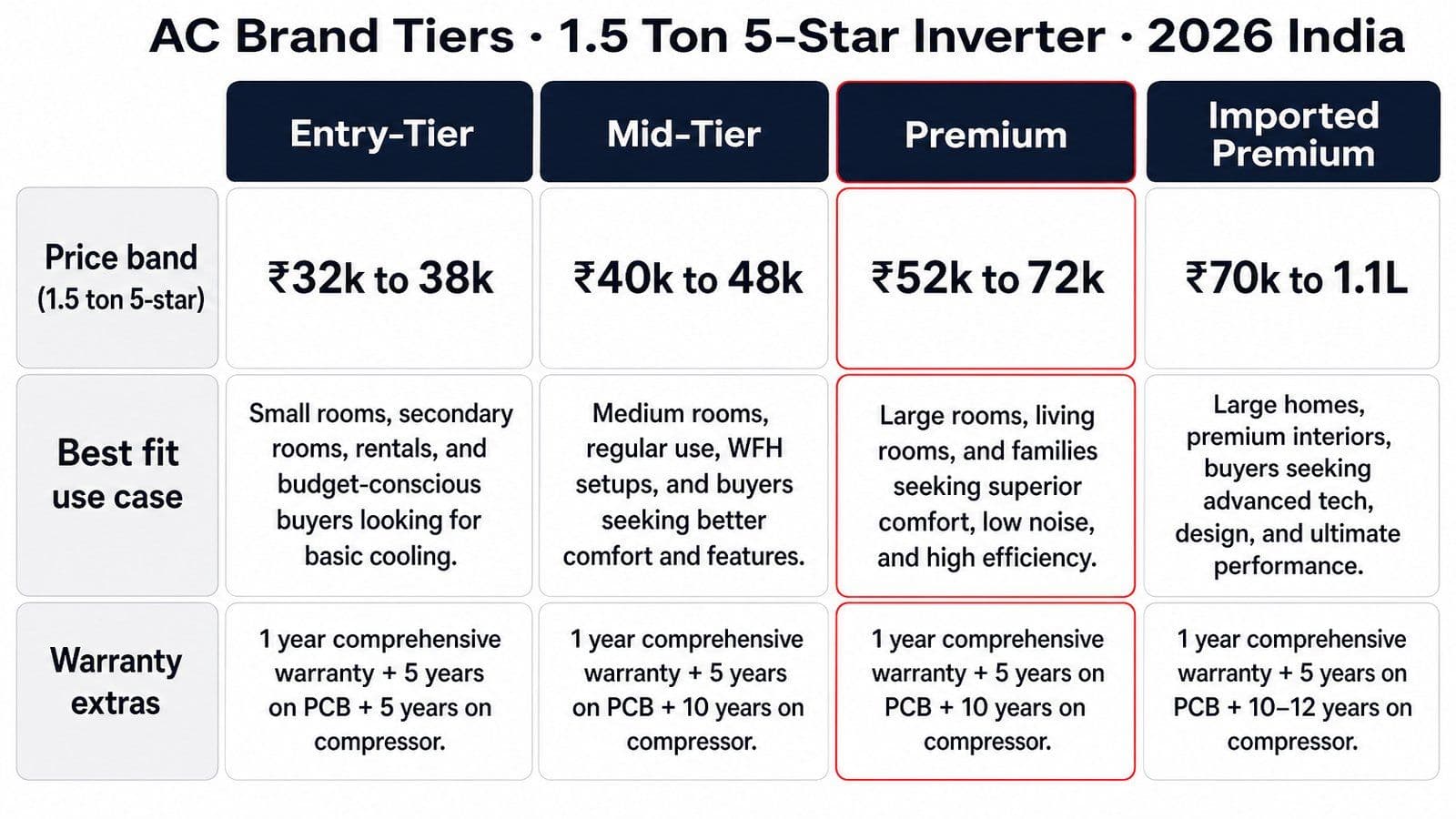
Photo: AC brand tier and price matrix
Brand questions get more emotional than they should. The honest answer is that for the same star rating and tonnage, the performance differences between top brands are small. Service network density and your local technician quality matter more.
Get quotes from verified, top-rated AC Service & Repair pros in Delhi.
How important is the brand vs the star rating?
Star rating matters more for your electricity bill. Brand matters more for service experience, warranty handling, and parts availability. For the actual physics of cooling your room, a 5-star inverter from any BEE-listed brand will perform within 5 percent of any other 5-star inverter at the same tonnage. The brand difference shows up in year three when you need a PCB replacement, and one brand stocks the part in your city while another makes you wait three weeks for an import.
What's the difference between brand entry-tier and premium models?
Within the same brand, the entry-tier (often labelled the "value" or "basic" range) and premium (often "luxury" or "AI-series") models share the same compressor and refrigerant cycle. What differs is the indoor unit's build quality, the remote functionality, the filter package (anti-virus filter, PM2.5 filter, ioniser), and the cosmetic finish. The premium model also typically gets the longer warranty terms. The price gap of ₹15,000 to ₹25,000 buys you mostly cosmetics and filter upgrades, not better cooling.
| Tier | 1.5 ton 5-star indicative price (2026) | What you actually get extra | Worth the premium for |
| Entry-tier inverter | ₹32,000 to ₹38,000 | Basic remote, single filter, 1 year full + 5 year PCB + 10 year compressor | Bedroom AC, 4 to 6 hours daily use |
| Mid-tier inverter | ₹40,000 to ₹48,000 | Better acoustics, PM2.5 filter, Wi-Fi, slightly faster cooling | Living room AC, 6 to 8 hours daily use |
| Premium inverter | ₹52,000 to ₹72,000 | Anti-virus filter, voice control, low-voltage operation, 18 month full warranty | Master bedroom, low-noise priority, severe voltage areas |
| Imported premium | ₹70,000 to ₹1,10,000 | Quieter compressor, longer in-warranty period, slightly higher real-world ISEER | Metro-only with dense service network |
Should I buy a "smart" Wi-Fi AC?
Wi-Fi connectivity in an AC is genuinely useful for two things: turning on the AC remotely 20 minutes before you reach home, and checking that you actually turned it off after leaving. Everything else (voice control, usage analytics, AI scheduling) sounds impressive in the demo but most owners stop using it after the first month. The Wi-Fi feature itself adds ₹3,000 to ₹5,000 to the price. If remote turn-on matters to you (long commute, hot afternoon arrival), worth it. Otherwise skip it.
Are imported brands worth the premium?
Premium imported brands (Japanese and European) cost 30 to 50 percent more than equivalent Indian-made models. The build quality is genuinely better and the noise floor is lower. The catch is the service network outside the top six cities is thin, and out-of-warranty parts are expensive. If you live in Mumbai, Delhi, Bengaluru, Pune, Hyderabad, or Chennai, an imported premium brand is a reasonable luxury choice. In tier-2 and tier-3 cities, the after-sales hassle usually outweighs the build-quality benefit.
What about emerging Indian brands?
Several Indian brands have launched aggressive entry-tier ranges in 2024 to 2026, priced 15 to 25 percent below the established players. The compressors in these units are typically sourced from the same handful of global suppliers as the bigger brands, so the cooling performance is usually fine. The weakness is the service network. Before buying any emerging brand, check directly whether they have a branded service centre in your city and read recent reviews of service-call response times. If both check out, the savings are real. If either is weak, pay the premium for an established brand with a dense service network.
The biggest factor in long-term AC satisfaction is not the brand badge, it is whether your city has a branded service centre that answers the phone in summer. Always verify this before you buy, even if it means walking out of a showroom and calling the brand's 1800 number from the parking lot.
Installation and Warranty
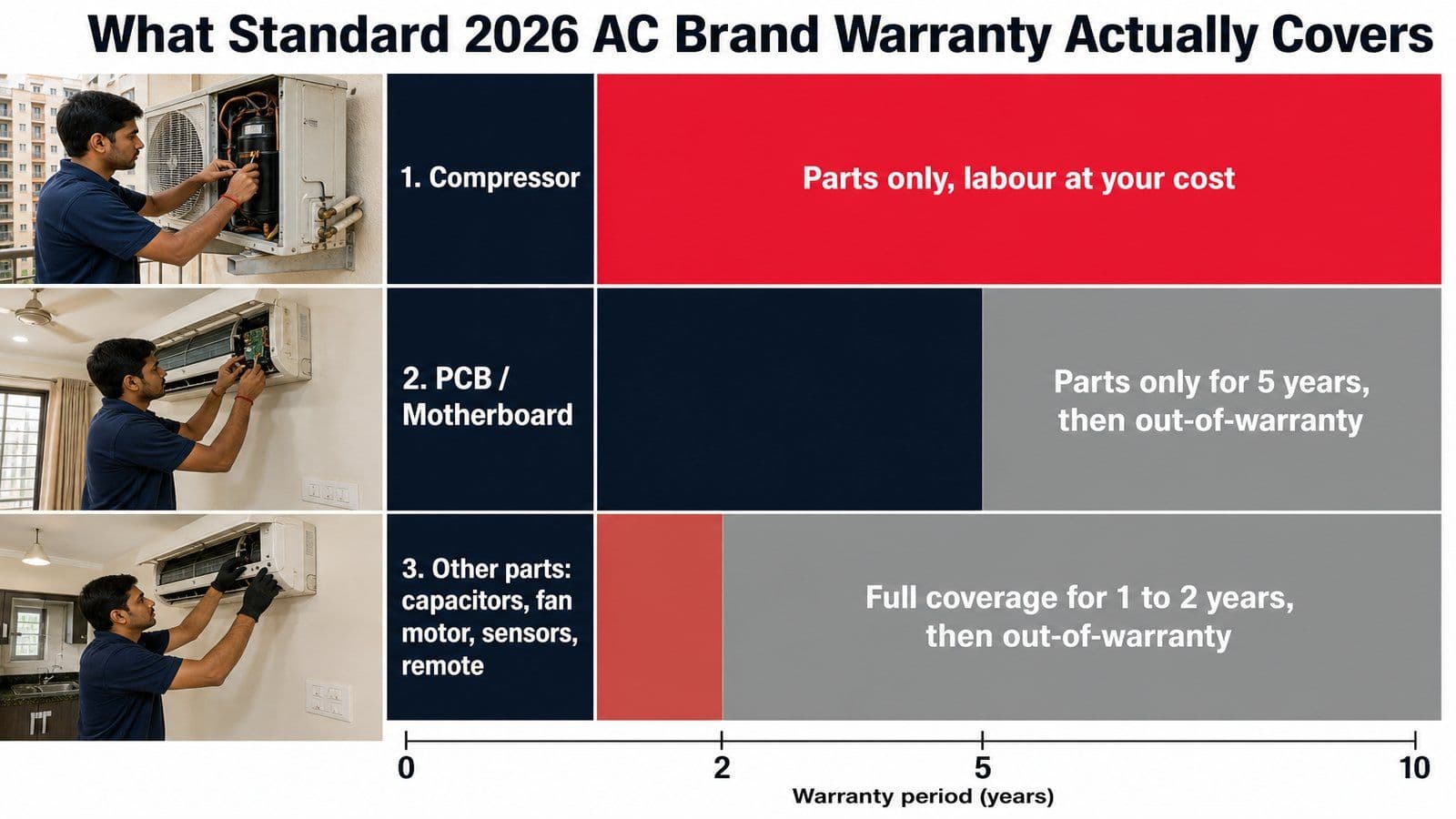
Photo: AC warranty coverage breakdown
The install is where 60 percent of year-two compressor failures originate. The unit warranty is what you fall back on when things go wrong. Both deserve more attention than most buyers give them.
Does the dealer's installer matter or should I hire separately?
The dealer's installer matters more than the dealer realises. Most large dealers outsource installation to a third-party crew paid ₹600 to ₹900 per install. At that rate, the crew has every incentive to finish in 90 minutes and move on, which is exactly how you get under-flared copper joints, missing wall sleeves, and skipped vacuum-and-leak-test. Two safer options:
- Insist on a brand-authorised installer by name, not just "an authorised installer" verbally. Ask for the technician's NSDC certification number before they start work.
- Hire a verified independent installer separately and ask the dealer for an installation-discount on the invoice. A good independent install costs ₹1,800 to ₹2,800 for a 1.5 ton split and you get a crew that takes 3 to 4 hours to do it properly.
What does the brand warranty actually cover (compressor / PCB / parts)?
Standard 2026 brand warranties on inverter splits look like this in practice:
- Compressor: 10 years parts only. Labour to remove, replace, and recharge refrigerant is your cost, typically ₹3,000 to ₹5,000.
- PCB / motherboard: 5 years parts only. Same labour catch.
- Other parts (capacitors, fan motor, sensors, remote): 1 to 2 years full coverage.
- Refrigerant top-up: not covered after the initial 30-day install warranty.
Read the actual warranty card, not the box marketing. The headline number ("10 year warranty") almost always refers to compressor parts only.
Is the extended warranty worth ₹3,000?
Generally yes, if it adds 2 to 3 years of full PCB and parts coverage beyond the standard 5-year PCB warranty. PCBs are the most common expensive failure in year six to eight and cost ₹6,000 to ₹12,000 to replace out of warranty. Extended warranties that only extend the compressor coverage (already 10 years) are not worth ₹3,000 because you are unlikely to claim against them. Read the inclusion list before you pay.
Get quotes from verified, top-rated AC Service & Repair pros in Delhi.
How do I verify a real-vs-fake brand-authorised technician?
Three checks before you let the technician open the unit:
- Call the brand 1800 service number from the technician's mobile and confirm the work order number against their job-sheet.
- Ask for the NSDC certification number and cross-check it on the NSDC skill portal.
- Check the uniform and the ID card for the brand logo and a photograph that matches the person.
Authorised technicians will not object to any of these checks. A technician who refuses or stalls is almost certainly a contractor who is not actually on the brand's payroll. This matters because warranty claims are voided if the install or service was done by an unauthorised person.
What's a fair installation labour charge in 2026?
For a standard 1.5 ton split install in a flat with no special requirements (existing wall hole, regular power point, ground-floor outdoor unit access), fair charges are:
- Basic install (1.5 m copper, standard bracket, no civil work): ₹1,500 to ₹2,200
- Extended install (3 m copper, drilling, sleeve fitting): ₹2,500 to ₹3,500
- Top-floor or crane-required outdoor unit lift: add ₹1,500 to ₹3,000
- Additional stabiliser wiring or MCB upgrade: add ₹800 to ₹1,500
Anything quoted above these ranges without a clear reason (extra copper length, civil work, high-rise mounting) is the installer testing your price sensitivity. Push back politely with the breakdown above.
AMC and Service Decisions
The Annual Maintenance Contract decision splits buyers cleanly. The right answer depends on warranty status, how often you actually use the AC, and whether you have access to a good local technician.
Do I need an AMC for a new AC under warranty?
No. In year one, your brand warranty covers all parts and labour for any genuine fault. An AMC in year one duplicates this coverage and the AMC company does not improve on the brand service network. Use year one to schedule the two free preventive services your brand warranty usually includes (pre-summer in February and post-monsoon in October) and skip the AMC entirely. Revisit the AMC question in month 13 when your unit warranty ends.
Basic AMC or comprehensive AMC?
For a 2 to 5 year old AC out of warranty:
- Basic AMC (₹1,800 to ₹2,500 per year) covers two preventive services per year plus any minor parts under ₹500. You pay for gas, PCB, and any major part replacements separately.
- Comprehensive AMC (₹3,500 to ₹5,500 per year) covers all parts and labour including gas, PCB, capacitors, sensors, and remote. Excludes only physical damage and stabiliser failures.
For a unit between years 2 and 5, basic AMC is the rational choice. For a unit between years 5 and 8, comprehensive AMC starts to make sense because PCB and compressor failure probability rises sharply. Above year 8, the AMC company often refuses comprehensive coverage anyway because the failure rate is too high.
Is AMC cheaper than pay-per-visit for a 5-year horizon?
Run the math for your usage:
- Pay-per-visit service: 2 services per year at ₹600 to ₹900 each = ₹1,200 to ₹1,800 annually
- Plus 1 minor repair every other year averaging ₹2,500 = ₹1,250 annually average
- Total annual pay-per-visit cost: ₹2,450 to ₹3,050
Basic AMC at ₹1,800 to ₹2,500 is cheaper than pay-per-visit for most owners. The savings widens if your AC needs more than the average frequency of repairs. Comprehensive AMC only beats pay-per-visit if you have at least one major repair every two years.
Should I sign AMC with the brand or a local certified contractor?
A local NSDC-certified contractor with five-plus years in your locality is usually the better AMC pick than the brand's service centre. Reasons:
- Faster response in summer, typically 24 hours versus 48 to 72 hours for the brand
- Lower AMC pricing, often 20 to 30 percent below the brand quote for equivalent coverage
- The technician knows your specific unit's history across multiple visits, not a different person each time
The brand AMC is the better choice if your unit is still under compressor warranty (months 13 to 60) because any work done by an unauthorised technician voids the compressor warranty. Wait until month 61 to switch to a local independent AMC.
How do I exit a bad AMC contract?
Most AMC contracts include a 30-day cooling-off clause that lets you cancel with a prorated refund. If the AMC company has missed two consecutive scheduled services or failed to respond to a service call within the contracted response time, you have grounds for cancellation with full refund. Document each missed visit in writing (WhatsApp messages with dates work as evidence). Send a formal email to the AMC company citing the missed visits and request a full refund within 15 days. If they refuse, file a consumer forum complaint citing deficiency in service. Most AMC companies settle within 30 days to avoid the legal cost.
Case study: Mr. Rajesh Iyer, Powai, Mumbai
Mr. Iyer signed a 3-year comprehensive AMC with a small AMC company in April 2024 for ₹14,000 covering both his bedroom and hall ACs. By summer 2025, the AMC company had missed both pre-summer services and ignored two service calls when the hall AC stopped cooling. Mr. Iyer documented the four missed contacts in WhatsApp and email, filed a written complaint, and received a full ₹9,300 refund (prorated for the year already used) within 23 days. He has since switched to an NSDC-certified local technician in Powai on a pay-per-visit basis and reports better service at lower cost.
When clients ask me about AMC, I tell them the same thing every time. Skip it in year one. Take basic AMC from year two to five. Move to comprehensive in year five to eight. After year eight, consider whether the unit is worth keeping at all. AMC is a tool, not a default purchase.
The verified AC technicians in our ProNearMe network report that 38 percent of homes we audit are running an AC at least half a ton smaller than the room actually needs, and roughly 62 percent of year-two compressor failures we attend trace back to a poor original installation, not a manufacturing defect. Both problems are buying-decision problems disguised as service problems, and both are preventable with the answers above.
Conclusion
This FAQ covers the 30 questions I get asked most often, organised the way an Indian buyer actually thinks about the purchase: tonnage first, then star rating and energy, then AC type, then brand, then install and warranty, then AMC. The framework matters because most buying mistakes are not about picking the wrong unit, they are about skipping a decision (usually tonnage or installer) that does not get the attention it deserves.
The 2026 market gives buyers genuine choice and genuine confusion in equal measure. Use the tonnage table as your starting point, treat the BEE revision seriously, weigh brand against your local service network rather than against marketing, and treat AMC as an optional year-two onwards tool, not a default add-on. If the decisions still feel uncertain after working through the list, that is a sign you need to physically see the room and the install location with a qualified technician, not read more articles.
Disclaimer
All prices, BEE thresholds, and warranty terms quoted in this FAQ are accurate to May 2026 market conditions in metros and tier-1 Indian cities and exclude applicable GST unless specified. Regional variance, dealer offers, and brand-specific promotions can shift the numbers by 5 to 15 percent in either direction. The recommendations are general guidance and do not substitute for an in-person heat-load assessment by an NSDC-certified technician. ProNearMe does not endorse any specific AC brand, dealer, or installer and the case study referenced is shared with the customer's consent.
Sources & References
- Bureau of Energy Efficiency, India: Star Labelled Equipment Programme
- Bureau of Energy Efficiency: ISEER for Room Air Conditioners (revised schedule January 2026)
- Ministry of Environment, Forest and Climate Change: India HFC Phase Down under the Kigali Amendment
- Bureau of Indian Standards: IS 1391 Part 2 Air Conditioners Specification
- National Skill Development Corporation: Skill India Air Conditioning Technician Qualification
- Indian Society of Heating, Refrigerating and Air Conditioning Engineers: Residential HVAC Guidelines
- Press Information Bureau, Government of India: Energy Efficiency Programme Updates
- Ministry of Power, Government of India: National Tariff Policy and DISCOM Performance
- Central Electricity Authority: Monthly Power Sector Reports
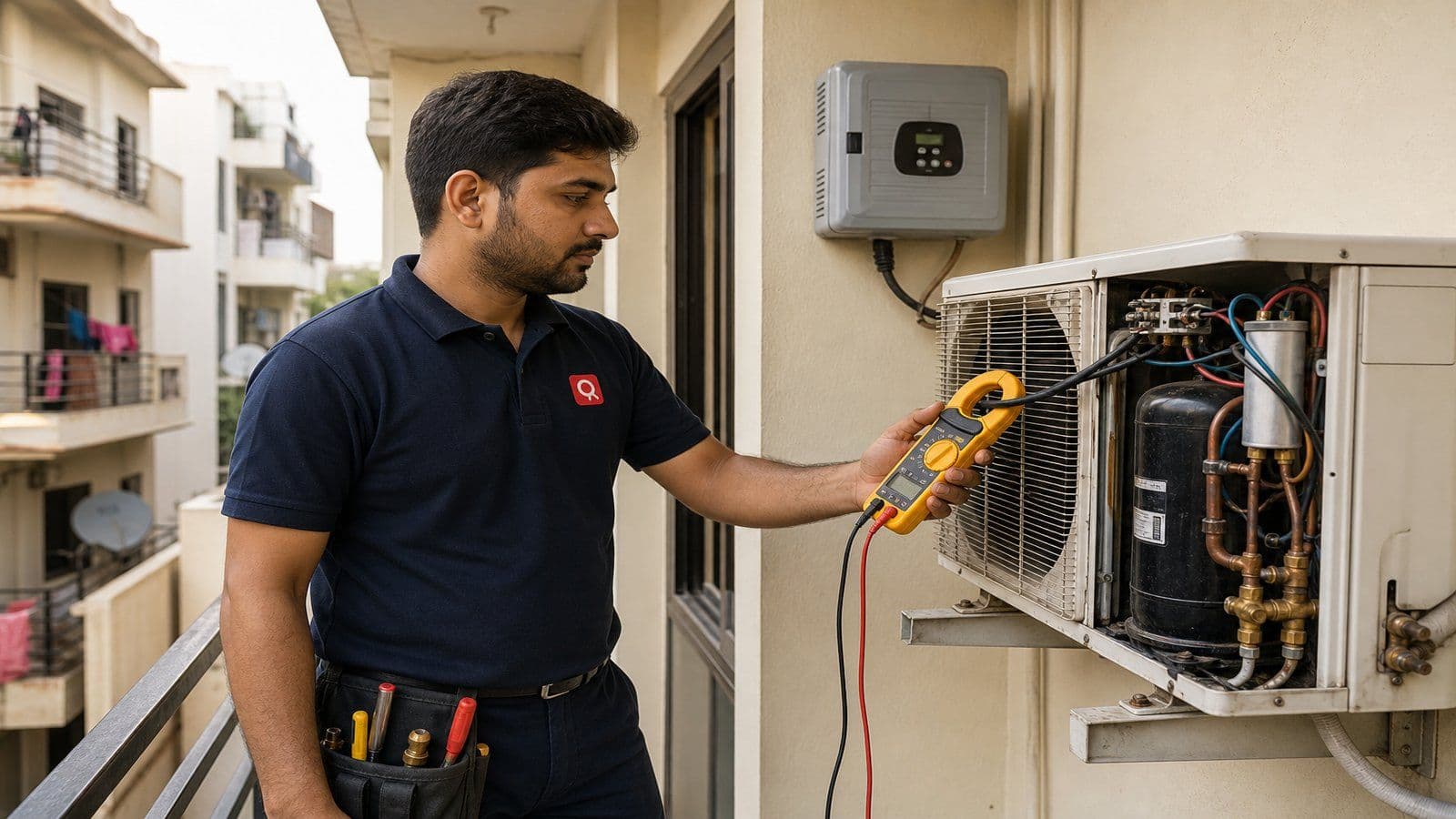
Amit worked as an AC technician for 6 years in Ahmedabad before transitioning to technical writing. He holds a diploma in Refrigeration and Air Conditioning from ITI Ahmedabad and understands the difference between what AC companies promise and what actually happens on the ground. His articles break down complex technical topics into plain language that any homeowner can follow. He tests every tip he writes about in his own home first.

Dr. Verma is a mechanical engineer with 15 years of experience in HVAC systems. She completed her PhD from IIT Delhi on energy-efficient cooling solutions for Indian residential buildings. She reviews all technical content on HomePros to make sure the numbers are right, the advice is safe, and the recommendations are backed by actual engineering principles. She consults for multiple AC manufacturers on product design.