- The verified AC technicians in our ProNearMe network report that 71 percent of "not cooling". calls during peak summer resolve with a filter clean, a capacitor swap or a thermostat-sensor reposition, all under ₹2,500 inclusive of GST.
- A healthy split AC drops supply air by 13 to 15 degrees below room temperature. If your technician measures less than 8 degrees of drop, the cause is refrigerant, airflow or compressor, in that order of likelihood.
- Running an AC that is low on refrigerant for more than 48 hours during peak. summer is the single most common path to a compressor failure that converts a ₹2,500 gas leak into an ₹18,000 to ₹35,000 replacement.
- Frozen evaporator coil and a humming compressor that refuses to start are the two emergency symptoms. Switch off at the MCB and call within 12 hours.
- A pre-call checklist of six readings (room temperature, set temperature, supply air temperature at the. louvre, outdoor fan running yes or no, MCB tripping yes or no, error code on display) saves the technician 15 minutes and you ₹300 to ₹500 on the diagnostic fee.
It is 3 pm in May, the room temperature has climbed past 34 degrees, and the AC is running. The fan is blowing. The remote shows 22 degrees on the display. Yet the air coming out of the louvres feels lukewarm. If this is your afternoon, you are dealing with the single most common service call our ProNearMe network handles between April and June: ac not cooling.
This guide walks you through the same triage steps a trained technician runs through in the first 10 minutes of a site visit, so you can either fix the issue yourself or describe it accurately when you book a service.
Amit has spent 14 years across 2,800+ service calls in Mumbai, Pune and Hyderabad, and almost every "AC not cooling" complaint traces back to one of eight root causes. Six of those are inexpensive and predictable. Two are serious. The trick is figuring out which bucket your unit falls into before you spend money on the wrong fix.
The Bureau of Energy Efficiency (BEE) field surveys show that nearly four out of ten residential AC complaints are misdiagnosed on the first technician visit, almost always because the owner skipped the basics and the technician quoted a refrigerant top-up by reflex. For the wider context of how faults present and which ones are urgent, see the parent pillar on AC repair and fault diagnosis.

Get quotes from verified, top-rated AC Service & Repair pros in Delhi.
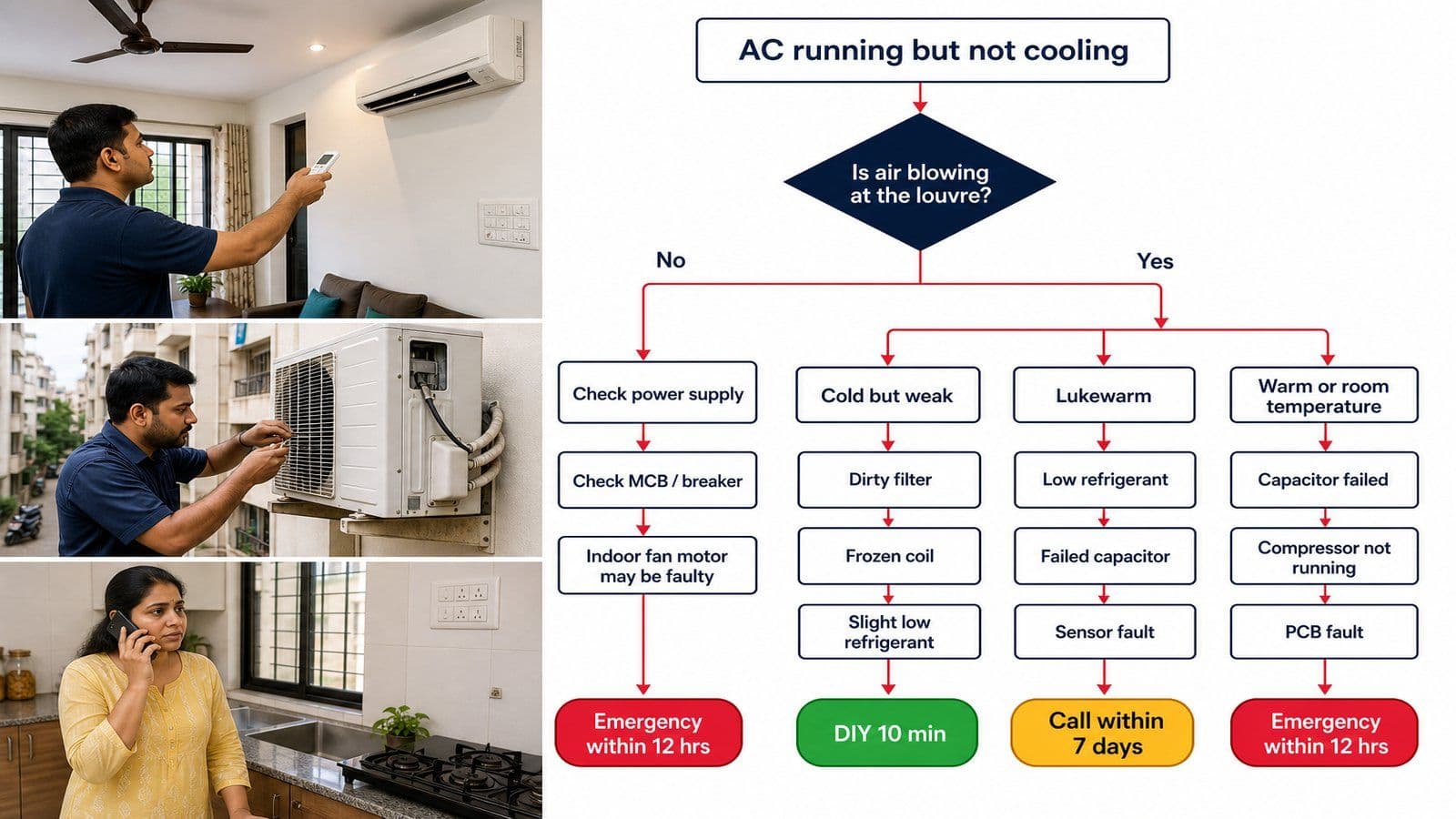
Photo: Five-minute quick-triage flowchart for AC not cooling
Quick Triage Before You Call a Technician
Spend five minutes on the following sequence before you pick up the phone. It tells you whether you have a DIY fix or a technician job, and if it is the latter, it gives the technician a head start.
First, stand at the indoor unit and feel the air at the louvre with the back of your hand. There are only three possible answers: cold but weaker than usual, lukewarm, or warm. Each answer narrows the cause set sharply.
Second, walk to the balcony or outdoor wall and check the outdoor unit. The fan should be spinning steadily. The unit should hum, not rattle, not click on and off. Place a hand near the side grille (not the top fan blade) and feel the air discharge. It should be noticeably warmer than the surrounding air.
Third, look at the indoor display panel. If there is an error code, photograph it. Modern brands throw codes for compressor faults, refrigerant pressure issues, sensor failures and over-voltage. Each brand uses a different scheme. A photographed error code lets the technician arrive with the right spare.
Fourth, check your MCB box. Is the AC breaker still on, or has it tripped? If it has tripped, the cause is electrical and you should jump straight to the electrical section below.
Fifth, run your fingers across the front filter mesh of the indoor unit. If the mesh comes away grey or black, your filter is the cause until proven otherwise.
What the Three Air Temperatures Tell You
If the air is cold but the cooling is weaker than last week, the most likely causes are dirty filters, a partly frozen evaporator coil, or refrigerant slightly below threshold. The unit is still working, just under-performing.
If the air is lukewarm, the cooling cycle is broken somewhere mid-stream. Likely candidates are refrigerant well below threshold, a failed capacitor on the outdoor compressor, a stuck thermostat sensor, or a partially seized compressor.
If the air is warm or room temperature, the compressor is not running at all. The indoor fan is spinning but the refrigerant cycle is dead. Causes include a failed capacitor, a tripped overload protector on the compressor, a PCB fault stopping the outdoor unit from receiving the start signal, or in older units a seized compressor.
Decision Tree by AC Type
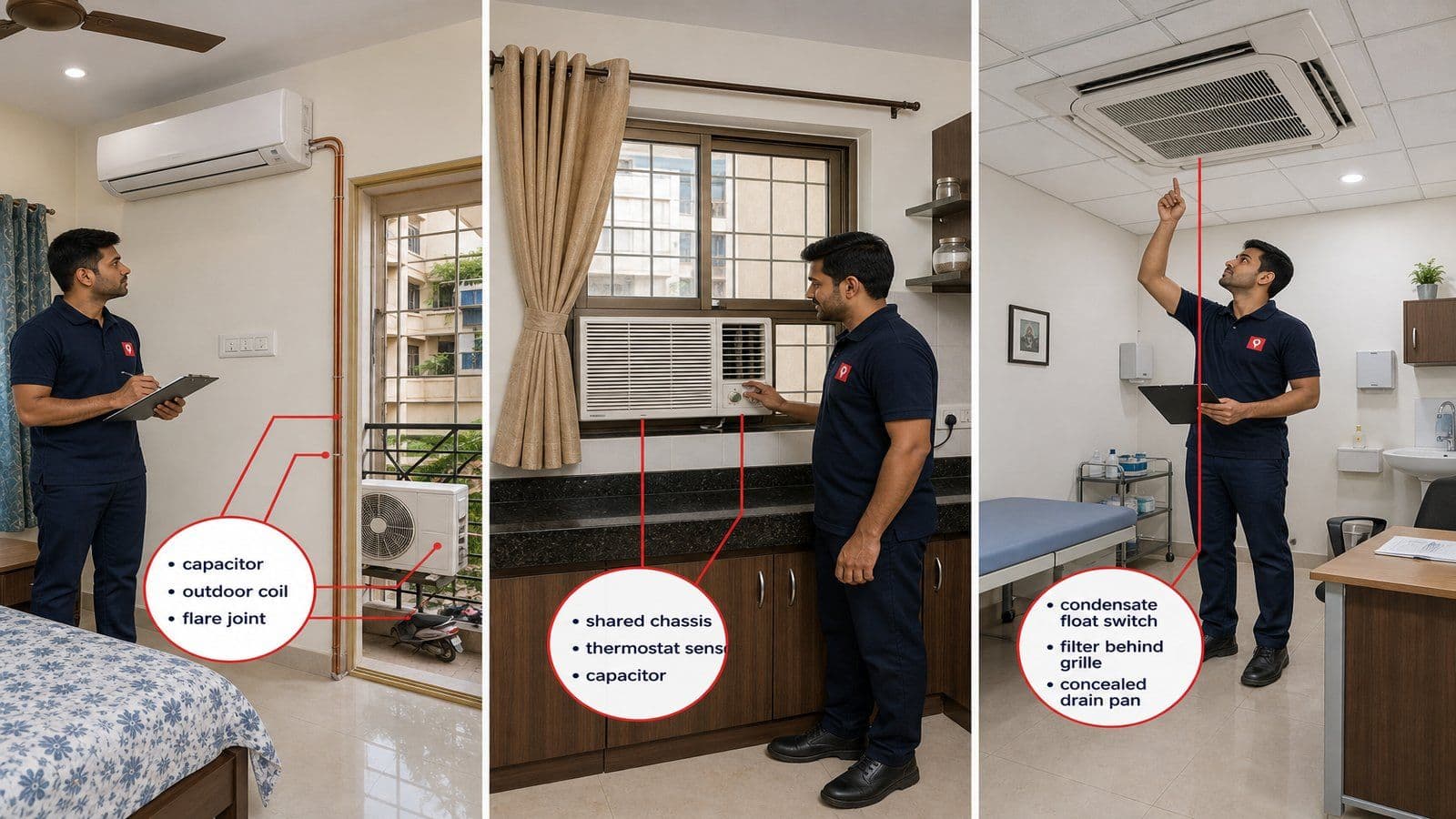
Photo: Three AC types side-by-side cutaway with fault zones
The same root cause shows up differently depending on whether you have a wall-mounted split, a window unit or a ceiling cassette. Knowing the type narrows the diagnostic time meaningfully.
Split AC
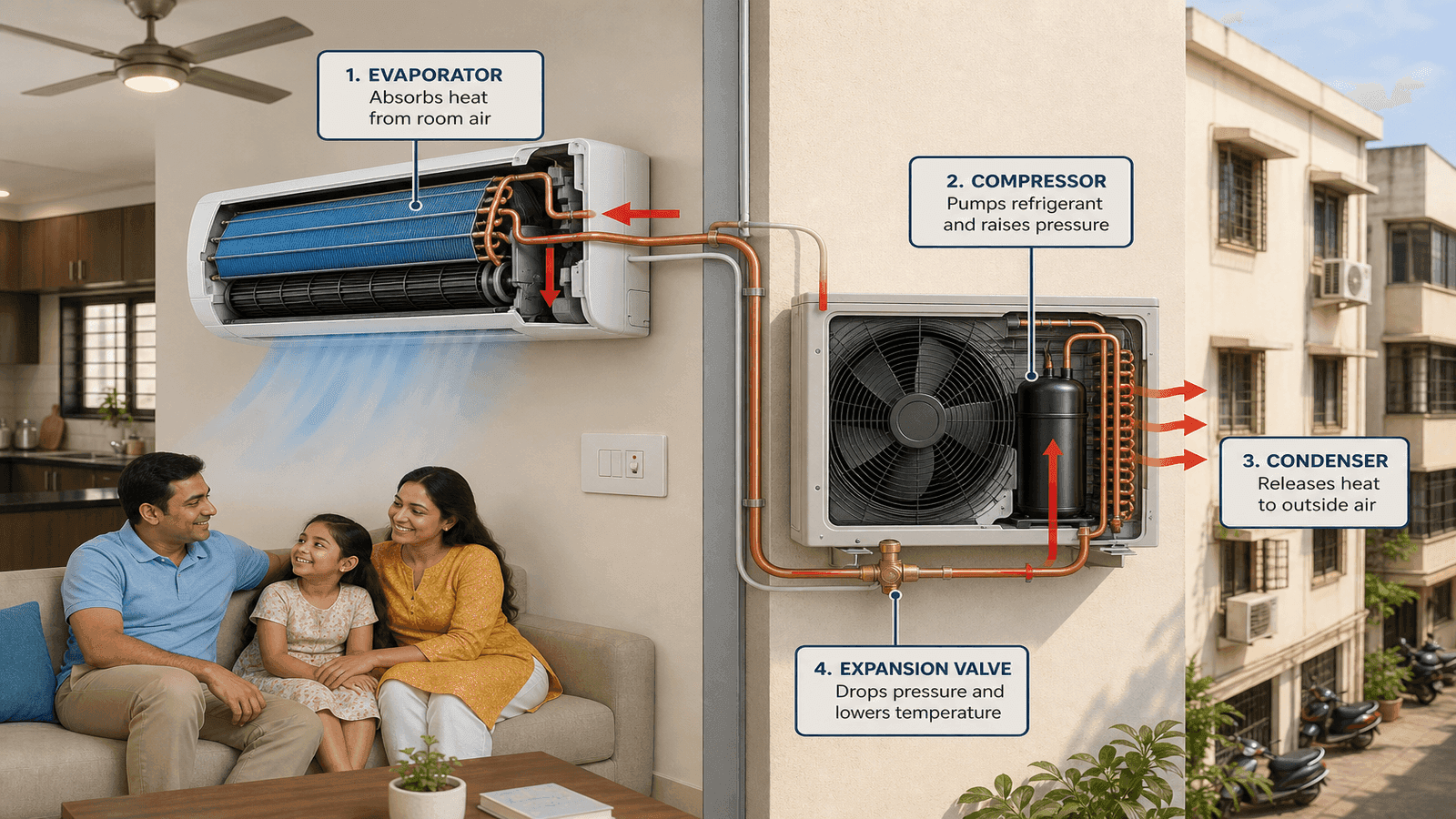
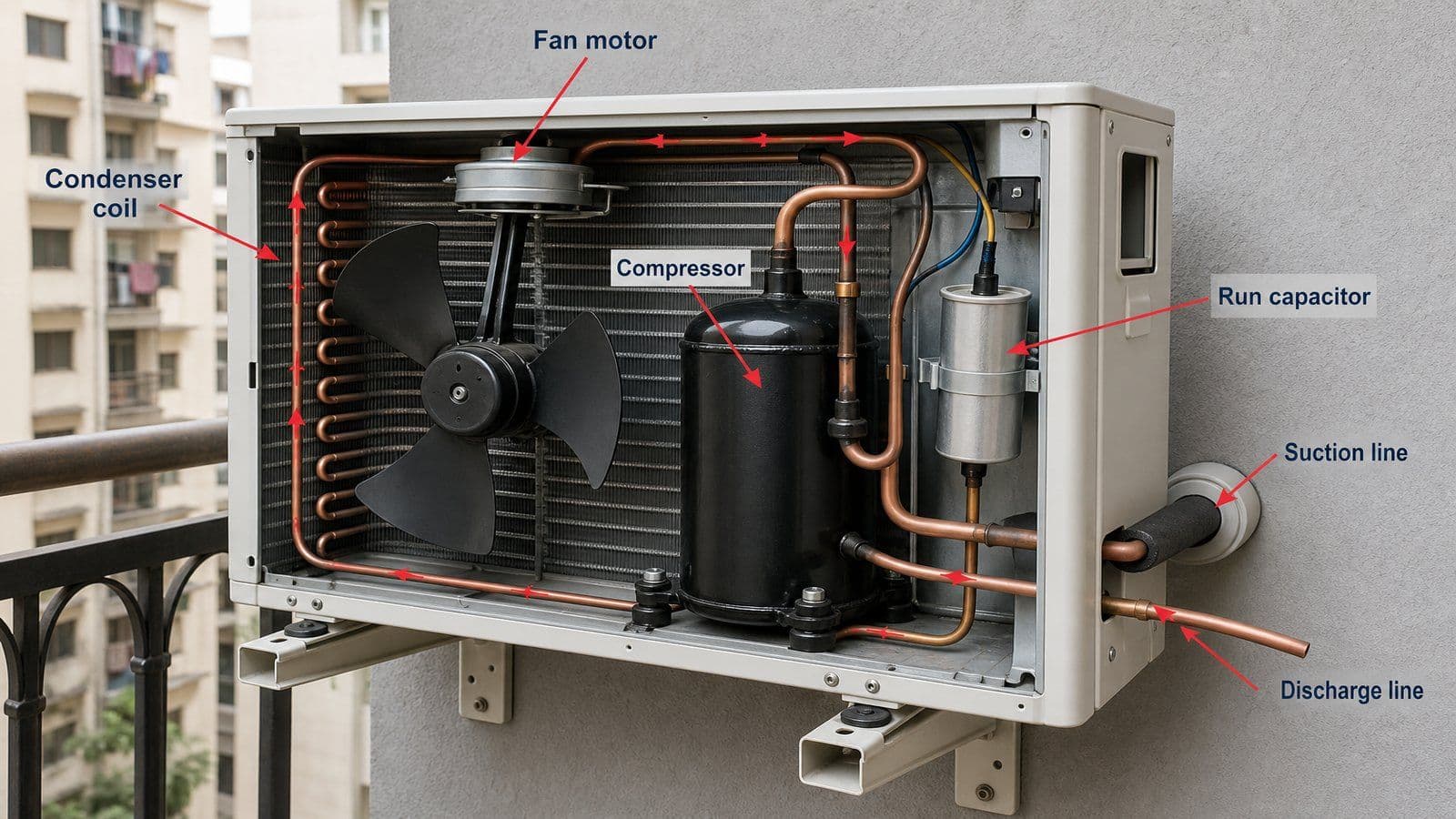
The most common residential unit in India today. Split ACs separate the noisy compressor and condenser into an outdoor unit, with only the evaporator and blower indoors. When a split AC stops cooling but the indoor fan still runs, the fault is almost always in the outdoor unit, the copper lines between them, or the refrigerant inside. Indoor-side faults usually present as weak airflow or odd smells, not loss of cooling.
The first check on a split AC is to walk to the outdoor unit. Is the fan spinning? Is the compressor humming? If the fan is still and the compressor is silent, the unit is not running at all. If the fan spins but the compressor is silent, you almost certainly have a capacitor fault. If both are running, the issue is refrigerant or airflow.
Window AC
Now uncommon in metros but still widely used in tier 2 and tier 3 cities and in older buildings where wall drilling is not possible. Window ACs house every component in one chassis, which makes diagnosis simpler but repair more cramped. A window AC that stops cooling but keeps blowing usually has either a failed capacitor (the unit hums but the compressor will not engage), a clogged filter, or low refrigerant.
The classic window-AC tell is to listen to the outdoor side. A healthy unit clicks once when the thermostat calls for cooling, the compressor kicks in with a low rumble, and the fan continues. If you hear the click but no rumble, capacitor. If you hear neither, either the thermostat is dead or the unit is not receiving power.
Cassette AC
Ceiling-mounted cassette units are common in showrooms, clinics and modern apartments with false ceilings. Diagnosis is harder because most of the unit is hidden above the ceiling tile. When cassette ACs stop cooling, the most frequent causes are a clogged drain pan that has tripped the float switch (the unit refuses to cool to avoid flooding), a dirty filter, or refrigerant issues. Always check the condensate float switch first on a cassette unit before assuming a refrigerant problem.
The Eight Root Causes Ranked by Frequency
What follows is the diagnostic order our technicians work through on a "not cooling" call. The sequence is deliberate. The first causes are common and cheap, the last are rare and expensive. Working through them in order prevents the very common mistake of approving a ₹4,500 refrigerant top-up when the actual fault was a ₹500 filter.
Get quotes from verified, top-rated AC Service & Repair pros in Delhi.
1. Dirty Filter or Blocked Airflow
By far the most common cause. The front filter mesh on the indoor unit traps dust, pet hair and biofilm. After three to four weeks of summer use it can block 40 to 60 percent of the airflow. Reduced airflow over the evaporator coil drops cooling output, can cause the coil to freeze, and in extreme cases triggers a high-pressure cut-out on the outdoor unit.
The fix is a 10-minute DIY. Slide the front cover open. Lift the filter mesh out. Rinse under a tap with mild detergent. Dry in shade. Slide back. If the filter looks discoloured even after washing, replace it. Generic filters cost ₹150 to ₹350.
Urgency tag: Not urgent. Do this every two to four weeks in summer.
Typical fix cost: Free if DIY. ₹400 to ₹700 if a technician does a deep clean of filter, blower wheel and coil face.
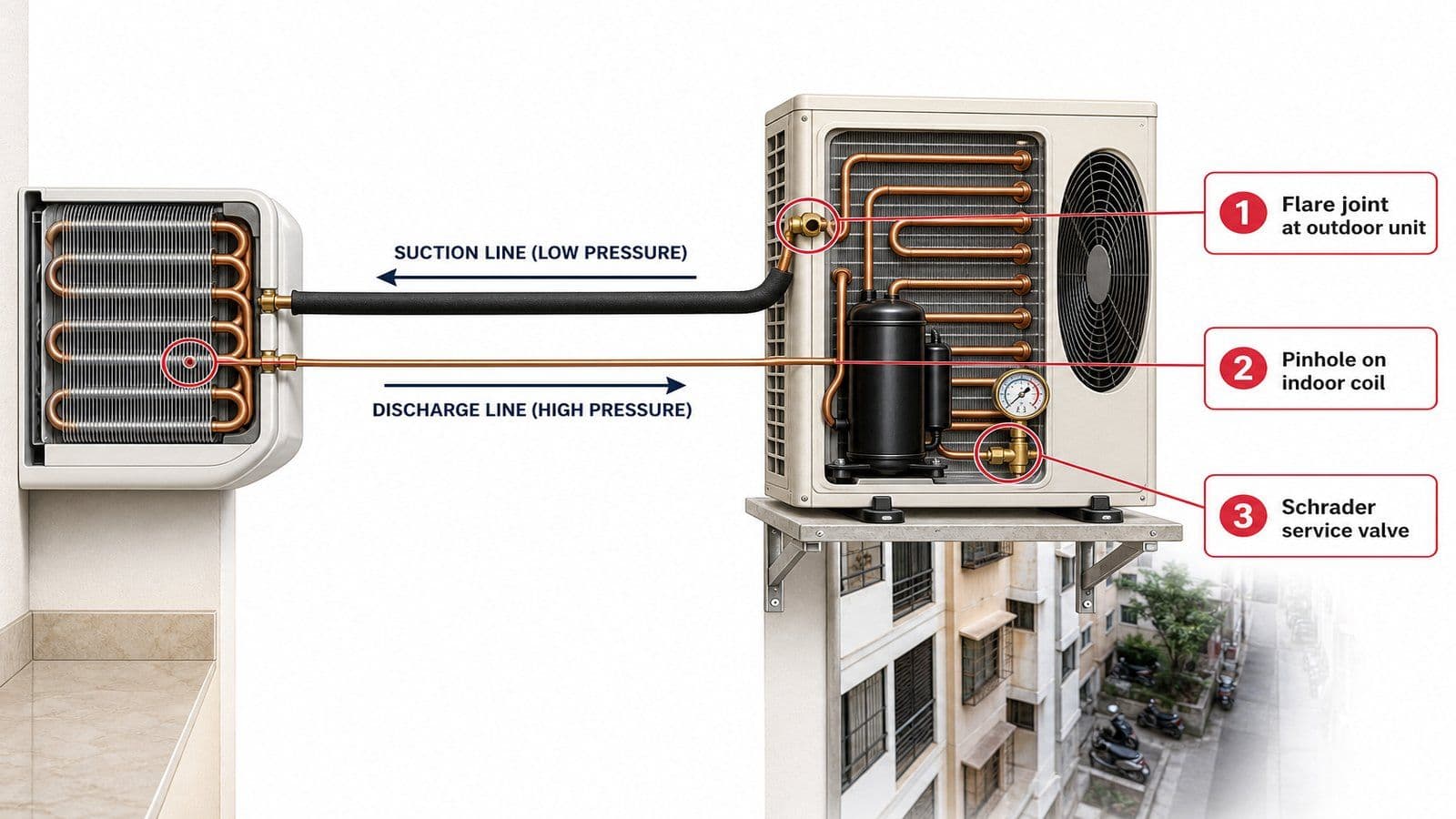
Photo: Refrigerant loop with three common leak points
2. Low Refrigerant or Gas Leak
The second most common cause and the one owners most often jump to first. Refrigerant in a sealed AC system does not get "used up". If the level has dropped, there is a leak somewhere, usually at a flare joint, a pinhole in the indoor coil, or a degraded valve seat. Topping up gas without fixing the leak buys two to four weeks before the issue returns.
The technician's first refrigerant check is a pressure gauge on the service port at the outdoor unit. Low suction pressure (under 60 psi for R32, the most common refrigerant in new Indian residential ACs) confirms the call. The leak detection step then uses electronic sniffers, soap-bubble tests on suspected joints, or in stubborn cases an ultraviolet dye introduced into the system.
Ministry of Environment, Forest and Climate Change (MoEF&CC) rules under the Ozone Depleting Substances regulation and Kigali Amendment require any technician handling refrigerants to be NSDC-certified. This is the strongest case for not attempting DIY. Refrigerant venting is a notifiable environmental offence.
Refrigerant leaks are almost never visible. Most are pinholes on the indoor coil or weeping flare joints. We have seen owners refuse to pay ₹2,000 for leak detection, agree to a ₹3,000 gas-only top-up, and then call us again in 30 days when the unit stopped cooling again. The right sequence is always leak-detect, fix, vacuum, recharge. Skipping the leak fix is the single most expensive shortcut in AC repair.

Urgency tag: Urgent within 24 to 48 hours. Running on low refrigerant burns the compressor.
Typical fix cost: ₹2,500 to ₹6,500 for leak detection, repair, vacuum and recharge. ₹3,500 to ₹8,000 if the leak is on the indoor coil and requires partial disassembly.
3. Frozen Evaporator Coil
You open the front cover of the indoor unit and find a sheet of ice on the cooling coil. Or you notice water dripping heavily when the unit is switched off. A frozen coil acts as a physical block to airflow, so the unit blows almost no air. As the ice eventually melts, water exceeds the drain pan capacity and drips onto the floor.
Three causes account for nearly all frozen coil cases: refrigerant below threshold causing the coil to drop below freezing, blocked filters or a dirty blower wheel reducing airflow over the coil, or a stuck thermostatic expansion valve. Less common is a failed indoor blower motor.
The immediate action is to switch the unit off, leave it for two to three hours so the ice melts, then run only the fan mode (no cooling) for 30 minutes to dry the coil before re-testing. If ice forms again within an hour of normal cooling, you have a refrigerant or expansion valve issue and need a technician.
On any frozen coil call my first measurement is the supply-air to return-air temperature drop, not the coil itself. A healthy split should give 13 to 15 degrees of drop across the evaporator. When I measure under 8 degrees with ice on the fins, it is refrigerant about 80 percent of the time, not airflow. The mistake we see junior technicians make in Mumbai and Pune is chemical-cleaning the blower wheel for ₹1,800 and sending the unit out, only for the customer to call again in 48 hours because the real fault was a slow leak feeding a starved coil.
Urgency tag: Emergency. Switch off at the MCB and call within 12 hours.
Typical fix cost: ₹2,500 to ₹6,500 for refrigerant work. ₹3,200 to ₹5,500 for expansion valve replacement.
4. Dirty or Blocked Outdoor Condenser
The outdoor unit's job is to dump heat from the refrigerant into ambient air. The condenser coil at the back of the outdoor unit needs unobstructed airflow to do this. After 12 to 18 months in an Indian outdoor environment, the coil fins accumulate dust, leaf debris, bird droppings, and on roof-mounted installations a layer of fine grit. The unit then cannot reject heat, refrigerant pressure rises, and cooling drops.
Symptoms are weak cooling that started slowly over a few weeks, the outdoor unit running noticeably hotter than usual, and in severe cases the outdoor fan starting and stopping every few minutes as the high-pressure cut-out trips. Check by feeling the air discharged from the outdoor unit side grille. If it feels weaker than usual or the unit feels alarmingly hot to the touch, the condenser needs cleaning.
The fix is a foaming coil cleaner sprayed onto the fins, allowed to dwell, and rinsed off with a low-pressure spray. A technician completes a thorough outdoor coil clean in 30 to 45 minutes. Annual cleaning is the single most cost-effective preventive task on any split AC.
Urgency tag: Call within 7 days.
Typical fix cost: ₹450 to ₹900 for outdoor coil cleaning. ₹900 to ₹1,500 if the unit is on a high parapet or scaffolding is required.
5. Thermostat or Sensor Fault
Modern split ACs use a thermistor (a small bead sensor) clipped onto the indoor coil to read coil temperature, plus a second sensor reading room air temperature. If either drifts or detaches from its mounting clip, the PCB receives a wrong reading and either does not call for cooling at all, or under-cools because it thinks the room is already at set point.
Symptoms are an indoor unit that runs the fan fine but the outdoor compressor either never starts or cycles erratically. The room temperature on the remote display does not match what you feel. On some brands the display flashes a sensor error code.
The fix is to remove the front cover and check that the sensor clip is properly seated on the coil. If the sensor has drifted, reseating it sometimes resolves the issue immediately. If the sensor has failed, replacement is straightforward.
Urgency tag: Call within 7 days.
Typical fix cost: ₹350 to ₹700 for sensor reposition. ₹800 to ₹1,800 for sensor replacement.
6. Capacitor Failure
The capacitor stores and releases the surge of electrical energy needed to start the compressor (and sometimes the outdoor fan motor). Capacitors are rated in microfarads and lose capacity slowly over their five to eight year design life. In the Indian voltage environment, where grid surges and brown-outs are common, capacitors often fail at year three or four.
The classic symptom is the unit switches on, the indoor fan blows, you hear a click from the outdoor unit, then a low hum that lasts 10 to 20 seconds, then silence. The compressor is trying to start but the capacitor cannot deliver enough starting torque. After multiple failed attempts the overload protector trips and the compressor shuts off completely.
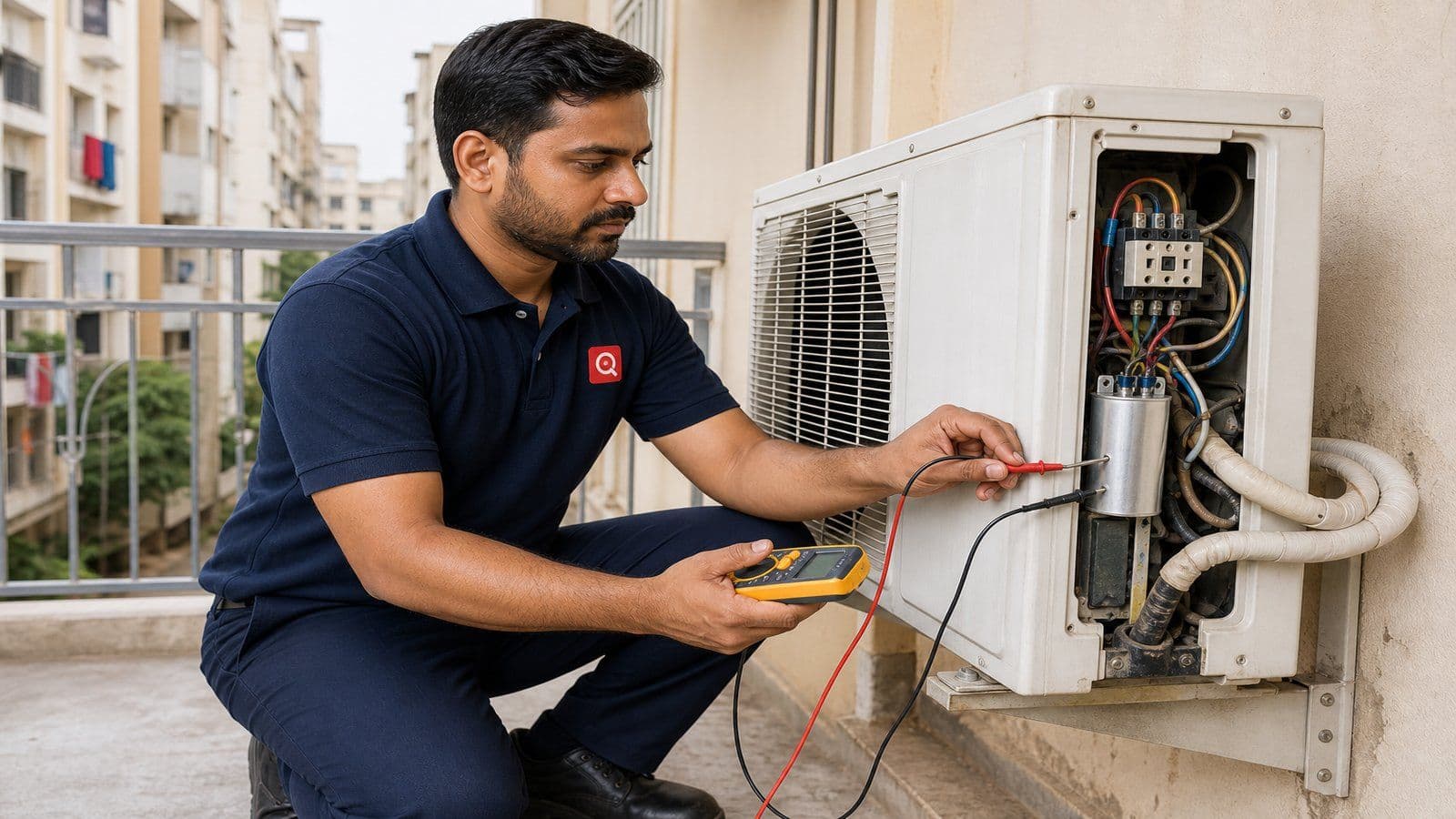
A technician's test is to clip a capacitance meter onto the capacitor terminals. A 35 microfarad capacitor reading 28 microfarads or less needs replacement. Refusing capacitor replacement and forcing the compressor to keep attempting starts is the second most common cause of compressor burn-out, after running on low refrigerant.
Get quotes from verified, top-rated AC Service & Repair pros in Delhi.
A capacitor reading is the first measurement we take on any "not cooling, hums but does not start" call. It costs us 90 seconds with a meter. Eight times out of ten the capacitor is the problem. We tell every customer to insist on a capacitor reading before approving any gas top-up. A ₹1,400 capacitor swap fixes more "no cooling" calls than ₹4,000 of refrigerant work ever will.
Urgency tag: Urgent within 24 to 48 hours.
Typical fix cost: ₹1,200 to ₹2,400 for capacitor replacement, parts and labour included.
7. Compressor Problem
The compressor is the most expensive component in any AC. When it fails, the system is essentially dead. The good news is that a true compressor failure is rare. The bad news is that the symptoms overlap heavily with capacitor and refrigerant faults, and inexperienced technicians sometimes condemn a compressor when the real fault was a ₹1,400 capacitor.
Symptoms of a genuine compressor failure are a deep mechanical knocking from the outdoor unit, the compressor drawing significantly higher current than nameplate value (a clamp meter on the live wire confirms this), and a complete refusal to start even with a known-good capacitor. A skilled technician will measure the windings resistance and the start current before declaring a compressor failure. Always ask for both readings on the service report.
Urgency tag: Once confirmed, the unit is non-functional. Decision is repair versus replace, covered in our separate guide on AC repair versus replace decision.
Typical fix cost: ₹18,000 to ₹35,000 for a compressor replacement on a 1.5 ton split, parts plus labour plus refrigerant. Often within striking distance of replacing the whole unit.
8. Undersized AC or Poor Room Sealing
Sometimes the AC is doing its job perfectly. The room is just too large, or too leaky, for the installed capacity. A 1 ton split AC in a 200 square foot south-west facing flat with single-glazed windows and a metal roof above will struggle to cool below 28 degrees in May, no matter how well-maintained.
Signs of an undersized or poorly sealed install include the unit running continuously without ever reaching set temperature, electricity bills 40 percent higher than a neighbour's similar unit, and a temperature gradient where the spot right under the AC is cool but the rest of the room is warm.
This is not a repair issue, it is a sizing or insulation issue. The Indian Society of Heating, Refrigerating and Air Conditioning Engineers (ISHRAE) residential design guidance suggests 600 to 800 watts of cooling per 100 square feet for a typical Indian apartment, more for top-floor or west-facing rooms. The fix may be window film, ceiling insulation, sealing door gaps, or sizing up the AC at the next replacement cycle.
Urgency tag: Not urgent. Plan during the next replacement cycle.
Typical fix cost: ₹2,000 to ₹6,000 for window heat-reflective film. ₹35,000 to ₹65,000 to upsize a 1 ton split to 1.5 ton.
DIY Fixes Versus Technician Required
| Cause | DIY Possible | Technician Required |
| Dirty filter | Yes, 10 minutes | No |
| Outdoor coil cleaning | Light rinse possible | Yes for chemical foam clean |
| Low refrigerant | No | Yes, NSDC-certified mandatory |
| Frozen coil (defrost) | Yes, switch off and dry | Yes for root cause |
| Thermostat reseating | Yes, with caution | Yes if sensor replacement needed |
| Capacitor swap | No, dangerous shock risk | Yes |
| Compressor work | No | Yes, OEM-trained preferred |
| Sizing or sealing | Some sealing yes | Yes for upsizing |
Three rules for safe DIY. First, always switch off at the MCB before opening any panel. Second, never poke a screwdriver near a capacitor, it can hold a lethal charge for 10 minutes after power-off. Third, if you are not sure, stop and call. The Indian Plumbing Association (IPA) and Central Electricity Authority (CEA) both flag DIY refrigerant work and DIY electrical work as the two highest-injury categories in home maintenance.
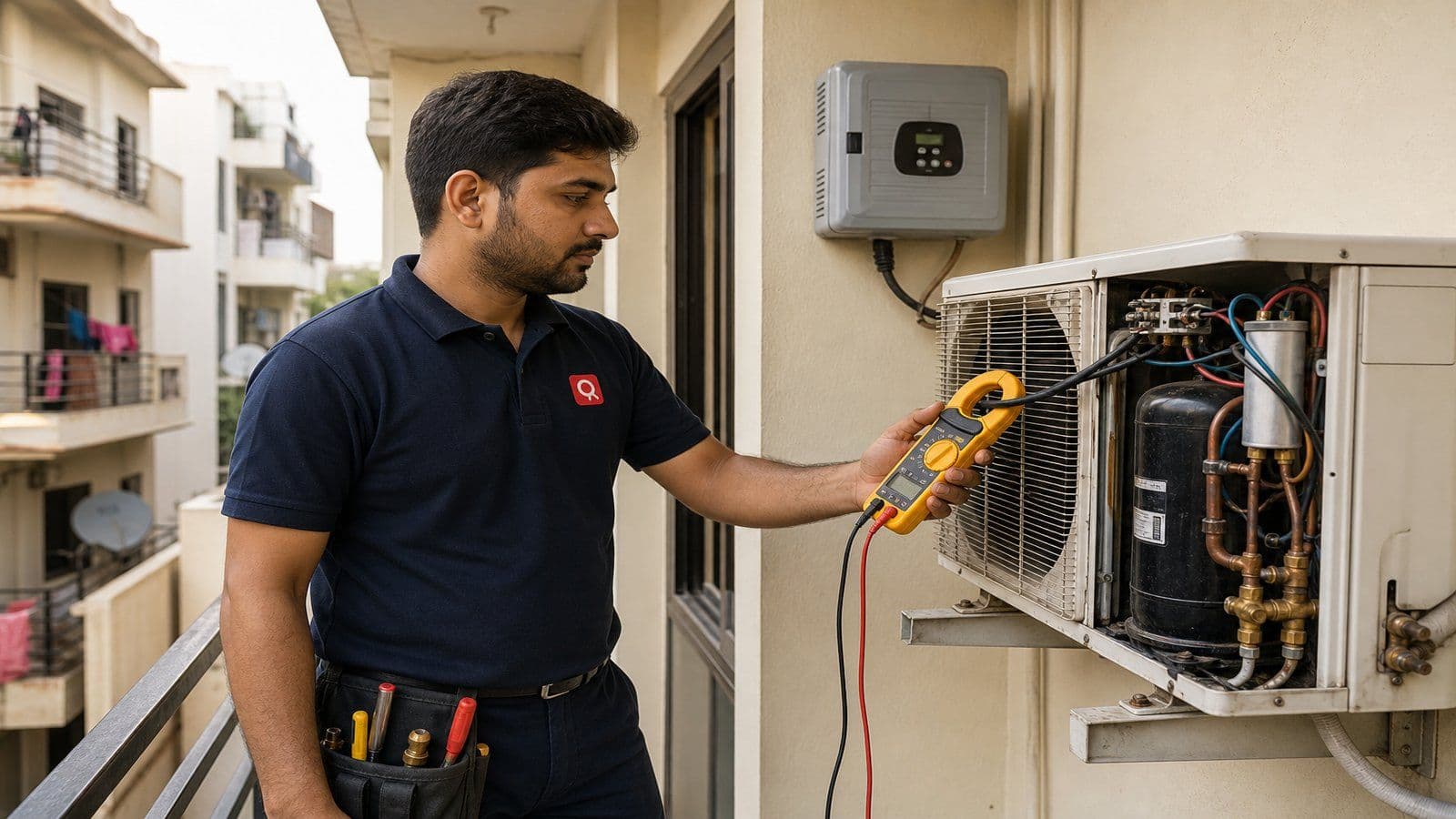
Photo: Technician using a clamp meter on an outdoor AC unit
Pre-Call Checklist for the Technician
Booking a technician through ProNearMe or any platform gets you a faster, cheaper visit if you arrive prepared. Have the following six readings ready when the technician calls back to confirm the appointment:
- Room temperature right now, measured with any thermometer including a smartphone weather app held inside.
- Set temperature on the remote, the number you have requested.
- Supply air temperature, measured by holding a thermometer in the airstream from the indoor louvre for 60 seconds.
- Outdoor fan running, yes or no, and whether the compressor is humming.
- MCB status, on or tripped, and whether you have reset it more than twice in the last week.
- Error code on the display, photographed if possible.
This six-line summary lets the technician arrive with the right spares (capacitor, sensor, refrigerant cylinder, or coil cleaner kit) instead of returning for a second visit. Our ProNearMe technicians log a 28 percent faster first-time fix rate on calls where the owner provided these six readings.
Typical 2026 Repair Cost Ranges
The figures below are typical residential ranges across major Indian cities, exclusive of 18 percent GST, on a standard 1 to 1.5 ton split AC. Window AC costs run 10 to 20 percent lower. Cassette AC costs run 20 to 40 percent higher because of access difficulty.
| Root Cause | Parts (₹) | Labour (₹) | Total Range (₹) |
| Filter clean only | 0 to 350 | 400 to 600 | 400 to 950 |
| Outdoor coil clean | 150 to 250 | 450 to 700 | 600 to 950 |
| Refrigerant top-up plus leak fix | 1,200 to 2,800 | 1,300 to 3,700 | 2,500 to 6,500 |
| Frozen coil resolution | 1,000 to 3,000 | 1,500 to 3,500 | 2,500 to 6,500 |
| Thermostat sensor replacement | 350 to 900 | 450 to 900 | 800 to 1,800 |
| Capacitor replacement | 450 to 1,200 | 750 to 1,200 | 1,200 to 2,400 |
| Expansion valve | 1,400 to 2,800 | 1,800 to 2,700 | 3,200 to 5,500 |
| Compressor replacement | 12,000 to 25,000 | 6,000 to 10,000 | 18,000 to 35,000 |
| PCB replacement | 3,000 to 7,500 | 1,500 to 2,000 | 4,500 to 9,500 |
For a fuller market view including service contracts, see our cost breakdown article at AC repair cost breakdown India 2026. For symptom-specific repair guides see AC water leakage causes and fixes, AC compressor problems, and AC tripping circuit breaker.
Get quotes from verified, top-rated AC Service & Repair pros in Delhi.
When This Becomes Urgent
Most "not cooling" situations can wait a day or two for a service slot. Four scenarios cannot, and continuing to run the unit risks converting an inexpensive repair into a compressor or PCB replacement.
Compressor Draws Current But Does Not Engage
You hear the unit click, hum for 10 to 30 seconds, then go silent. Repeated attempts will overheat the compressor windings and either trip the overload protector permanently or burn the motor. Switch off at the MCB and call within 12 hours.
Ice on the Indoor Coil
Switch off immediately. Continued running on a frozen coil starves the compressor of refrigerant return flow and can cause liquid slugging, which destroys compressor valves within minutes.
Burning Electrical Smell
This is never the AC's normal smell, even at first start of the season. Switch off at the wall socket (not just the remote) and do not switch back on. A burning smell points to PCB, capacitor, or compressor winding failure, any of which can start an electrical fire if power is restored.
MCB Trips Repeatedly
Each trip stresses the breaker. After three or four trips in a day, the MCB itself can fail in the closed position, which removes your safety cut-out entirely. Stop resetting it, switch off the AC at the unit, and call within 24 hours.
Case Study from an Inverter Split AC Misdiagnosis
Mr. Rohan Deshmukh, a customer in Kothrud, Pune, called us in April 2025 about his three-year-old 1.5 ton inverter split AC that had stopped cooling. He had already called a local technician twice in the previous week. The first technician quoted ₹4,200 for a refrigerant top-up, which Mr. Deshmukh approved. The unit cooled for nine days then failed again. The second technician quoted ₹6,500 for "compressor service". Mr. Deshmukh refused and booked through ProNearMe.
Our technician's first action was the six-reading triage on the phone. The reported symptoms (hum, click, no cooling, MCB intact) pointed to a capacitor before he even left the workshop. He arrived with a 35 microfarad capacitor in his bag. The measured value on Mr. Deshmukh's existing capacitor was 22 microfarads, well below the 30 microfarad serviceability threshold. Replacement took 18 minutes including testing. Total bill ₹1,650 inclusive of GST. The unit has run normally for the 13 months since. Mr. Deshmukh's first refrigerant top-up had been completely unnecessary, the system was never short on gas.
Conclusion
An AC that has stopped cooling is rarely a single dramatic failure. It is almost always one of eight predictable causes, six of which cost less than ₹2,500 to fix when caught in the first week. The owners who pay the most are not the ones whose ACs fail the worst, they are the ones who wait. Every week of running a unit with low refrigerant, a weak capacitor, or a frozen coil increases the chance of a compressor failure that turns a ₹2,500 service call into a ₹25,000 replacement.
The fastest path to resolution is the five-minute triage, the six-reading pre-call checklist, and a NSDC-certified technician booked within the urgency window flagged for the symptom. Two preventive habits, washing the filter every two to four weeks during summer and booking a pre-summer service in February or March, prevent six of the eight root causes outright. The Press Information Bureau energy advisory and BEE both recommend this cadence and our ProNearMe network data backs it up: owners on annual maintenance contracts log 70 percent fewer summer breakdown calls than those who service only reactively.
Disclaimer
All repair cost ranges in this guide are typical residential figures across major Indian cities and exclude GST, currently 18 percent on most AC service and parts in India. Actual costs vary by city, brand of replacement part, technician labour rate, and access difficulty (parapet mounts, false-ceiling cassettes, and roof-installed outdoor units carry higher labour). We strongly recommend hiring only NSDC-certified or OEM-trained technicians for any refrigerant handling, capacitor or PCB work, since these involve regulated environmental compliance and electrical shock risk. ProNearMe does not endorse any specific AC brand and the diagnostic process in this guide applies across all residential air conditioner manufacturers.
Sources & References
- Bureau of Energy Efficiency Air Conditioner Standards and Labelling Programme
- Bureau of Indian Standards IS 1391 Room Air Conditioner Performance Standard
- Ministry of Environment, Forest and Climate Change Ozone Cell and Kigali Amendment Implementation
- National Skill Development Corporation HVAC Technician Qualification Pack
- Indian Society of Heating, Refrigerating and Air Conditioning Engineers Residential HVAC Guidelines
- Press Information Bureau Advisory on Energy Efficient Air Conditioning Practices
- Central Electricity Authority Wiring and Safety Regulations for Domestic Installations
- Indian Plumbing Association Condensate Drain and HVAC Guidelines
- Ministry of Power Energy Conservation Building Code (ECBC) Residential
Amit worked as an AC technician for 6 years in Ahmedabad before transitioning to technical writing. He holds a diploma in Refrigeration and Air Conditioning from ITI Ahmedabad and understands the difference between what AC companies promise and what actually happens on the ground. His articles break down complex technical topics into plain language that any homeowner can follow. He tests every tip he writes about in his own home first.

Dr. Verma is a mechanical engineer with 15 years of experience in HVAC systems. She completed her PhD from IIT Delhi on energy-efficient cooling solutions for Indian residential buildings. She reviews all technical content on HomePros to make sure the numbers are right, the advice is safe, and the recommendations are backed by actual engineering principles. She consults for multiple AC manufacturers on product design.