- More than 70 percent of all AC service calls in India trace to just six root causes: dirty filters, low refrigerant, dirty coils, faulty capacitor, drainage blockage, and PCB sensor faults. Learn these six and you have covered most of what can go wrong.
- The BIS safety standard IS 1391 and NSDC Mechanic-RAC certification framework set the baseline for. any legitimate AC repair work in India. Any technician handling refrigerant without these credentials is operating outside the regulatory norm, regardless of how cheap the quote is.
- The 2026 repair-cost ladder for a 1.5 ton split AC runs from ₹400 (basic dry. service) to ₹25,000 (out-of-warranty compressor replacement). Know the eight standard line items and you cannot be over-charged.
- Run the 5-minute owner diagnostic before calling any technician. Filter check, drainage check, MCB reset, remote battery swap, and outdoor unit airflow check together resolve roughly 35 percent of complaints with zero spend.
- The 50 percent rule for repair versus replace: if the repair quote exceeds half the price of an equivalent new AC AND the unit is over eight years old, replacement wins. Below either threshold, repair almost always wins.
Most AC breakdowns in Indian homes are not random. They follow a small set of patterns, and once you can read those patterns, you can decide in under five minutes whether you are looking at a ₹400 fix, a ₹4,500 repair, or a ₹35,000 replacement decision. This ac fault diagnosis manual is built for exactly that purpose.
It walks through every common fault an Indian homeowner will face across the lifespan of a window or split AC, gives you the diagnostic steps that any sensible owner can run before a technician arrives, and tells you what a fair 2026 repair quote should look like.
The aim is not to turn you into an AC mechanic. The aim is to give you the language and the cost intuition to talk to a NSDC-certified technician on equal terms, catch the inflated quote before you pay it, and know exactly when the math has shifted from repair to replacement. I have spent 14 years across 2,800-plus AC repair calls in Mumbai, Pune, and Hyderabad, and the patterns below are the ones I see week after week.
This article is the pillar for our AC Repair Faults & Diagnosis hub. Each problem area below is summarised here at the level you need to make a decision, then linked to a deeper guide for the actual fix.

Get quotes from verified, top-rated AC Service & Repair pros in Delhi.
How to Use This Diagnosis Manual

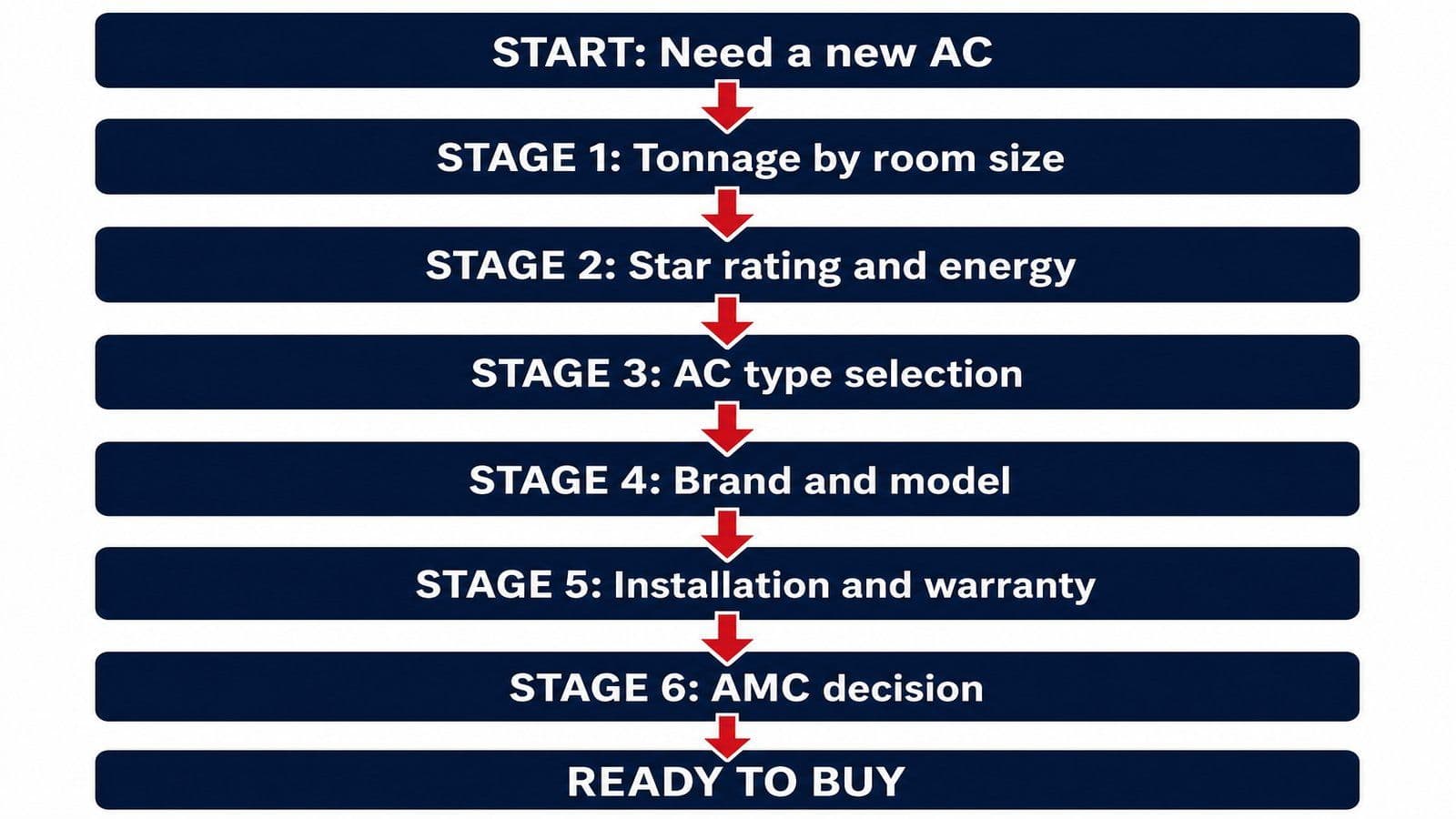
Photo: Seven-step AC fault diagnosis flow
Every AC fault you will face fits into one of ten symptom families. The structure of this guide follows that. You identify the symptom (the AC is not cooling, water is dripping, there is a strange noise, the remote has stopped working, and so on), you read the matching section, you run the owner-side checks, and you arrive at a technician call with a clear sense of what the fault is and what it should cost.
This approach is borrowed directly from how proper service workshops triage. A senior technician at a BIS-aligned service centre does not start by opening the AC. They start by asking five questions about symptom history, run a visual inspection, and only then reach for instruments. You can run the first two layers of that triage yourself.
The ten symptom families covered below are the ones we see most often in the ProNearMe network. Each section ends with a link to the dedicated cluster article for the deep-dive fix steps, so you can decide whether to handle it yourself or hand it over.
Use this quick lookup as your starting point. The table maps the symptom you are seeing to the most likely root cause, the typical 2026 fix cost, and whether owner-side checks should be your first move.
| Symptom you see | Most likely root cause | Typical fix cost (2026) | Try owner check first? |
| AC running but blowing warm air | Dirty outdoor coil or low refrigerant | ₹800 to ₹3,500 | Yes |
| Water dripping from indoor unit | Drainage line blockage or improper tilt | ₹300 to ₹1,200 | Partial |
| Loud rattling noise | Loose panel or foreign object | ₹0 to ₹600 | Yes |
| Buzzing or humming without cooling | Weak or failed capacitor | ₹600 to ₹1,200 + labour | No |
| Remote unresponsive | Dead batteries or remote failure | ₹0 to ₹1,500 | Yes |
| Ice on indoor coil | Restricted airflow or low refrigerant | ₹0 to ₹3,500 | Filter only |
| Musty or chemical smell | Coil biofilm or refrigerant leak | ₹1,200 to ₹6,000 | No |
| AC trips the MCB on startup | Capacitor, MCB rating, or voltage swing | ₹600 to ₹4,000 | MCB reset only |
| AC error code on display | Sensor or communication fault | ₹600 to ₹9,500 | MCB reset only |
| AC over 8 years and major fault | Use 50 percent rule | Decision point | No |
The biggest cost lever in Indian AC repair is not the repair itself. It is whether the owner can describe the fault in 30 seconds. A confused complaint produces a fishing-expedition diagnostic that pads the bill. A specific complaint ("the unit cools fine for 15 minutes then warm air starts and the outdoor fan keeps running") produces a targeted check that often resolves on the first visit at half the cost.

Symptom 1: AC Running but Not Cooling
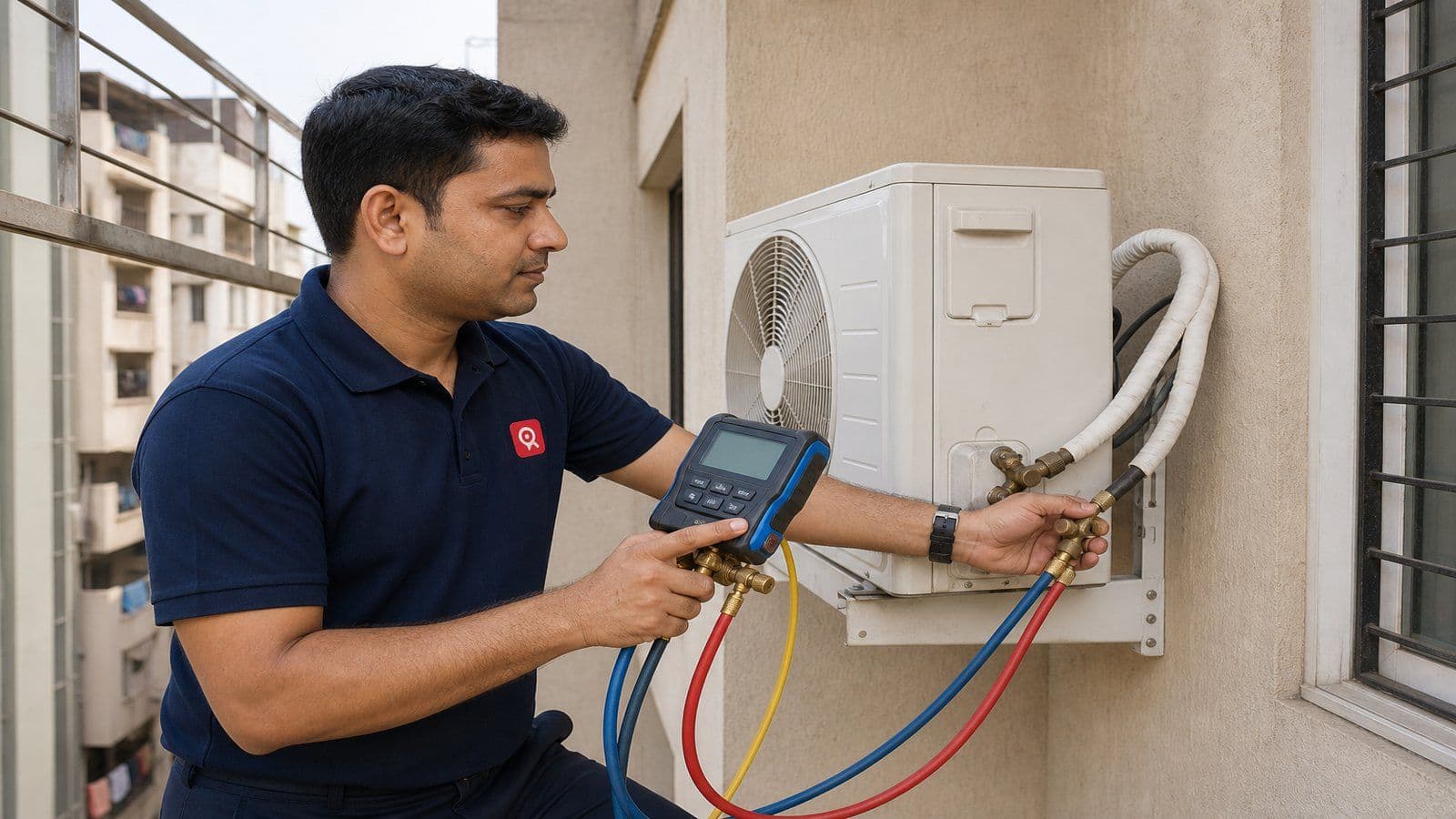
Photo: Technician checking refrigerant pressure with manifold gauge
This is the single most common complaint in the ProNearMe network, accounting for roughly 28 percent of all summer service calls. The good news is that the diagnostic tree is short. The bad news is that the wrong technician will jump straight to "you need a gas refill" without checking anything else, and gas refill is one of the most over-quoted line items in the Indian market.
Run these checks before calling anyone. Set your thermostat to 18 degrees and switch to high fan. If the indoor unit blows air that feels close to room temperature, the fault is on the cooling side, not the airflow side. If the air is barely moving at all, the fault is on the airflow side (dirty filter, blower issue, or blocked vent).
For cooling-side faults, the order of likelihood is: dirty outdoor condenser coil (40 percent of cases), low refrigerant from a slow leak (25 percent), dirty indoor evaporator coil (15 percent), compressor weakness (10 percent), and PCB or capacitor faults that prevent the compressor from running at full output (the remaining 10 percent).
A reputable technician will check coil cleanliness and outdoor fan operation first, run a refrigerant pressure test second, and only then start talking about refills or compressor work. If your technician opens with "you need 2 kg of gas, that will be ₹4,000," ask them to show you the pressure gauge reading first. R32 systems should read around 130 to 150 psi on the low side at typical Indian summer ambient, R410A around 120 to 140 psi.
Cost expectations for typical fixes. Coil cleaning runs ₹800 to ₹1,500. A genuine R32 refill (when actually needed) runs ₹1,800 to ₹3,500 including labour, and R410A runs ₹2,200 to ₹4,000. Capacitor replacement runs ₹600 to ₹1,200 for the part plus labour.
For the complete decision tree including DIY filter cleaning steps, the leak-detection sequence, and the specific brand-tier coil cleaning protocols, see our dedicated guide on AC not cooling troubleshooting.
Symptom 2: Water Leakage from the Indoor Unit
Water dripping from the indoor unit is the second most common monsoon-season complaint we handle. It is almost always one of three things, and only one of them is genuinely serious.
The first and most likely cause is drainage line blockage. Algae, dust, and biofilm build up inside the condensate drain over a season. Water backs up at the indoor unit and overflows from the front. This is a 20-minute fix for any technician, costs ₹300 to ₹600, and a homeowner can often clear a partial blockage themselves by gently pushing a thin garden hose or a stiff wire down the drain line from outside while someone watches the indoor unit.
The second cause is improper indoor unit tilt. The indoor blower unit must tilt about 3 degrees toward the drain side so water naturally flows out. If the original installer skipped this, you will see leakage from one specific corner of the indoor unit. Re-mounting at the correct angle costs ₹500 to ₹1,200 depending on whether copper pipework needs to be re-routed.
The third cause, and the only one that is genuinely worrying, is ice formation on the evaporator coil that subsequently melts. This points to either severely restricted airflow (very dirty filter), low refrigerant, or a stuck blower motor. The water leakage is a symptom of the deeper problem, and if you only fix the dripping without addressing the root cause, you will be back here in a month.
A senior technician identifies the right cause by checking the indoor unit tilt with a small spirit level first, then inspecting the drain outlet, then opening the front panel to look at the coil for ice or condensation patterns. If the technician does not do these three checks in order before quoting, push back.
For the full diagnostic flow including the algae-removal protocol, the tilt-correction steps, and the seven-point ice-formation checklist, see our AC water leakage causes and fixes guide.
Symptom 3: Loud or Unusual Noise

Photo: AC noise type to root cause mind map
AC noise is one of the most diagnostic symptoms because the type of noise tells you almost exactly where the fault is. A trained ear can localise the problem in under a minute. Here is the matching guide.
Rattling
Usually a loose panel screw or a foreign object that has fallen into the outdoor unit (leaves, a small twig, a piece of plastic that blew in during a storm). Switch the AC off at the MCB, inspect the outdoor unit fan area visually, and tighten any obvious loose screws on both indoor and outdoor panels. Costs ₹0 if you handle it yourself, ₹400 to ₹600 for a technician visit.
Buzzing or Humming Without Cooling
This is the compressor trying to start and failing, almost always due to a weak or burnt-out capacitor. The unit will hum for 5 to 10 seconds, then the internal overload protector cuts power and it goes silent. The capacitor is a ₹600 to ₹1,200 part and a 15-minute swap for any competent technician. Do not ignore this. A weak capacitor that keeps trying to start the compressor will eventually destroy the compressor itself, turning a ₹1,500 repair into a ₹20,000 one.
Hissing
A continuous low-pressure hiss from the indoor unit usually means refrigerant is leaking from a damaged copper joint or a corroded coil. A sharper, intermittent hiss from the outdoor unit during operation can be the expansion valve cycling normally and is not always a fault. The leak version needs immediate attention because the refrigerant will continue to escape and the system will eventually stop cooling entirely. Leak detection and repair runs ₹2,500 to ₹6,000 including the refill.
Clanking, Banging, or Metal-on-Metal
This is the most expensive noise. It usually means internal compressor damage (broken valve, failed bearing, or a fragmented connecting rod). The compressor will need replacement or the unit will need replacement. Expect ₹15,000 to ₹25,000 for compressor swap or factor in the 50 percent rule for replacement.
Gurgling or Bubbling
Continuous gurgling from the indoor unit indicates low refrigerant. The remaining gas-liquid mix is moving through the lines audibly. Pressure check and refill, ₹1,800 to ₹3,500.
Get quotes from verified, top-rated AC Service & Repair pros in Delhi.
Whistling or High-Pitched Whine
Usually a duct or vent restriction in window units or cassette ACs, or a slightly bent fan blade in splits. Cheap fixes, ₹400 to ₹800.
Clicking on Startup
Normal in most cases (relay engaging). If the clicking continues with no cooling, the relay or the contactor on the outdoor unit has failed. ₹600 to ₹1,500 to replace.
Grinding
Bearing failure in the indoor blower motor or the outdoor fan motor. Motor replacement runs ₹2,500 to ₹6,500 depending on whether it is indoor or outdoor and the AC tonnage.
For the full noise-to-cause mapping with audio examples and the technician-handoff script, see our AC making loud noise diagnosis guide.
Symptom 4: Compressor Problems

Photo: Four compressor failure modes illustrated
The compressor is the single most expensive component in your AC, and compressor faults are where most of the cost-versus-value decisions get made. There are four distinct compressor failure modes you should be able to recognise.
Compressor Refusing to Start
The indoor unit blows air, the outdoor fan may or may not run, but the compressor never engages. As covered in the noise section above, this is most often a capacitor fault. Cheap fix.
Compressor Starts then Trips Within Minutes
Internal overload protection is cutting in because the compressor is running too hot. Possible causes are dirty condenser coil reducing heat rejection, low refrigerant causing the compressor to work against an unbalanced pressure, voltage fluctuation tripping the protector, or a failing compressor motor. Diagnostic visit runs ₹500 to ₹800, the underlying fix varies from ₹800 (coil clean) to ₹20,000 (compressor swap).
Compressor Running Continuously Without Cooling
The compressor is mechanically intact but producing no useful work. This usually means an internal valve has failed and the compressor is no longer building pressure properly. Compressor replacement is the only fix.
Inverter Compressor Faults
Inverter ACs have a more complex compressor that includes its own electronic driver. The most common inverter compressor fault is actually the IPM (Intelligent Power Module) on the outdoor PCB, not the compressor itself. IPM replacement runs ₹3,500 to ₹7,500, which is much cheaper than full inverter compressor replacement (₹18,000 to ₹30,000). A good technician will test the IPM first before condemning the compressor.
For the complete compressor diagnostic protocol including how to interpret error codes from major brands, the capacitor-versus-compressor decision tree, and inverter-specific tests, see our AC compressor problems diagnosis guide.
I see at least one customer a month who paid ₹22,000 for a "compressor replacement" that was actually a ₹900 capacitor swap. Always ask the technician to physically show you the failed component before paying. A genuine compressor failure produces a visibly damaged or scorched part. A capacitor mis-diagnosis cannot be hidden if you ask.
Symptom 5: Remote Not Responding
This is the most common false-alarm complaint in the ProNearMe network. Roughly 65 percent of "remote not working" calls are resolved by changing the batteries, and another 20 percent by replacing the remote itself. Only about 15 percent are actual receiver-side faults on the indoor unit.
Run these checks before calling anyone. Replace the two AAA batteries with a fresh pair from a sealed pack (drawer batteries are often half-discharged). Point the remote at your phone's camera and press any button. You should see the IR LED flash on the camera screen even though it is invisible to your eye. If you see the flash, the remote is sending. If you do not, the remote is the problem.
If the remote is sending but the indoor unit is not responding, try the manual power button on the indoor unit itself (usually behind the front panel, near the display). If the manual button works, the IR receiver on the indoor unit has failed and needs replacement. IR receiver replacement runs ₹800 to ₹1,500.
For inverter ACs and Wi-Fi-enabled models, there is a separate failure mode where the indoor PCB has lost its remote pairing. A simple power cycle (switch off at the MCB for 10 minutes, switch back on) clears this in most cases.
Replacement remotes are widely available. Genuine brand remotes cost ₹600 to ₹1,500, and universal AC remotes that work with most brands cost ₹250 to ₹600 and are perfectly adequate for basic functions.
For the complete remote troubleshooting flow including the camera test, the pairing reset procedures for the top brands, and how to choose a reliable universal remote, see our AC remote not working troubleshooting guide.
Symptom 6: Ice Formation on Coils
Visible ice on the indoor evaporator coil is one of those symptoms that looks dramatic but has a small set of well-understood causes. The same icing on the outdoor coil during summer is always a fault. (During winter on cold mornings, light frosting can be normal in some hybrid systems but is rare for residential ACs in most of India.)
There are four common causes of evaporator coil icing, in order of frequency.
The first is severely restricted airflow across the coil. A clogged filter starves the coil of warm room air. The refrigerant continues to cool the coil, but with no warm air to absorb that cooling, the coil itself drops below freezing and the moisture in the surrounding air freezes on it. Diagnostic: pull the filter, look at it. If it is grey or has visible dust mats, this is your cause. Wash with water and a mild detergent, air-dry completely, reinstall. Costs ₹0.
The second is low refrigerant. With less refrigerant in the system, the same amount of cooling is concentrated in a smaller portion of the coil, which then over-cools and freezes. Pressure check and refill, ₹1,800 to ₹3,500.
The third is a stuck or weak blower motor that is not pushing enough air across the coil. Blower motor or capacitor replacement, ₹1,200 to ₹3,500.
The fourth is a faulty thermostat sensor that is reading room temperature incorrectly and keeping the compressor running far longer than needed. Sensor replacement runs ₹600 to ₹1,400.
The key safety rule with ice formation. Switch the AC off immediately when you see ice and let it defrost naturally for at least 2 hours before running it again. Running an AC with iced coils can damage the compressor (liquid refrigerant returning to the compressor instead of vapour) and bend the fan blades when ice fragments break loose.
For the full diagnostic decision tree and the safe defrost protocol, see our AC ice formation causes and fixes guide.
Symptom 7: Bad Smells from the AC

Photo: Four AC smell categories matched to causes
A bad smell when the AC runs is genuinely a health concern, not just a comfort one. Dr. Sunita Verma, our reviewer, has published research on biofilm growth in residential AC systems in the Indian climate, and her core finding is that any AC running for more than three years without a deep clean will host measurable mould and bacterial colonies that release detectable volatile organic compounds. Here is the smell-to-cause mapping.
Musty or Mildewy Smell
This is the most common smell complaint. It is biofilm and mould growing on the evaporator coil and inside the drain pan. Indian humidity and the constant cool-damp surface of the operating coil are perfect conditions for it. The fix is a proper deep coil cleaning with an antibacterial coil treatment. Costs ₹1,200 to ₹2,500. Frequency: every 12 to 18 months in coastal cities, every 18 to 24 months inland.
Sour or Vinegar-Like Smell
Specific to active bacterial growth in the drain pan. Often indicates standing water (drainage line is partly blocked). Drain line flush plus antibacterial pan treatment, ₹600 to ₹1,500.
Get quotes from verified, top-rated AC Service & Repair pros in Delhi.
Burnt or Electrical Smell
Stop using the AC immediately and switch off at the MCB. This is either a wiring fault, a failing capacitor, or a motor winding that is starting to burn out. Have a technician inspect within 24 hours. Diagnostic and repair runs ₹800 to ₹4,000 depending on what is found.
Chemical or Solvent-Like Smell
Usually refrigerant escaping from a leak inside the indoor unit. The smell is sweet-acrid. Ventilate the room and call a technician promptly. Refrigerants used in residential ACs are not acutely toxic in small quantities but should not be inhaled regularly. Leak detection and repair, ₹2,500 to ₹6,000.
Cigarette Smoke, Cooking, or Pet Odours
These accumulate on the coil and the blower wheel over time and get re-released into the room. A deep clean with a proper coil degreaser resolves this. Costs ₹1,200 to ₹2,500.
For the antibacterial coil treatment protocols and the seasonal smell-prevention calendar, see our AC bad smell causes and removal guide.
Symptom 8: AC Tripping the Circuit Breaker

Photo: Indian residential MCB box with dedicated AC circuit
When your AC trips the MCB, the breaker is doing exactly what it is designed to do, which is protecting your home wiring from a fault. The question is which fault, and there are five common ones.
The first is an under-rated MCB. If your AC is on a circuit shared with other appliances or on an MCB rated below the AC's startup current, normal compressor startup can trip the breaker. The fix is a dedicated AC circuit with an appropriately rated MCB (16A for a 1.5 ton split is typical). Electrician work runs ₹1,500 to ₹4,000.
The second is voltage fluctuation. Compressor startup pulls a brief high current, and if the supply voltage is dipping below 200 V at the same time, the MCB trips. A voltage stabiliser sized appropriately for the AC tonnage solves this. Stabilisers run ₹2,500 to ₹6,000 for typical residential ACs.
The third is a failing capacitor. A weak start capacitor causes the compressor to draw excessive current during startup, which trips the breaker. Capacitor replacement, ₹600 to ₹1,200.
The fourth is a compressor short to ground or a winding failure. The compressor is drawing fault current and tripping the MCB on startup. This is a serious fault that points to compressor replacement.
The fifth is wiring damage somewhere in the AC circuit. Rodent damage to the cable, corroded terminal block in the outdoor unit junction box, or a damaged conduit. Inspection and rewiring runs ₹1,500 to ₹4,000.
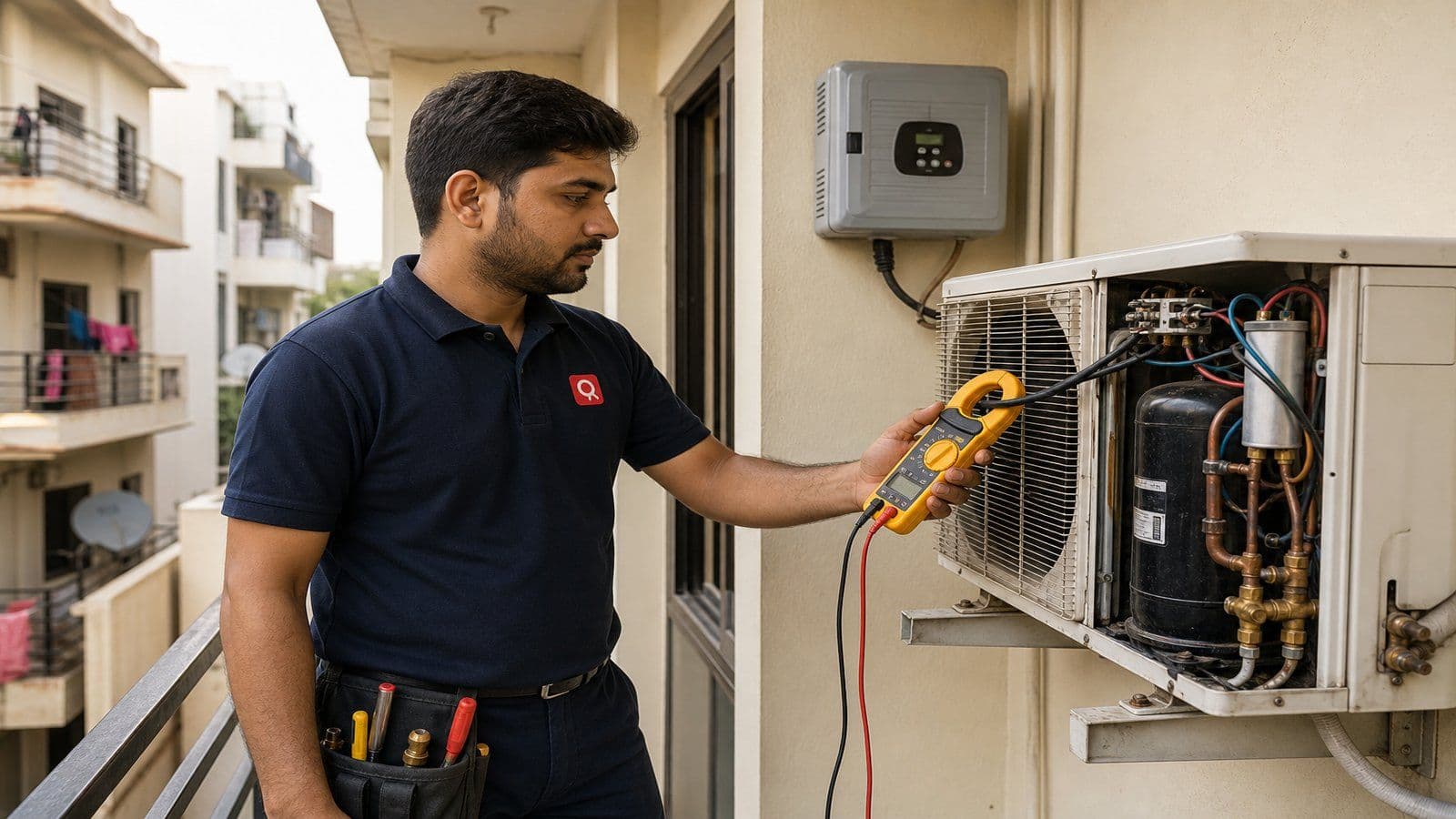
A competent technician will check the MCB rating and the supply voltage first using a clamp meter, then test the capacitor, then check the compressor windings for ground faults, and only then move to wiring inspection. The order matters because each step rules out the previous as the cost goes up.
For the complete tripping diagnostic protocol including how to safely test continuity yourself before calling for help, see our AC tripping circuit breaker fixes guide.
Symptom 9: When to Repair Versus When to Replace

Photo: AC repair versus replace decision tree
This is the question every AC owner faces eventually. Your unit is acting up, you have a repair quote in hand, and you need to decide whether to spend the money or buy a new AC. The decision is mostly arithmetic.
The 50 percent rule. If the repair quote exceeds half the price of a comparable new AC of the same tonnage AND the unit is older than 8 years, replace it. Below either threshold, repair almost always wins.
Why eight years matters. Most residential ACs in India have a usable life of 10 to 12 years with proper service, or 7 to 9 years without. An AC that has crossed eight years has most of its wear ahead of it. A single major repair often signals more on the way. The capacitor that needed replacement this summer is rarely the last component to fail in a unit this age.
Why 50 percent matters. The 2026 entry-tier 1.5 ton split AC runs around ₹32,000 to ₹38,000 with a 5-star BEE rating. Half of that is ₹16,000 to ₹19,000. The two repairs that commonly cross this threshold are compressor replacement (₹15,000 to ₹25,000) and full PCB replacement combined with a compressor or coil issue (₹12,000 to ₹18,000). At that price point, the new AC offers three meaningful advantages over a repair: a fresh warranty, the latest BEE 2026 efficiency, and a refrigerant (R32) that the spare parts market will support for the next 15 years.
The inverter exception. If your inverter AC fails out of warranty but is under six years old, replacement is usually NOT the answer. Inverter compressor swaps cost less proportionally (₹12,000 to ₹18,000 versus ₹20,000 to ₹30,000 for full replacement), the IPM module is often the actual culprit at ₹3,500 to ₹7,500, and the rest of the unit (coils, fans, PCB) still has good remaining life.
The total cost of ownership view. Pre-2018 non-inverter ACs consume 1.5 to 2 times the electricity of a current 5-star inverter at the same tonnage. If your old AC runs six hours daily, the electricity penalty alone is ₹6,000 to ₹10,000 per year over a new 5-star inverter at ₹7 per unit. Over the next five years, that is ₹30,000 to ₹50,000 in avoidable electricity costs. The replacement maths is not just about the immediate repair quote.
For the detailed cost-comparison spreadsheet and the brand-specific replacement guidance, see our AC repair vs replace decision guide.
Symptom 10: Understanding the 2026 Repair Cost Ladder

Photo: AC repair cost ladder India 2026 bar chart
Most over-charging in the Indian AC repair market is enabled by a simple fact: customers do not know what fair 2026 prices are. Here is the standard ladder. Tier-1 metros sit at the higher end, tier-2 and tier-3 cities at the lower end, and authorised brand service centres are typically 20 to 30 percent more expensive than reputable independent NSDC-certified technicians for the same work.
| Repair line item | 2026 typical range | What it actually covers |
| Filter cleaning (DIY) | ₹0 | Owner-side, 5 minutes per AC, water and mild detergent |
| Diagnostic visit only | ₹300 to ₹600 | Technician visit, no repair, no parts |
| Basic dry service | ₹400 to ₹800 | Filter wash, drainage check, electrical inspection, functional test |
| Deep wet service | ₹800 to ₹1,500 | Above plus jet wash of both coils, blower cleaning |
| Drainage line clearing | ₹300 to ₹600 | Algae and blockage removal, includes flush |
| Capacitor replacement | ₹600 to ₹1,200 + labour | Indoor or outdoor capacitor, 15-minute swap |
| IR receiver replacement | ₹800 to ₹1,500 | Indoor PCB receiver module |
| Gas refill (R32) | ₹1,800 to ₹3,500 | Pressure check, leak test, full charge |
| Gas refill (R410A) | ₹2,200 to ₹4,000 | As above, R410A has shrinking parts supply |
| Leak detection and repair | ₹2,500 to ₹6,000 | Pressure test, joint repair, refill included |
| Blower motor replacement | ₹2,500 to ₹6,500 | Indoor or outdoor, varies by tonnage |
| IPM module (inverter) | ₹3,500 to ₹7,500 | Outdoor PCB power module, frequent inverter fault |
| Full PCB replacement | ₹4,500 to ₹9,500 | Indoor or outdoor full board |
| Sensor replacement (temperature, humidity) | ₹600 to ₹1,400 | Single sensor swap |
| Compressor repair (in warranty) | ₹3,000 to ₹6,500 | Labour billed, parts under warranty |
| Inverter compressor replacement | ₹18,000 to ₹30,000 | Out of warranty, full cost |
| Conventional compressor replacement | ₹15,000 to ₹25,000 | Out of warranty, full cost |
| Annual maintenance contract (basic) | ₹2,500 to ₹4,000 per AC | Two scheduled services, parts excluded |
| Annual maintenance contract (comprehensive) | ₹4,500 to ₹6,500 per AC | Includes most spare parts and gas top-up |
Three rules to use this table effectively. First, always ask for an itemised quote with parts, labour, and GST shown separately before any work starts. A combined "total" quote is the single biggest sign of an inflated bill. Second, the gas refill is the most common over-quoted line item, ask to see the pressure gauge reading before agreeing to a refill. Third, brand-authorised service centres are not always better, they are just more expensive. An NSDC Mechanic-RAC certified independent technician with verifiable reviews handles 90 percent of repairs at the same quality for 25 to 30 percent less.
For the complete cost breakdown by city tier, by AC tonnage, and by brand category, see our AC repair cost breakdown India 2026 guide.
The fastest way to verify a quote is to ask the technician to list the part number and the source of the spare. A legitimate spare has a printed part number, a manufacturer name, and ideally the original packaging. Generic spares without these markings are often 40 to 60 percent cheaper at the wholesale level, but they get charged at brand prices in many invoices. You should see the same margin difference reflected in your bill.
Case Study: A Real Diagnostic Walkthrough
Last summer Mrs. Lakshmi Iyer in Adyar, Chennai, called us with a complaint that her 1.5 ton inverter split (purchased in 2021) had "stopped cooling completely and is making a strange noise." Two previous technicians had already visited. The first had told her she needed a gas refill at ₹3,800 (she paid, no improvement). The second had told her the compressor was failing and she needed a replacement at ₹22,000.
Our technician ran the standard triage. Indoor airflow was strong, so the blower was fine. The outdoor unit was running, but the fan was spinning at half speed. He measured the outdoor unit's running current with a clamp meter, which was within the normal range. He then checked the outdoor fan capacitor, which had visibly bulged on top, a classic capacitor failure sign.
The fix was a ₹850 capacitor and 20 minutes of labour, total invoice ₹1,400 including GST. The "compressor failure" diagnosis from the previous technician was wrong. The compressor was perfectly healthy, it had simply been struggling against an outdoor unit that was not rejecting heat properly because the fan was running slow.
This is exactly the kind of case where a basic understanding of the symptom-to-cause mapping saves an Indian household ₹20,000. Mrs. Iyer's AC has now run two full summers without another service call.
Owner-Side Pre-Call Checklist

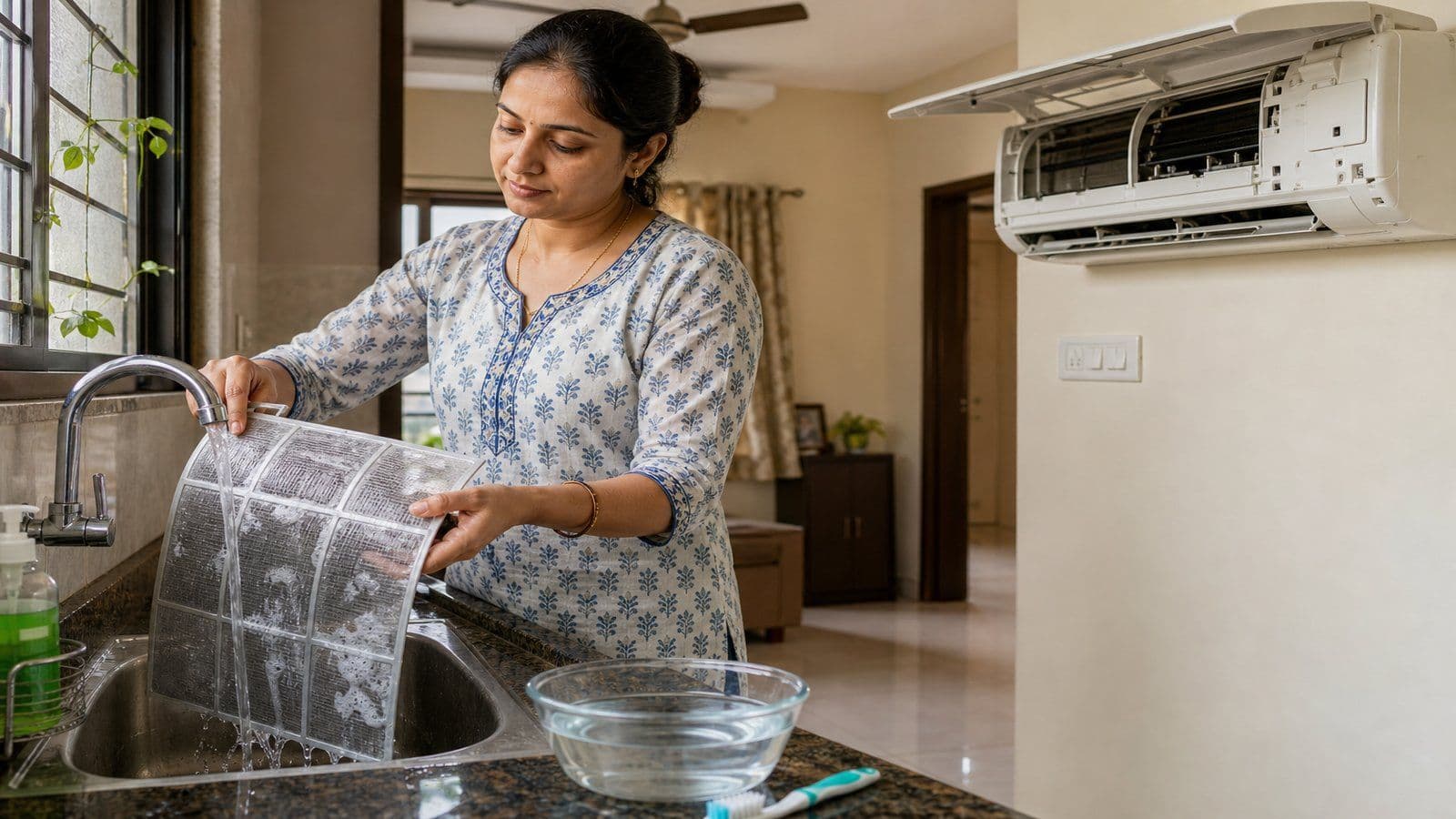
Photo: Indian homeowner removing AC filter for cleaning
Before any technician arrives, run these five checks. They take 10 minutes total and resolve roughly 35 percent of complaints with zero spend.
1. Filter inspection. Open the indoor unit front panel and pull out the mesh filters. If they look grey or have visible dust mats, wash with water and a mild detergent, air-dry completely, reinstall. Many "not cooling" complaints resolve here.
2. Remote battery swap. Replace both AAA batteries from a sealed pack. Check the IR signal using your phone camera. This catches 65 percent of remote complaints.
3. MCB reset. Switch the AC off at the dedicated MCB for 10 minutes, switch back on. This clears around one in four PCB error codes and inverter pairing faults.
4. Outdoor unit visual. Walk to the outdoor unit. Check that the fan spins freely and at normal speed (you should see the fan disappearing into a blur when running, not visible individual blades). Check that no leaves or debris are stuck in the fan guard. Confirm the unit is not surrounded by furniture or a closed balcony cover that blocks airflow.
5. Drainage check. Look at the drainage pipe outlet outside. Water should drip steadily when the AC runs in cooling mode for 15 minutes on a humid day. No water dripping at all could mean the drain is fully blocked. Excess water dripping or sprays from the indoor unit means a tilt or drainage problem.
If any of these five resolves your complaint, you have saved a service call. If none does, you call the technician with a much clearer picture of what is not the problem.
Get quotes from verified, top-rated AC Service & Repair pros in Delhi.
Choosing the Right Technician for Diagnosis
The technician you pick is at least as important as the AC you own. Here is the short checklist.
NSDC or ITI Certification
Ask to see it. The NSDC registry is publicly verifiable online via the National Skill Development Corporation portal. An NSDC Mechanic-RAC certification or ITI Refrigeration and Air Conditioning trade certificate is the baseline credential.
Brand Authorisation for Warranty Work
Unauthorised service voids most brand warranties, so this matters even for routine work.
Itemised Written Quote
Parts, labour, and GST shown separately, before any work starts. Verbal quotes that change after the work is done are the single largest source of complaints we hear.
Pre-Work Diagnosis With the Owner Watching
A trustworthy technician explains what they have found, shows you the failed component if possible, and gets your approval before doing anything beyond the diagnostic.
Genuine Spares With Part Numbers
Genuine spares come in original packaging with a visible part number. Compatible generic parts can be cheaper but routinely fail within months. If a technician pushes you toward generic, ask for both prices in writing and you decide.
Written Warranty on the Work
Minimum 30 days on routine repairs, 90 days on PCB or capacitor replacement, one year on full installations. In writing on the invoice.
Reviewable Work History
Either through aggregator platforms with itemised reviews (not five-star strings), or referrals from people you can actually call.
I would not hire a technician who fails any two of these seven checks. The first failure can sometimes be explained, two failures means the operation is not professional enough to trust with a ₹40,000 piece of equipment in your home.
A genuine technician welcomes the question "can I see the part number on the failed component?" An over-charging operator will deflect with "trust me, this is the problem." That single question filters out roughly 80 percent of bad actors in our experience training new technicians for the ProNearMe network.
Safety Notes for Owner-Side Diagnosis
Three hard limits on what you should do yourself before a technician arrives.
Never Open the Unit Beyond the Filter Panel
Both indoor and outdoor units carry residual mains voltage on the internal capacitors for several minutes after disconnection. Industry data published under Indian electrical safety norms shows that capacitor discharge is one of the most under-reported sources of shock injuries in home appliance servicing.
Never Attempt Refrigerant Work Yourself
Refrigerant handling is regulated under the MoEF&CC framework and ozone-depleting substance rules. Releasing refrigerant into the atmosphere is a regulatory violation. Refilling, leak repair, and recovery all require NSDC Mechanic-RAC certified handlers with proper recovery equipment.
Never Bypass the MCB or Remove the Earth Wire
Some online videos suggest "just bypass the safety device if it keeps tripping." This is the single fastest way to convert a fixable fault into a house fire. The MCB is tripping because something is wrong. Find what is wrong, do not silence the warning.
For routine maintenance that owners can safely perform (filter washing, drain pipe clearing from outside the AC, outdoor unit visual inspection, MCB reset), the BIS-aligned residential air conditioning safety guidance and the NSDC trade module materials provide good reference points.
Conclusion
The ac fault diagnosis framework in this manual is built around a simple observation. Most AC repair over-charging in India is enabled by information asymmetry. The technician knows what is wrong, the owner does not, and the gap between those two is where the bill grows. Closing that gap does not require becoming an AC mechanic. It requires knowing the ten symptom families, the standard 2026 cost ladder, and the seven-point technician checklist. Together, those three things put you on equal terms with any service provider in the Indian market.
Your next step depends on which symptom you arrived here with. If your AC is acting up right now, run the 5-minute owner diagnostic first, then open the matching cluster guide for the deep-dive fix. If your AC is currently running fine, bookmark this page and run a pre-summer service in February or early March, that single habit prevents more than half of the breakdowns we see across the ProNearMe network.
Disclaimer
The cost ranges, diagnostic protocols, and service intervals in this manual reflect typical Indian-market conditions as of May 2026. Actual prices vary by city, AC capacity, brand, GST treatment, and the individual technician you hire. Always obtain an itemised written quote with parts, labour, and GST shown separately before authorising any AC repair. For decisions specific to your unit and home, consult a licensed AC technician with NSDC Mechanic-RAC certification. ProNearMe does not endorse specific brands or technicians; brand and refrigerant mentions in this article are illustrative of the Indian market context.
Sources & References
- Bureau of Indian Standards (BIS), IS 1391 Part 1 and Part 2 specification for room air conditioners
- Bureau of Energy Efficiency (BEE), Revised ISEER thresholds for room air conditioners effective January 2026
- Bureau of Energy Efficiency, Insights from the 2024 Household Survey on Residential Energy
- National Skill Development Corporation (NSDC), Mechanic-RAC Refrigeration and Air Conditioning certification framework and qualification pack
- Ministry of Environment, Forest and Climate Change (MoEF&CC), Ozone Depleting Substances Rules and refrigerant phase-down schedule under the Kigali Amendment
- Press Information Bureau (PIB), Government's Star Labelling Programme efficiency improvements for residential air conditioners
- Indian Society of Heating, Refrigerating and Air Conditioning Engineers (ISHRAE), COOL Conclave residential systems track
- Central Electricity Authority (CEA), Indian residential electricity tariff bands and per-unit cost data by state
- National Building Code of India (NBC 2016), Part 8 on Building Services and provisions for residential air conditioning installation
- Ministry of Power (MoP), Energy Conservation Building Code and residential efficiency notifications
Amit worked as an AC technician for 6 years in Ahmedabad before transitioning to technical writing. He holds a diploma in Refrigeration and Air Conditioning from ITI Ahmedabad and understands the difference between what AC companies promise and what actually happens on the ground. His articles break down complex technical topics into plain language that any homeowner can follow. He tests every tip he writes about in his own home first.

Dr. Verma is a mechanical engineer with 15 years of experience in HVAC systems. She completed her PhD from IIT Delhi on energy-efficient cooling solutions for Indian residential buildings. She reviews all technical content on HomePros to make sure the numbers are right, the advice is safe, and the recommendations are backed by actual engineering principles. She consults for multiple AC manufacturers on product design.