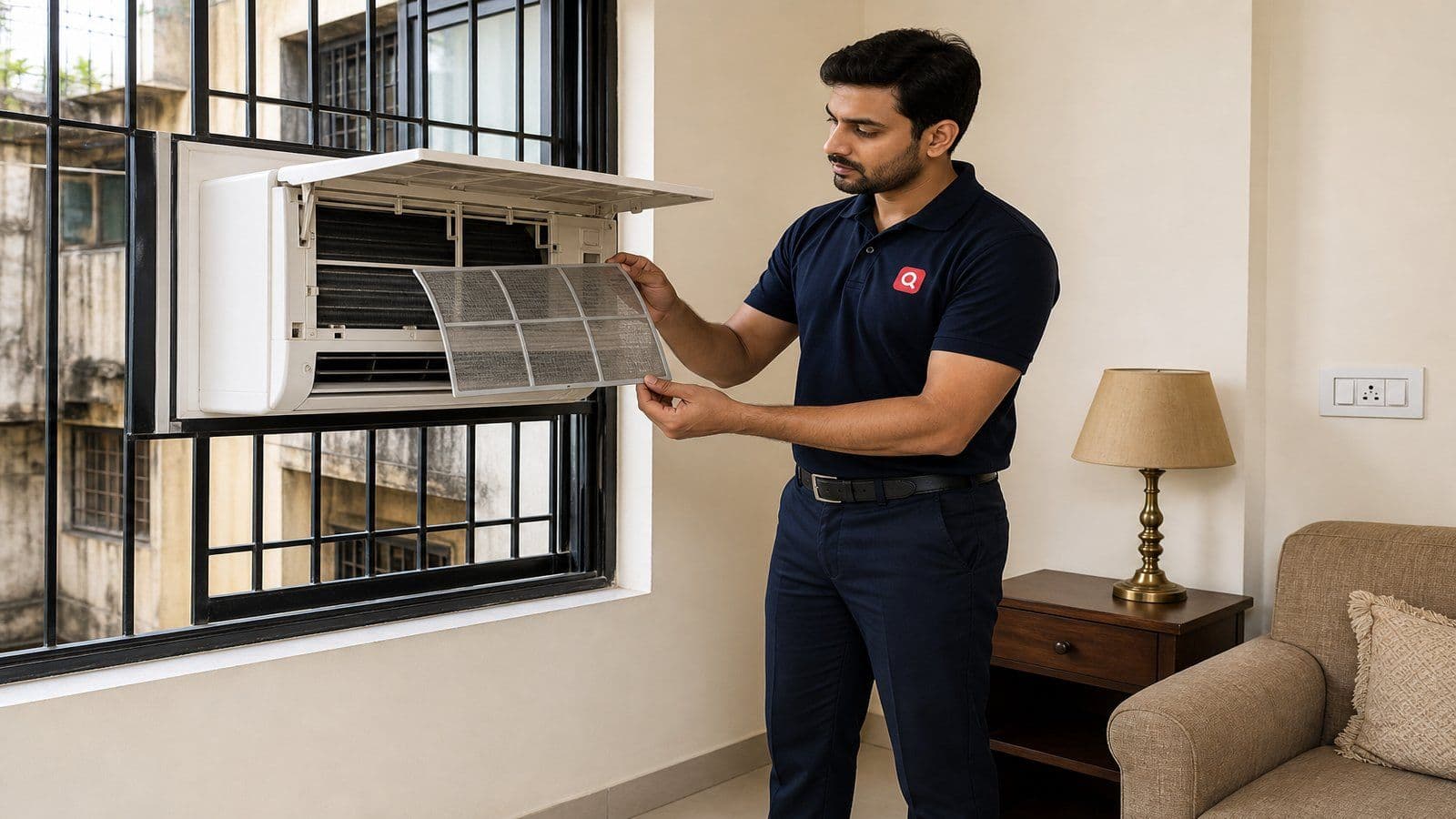
- ProNearMe network data shows that 38 percent of summer noise complaints trace to just three causes: loose outdoor unit panels, weak run capacitors causing compressor hum, and clogged blower wheels making indoor whirring sounds.
- A hissing or whistling AC needs urgent attention within 24 hours. It almost always signals a refrigerant leak, which the Ministry of Environment, Forest and Climate Change has tightened handling rules around under the Kigali Amendment.
- Grinding, banging or loud metal-on-metal sounds require immediate power-off at the MCB. Running the unit even another 30 minutes can destroy the compressor mounting or shatter a fan blade.
- Light clicking sounds when an AC starts up or shuts down are usually normal thermal expansion in the copper piping. Constant clicking from a running unit, on the other hand, points to a sticking relay and needs a ₹600 to ₹1,200 repair.
- Annual servicing under ₹800 prevents the bulk of noise-generating problems: loose bolts torqued, blower wheels washed, capacitor microfarads measured, fan blades inspected, and bracket levels checked.
An AC making noise is rarely a small thing. A healthy split unit measured one metre from the outdoor fan should sit between 48 and 54 decibels, roughly the level of a quiet conversation. The moment your AC develops a new loud noise, whether a rattle, a buzz, a deep hum, a hiss, a clank or a high-pitched whistle, the unit is asking for attention.
Some sounds mean a ₹300 bracket bolt is loose. Others mean the compressor is about to seize and the gas line is venting refrigerant into the atmosphere. The difference between the cheap fix and the ₹35,000 disaster is usually a matter of recognising the sound type in the first 48 hours and acting before it cascades.
This guide walks through the eight distinct noise families our ProNearMe network technicians hear most often in Indian homes, what each one almost always means, which need immediate power-off and which can wait until morning, and the typical fix cost in 2026 rupees.
It also covers indoor blower noises, the difference between startup sounds and steady-state sounds, and the small set of DIY checks an owner can safely make before calling for service. For wider context on AC faults, see the parent guide on AC repair faults and diagnosis.

Get quotes from verified, top-rated AC Service & Repair pros in Delhi.
Why Your AC Is Making Loud Noise: How to Diagnose by Sound Type

Photo: AC Noise Classification Chart
Every loud AC noise belongs to one of about eight families. Identifying the family in the first 30 seconds of listening is the most useful diagnostic step an owner can take. The frequency, the location (indoor unit or outdoor unit), the timing (startup, steady running, shutdown) and the rhythm (constant, intermittent, pulsing) all narrow the cause. Most technicians, including ours, ask exactly these four questions before reaching for any tool.
The Indian Society of Heating, Refrigerating and Air Conditioning Engineers (ISHRAE) residential HVAC guidelines suggest that any split AC running louder than 60 decibels at one metre should be investigated. A practical home rule is simpler. If your unit suddenly sounds different from how it sounded last week, that is your signal.
Where Is the Sound Coming From
Stand inside the room with the AC running for two minutes. Then stand outside on the balcony or wherever the outdoor unit sits, for another two minutes. The indoor unit produces blower noise, drain gurgles, expansion clicks, and occasional electrical buzzes from the PCB. The outdoor unit produces compressor hum, fan noise, refrigerant flow sounds, and most mechanical rattles. Localising the source halves the diagnosis time.
When Does the Sound Occur
Sounds that appear only during the first 30 seconds after switch-on are usually startup phenomena: thermal expansion clicking, compressor inrush hum, fan blade spinning up against a leaf. Sounds that appear only during steady running point to ongoing faults: a worn bearing, a loose panel vibrating at running frequency, a refrigerant leak. Sounds at shutdown are again usually expansion or relay release, almost always normal.
How Frequent Is the Sound
A constant noise that does not change with the compressor cycle suggests something mechanical and continuous: a loose bracket, a fan blade fouled by debris, a deteriorating bearing. An intermittent noise that comes and goes with the compressor cycle suggests a refrigerant-side issue or a capacitor that struggles at higher load. A pulsing rhythm at roughly one beat per second is often a fan blade hitting something on each rotation.
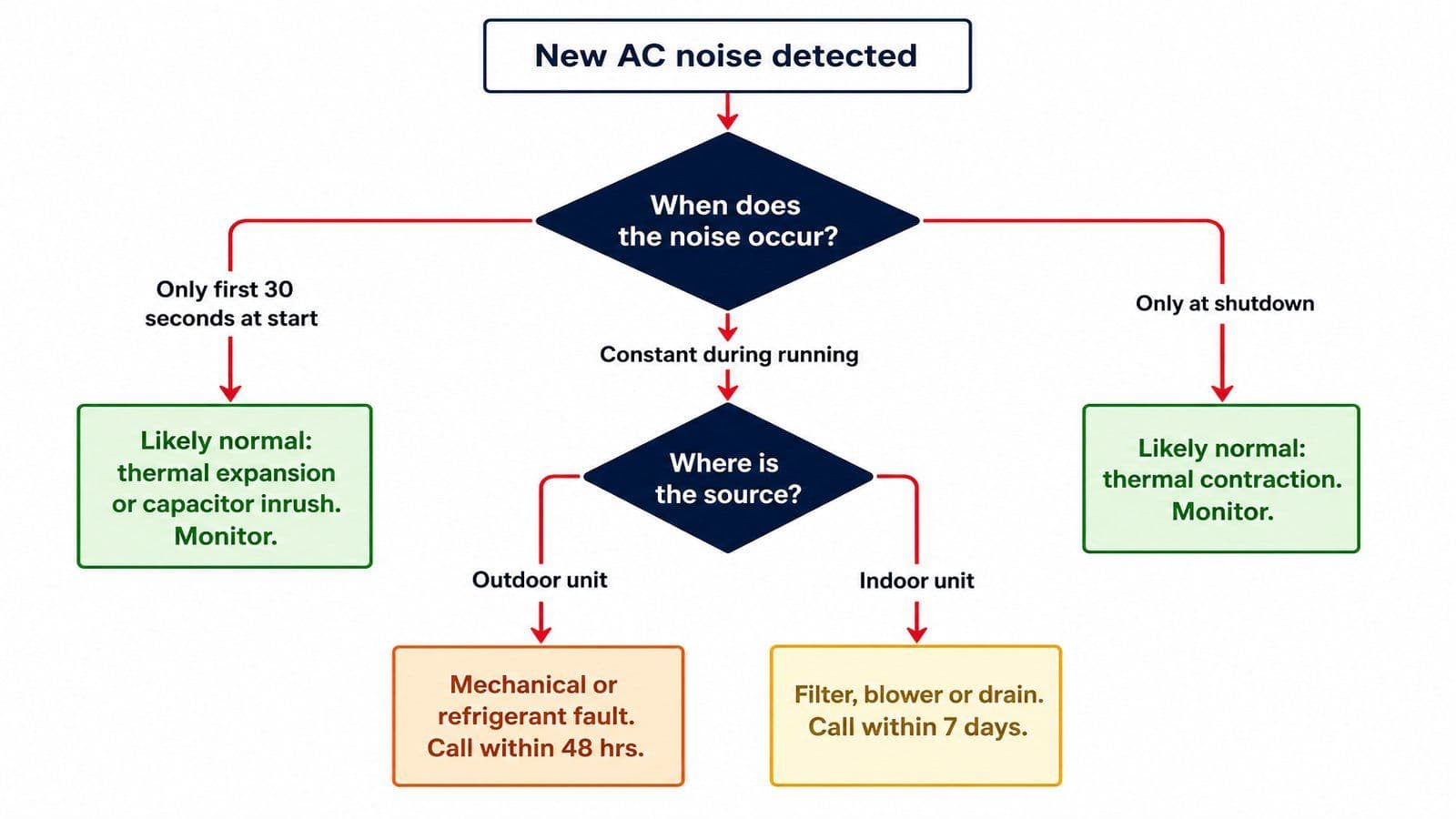
Photo: Noise Timing Diagnosis Flowchart
Rattling Sounds: Loose Parts and Debris
Rattling is the single most common noise complaint our technicians receive, accounting for roughly 22 percent of all noise calls in our network last summer. It is also the most owner-fixable, at least at the first level of inspection.
Loose Panel Screws on the Outdoor Unit
Outdoor units sit through pre-summer heat, monsoon vibration and post-monsoon contraction. Over two or three seasons the panel screws on the outdoor unit casing slowly back out, especially on units with cheap zinc-plated hardware. The casing then vibrates at the compressor's running frequency and produces a steady rattle that gets worse the longer the unit runs. A NSDC-certified technician will check and re-torque every panel screw in 10 minutes.
Typical fix cost: ₹300 to ₹500 for a full screw inspection and torque pass.
Debris Inside the Outdoor Unit
Leaves, twigs, paper, the occasional bird feather, even small toys flung off a balcony above, can lodge inside the outdoor fan housing. As the fan spins, the debris bounces around producing an irregular rattling or tapping. Owners can safely look (do not reach in) through the protective grille with a torch. If you see debris, switch off at the MCB before any technician opens the cowl.
Typical fix cost: ₹300 to ₹600 for debris removal and fan inspection.
Loose Wall Bracket Bolts
The L-shaped MS bracket holding the outdoor unit to the wall takes the full vibration load. Over time the wall plugs loosen, especially in older buildings with brick walls or in monsoon-prone coastal flats. A rattling bracket transmits compressor vibration into the wall and into the room below. This is the most common complaint that gets misdiagnosed as a compressor fault.
Whenever a customer calls about loud rattling that started suddenly after the first rain of the season, my first stop is the wall bracket. Nine times out of ten it is two loose bolts and a missing rubber dampener. We re-bolt, add fresh anti-vibration pads, and the rattle goes. Costs ₹400. The compressor was never the problem.

Typical fix cost: ₹400 to ₹800 for bracket re-bolting and fresh anti-vibration pads.
Loose Fan Blade or Cracked Blade
A fan blade that has worked loose on its hub will produce a heavier, rhythmic rattling that gets faster as the fan speeds up. A cracked blade produces a similar sound but with an added thump every rotation. Both need immediate attention because a blade flying off at full speed inside the cowl can damage the coil, shatter against the casing and become a projectile.
Typical fix cost: ₹900 to ₹1,800 for fan blade replacement including labour.
Get quotes from verified, top-rated AC Service & Repair pros in Delhi.
Buzzing Sounds: Electrical and Refrigerant
Buzzing is the second-largest noise category, accounting for around 18 percent of network calls. Most buzzing is electrical, which makes it both easier to diagnose and more dangerous to ignore.
Failing Contactor
The contactor is the heavy-duty relay that switches power to the compressor on each cycle. As the contacts oxidise and pit, the contactor draws an arc instead of making a clean connection. The result is a steady electrical buzz from inside the outdoor unit's control box, often loudest during the first second of compressor start. Left unattended, a failing contactor will eventually weld shut or fail to close at all.
Typical fix cost: ₹800 to ₹1,500 for a contactor swap.
Weakening Run Capacitor
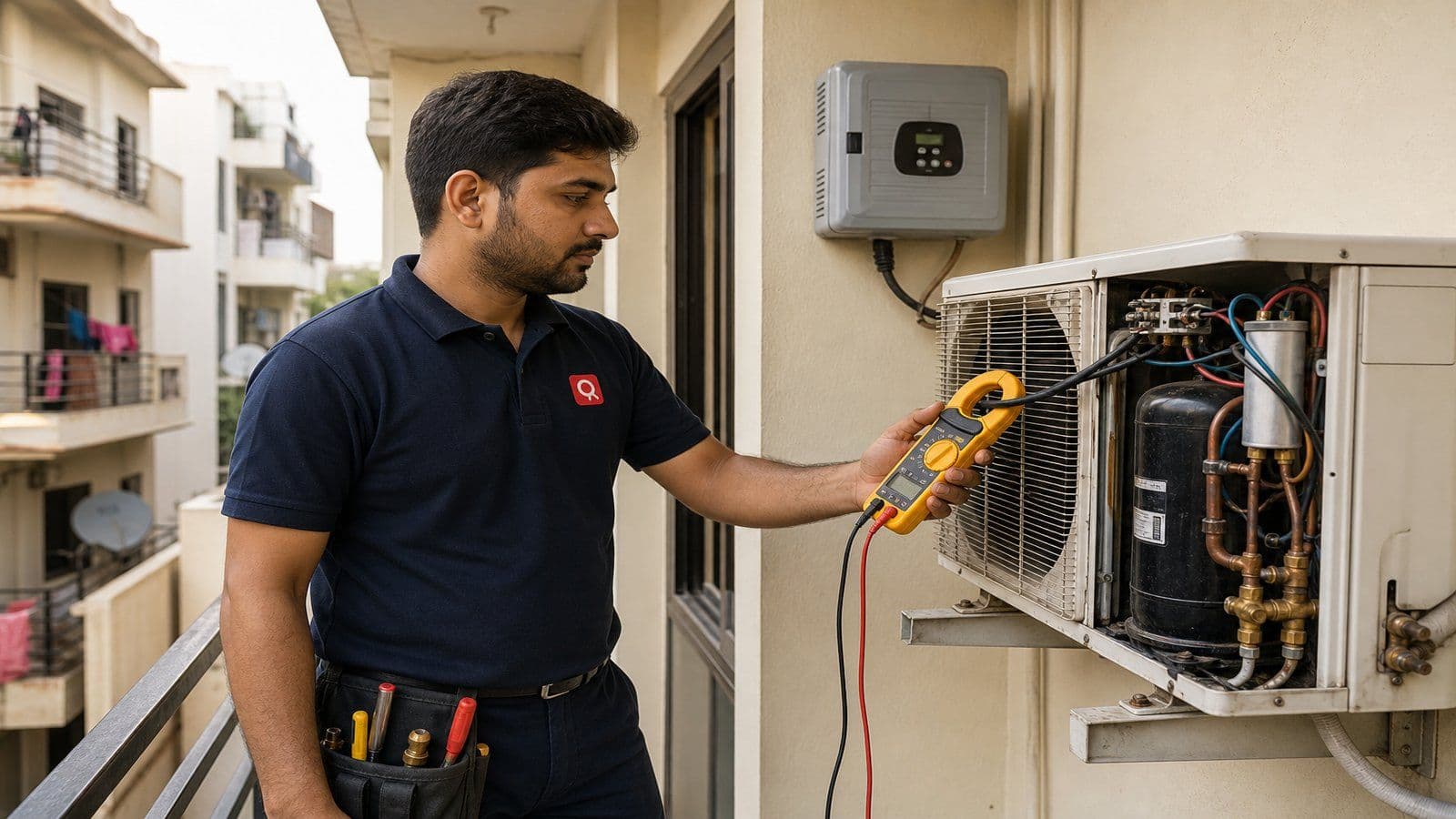
A run capacitor that is losing microfarads cannot maintain a clean voltage phase for the compressor windings. The result is a low-frequency buzzing or growling sound from the outdoor unit during steady operation, often paired with reduced cooling. Our technicians measure capacitor microfarads on every service call because a weak capacitor stresses the compressor windings and shortens compressor life dramatically.
Typical fix cost: ₹1,200 to ₹2,400 for capacitor replacement.
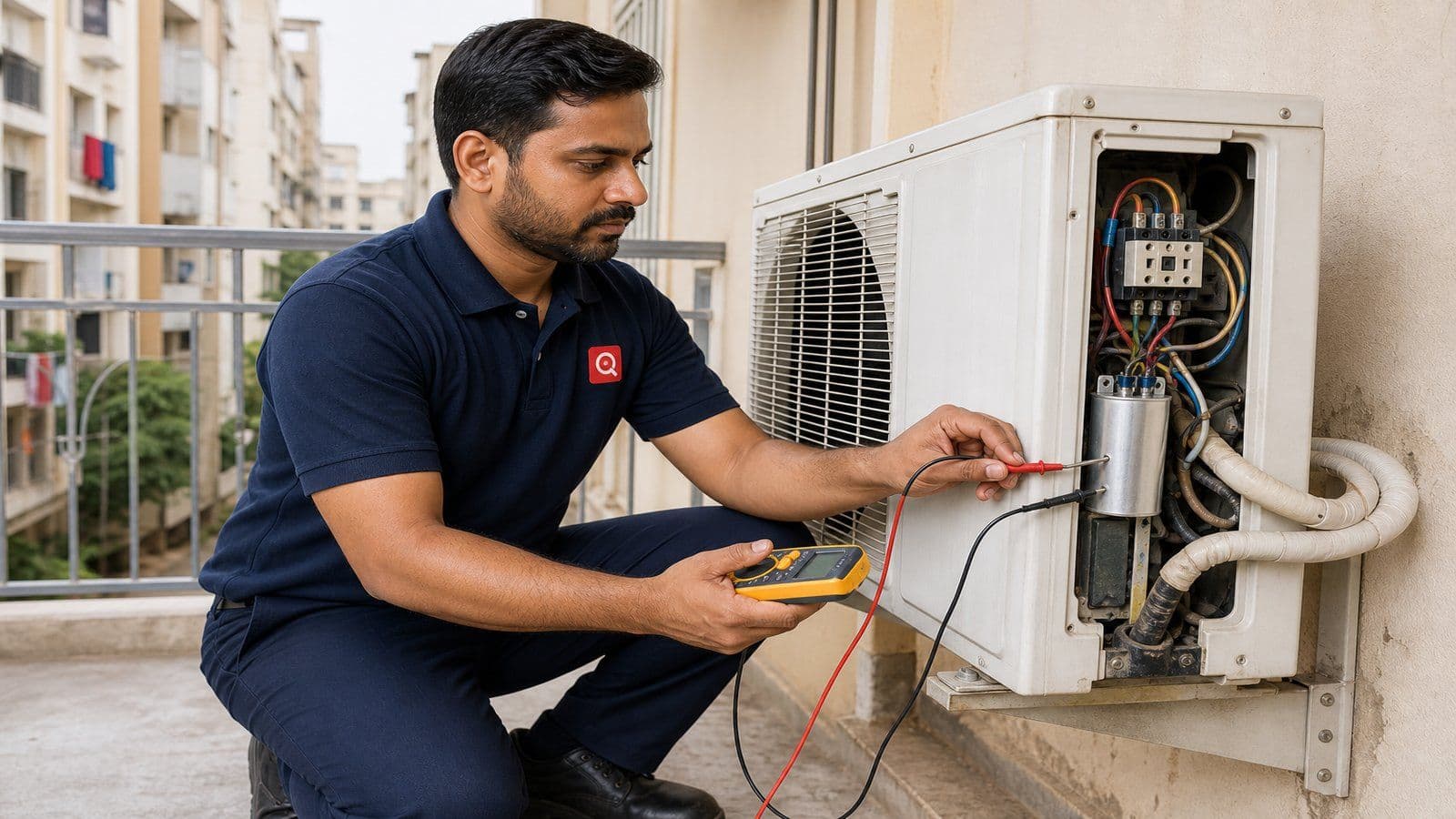
Photo: Indian Technician Measuring AC Outdoor Unit
Refrigerant Flow Turbulence
A high-pitched buzz or whine from inside the indoor unit, especially right after the compressor kicks in, is sometimes refrigerant flowing through a partially blocked expansion valve or a worn TXV pin. This is uncommon but real, and it requires NSDC-certified handling because diagnosis involves opening the refrigerant circuit. Owners should not attempt this.
Typical fix cost: ₹2,500 to ₹4,500 for expansion valve service or replacement.
Humming Sounds: Compressor Struggle
A loud, deep humming sound from the outdoor unit, especially one not accompanied by the fan spinning up, almost always points to a compressor that wants to start but cannot.
Compressor Stuck on Start
The compressor draws inrush current, the contactor closes, and the compressor hums loudly for three to five seconds but does not spin. The hum then either trips the internal overload protector or the compressor finally lurches into operation with an audible thump. This pattern is classic capacitor failure. The compressor is healthy, the capacitor cannot deliver starting torque.
Typical fix cost: ₹1,200 to ₹2,400 for capacitor replacement.
Failed Start Relay (on Reciprocating Compressors)
Older non-inverter reciprocating compressors use a separate start relay that disengages once the compressor reaches running speed. A failed start relay leaves the start winding energised continuously, producing a loud hum and rapidly overheating the windings. This is one of the few faults where a 10-minute delay genuinely matters.
Typical fix cost: ₹800 to ₹1,500 for start relay replacement.
Compressor Near End of Life
A 10 to 12 year old AC whose compressor produces a louder and rougher hum each season is in the final phase of its mechanical life. Internal bearings are wearing, the discharge valves are softening, and the windings are degraded. Replacement is usually more economical than repair beyond this point. Read our analysis on AC repair versus replace decisions before approving a major fix.
Typical fix cost: ₹18,000 to ₹35,000 for compressor replacement, often equal to half a new AC.
Hissing Sounds: Refrigerant Leaks
Hissing is the noise type that should make every owner reach for the switch. A steady hiss from any part of the system is refrigerant escaping under pressure, almost always through a pinhole in the copper piping, a corroded coil joint, or a damaged flare connection. For the underlying mechanics of the cooling circuit, see how AC components work.
Pinhole Leak in Copper Lines
The thin copper suction or discharge lines develop pinholes from vibration fatigue, salt corrosion in coastal cities, or accidental damage during a previous service. A steady fine hiss accompanies the leak and the unit progressively loses cooling capacity. Within a week of a pinhole opening, the system pressure drops below threshold and the compressor begins running hot.
Typical fix cost: ₹2,500 to ₹6,500 for leak detection, repair and refrigerant recharge.
Damaged Flare Joint at Indoor or Outdoor Unit
The flare nuts that connect the copper piping to the indoor and outdoor units can loosen, crack or develop micro-leaks if they were over-torqued during installation. A hiss audible right at the joint, or visible oil staining on the copper just below the flare, is the signature. This is the most common leak point on poorly installed units.
Typical fix cost: ₹600 to ₹1,500 for re-flaring plus ₹2,000 to ₹4,000 for refrigerant recharge if pressure has dropped.
High Pressure Release Through Safety Valve
Less common but more dramatic. If the system over-pressurises because of a stuck check valve or a blocked condenser, the high-pressure safety vents a short burst of refrigerant with a loud hiss. This is a one-time emergency event and needs immediate technician callout. The MoEF&CC Ozone Depleting Substances Rules require this kind of handling to be done by certified personnel.
Hissing is the noise where time genuinely matters. Every hour the unit runs with a refrigerant leak is an hour the compressor is running on inadequate cooling, which causes permanent winding insulation damage. The repair cost for a leak detected on day one is ₹3,000. The same leak detected at day 14 with a burnt compressor is ₹25,000.
Typical fix cost: ₹3,500 to ₹8,000 including high-pressure switch reset and full system check.
Get quotes from verified, top-rated AC Service & Repair pros in Delhi.
Clanking and Banging: Mechanical Damage
A loud, single bang or repeated clanking from the outdoor unit is a sign of broken or detached mechanical parts inside the compressor or fan assembly. This is the noise category with the strictest power-off rule.
Compressor Internal Damage
A broken connecting rod, a fractured valve plate, or a shattered piston ring inside the compressor produces a heavy metal-on-metal clanking that varies with compressor speed. The compressor may still cool, but every revolution is doing additional damage. Continued running guarantees a full compressor failure.
Typical fix cost: ₹18,000 to ₹35,000 for compressor replacement.
Broken Compressor Mount
The compressor sits on three or four rubber mounts inside the outdoor unit chassis. When a mount fails, the compressor sags and begins striking the chassis or copper piping on each vibration cycle, producing a regular clanking. Left unfixed, this also damages the copper lines, leading to refrigerant leaks. For more on this, see our coverage of AC compressor problems and diagnosis.
Typical fix cost: ₹1,500 to ₹3,200 for a full compressor mount kit replacement.
Loose Blower Wheel (Indoor Unit)
The indoor blower wheel can work loose on its shaft, especially after a deep clean where the set screws were not properly retorqued. A wobbling blower wheel strikes the housing on each rotation, producing a loud thumping or clanking from inside the indoor unit. This is a fast indoor-unit fix.
Typical fix cost: ₹500 to ₹900 for blower wheel re-seating.
Grinding Sounds: Bearing Failure
A grinding sound, usually from inside the indoor unit but occasionally from the outdoor fan, almost always means a bearing has run out of lubrication.
Indoor Blower Motor Bearing Failure
The indoor blower motor runs on sealed bearings rated for around five to seven years of continuous summer use. Once a bearing fails, the motor produces a grinding or scraping sound that progressively worsens. The blower wheel begins wobbling on the shaft and the motor draws higher current. Replacing the motor is almost always more economical than attempting to replace just the bearings.
Typical fix cost: ₹1,800 to ₹3,500 for indoor blower motor replacement.
Outdoor Fan Motor Bearing Failure
Less common because outdoor motors are typically heavier-duty, but the failure pattern is the same. A grinding outdoor fan motor produces a louder sound than an indoor one because the outdoor fan is larger and exposed. Owners often confuse this with compressor noise initially.
Typical fix cost: ₹2,200 to ₹4,500 for outdoor fan motor replacement.
The fastest way to tell a bearing grind apart from a compressor problem on a service call is to kill power and spin the indoor blower wheel by hand for one full rotation. A healthy bearing glides silently. A failing one catches and grates every quarter turn. About 70 percent of grinding complaints we see in flats older than six summers are blower motor bearings, not compressors. The motor swap is a 40 minute job and the AC goes back to library-quiet.
Clicking and Popping: Mostly Normal, Sometimes Not
This is the noise type owners most often worry about unnecessarily. Most clicking sounds in an AC are routine.
Thermal Expansion Clicks at Startup and Shutdown
When the compressor starts and the refrigerant suddenly cools the copper piping, the copper contracts and produces small clicking sounds. The opposite happens at shutdown as the piping warms back up. These clicks are completely normal and you will hear them every single cycle.
Typical fix cost: ₹0. This is normal operation.
Sticking Relay or Contactor
A relay or contactor that fails to fully close, then partially releases, then closes again, produces a rapid clicking from inside the outdoor unit's control box during steady running. This is not normal and the relay needs replacement before it welds shut or fails entirely.
Typical fix cost: ₹600 to ₹1,200 for relay replacement.
Stiff Compressor Inrush Click on Startup
A single loud click followed by the compressor hum is the contactor closing under heavy inrush current. This is normal. A series of three or four clicks before the compressor catches indicates a struggling capacitor and warrants service.
Typical fix cost: ₹1,200 to ₹2,400 for capacitor replacement if the multi-click pattern is observed.
Whistling and Squealing: Belts and Airflow
This noise category is less common in modern split ACs but appears in older window units and ducted systems.
Slipping Fan Belt (Older Window Units and Ducted Systems)
Window ACs and ducted systems with belt-driven blowers can develop slipping belts as the rubber ages and stretches. The slip produces a high-pitched squeal, loudest at startup and during high-load running. Replacement is straightforward but increasingly rare since most residential splits use direct-drive motors.
Typical fix cost: ₹400 to ₹900 for belt replacement.
Airflow Restriction Whistle
A high-pitched whistle from inside the indoor unit when the fan is running on high is usually airflow being forced through a partially blocked filter or a damaged blower housing. The whistle is harmless but the underlying blockage is starving the unit of airflow, which can lead to coil freezing. Read about that risk in our piece on ice formation on AC coils.
Typical fix cost: ₹0 if it is just a filter clean. ₹500 to ₹1,200 if the blower housing needs repair.
Get quotes from verified, top-rated AC Service & Repair pros in Delhi.
Indoor Unit Specific Noises
The indoor unit produces a distinct set of sounds that need their own troubleshooting lens because the components are different from the outdoor unit.
Dirty Filter Whoosh and Whir
A whirring or whooshing sound from the indoor unit that has steadily got louder over weeks usually traces to a heavily clogged filter. As airflow drops, the blower works harder and the sound character changes. The fix is a 10-minute filter wash, which every owner can do safely. The Bureau of Indian Standards IS 17613 indoor air quality standard recommends filter washing every two to three weeks during peak summer in dusty cities.
Typical fix cost: ₹0 for DIY filter wash. ₹400 to ₹600 if you call a technician.
Blower Wheel Imbalance
A blower wheel that has accumulated uneven biofilm deposits, especially after a wet monsoon, becomes unbalanced and produces a low-frequency throbbing whir. Owners often describe this as "the AC sounds tired". A deep chemical clean of the blower wheel restores balance.
Typical fix cost: ₹500 to ₹900 for blower wheel chemical clean.
Drain Pan Gurgle
A gurgling or bubbling sound from the indoor unit, usually right after shutdown, is condensate draining through a partially blocked drain pipe. Not loud enough to be a problem in itself, but a signal that the drain needs flushing before it backs up and causes a water leak. See related details in AC water leakage causes and fixes.
Typical fix cost: ₹400 to ₹900 for drain flush.
AC Noise Diagnosis at a Glance
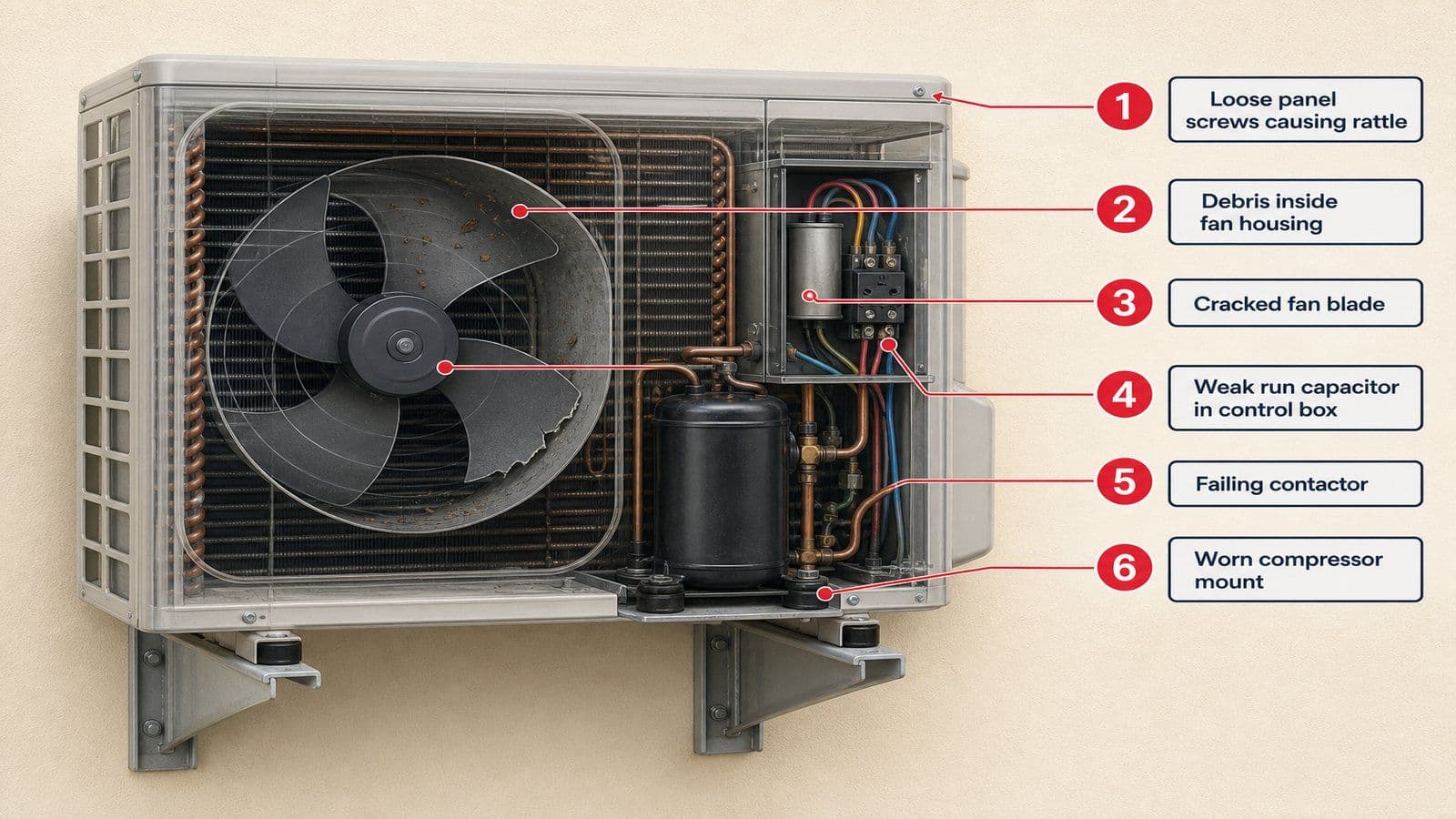
Photo: Outdoor Unit Noise Source Diagram
The table below summarises every noise type covered in this guide, the most common cause, the urgency band, and the typical 2026 fix cost in Indian rupees.
| Noise Type | Most Likely Cause | Urgency | Typical Fix Cost (₹) |
| Rattling | Loose panel, bracket bolts, debris | Within 7 days | 300 to 1,800 |
| Buzzing | Failing contactor, weak capacitor | Within 48 hrs | 800 to 2,400 |
| Humming (no start) | Capacitor, start relay | Within 24 hrs | 800 to 2,400 |
| Hissing or whistling | Refrigerant leak | Urgent, 24 hrs | 2,500 to 8,000 |
| Clanking or banging | Compressor mount, internal damage, loose blower wheel | Emergency, switch off | 500 to 35,000 |
| Grinding | Blower motor bearing failure | Within 48 hrs | 1,800 to 4,500 |
| Clicking (constant) | Sticking relay | Within 7 days | 600 to 1,200 |
| Clicking (startup or shutdown only) | Thermal expansion, normal | None | 0 |
| Whistling or squealing | Belt slip (older units), airflow restriction | Within 7 days | 0 to 1,200 |
| Indoor whoosh or whir | Dirty filter, blower wheel biofilm | Within 7 days | 0 to 900 |
| Drain gurgle | Drain pipe partial block | Within 14 days | 400 to 900 |
DIY Safe Checks Before You Call a Technician
There is a short list of inspections an owner can safely perform before paying for a callout. None of these requires opening any panel or touching any electrical component.
The first is the wall bracket on the outdoor unit. Stand near the outdoor unit while it runs. Place a hand flat on the wall just below the bracket. If you feel strong vibration transmitting through the wall, the bracket is almost certainly loose. Note this for the technician.
The second is the air filter on the indoor unit. Slide the front cover up, remove the two plastic filters, and check whether they are visibly dust-clogged or sagging. Rinse under a tap with mild soap, dry in shade, slide back. This single 10-minute habit prevents at least four of the noise types listed above.
The third is to switch the unit off and on three times with a 30-second gap and listen carefully each time. If the noise appears only during the first 30 seconds, it is most likely startup-related (thermal expansion or capacitor inrush). If it appears consistently throughout the running cycle, it is mechanical or refrigerant-related.
The fourth, and the most useful, is to record a 30-second video of the noise on your phone with the camera pointed at the source. Most ProNearMe technicians will diagnose 80 percent of noise complaints from a short video before they even arrive on site. This often saves a callout fee.
When to Power-Off Immediately
There is a small set of noises where continued running causes cascade damage in under an hour. Switch off at the wall socket or, ideally, at the MCB, the moment you hear any of these:
Loud metal-on-metal grinding from the outdoor unit. This is almost always a fan blade hitting something or a compressor internal failure. Each rotation does more damage.
A single loud bang followed by silence or rough running. This usually means a compressor connecting rod has broken or a fan blade has shattered.
Continuous hissing accompanied by a burning electrical smell. This is the worst-case scenario, a refrigerant leak combined with an electrical fault.
Constant relay clicking with the unit refusing to start. This indicates the contactor is on the verge of welding shut, which can cause an electrical fire.
Any noise paired with smoke, a burning smell, or warm air smelling of plastic. Switch off at the MCB, do not just hit the remote, and call a NSDC-certified technician immediately.
A Case Study from the Network
Mr. Rohan Mehta, a customer in Powai, Mumbai, called us in April 2025 about a deep humming noise that had appeared overnight on his five-year-old 1.5 ton split AC. The compressor was humming loudly for 8 to 10 seconds on every start, then either trip or finally engage with a thump. The room had stopped cooling effectively. He had called a local technician the previous week who quoted ₹4,500 for a gas top-up, claiming the refrigerant was low. Rohan asked for a second opinion through ProNearMe.
Our verified technician arrived with a digital multimeter, measured the run capacitor at 18 microfarads against a nameplate value of 35 microfarads, and confirmed a failing capacitor. A new 35 microfarad capacitor cost ₹1,400 including labour. The compressor returned to a clean two-second startup hum, the cooling came back, and the gas top-up was never needed. Rohan has since signed up for an annual maintenance contract at ₹2,800 a year.
This case is typical of why noise diagnosis matters. The same symptom, in this case a hum on startup, can be misdiagnosed as an expensive refrigerant problem when it is actually a ₹1,400 capacitor. Always insist on a measured reading of the capacitor microfarads and refrigerant pressure before approving any major part swap or gas top-up. Our cluster guide on AC repair cost breakdown for 2026 covers how to spot and avoid this kind of overcharging.
2026 Typical Fix Costs Summary
The price ranges below are typical residential figures across major Indian cities, before GST. Coastal city pricing tends to sit at the upper end because of higher salt corrosion damage and shorter component life. The Central Electricity Authority wiring regulations and the National Skill Development Corporation HVAC technician qualification pack both require certain repairs to be carried out only by certified personnel, so insist on credentials for any refrigerant or electrical work.
A rattle or panel-tightening callout typically lands at ₹300 to ₹800. A capacitor replacement runs ₹1,200 to ₹2,400 including the part. A contactor swap costs ₹800 to ₹1,500. Refrigerant leak detection plus repair plus recharge sits at ₹2,500 to ₹6,500. Blower motor replacement is ₹1,800 to ₹3,500. Compressor mount replacement runs ₹1,500 to ₹3,200. Full compressor replacement is ₹18,000 to ₹35,000 depending on tonnage and inverter type.
Conclusion
An AC making loud noise is rarely random. Almost every sound your unit produces sits in one of the eight categories covered in this guide, and almost every cause within those categories has a predictable fix cost and urgency band. Owners who learn to localise the source, time the occurrence, and note the rhythm of a new noise pay far less for the eventual repair than owners who keep running the unit hoping the noise will fade. In our network data, owners who book service within 48 hours of a new noise pay an average of ₹1,400. Owners who wait until the unit fails completely pay an average of ₹6,200.
Two habits genuinely prevent the bulk of noise problems. The first is washing the indoor filters every two to three weeks during summer. The second is booking a proper preventive service every February or March before peak summer load arrives. Both habits are cheaper than a single emergency repair. For broader AC ownership best practices, the parent guide on AC repair and fault diagnosis covers the wider service landscape and ties together the related cluster pieces on cooling, leakage, compressor and electrical faults.
Disclaimer
All cost ranges in this guide are typical residential figures across major Indian cities and exclude GST, which is currently 18 percent on most AC service and parts in India. Actual costs vary by city, brand of replacement part, building wiring, and the specific technician's labour rate. We strongly recommend hiring only NSDC-certified or OEM-trained technicians for any refrigerant handling, electrical work or PCB diagnosis. ProNearMe does not endorse any specific AC brand and the noise patterns covered apply across all manufacturers and tonnages.
Sources & References
- Bureau of Energy Efficiency (BEE) Air Conditioner Energy Efficiency Standards and Labelling Programme
- Bureau of Indian Standards (BIS) IS 17613 Indoor Air Quality Standard
- Ministry of Environment, Forest and Climate Change Ozone Depleting Substances Rules and Kigali Amendment Implementation
- National Skill Development Corporation HVAC Technician Qualification Pack
- Indian Society of Heating, Refrigerating and Air Conditioning Engineers Residential HVAC Guidelines
- Central Electricity Authority Wiring and Safety Regulations for Domestic Installations
- Press Information Bureau Advisory on Energy Efficient Air Conditioning
- National Building Code of India 2016 Part 8 Building Services Section 3 Air Conditioning Heating and Mechanical Ventilation

Amit worked as an AC technician for 6 years in Ahmedabad before transitioning to technical writing. He holds a diploma in Refrigeration and Air Conditioning from ITI Ahmedabad and understands the difference between what AC companies promise and what actually happens on the ground. His articles break down complex technical topics into plain language that any homeowner can follow. He tests every tip he writes about in his own home first.

Dr. Verma is a mechanical engineer with 15 years of experience in HVAC systems. She completed her PhD from IIT Delhi on energy-efficient cooling solutions for Indian residential buildings. She reviews all technical content on HomePros to make sure the numbers are right, the advice is safe, and the recommendations are backed by actual engineering principles. She consults for multiple AC manufacturers on product design.