- Switch the AC off at the wall socket the moment the breaker trips, not just. at the remote, and leave the breaker open until the cause is identified. Repeated re-racking is the single most common reason a ₹1,400 capacitor problem turns into a ₹28,000 compressor replacement.
- ProNearMe network data from the 2025 summer season shows that 64 percent of AC tripping. complaints trace to just three causes: a weakened run capacitor, an undersized or wrong-curve MCB, and earth-leakage through a damp indoor unit during monsoon.
- MCBs trip on overload or short circuit and protect the wiring. RCCBs or ELCBs trip on earth-leakage and protect people. Identifying which device tripped narrows the diagnosis within 30 seconds.
- A 1.5 ton split AC needs a 16A C-curve MCB on a dedicated circuit. A B-curve breaker, still common in older Indian flats, nuisance-trips on AC inrush current even when the unit is healthy.
- Any breaker work, wiring inspection or earthing repair requires a licensed electrician under Central Electricity Authority (CEA) regulations. Owner-side action is limited to switching off and noting which device tripped, in line with the National Building Code (NBC) Part 8 electrical-installation guidance.
An AC tripping circuit breaker is the electrical panel telling you something is wrong, and the worst possible response is to keep flipping the breaker back on. Each re-rack pushes another surge of inrush current through windings that may already be overheating, contacts that may be welded half-closed, or insulation that has begun to fail.
In our ProNearMe network across Mumbai, Pune, Hyderabad, Delhi NCR, Bengaluru and Chennai, roughly 9 percent of all summer AC service calls trace back to a tripping MCB or RCCB, and about a quarter of those calls end in a much more expensive compressor or PCB failure because the owner kept resetting the breaker for two or three days before booking service.
This guide covers the six root causes of an AC tripping the breaker in Indian homes, what an MCB trip and an RCCB trip each tell you, why monsoon and old building wiring make the problem worse, and the 2026 repair cost benchmarks. For wider context, see the parent guide on AC repair and fault diagnosis.

Get quotes from verified, top-rated AC Service & Repair pros in Delhi.
First Response When the AC Trips
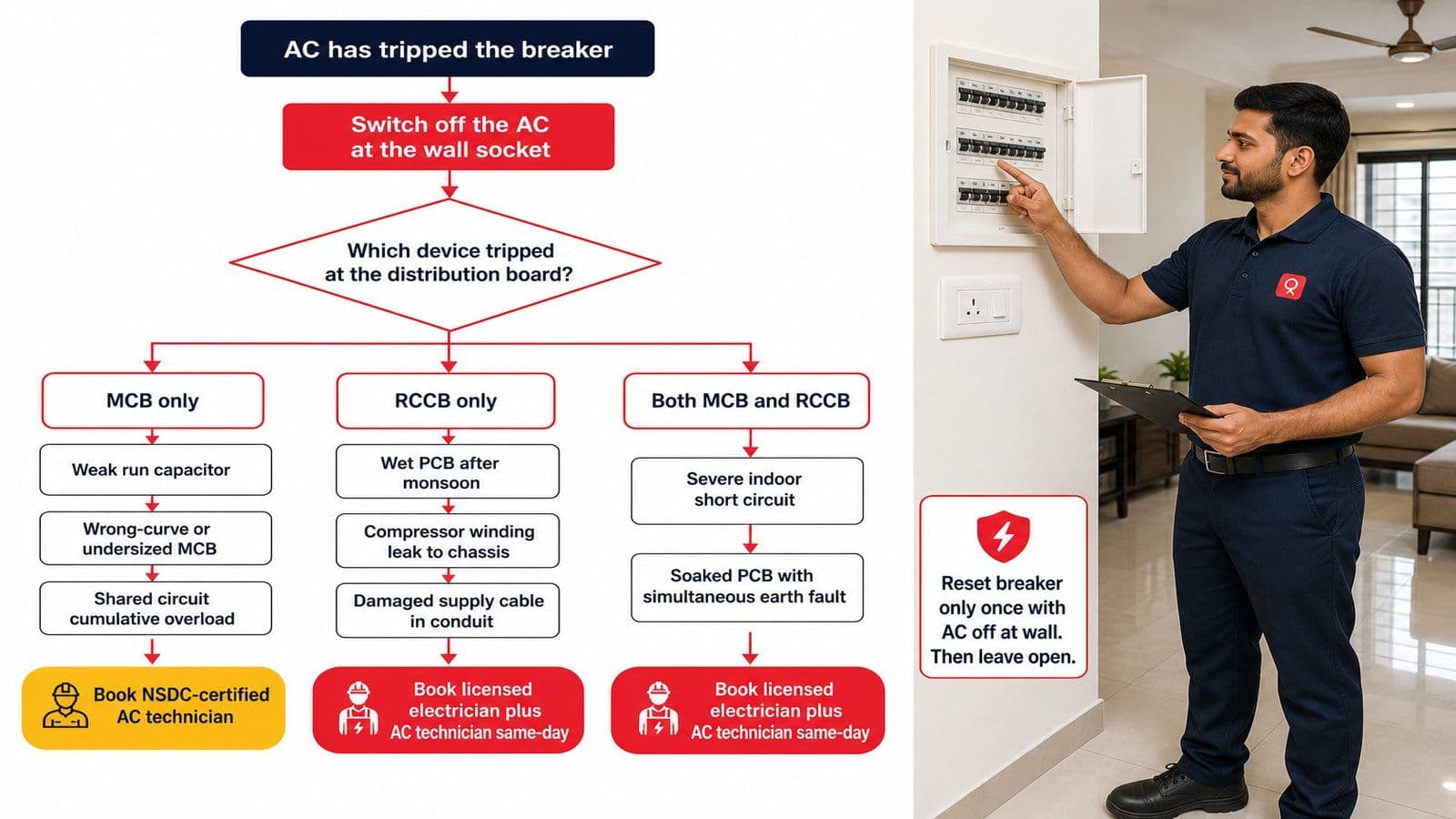
Photo: First five minutes flowchart for an AC tripping the breaker
The first five minutes matter more than any later step. Most cascade damage happens because the owner reset the breaker three or four times in the first hour, each reset pushing fresh inrush current through windings or contacts that were trying to fail safely.
Switch Off the AC at the Wall
Before you touch the breaker, switch the AC off at the wall socket. The remote only sends a standby command. The compressor and PCB remain live as long as the wall switch is on. Switching off at the wall ensures no fresh inrush hits the windings the moment the breaker is re-racked.
Reset Only Once, Then Stop
Reset the breaker exactly once with the AC switched off at the wall, to confirm the breaker itself is not faulty, then leave it open until a technician inspects. Resetting a tripped MCB three or four times with the AC live can melt compressor windings, weld the contactor closed, or in the worst case start an insulation fire inside the indoor PCB enclosure.
Note Which Breaker Tripped
Walk to the distribution board and identify exactly which device tripped. Indian flats typically carry a main isolator, a 30 milliamp RCCB or ELCB, and a row of MCBs. The tripped device sits in the OFF position. Whether the MCB tripped, the RCCB tripped, or both tripped tells the technician which fault family to investigate first. Photograph the panel.
MCB, RCCB and ELCB Explained
Indian electrical panels carry three different protective devices, and confusion between them is the most common owner-side misunderstanding. The device that tripped tells you the fault family.
What an MCB Does
The Miniature Circuit Breaker protects the wiring from overload and short circuit. An MCB trip on an AC circuit almost always points to compressor inrush overload, a wrong-curve breaker, a shared-circuit cumulative overload, or a short circuit in the unit's wiring.
What an RCCB or ELCB Does
The Residual Current Circuit Breaker, still called ELCB in older Indian installations, watches the difference between current going out on the live wire and current returning on the neutral. If the difference exceeds 30 milliamps, it opens the circuit within 30 milliseconds. An RCCB trip almost always points to earth-leakage, damp wiring after monsoon, a degraded compressor winding leaking to chassis, or a wet PCB.
Get quotes from verified, top-rated AC Service & Repair pros in Delhi.
MCB Curve Ratings
The number on an MCB (6A, 10A, 16A, 20A) is its continuous rating. The letter (B, C, D) is its tripping curve. B-curve trips at 3 to 5 times rated current, C-curve at 5 to 10 times. AC compressors draw 5 to 7 times their running current at startup. A B-curve breaker on an AC circuit nuisance-trips on the first compressor kick even when nothing is wrong. The correct choice for a residential AC circuit is C-curve.
I always ask the customer to send a photo of their distribution board with the tripped device circled, before I even leave for the site. Nine times out of ten that single photo tells me whether to bring a capacitor and clamp meter (MCB trip) or a megger and a fresh chassis earth wire (RCCB trip). It saves a second visit and saves the customer time.

The Six Root Causes
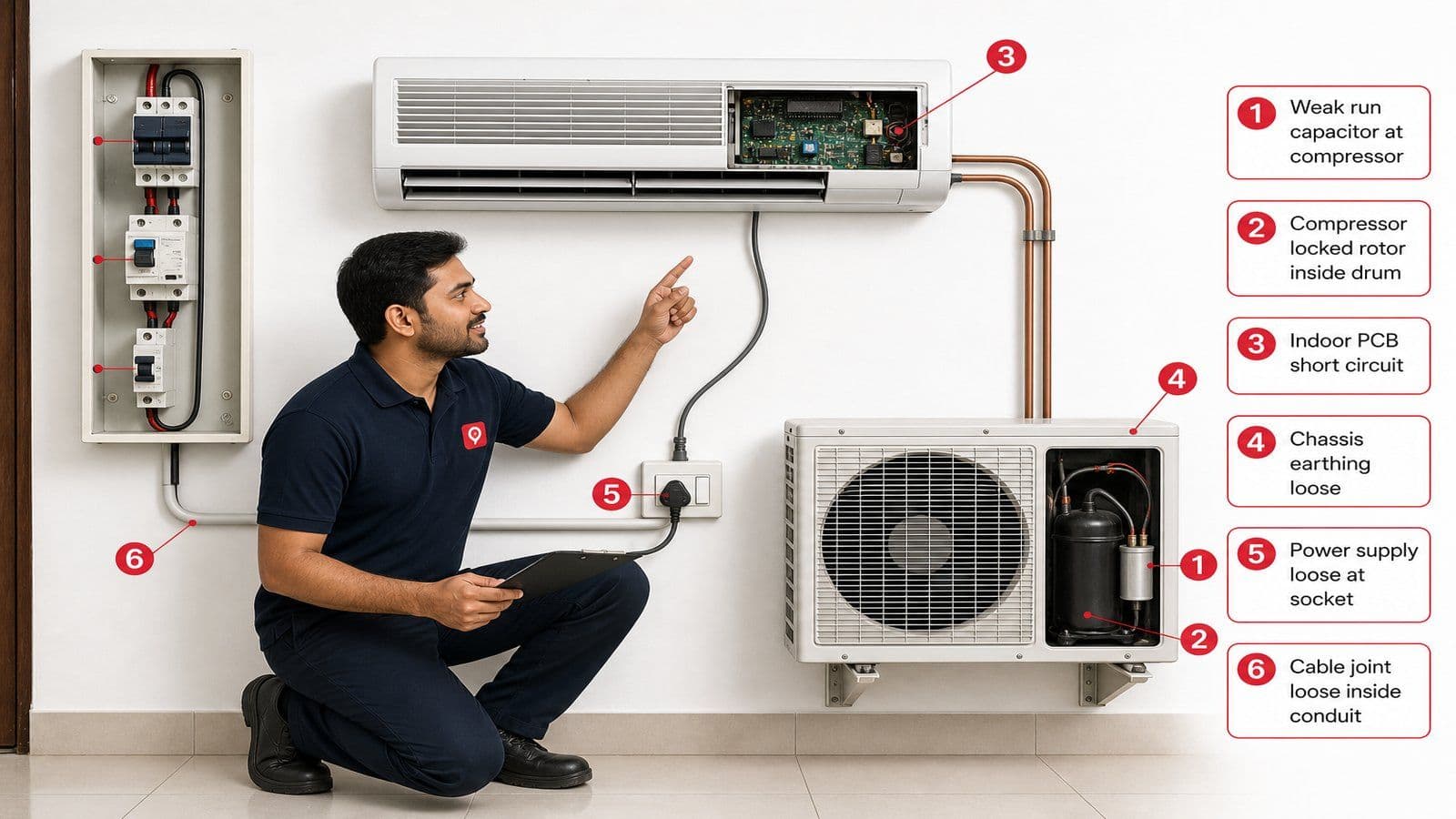
Photo: Six common AC tripping fault points on a split AC circuit
Weak Run Capacitor Causing Inrush Overload
This is the single most common cause in our network, accounting for roughly 38 percent of tripping complaints in the 2025 summer season. The run capacitor degrades naturally over three to six years. As capacitance drops, the compressor cannot reach running speed quickly. It draws inrush current for 6 to 10 seconds instead of the normal 2 seconds, and the MCB sees that sustained overload and trips. The AC trips within 5 to 30 seconds of switching on. A NSDC-certified technician confirms the diagnosis in 5 minutes with a digital capacitance meter.
Typical fix cost: ₹1,200 to ₹2,400 for capacitor replacement including labour.
Compressor Locked Rotor
If the compressor has seized from age or a refrigerant slugging event, the rotor will not turn. The motor draws locked-rotor current (5 to 7 times running current) continuously instead of the normal 2-second spike, and the MCB trips within 2 to 4 seconds every time. A clamp meter on the live wire differentiates this from a failing capacitor instantly: a weak capacitor produces 6 to 10 seconds of inrush at 3 to 4 times running current, a locked rotor produces continuous 5 to 7 times running current until the breaker trips.
Typical fix cost: ₹18,000 to ₹35,000 for compressor replacement, ₹4,500 to ₹9,000 for an inverter driver board if the driver has failed.
Short Circuit in the Indoor Unit
Water entering the indoor PCB enclosure during monsoon, or melted winding insulation on the indoor blower motor, can cause a direct live-to-neutral short. The MCB trips instantly, often with an audible pop or a brief smell of burnt plastic. If you smell anything burning, do not reset the breaker under any circumstances.
Typical fix cost: ₹2,500 to ₹6,500 for PCB replacement, ₹1,800 to ₹3,500 for blower motor replacement.
Earth Fault or Ground Leakage
If current is leaking from a live winding or damaged supply wire to the AC chassis or to ground, the RCCB trips. The Central Electricity Authority wiring regulations specifically require a 30 milliamp RCCB on all residential AC circuits for this reason. Common causes: a degraded compressor winding leaking to chassis, a wet indoor PCB after monsoon humidity, a damaged supply cable inside the wall conduit. The diagnostic tool is a megger. A healthy insulation reading is above 10 megohms; below 1 megohm confirms leakage.
Typical fix cost: ₹800 to ₹1,800 for PCB drying and isolation, ₹2,500 to ₹6,500 for PCB replacement, ₹4,500 to ₹9,000 for partial rewiring.
Wrong-Curve or Undersized MCB
A B-curve MCB on an AC circuit nuisance-trips on inrush even when the AC is healthy. This is common in older Indian flats built before the 2016 National Building Code revision, where the original electrical contractor fitted generic B-curve 6A or 10A MCBs across the whole flat. The correct MCB for a 1.5 ton split AC is 16A C-curve on a dedicated circuit, or 20A C-curve if the wiring run is long. The correct MCB for a 2 ton split AC is 20A C-curve.
Typical fix cost: ₹350 to ₹800 for the MCB, plus ₹400 to ₹900 for the licensed electrician's visit.
Get quotes from verified, top-rated AC Service & Repair pros in Delhi.
Roughly 1 in 4 tripping calls I attend in older Mumbai and Pune flats turns out to be a wrong-curve MCB, not a faulty AC. Some technicians use this as an upsell trap and quote a ₹6,000 capacitor and gas top-up job when a ₹500 C-curve 16A MCB swap would have solved it. Always ask the technician to show you the MCB markings and the clamp meter reading before approving any compressor or gas work.
Shared Circuit Cumulative Overload
If the AC shares a circuit with the fridge, microwave or geyser, cumulative current draw can exceed the MCB rating during peak load. The fridge compressor kicks in, the microwave runs, the AC compressor starts, and the MCB sees 18 to 22 amps on a 16 amp circuit and trips. The pattern is consistent: the trip happens only when multiple high-load appliances run together. The fix is moving the AC to a dedicated circuit, which the National Building Code already recommends for any AC above 1 ton.
Typical fix cost: ₹2,500 to ₹5,500 for a dedicated AC circuit including MCB, cable and electrician labour.
Inverter vs Non-Inverter Patterns
A non-inverter AC draws a single large inrush spike at startup (5 to 7 times running current, lasting about 2 seconds) and then runs at fixed current. If the MCB trips, it almost always trips during that 2-second window.
An inverter AC has a variable-speed compressor driven by a PCB. The driver ramps the compressor up smoothly, so the inrush spike is smaller in magnitude (2 to 3 times running current) but lasts longer (4 to 6 seconds). A B-curve MCB rated for the running current will often trip on this longer ramp even though the peak current is lower.
Inverter ACs are also more susceptible to earth-leakage trips because PCB switching produces high-frequency leakage currents through the chassis. A modern A-type 30 milliamp RCCB handles inverter loads correctly, and this is now the BIS-recommended specification.
Why Monsoon Triggers More Tripping
Indian monsoon brings two simultaneous problems. High humidity (often above 85 percent for weeks) condenses on cold PCB surfaces inside the indoor unit, dropping insulation resistance until the RCCB trips. Direct water ingress from a partially blocked condensate drain can back water up into the indoor unit's lower casing where the PCB sits. Coastal cities such as Mumbai, Chennai and Kochi are particularly vulnerable because of salt-laden monsoon air, which corrodes PCB tracks faster than inland air.
Every July and August, my service call volume for tripping complaints triples. The pattern is almost always the same: humidity enters the PCB enclosure through condensation or a blocked drain. The insulation resistance drops from 10 megohms to 0.3 megohms, the RCCB trips on the first start of the morning, and the customer assumes the compressor has died. A PCB drying and re-sealing job, two hours of work, restores it for ₹1,400.
The preventive habit that works best is an annual pre-monsoon service in May or June that includes drain flushing, PCB enclosure inspection, gasket replacement and a megger reading of insulation resistance. This typically costs ₹800 to ₹1,200 and prevents the bulk of monsoon trip calls.
DIY Safe Checks Before You Call
None of these inspections requires opening any panel or touching any electrical component. Identify which device tripped at the distribution board with the AC switched off, and photograph the panel with the tripped device clearly visible. Check whether other appliances on the same circuit might have contributed: if the AC trips only when the microwave runs at the same time, the cause is cumulative overload.
Check the indoor unit's drain pipe for blockage. If water has been dripping inside the indoor unit during the previous days, mention this to the technician, it strongly suggests a wet PCB.
Observe the timing of the trip on a single fresh attempt. Switch the AC off at the wall, reset the breaker, switch the wall socket back on, and count the seconds to the next trip. An immediate trip (under 2 seconds) points to a short circuit or earth-leakage. A 5 to 10 second trip points to compressor inrush overload. A trip only after 30 minutes points to a thermal overload or a deteriorating contactor.
When to Power-Off Immediately
The following situations require switching off at the wall socket, leaving the breaker open, and waiting for the technician. Do not attempt another reset.
Any burning smell, plastic smell, or visible smoke from the indoor or outdoor unit. A loud pop or bang at the moment of trip, which usually means a capacitor has ruptured or a contactor has exploded. The RCCB trips and someone in the family received a tingle or shock from touching the AC chassis or the wall around it, this is an active earth-leakage event and the chassis is energised. The MCB handle feels warm to the touch, which indicates the breaker itself is failing internally.
A Case Study from the Network
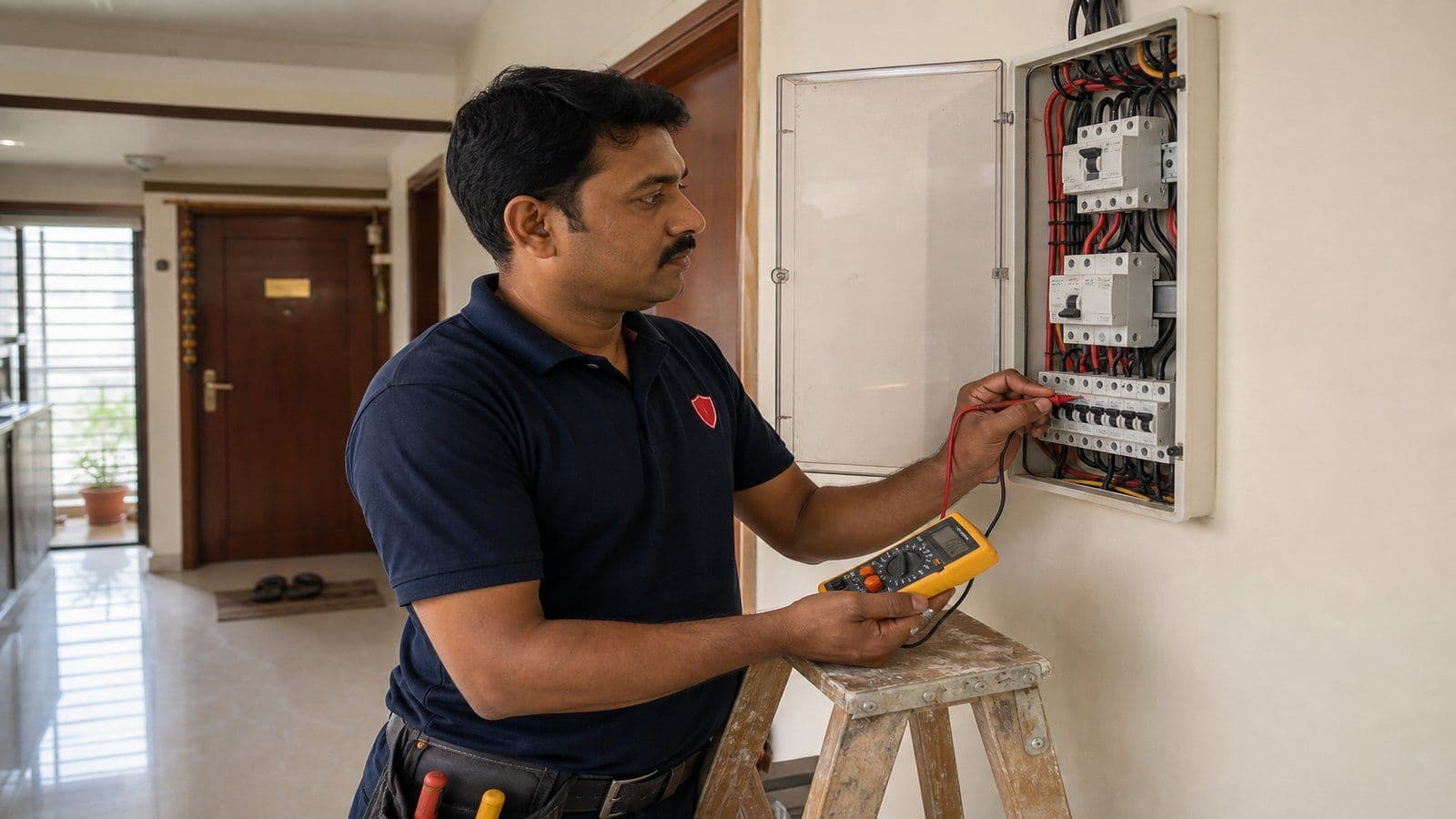
Photo: Licensed electrician inspecting a residential distribution board MCB
Mr. Karthik Iyer, a customer in Adyar, Chennai, called us in August 2025 about his 18-month-old 1.5 ton inverter split AC tripping the RCCB every morning at the first switch-on. The unit had run perfectly through the previous summer. He had reset the RCCB four or five times before booking. A local technician had quoted ₹22,000 for a full PCB replacement, blaming a manufacturer defect.
Our verified technician arrived with a megger and measured the indoor unit's insulation resistance at 0.4 megohms (healthy reading is above 10 megohms). The cause was monsoon moisture inside the PCB enclosure: the bottom gasket had perished and humid air had been condensing on the PCB for weeks. The fix was a PCB drying with a low-temperature heat gun, a new EPDM gasket on the enclosure base, and a re-seal with electrical-grade silicone. Two hours of labour, ₹1,400 total. The insulation resistance came back to 14 megohms and the RCCB has not tripped since.
This case is typical of how RCCB trips during monsoon get misdiagnosed as expensive PCB faults. Always insist on a megger reading and a moisture inspection before approving a PCB replacement. Our cluster guide on AC repair cost breakdown for 2026 covers how to spot and avoid this kind of overcharging.
Get quotes from verified, top-rated AC Service & Repair pros in Delhi.
2026 Typical Fix Costs
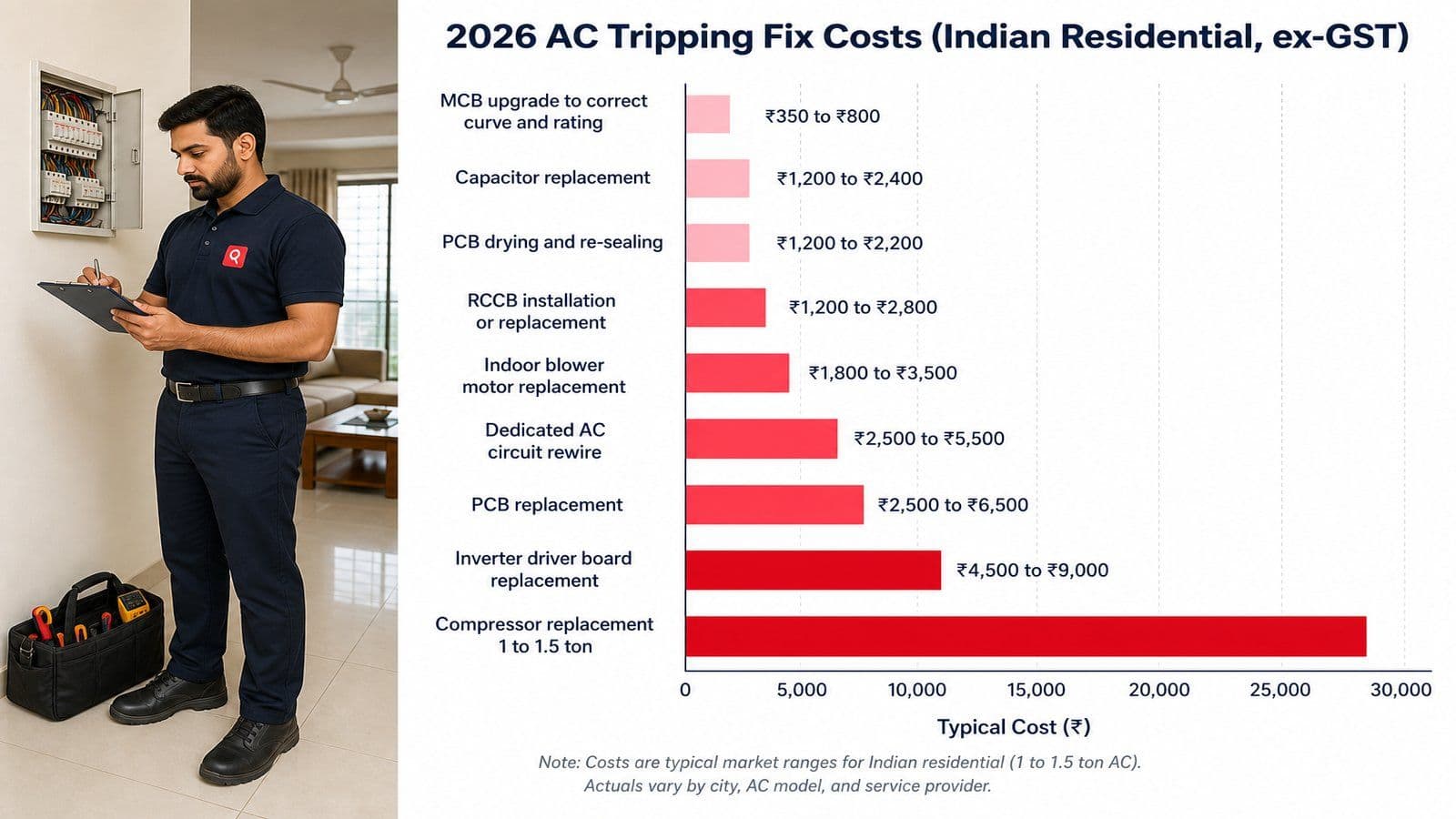
Photo: 2026 AC tripping fix cost comparison bar chart
The ranges below are typical residential figures across major Indian cities, before GST. Coastal city pricing tends to sit at the upper end because of higher salt corrosion damage. The Central Electricity Authority wiring regulations require breaker, wiring and earthing work to be carried out only by licensed electricians.
| Fault Category | Typical 2026 Fix Cost (₹) | Who Does the Work |
| Capacitor replacement | 1,200 to 2,400 | NSDC-certified AC technician |
| MCB upgrade to correct curve and rating | 350 to 800 plus electrician visit | Licensed electrician |
| RCCB installation or replacement | 1,200 to 2,800 | Licensed electrician |
| PCB drying and re-sealing | 1,200 to 2,200 | NSDC-certified AC technician |
| PCB replacement | 2,500 to 6,500 | NSDC-certified AC technician |
| Indoor blower motor replacement | 1,800 to 3,500 | NSDC-certified AC technician |
| Inverter driver board replacement | 4,500 to 9,000 | OEM-trained or NSDC-certified |
| Dedicated AC circuit rewire | 2,500 to 5,500 | Licensed electrician |
| Compressor replacement (1 to 1.5 ton) | 18,000 to 28,000 | NSDC-certified AC technician |
| Compressor replacement (2 ton inverter) | 24,000 to 35,000 | OEM-trained technician |
A useful rule of thumb: any tripping problem solved for under ₹2,500 is almost certainly a capacitor, a wrong-curve MCB, or a wet PCB. Anything quoted above ₹15,000 should be confirmed with a megger reading and a clamp meter reading from a second technician before you approve.
To distinguish an AC fault from a building-side fault, run another appliance with a similar load profile on the same circuit. A geyser or microwave draws 8 to 12 amps continuously, which approximates an AC's running load. If the other appliance runs without tripping, the fault is inside the AC. If the other appliance also trips, the fault is in the wiring, the breaker, or the building supply, in which case the responsibility shifts to the building electrician or the society. For related electrical fault families, our cluster guides on AC compressor problems and AC remote not working cover the adjacent diagnosis paths.
Conclusion
An AC tripping the circuit breaker is the panel doing its job, telling you that something is drawing more current, leaking to earth, or shorting somewhere. The worst response is to reset the breaker three or four times hoping the trip was a one-off. In our network, owners who book service after a single trip pay an average of ₹1,800 for the fix. Owners who keep resetting for two or three days before calling pay an average of ₹7,400, often because a capacitor problem ended as a compressor replacement.
Two habits genuinely prevent the bulk of tripping faults. A pre-summer service in February or March that includes a capacitor microfarad reading, a chassis insulation test, and a contactor inspection. A pre-monsoon service in May or June that includes drain flushing and a PCB enclosure inspection. Both services together cost less than a single emergency repair. For wider AC ownership context and the related cluster guides, see the parent guide on AC repair and fault diagnosis.
Disclaimer
All cost ranges in this guide are typical residential figures across major Indian cities and exclude GST, which is currently 18 percent on most AC service and parts in India. Actual costs vary by city, building wiring age, brand of replacement part, and the specific technician's or electrician's labour rate. Any work on the distribution board, MCB, RCCB, ELCB or building wiring requires a licensed electrician under Central Electricity Authority regulations. Refrigerant work and PCB repair on AC units must be carried out by NSDC-certified or OEM-trained technicians. ProNearMe does not endorse any specific AC brand and the tripping diagnosis patterns covered apply across all manufacturers and tonnages.
Sources & References
- Bureau of Energy Efficiency (BEE) Air Conditioner Energy Efficiency Standards and Labelling Programme
- Bureau of Indian Standards (BIS) IS 8828 Specification for Circuit Breakers for Overcurrent Protection for Household Installations
- Central Electricity Authority (Measures Relating to Safety and Electric Supply) Regulations
- National Skill Development Corporation HVAC Technician Qualification Pack
- National Building Code of India 2016 Part 8 Building Services Section 2 Electrical and Allied Installations
- Indian Society of Heating, Refrigerating and Air Conditioning Engineers Residential HVAC Guidelines
- Ministry of Environment, Forest and Climate Change Ozone Depleting Substances Rules and Kigali Amendment Implementation
- Press Information Bureau Advisory on Safe Use of Electrical Appliances in Indian Homes
- Bureau of Indian Standards IS 12640 Residual Current Operated Circuit Breakers for Household and Similar Uses
Amit worked as an AC technician for 6 years in Ahmedabad before transitioning to technical writing. He holds a diploma in Refrigeration and Air Conditioning from ITI Ahmedabad and understands the difference between what AC companies promise and what actually happens on the ground. His articles break down complex technical topics into plain language that any homeowner can follow. He tests every tip he writes about in his own home first.

Dr. Verma is a mechanical engineer with 15 years of experience in HVAC systems. She completed her PhD from IIT Delhi on energy-efficient cooling solutions for Indian residential buildings. She reviews all technical content on HomePros to make sure the numbers are right, the advice is safe, and the recommendations are backed by actual engineering principles. She consults for multiple AC manufacturers on product design.