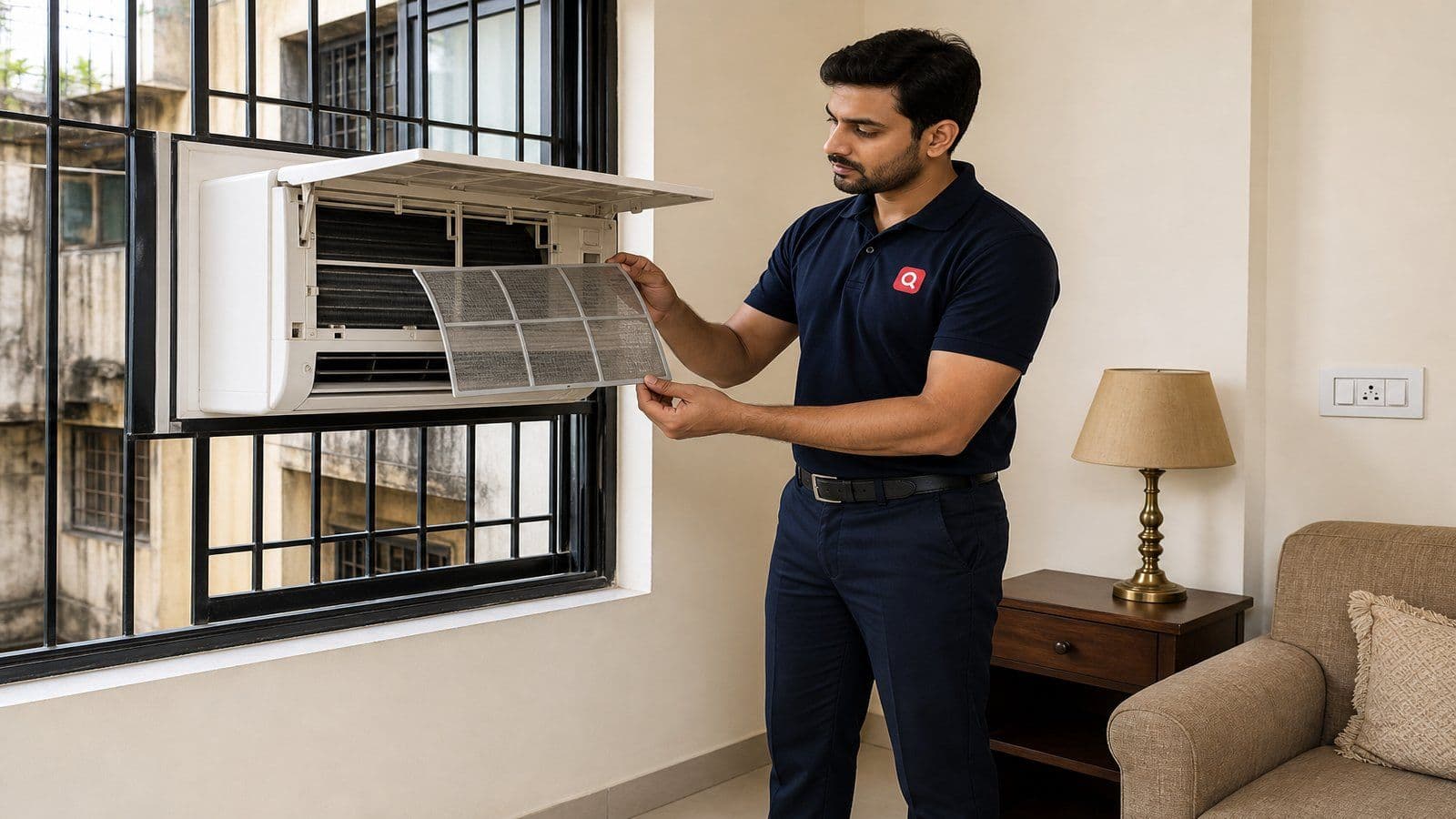
- Roughly 70 percent of indoor AC water leakage cases trace back to one root cause,. a drain pipe choked with biofilm. Typical fix ₹400 to ₹900 plus a 30-minute flush.
- A split AC indoor unit should tilt 5 to 8 mm toward the drain side. Less and water overflows into the wall.
- Window ACs leak inside the room when the rear tilt is wrong. The rear should sit 10 to 15 mm lower than the front so condensate exits outside.
- Monsoon leaks (June to September) are almost always biofilm-related. The Indian Plumbing Association recommends a chemical drain flush at start of monsoon and again in August.
- If water drips near the MCB box or any wall socket, switch off immediately. Water plus 230 volts is not a problem you postpone by a day.
AC water leakage is the single most common monsoon complaint we hear from Indian homeowners. A puddle on the floor at 6 am, a wet patch creeping down the wall, water dripping onto the bedside table.
In nine cases out of ten the cause is mundane and the fix is under ₹900. The remaining one in ten gets expensive, water finding wiring or plaster turns a ₹500 problem into ₹6,000 inside a fortnight.
This guide covers every realistic cause, separates indoor drips from outdoor pooling, contrasts split and window AC drainage, lays out DIY fixes, and flags symptoms that need a NSDC-certified technician the same day. See the AC repair and fault diagnosis pillar and common AC problems guide for broader context.

Get quotes from verified, top-rated AC Service & Repair pros in Delhi.
Why Your AC Produces Water
A split or window AC pulls warm humid air across a cold evaporator coil. Moisture condenses on the fins the way water beads on a chilled glass. Drops collect in a sloped drain pan and exit through a pipe routed outside, or in a window AC drip out the chassis rear.
In Mumbai or Chennai during peak monsoon a 1.5-ton split running 8 hours produces 8 to 12 litres of condensate a day. If anything in the chain fails, water defaults to the front of the indoor unit or the wall behind.
Bureau of Energy Efficiency (BEE) field studies show 18 percent of all summer and monsoon AC service calls in India involve water leakage. The Indian Plumbing Association notes drain pipe blockages account for the largest share, well ahead of pan damage or refrigerant leaks.
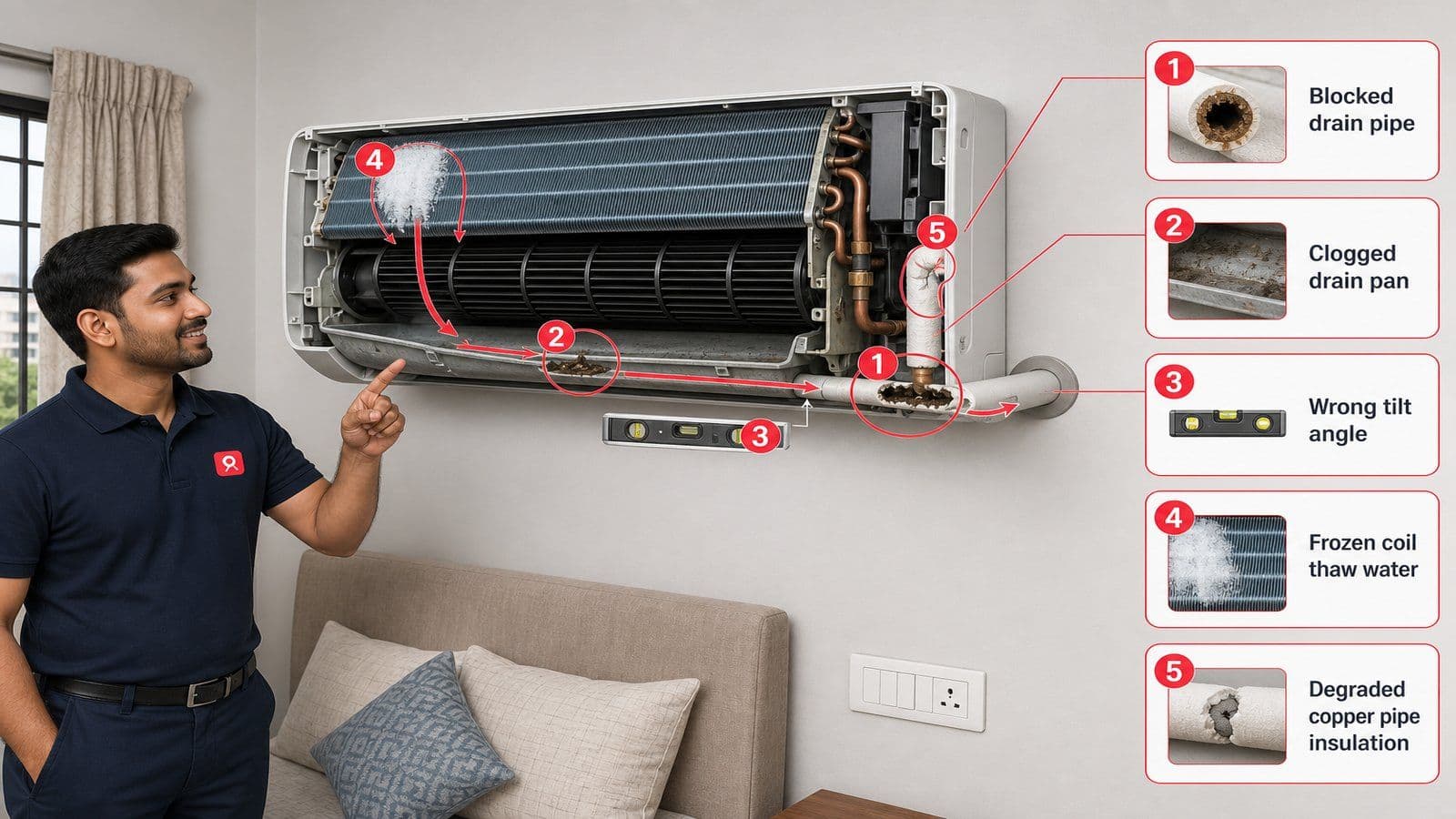
Photo: Indoor unit leak causes labelled cutaway diagram
Six Causes of Indoor Unit Water Dripping
Blocked Drain Pipe
Most indoor leaks trace here. The drain pipe is a 16 mm PVC tube from the drain pan through the wall sleeve to an outdoor drip point. Condensate carries dust, mould spores and insects in. Biofilm builds on the inner wall. By the second monsoon a 16 mm pipe can be down to 4 or 5 mm of clear flow. The giveaway is a slow drip that builds 20 to 30 minutes into a cycle, never on switch-on.
Dirty Filter Causing Coil Frost
When filters are caked with dust, airflow drops sharply and the evaporator coil plunges below freezing. Ice forms on the fins. When the unit cycles off, that ice melts at once and overwhelms the pan. Owners describe this as a leak that "only happens when we switch the AC off".
Wrong Tilt Angle on the Indoor Unit
A correctly mounted split AC indoor unit tilts toward the drain side, 5 to 8 mm of drop across the width. If the installer skipped a spirit level, or the bracket has loosened, the tilt reverses. Water pools on the wrong side, overflows the back edge, and runs down the wall. Common in apartments where the AC was installed by a building contractor not an OEM-trained installer.
Cracked or Corroded Drain Pan
Units past 7 to 8 years can develop hairline cracks. Acidic biofilm slowly degrades the plastic. Water seeps out the bottom, bypassing the pipe. This leak shows up on switch-on. Pan replacement is not DIY. Budget ₹1,800 to ₹3,500 by brand.
Frozen Coil Thaw From Refrigerant Loss
A refrigerant leak can drop coil temperature low enough to ice over. The pattern looks identical to dirty filters but cleaning does not help. Ask for a manifold gauge pressure check. Ministry of Environment, Forest and Climate Change (MoEF&CC) Ozone Cell rules require all refrigerant handling by Kigali Amendment-trained technicians.
Degraded Suction Pipe Insulation
The copper suction pipe between indoor and outdoor unit is wrapped in foam insulation. After 4 to 5 monsoons the insulation cracks and falls away in patches. The bare cold pipe sweats heavily, like a cold beer bottle on a humid day. That sweat shows up as a wet patch behind the indoor unit.
Get quotes from verified, top-rated AC Service & Repair pros in Delhi.
Owners almost always blame the drain pipe when they see a wet patch behind the indoor unit. But if the front louvre is dry and only the wall behind is wet, it is the suction pipe insulation 90 percent of the time. We replace insulation on one in five service calls in coastal cities during monsoon.

Outdoor Unit Water: Normal vs Fault
A split AC outdoor unit produces no condensate of its own in cooling mode. Water at the base is almost always drain pipe condensate, normal. Not normal is heavy pooling around the base, water from outdoor coil fins, or ice on the outdoor coil during cooling season. Pooling usually means the drain outlet is too close to the ground and back-splashing, or the drip tray is clogged with leaves.
Water from outdoor coil fins points to refrigerant trouble, NSDC-certified technician within 48 hours. Ice on the outdoor coil in summer is a refrigerant emergency, switch off and call within 12 hours.
Window AC vs Split AC Drainage
A window AC sits in a wall sleeve tilted slightly downward toward outside. The drain pan is integrated into the chassis bottom. Condensate flows to the rear, drips outside, or pools in a reservoir that the fan blade slings onto the hot outdoor coil for evaporation. Window AC leaks inside the room for three reasons: unit installed dead level or tilted forward, the rear reservoir drain pushed closed during cleaning, or the front gasket perished and wicking condensate forward.
A split AC relies on gravity drainage through a dedicated PVC pipe routed outside. The pipe needs continuous downward slope, no sags. A sag acts as a water trap, biofilm grows fast, the pipe chokes within weeks. Common where the drain pipe was draped over a curtain rod or window ledge before exiting.
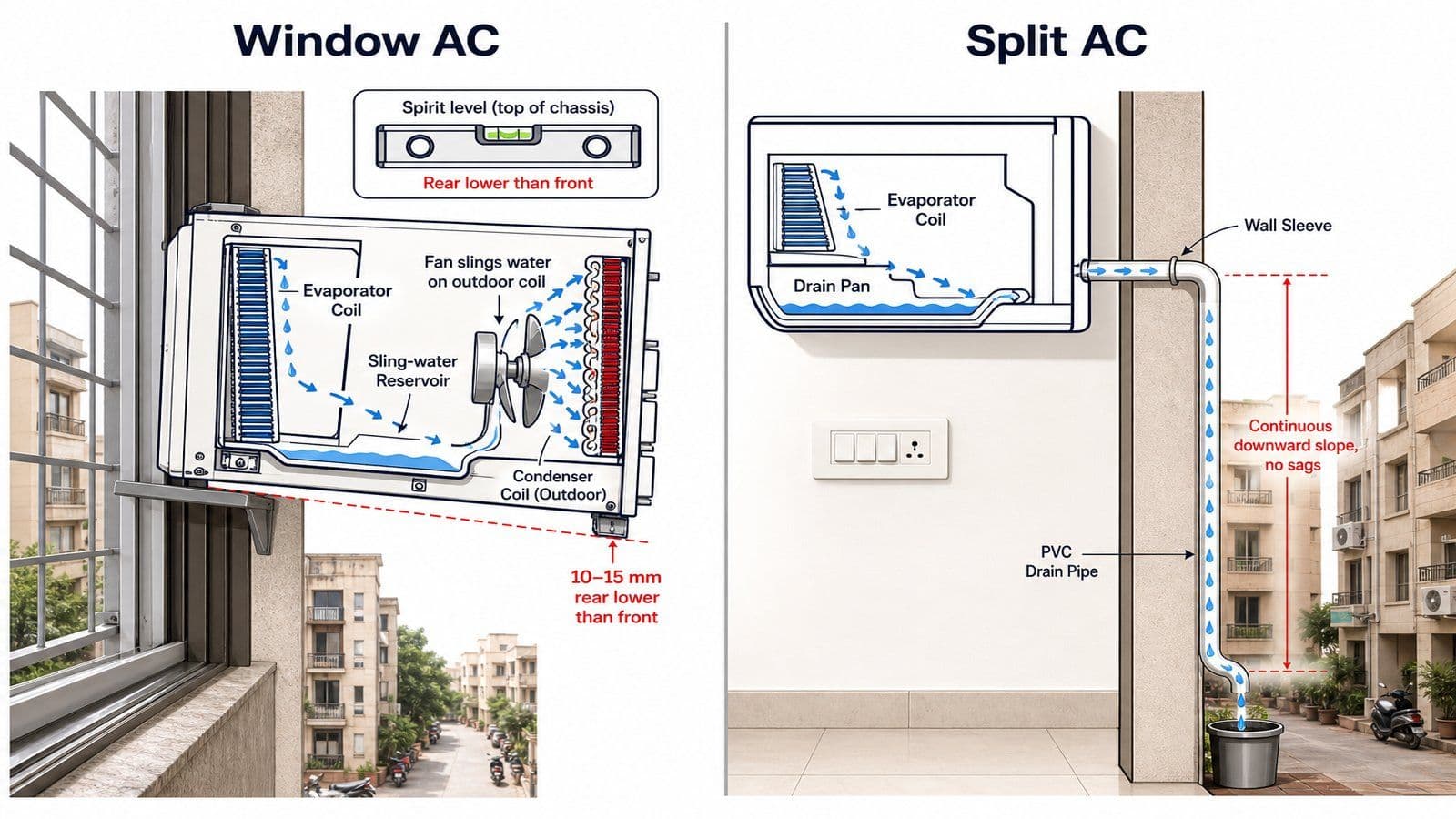
Photo: Window AC vs Split AC drainage side-by-side comparison
DIY Fixes for a Careful Homeowner
How to Flush a Blocked Drain Pipe
The highest-payoff DIY job. Tools: a small funnel, half a litre of warm soapy water, 60 ml plastic syringe (₹40 at any chemist). Switch off at the wall socket. Place a bucket under the outdoor drain stub. Lift the front louvre. Pour the soap solution into the drain pan trough. Wait two minutes. Flush two syringes of plain water through firmly. If blockage is mild, brown water drips out the outdoor stub within seconds. Repeat once. Leave off 30 minutes, then switch on. If no water exits after two flushes, you have a hard blockage needing a technician with a drain rod or compressed-air gun.
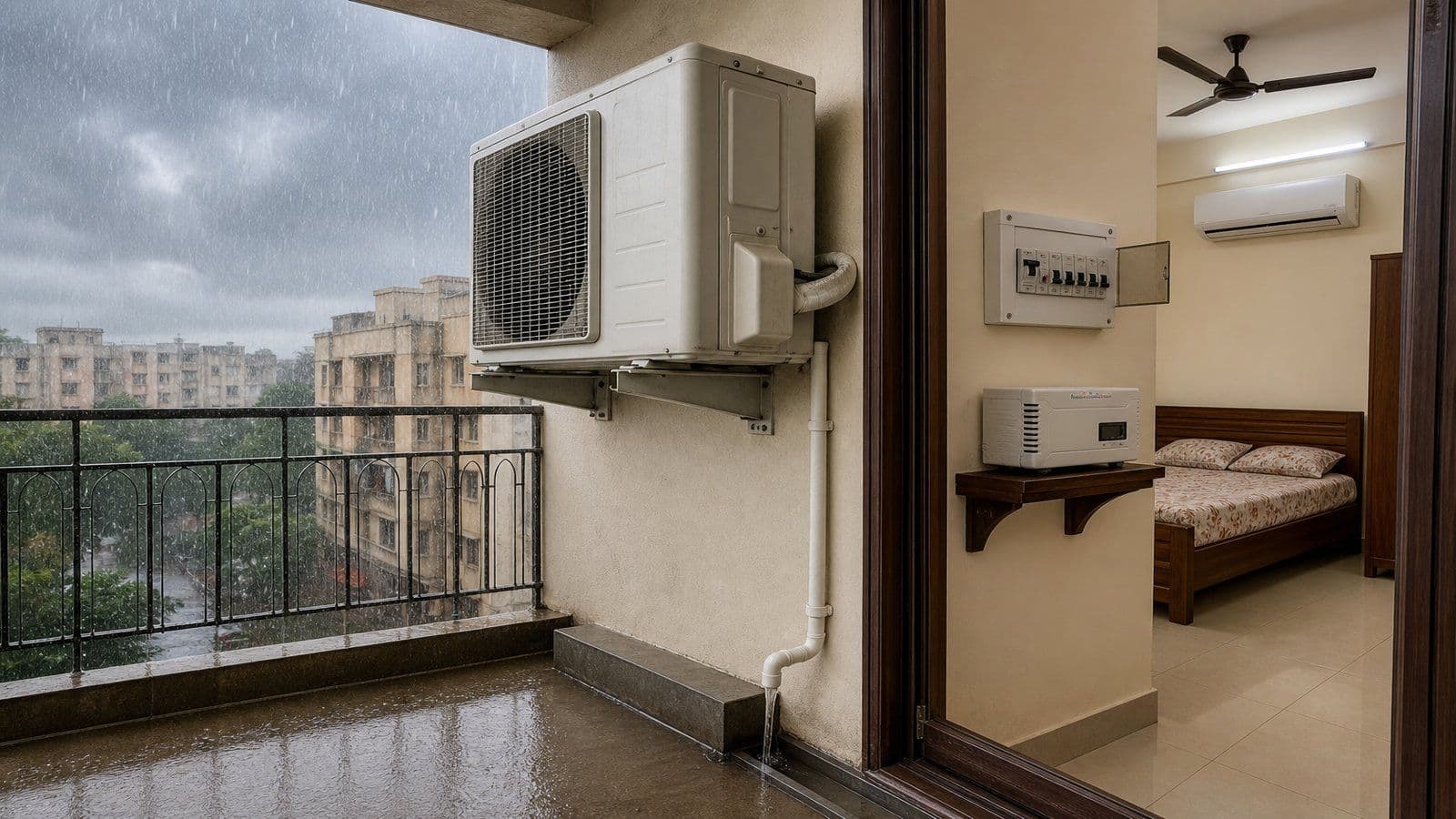
Photo: Monsoon balcony AC installation scene
How to Wash the Filters
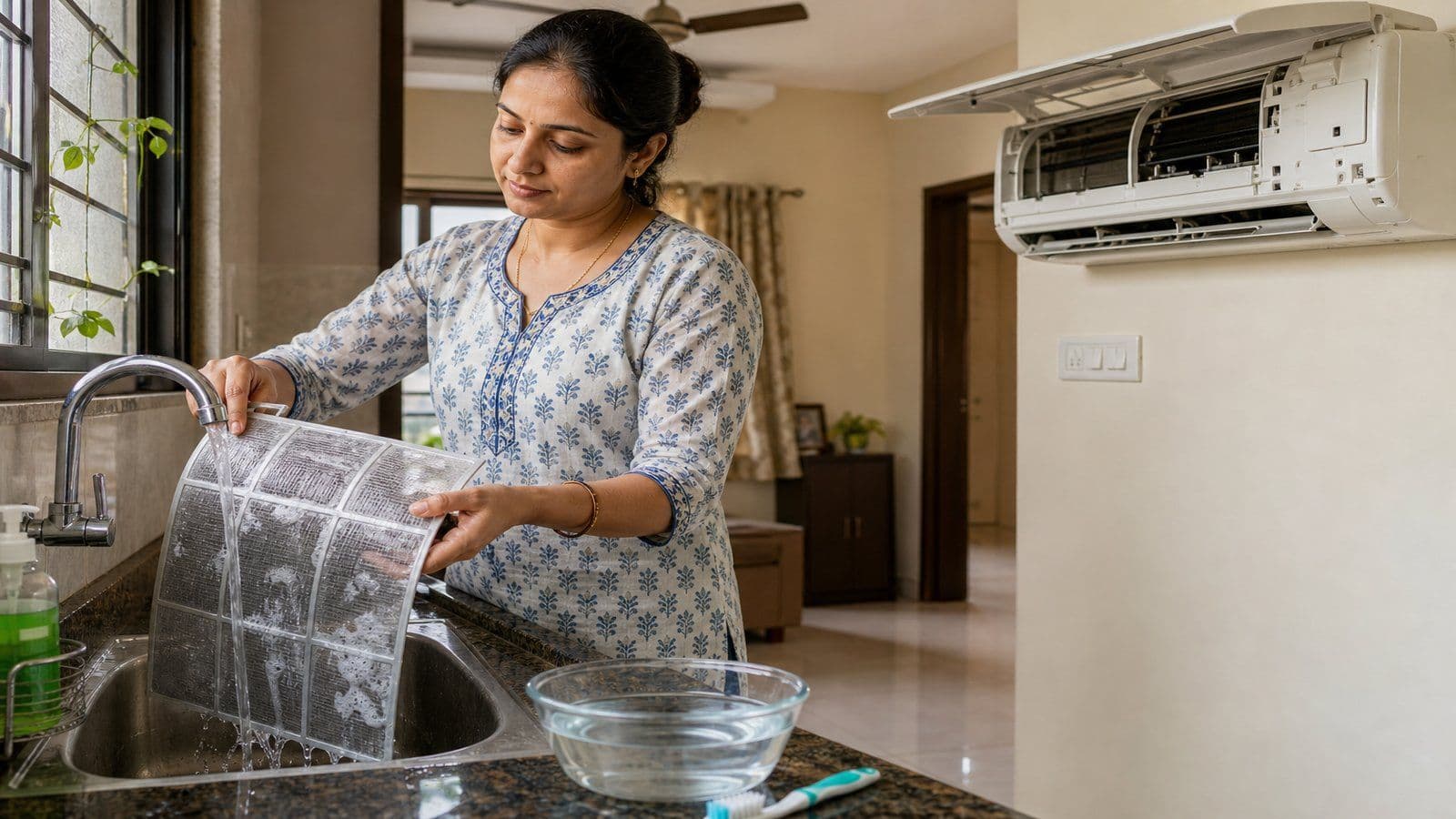
Five minutes, no tools. Slide both filter screens out, rinse under the tap, scrub with mild soap, dry in shade (never sunlight, it warps the frame), slide back. Every two to three weeks during summer in dusty cities, four to six in coastal cities and during monsoon.
How to Check the Tilt Angle
You need a small spirit level (₹150 to ₹250) or a smartphone level app. Place it on top of the indoor unit across the width. The bubble should sit off-centre toward the drain side. If centred or off toward the non-drain side, the unit is tilted wrong. Re-bracketing is not DIY, call a technician.
If the unit is under 3 years old, we check filter cleanliness and drain pipe flow first. In 7 of 10 such calls those two checks resolve it and the customer pays only ₹450. The ones needing pan replacement or refrigerant work are clearly different on inspection within 5 minutes.
Get quotes from verified, top-rated AC Service & Repair pros in Delhi.
When to Call a Verified Technician
Stop DIY and book a NSDC-certified technician if any of these apply. Water dripping near the MCB box, wall socket, or any wiring junction, switch off at the wall socket immediately, Central Electricity Authority (CEA) safety regulations are clear that water plus 230-volt mains is an electrocution and fire risk. Leak started suddenly after a recent service visit, vendor fixes free. Ice on the indoor copper pipe or coil, refrigerant trouble. Drip from the bottom of the unit on switch-on, usually a cracked drain pan. Gurgling water inside the indoor unit, the pipe is choked and back-pressure is pushing water up.
Monsoon-Specific Leakage Issues
Monsoon (June to September) is peak season for AC water complaints. Warm humidity plus high condensate creates ideal conditions for algae and bacterial film in the drain pipe. A pipe flowing fine in May can choke fully by late June. The Indian Plumbing Association recommends a chemical drain flush at start of monsoon (100 ml bleach plus 500 ml water in the pan, 20 minutes, then clear-water flush). Once in May, once in August.
If your outdoor drip stub is too close to the ground or near a clogged building drain that floods in heavy rain, water can back up into your wall. The outlet should sit at least 30 cm above ground. In top-floor apartments a wet patch behind the indoor unit during monsoon is sometimes terrace water seeping through poor waterproofing. Switch off the AC for 48 hours during rain. If the patch persists, the AC is not the cause.
In Pune and Mumbai monsoon calls, I see one pattern repeat in almost 40 percent of building drainage cases. The outdoor drip stub was originally fine but a society painter or AMC plumber routes it into a clogged chajja gutter. Water has nowhere to go, backs up the pipe, and surfaces inside the bedroom wall. Always trace the full pipe path outdoors before flushing anything indoors.
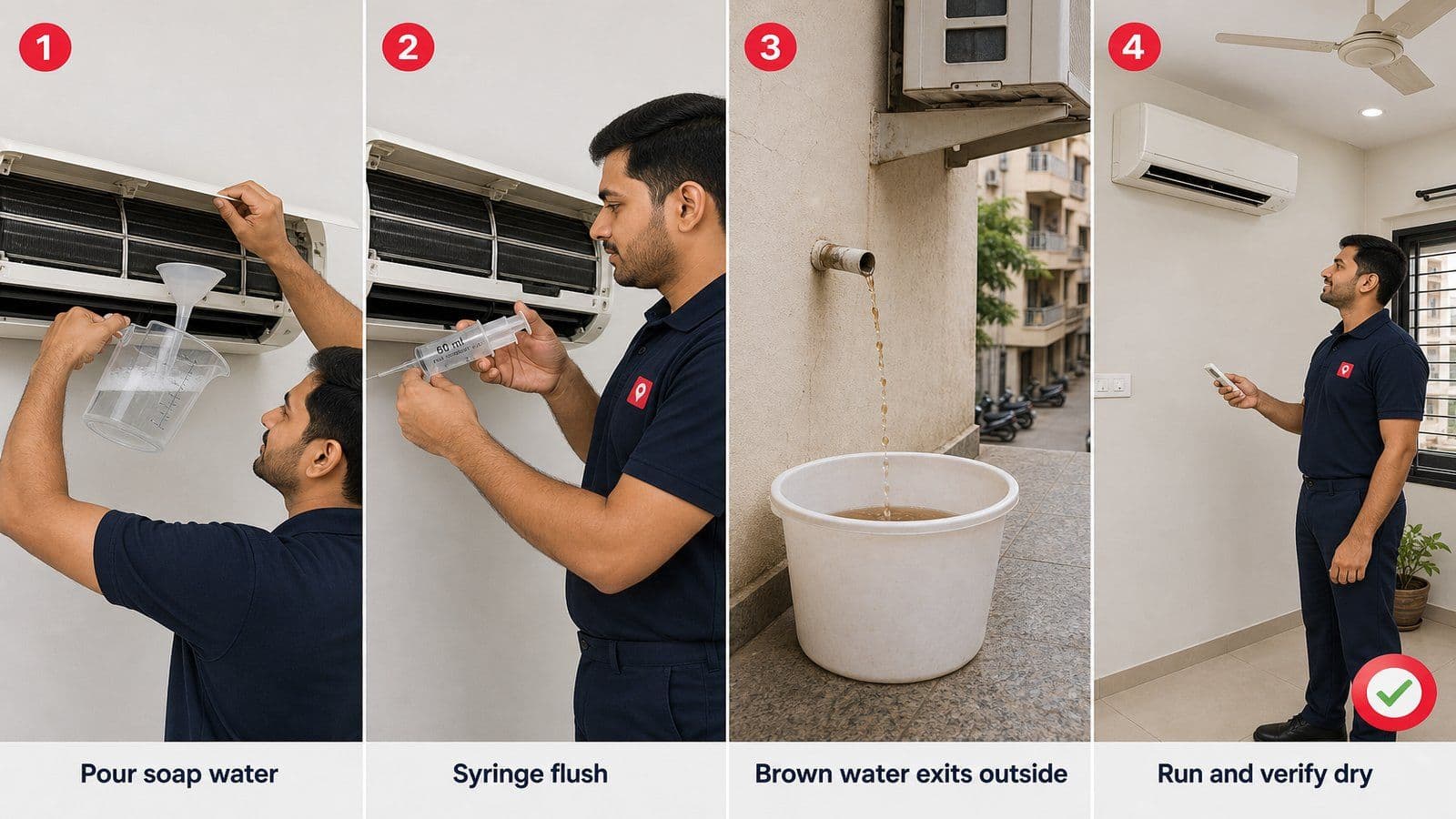
Photo: DIY drain pipe flush step-by-step illustration
2026 Typical Fix Costs in India
Ranges reflect ProNearMe network technician charges across major Indian metros in 2026, excluding 18 percent GST.
| Fix | Typical Cost (₹) | Time |
| Drain pipe flush, mild blockage | 400 to 700 | 30 min |
| Drain pipe flush, hard blockage | 700 to 1,100 | 45 min |
| Filter deep clean | 300 to 500 | 20 min |
| Tilt angle correction | 600 to 1,200 | 60 min |
| Suction pipe insulation per metre | 350 to 600 | 40 min |
| Drain pan replacement | 1,800 to 3,500 | 90 min |
| Drain pipe re-routing | 1,200 to 2,400 | 75 min |
| Refrigerant top-up with leak seal | 2,800 to 6,500 | 90 to 120 min |
| Deep chemical cleaning | 1,400 to 2,800 | 120 min |
| Window AC gasket replacement | 200 to 450 | 30 min |
A ProNearMe AMC at ₹2,400 to ₹3,200 per AC per year covers two preventive visits with drain flushes plus discounted repair rates, cheaper than two emergency visits for most owners. See AC repair vs replace decision and AC repair cost breakdown for broader context.
Real Case from the ProNearMe Network
In July 2025, Mr. Rohan Mehta from Kothrud, Pune logged a complaint at 11 pm Sunday. Water was dripping from his three-year-old split AC onto his daughter's desk and laptop. A verified technician was dispatched 8 am Monday. The drain pan was 60 percent full, the pipe choked with brown biofilm. The unit had been installed in 2022 and never flushed. Compressed-air clearance, a chemical flush, and a filter wash restored full flow in 45 minutes. Total cost ₹780. The technician also re-torqued a loose wall bracket free. Rohan reported zero further leaks through 2025 monsoon and signed an AMC for 2026.
Conclusion
AC water leakage looks alarming the first morning you spot a puddle but resolves cheaply when caught early. The single most useful habit is a twice-yearly drain flush, alone preventing 60 to 70 percent of leak cases. Washing the front filters every two to four weeks during summer prevents the frozen coil cases. The scenarios that need a NSDC-certified technician (cracked drain pan, refrigerant freeze-thaw, water near electricals) are clear on inspection.
Disclaimer
All cost ranges are typical residential figures for Indian metros in 2026, excluding 18 percent GST. Actual costs vary by city, season, part and labour rate. Refrigerant handling, drain pan replacement and any work inside the electrical compartment should be done only by NSDC-certified or OEM-trained technicians. ProNearMe does not endorse any specific AC brand, and the leak causes and fixes covered apply across all manufacturers and split or window AC configurations sold in India.
Sources & References
- Bureau of Energy Efficiency (BEE) Air Conditioner Energy Efficiency Standards and Labelling Programme
- Bureau of Indian Standards (BIS) IS 1391 Room Air Conditioners Specification
- Ministry of Environment, Forest and Climate Change Ozone Cell Kigali Amendment Implementation Guidelines
- Press Information Bureau Advisory on Energy Efficient Air Conditioning and Servicing
- National Skill Development Corporation HVAC Technician Qualification Pack
- Indian Society of Heating, Refrigerating and Air Conditioning Engineers Residential HVAC and Indoor Comfort Guidelines
- Central Electricity Authority Wiring and Safety Regulations for Domestic Electrical Installations
- Indian Plumbing Association Condensate Drain Maintenance and Indoor Air Quality Guidelines
- National Building Code of India 2016 Part 8 Section 3 Air Conditioning, Heating and Mechanical Ventilation

Amit worked as an AC technician for 6 years in Ahmedabad before transitioning to technical writing. He holds a diploma in Refrigeration and Air Conditioning from ITI Ahmedabad and understands the difference between what AC companies promise and what actually happens on the ground. His articles break down complex technical topics into plain language that any homeowner can follow. He tests every tip he writes about in his own home first.

Dr. Verma is a mechanical engineer with 15 years of experience in HVAC systems. She completed her PhD from IIT Delhi on energy-efficient cooling solutions for Indian residential buildings. She reviews all technical content on HomePros to make sure the numbers are right, the advice is safe, and the recommendations are backed by actual engineering principles. She consults for multiple AC manufacturers on product design.