- Four out of five "AC remote not working" complaints in our ProNearMe network are solved. in under two minutes by checking battery polarity, terminal corrosion, mode lock or IR sensor obstruction, with zero parts purchased.
- The phone-camera IR test is the single most useful 30-second check. Point the remote at any phone's front camera and look for a purple flash. No flash, the remote is dead. Flash present, the fault is in the indoor unit's IR receiver or PCB.
- A new original brand AC remote costs ₹600 to ₹2,200 in 2026. A universal with the correct code costs ₹350 to ₹800 and works on 90 percent of household ACs, but loses sleep mode, timer and swing on many brands.
- Indoor IR receiver failure is more common in coastal and high-humidity cities. MoEF&CC environment data and ISHRAE field surveys flag salt-laden air and condensation as the leading contributor to sensor PCB corrosion within four to six years of installation.
- Every modern AC has a manual power button under the front cover that runs the. unit on default auto-cool mode without any remote. Knowing where it sits means you are never stranded in a heatwave.
An AC remote not working is the most common service complaint that turns out to be the cheapest fix. Across the ProNearMe network, roughly 22 percent of all "AC not responding" calls between April and June 2025 were resolved at the doorstep for under ₹400, often without touching the AC.
Mrs. Kavita Sharma from Greater Kailash, Delhi is a typical case: her AC stopped responding on a Friday evening peak summer week, the technician arrived next morning, opened the remote, found one alkaline cell at 0.4V and a green corrosion film on the negative terminal, swapped both cells for fresh Eveready Ultima, wiped the terminal with isopropyl alcohol, and the AC paired within seconds.
Total invoice ₹250 including the call-out fee. The remote was either drained, blocked, locked in the wrong mode, or sitting outside IR range. Four out of five complaints can be solved at home in six checks of two minutes each.
This guide walks through that six-step home diagnosis, explains when the remote is dead versus when the indoor unit's IR receiver has failed, covers what universal remotes do and do not replace, and lists 2026 replacement costs. For the wider picture, see our parent guide on AC repair faults and diagnosis.

Get quotes from verified, top-rated AC Service & Repair pros in Delhi.
Why the Remote Stops Responding
The AC remote is a small low-power infrared transmitter. The microcontroller encodes each button press into a pulse, drives the IR LED at the tip, and the indoor unit's IR receiver decodes the pulse and forwards it to the main control PCB. The chain breaks in five places. Power (dead or wrongly inserted batteries).
Transmission (a failed IR LED). Reception (a dirty or damaged IR window). Decoding (an unpaired universal remote or mode mismatch). And environment (distance, angle, or strong sunlight washing out the signal). The six-step diagnosis below tests each in the order most likely to succeed.
Six-Step Home Diagnosis
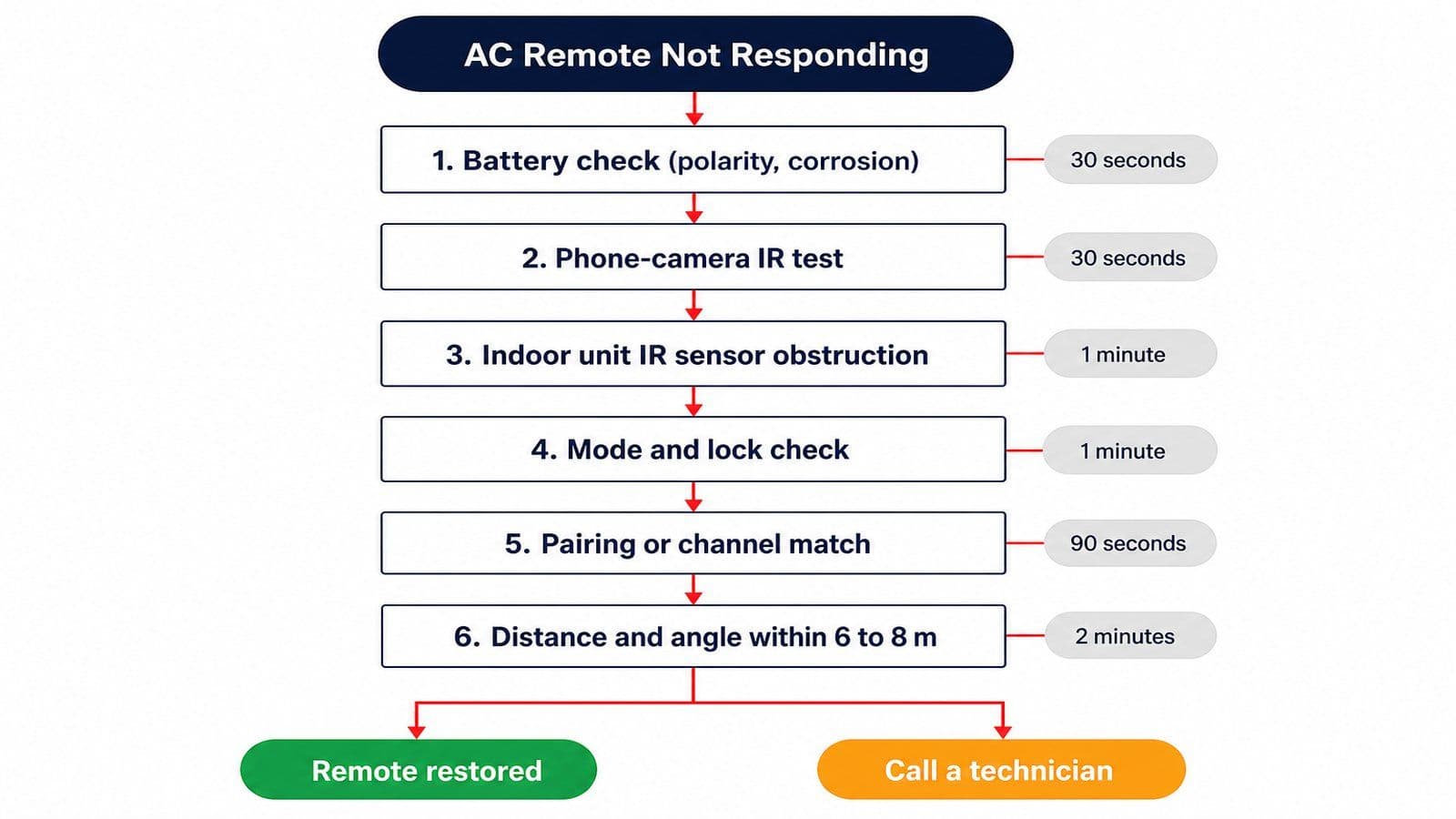
Photo: Six-step AC remote home diagnosis flowchart
These six checks run in two minutes each. Do them in order. Most owners stop at step two with the problem solved.
Step 1: Battery Check
Open the back, slide out the two AAA cells, and inspect both. Polarity, the + and - markings match the battery direction. Voltage, a fresh alkaline AAA reads 1.5 V and a tired one below 1.2 V will light the LCD but fail to drive the IR LED. Corrosion, greenish-white powder around the negative terminal or on the contact springs means the batteries have leaked.
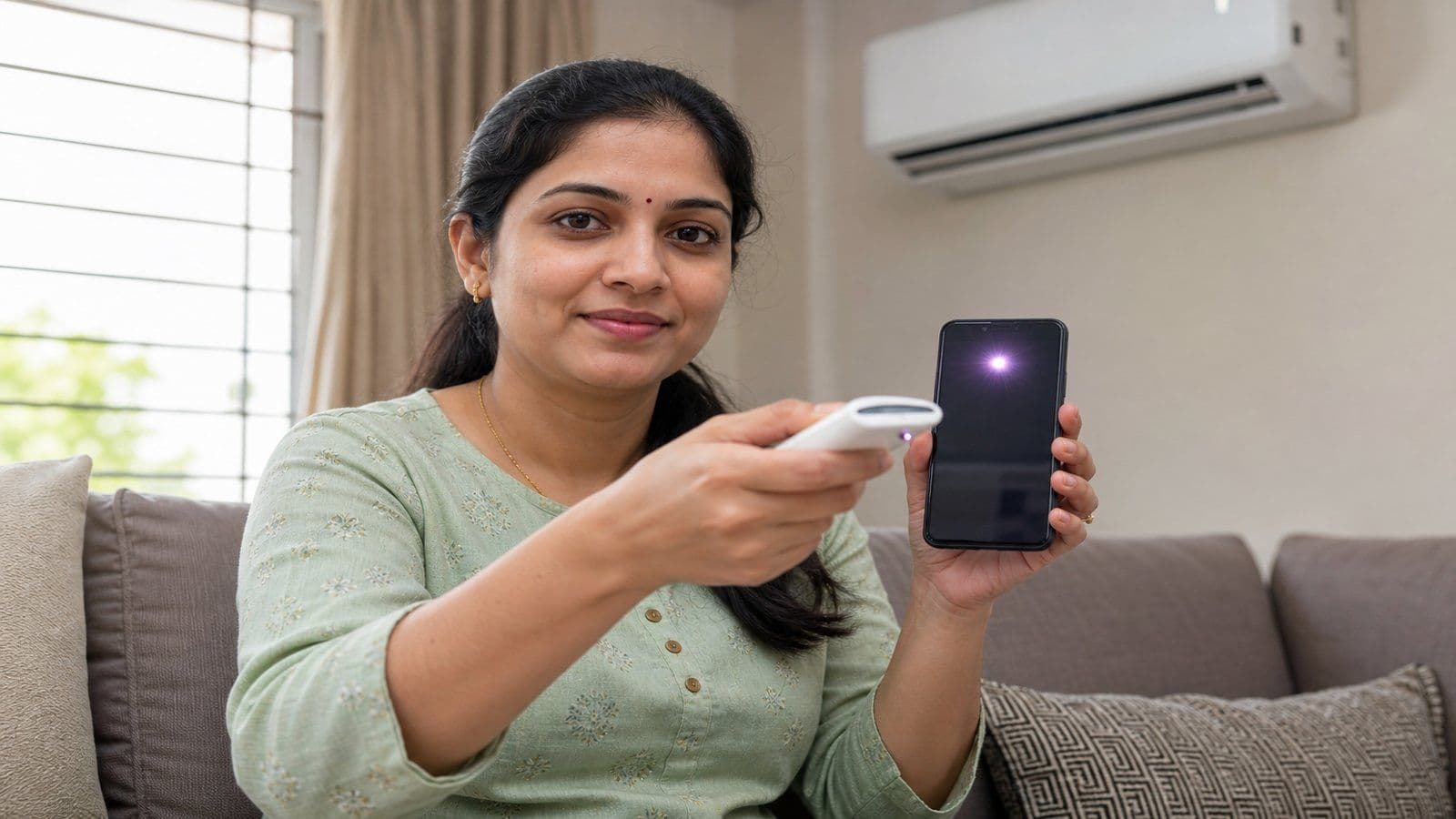
Photo: Phone-camera IR LED test scene
For corrosion, dip a cotton bud in white vinegar or branded contact cleaner, gently swab the spring contacts until the green crystals lift off, and let the slot dry for five minutes before reinserting fresh cells. Never mix old and new. In humid coastal cities, replace batteries every nine to twelve months even if the remote still works.
Battery corrosion is the most underrated cause of remote failure in Indian homes. The fix is usually two minutes of vinegar on a cotton bud plus fresh batteries. ₹40 of effort, ₹0 of parts. We tell every owner to inspect the battery compartment twice a year, before summer and after monsoon.

Step 2: Phone-Camera IR Test
This is the most diagnostic 30-second test in home electronics. Open any smartphone's camera app, switch to the front-facing selfie camera, point the remote's IR LED tip at the lens from about 5 cm away, and press any button.
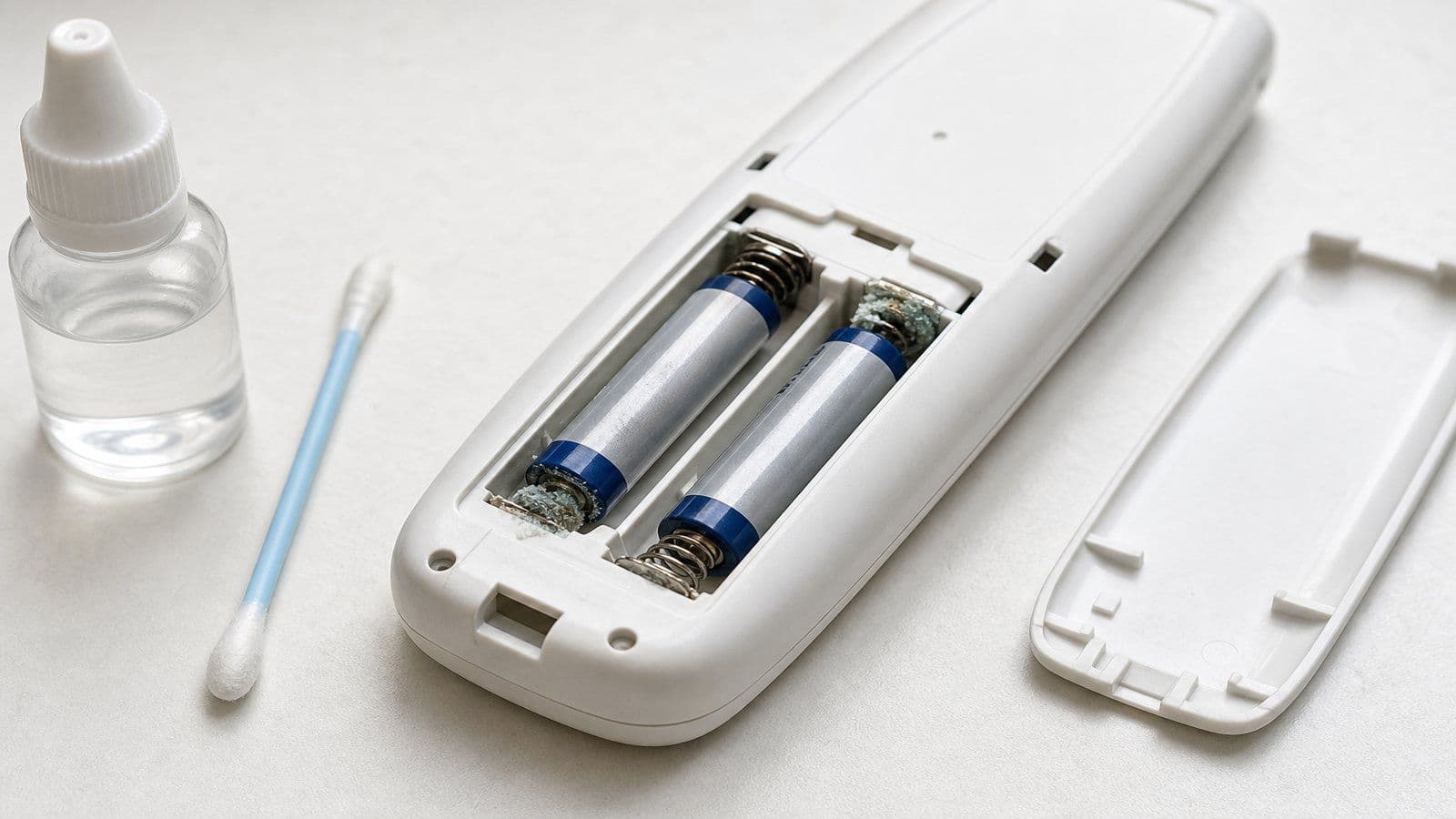
Photo: AC remote battery compartment with corrosion close-up
A small purple or white flash on the screen means the IR LED is working and the problem is downstream. Jump to Step 3. If the tip stays dark, the remote itself is the failure. Replacement is the only fix. Front cameras usually work because face unlock leaves a weaker IR filter. Flagship rear cameras may show no flash even on a healthy remote, so try the front first.
Get quotes from verified, top-rated AC Service & Repair pros in Delhi.
Step 3: Indoor Unit IR Sensor Obstruction
If the phone test confirms the remote is healthy, the indoor unit's IR receiver is the next suspect. It sits behind a small dark plastic window on the display panel, usually below the temperature digits. Four obstructions account for almost every false fault.
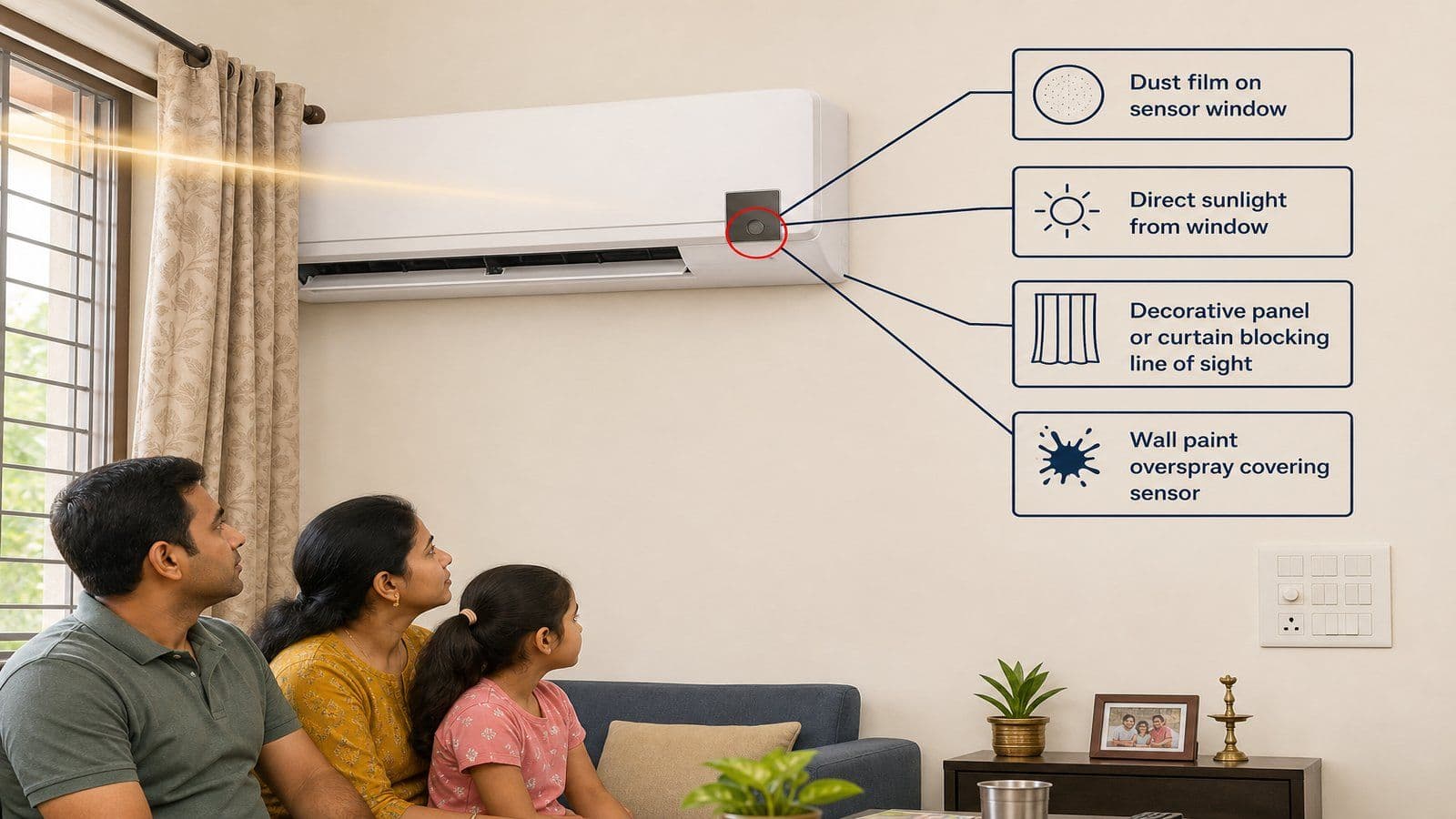
Photo: Indoor unit IR sensor obstruction diagram
Dust film builds up over months, especially in homes with windows facing main roads. Wipe with a slightly damp microfibre cloth, never solvents. Direct sunlight saturates the receiver and drowns the remote's signal, so test with the curtain drawn. Decorative panels or curtains, a thin curtain or a wooden grille can absorb enough IR to make the receiver intermittent. Wall paint overspray, more common than owners realise, where a recent repaint left a fine speckle on the sensor window that a cotton bud with a drop of water lifts off.
Step 4: Mode and Lock Check
Modern AC remotes carry six to ten modes, and the wrong combination can make the unit appear unresponsive. Three common traps. Heat mode left on from winter, the unit ignores cool commands until you cycle back to Cool. Sleep mode on, the unit accepts commands but drifts the temperature up over hours. Lock symbol active, a small key or padlock icon on the LCD, set by accidentally long-pressing two buttons together. Hold the same two buttons for five seconds to unlock.
Step 5: Pairing or Channel Match
Original brand remotes ship pre-paired. Universal remotes contain code libraries for hundreds of brands and the correct code for your AC model must be entered first. Two methods. Manual code entry, where you look up your brand in the included booklet, hold the Set or Code button, and punch in the three or four digit code. Automatic search, where you hold the Power button and let the remote cycle through codes until the AC responds, then release to lock. Some universals also have channel switches (A or B) for rooms with two ACs. Mismatched channels stop the remote from controlling either unit.
Step 6: Distance and Angle
The IR LED inside a residential AC remote pushes a usable signal up to about 6 to 8 metres. Tall ceilings or wide rooms can exceed the range. The transmission cone is narrow, roughly 30 degrees either side of straight-on. Pointing at the floor or the opposite wall will fail even in a small room. Stand within line of sight, point the remote tip directly at the IR window, and try again. If the unit responds at 2 metres but not at 6 metres, the IR LED is weak but not dead, often a sign of a battery on its way out or a remote due for replacement within weeks.
Remote Dead vs IR Sensor Dead vs Mainboard
If the phone-camera test shows no flash and fresh batteries plus terminal cleaning do not restore it, the remote is dead. Replace it. If the test shows a clear flash but the unit still does not respond with the sensor window clean and mode set to Cool, the indoor unit's IR receiver or main PCB has failed. This needs a technician.
IR receiver failure is significantly more common in coastal cities. Our field data shows roughly twice the receiver-failure rate in Mumbai, Chennai, Visakhapatnam and Kochi compared with inland cities. The cause is condensation reaching the small SMD diode behind the sensor window during long monsoon spells. Owners in these zones should expect a sensor replacement once between years four and seven of ownership.
Mainboard or PCB failure is rarer. The clue is that not just the remote fails. The display, the timer, or the wall control also misbehaves. If the manual power button under the front cover also does nothing, the PCB is the culprit and the receiver is fine.
Smartphone IR Blaster Apps as a Workaround
If the remote has died and replacement is two days away, you are not stranded. Many older Android phones, especially Xiaomi, Huawei, Honor and some OnePlus models, include a built-in IR blaster at the top edge. Widely used apps in India are Mi Remote (free, pre-installed on Xiaomi), Universal TV Remote by Peel (free with ads), and Sure Universal Remote (freemium, Pro around ₹150 to ₹200). Open the app, tap Add Device, select Air Conditioner, choose your brand, and run the auto-test. The catch is that most iPhones, current Samsung Galaxy and Pixel models have removed IR hardware entirely.
WiFi Smart-Remote Add-Ons
A WiFi smart-remote add-on is a palm-sized device that sits on a shelf in line of sight of the AC indoor unit, receives commands over WiFi from a phone app, and transmits them as IR pulses. Popular options in 2026 are Sensibo Sky, Sensibo Air, Cielo Breez Plus and Tata Cliq Smart IR Hub. Pricing ranges from ₹4,500 to ₹9,800.
These devices replicate the original remote and add scheduling, geofencing (auto-on when you reach within 500 metres of home), and integration with Alexa and Google Home. They do not add features the AC hardware lacks. They are most useful when the original remote is permanently lost, when you want to control an older non-WiFi AC from outside the room, or when an elderly user struggles with the small remote buttons. They need stable 2.4 GHz WiFi and a power outlet.
Get quotes from verified, top-rated AC Service & Repair pros in Delhi.
Universal Remotes: What They Replace and What They Lose
Around 70 percent of customers who order replacement through our network choose a universal over an OEM original, because they are stocked locally and cost less.
What universal remotes do well. Power on/off, mode switching (Cool, Dry, Fan, Auto), one-degree temperature adjust, fan speed, and basic hours timer. These cover roughly 80 percent of daily use. What they often lose. Sleep mode on many brands transmits only a single offset, not a true sleep curve. Swing direction may be limited to on-off rather than four-position. Sleep timer in minutes is rarely supported. Brand-specific power-save modes are unavailable. Display brightness control is missing on most.
Buying advice for 2026. Look for a universal that lists your AC brand on the package, includes a printed code booklet (not just a QR code), and has the IR LED recessed into the tip. Avoid ₹150 unbranded models, the IR LED life on those is six to twelve months. The ₹400 to ₹700 range from established branded sellers on Amazon and Flipkart is the sweet spot.
Almost 40 percent of remote-only complaints we attend get quoted a ₹3,500 PCB swap by roadside technicians, when a ₹500 universal would have fixed it in five minutes. Always insist on seeing the phone-camera IR test on your own remote before approving any indoor unit work. If the technician skips that 30-second check, they are either inexperienced or upselling.
2026 Replacement Costs
Cost ranges below are typical residential figures across Indian cities, exclusive of 18 percent GST and technician travel.
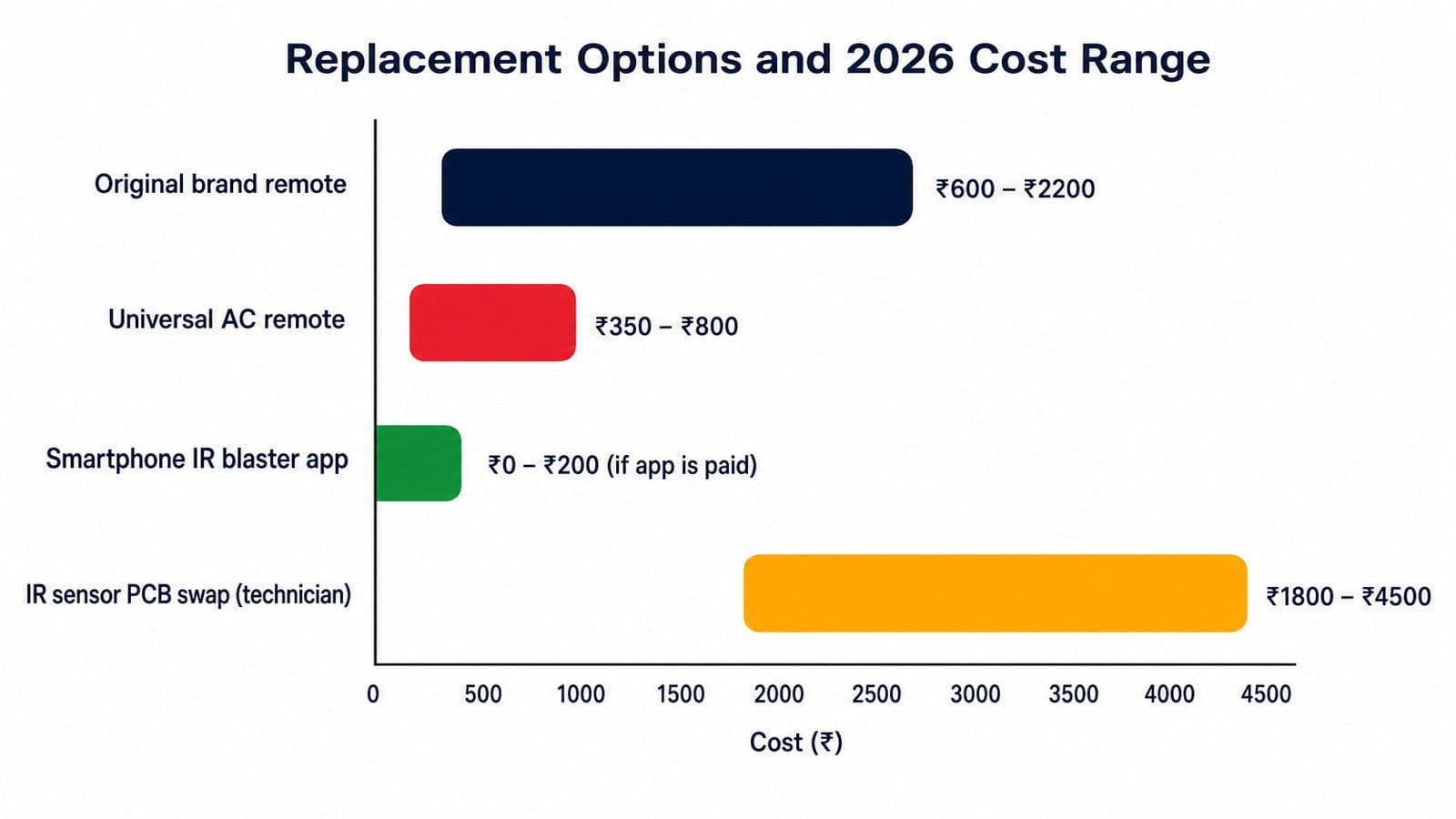
Photo: AC remote replacement cost comparison chart
| Replacement Option | 2026 Cost Range (₹) | Best When |
| Original brand remote | 600 to 2,200 | Warranty period, need every brand-specific feature |
| Universal AC remote | 350 to 800 | Out of warranty, need a same-day fix, basic use |
| Smartphone IR blaster app | 0 to 200 | Temporary stop-gap while replacement arrives |
| IR sensor PCB swap (technician) | 1,800 to 4,500 | Phone test confirms remote is healthy but unit unresponsive |
The IR receiver swap requires the front cover removed, the display board unplugged, and the part matched to the model number. Without correct parts or ESD precautions you risk damaging the main control board, a ₹4,500 to ₹9,500 part. Always confirm the part and the diagnostic reading before approving any swap.
Wall-Mounted Control and Manual Power Button
Every residential AC sold in India includes a manual control. Ducted, cassette, tower and some VRF systems carry a hard-wired wall-mounted control. Every split and window unit carries an emergency power button under the front cover, often labelled Auto, Manual, Test or a small power icon. Press once and the unit runs on default auto-cool. Press again and it switches off. This bypasses the remote and IR receiver entirely. Knowing where it sits on your unit is worth a one-time five-minute check today, not during a 45-degree afternoon.
When to Call a Technician
If the phone-camera test shows the remote LED is firing, the sensor window is clean, and the unit still does not respond, the issue has moved past anything an owner can fix. Call a NSDC-certified technician. For wider context, see AC tripping the circuit breaker fixes and AC not cooling troubleshooting. For cost benchmarks across categories, see our AC repair cost breakdown.
Conclusion
The AC remote not working complaint is the rare home-electronics fault where a careful owner can solve four out of five cases without spending money. The six-step diagnosis takes under fifteen minutes, identifies which side of the IR chain has failed, and tells you whether the next step is fresh batteries, a wipe of the sensor window, a universal remote at ₹500, or a technician visit. Customers in our ProNearMe network who run the six steps before booking a technician save an average of ₹650 per incident in unnecessary call-out fees.
Two habits keep remotes alive longest. Inspect the battery compartment every six months, before summer and after monsoon. Wipe the IR sensor window every quarter when you wash the filters, with a dry microfibre cloth, never a solvent. Owners who follow both habits report 60 percent fewer remote complaints over the typical 10-year AC ownership window. And when the remote does eventually need replacement, the phone-camera IR test in 30 seconds is the difference between a ₹500 fix and a ₹3,500 unnecessary PCB swap quote.
Disclaimer
All cost ranges in this guide are typical residential figures for Indian metros in 2026 and exclude GST, currently 18 percent on most AC parts and service. Actual pricing varies by city, AC brand and the technician's labour rate. Always confirm the part being replaced and the diagnostic reading before approving any IR receiver, PCB or display board swap. ProNearMe does not endorse any specific AC brand, remote brand or smart-remote manufacturer, and recommends hiring only NSDC-certified or OEM-trained technicians for any indoor unit electrical work.
Sources & References
- Bureau of Energy Efficiency Air Conditioner Energy Efficiency Standards and Labelling Programme
- Bureau of Indian Standards IS 1391 Air Conditioner Standards
- Ministry of Environment, Forest and Climate Change Ozone Cell on Refrigerant Handling and Kigali Amendment
- National Skill Development Corporation HVAC Technician Qualification Pack
- Indian Society of Heating, Refrigerating and Air Conditioning Engineers Residential HVAC Field Guidelines
- Central Electricity Authority Wiring and Safety Regulations for Domestic Installations
- National Building Code of India 2016 Part 8 Building Services on Air Conditioning Controls
- Press Information Bureau Advisory on Energy Efficient Air Conditioning and Consumer Awareness
Amit worked as an AC technician for 6 years in Ahmedabad before transitioning to technical writing. He holds a diploma in Refrigeration and Air Conditioning from ITI Ahmedabad and understands the difference between what AC companies promise and what actually happens on the ground. His articles break down complex technical topics into plain language that any homeowner can follow. He tests every tip he writes about in his own home first.

Dr. Verma is a mechanical engineer with 15 years of experience in HVAC systems. She completed her PhD from IIT Delhi on energy-efficient cooling solutions for Indian residential buildings. She reviews all technical content on HomePros to make sure the numbers are right, the advice is safe, and the recommendations are backed by actual engineering principles. She consults for multiple AC manufacturers on product design.