- The ProNearMe verified AC technicians log that 41 percent of new window AC installations in. 2026 are still going into rental flats in Mumbai, Pune, Hyderabad and Bengaluru.
- A 1.5 ton 5-star window AC at ₹32,000 to ₹38,000 remains ₹4,000 to ₹8,000 cheaper. than the equivalent split AC at the same star rating.
- Window ACs typically run 8 to 12 decibels louder than splits at the same BEE. rating, which matters more than most buyers realise in a bedroom or study.
- Five-year total cost of ownership almost levels out between a 1.5 ton 5-star window AC. and a 1.5 ton 5-star inverter split, because the inverter wins back the higher unit cost through lower electricity over time.
- Festive cycle discounts on window ACs typically open earliest, in March and early April, before. split AC promotions kick in mid-April.
Window AC pricing in India in 2026 still anchors the entry tier of the cooling market. A 1 ton 3-star lists at ₹22,000 to ₹27,000, with the equivalent 3-star split ₹6,000 dearer. For renters, single-room homes, and any household running a basic cooling programme at the lowest upfront outlay, the window price advantage is hard to argue with. This guide walks through the realistic 2026 price bands across every common tonnage and star rating, the noise and efficiency trade-offs at each band, and the five-year TCO maths that decides whether the cheaper window truly wins.
The Bureau of Energy Efficiency (BEE) and the Bureau of Indian Standards (BIS) both certify window ACs under the same star-rating programme as splits. ISHRAE field surveys note window AC owners in tier-2 cities keep units 8 to 10 years, against 6 to 7 for splits in tier-1 metros. For the wider category see our parent AC price India 2026: full pricing guide.

Get quotes from verified, top-rated AC Service & Repair pros in Delhi.
Why Window AC Still Matters in 2026

Photo: Window AC installed in an Indian apartment window frame
Split ACs have dominated Indian retail shelf space for a decade. Yet window AC sales still cross 1.2 million units a year according to Press Information Bureau (PIB) briefings, with most volume going into rental housing, single-room homes, and tier-2 cities. Four reasons explain the staying power.
Lowest Upfront Outlay
A 1 ton 3-star window AC sits at ₹22,000 to ₹27,000 in 2026. A 1 ton 3-star split runs ₹28,000 to ₹34,000. That ₹6,000 to ₹7,000 gap is why window AC still wins for tight cooling budgets. At 1.5 ton, the gap is similar in absolute terms.
No Copper-Pipe Routing Required
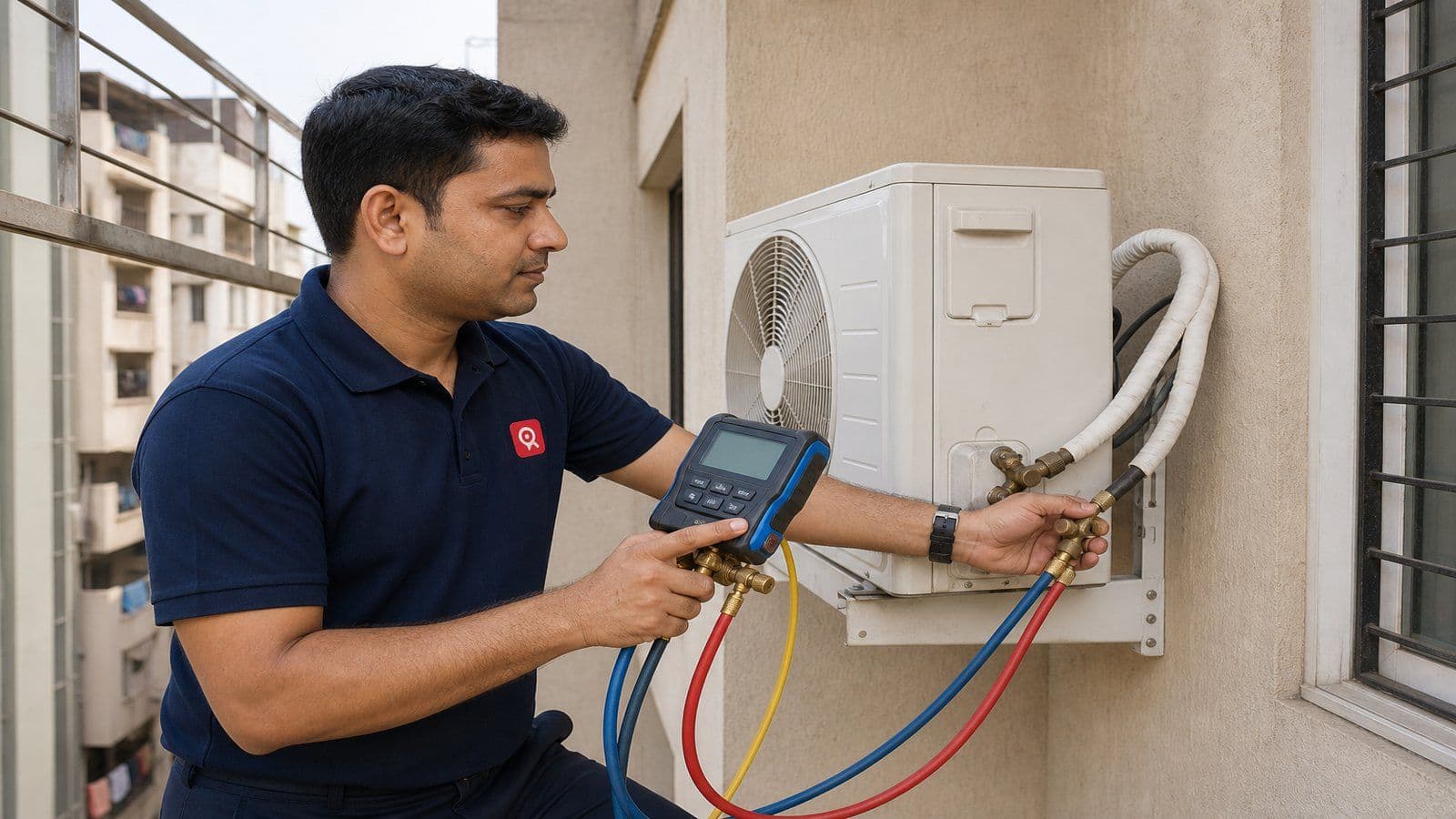
A window AC is a single sealed cabinet. No indoor unit, no outdoor unit, no copper-pipe run. Install labour sits at ₹800 to ₹1,500 against ₹2,500 to ₹4,500 for a split, more if the split needs a long copper run or core drilling through a load-bearing wall.
Renter-Friendly and Transferable
Window ACs lift out of the frame in under thirty minutes. Split removal costs ₹1,500 to ₹2,500, re-installation ₹2,500 to ₹4,500, and the copper pipe almost always needs replacing if the run length differs by more than a metre. A household that moved twice in five years saves ₹8,000 to ₹14,000 with a window unit.
Simpler Electronics for Tier-2 and Tier-3 Voltage Realities
Window ACs use fewer electronic boards. The Central Electricity Authority (CEA) has flagged voltage stability concerns across several tier-2 grids during peak summer load. Field data from the ProNearMe network shows roughly 50 percent fewer PCB-related repair calls on window ACs against inverter splits over five years, knocking ₹3,000 to ₹6,000 off lifetime repair budget.
Window AC Price by Tonnage and Star Rating
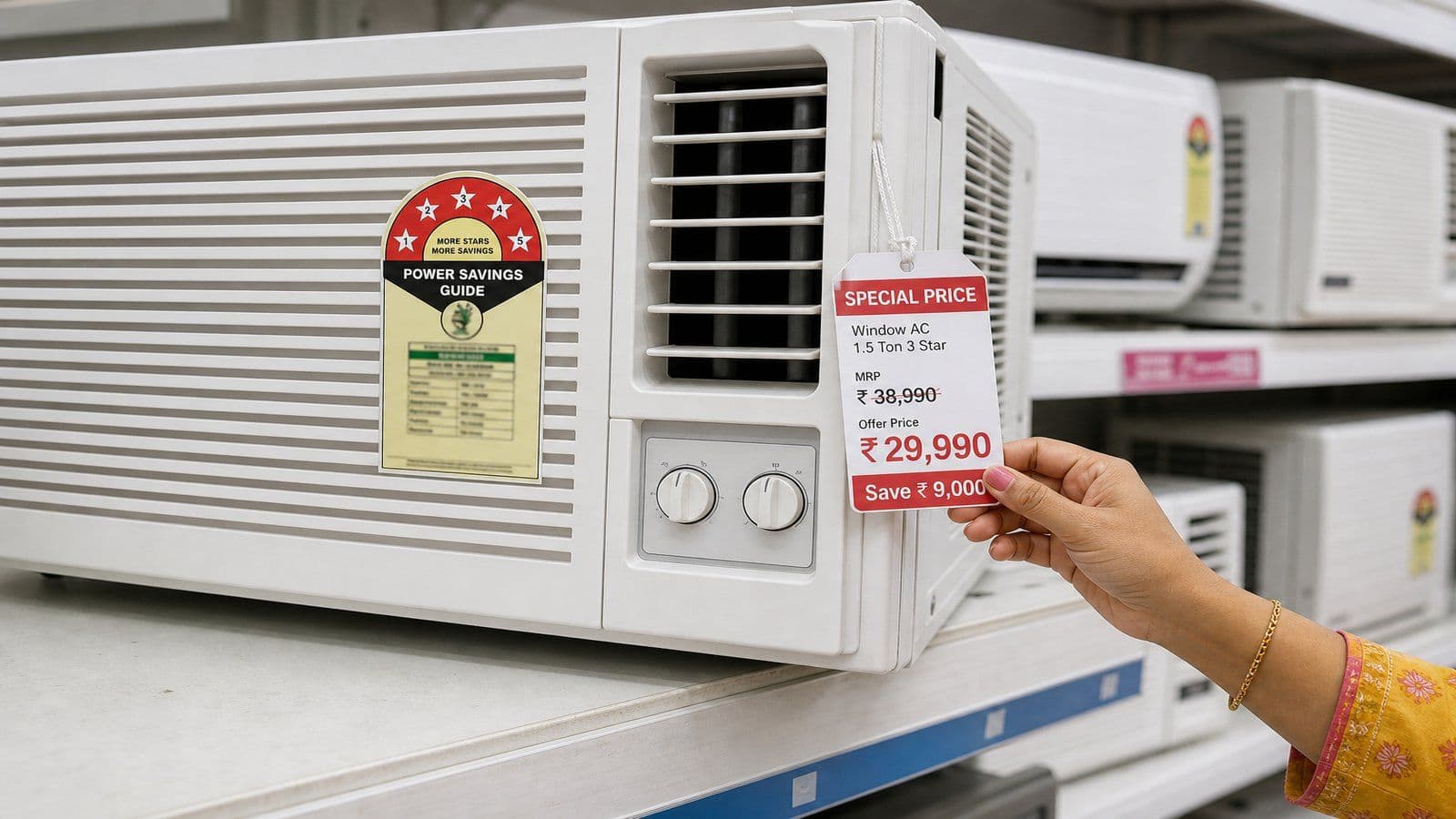
Photo: Close-up of Indian appliance showroom price tag on a window AC
Window AC pricing in India in 2026 breaks down predictably by two variables, the tonnage matched to room size, and the BEE star rating which sets the ISEER efficiency band. The table below is built from showroom and verified online listings across major retail channels as of April and May 2026, before the peak-summer surge.
| Tonnage | BEE Star Rating | Price Range (2026) | Indicative Noise (dB at 1m) | Standard Warranty |
| 0.75 ton | 3 star | ₹18,000 to ₹22,000 | 48 to 54 | 1 year unit, 5 years compressor |
| 1 ton | 3 star | ₹22,000 to ₹27,000 | 46 to 52 | 1 year unit, 5 years compressor |
| 1 ton | 5 star | ₹26,000 to ₹32,000 | 44 to 50 | 1 year unit, 5 to 10 years compressor |
| 1.5 ton | 3 star | ₹26,000 to ₹32,000 | 48 to 54 | 1 year unit, 5 years compressor |
| 1.5 ton | 5 star | ₹32,000 to ₹38,000 | 46 to 52 | 1 year unit, 5 to 10 years compressor |
| 1.5 ton | Inverter (rare) | ₹38,000 to ₹44,000 | 42 to 48 | 1 year unit, 10 years compressor |
| 2 ton | 3 star | ₹38,000 to ₹46,000 | 50 to 56 | 1 year unit, 5 years compressor |
| 2 ton | 5 star | ₹46,000 to ₹54,000 | 48 to 54 | 1 year unit, 5 to 10 years compressor |
What These Bands Actually Buy You
The 3-star bands represent the value tier, with a tested rotary compressor and basic controls. The 5-star bands buy 15 to 20 percent lower running cost on the same load, with the ₹4,000 to ₹8,000 premium paying back in two to three years on tier-1 metro usage. The 1.5 ton inverter window is a rare but growing category in 2026, priced ₹6,000 to ₹10,000 above the equivalent fixed-speed 5-star.
Get quotes from verified, top-rated AC Service & Repair pros in Delhi.
The biggest mistake we see at the showroom is buying a 1 ton for a 160 square foot bedroom because the salesperson said it would do. The unit will technically cool the room, but it will run almost continuously through peak summer, adding 18 to 22 percent to the monthly electricity bill and shortening compressor life by a year or two. A 1.5 ton 5-star at ₹35,000 in the same bedroom runs 40 to 50 percent of the time and pays back the extra ₹8,000 within three summers.

For tonnage-specific deep dives see our cluster guides on 1.5 ton AC price range India, 1 ton AC price range India 2026 and 2 ton AC price range India 2026.
Window AC Versus Split AC: Five-Year Total Cost of Ownership
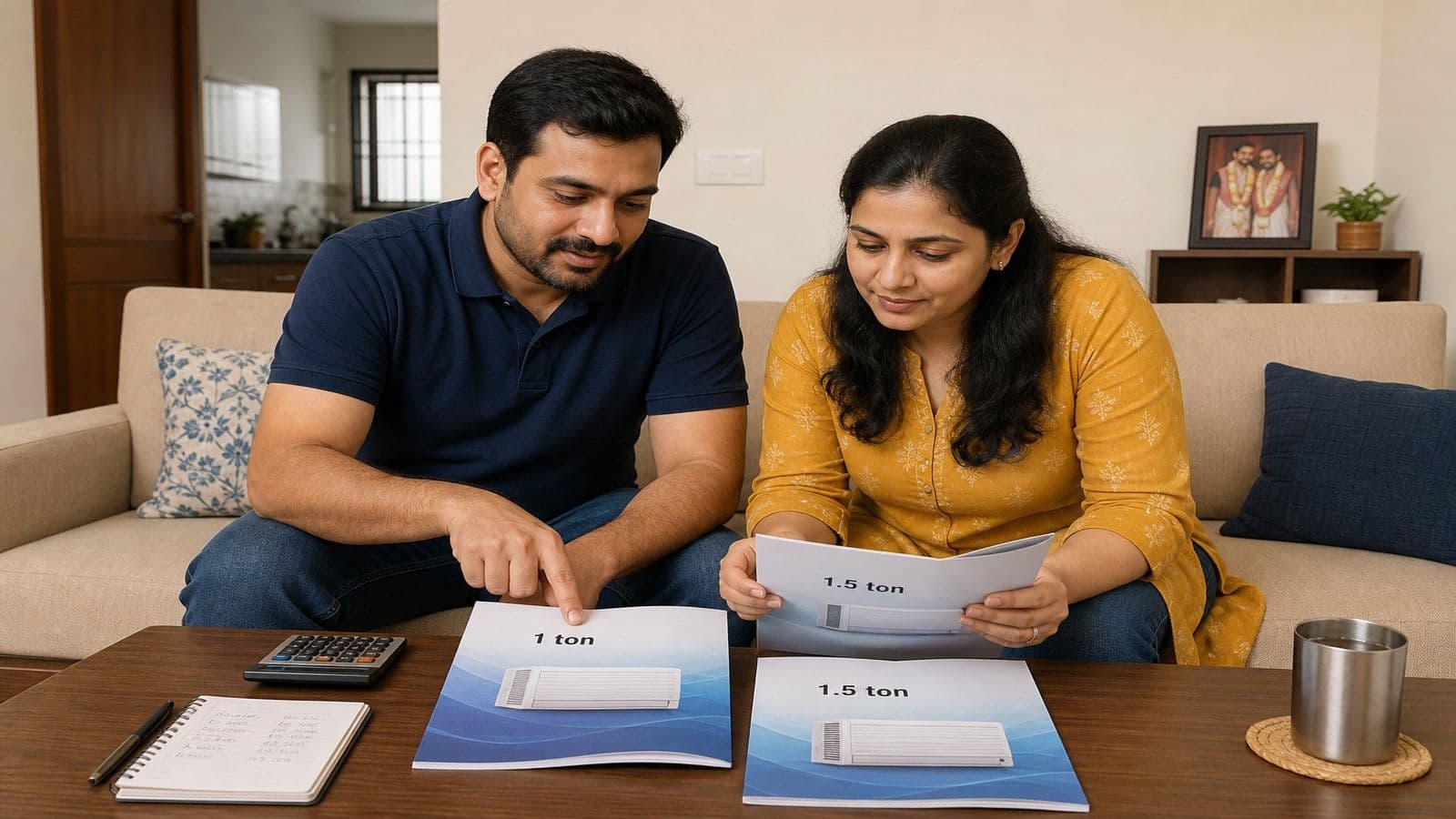
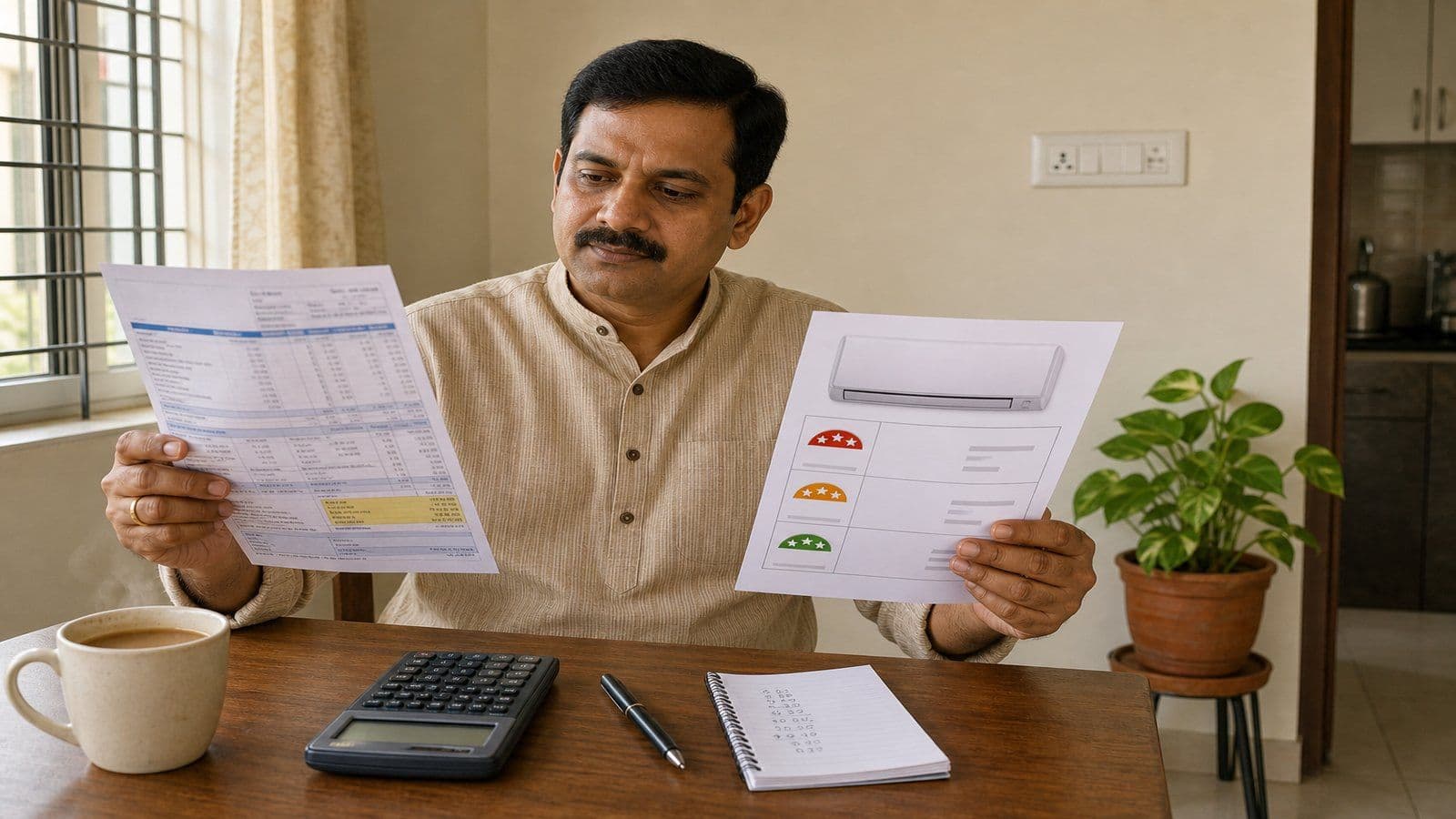
Photo: Indian couple comparing two window AC brochures at home
The showroom price tag is the loudest number. The five-year electricity bill is the quieter, larger one. The table compares a 1.5 ton 5-star window AC against a 1.5 ton 5-star inverter split, both running 1,400 hours per year at a tier-1 metro tariff of ₹8 per unit.
| Cost Component | Window AC (1.5T 5-star) | Inverter Split (1.5T 5-star) |
| Unit cost | ₹35,000 | ₹42,000 |
| Installation cost | ₹1,200 | ₹3,500 |
| 5-year electricity total | ₹52,000 | ₹42,000 |
| 5-year service and AMC | ₹12,000 | ₹14,000 |
| Estimated 5-year TCO | ₹1,00,200 | ₹1,01,500 |
The maths is close. The window wins on upfront by ₹9,300. The inverter split wins back ₹10,000 over five years through lower electricity. If the household keeps the AC seven or eight years, the inverter pulls clearly ahead. If the household moves within three years and takes the AC along, the window wins decisively. For a full framework see AC total cost of ownership 5 years India.
Why the TCO Almost Levels Out
A 1.5 ton 5-star window AC has an ISEER of roughly 3.5 to 3.7. The equivalent inverter split runs 4.6 to 5.2 on BEE laboratory protocol. Real-world inverter savings in our ProNearMe network log average 18 to 22 percent over a comparable 5-star window unit, a little lower than the lab figure because of door openings and setpoint behaviour. For broader category pricing see split AC price range India 2026 and inverter AC price range India 2026.
When Window AC Wins
Five common scenarios where the window AC is the clearly better choice in 2026.
Rental Apartments
The biggest single category. Renters in Mumbai, Pune, Bengaluru, Hyderabad and Delhi NCR move every two to three years. Window removal takes thirty minutes. Split removal plus re-installation across three moves over six years adds ₹15,000 to ₹25,000 to lifetime cost.
Single-Room Cooling
A studio apartment, a maid's room, a single bedroom in a tier-2 household. The window AC saves ₹6,000 to ₹10,000 over a comparable split installation.
Get quotes from verified, top-rated AC Service & Repair pros in Delhi.
Tier-2 and Tier-3 Cities with Voltage Drops
Where voltage dips below 180 volts during peak summer load, the fixed-speed compressor tolerates the swing better than inverter electronics on a split.
Tight Renovation Budgets
In societies without ducting or balcony space for split outdoor units, the window AC eliminates an entire layer of complication and neighbour negotiation about outdoor placement.
Backup or Secondary Cooling
A second window AC for the guest room or servant's quarter. Intermittent cooling need where upfront cost discipline matters more than long-term efficiency.
We see a clear pattern in field testing. Window ACs in tier-2 city homes on weak grids show 30 to 40 percent fewer PCB and inverter board failures over a five-year window than splits in the same grid conditions. The fixed-speed compressor design is simply more tolerant of voltage realities outside the metro grid. Owners in Indore, Coimbatore, Lucknow and Bhubaneswar should not feel they are buying outdated technology. They are buying a unit better matched to their grid.
When Window AC Loses
Equally, five scenarios where the window AC is the wrong choice even at its price.
No Suitable Window Sleeve
Modern Indian apartments increasingly use sliding aluminium windows that cannot accept a window AC cabinet. Without a fixed window of roughly 26 inches by 18 inches, a split AC is the only option.
Society Aesthetic Rules
Premium high-rise societies in Bandra, Powai, Whitefield, Indiranagar, Gurugram DLF phases, and most Class A new developments forbid window-mounted units for facade aesthetics. Society rules supersede personal preference.
Noise-Sensitive Users
Window ACs run 8 to 12 decibels louder than splits at the same capacity. A 5-star window at 48 dB is roughly a busy restaurant. A split indoor at 28 to 32 dB is roughly a quiet whisper.
Long-Term Ownership Plans
If the household plans to keep the AC for seven or more years, the inverter split wins on five-year TCO and pulls further ahead by years seven and eight.
Multi-Room Cooling
For three or four rooms, cumulative noise and per-room labour adds up. A multi-split inverter system delivers a better five-year outcome.
Noise Benchmarks: The Specification Most Buyers Overlook
BIS rating norms require manufacturers to declare the indoor decibel level at one metre. For window ACs this single number captures the full experience because the indoor user is also the outdoor user.
Get quotes from verified, top-rated AC Service & Repair pros in Delhi.
Premium window AC
38 to 45 dB. Most 5-star models and the rare inverter window models, achieved through better blower design and isolated compressor mounts.
Mid-tier window AC
45 to 52 dB. The standard 3-star and bulk-volume 5-star models. A constant low hum, audible enough to mask soft conversation.
Split AC equivalent
28 to 38 dB indoor unit. Roughly half the perceived loudness of a window unit.
Ask the showroom to run the unit at full speed for thirty seconds before you buy. A rattling, buzzing or pulsing noise at the showroom only gets worse in your bedroom over the years.
Festive Cycle and When to Buy
Window AC pricing runs slightly ahead of the split AC cycle, because window stock turns faster through the channel. March to early April brings pre-summer discounts of 5 to 10 percent, the best window of the year for a buyer who knows the model. Mid-April to end of May is full MRP with no negotiating leverage. July and August carry a monsoon lull discount of 5 to 8 percent plus free installation. October and November is the festive bumper window with 12 to 20 percent off MRP, often stacked with no-cost EMI of 6 to 12 months. December to February brings off-season clearance of last year's stock at 5 to 10 percent below MRP. For deeper financing strategy see AC EMI options India 2026 comparison.
The biggest pricing arbitrage we flag for network customers is late October to mid-November. Festive offers stack with no-cost EMI and free installation. A 1.5 ton 5-star that lists at ₹38,000 in May can land at ₹32,000 with free install, free first-year service and a 6-month no-cost EMI in late October. Owners who plan six months ahead save ₹4,000 to ₹7,000 against panic-buying in May.
A Renter Case Study
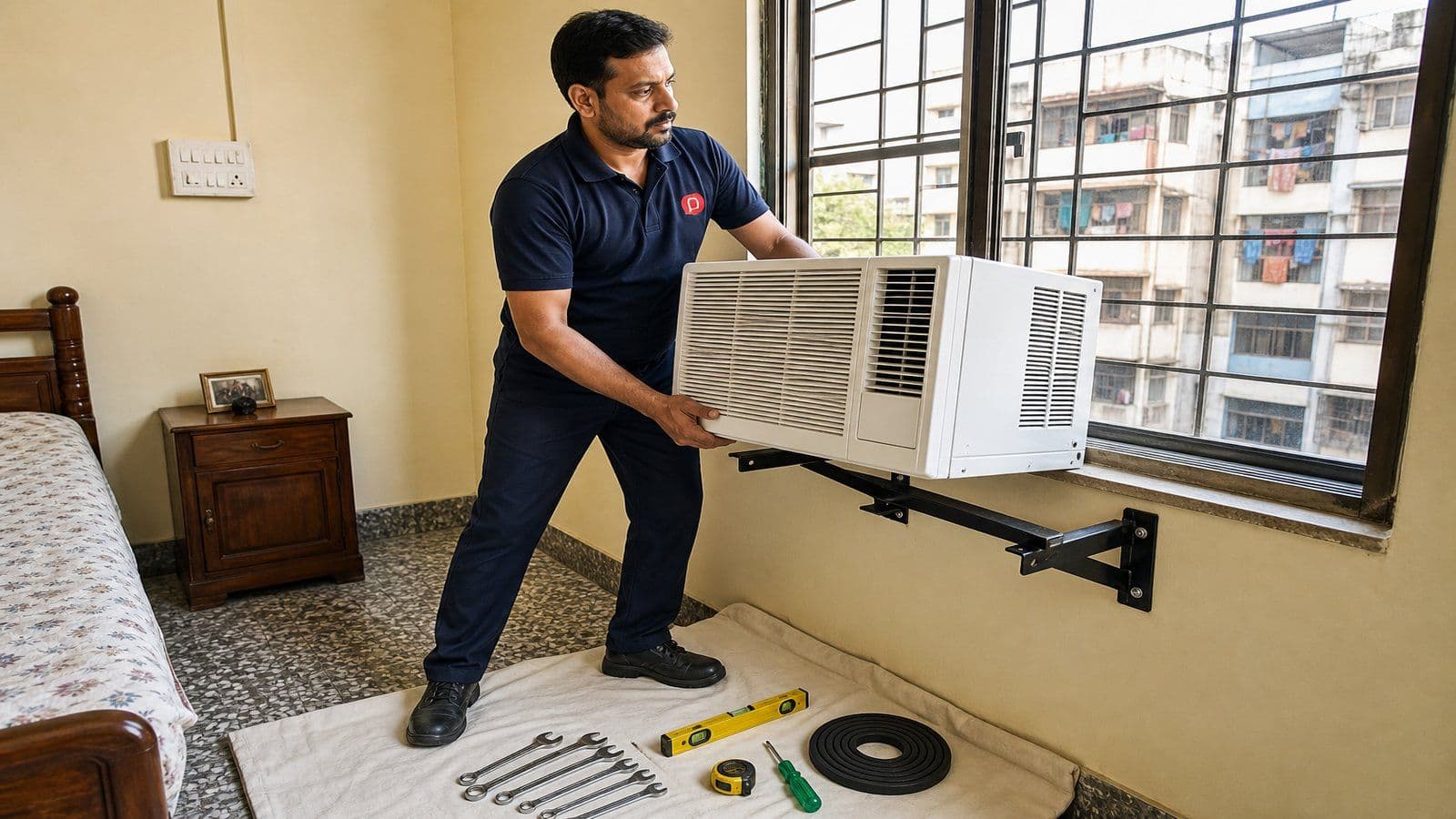
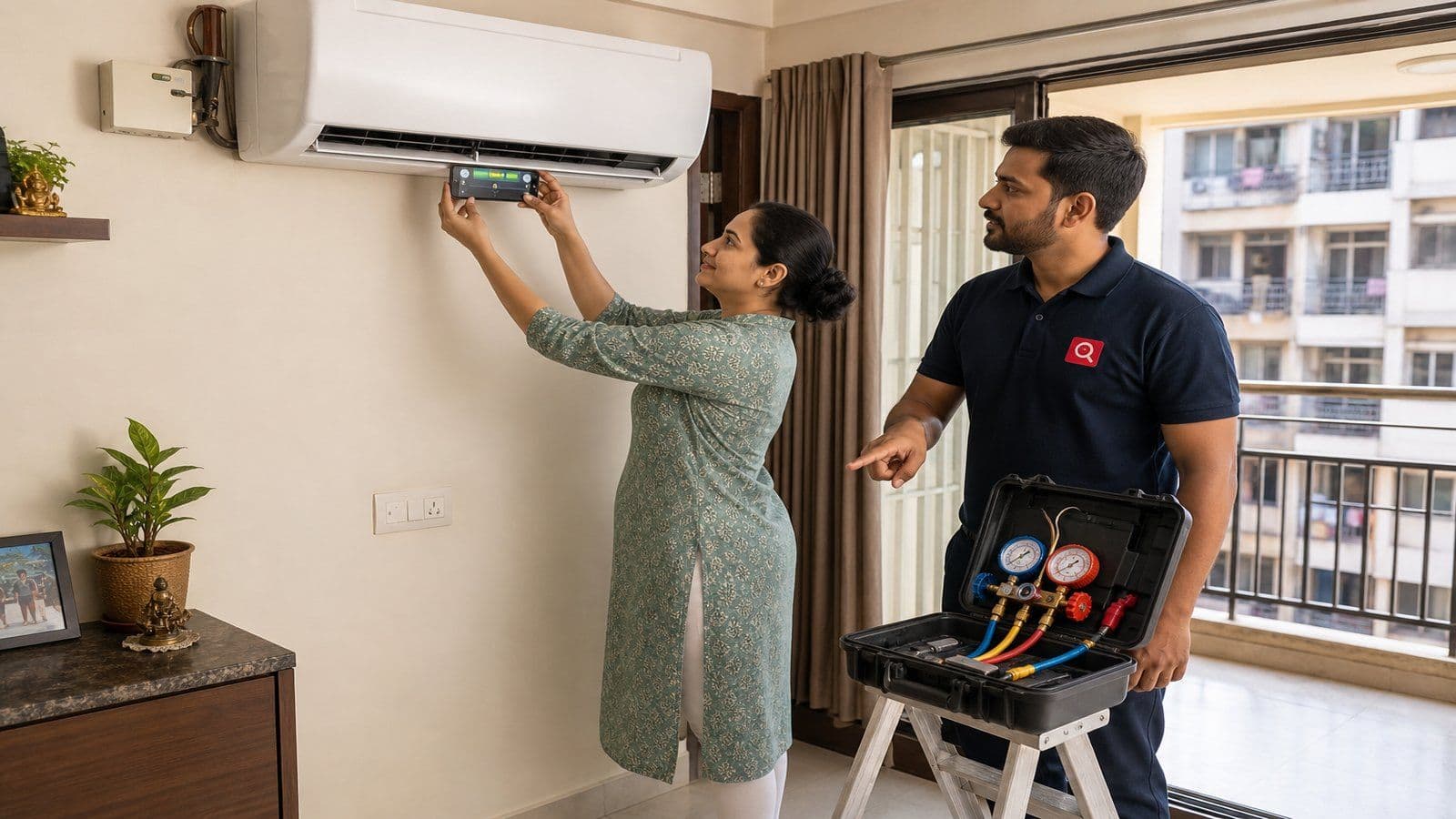
Photo: ProNearMe technician fitting a window AC into a steel window frame
Mr. Rohan Sharma in Bandra, Mumbai called the ProNearMe network in March 2026 to install a newly bought 1.5 ton 5-star window AC in his rented one-bedroom flat. The frame was the older steel-section type common in 1990s Bandra buildings, sound but with no existing bracket. An unverified local installer quoted ₹2,800 with a ₹600 add-on for the bracket.
Our network's NSDC-certified installer did the job for ₹1,200 inclusive of bracket, in 75 minutes, with a printed GST bill and a 30-day workmanship warranty. The renter saved ₹2,200, and the install has held through one full Mumbai summer without a drip or rattle. The original quote was a classic case of an unverified installer building bracket cost into a vague labour line. For related service costs see AC gas refill cost India 2026 guide and cassette AC price range India 2026.
Conclusion
Window AC pricing in India in 2026 remains the most accessible entry to home cooling, with 1 ton 3-star units at ₹22,000 and 1.5 ton 5-star units at ₹32,000 to ₹38,000. The category earns its place for renters, single-room households, tier-2 grid realities, and any buyer prioritising upfront cost. The honest counterweight is that on a five-year TCO view in a settled tier-1 household, an inverter split AC almost levels out and pulls ahead beyond year five.
The right window AC choice starts with two honest measurements. Measure the room to get tonnage right. Measure your ownership window, three years for renters who move often, eight to ten for a settled household. Match those numbers against the bands here, layer in the late October festive cycle, and the purchase becomes a calm decision rather than a panic May visit to a showroom at peak prices.
Disclaimer
All price ranges are typical 2026 retail figures from showroom and verified online listings across major Indian cities, and include GST at the prevailing 28 percent rate unless stated. Actual prices vary by city, channel, festive cycle and model availability. Installation labour is quoted separately. We recommend NSDC-certified or OEM-authorised installers and a printed GST invoice for any purchase or installation. ProNearMe does not endorse any specific AC brand, retailer or model. All ranges should be treated as guidance, not a fixed quote.
Sources & References
- Bureau of Energy Efficiency Star Rating Programme for Room Air Conditioners
- Bureau of Indian Standards IS 1391 Room Air Conditioner Specifications
- Ministry of Power Energy Conservation Building Code and Domestic Cooling Guidelines
- Indian Society of Heating, Refrigerating and Air Conditioning Engineers Residential HVAC Guidelines
- Press Information Bureau Standards and Labelling Programme Consumer Advisory
- Central Electricity Authority Domestic Electrical Installation Guidelines
- National Skill Development Corporation HVAC Technician Qualification Pack
- Goods and Services Tax Council Rate Schedule for Goods and Services
- Ministry of Environment, Forest and Climate Change Ozone Cell Refrigerant Transition Programme
- Department of Consumer Affairs Jago Grahak Jago Consumer Awareness Programme

Amit worked as an AC technician for 6 years in Ahmedabad before transitioning to technical writing. He holds a diploma in Refrigeration and Air Conditioning from ITI Ahmedabad and understands the difference between what AC companies promise and what actually happens on the ground. His articles break down complex technical topics into plain language that any homeowner can follow. He tests every tip he writes about in his own home first.

Dr. Verma is a mechanical engineer with 15 years of experience in HVAC systems. She completed her PhD from IIT Delhi on energy-efficient cooling solutions for Indian residential buildings. She reviews all technical content on HomePros to make sure the numbers are right, the advice is safe, and the recommendations are backed by actual engineering principles. She consults for multiple AC manufacturers on product design.