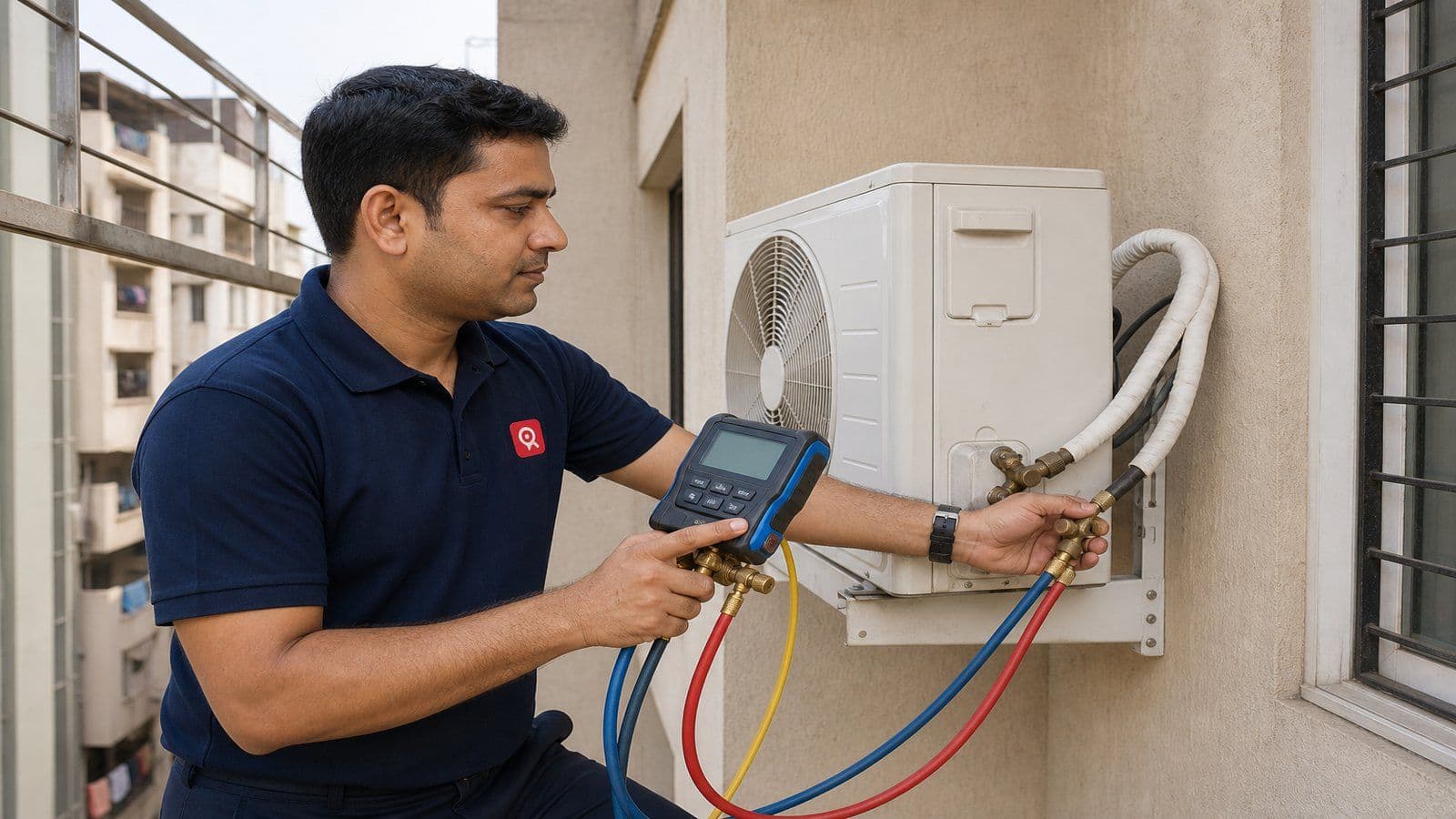
- Tonnage in AC has nothing to do with weight. One ton means the cooling needed to melt one short ton of ice in 24 hours, equal to 3,517 watts of cooling, or 12,000 BTU per hour.
- ISEER replaced EER from 2018 onwards under the BEE rating scheme. The January 2026 revision raised every ISEER threshold by roughly 0.5, so what was 5-star in 2024 is roughly 4-star today.
- R32 is the default refrigerant in 2026. R22 has been phased out of new units under the MoEF&CC schedule aligned with the Kigali Amendment. R410A is being phased down in turn.
- The capacitor microfarad rating (MFD) is the single most common spare you will buy in an AC's lifetime. A 35 MFD running capacitor for a 1.5 ton outdoor unit costs ₹250 to ₹600 and lasts 4 to 7 years.
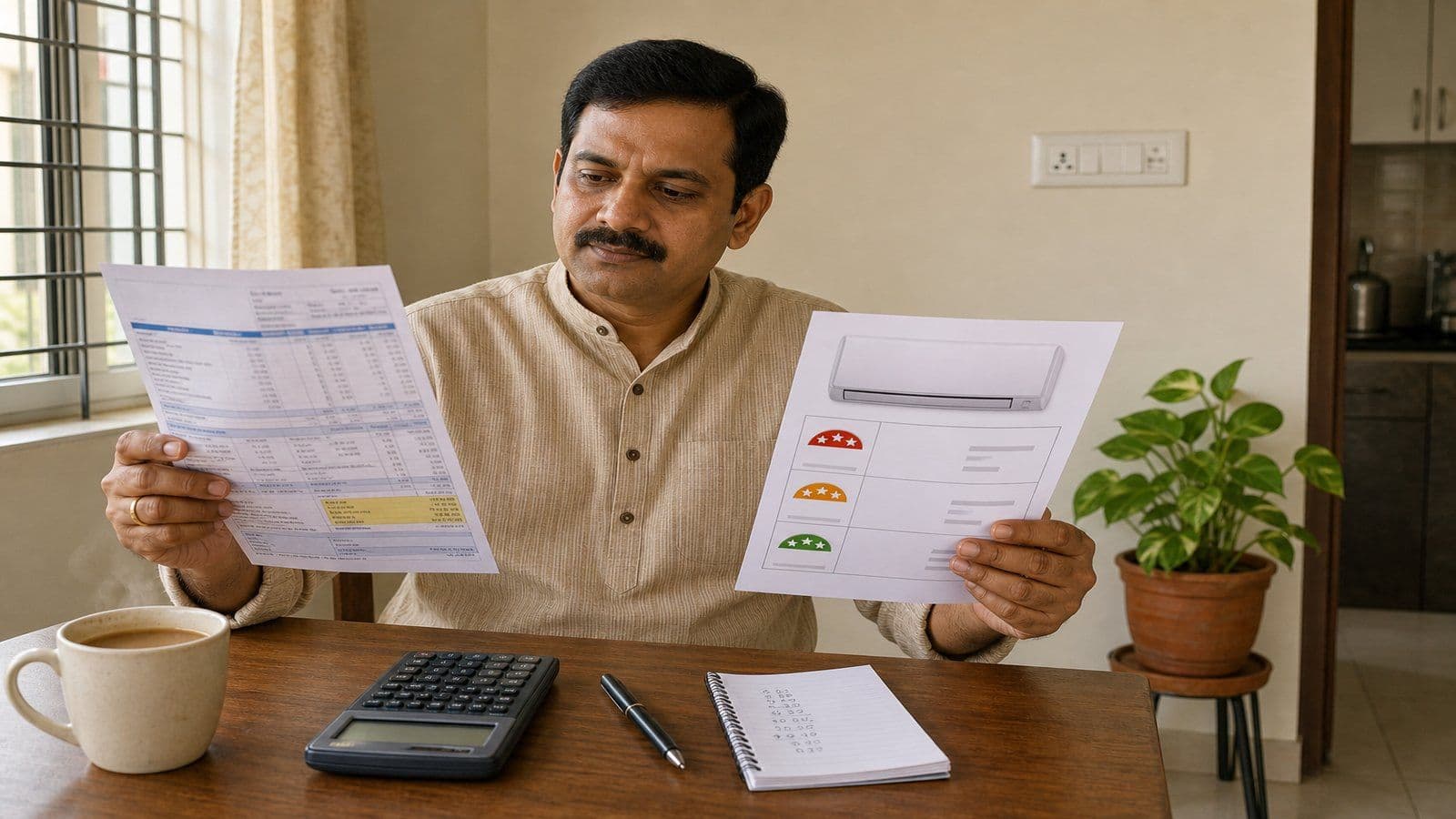
- A 5-star inverter AC saves ₹2,200 to ₹4,350 per year over a 3-star unit at typical Indian usage. The label is government-mandated under the Energy Conservation Act 2001.
This AC terminology glossary is for the Indian homeowner who has sat through a 20 minute pitch from a salesperson, scrolled through a Flipkart spec sheet, or had a technician rattle off jargon during a service visit and walked away unsure what half of it meant. Tonnage, ISEER, R32, BTU, MFD, condensate slope, blue fin coating, the language sits between mechanical engineering, electrical wiring, and consumer marketing, and the result is that most owners nod politely without understanding what they are paying for.
The A to Z below covers more than 60 terms that show up on Indian AC labels, invoices, AMC contracts, technician notes, and salesperson decks in 2026. Definitions are written for owners, not engineers. Where a term has shifted recently, like the BEE rating revision in January 2026 or the R22 phase-out under the MoEF&CC schedule, the entry flags the current state.
I have personally supervised over 1,800 AC installations and 3,500 service calls across Ahmedabad, Gandhinagar, and the wider Gujarat region over the past six years. Every term here is one I have used in an actual customer or technician conversation.

Get quotes from verified, top-rated AC Service & Repair pros in Delhi.
How to Use This Glossary

Photo: AC Terminology Glossary Cover Infographic
The glossary is organised alphabetically. Inside each letter, terms appear as their own subheadings so you can scan to the one you need. For the wider context that uses these terms, the complete AC owner's guide for Indian homes sits as the pillar reference. Sibling articles cover specific decisions: types of AC units compared, how an AC works and its components, BEE star rating decoded, common AC problems and how to spot them, and the AC technician certification guide for India.
A
Ambient Temperature
The temperature of the outdoor air at the time of measurement. AC capacity ratings are measured at standard ambient (35 degrees Celsius outdoor, 27 indoor under ISEER conditions). When ambient crosses 45 degrees Celsius, as it did across north India in May 2024, every unit loses 10 to 20 percent of rated output. Sizing for peak ambient instead of average is the single most common mistake in Delhi and Jaipur installations.
Anti-Bacterial Filter
A removable filter coated with silver ions or other antimicrobial agents, intended to slow bacterial growth on the trapped dust. Useful in humid coastal cities like Mumbai and Chennai where the indoor coil stays damp. Wash every 15 to 20 days during heavy use.
AHU (Air Handling Unit)
The indoor blower assembly in a split or ducted AC, containing the evaporator coil, blower wheel, drain pan, and air filter. In residential splits, the AHU is the wall-mounted indoor unit.
AMC (Annual Maintenance Contract)
A paid annual service agreement covering scheduled cleaning, gas top-up if needed, and repair labour. Two common formats: comprehensive (parts and labour, ₹3,500 to ₹6,000 per 1.5 ton split per year) and non-comprehensive (labour and visits only, ₹1,800 to ₹3,200). Worth it for units older than three years.
Auto-Clean (Self-Clean)
A short post-shutdown mode where the indoor fan runs 20 to 40 minutes after switch-off, drying the evaporator coil to slow mould growth. Useful in monsoon humidity. Different from a deep coil clean.
B
BEE (Bureau of Energy Efficiency)
The statutory body under the Ministry of Power that runs India's appliance energy labelling programme. The 1 to 5 star label on every Indian AC is BEE's. Established under the Energy Conservation Act 2001. The most recent ISEER threshold revision took effect January 2026.
Blower Wheel
The cylindrical rotating component inside the indoor unit that pushes cooled air across the room. Collects dust and oily residue over time, which restricts airflow and raises consumption. Needs deep cleaning every 12 to 18 months using a foam cleaner spray.
Blue Fin Coating
A thin hydrophilic coating on aluminium coil fins to resist corrosion in humid or coastal environments. Standard on most mid-tier splits in India. Coastal cities (Mumbai, Chennai, Kochi, Visakhapatnam) benefit the most. Lifespan is typically 4 to 6 years.
BTU (British Thermal Unit)
The unit of heat used in AC capacity ratings. AC cooling is often quoted in BTU per hour: 1 ton = 12,000 BTU/hr, 1.5 ton = 18,000 BTU/hr, 2 ton = 24,000 BTU/hr.
C
Capacitor
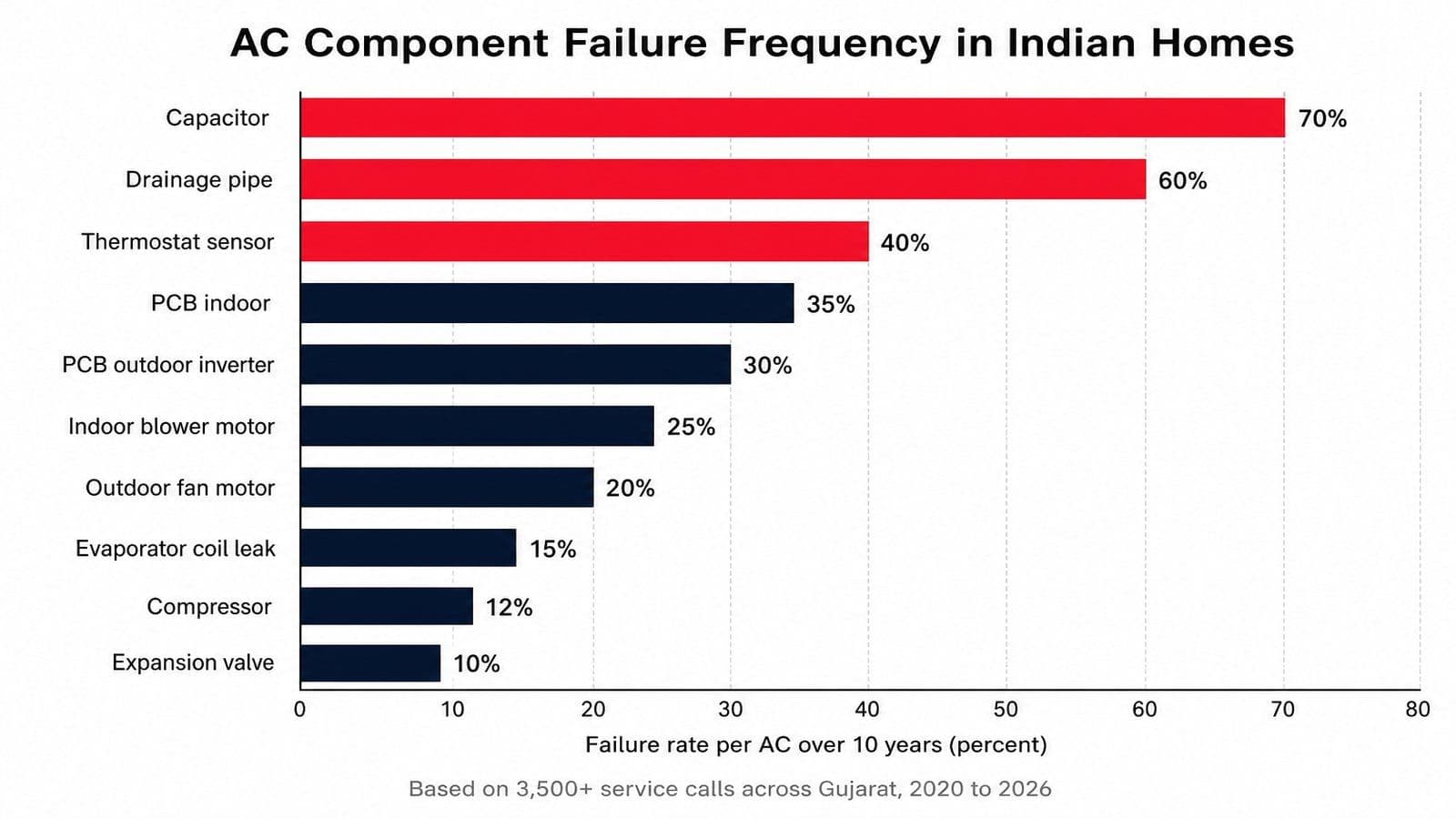
A small cylindrical electrical component that stores and releases energy to start (start capacitor) or run (run capacitor) the compressor and fan motor. Rated in microfarad (MFD or μF), typical values 25 to 55 MFD. A failing run capacitor is the single most common AC fault in Indian homes, accounting for roughly 22 percent of all service calls in the ProNearMe network. Replace cost: ₹250 to ₹650 plus ₹200 to ₹400 labour.
Capillary Tube
A thin copper tube (1 to 2 mm internal diameter) used as the metering device in older fixed-speed ACs. Drops refrigerant pressure between condenser and evaporator. Cheaper and simpler than an expansion valve but less precise. Most inverter ACs use an electronic expansion valve instead.
CFM (Cubic Feet per Minute)
The volume of air a fan or blower moves per minute. A typical 1.5 ton split AC indoor unit moves 400 to 550 CFM. Higher CFM means better air mixing but more noise.
COP (Coefficient of Performance)
The ratio of cooling output to electrical input, both in the same energy unit. A COP of 3.5 means the AC moves 3.5 watts of heat for every 1 watt of electricity drawn. The Indian retail equivalent is ISEER, which averages COP across the seasonal temperature range.
Compressor
The pump that drives refrigerant through the system, located inside the outdoor unit. The single most expensive component to replace (₹8,000 to ₹22,000 depending on tonnage and brand). Three common types: reciprocating (older window ACs), rotary (default in fixed-speed splits), and scroll (larger commercial units). Inverter ACs use variable-speed rotary or twin-rotary compressors.
Condensate
The water produced as the evaporator coil cools warm humid room air below its dew point. A 1.5 ton split removes roughly 0.5 to 1.5 litres per hour in Indian monsoon humidity. Drained out via a pipe with downward slope of at least 1 in 100.
Condenser Coil
The heat exchanger inside the outdoor unit that releases collected heat into outside air. Made of copper tubes with aluminium fins. A dust-clogged condenser can cut output by 25 to 35 percent and burn out the compressor in extreme cases.
The mistake I see most often is owners checking cooling capacity in tons on the label but not checking the rated ambient. A unit rated 1.5 ton at 35 degrees Celsius will deliver maybe 1.2 ton at 45 degrees Celsius. In Jaipur and Nagpur summers, that gap is the difference between a comfortable room and an AC that struggles all day.

Copper Pipe (Refrigerant Line)
The pair of copper tubes that connect indoor and outdoor units. Standard sizes for a 1.5 ton split are 1/4 inch for the liquid line and 1/2 inch for the suction line. BIS-marked 99.9 percent pure copper at the right wall thickness (typically 0.61 mm) prevents future leaks. Cheap unbranded copper is the silent cause of leaks 18 to 30 months after install.
D
Dehumidification Mode (Dry Mode)
A mode where the compressor runs intermittently and the fan runs slowly, prioritising moisture removal over cooling. Useful in monsoon when the room feels muggy at 28 degrees Celsius. Power consumption roughly 60 percent of cooling mode.
Drainage Pipe (Drain Line)
The flexible pipe that carries condensate out of the building. Needs at least 1 in 100 downward slope along its full run, no upward bends. Clogged drainage pipes cause roughly 18 percent of indoor water-leak complaints in our network.
Dry Bulb Temperature
The temperature reading from a standard thermometer, the everyday measure. Different from wet bulb temperature which factors in humidity.
Dust Filter
The basic mesh filter at the front of the indoor unit, trapping large dust particles before they reach the evaporator. The owner should wash it every 15 days during heavy use. Running with a clogged dust filter is the single fastest way to lose cooling and raise electricity bills.
Get quotes from verified, top-rated AC Service & Repair pros in Delhi.
E
EER (Energy Efficiency Ratio)
The older Indian efficiency metric, measured at a single fixed outdoor temperature. Replaced by ISEER from 2018 onwards because ISEER better reflects the variable temperatures Indian homes actually see.
Energy Conservation Act 2001
The Indian law under which BEE was established and the star rating programme operates. Sets the legal basis for the mandatory energy label on every AC sold in India.
Expansion Valve (Electronic Expansion Valve, EXV)
The metering device that controls refrigerant flow into the evaporator, dropping pressure to make it cold. EXVs, now standard in inverter ACs, adjust flow continuously based on sensor input.
Evaporator Coil
The heat exchanger inside the indoor unit that absorbs heat from room air. Made of copper tubes with aluminium fins. Refrigerant flowing cold through it absorbs heat from the warm air blown across by the blower wheel.
F
Fan Coil Unit (FCU)
The technical name for the indoor unit of a split AC, combining evaporator coil with blower fan in a single enclosure. Used more in commercial HVAC literature than residential.
Fin Spacing
The gap between aluminium fins on the condenser or evaporator coil, typically 1.4 to 2.0 mm. Tighter spacing means more heat transfer surface but more risk of dust clogging. Indian conditions favour wider spacing (1.7 to 2.0 mm) for dust tolerance.
Floor Standing AC
A vertical free-standing unit (tower AC), intended for halls above 250 square feet. Higher capacity (2 to 4 ton) than typical splits. Common in showrooms and double-height living rooms.
G
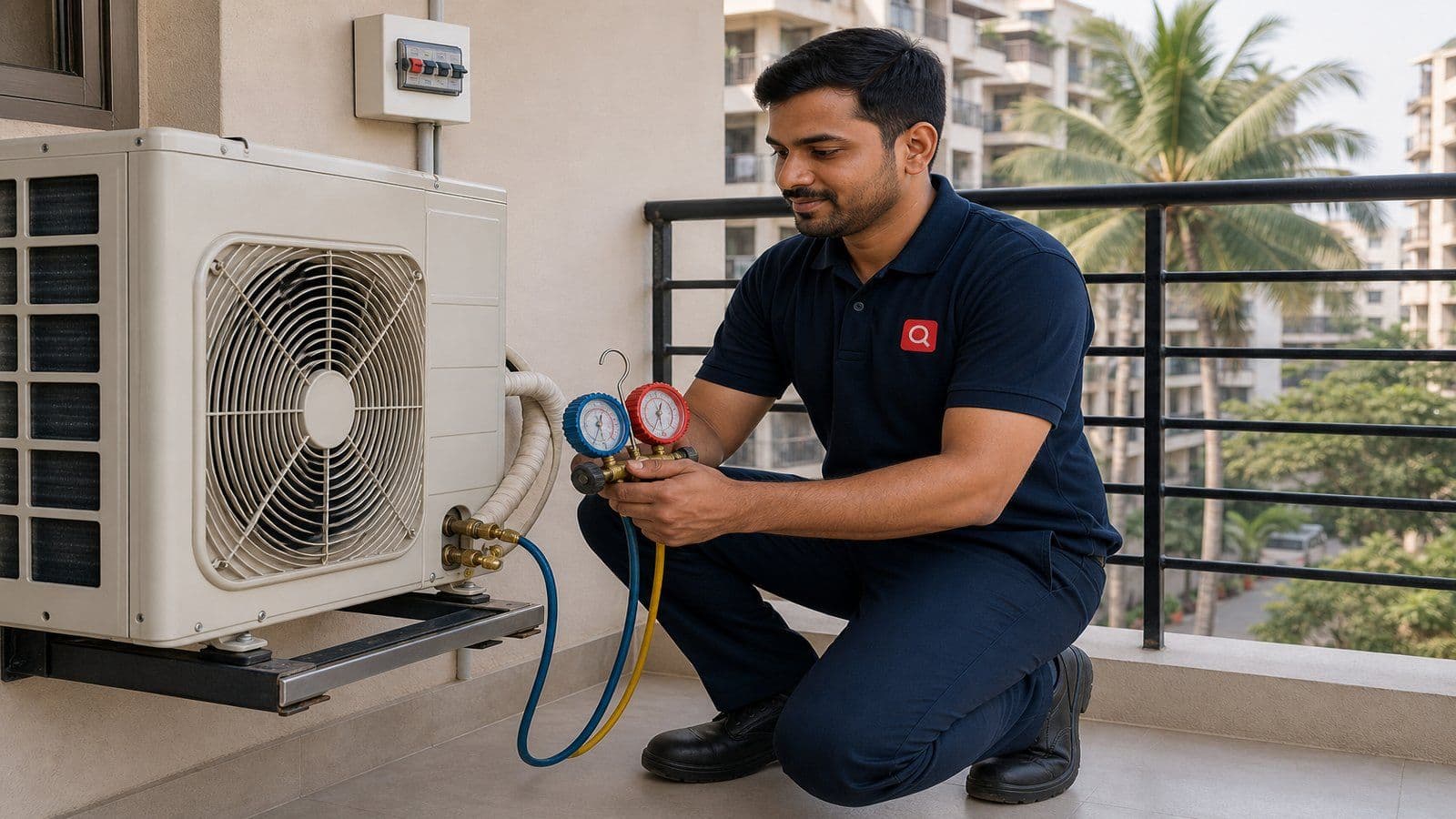
Gas Charging (Refrigerant Charging)
Adding refrigerant to a system that has lost charge. Done by weight (digital scale, accurate) or by pressure (manifold gauge, approximate). Cost in 2026: ₹1,800 to ₹3,500 for R32 on a 1.5 ton split, ₹2,500 to ₹4,500 for R410A. Always insist on finding and fixing the leak first, charging an unfound leak just postpones failure.
Gold Fin Coating
A premium fin coating variant for very corrosive environments (coastal, industrial). Same idea as blue fin but with a thicker hydrophobic layer. Real-world durability 5 to 8 years.
GWP (Global Warming Potential)
A measure of how much heat a refrigerant traps in the atmosphere relative to carbon dioxide. R22 has GWP 1,810, R410A has 2,088, R32 has 675. The MoEF&CC phase-down schedule under the Kigali Amendment targets high-GWP refrigerants for reduction.
H
HEPA Filter
A high efficiency particulate air filter rated to trap 99.97 percent of particles down to 0.3 micron. True HEPA is rare on residential splits because of airflow resistance. Most splits advertised as HEPA carry HEPA-style filters, a notch below medical-grade. Useful for allergy households if cleaned every 6 to 12 months.
HVAC (Heating, Ventilation, Air Conditioning)
The umbrella industry term covering all building climate-control systems. ACs are the cooling subset. ISHRAE is the main Indian industry body.
I
IAQ (Indoor Air Quality)
The measure of how clean and breathable indoor air is, factoring in PM2.5, PM10, VOCs, carbon dioxide, and humidity. AC plays a role through filtration and dehumidification, but the AC alone is not an air purifier. Cities like Delhi and Lucknow with high outdoor PM2.5 benefit from layered solutions.
IDU / ODU (Indoor Unit / Outdoor Unit)
Industry shorthand for the indoor and outdoor halves of a split AC. The IDU houses the evaporator and blower; the ODU houses the compressor and condenser. Appears in technician notes and installation invoices.
Inverter Compressor
A variable-speed compressor that throttles up and down to match cooling demand, instead of older on-off cycling. Saves 20 to 30 percent on electricity for typical Indian use, lasts longer due to fewer hard starts, and runs more quietly. The default choice in 2026 for any new split.
ISEER (Indian Seasonal Energy Efficiency Ratio)
The official BEE efficiency metric for split and window ACs, averaging cooling output against electricity input across India's representative annual temperature range. Higher ISEER means better efficiency. The current 5-star threshold is 5.0 after the January 2026 revision, up from 4.5 previously.
When a customer asks me whether to buy 4-star or 5-star, the answer depends on daily run hours. Below 4 hours per day, the price premium for 5-star takes 5 to 6 years to recover. Above 6 hours per day, it recovers in 2 to 3 summers. Quote your actual usage, not what you imagine.
ISHRAE
The Indian Society of Heating, Refrigerating and Air Conditioning Engineers, founded 1981, with chapters in 40 plus cities. Sets technical standards and runs continuing-education programmes. Worth looking for ISHRAE membership when hiring an install supervisor for a project larger than two splits.
J
Jet Cool (Power Cool, Turbo)
A short-duration mode running maximum fan speed and lowest set temperature to cool a hot room rapidly. Useful when entering a closed flat at 40 degrees Celsius outside. Switch off after 10 to 15 minutes to avoid over-cooling.
K
Kigali Amendment
A 2016 amendment to the Montreal Protocol committing signatory countries to phase down hydrofluorocarbon (HFC) refrigerants like R410A. India signed in 2021. MoEF&CC publishes the national schedule, the regulatory driver behind the R22 to R32 transition.
Kilowatt (kW)
The metric unit of power. AC cooling capacity in kW: 1 ton equals 3.517 kW. AC electrical input is also in kW: a 1.5 ton 5-star inverter draws roughly 1.3 to 1.5 kW at peak.
L
Latent Heat
The energy needed to change water from liquid to vapour without changing temperature. The AC removes both sensible heat (cooling you feel) and latent heat (moisture pulled as condensate). In humid Indian monsoon conditions, latent load can be 30 to 40 percent of total cooling work.
Get quotes from verified, top-rated AC Service & Repair pros in Delhi.
Leak Test
Pressurising the refrigerant circuit with dry nitrogen and checking for pressure drop or audible hiss to locate leaks. The right way to find a leak before charging gas. Cost: ₹500 to ₹1,200 standalone, often included in gas-charging visits.
M
MCB (Miniature Circuit Breaker)
The switchable circuit breaker in your electrical panel that protects the AC circuit from over-current. A 1.5 ton split needs at least a 16 amp single-pole MCB, ideally on a dedicated circuit. Sharing the MCB with geyser or microwave causes nuisance tripping in older flats.
MFD (Microfarad)
The capacitance rating of a capacitor, equal to one-millionth of a farad. AC capacitors come in 25, 30, 35, 40, 45, and 50 MFD values depending on the motor served. When a technician says "the 35 MFD has gone weak", they mean the 35 microfarad run capacitor needs replacement.
MoEF&CC (Ministry of Environment, Forest and Climate Change)
The Indian government ministry overseeing refrigerant phase-down schedules in line with the Montreal Protocol and Kigali Amendment. Drove the move from R22 (banned for new units from 2025) toward R32.
MoP (Ministry of Power)
The Indian government ministry under which BEE operates. Sets policy direction on energy efficiency labelling for ACs and other appliances.
N
Nitrogen Purge
Flushing the copper refrigerant lines with dry nitrogen during installation, to remove moisture and air before charging refrigerant. Skipping this step (a corner cut by under-trained installers) shortens compressor life because trapped moisture forms acids inside the system. Always ask your installer to show you the nitrogen cylinder during install.
Noise Level
Measured in decibels (dB). Indoor unit noise for a 1.5 ton split typically falls between 28 and 45 dB depending on fan speed. Outdoor unit noise: 48 to 56 dB, important for owners with close neighbour balconies.
NSDC (National Skill Development Corporation)
The Indian body that sets occupational skill standards and runs certified training for HVAC technicians under the ESSCI curriculum. NSDC certification confirms a technician completed required theory and practical hours. Always ask to see the certificate before hiring for installation.
Across the 12,000 plus service calls handled by the verified AC technicians in our ProNearMe network last year, 68 percent of customer complaints traced back to either bad installation 18 to 30 months earlier, or a missed annual pre-summer service. Both are preventable with NSDC-certified labour and a simple seasonal calendar.
O
Outdoor Unit
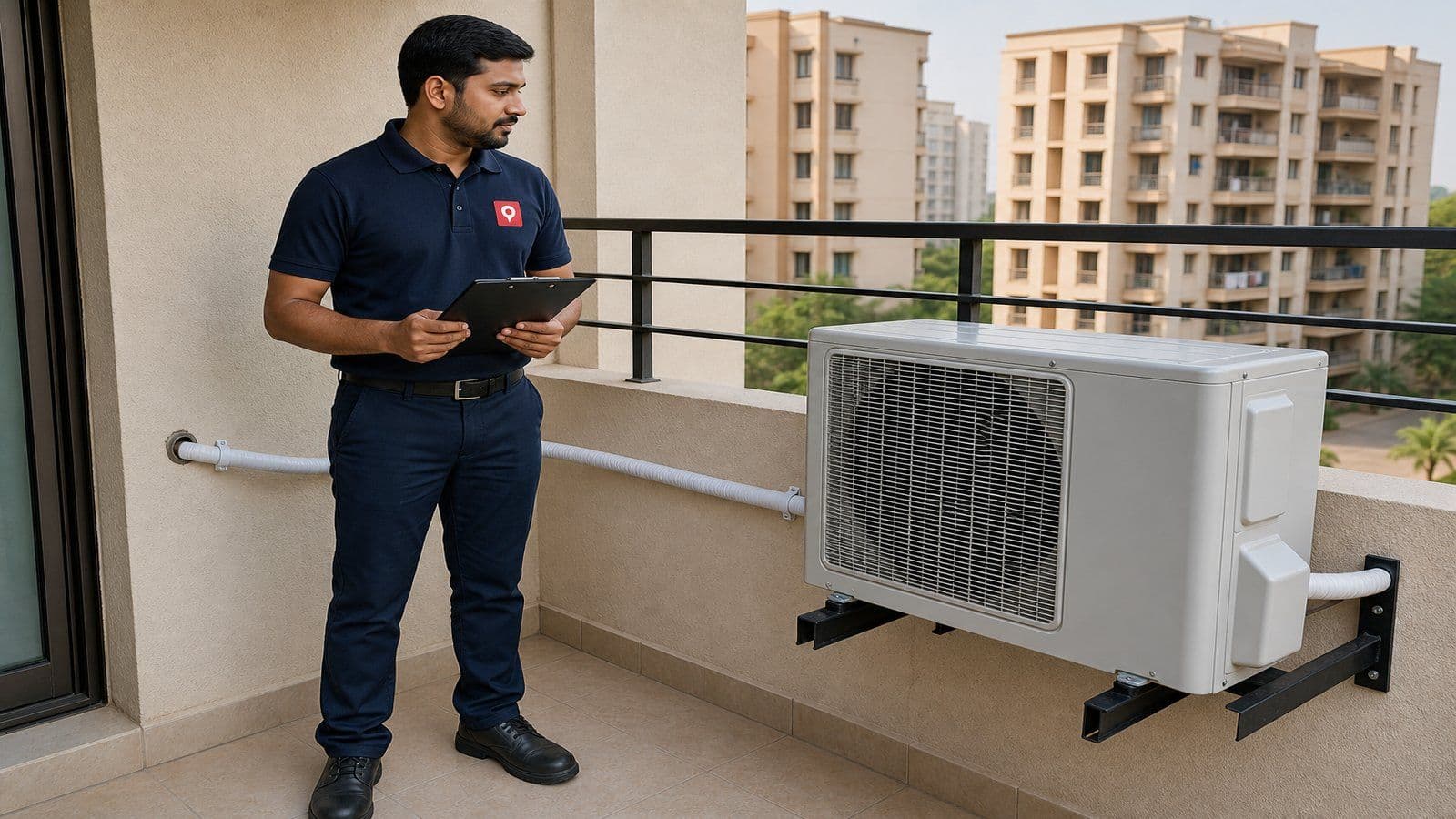
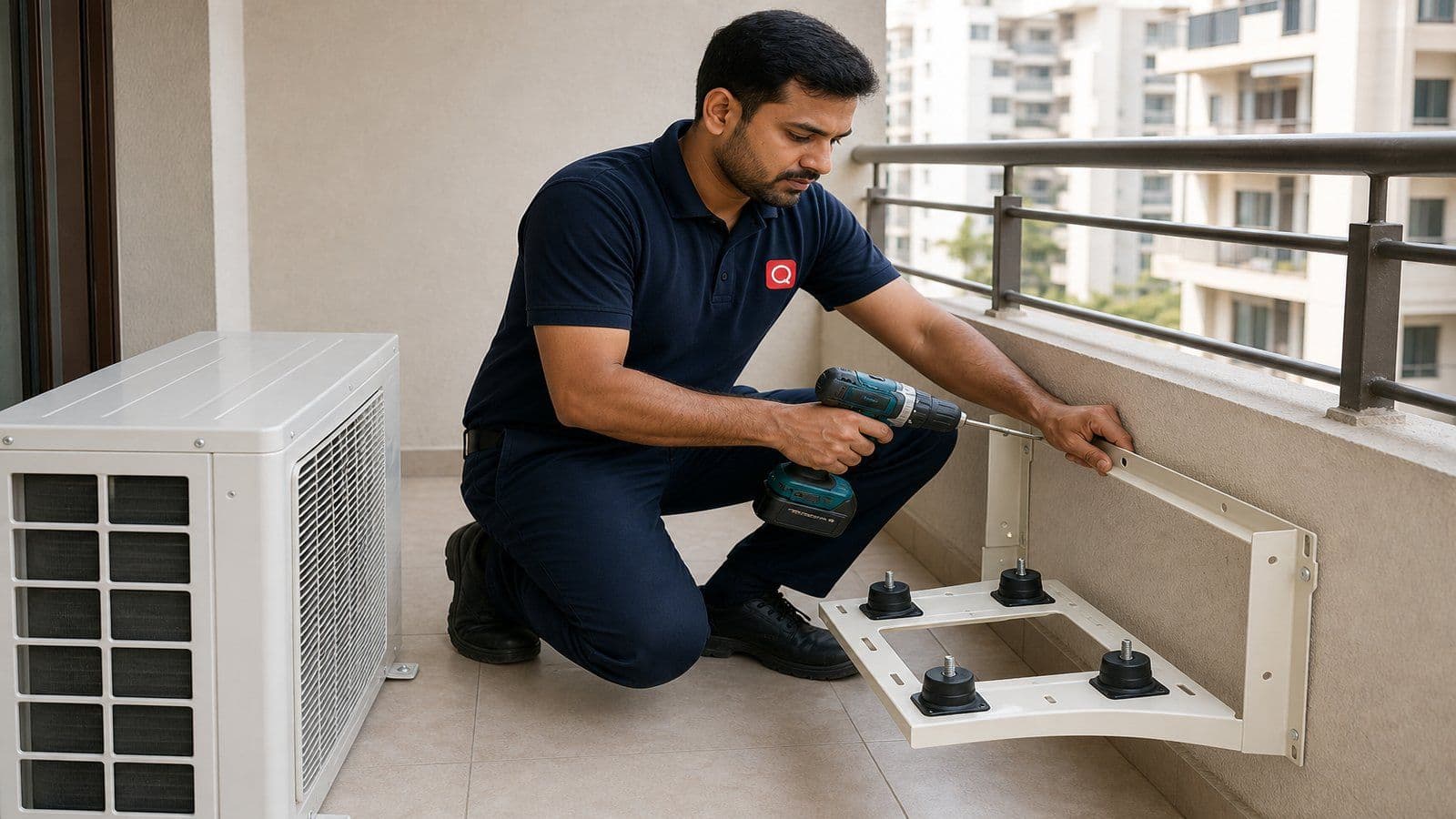
The half of a split AC that lives outside the building, containing compressor, condenser coil, and outdoor fan. Mounted on a wall bracket or balcony stand. Needs at least 30 cm clearance from the wall behind, 100 cm in front, and unobstructed airflow on the discharge side.
P
PCB (Printed Circuit Board)
The electronic control board inside the indoor unit (and a separate one in inverter outdoor units) that processes remote commands, sensor input, and motor control. PCB failures account for roughly 14 percent of AC service calls in our network, often triggered by voltage spikes. Replacement: ₹2,400 to ₹6,500 for indoor PCB, ₹4,500 to ₹14,000 for inverter outdoor PCB.
PM2.5 Filter
A higher-efficiency filter rated to trap particles down to 2.5 microns, marketed as protection against urban air pollution. Useful in Delhi, Lucknow, Patna, and Kanpur where outdoor PM2.5 regularly crosses 150 micrograms per cubic metre. Needs cleaning every 3 to 6 months.
R
R22 (Chlorodifluoromethane)
The legacy refrigerant in Indian ACs until the mid-2010s. High ozone depletion potential, phased out under the Montreal Protocol. From 2025, no new R22 units may be manufactured or imported into India under MoEF&CC schedule. Existing R22 units can still be serviced, but recharge gas is ₹3,500 to ₹5,000 for a top-up.
R32 (Difluoromethane)
The default refrigerant in new Indian AC units sold in 2026. Lower GWP than R410A (675 vs 2,088), more thermodynamically efficient, and currently the brand and service-network default. Mildly flammable (A2L safety class), so installation requires R32-specific training.
R134A
A refrigerant used in some commercial chillers and older car AC systems. Not used in residential Indian splits or windows.
R290 (Propane)
A natural hydrocarbon refrigerant with very low GWP (3), used in a small number of premium splits in India. Highly flammable (A3 safety class), so installation rules are stricter. A future direction but not yet mainstream.
R410A
A hydrofluorocarbon blend used in Indian splits from roughly 2012 to 2023. Being phased down under the Kigali Amendment. Still serviceable. Recharge cost: ₹2,500 to ₹4,500 for a 1.5 ton split.
Refrigerant Quick Comparison
The four refrigerants you will see in current Indian residential AC service notes, side by side.
| Refrigerant | GWP | Status in India 2026 | Recharge cost (1.5 ton) | Safety class |
| R22 | 1,810 | Phased out for new units (2025) | ₹3,500 to ₹5,000 | A1 (non-flammable) |
| R410A | 2,088 | Phased down, still serviceable | ₹2,500 to ₹4,500 | A1 (non-flammable) |
| R32 | 675 | Default for new units in 2026 | ₹1,800 to ₹3,500 | A2L (mildly flammable) |
| R290 | 3 | Niche premium, growing slowly | ₹2,500 to ₹4,000 | A3 (highly flammable) |
RCCB (Residual Current Circuit Breaker)
An electrical safety device that trips if it detects current leaking to ground (through a person touching a faulty live wire). NBC 2016 recommends an RCCB on every AC circuit. A 30 mA RCCB is the residential standard. Different from MCB, which handles overload, not earth leakage. Both belong on the AC circuit.
Reciprocating Compressor
The oldest compressor type, using a piston in a cylinder. Found in older window ACs and small commercial units. Noisier and less efficient than rotary or scroll designs.
Rotary Compressor
The standard compressor in fixed-speed splits and small commercial units, using a rotating roller inside a cylinder. Quieter and more efficient than reciprocating designs. Inverter ACs use variable-speed rotary or twin-rotary variants.
S
Scroll Compressor
A higher-efficiency compressor using two interlocking spirals. Found in larger commercial AC units (3 ton and above) and some premium residential systems. More expensive than rotary, with smoother operation under heavy duty cycles.
Sensible Heat
The heat that changes air temperature (and feels like cooling), as opposed to latent heat which changes moisture content. Sensible load dominates in dry Indian climates (Jaipur, Ahmedabad pre-monsoon); latent load dominates in humid coastal climates (Mumbai, Chennai, Kochi).
Get quotes from verified, top-rated AC Service & Repair pros in Delhi.
Service Valve
The two small valves on the outdoor unit where copper pipes meet, used by technicians to charge or recover refrigerant. Should be kept tight under their plastic caps. Loose service valves are a common slow-leak source.
Sleep Mode
A mode where the AC gradually raises set temperature by 1 to 2 degrees over the night, matching the body's lower nighttime cooling need. Saves 10 to 18 percent of overnight electricity.
Star Rating
The 1 to 5 star BEE energy efficiency label on every Indian AC. More stars means higher ISEER means lower electricity bill. After the January 2026 revision, the entire scale shifted: what was 5-star in 2024 is roughly 4-star in 2026. Always check the manufacture year against the rating shown.
Stabiliser (Voltage Stabiliser)
An external box wired between wall socket and AC, smoothing input voltage to keep it within the AC's rated range. Critical in areas with frequent voltage sags or surges. Most premium inverter ACs now have built-in stabiliser circuitry rated for 145 to 290 volts, letting you skip the external box in stable supply areas.
Surge Protector
A device that absorbs short electrical spikes (lightning, grid switching). Different from a stabiliser which handles sustained over- and under-voltage. Worth the ₹1,500 to ₹4,500 outlay in lightning-prone regions like West Bengal, Assam, and the north-east.
T
Tonnage (Ton of Refrigeration)
The AC industry's unit of cooling capacity, equal to the heat needed to melt one US short ton of ice at 0 degrees Celsius in 24 hours. Converts to: 1 ton = 3.517 kW = 12,000 BTU/hr. A 1.5 ton split produces 18,000 BTU/hr of cooling. Indian residential common sizes: 0.8, 1.0, 1.5, 2.0, 2.5 ton.
Twin Rotary Compressor
A rotary compressor with two rotors arranged 180 degrees apart, balancing vibration and improving efficiency over single-rotor designs. Common in premium inverter splits.
U
Unit Conversion Quick Reference
Cooling capacity appears in different units across brands and spec sheets.
| Capacity in tons | BTU per hour | Kilowatts (cooling) | Typical room size |
| 0.8 ton | 9,600 BTU/hr | 2.81 kW | Up to 100 sq ft |
| 1.0 ton | 12,000 BTU/hr | 3.52 kW | 100 to 130 sq ft |
| 1.5 ton | 18,000 BTU/hr | 5.27 kW | 130 to 180 sq ft |
| 2.0 ton | 24,000 BTU/hr | 7.03 kW | 180 to 240 sq ft |
| 2.5 ton | 30,000 BTU/hr | 8.79 kW | 240 to 320 sq ft |
For Indian ambient conditions (45 degrees Celsius peak summer), de-rate by 15 to 20 percent when sizing, especially in west-facing or top-floor flats.
V
Vacuum Pull
Using a vacuum pump to remove all air and moisture from the copper refrigerant lines before charging refrigerant during installation. Should bring the system below 500 microns. Skipping or shortening this step traps moisture inside, forming acids and shortening compressor life. Takes 20 to 45 minutes done properly. Always ask the installer to show the vacuum gauge.
Voltage Range
The acceptable AC input voltage range, printed on the rating label. Older fixed-speed units tolerate 200 to 240 volts. Modern inverter units tolerate 160 to 270 volts. Wide-voltage premium models tolerate 145 to 290 volts.
W
Warranty
The manufacturer's coverage period for repair or replacement at no cost. Indian AC brands typically offer: 1 year on the entire unit (parts plus labour), 5 years on the PCB, and 10 years on the compressor (parts only). Most compressor warranties are void if installed by a non-authorised technician or run without a stabiliser in a low-voltage area.
Wet Bulb Temperature
The temperature recorded by a thermometer with a wet cloth around the bulb, evaporative cooling lowers the reading below dry bulb. Used in psychrometric calculations.
Window AC
A self-contained AC where all components (compressor, condenser, evaporator, blower) sit in one rectangular box that fits in a window or wall opening. Capacities 0.8 to 2.0 ton. Cheapest to buy, easiest to install, but noisier because the compressor is in the room. Stock options shrank in 2026 after the BEE revision raised ISEER thresholds many window models could not meet.
X, Y, Z
Zone Control
A control system in ducted or multi-split installations that lets you cool only the rooms in use, conserving energy. Common in commercial buildings, premium villas, and large multi-bedroom flats with a single ducted system.
A Real Service Visit in Detail
To anchor these terms, here is how they show up in a real ProNearMe service ticket. Mr. Aditya Sharma, a 3 BHK owner in Powai, Mumbai, raised a complaint in March 2026 that his 1.5 ton split AC, four years old, was "not cooling enough." Our network technician worked through the standard diagnostic in 40 minutes.
First, an ambient temperature check. Outdoor air was 33 degrees Celsius, indoor 31, set temperature 22. Within design envelope. Voltage at the AC plug point was 198 volts, slightly low but within the inverter's tolerance. Current draw at the outdoor unit was 6.1 amps under load, normal for that compressor at that condition.
The technician then opened the indoor cover and found the dust filter completely clogged with grey dust, the kind of buildup you see after 18 to 24 months without a wash. He pulled out the blower wheel housing and confirmed the wheel itself was caked with oily Mumbai-coastal dust. He photographed both for the customer.
He then tested the run capacitor at the outdoor unit. The original 50 MFD capacitor was measuring 38 MFD, below the 90 percent threshold (which would be 45 MFD), meaning it was on its way out.
The diagnosis: 70 percent of the cooling loss was airflow restriction from the dirty filter and blower wheel. The remaining 30 percent risk was the weak capacitor. He performed a complete service (filter wash, evaporator coil foam clean, blower wheel deep clean), replaced the capacitor with a new 50 MFD unit, and confirmed cooling output recovered to a 7 degree Celsius temperature drop across the evaporator. Total invoice: ₹2,400 including parts. Total time: 95 minutes.
Mr. Sharma's note in the post-service feedback was telling. "I knew most of these words from the spec sheet but I had no idea how they connected to what was actually wrong with my AC." That gap, between knowing the vocabulary and understanding the system, is what this glossary is built to close.
For decisions around buying and ongoing AMC choices, see the AC buying decisions FAQ, the AC industry trends India 2026, and the history of air conditioning in India for context on how this vocabulary evolved. For air quality and health, see indoor air quality and AC health impact.
An owner who can match the numbers on a service report to the right normal range is the owner who never gets overcharged. The whole point of this glossary is to give you that lookup.
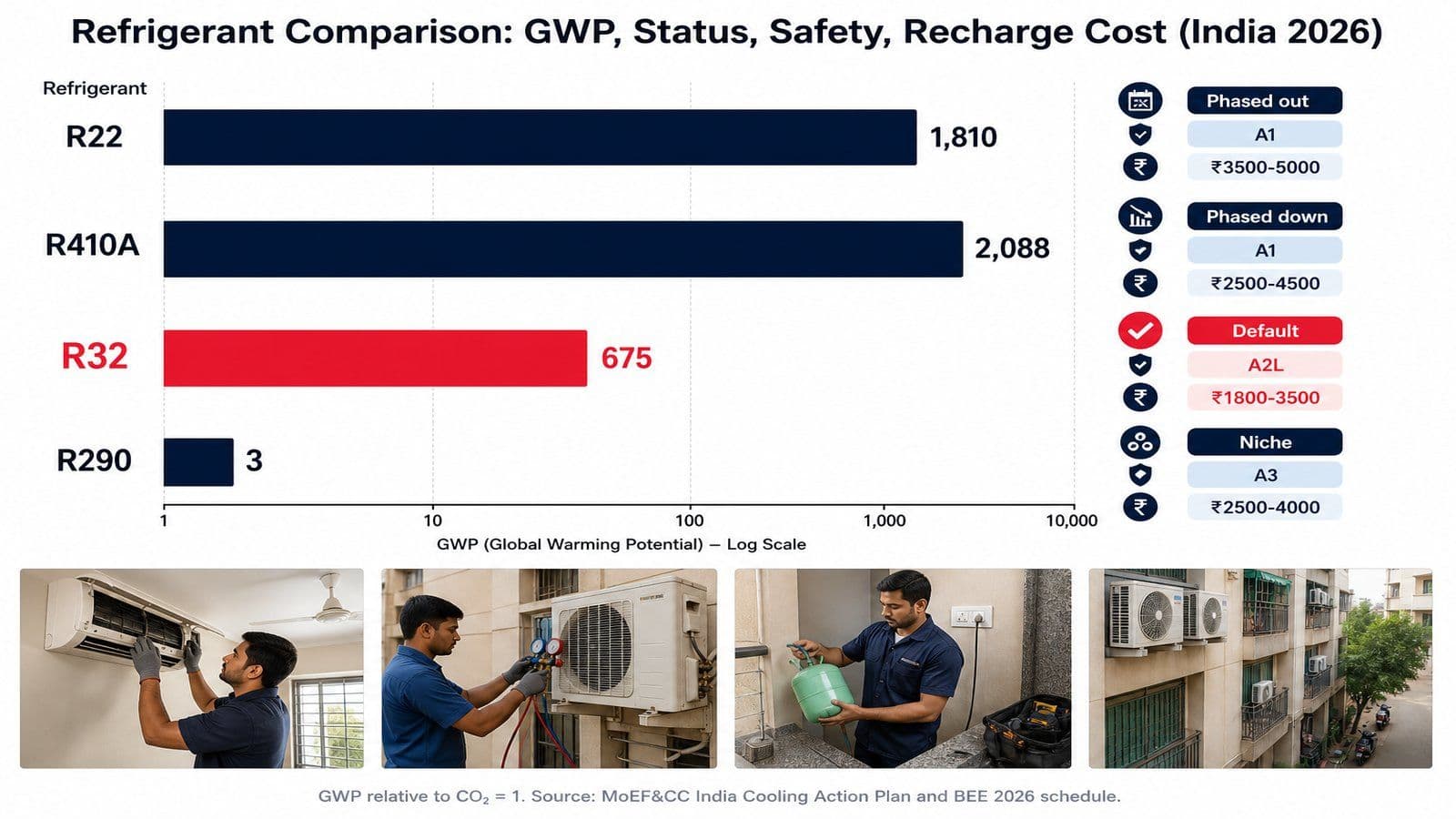
Photo: Refrigerant comparison chart for Indian residential ACs
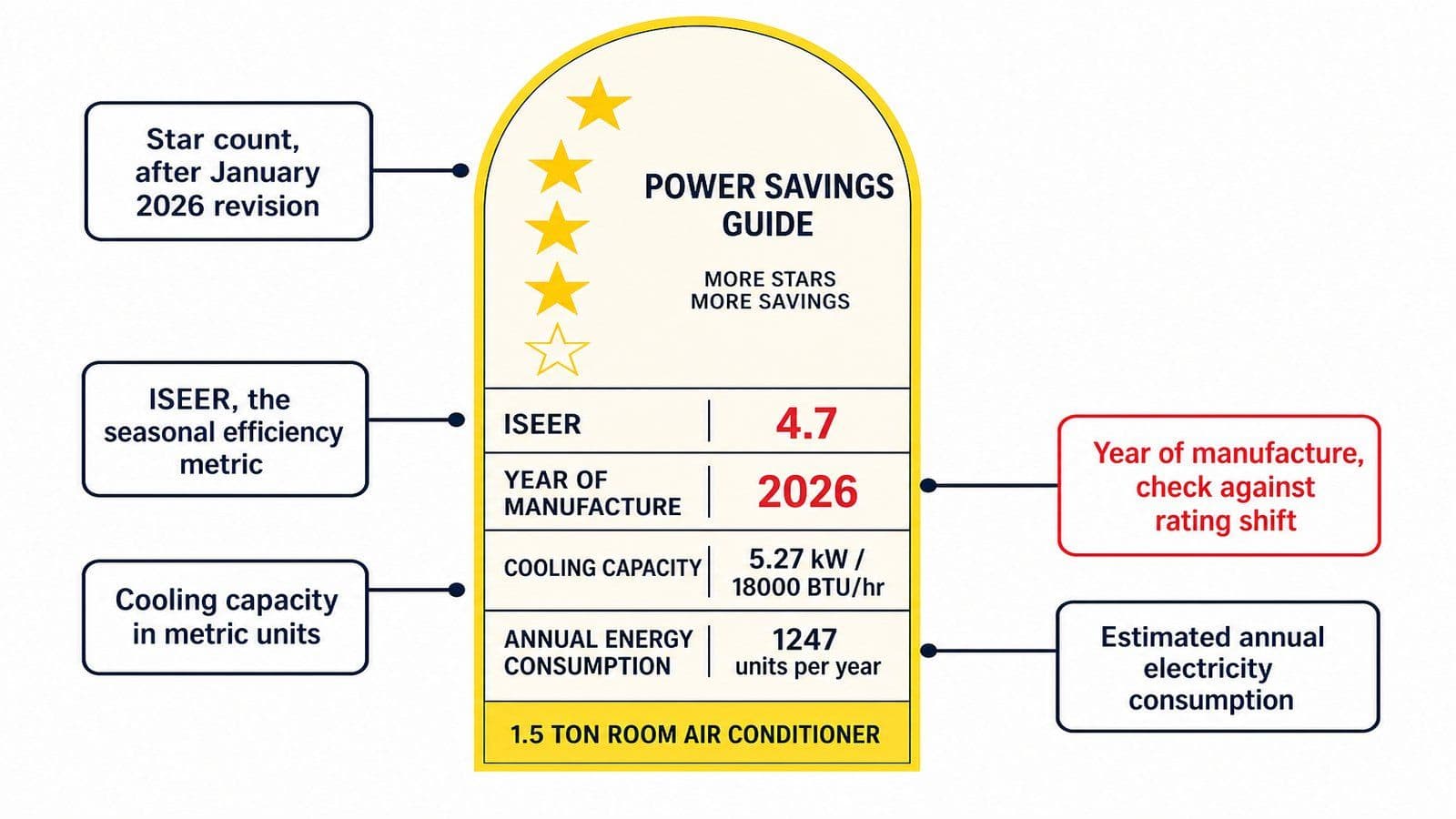
Photo: BEE Star Label Decoded
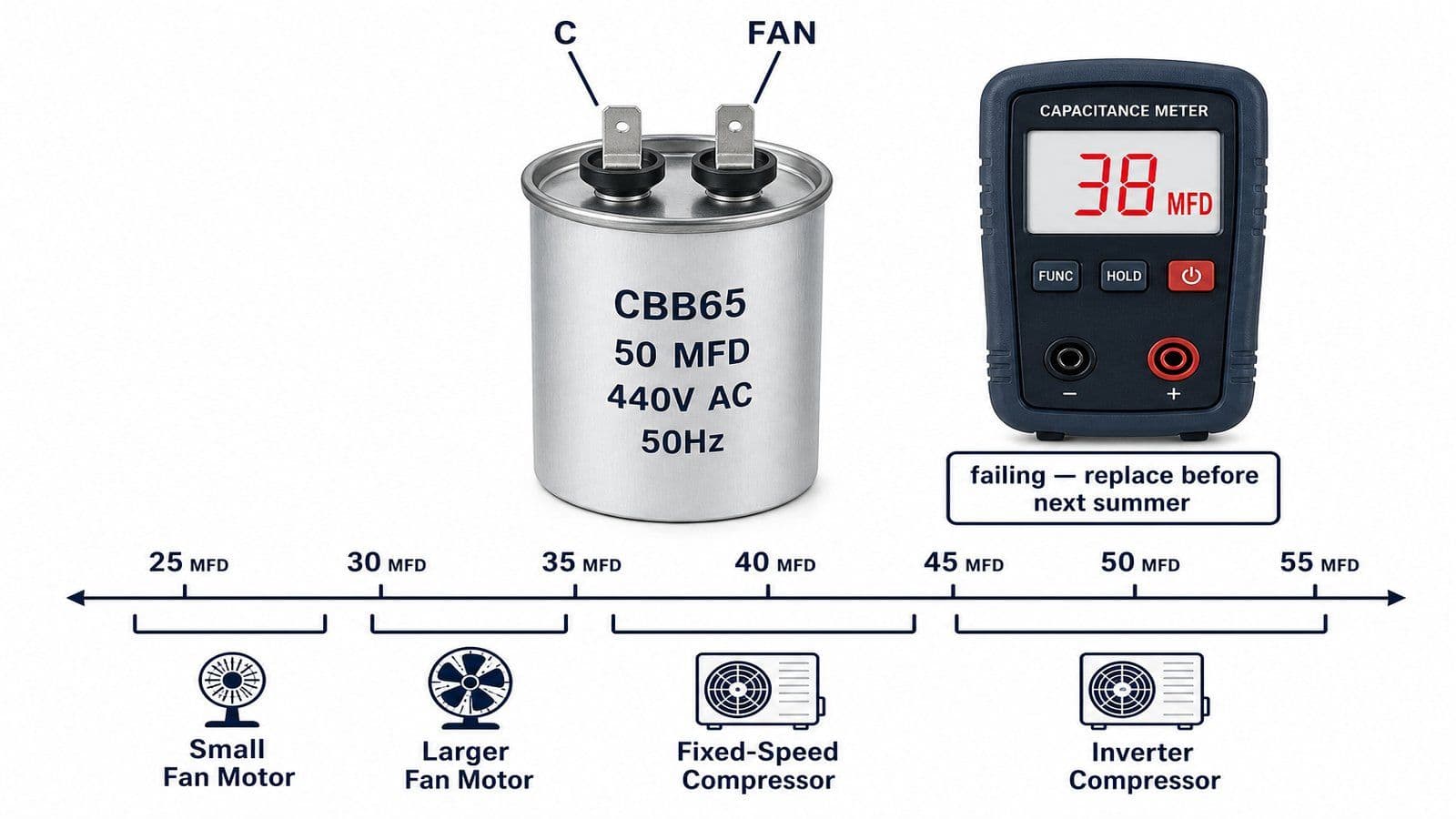
Photo: AC Capacitor Diagram with MFD Rating Explained
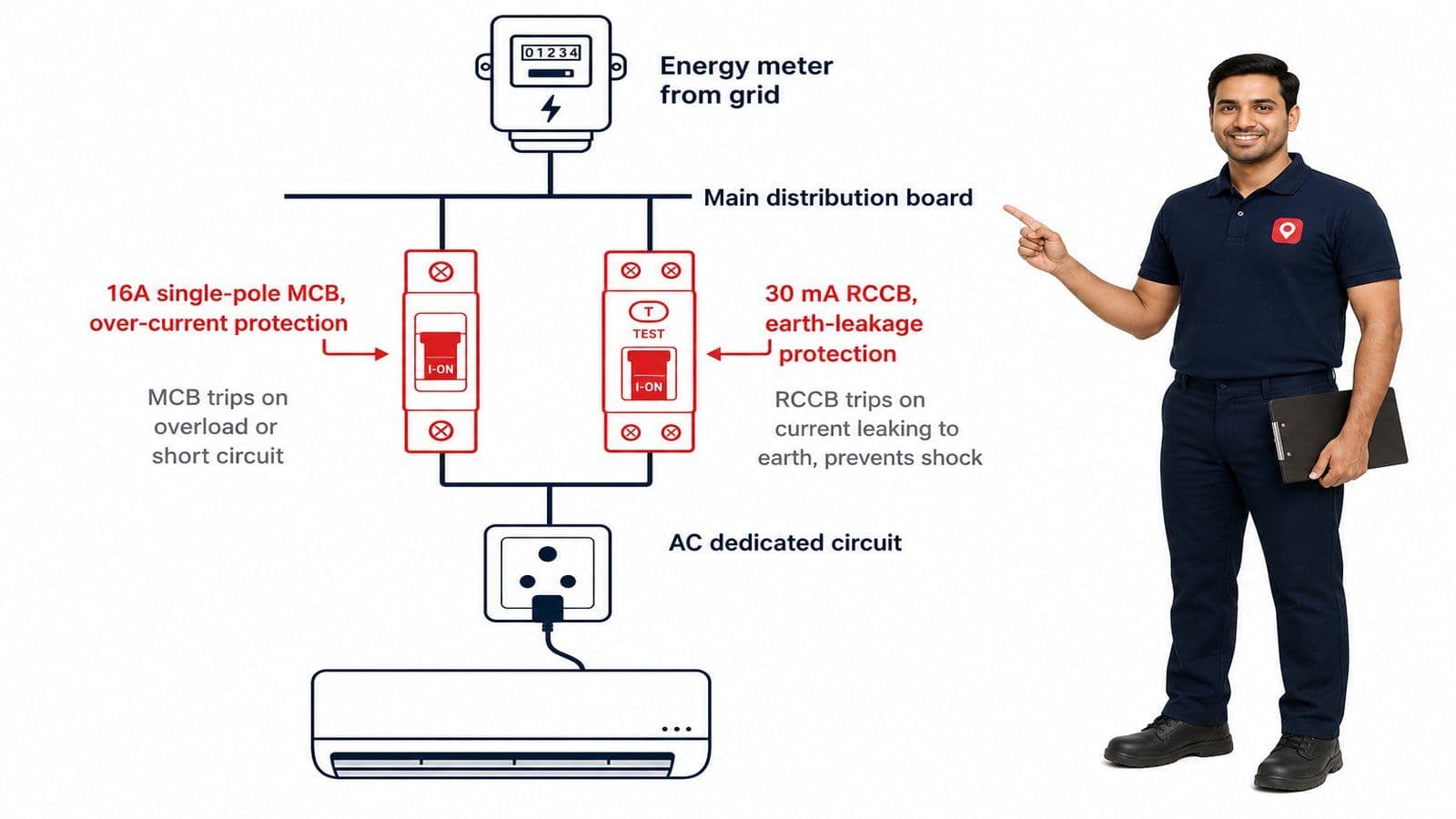
Photo: MCB and RCCB Safety Diagram for AC Circuit
Conclusion
A working vocabulary for AC technology gives Indian owners three things. First, the confidence to read a spec sheet or AMC contract and spot the cost-driving line items. Second, the language to ask a technician the right questions during a service visit. Third, the framework to make rational decisions about repair versus replace, AMC versus pay-per-visit, and 4-star versus 5-star, decisions that compound to ₹20,000 to ₹50,000 across the typical 10 year life of a residential AC.
The 60 plus terms above cover roughly 95 percent of the vocabulary you will encounter in Indian owner situations through 2026. Bookmark this glossary and return to specific entries when you need them. For the wider context, the pillar guide and the sibling clusters listed above walk through how these terms come together in real buying, running, and repair decisions.
Disclaimer
The cost ranges and regulatory references in this glossary reflect the Indian market as of May 2026. Prices vary 15 to 25 percent across cities and seasons, and BEE thresholds may revise again. Brand mentions in technical context are not endorsements. For any installation or major repair, always insist on an NSDC-certified technician and a written invoice with GST clearly itemised, the standard GST rate on AC service is 18 percent under the current HSN code.
Sources & References
- Bureau of Energy Efficiency (BEE) Star Labelling Programme for Room Air Conditioners
- BEE Schedule Revision for Room Air Conditioners 2026
- Ministry of Environment, Forest and Climate Change: India Cooling Action Plan
- Press Information Bureau: India ratifies the Kigali Amendment to the Montreal Protocol
- Indian Society of Heating, Refrigerating and Air Conditioning Engineers (ISHRAE): Standards and Publications
- National Skill Development Corporation: Electronics Sector Skills Council, AC Technician QP
- Bureau of Indian Standards: IS 1391 Room Air Conditioners specification
- Central Electricity Authority: National Electricity Plan and demand projections
- National Building Code of India (NBC) 2016: Part 8 Building Services, electrical and HVAC sections
Amit worked as an AC technician for 6 years in Ahmedabad before transitioning to technical writing. He holds a diploma in Refrigeration and Air Conditioning from ITI Ahmedabad and understands the difference between what AC companies promise and what actually happens on the ground. His articles break down complex technical topics into plain language that any homeowner can follow. He tests every tip he writes about in his own home first.

Dr. Verma is a mechanical engineer with 15 years of experience in HVAC systems. She completed her PhD from IIT Delhi on energy-efficient cooling solutions for Indian residential buildings. She reviews all technical content on HomePros to make sure the numbers are right, the advice is safe, and the recommendations are backed by actual engineering principles. She consults for multiple AC manufacturers on product design.