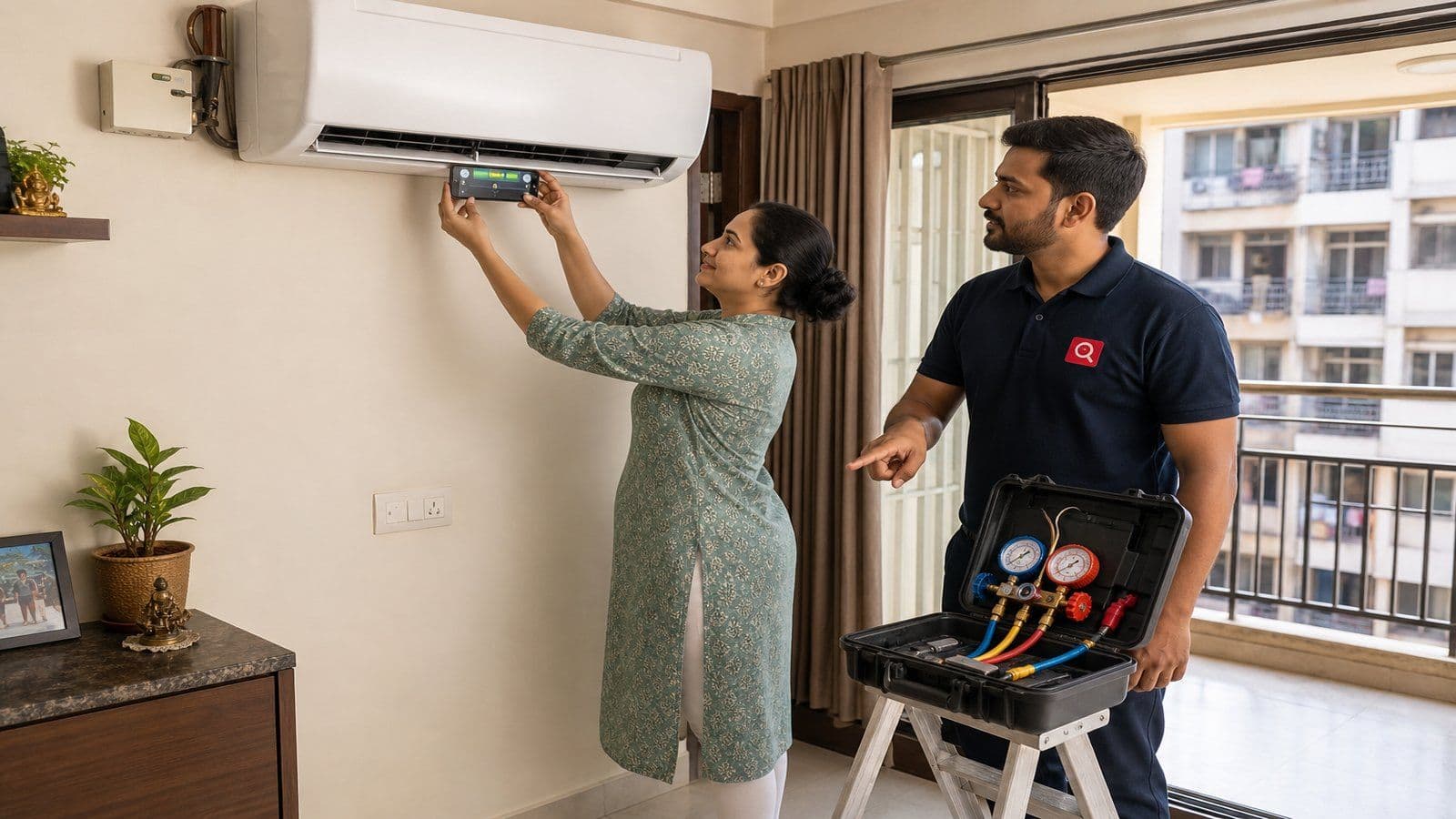
- NSDC Mechanic-RAC certification (NSQF Level 3 to 5) is the national standard for an AC technician in India. NSQF Level 4 is the minimum credential to look for on a residential service call.
- The ITI Mechanic Refrigeration and Air Conditioning trade is a 2-year, NCVT-affiliated programme offered across roughly 2,300 government and private ITIs nationwide. It is the deepest formal training route a technician can take.
- Brand-authorised technicians carry a unique brand ID and complete 5 to 15 days of in-house training on a specific manufacturer's units. They are required for in-warranty repairs on most premium brands.
- A certified technician earns roughly twice what an uncertified handyman earns, even at the entry tier. Across our ProNearMe network, 78 percent of jobs go to NSDC or ITI certified pros.
- Always ask for the NSDC certificate number, the ITI trade marksheet, or the brand-authorised technician ID before service begins. A technician who refuses to share at least one of these on request is a red flag.
When you hand a stranger a screwdriver and access to your 1.5 ton inverter, you are trusting them with about ₹45,000 of hardware and a warranty that runs five to ten years. AC technician certification in India is the most reliable filter between competent hands and the rest. It tells you which paper trail the person standing in your hall has walked through, which skills a third party has tested, and whether the brand on your outdoor unit will honour a claim six months from now.
The system has three parallel tracks, and most homeowners cannot tell them apart. There is the NSDC framework, the ITI route through state Industrial Training Institutes, and brand-authorised training run separately by each manufacturer. This guide covers all three and shows you how to verify a technician's papers before service begins.
I hold an ITI Diploma in Refrigeration and Air Conditioning myself, along with a BEE Certified Energy Manager credential. Over the last six years I have supervised over 3,500 service calls and 1,800 installations across Ahmedabad, Gandhinagar, and Gujarat.

Get quotes from verified, top-rated AC Service & Repair pros in Delhi.
Why Certification Matters for Your AC
Certification matters for three reasons that show up on your electricity bill and your warranty claim form.
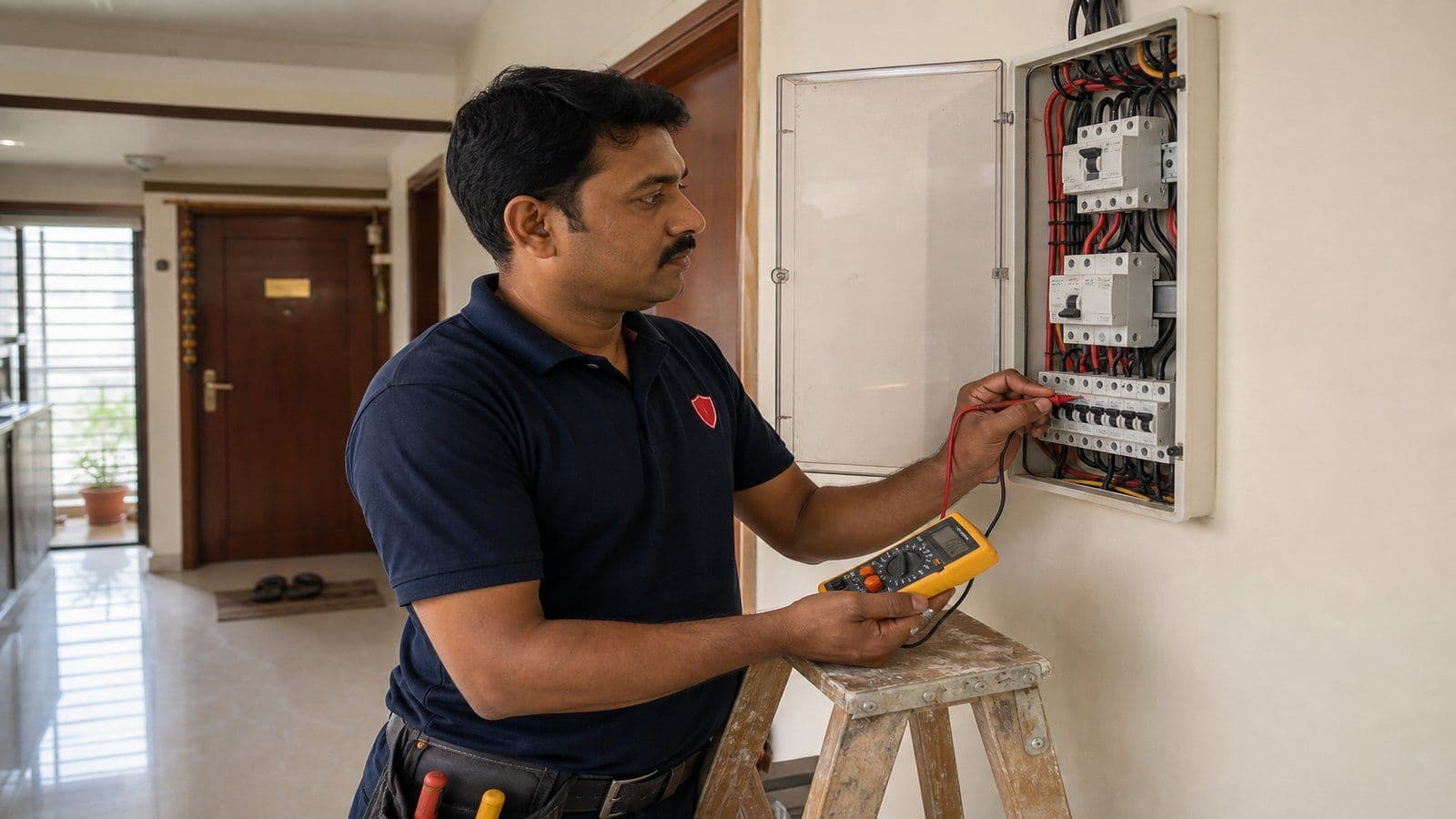
First, safety. An AC carries pressurised refrigerant at 250 to 500 psi, runs on a 230 volt supply, and the outdoor compressor weighs 30 to 50 kg mounted three to nine metres above the kerb. An untrained hand can release refrigerant, short the PCB, drop a compressor on a parked two-wheeler below, or wire a unit so the next monsoon brings a 230 volt shock through a wet drainage tray. The NSDC syllabus and the ITI curriculum both cover refrigerant handling, electrical safety, and working-at-height protocols.
Second, warranty validity. Almost every major brand sold in India requires that in-warranty service be performed by a brand-authorised technician or a person holding a recognised RAC credential. If you let an uncertified handyman top up gas or replace a capacitor while the unit is under warranty, you have voided the manufacturer's compressor warranty in most cases. That is a ₹15,000 to ₹25,000 hit if the compressor fails two years later.
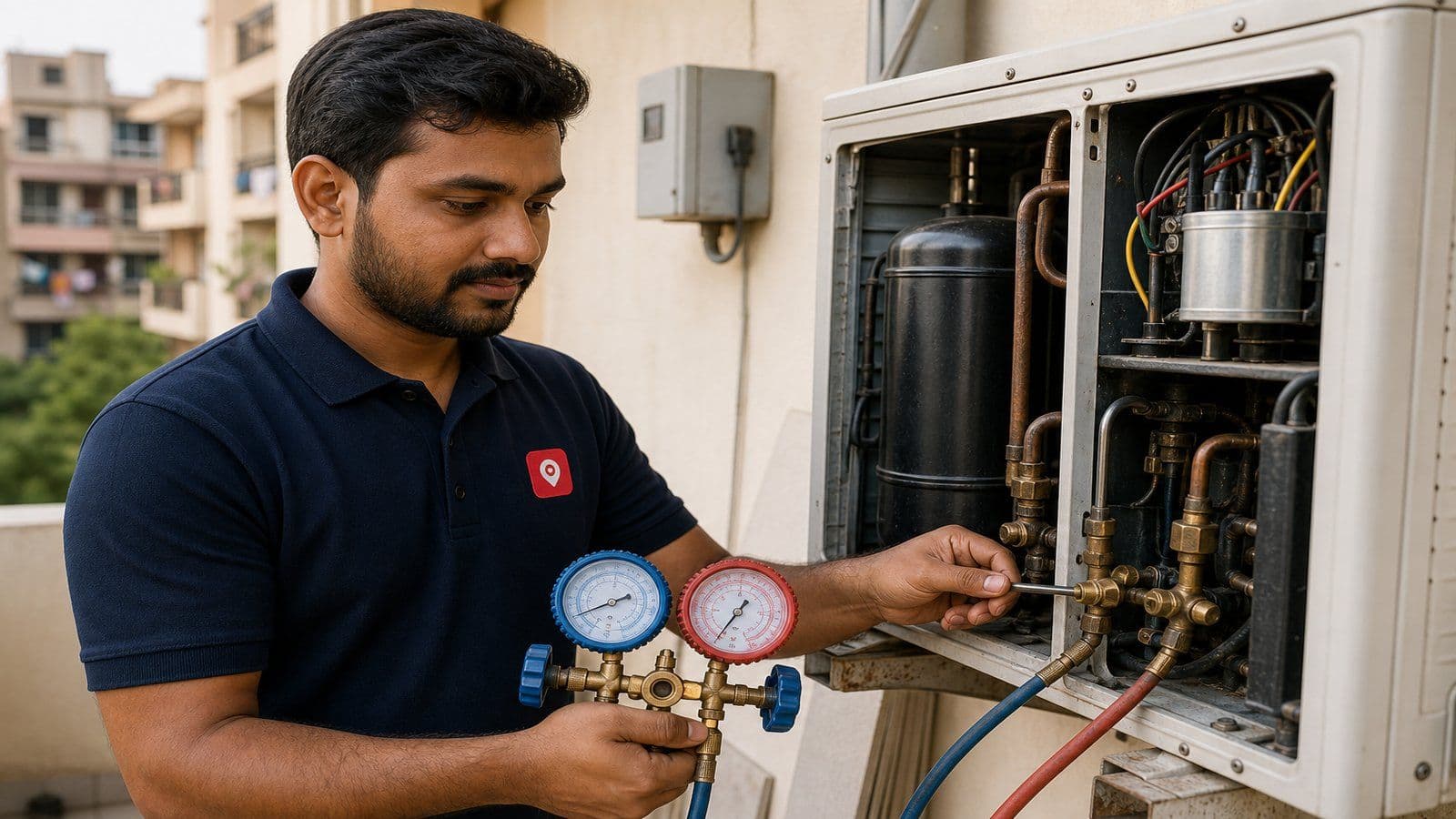
Third, work quality. Certified technicians torque the flare nuts to spec, vacuum-evacuate the lines for the prescribed 20 to 30 minutes before charging refrigerant, measure superheat and subcool, and use a digital manometer. The Bureau of Energy Efficiency's 2024 field study on residential AC efficiency found that units installed by certified technicians delivered 12 to 18 percent better ISEER performance over the first three years than units installed by uncertified hands.
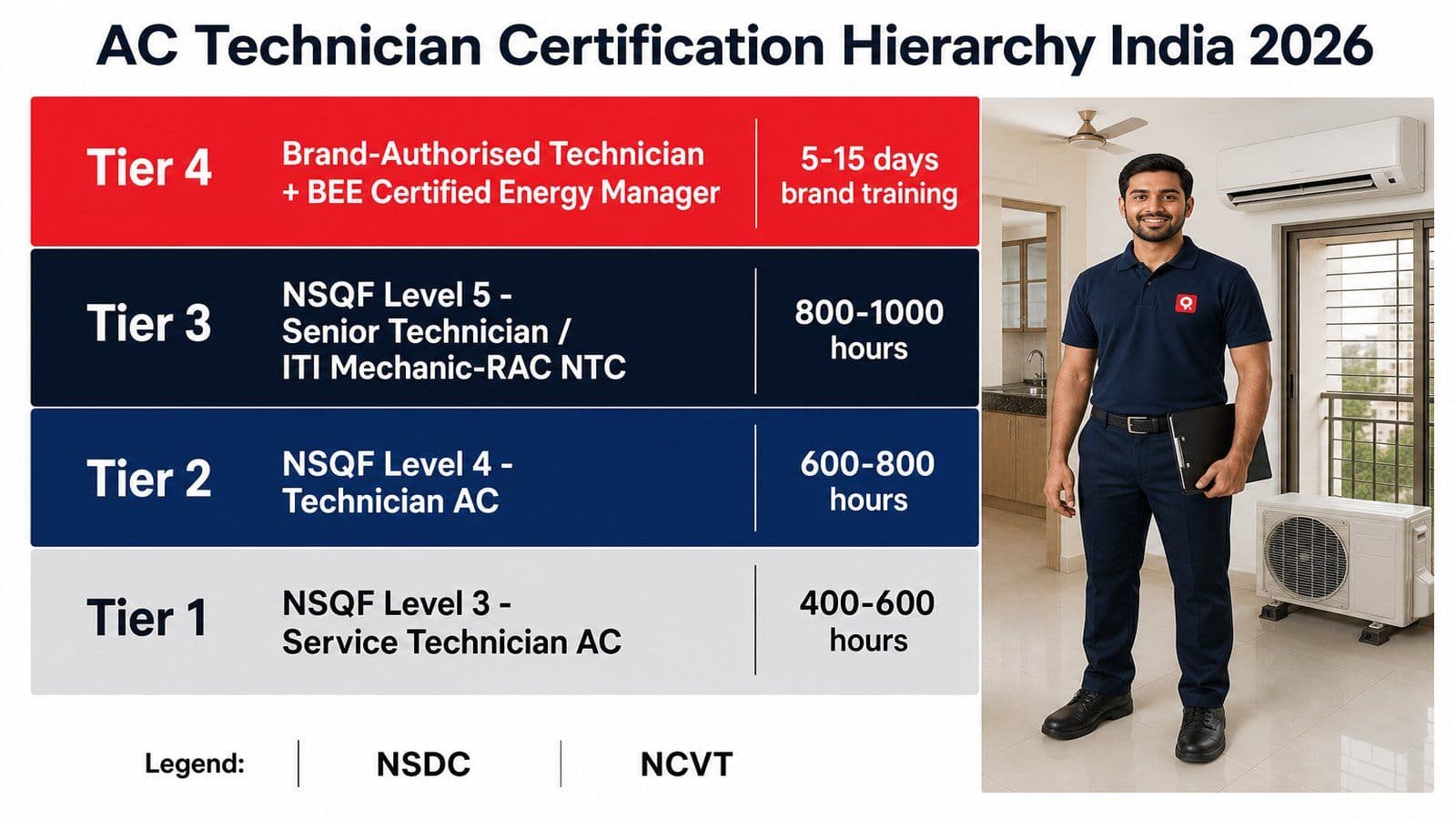
Photo: AC technician certification hierarchy in India
When I review a service call gone wrong, eight times out of ten the root cause traces back to skipped procedure. Wrong torque on a flare nut, no vacuum pull before gas, capacitor replaced without checking the run winding resistance first. Certification is not a guarantee of brilliance, it is a guarantee that the person was taught the procedure once and tested on it.

The NSDC Mechanic-RAC Framework
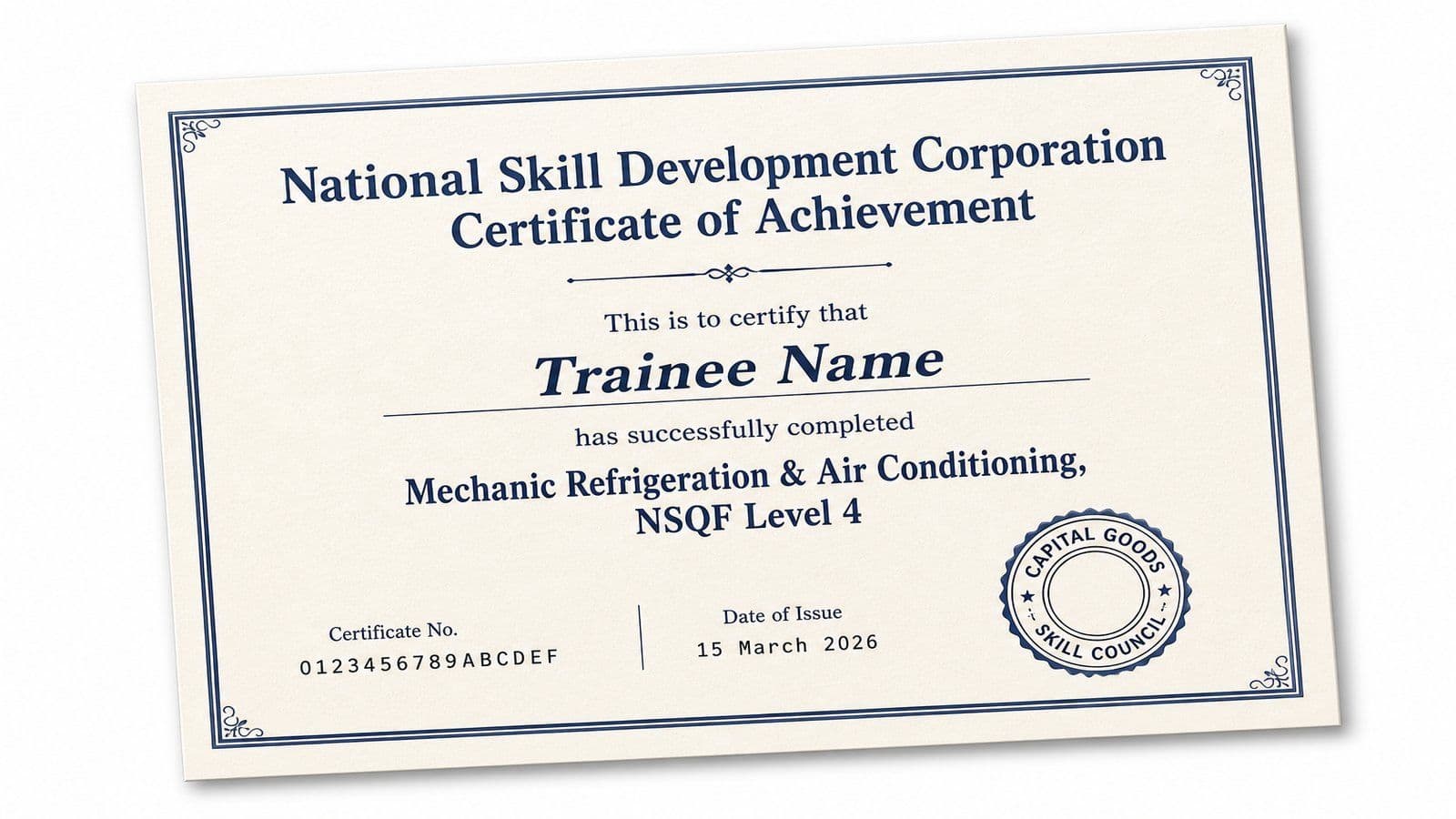
Photo: NSDC Mechanic-RAC certificate sample mockup
The National Skill Development Corporation, under the Ministry of Skill Development and Entrepreneurship, runs the modular framework most working AC technicians in India train against today. It is delivered through the Capital Goods Skill Council, which writes the qualification packs, and the National Skills Qualifications Framework, which slots each credential into a level from 1 to 10.
NSQF Level 3: Service Technician Air Conditioning
The entry-tier credential. Training is 400 to 600 hours over three to four months. Coverage includes basic refrigeration theory, identifying components on a split or window unit, routine service (filter wash, coil cleaning, drainage check, gas pressure reading), and basic fault diagnosis. A Level 3 holder can run a standard ₹500 to ₹1,500 dry or wet service safely, but is not qualified for installations or compressor work.
NSQF Level 4: Technician Air Conditioning
The working credential most homeowners should ask for. Training is 600 to 800 hours over four to six months. Adds installation procedures, refrigerant charging by superheat and subcool, capacitor and PCB diagnostics, copper pipe brazing, leak detection, and electrical work up to a 16 amp dedicated AC circuit. A Level 4 technician can install a new split AC, recharge gas, replace a capacitor, swap a fan motor, and troubleshoot most common faults end-to-end.
Get quotes from verified, top-rated AC Service & Repair pros in Delhi.
NSQF Level 5: Senior Technician or Supervisor
The credential a service centre manager or contractor holds. Adds VRF and VRV systems, cassette and ductable units, commercial chiller basics, refrigerant recovery under the Kigali Amendment rules, and quotation preparation. This level qualifies a person to sign off on commercial AMC contracts.
How NSDC Certification Is Delivered
NSDC does not run training centres itself. It approves training partners and assessment agencies. Funding can come from PMKVY, DDU-GKY for rural candidates, or the trainee themselves. A third-party assessment agency tests the candidate and issues the certificate with a unique number. It also appears on the candidate's Skill India Digital profile, which any homeowner can verify online. Across our verified pros in the ProNearMe network, roughly 64 percent hold an NSDC certification at NSQF Level 4 or above.
The ITI Mechanic-RAC Trade
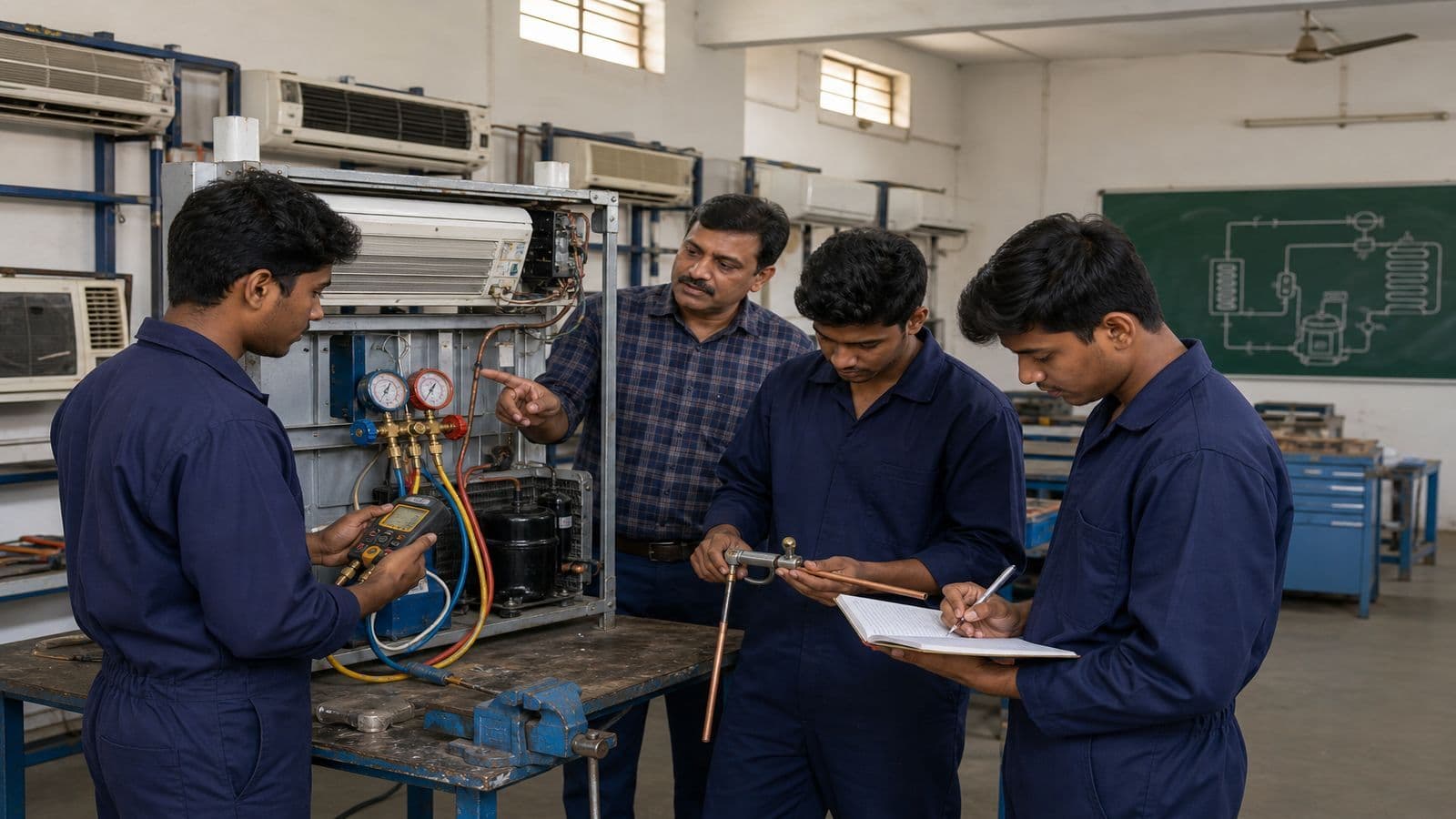
Photo: ITI Mechanic-RAC workshop training
The Industrial Training Institute system, run under the Directorate General of Training, predates NSDC by half a century. ITIs were set up in the 1950s under the Craftsmen Training Scheme and remain India's deepest technical training network for industrial trades. The Mechanic Refrigeration and Air Conditioning trade is one of the longest-running courses in the ITI catalogue.
It is a two-year programme across four semesters. Year one covers fundamentals: refrigeration principles, thermodynamics basics, electrical wiring, soldering and brazing of copper, sheet metal work, and tool handling. Year two specialises into commercial and domestic AC systems, refrigerant cycle troubleshooting, PCB and inverter board basics, central AC and VRF concepts, and a 180-hour industry attachment.
Admission is after class 10. The trade is affiliated with the National Council for Vocational Training and on completion the trainee receives the National Trade Certificate, the recognised qualification across India. NCVT certification is also recognised in several Gulf countries, which is why many ITI Mechanic-RAC graduates take jobs in the UAE and Saudi Arabia.
There are roughly 14,000 ITIs across India, of which 1,300 are government-run and 12,700 private. The Mechanic-RAC trade is offered at around 2,300 of these. Tuition at a government ITI is ₹500 to ₹2,000 per year. Private ITIs charge ₹15,000 to ₹40,000 per year.
I tell trainees that the ITI route is the long road and the higher road. Two years is a real commitment, but at the end of it you have soldering hands, fault-finding intuition, and a paper credential that opens doors in the Gulf as well as any tier-1 Indian service centre. An NSDC short-course is the quick way in. An ITI Diploma is the way up.
Brand-Authorised Technician Programmes
Every major AC brand in India runs an internal training academy for its dealer-network technicians. These programmes do not replace NSDC or ITI certification, they sit on top of it. A typical brand-authorised technician already holds NSQF Level 3 or 4, or an ITI Mechanic-RAC NTC, before being inducted.
Brand training runs between 5 and 15 working days at a regional centre. The curriculum is specific to the brand's current product line, the proprietary PCB diagnostics tools the brand uses, the warranty workflow on its dealer portal, and the brand's installation specification (which often differs from the generic ISHRAE specification on details like minimum copper pipe run and bracket gauge). The training ends with a written and practical assessment, and the technician is issued a brand ID card.
If your AC is in warranty, the brand will usually insist on a brand-authorised technician for any covered repair. Verify this by calling the brand's customer service number, sharing the unit serial number, and asking which authorised dealers in your pin code can handle the service. Brand-authorised technicians are not always brand employees: most are the field-service staff of an independent authorised dealer, and the same technician may be authorised by two or three brands simultaneously.
The Certification Hierarchy at a Glance
| Credential | Issuing body | NSQF level | Training duration | What it qualifies | Verification |
| Mechanic-RAC ITI Trade (NTC) | NCVT, Ministry of Skill Development | Level 4 equivalent | 2 years (full-time) | Full residential + commercial AC service, install, troubleshoot | NCVT certificate, state DTE portal |
| NSDC Level 3 (Service Technician AC) | NSDC via CGSC | Level 3 | 400-600 hours | Routine residential service only | Skill India Digital portal |
| NSDC Level 4 (Technician AC) | NSDC via CGSC | Level 4 | 600-800 hours | Residential install + service + diagnostics | Skill India Digital portal |
| NSDC Level 5 (Senior Technician) | NSDC via CGSC | Level 5 | 800-1,000 hours | Commercial systems, AMC contracts, team lead | Skill India Digital portal |
| BEE Certified Energy Manager | Bureau of Energy Efficiency | Post-graduate | 3-month course + exam | Energy audit, ISEER assessment, large facility design | BEE national registry |
| Brand-Authorised Technician | Manufacturer | On top of NSDC/ITI | 5-15 days at brand academy | In-warranty service on specific brand | Brand customer service line |
A residential homeowner with a 1 ton or 1.5 ton split AC realistically needs an NSDC Level 4 or an ITI Mechanic-RAC graduate for general service, and a brand-authorised technician for any in-warranty claim. Level 5 and the BEE Energy Manager credential matter more for commercial buildings and large housing societies running AMC contracts on multiple units.
Skill India and PMKVY Funding
Many working AC technicians today have walked through one of the publicly funded skilling programmes rather than paying out of pocket. The Pradhan Mantri Kaushal Vikas Yojana (PMKVY), in its fourth iteration since 2015, funds the NSDC Mechanic-RAC qualification packs for eligible candidates aged 18 to 35. The candidate pays nothing, the training partner is reimbursed per certified placement. The Deen Dayal Upadhyaya Grameen Kaushalya Yojana (DDU-GKY) targets rural BPL candidates, and the One District One Product initiative funnels funds toward the dominant employer cluster in each district. The net effect: the cost of becoming an NSDC-certified AC technician has dropped to near zero for an eligible candidate.
Get quotes from verified, top-rated AC Service & Repair pros in Delhi.
How a Customer Verifies a Technician's Certification
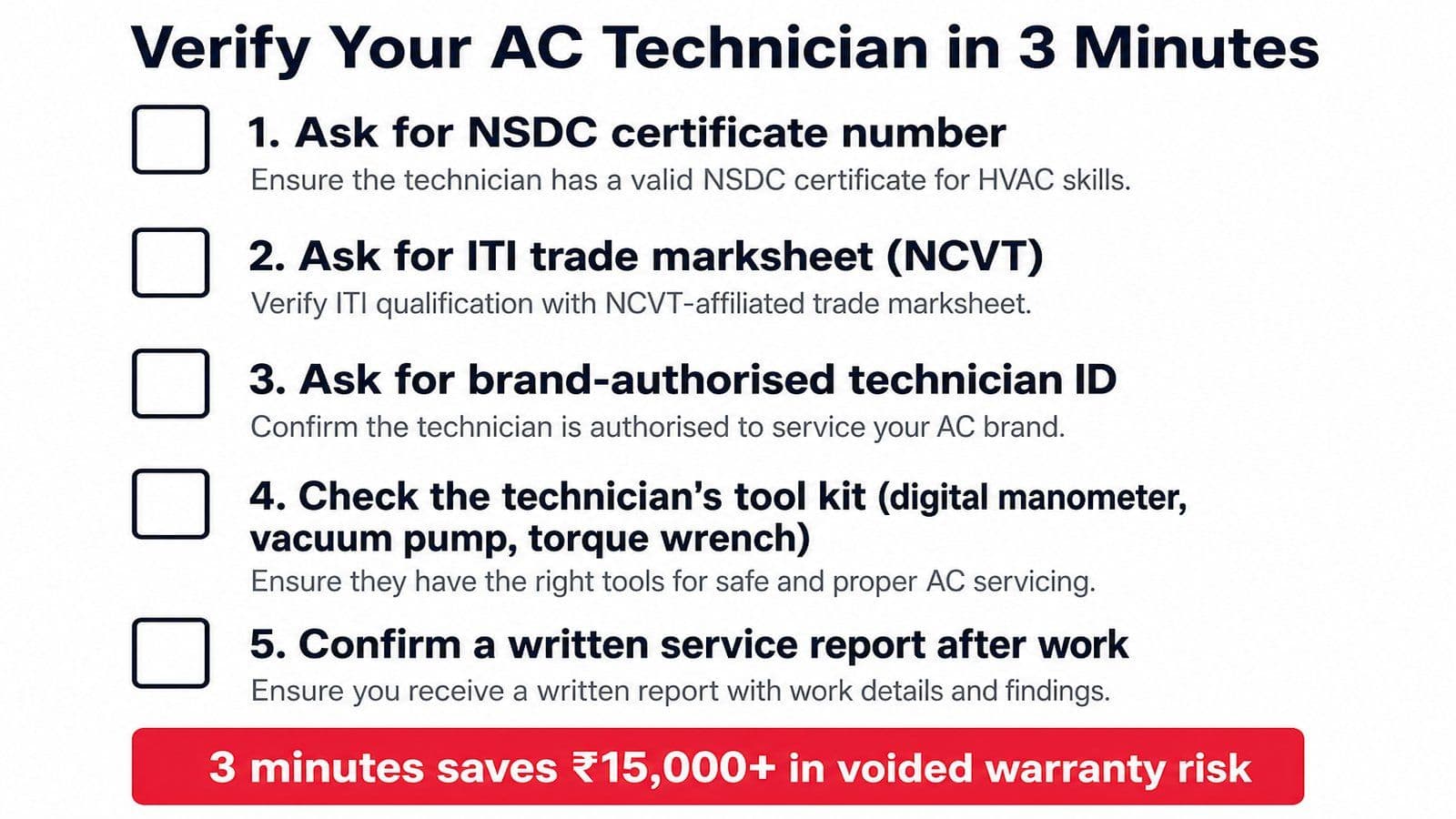
Photo: Customer verification checklist for AC technicians
Verification takes three minutes if you do it before the work begins. After the work begins it is awkward to ask, and useless to ask once the gas is in the lines.
Ask for the NSDC certificate number
The certificate carries an alphanumeric serial that the technician can read off their certificate or their Skill India Digital profile on their phone. Search for it on the Skill India Digital portal. The lookup returns the candidate's name, qualification pack, level, year of certification, and training partner. Verify the name on screen matches the technician in front of you.
Ask for the ITI trade marksheet
ITI Mechanic-RAC graduates carry their NTC certificate and an NCVT marksheet. The certificate shows the trade, the institute, the passing year, and a serial number. State Directorates of Technical Education publish marksheet verification on their portals, though the experience varies state by state.
Ask for the brand ID card
A brand-authorised technician carries a laminated card with their photo, brand logo, technician ID, and validity date. The brand's customer service line will verify the ID against the brand serial of your unit.
Cross-check the technician's tools
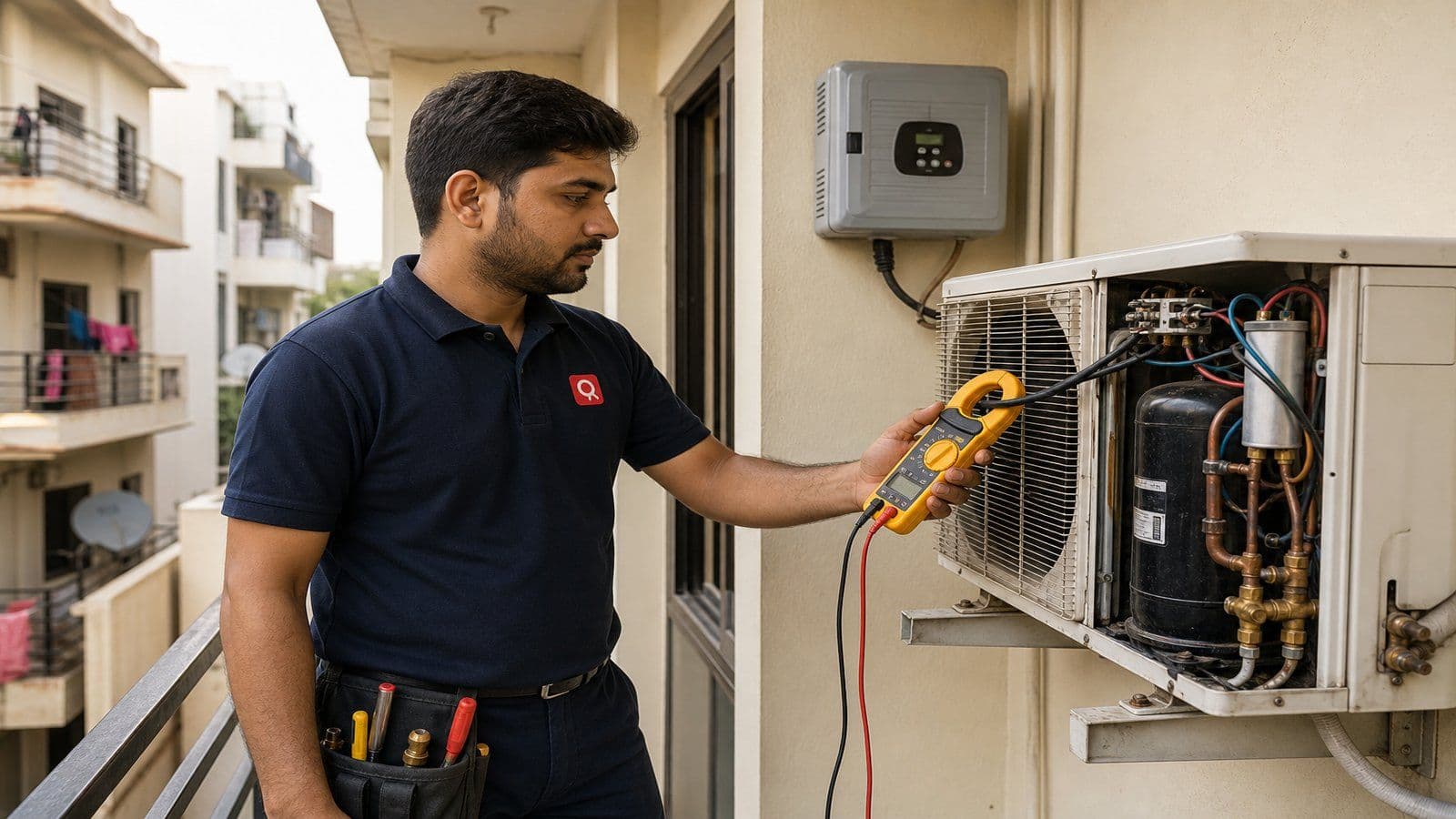
A certified technician carries a digital manometer, a vacuum pump, a torque wrench, a refrigerant scale (for charging by weight, not pressure), and a multimeter. An uncertified handyman carries a spanner set, a hammer, and a cylinder of gas. The tool kit tells you most of what you need to know in 30 seconds.
If a technician balks when you ask to see their certificate, that is your answer. A real certified pro is proud of the certificate and will pull it out of their phone in seconds.
Red Flags for an Uncertified Technician
Most fraud in the AC service market is at the small end. A few patterns repeat often enough to be diagnostic.
The first red flag is the "self-taught for fifteen years" claim. A technician with genuine field experience usually also holds an NSDC or ITI credential, because the brands they have worked with would have required it. A pure self-taught claim means no warranty path and no third party to escalate to.
The second red flag is the unbranded uniform or a fake brand T-shirt printed cheaply at a local press. If the uniform has misspellings, mismatched logos, or contact numbers that do not match the brand's national customer-service number, something is off.
The third red flag is no-receipt no-warranty service. A certified pro provides a service report with work performed, parts used, gas type and quantity charged, and a 30 to 90 day labour warranty. A handyman pockets the cash and leaves.
The fourth red flag is the unrealistically low quote. The 2026 cost band for a deep wet service on a residential split AC is ₹800 to ₹1,500 depending on city and tonnage. A ₹299 wet service is mathematically impossible to deliver well, the technician will rush the job, skip the coil cleaning, or upsell a fictional gas top-up.
A Field Case: Mr Sharma's Repair in Powai
Mr Rajesh Sharma, in a 3 BHK flat in Powai, Mumbai, called our office in March 2026 about a 2 ton split AC that had stopped cooling halfway through its third summer. A society watchman had recommended a "very cheap" local technician the previous year for a gas top-up, and Mr Sharma had paid ₹2,200 for that visit. Cooling returned briefly and then deteriorated again over six months.
Our NSDC Level 4 technician arrived, asked for the previous service receipt (there was none), and ran a leak-detection cycle. He found a slow leak at the indoor evaporator's third-row return bend, caused by formicary corrosion (a known issue on units installed in humid coastal cities with high indoor sulphur exposure from cooking fumes). The earlier "gas top-up" had been a one-shot fix that ignored the underlying leak.
The certified diagnosis cost ₹500. The corrosion-resistant coil replacement under brand warranty (Mr Sharma had a 10-year coil warranty from 2023, still active) cost zero in parts, only ₹2,800 in labour. The brand validated the claim because our technician's NSDC Level 4 ID and brand-authorised technician ID were on file. Total saved: roughly ₹18,000 on a new coil out of warranty, plus the ₹2,200 the earlier service had cost. The certificate created the audit trail that unlocked the warranty.
Career Path and Earnings for Certified Technicians
Get quotes from verified, top-rated AC Service & Repair pros in Delhi.
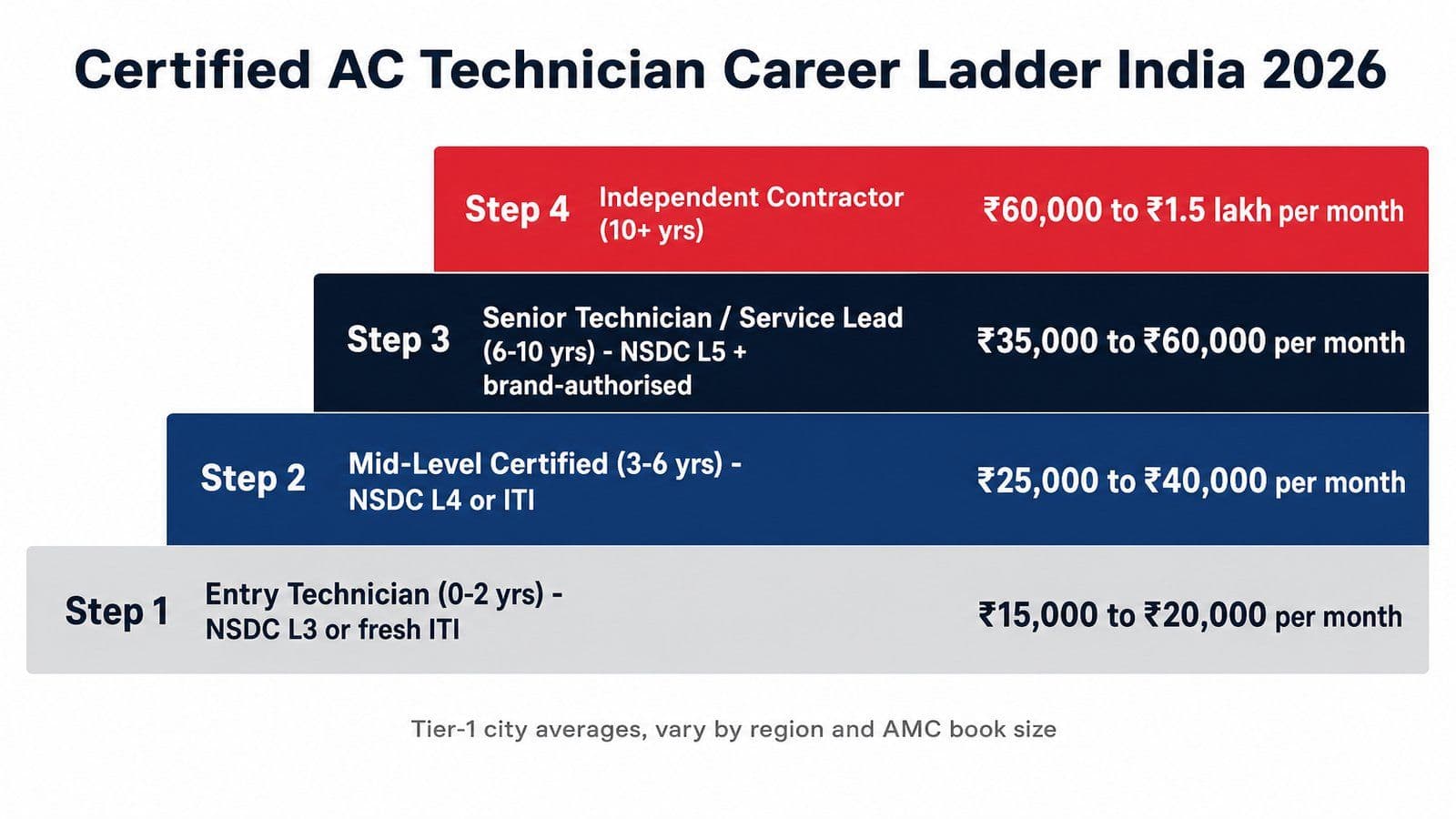
Photo: Career path earnings ladder for AC technicians in India
Earnings tell you what you are paying for and why certified pros stay in the trade rather than drifting into delivery work.
Entry Technician (0 to 2 years)
Typically NSDC Level 3 or fresh ITI Mechanic-RAC graduate, working as a junior on a service team. Monthly take-home in 2026 is ₹15,000 to ₹20,000 in a tier-1 city, ₹12,000 to ₹16,000 in tier-2.
Mid-Level Certified Technician (3 to 6 years)
NSDC Level 4 or ITI graduate with three plus years in the field. Capable of running an installation or a complex diagnostic call alone. Monthly take-home is ₹25,000 to ₹40,000 in tier-1 cities.
Senior Technician or Service Lead (6 to 10 years)
NSDC Level 5 or ITI graduate plus brand-authorised credentials from two or more major brands. Runs a team of two to four juniors, handles AMC accounts. Monthly take-home is ₹35,000 to ₹60,000.
Independent Contractor (10+ years)
Has built their own client base. Earnings range from ₹60,000 to ₹1.5 lakh per month for a well-run single-owner operation in a tier-1 city.
Certification lets a technician charge fair labour rates and turn down jobs they should not take. From the homeowner's side, this is exactly the technician you want, the one who has the freedom to walk away from a bad job because they have a queue of better ones.
Conclusion
AC technician certification in India reduces to three tracks any homeowner can reason about. NSDC for the modern modular short-course route. ITI for the deep two-year trade route. Brand-authorised on top of either, for in-warranty service. A certified technician costs more on the labour line and saves you many multiples of that cost over the AC's life through better installation, fewer callbacks, and intact warranty claims.
The honest takeaway: ask for the paper, every time. Three minutes of verification before the work starts is the cheapest insurance you will ever buy on your AC. For the full owner's playbook, see our complete AC owner's guide for Indian homes, the BEE star rating guide, and the breakdowns of common AC problems and AC terminology.
Disclaimer
All cost figures, training durations, and certification details in this guide reflect publicly available information as of May 2026 and vary by city, training partner, and individual technician. GST is applicable on certification course fees and brand training fees per prevailing rates. Always verify a technician's NSDC or ITI credentials through the issuing body's official portal before service, and check the warranty fine print on your specific unit before authorising any repair. This guide does not endorse any specific brand or training partner; named credentials reflect the public regulatory framework only.
Sources & References
- National Skill Development Corporation (NSDC): Qualification Packs and Training Partner Directory
- Skill India Digital Portal: Certificate Verification
- Directorate General of Training (DGT), Ministry of Skill Development and Entrepreneurship: ITI Trade Directory
- Capital Goods Skill Council: Mechanic Refrigeration and Air Conditioning Qualification Packs
- Bureau of Energy Efficiency (BEE): Star Labelling Programme and Certified Energy Manager Scheme
- Pradhan Mantri Kaushal Vikas Yojana (PMKVY) Programme Overview, Ministry of Skill Development
- National Council for Vocational Training (NCVT): National Trade Certificate Information
- Ministry of Environment, Forest and Climate Change (MoEF&CC): Kigali Amendment Implementation in India
Amit worked as an AC technician for 6 years in Ahmedabad before transitioning to technical writing. He holds a diploma in Refrigeration and Air Conditioning from ITI Ahmedabad and understands the difference between what AC companies promise and what actually happens on the ground. His articles break down complex technical topics into plain language that any homeowner can follow. He tests every tip he writes about in his own home first.

Dr. Verma is a mechanical engineer with 15 years of experience in HVAC systems. She completed her PhD from IIT Delhi on energy-efficient cooling solutions for Indian residential buildings. She reviews all technical content on HomePros to make sure the numbers are right, the advice is safe, and the recommendations are backed by actual engineering principles. She consults for multiple AC manufacturers on product design.