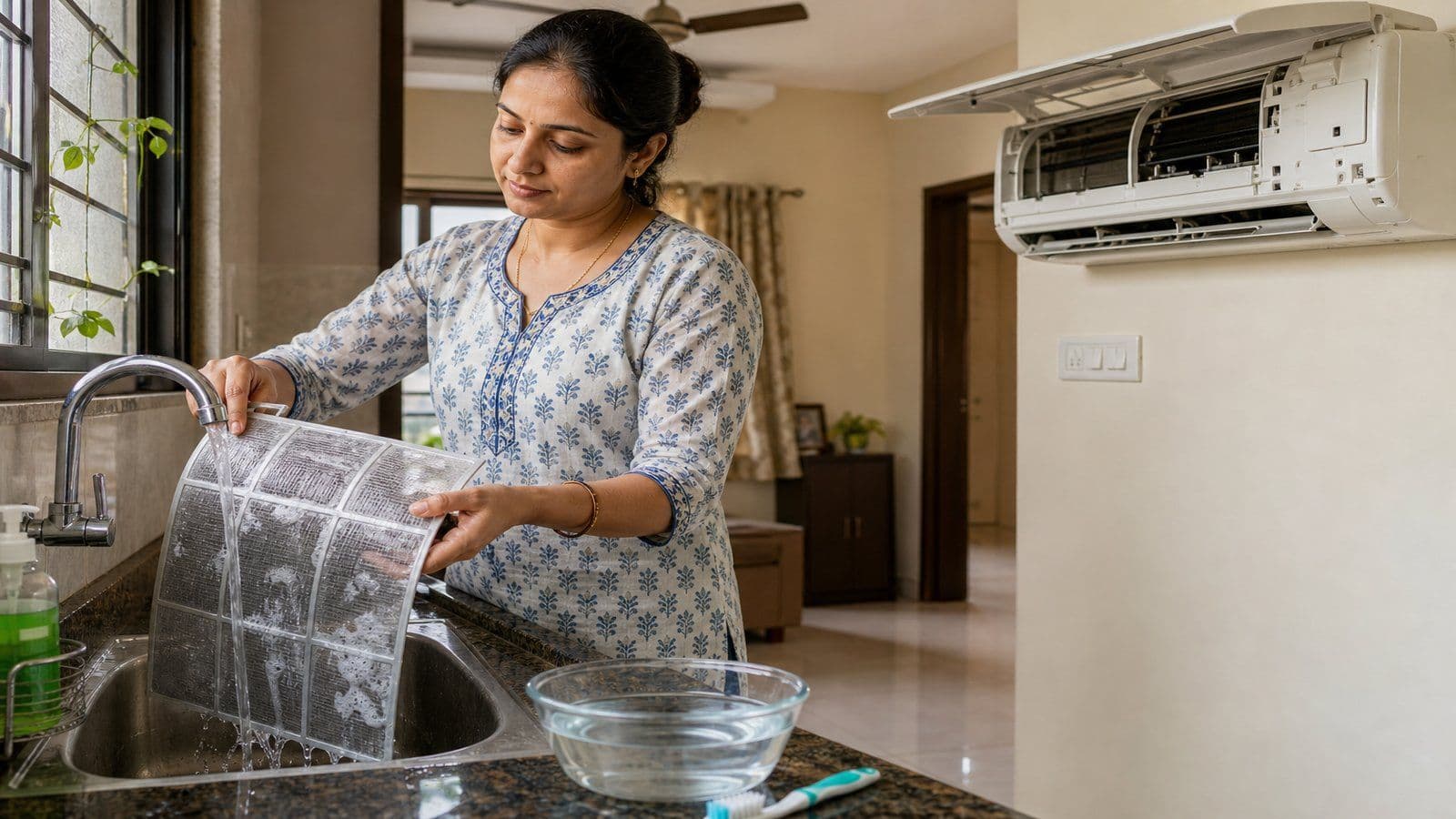
- The verified AC technicians in our ProNearMe network report that 62 percent of summer service calls are caused by dirty filters, low refrigerant or blocked drains, all preventable with annual servicing under ₹800.
- BEE flags any AC that loses more than 15 percent cooling capacity year on year as a candidate for refrigerant check or coil cleaning, not replacement.
- A water leak from the indoor unit costs ₹400 to ₹900 to fix if caught in week one, but can rise to ₹3,500 if the leak damages ceiling plaster.
- MCB tripping during peak summer is almost never an "AC fault" in isolation. It usually points to wiring under-rating, a shared circuit or a failing capacitor.
- Strange smells, ice formation and PCB errors are urgent. If you see any of these three, switch off the unit at the wall and call a NSDC-certified technician within 48 hours to prevent compressor damage.
Most AC failures in Indian homes do not arrive as a single dramatic breakdown. They show up as small complaints. The room takes longer to cool. Water drips onto the curtain rod. The MCB trips at 2 pm. By the time the owner picks up the phone, the underlying fault has often been brewing for two or three weeks.
This guide covers the common AC problems that account for the bulk of service calls across the ProNearMe technician network, what each symptom means, how urgent it is, and the typical fix cost in rupees.
Air conditioners in India work harder than units in cooler markets. Peak summer pulls compressors above their design temperature for weeks, monsoon humidity stresses drain pans, and dust loads in Delhi, Mumbai and Bengaluru clog filters in days.
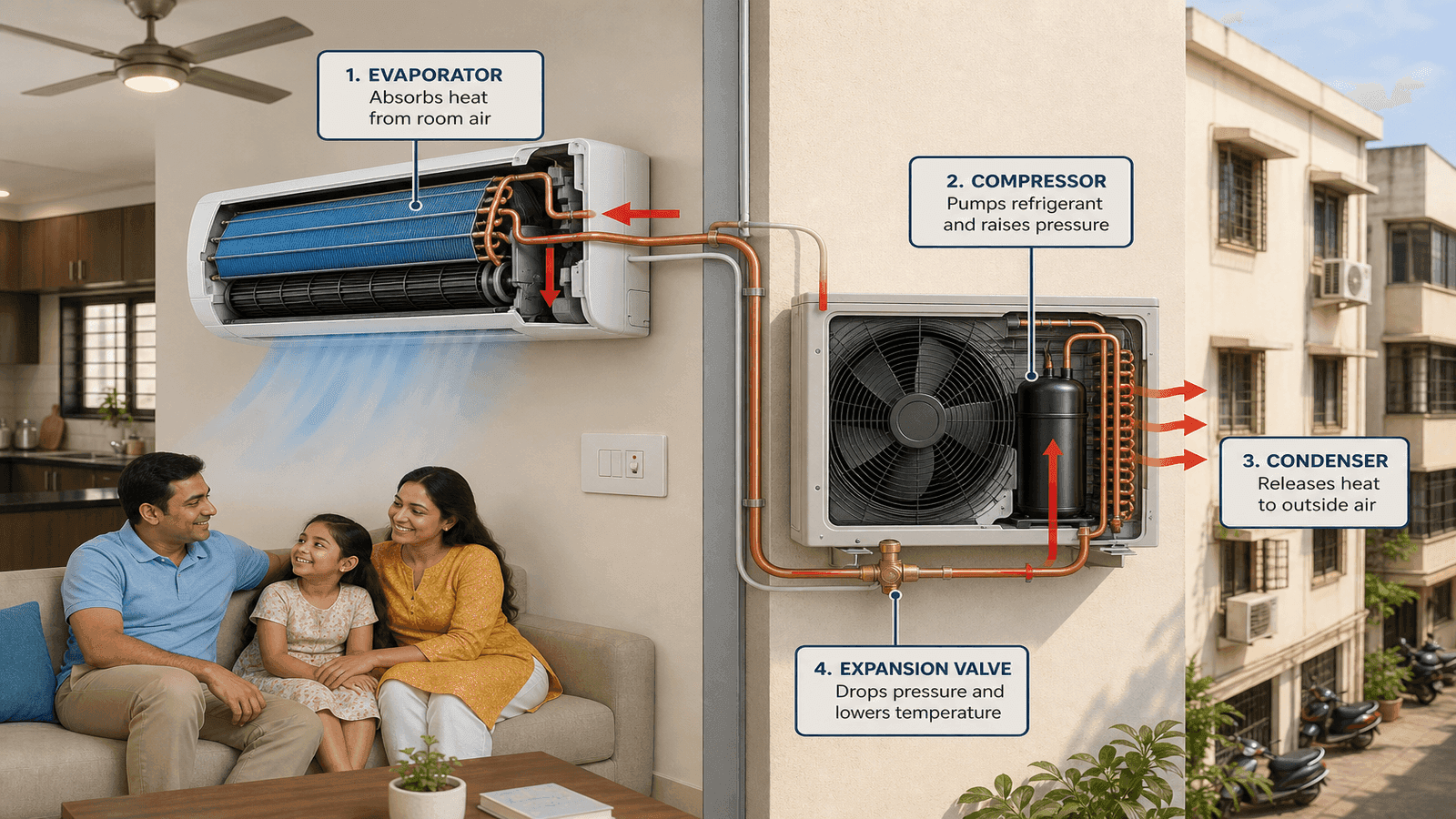
The Bureau of Energy Efficiency (BEE) field studies show that nearly 40 percent of residential AC service calls trace back to three root causes: dirty filters, refrigerant issues and electrical faults. For deeper context, see our pillar guide on all about AC ownership in India and the breakdown of how an AC actually cools a room.
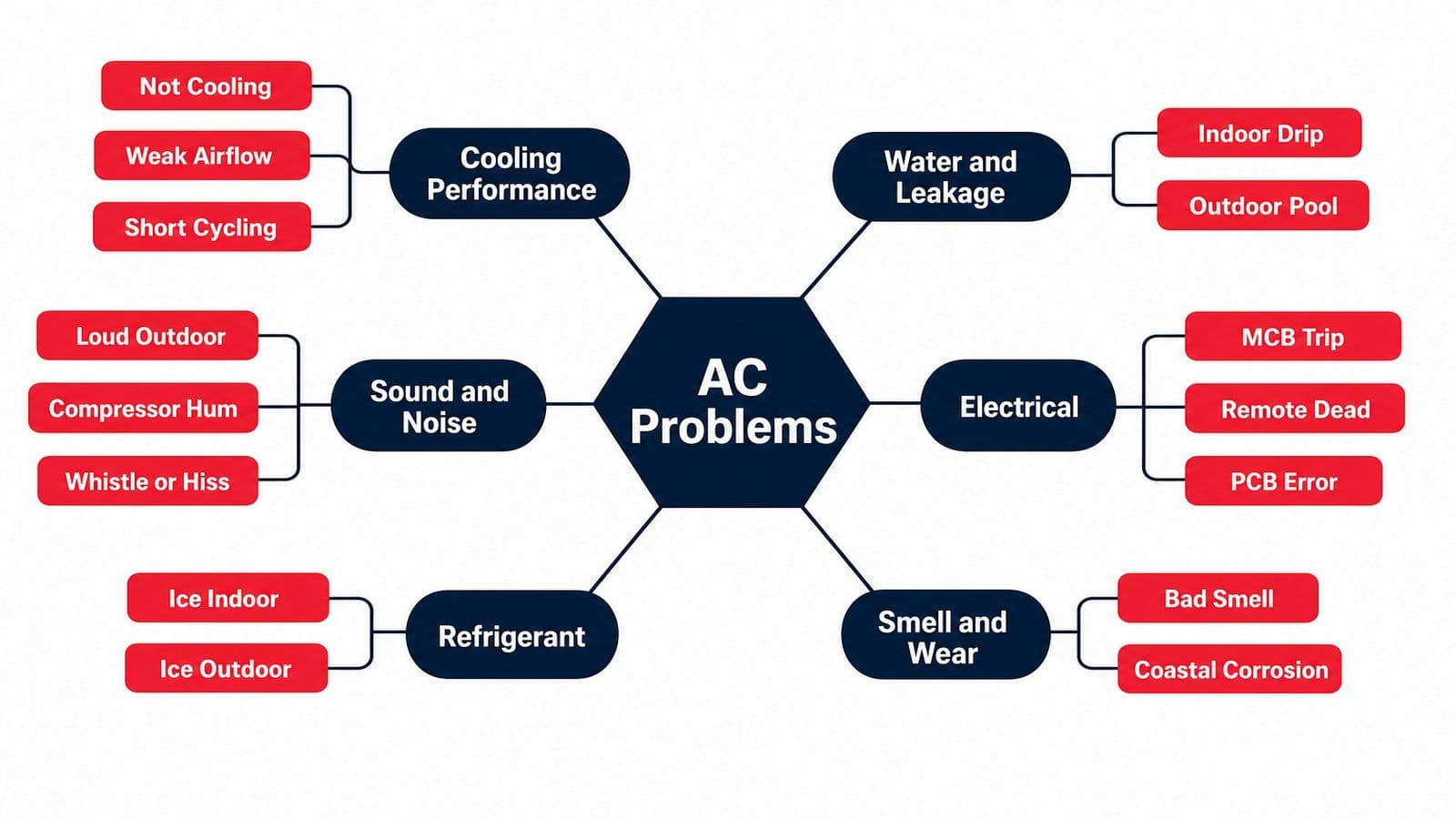
Photo: The 15 Common AC Problems at a Glance

Get quotes from verified, top-rated AC Service & Repair pros in Delhi.
Cooling Performance Problems

Photo: Symptom-to-cause-to-action flowchart
Roughly half of all summer service calls fall here. The unit runs, the fan spins, but the room does not cool. A healthy split AC delivers supply air 13 to 15 degrees below room temperature. If your technician measures less than 8 degrees of drop, the issue is refrigerant, airflow, or compressor.
1. AC Not Cooling at All
The unit switches on, the indoor fan blows, but the air feels barely cool. Six causes account for almost every instance: blocked filters not cleaned in months, a frozen evaporator coil acting as an air dam, a refrigerant leak below operating threshold, a failed capacitor preventing the outdoor compressor from starting, a tripped overload protector, or a seized compressor.
Urgency tag: Call within 48 hours during summer. Running on low refrigerant burns the compressor.
Typical fix cost: ₹400 to ₹600 for filter cleaning. ₹1,200 to ₹2,400 for capacitor replacement. ₹2,500 to ₹6,500 for a gas top-up plus leak fix. ₹18,000 to ₹35,000 if the compressor has failed.
2. Weak Airflow Even Though Unit Runs
The thermostat is set to 22 degrees, the unit reports it is cooling, but very little air comes out of the louvres. The blower wheel may be caked with biofilm. The filter may be partially blocked. The blower motor capacitor may be weak. In ducted systems, a collapsed flexible duct is common.
When weak airflow shows up after the first monsoon shower, the blower wheel is almost always the problem. Damp dust cakes onto the fins overnight and the unit never recovers until we pull the wheel out and wash it in a soap bath. We see this in maybe one out of every four post-monsoon service calls.

Urgency tag: Call within 7 days. Not an emergency but it strains the compressor.
Typical fix cost: ₹500 to ₹900 for blower wheel deep clean. ₹1,400 to ₹2,800 for capacitor or motor replacement.
3. AC Cools Then Stops Cooling Mid-Cycle
The room cools for the first 15 to 20 minutes. Then the outdoor compressor switches off but the indoor unit keeps blowing warm air. After a few minutes it restarts and the cycle repeats. This is short cycling, usually caused by an over-sized AC for the room, a slipped thermostat sensor, low refrigerant tripping the high-pressure cut-out, or a failing thermistor.
Urgency tag: Call within 7 days. Short cycling triples electricity bills.
Typical fix cost: ₹350 to ₹700 for thermistor work. ₹2,200 to ₹4,500 if refrigerant is the cause.
Water and Leakage Problems
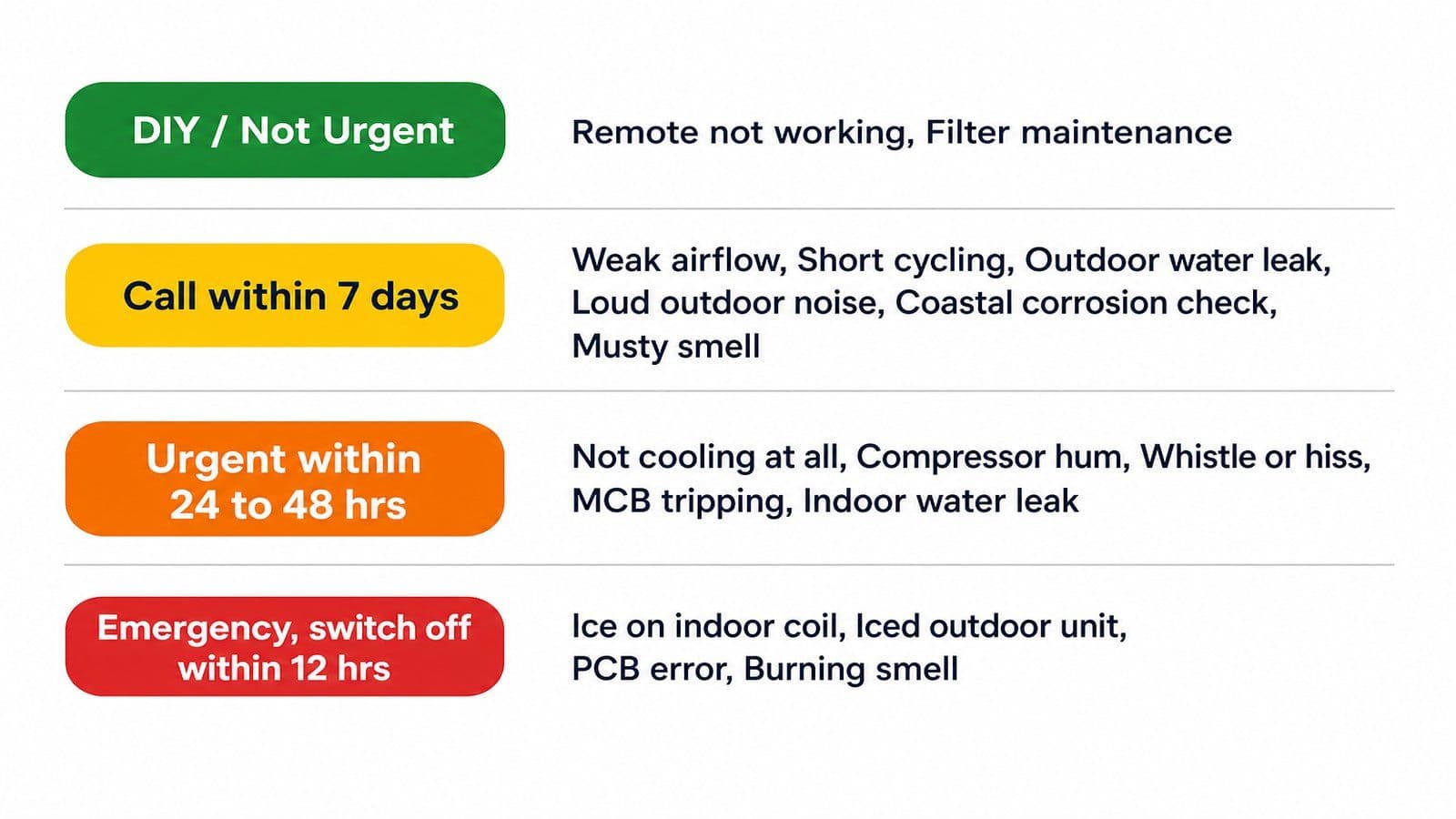
Photo: AC problem urgency colour-coded chart
Get quotes from verified, top-rated AC Service & Repair pros in Delhi.
Monsoon brings water complaints. Roughly 18 percent of the calls our technicians log between June and September involve water dripping where it should not. The cause is almost always a clogged drain line or a blocked condensate pan, both inexpensive to fix if caught early.
4. Water Dripping from Indoor Unit
The most common monsoon complaint. Water drips from the front louvre or runs down the wall behind the indoor unit. Usually the drain pipe is clogged with biofilm, the drain pan is tilted from a loose bracket, or the suction copper pipe insulation has degraded and is sweating.
Urgency tag: Emergency if dripping onto electrical points or the MCB box. Otherwise call within 48 hours.
Typical fix cost: ₹400 to ₹900 for drain flush and pan reposition. ₹600 to ₹1,200 if copper pipe insulation needs replacement.
5. Outdoor Unit Water Leakage
Some condensate from an outdoor unit is normal on humid days. Excessive water pooling signals a blocked drain port, the unit mounted at the wrong angle, or rarely, the outdoor coil itself freezing and thawing due to low refrigerant.
Urgency tag: Call within 7 days unless the water is hitting a neighbour's window or the building's electrical conduit.
Typical fix cost: ₹300 to ₹600 for drain port cleaning and bracket levelling.
Sound and Noise Problems
A healthy split AC measured one metre from the outdoor unit runs at 48 to 54 decibels. Anything louder, or any new noise that was not there last week, is a flag. Indian Society of Heating, Refrigerating and Air Conditioning Engineers (ISHRAE) guidelines suggest investigating any unit that crosses 60 dB at one metre.
6. Loud Noise from Outdoor Unit
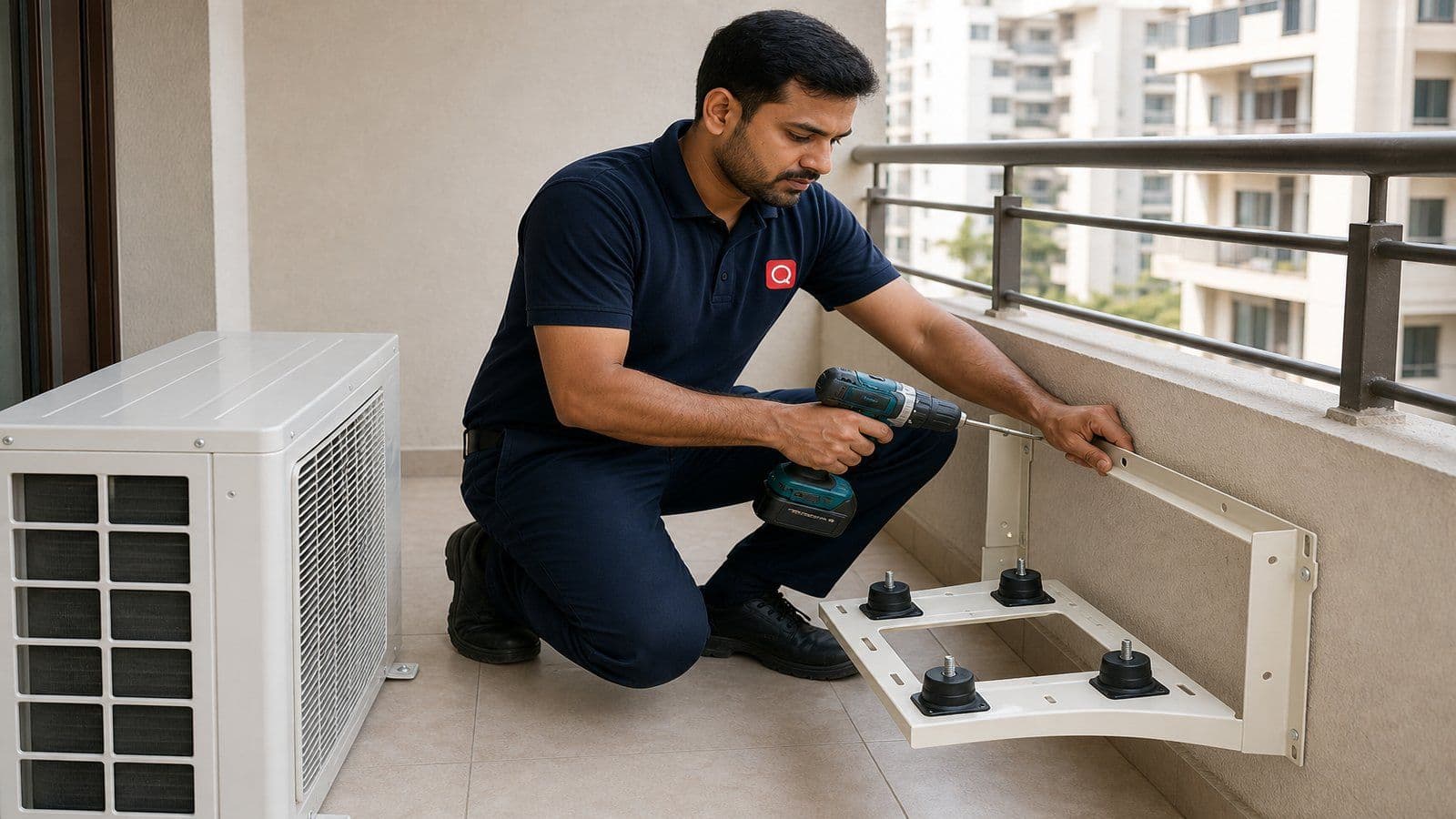
Rattling, banging or grinding from the outdoor unit usually points to three things: loose wall bracket bolts, a cracked or warped fan blade striking the cowl, or degraded compressor mounts letting the compressor vibrate against the chassis.
Urgency tag: Switch off if you hear metal-on-metal grinding. Continued running can destroy the compressor mounting bolts.
Typical fix cost: ₹300 to ₹600 for bracket re-bolting. ₹900 to ₹1,800 for fan blade replacement. ₹1,500 to ₹3,200 for compressor mount kit.
7. Compressor Humming or Rattling
The outdoor compressor hums loudly but does not start cooling. Or it starts with an audible thump and settles into a rough rattle. This is almost always a weak run capacitor unable to give starting torque, a failing start relay, or a compressor near end of life.
A humming compressor with no cool air is the easiest fault for owners to misdiagnose. They assume the gas is over. Eight times out of ten it is just a ₹1,400 capacitor. We tell every customer to ask for a capacitor reading before approving a gas top-up.
Urgency tag: Call within 48 hours. A weak capacitor causes compressor overheating and permanent winding damage.
Typical fix cost: ₹1,200 to ₹2,400 for capacitor swap. ₹800 to ₹1,500 for start relay. ₹18,000 to ₹35,000 if the compressor has failed.
8. Whistling or Hissing Sound
A high-pitched whistle or steady hiss is usually a refrigerant leak. Refrigerant under pressure escaping through a pinhole sounds like a slow tyre puncture. Less commonly, air being sucked through a damaged duct joint or a loose indoor unit panel.
Urgency tag: Urgent. Switch off and call within 24 hours. A refrigerant leak left running burns the compressor and releases F-gases, which the Ministry of Environment, Forest and Climate Change (MoEF&CC) has flagged for stricter handling under the Kigali Amendment.
Typical fix cost: ₹2,500 to ₹6,500 for leak detection plus repair plus gas recharge. ₹3,500 to ₹8,000 if the leak is on the indoor coil.
Electrical Problems
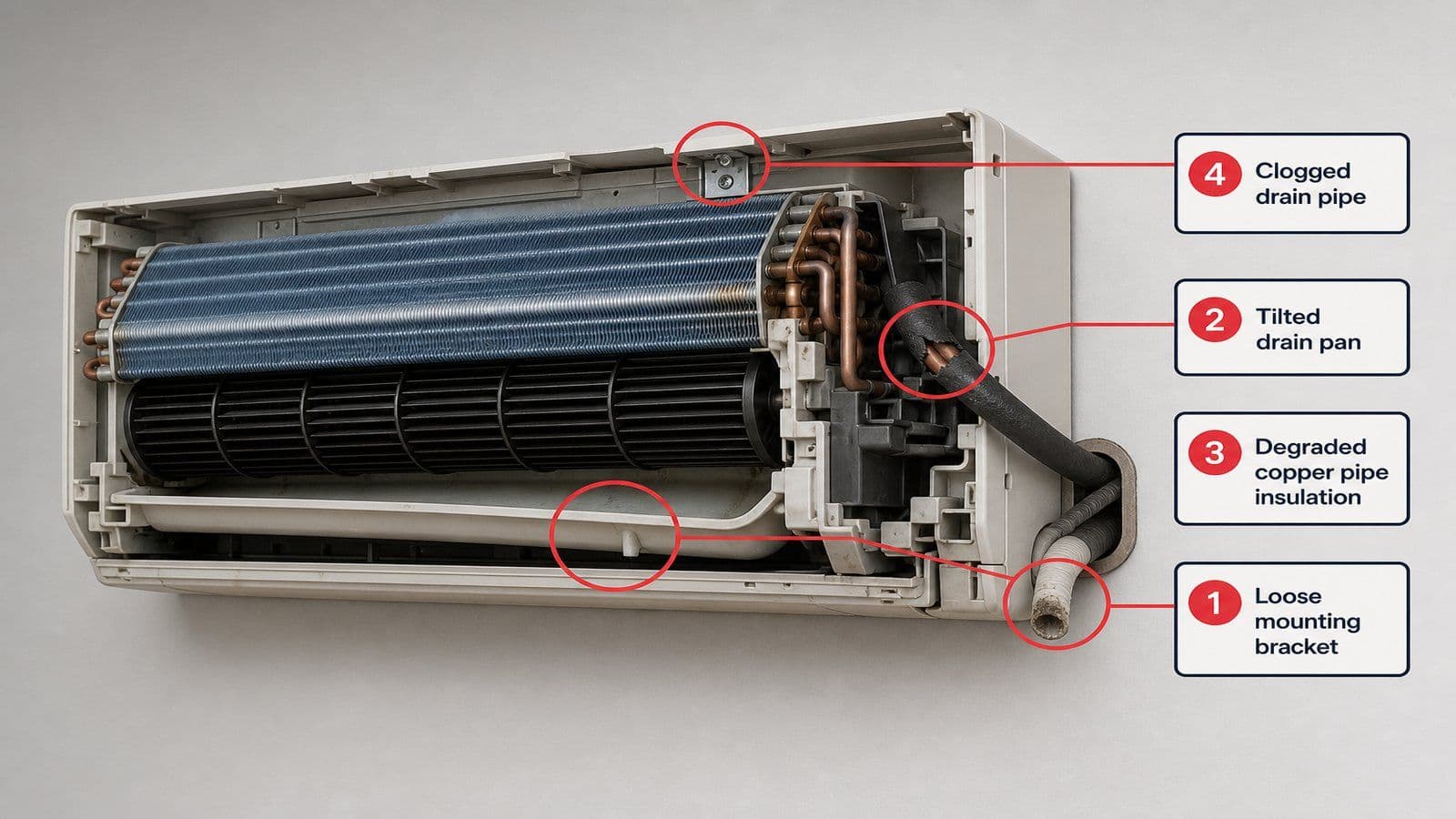
Photo: Indoor unit water leak diagnostic diagram
Get quotes from verified, top-rated AC Service & Repair pros in Delhi.
Electrical issues are the second-largest bucket of AC complaints, especially in older buildings where the wiring was rated for fans and a tube light, not a 1.5 ton inverter AC. The Central Electricity Authority (CEA) recommends a dedicated 16-amp circuit for any AC above 1 ton.
9. AC Tripping the Circuit Breaker
The MCB trips within 10 minutes of switching on, or trips repeatedly through the afternoon. Four common causes: a shared circuit with another high-load appliance, a compressor drawing higher than nameplate current due to a failing capacitor, a short circuit in the wiring or wall socket, or an under-rated MCB.
Urgency tag: Urgent. Do not keep resetting the MCB. Each trip stresses the breaker. Call within 24 hours.
Typical fix cost: ₹600 to ₹1,500 for MCB upgrade. ₹1,200 to ₹2,400 if a capacitor is the cause. ₹3,500 to ₹8,000 if dedicated wiring needs to be pulled.
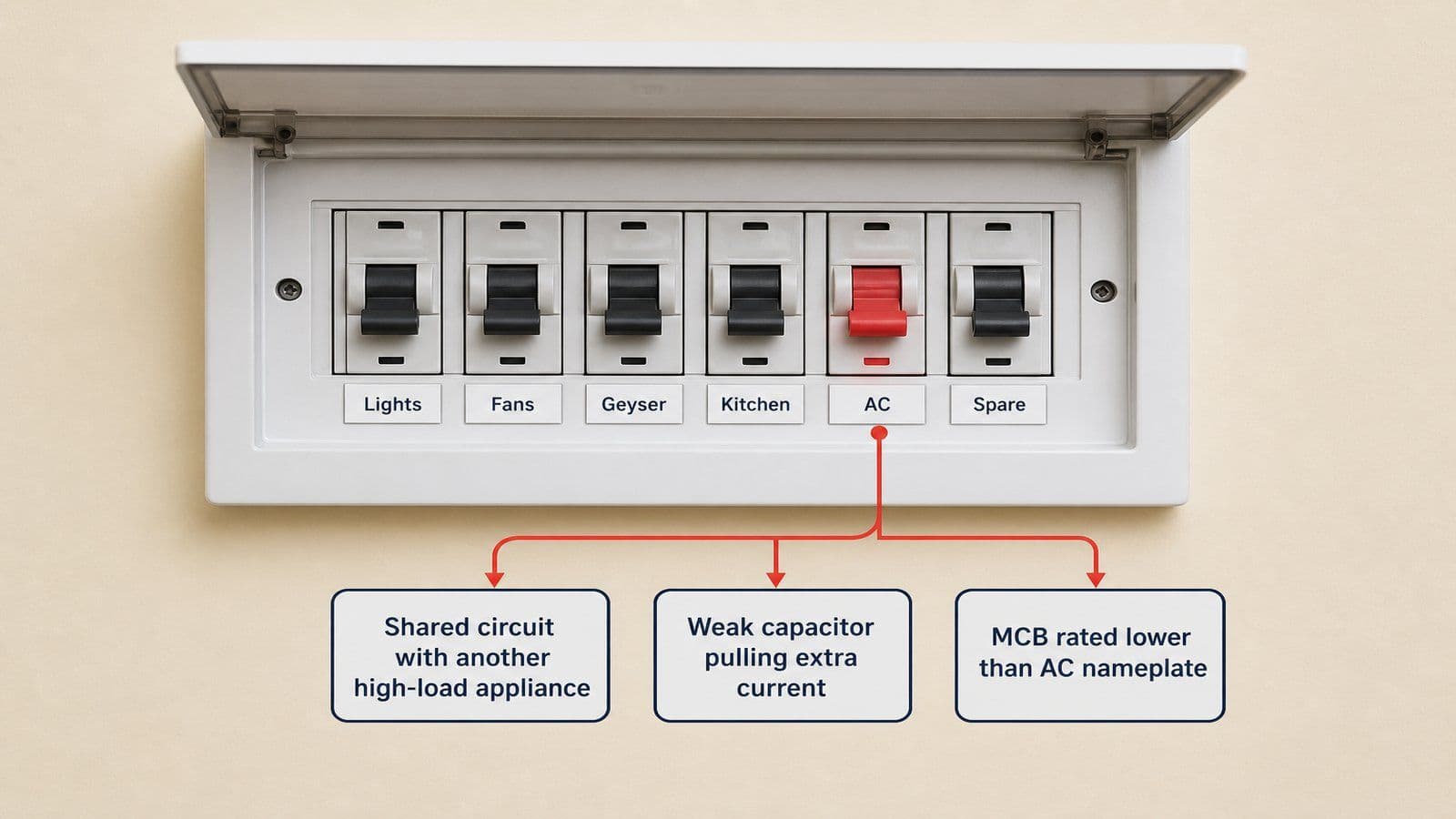
Photo: MCB tripping wiring visual
10. AC Remote Not Working
The unit will not respond even with fresh batteries. Check the remote's IR LED through a phone camera while pressing a button. If the LED is dark, the remote is dead. If it lights up, the indoor unit's IR receiver or PCB is faulty.
Urgency tag: Not urgent. Most modern ACs respond to a wall switch, manual button, or smartphone app.
Typical fix cost: ₹350 to ₹800 for a universal remote. ₹1,800 to ₹3,500 for IR receiver or PCB repair.
11. AC PCB Failure / Display Errors
The display shows a flashing error code, the unit refuses to start, or starts then immediately switches off. Modern PCBs throw codes for compressor faults, sensor failures, communication errors and over-voltage. Every brand uses different codes. The owner's manual or a photo to a technician decodes the error in minutes.
Urgency tag: Urgent. Do not keep power-cycling. Repeated restarts on a PCB error can blow secondary fuses.
Typical fix cost: ₹1,800 to ₹3,500 for sensor replacement. ₹4,500 to ₹9,500 for a full PCB swap on an inverter split. ₹2,800 to ₹5,500 for non-inverter.
Refrigerant Problems
Refrigerant issues account for around 12 percent of summer service calls in our ProNearMe network, but trigger an outsized share of compressor failures because owners keep running the unit hoping cooling returns. Indian regulations under the Ozone Depleting Substances Rules and the Kigali Amendment require any technician handling refrigerants to be NSDC-certified, so this is the strongest case for not attempting DIY.
12. Ice Formation on Indoor Coil
You open the indoor unit cover and find the evaporator coil covered in a thick layer of ice. Or water drips dramatically increase when the unit is switched off. Three causes: refrigerant below threshold causing the coil to fall below freezing, blocked filters or slow blower reducing airflow so moisture freezes faster than it drains, or a stuck expansion valve.
Ice on the indoor coil is the single biggest warning sign that the compressor is about to fail. Every week we get one or two calls where the customer kept running the unit for a fortnight after spotting ice. By the time we arrive the compressor has already lost suction pressure and needs replacement. If you see ice, switch off immediately.
Urgency tag: Emergency. Switch off at the MCB and call within 12 hours.
Typical fix cost: ₹2,500 to ₹6,500 for refrigerant top-up plus leak fix. ₹3,200 to ₹5,500 for expansion valve.
13. Outdoor Unit Iced Over
Less common but more dramatic. Copper pipes between the indoor and outdoor units, or the outdoor coil itself, coated in ice. Signals very low refrigerant pressure or a stuck reversing valve on a heating-capable unit. In coastal cities, salt corrosion on the outdoor coil can also reduce heat exchange enough to ice over.
Urgency tag: Emergency. Switch off and call within 12 hours.
Typical fix cost: ₹2,500 to ₹6,500 for leak repair plus recharge. ₹4,500 to ₹8,500 for reversing valve replacement.
Smell and Air Quality
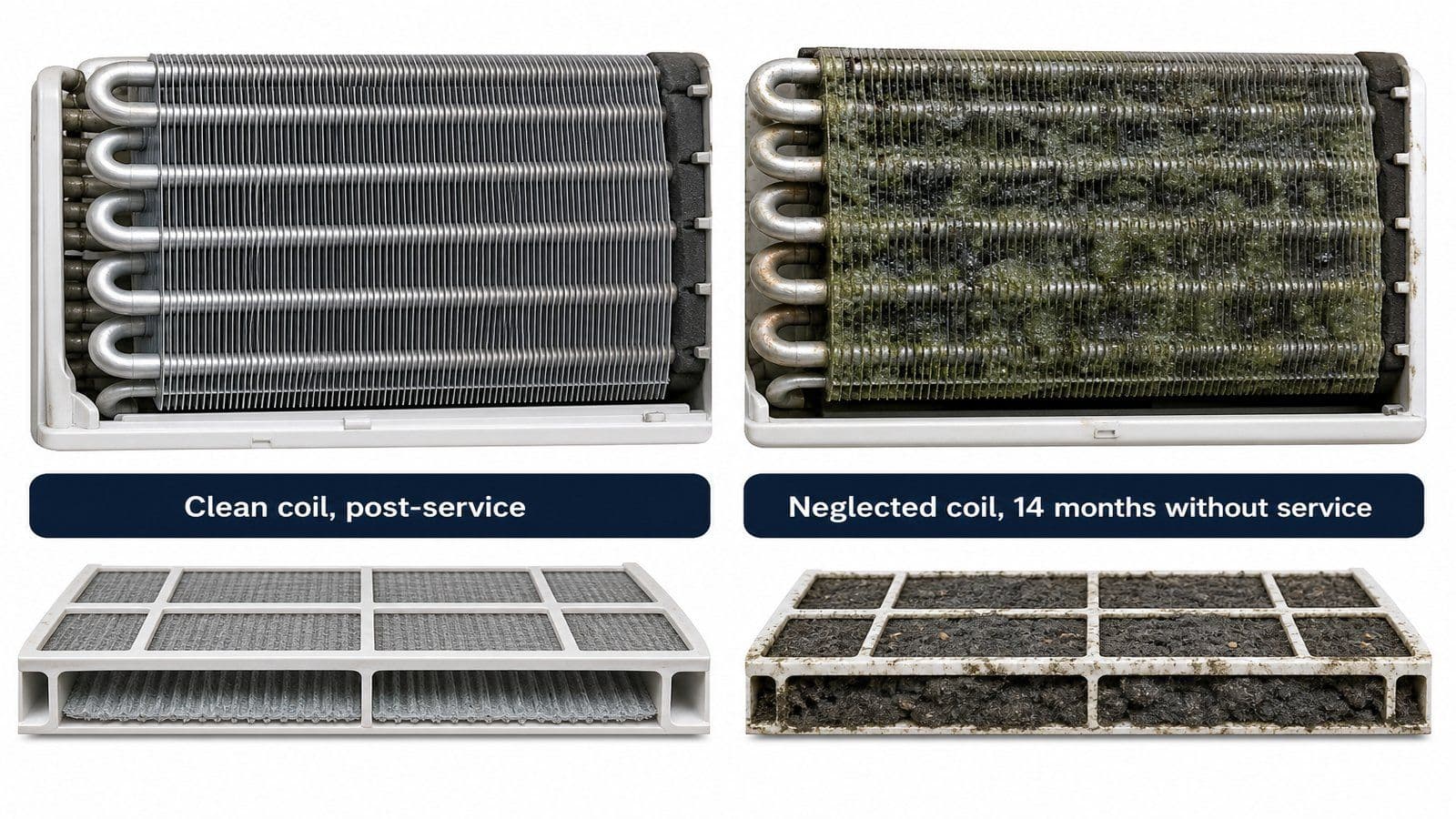
Air conditioners pull warm air across a cold, wet coil. That coil is a textbook breeding ground for mould, bacteria and biofilm. The Bureau of Indian Standards (BIS) IS 17613 indoor air quality standard recommends professional coil cleaning every 6 to 9 months, more often in coastal zones. The Indian Plumbing Association (IPA) has flagged AC condensate drain biofilm as a contributor to musty smells in apartments.
Get quotes from verified, top-rated AC Service & Repair pros in Delhi.
14. Bad Smell from AC
A musty, sock-like or vinegar smell when the AC switches on is the classic dirty-coil signature. A burning electrical smell is something else entirely and means switch off immediately. For musty, the fix is a deep coil clean with foaming biocide, drain flush, and filter wash. For burning, do not switch on again until a technician has inspected the PCB, capacitor and compressor windings.
Case study: Mrs. Priya Iyengar, a customer in Indiranagar, Bengaluru, called us in April 2025 about a sour smell from her three-year-old 1.5 ton split AC. The previous summer she had skipped servicing because the unit "still cooled fine". Our technician found a clogged drain line, biofilm on the coil and dust in the blower wheel. A full chemical clean plus drain flush plus filter replacement cost ₹1,650 and the smell was gone the same day. She has now signed onto a ProNearMe AMC at ₹2,800 a year.
Urgency tag: Musty, call within 7 days. Burning, switch off immediately and call within 24 hours.
Typical fix cost: ₹900 to ₹2,200 for deep chemical clean. ₹2,500 to ₹6,000 for PCB or capacitor work.
Long-Term Wear
The fifteenth issue is not really a fault, it is the slow attrition that affects every AC over a 7 to 12 year life. Recognising it early lets you budget for replacement.
15. Outdoor Unit Corrosion (Coastal Cities)
Coastal cities, especially Mumbai, Chennai, Kochi and Visakhapatnam, expose outdoor units to constant salt-laden air. Aluminium fins corrode, copper-aluminium joints develop pinholes, and the steel chassis rusts. Within four to six years a non-anti-corrosive coastal AC can lose 30 percent of its heat-exchange capacity. Inland cities see the same on a slower 8 to 10 year timeline.
Urgency tag: Not urgent at any single moment, but plan for annual anti-corrosion spray from year four.
Typical fix cost: ₹1,500 to ₹3,000 for annual coating. ₹4,500 to ₹9,500 for fin straightening plus coil treatment.
The 15 AC Problems at a Glance
| # | Problem | Most Likely Cause | Urgency | Typical Fix Cost (₹) |
| 1 | Not cooling at all | Filter, refrigerant, capacitor | Within 48 hrs | 400 to 35,000 |
| 2 | Weak airflow | Blower wheel, capacitor | Within 7 days | 500 to 2,800 |
| 3 | Short cycling | Sensor, refrigerant | Within 7 days | 350 to 4,500 |
| 4 | Indoor water leak | Drain clog, pan tilt | 48 hrs (emergency if near MCB) | 400 to 1,200 |
| 5 | Outdoor water leak | Drain port, bracket angle | Within 7 days | 300 to 600 |
| 6 | Loud outdoor noise | Bracket, fan, compressor mount | Switch off if grinding | 300 to 3,200 |
| 7 | Compressor hum | Capacitor, start relay | Within 48 hrs | 800 to 35,000 |
| 8 | Whistle or hiss | Refrigerant leak | Urgent, 24 hrs | 2,500 to 8,000 |
| 9 | MCB tripping | Shared circuit, capacitor, wiring | Urgent, 24 hrs | 600 to 8,000 |
| 10 | Remote not working | Battery, IR receiver | Not urgent | 350 to 3,500 |
| 11 | PCB error or display | Sensor, PCB | Urgent, do not power-cycle | 1,800 to 9,500 |
| 12 | Ice on indoor coil | Refrigerant, airflow | Emergency, 12 hrs | 2,500 to 6,500 |
| 13 | Iced outdoor unit | Refrigerant, reversing valve | Emergency, 12 hrs | 2,500 to 8,500 |
| 14 | Bad smell | Biofilm or electrical | 7 days or 24 hrs if burning | 900 to 6,000 |
| 15 | Outdoor corrosion | Coastal exposure | Annual planning | 1,500 to 9,500 |
Owners who call within the first week of noticing a small symptom pay an average of ₹1,400 to resolve it. Owners who wait until the unit fails completely pay an average of ₹6,200. That four-and-a-half-times multiplier is the most consistent pattern in our service-call data.
What These Symptoms Tell You About Servicing Cadence
If your AC has thrown two or more of the problems above in the past 12 months, the unit is overdue for proper preventive service rather than another spot-fix. The Press Information Bureau (PIB) energy advisory and BEE both recommend twice-yearly servicing, a full chemical clean in February or March before peak summer, and a lighter mid-monsoon check in August. At ProNearMe AMC pricing of ₹2,400 to ₹3,200 a year, that is roughly the cost of a single emergency repair.
For deeper grounding in efficiency standards see our cluster pieces on BEE star rating explained and types of AC units compared. For air quality, see AC and indoor air quality.
Conclusion
Most common AC problems Indian owners face are predictable and inexpensive to fix when caught early. The hardest part is recognising the symptom before the underlying fault has damaged the compressor, PCB or building wiring. The 15 issues in this guide cover roughly 95 percent of what our ProNearMe network technicians see in a typical year. Match the symptom to the most likely cause, note the urgency tag, and call a NSDC-certified technician within the recommended window.
Two habits prevent most of these problems from recurring. Wash the indoor filters every two to four weeks during summer. Book a preventive service in February or March before peak season. Owners who follow both habits report 70 percent fewer summer breakdown calls in our annual customer survey. An AMC consistently costs less than a single emergency repair.
Disclaimer
All cost ranges in this guide are typical residential figures and exclude GST, which is currently 18 percent on most AC service and parts in India. Actual costs vary by city, brand of replacement part, and the specific technician's labour rate. We strongly recommend hiring only NSDC-certified or OEM-trained technicians for any refrigerant handling, electrical work or PCB diagnosis. ProNearMe does not endorse any specific AC brand and the issues covered apply across all manufacturers.
Sources & References
- Bureau of Energy Efficiency (BEE) Air Conditioner Energy Efficiency Standards and Labelling Programme
- Bureau of Indian Standards (BIS) IS 17613 Indoor Air Quality Standard
- Ministry of Environment, Forest and Climate Change Ozone Depleting Substances Rules and Kigali Amendment Implementation
- Press Information Bureau Advisory on Energy Efficient Air Conditioning
- National Skill Development Corporation HVAC Technician Qualification Pack
- Indian Society of Heating, Refrigerating and Air Conditioning Engineers Residential HVAC Guidelines
- Central Electricity Authority Wiring and Safety Regulations for Domestic Installations
- Indian Plumbing Association Condensate Drain and Indoor Air Quality Guidelines
Amit worked as an AC technician for 6 years in Ahmedabad before transitioning to technical writing. He holds a diploma in Refrigeration and Air Conditioning from ITI Ahmedabad and understands the difference between what AC companies promise and what actually happens on the ground. His articles break down complex technical topics into plain language that any homeowner can follow. He tests every tip he writes about in his own home first.

Dr. Verma is a mechanical engineer with 15 years of experience in HVAC systems. She completed her PhD from IIT Delhi on energy-efficient cooling solutions for Indian residential buildings. She reviews all technical content on HomePros to make sure the numbers are right, the advice is safe, and the recommendations are backed by actual engineering principles. She consults for multiple AC manufacturers on product design.