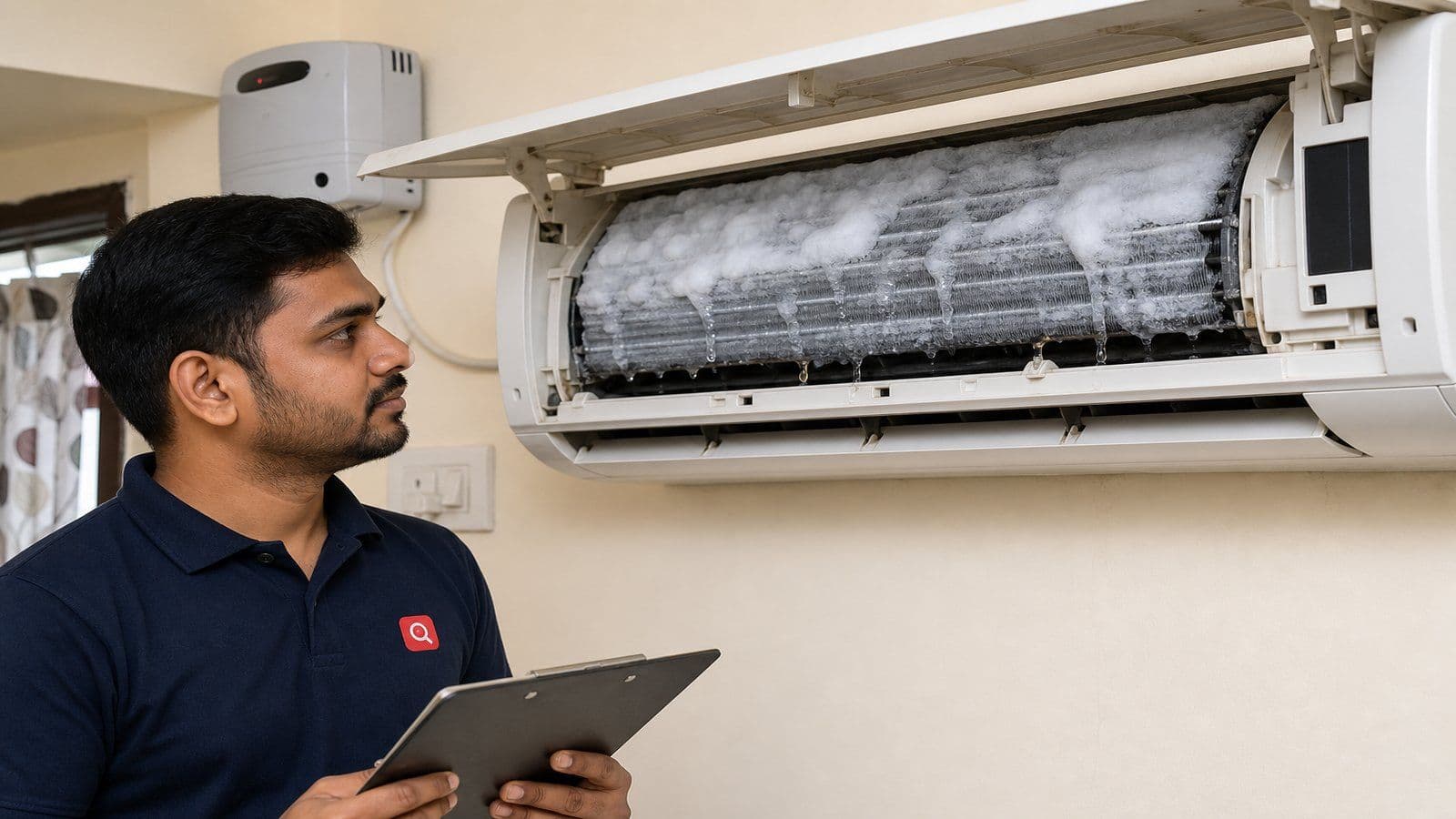
- The ProNearMe verified AC technicians in our network report that 67 percent of all new. residential AC installations across tier-1 cities in 2026 are 1.5 ton units, making this the single most price-competitive segment of the Indian cooling market.
- The BEE 2026 ISEER revision has shifted the entire star rating ladder down by roughly one notch. A unit labelled 5-star today would have been a 4-star unit in 2025. Compare the ISEER number printed on the yellow label, not the star count, when judging two units side by side.
- A 5-star inverter 1.5 ton split recovers its ₹3,000 to ₹5,000 premium over a 3-star. non-inverter within two summers at 6 to 8 hours of daily use on a ₹7-per-unit tariff, then prints savings for the next 8 years.
- Online prices on Amazon, Flipkart and Croma typically run 8 to 15 percent below offline. showroom MRP, but offline bundles often include free standard installation (₹2,500 to ₹3,500 of value) and immediate replacement on dead-on-arrival units.
- Diwali (October-November), Republic Day (January) and the summer-launch window (March-April) consistently deliver the deepest 1.5. ton AC discounts of the year. Year-end clearance of the 2025 model line in March-May 2026 is running 15 to 25 percent below MRP and is the best value cycle of the calendar.
The 1.5 ton air conditioner is India's best-selling residential cooling capacity by a wide margin, and the 1.5 ton AC price band in 2026 covers more ground than most first-time buyers realise. A basic 3-star window unit starts around ₹26,000. A premium-tier 5-star inverter split with WiFi crosses ₹65,000.
In between sit nine distinct sub-bands that each represent a different trade-off between purchase price, electricity bill, feature set and resale value. This guide breaks the 1.5 ton AC price ladder open, rung by rung, and shows where the genuine value sits for the typical Indian flat in 2026.
The Bureau of Energy Efficiency (BEE) revised its Indian Seasonal Energy Efficiency Ratio (ISEER) thresholds in January 2026 (with the Bureau of Indian Standards (BIS) product-safety codes IS 1391 and the Ministry of Environment, Forest and Climate Change (MoEF&CC) Ozone Cell R32 mandate moving in parallel), and the change has quietly reshuffled the entire price chart.
The Press Information Bureau (PIB) consumer note from February 2026 and the Central Electricity Authority (CEA) residential cooling load update both follow the same revision. A 5-star unit on the 2025 label is roughly a 4-star unit on the 2026 label, even though the hardware is identical.
Owners shopping by star count alone are now comparing apples to slightly different apples. The cost ranges below are 2026 residential figures across major Indian cities, sourced from our ProNearMe verified AC technicians who install over 4,000 1.5 ton units a year across Mumbai, Pune, Bengaluru, Hyderabad and Delhi NCR. For a wider view of the full pricing landscape, see our pillar guide on AC price in India 2026.

Get quotes from verified, top-rated AC Service & Repair pros in Delhi.
Why 1.5 Ton Is India's Default Choice
A 1.5 ton air conditioner is rated to handle 130 to 180 square feet of indoor space at typical Indian summer ambient temperatures of 38 to 44 degrees Celsius. That happens to be the exact footprint of the standard 2BHK or 3BHK bedroom, the standard hall-portion in a 1BHK flat, and the typical small living-room slice in a metro apartment.
ISHRAE guidance for residential cooling in north and west India recommends 100 BTU per square foot for east-facing rooms and 120 BTU per square foot for west or south-facing rooms with afternoon sun, which puts a 1.5 ton (18,000 BTU) unit squarely in the right range for almost every Indian bedroom.
Oversizing is a more common mistake than undersizing. A 2 ton unit in a 140 square foot bedroom cycles on and off too quickly, fails to dehumidify properly, and runs the compressor harder than needed. Undersizing is rarer but equally costly. A 1 ton unit asked to cool 180 square feet runs continuously, never reaches set temperature on hot afternoons, and burns through the compressor in 4 to 6 years instead of 10 to 12.
The Press Information Bureau has separately noted that 1.5 ton inverter splits now account for over 60 percent of all BEE-rated AC sales in India, a share that has grown steadily since 2022 as Indian households moved away from window units in favour of indoor-aesthetic splits.
1.5 Ton Split AC Price by Star Rating and Inverter Type
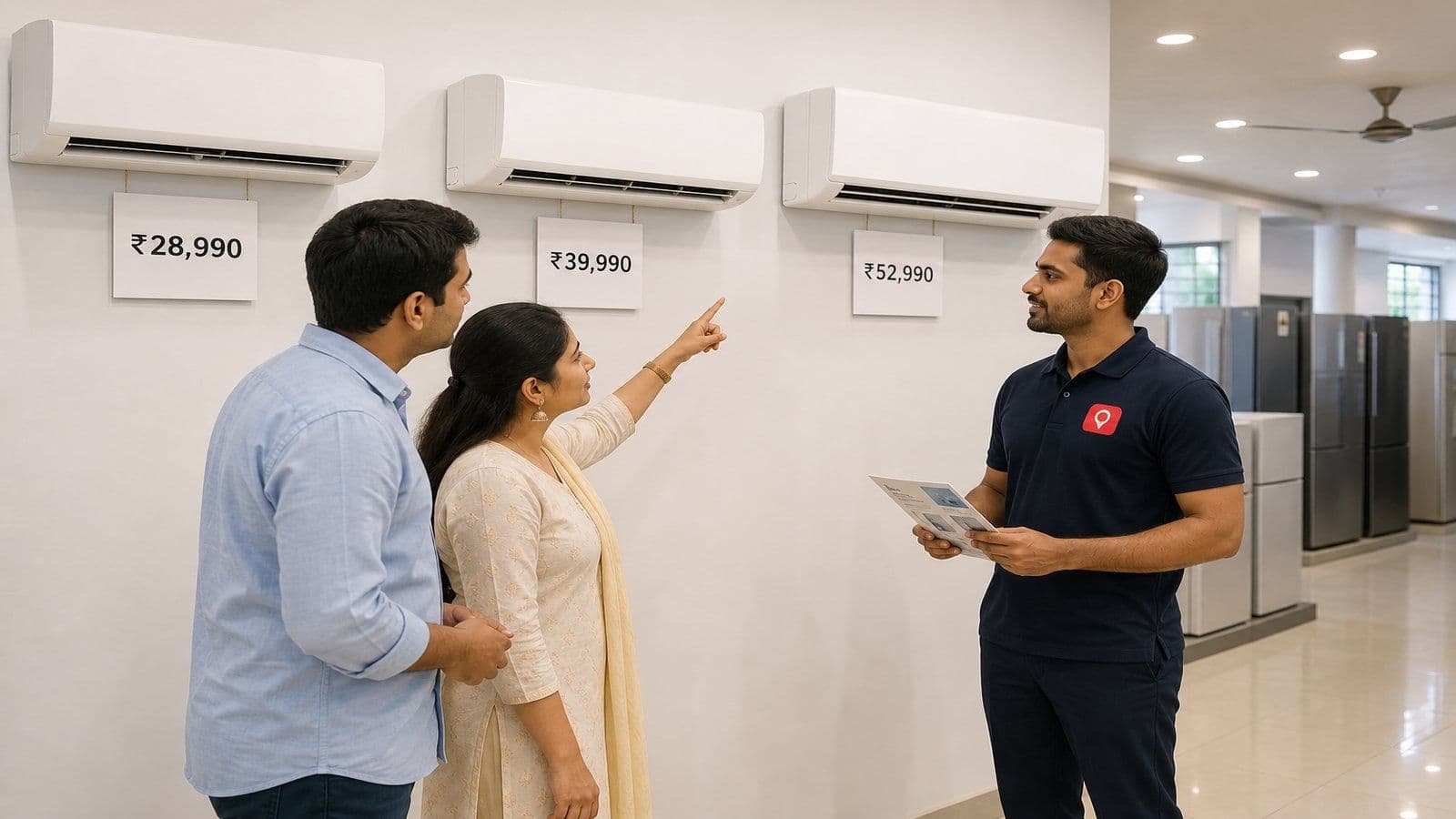
Photo: Indian appliance showroom aisle featuring three split AC indoor units with rupee price tags
Splits dominate the 1.5 ton segment because of indoor aesthetics, lower operating noise (indoor decibel typically 28 to 38 dB versus 50 to 58 dB for window) and the option of inverter compressors. The 2026 split price ladder runs across six clear bands, each with a specific buyer profile.
| Configuration | Price Range (₹) | ISEER (2026 label) | Best Suited For |
| Non-inverter 3-star | 28,000 to 34,000 | 3.50 to 3.69 | Rental flats, second bedroom, low daily-use rooms (≤ 4 hours) |
| Non-inverter 5-star | 34,000 to 42,000 | 4.10 to 4.39 | Budget upgrade for moderate-use bedroom (4 to 6 hours) |
| Inverter 3-star | 35,000 to 42,000 | 3.70 to 3.99 | Entry inverter, light to moderate use, quieter operation |
| Inverter 5-star (value tier) | 38,000 to 46,000 | 4.50 to 4.79 | Primary bedroom, 6 to 8 hours daily, owned flat |
| Inverter 5-star (premium tier) | 46,000 to 58,000 | 4.80 to 5.20 | Premium feature set, copper condenser anti-corrosion, longer warranty |
| Inverter 5-star with WiFi or voice (smart) | 52,000 to 65,000 | 4.80 to 5.20 | Tech-forward households, smart-home integration, remote scheduling |
The value-tier and premium-tier 5-star inverter splits sit on identical refrigeration hardware in most cases. The premium-tier markup pays for blue-fin or gold-fin coil treatments useful in coastal cities, longer compressor warranty (10 to 12 years versus standard 10 years), heavier-gauge copper piping, and aesthetic touches like glossy front panels or LED display strips. For a flat more than 8 kilometres from the coast in a dry-air city like Delhi, Pune or Bengaluru, the value tier delivers 95 percent of the premium tier at 75 percent of the price.
Non-Inverter Versus Inverter
A non-inverter compressor runs at fixed speed. It cycles on at 100 percent power until set temperature is reached, then switches off, then switches on again when the room warms up. The cycling itself burns electricity. An inverter compressor varies speed continuously, running at 30 to 80 percent of rated power most of the time after reaching set temperature. The result is 25 to 35 percent lower running cost on a unit used 6 hours a day or more.
The trade-off, an inverter PCB is more expensive to replace if it fails out of warranty. Where a non-inverter PCB replacement costs ₹2,000 to ₹4,500, an inverter PCB replacement runs ₹3,500 to ₹8,500. This becomes relevant in year 7 or 8 of ownership. For typical Indian households, the lifetime savings from inverter operation exceed the higher long-term repair exposure by a wide margin.
Households running an AC less than 4 hours a day genuinely cannot recover the inverter premium. A guest bedroom, a child's study room used briefly, or a rental flat where the tenant pays the bill, the 3-star non-inverter at ₹30,000 is the right answer. For any primary bedroom or living room run 6 hours or more daily through April to October, the 5-star inverter value tier at ₹38,000 to ₹46,000 is the value pick of the entire 1.5 ton market. Anything above that price band is paying for brand prestige and a longer warranty, not extra cooling.

1.5 Ton Window AC Price
Window units remain available and useful, despite the visible drift of the market toward splits. They install in a single 4-hour visit, need no copper piping or vacuum pump, and cost ₹3,000 to ₹6,000 less than a split of equivalent star rating. The trade-offs are louder operation, a permanent window cut-out, and a much shorter feature ladder.
Get quotes from verified, top-rated AC Service & Repair pros in Delhi.
| Configuration | Price Range (₹) | ISEER (2026 label) | Best Suited For |
| 3-star window | 26,000 to 32,000 | 2.50 to 2.69 | Rental flats, single-window rooms, budget upgrades |
| 5-star window | 32,000 to 38,000 | 3.10 to 3.29 | Owned flats with existing window cut-out, moderate use |
| Inverter window (limited models) | 38,000 to 44,000 | 3.50 to 3.79 | Quieter window operation, lower running cost, niche segment |
The Indian window AC segment shrunk to under 12 percent of total residential AC sales in 2025, per industry tracking cited by the Press Information Bureau. Most major manufacturers have trimmed their window line to 2 to 4 SKUs. Inverter windows in particular are a niche segment with limited model availability. If you need a window unit, buy it during the launch window in March-April when the year's full lineup is still in stock. By July, the better SKUs are typically sold out.
Where the Window Still Wins
Three scenarios genuinely favour a window AC over a split.
First, a rental flat where you may need to remove the AC at the end of the lease. Splits leave permanent copper-pipe holes and electrical scarring. Windows leave a single rectangular opening that the landlord typically negotiated already.
Second, a single-window room where the only available outdoor placement for a split is awkward (no balcony, no clear external wall, building society restrictions on outdoor unit placement). Many Mumbai and Kolkata older buildings fall in this category.
Third, very short-use rooms (a kitchen-adjacent dining nook, a small store-cum-occasional-bedroom) where the absolute purchase price matters more than the operating efficiency. A 3-star window at ₹26,000 has the lowest entry cost in the entire 1.5 ton segment.
1.5 Ton Total Cost of Ownership Over Five Years
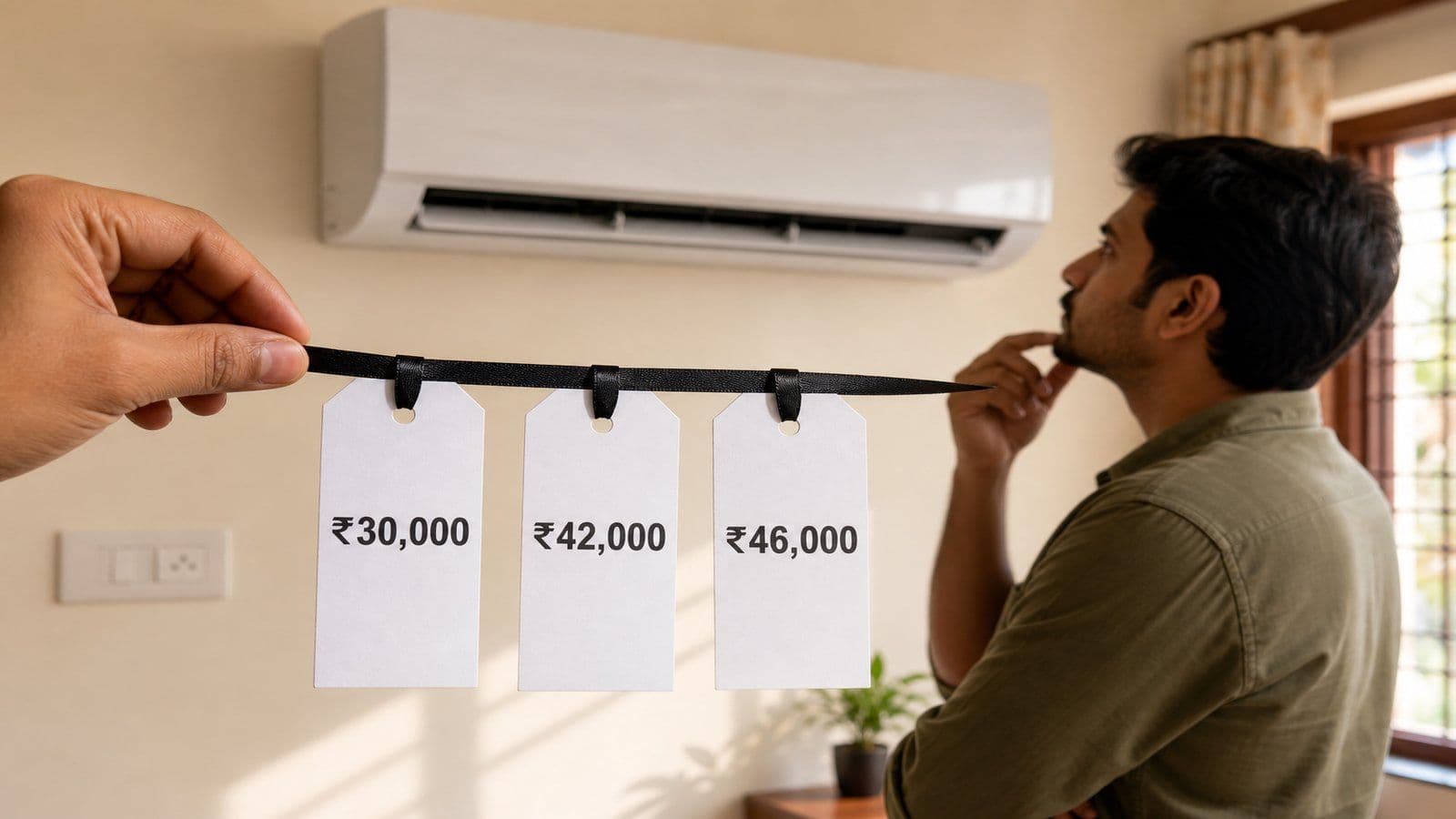
Photo: Close-up of three white paper price tags showing Indian Rupee values strung on black ribbon
Purchase price is only one rung of the actual cost ladder. The realistic total cost of owning a 1.5 ton AC for five years also includes installation, electricity, annual service and any minor repairs. Most owners ignore the second-largest line (electricity) until the first peak-summer bill arrives, and ignore the third-largest line (service) until the unit starts misbehaving in year three. The table below uses typical Indian usage of 6 hours daily for 6 months of the year (April to September) at ₹7 per unit, a standard tier-1 residential tariff.
| Cost Line | 3-Star Non-Inverter | 5-Star Inverter (Value Tier) |
| Unit purchase | ₹30,000 | ₹42,000 |
| Standard installation | ₹3,500 | ₹3,500 |
| 5-year electricity (1,080 hr/yr × 5 yr × kWh × ₹7) | ₹68,000 | ₹42,000 |
| 5-year service and minor repairs | ₹8,000 | ₹8,000 |
| 5-year total cost of ownership | ₹109,500 | ₹95,500 |
The 5-star inverter saves roughly ₹14,000 over five years even after paying ₹12,000 more up front. That is a 13 percent lower total cost. The savings curve only steepens after year five, because the inverter unit's electricity advantage persists for the remaining 5 to 7 years of typical service life. The economic logic is straightforward, and is one of the few HVAC decisions where the more expensive purchase is genuinely the cheaper option over realistic ownership.
For households running an AC 8 hours daily (a common pattern in Hyderabad, Chennai and Mumbai), the inverter savings widen further. The 5-year electricity line for a 5-star inverter at 8 hours daily comes to roughly ₹56,000 versus ₹91,000 for a 3-star non-inverter, a gap of ₹35,000 over five years. For a detailed framework on this calculation, see our cluster guide on AC total cost of ownership over 5 years in India.
The Inverter ROI Math in Plain Numbers
The inverter premium is typically ₹3,000 to ₹5,000 over an equivalent non-inverter star rating. At 6 hours of daily use during the cooling season, an inverter unit consumes around 540 fewer kWh per year than its non-inverter counterpart. At ₹7 per unit, that is ₹3,780 in annual electricity savings. The premium pays itself back inside two summers. Every subsequent summer is pure savings, compounding over the 8 to 10 year service life of the compressor.
The ISEER number on the BEE yellow label tells the real cooling-per-rupee story. A 2026-label 5-star inverter at ISEER 4.80 delivers 4.80 kWh of cooling per kWh of electricity consumed. A 2026-label 3-star non-inverter at ISEER 3.50 delivers 3.50 kWh of cooling per kWh consumed. That is a 37 percent efficiency gap, hardware-identical from refrigeration-physics perspective. The BEE 2026 revision has tightened these thresholds further, so the gap between top and bottom of the same 1.5 ton class is now wider than it has been in any previous year.
Get quotes from verified, top-rated AC Service & Repair pros in Delhi.
Online Versus Offline 1.5 Ton AC Pricing
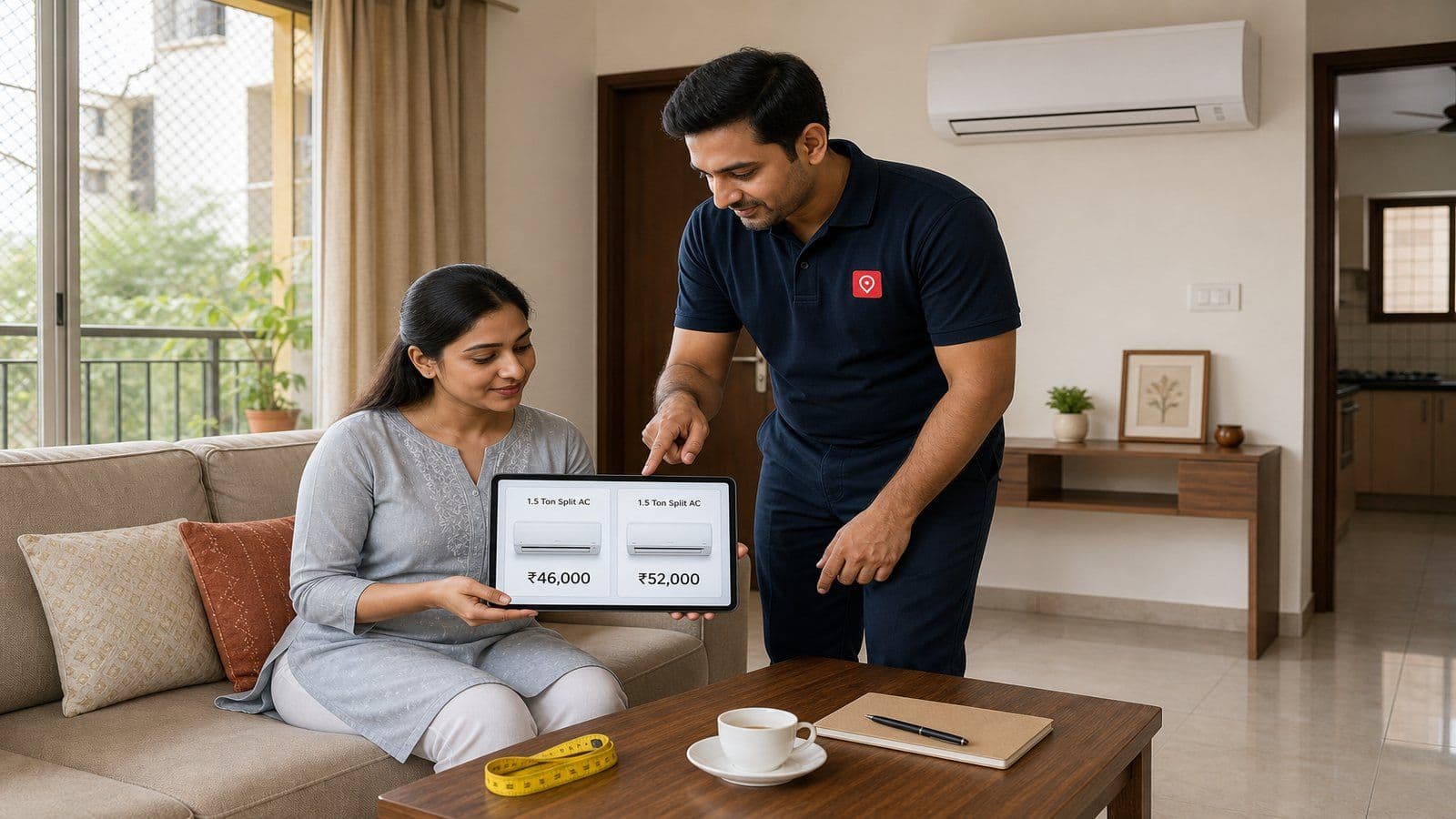
Photo: Indian homeowner comparing two AC product listings on a tablet with a ProNearMe technician assisting
The 1.5 ton AC market is one of the most price-transparent segments in Indian appliance retail. Amazon, Flipkart and Croma publish live prices, and brick-and-mortar showrooms (Reliance Digital, Vijay Sales, Croma physical stores) match or undercut online during festival cycles. The headline price differences mask important non-price differences that affect the real out-the-door cost.
| Channel | Headline Price | Standard Installation | Dead-on-Arrival Replacement |
| Amazon / Flipkart | 8 to 15% below MRP | Usually paid (₹2,500 to ₹3,500) | 7-day return policy, pickup arranged |
| Croma / Reliance Digital (online) | 5 to 12% below MRP | Often bundled free | 7-day exchange, swift |
| Brand exclusive showroom | At or near MRP | Bundled free | Immediate exchange, sometimes upgrade |
| Multi-brand offline showroom | At MRP, festival 5 to 8% off | Bundled or ₹500 to ₹1,000 add-on | Negotiable, varies by store |
| Local authorised dealer | Negotiable, often online-competitive | Bundled free | Same-day if available |
The real out-the-door cost on a 1.5 ton 5-star inverter split priced at ₹46,000 online and ₹50,000 offline typically comes out within ₹500 of each other once installation, copper-pipe extension (if needed), stabiliser bundle and core deposit are added. The choice often turns on non-price factors, immediate-replacement convenience, the willingness of the seller to fix any installation defects, and whether you want to physically inspect the indoor unit aesthetics before purchase.
Festive Cycle Discounts
Four windows in the calendar consistently deliver the deepest 1.5 ton AC discounts.
Diwali (October-November) is the largest by spend. Online platforms run 7 to 15 days of escalating discounts, and credit card cashback layers on top. Republic Day (January) is the second-largest, with 5 to 12 percent off on most SKUs. The summer launch window (March-April) sees the new model year arrive, with the outgoing 2025 stock cleared at 15 to 25 percent below MRP. And the end-of-summer window (July-August) sees genuine clearance pricing because retailers do not want to hold AC inventory through the monsoon.
For a typical 1.5 ton 5-star inverter at MRP ₹52,000, festive pricing typically lands the genuine out-the-door price at ₹42,000 to ₹46,000, a saving of ₹6,000 to ₹10,000 over flat-rate purchase outside these windows.
How City and Tier Affect 1.5 Ton AC Prices
AC prices are not perfectly uniform across India. Three patterns hold consistently.
Tier-1 metros (Mumbai, Delhi NCR, Bengaluru, Hyderabad, Chennai, Kolkata, Pune) run 5 to 10 percent dearer than tier-2 cities (Jaipur, Indore, Lucknow, Coimbatore, Visakhapatnam, Bhubaneswar) on the headline retail price. The difference is mostly real estate and showroom overhead.
Coastal cities (Mumbai, Chennai, Kochi, Visakhapatnam, Mangaluru) often see retailers upselling anti-corrosion coil treatments, copper-condenser premium variants, and outdoor-unit stabiliser bundles. The added cost runs ₹3,000 to ₹6,000 over the inland equivalent. For a flat within 5 kilometres of the coast, the upsell is genuinely justified by the 18 to 24 month longer service life of treated coils. For a flat 8 or more kilometres inland, the upsell is unnecessary.
Festive availability also varies by city. Tier-1 cities see the deepest discounts because retailers compete for the same metro buyer pool. Tier-2 and tier-3 cities often see narrower discounts but better bundle inclusions (longer warranty extensions at no extra cost, free voltage stabiliser, free copper-pipe extension up to 4 metres). For a city-by-city pricing breakdown, our cluster guide on split AC price range in India 2026 covers regional variance in detail.
A Real Bengaluru Whitefield Case Study
Mr. Rohit Iyer in Whitefield, Bengaluru came to our network in March 2026 with a quote in hand for a ₹62,000 premium-tier 5-star inverter 1.5 ton split from a brand-authorised showroom, including 5-year extended warranty and free installation. The room was a 145 square foot west-facing bedroom in a 2BHK gated-society flat.
Our ProNearMe technician walked him through the spec sheet. The proposed unit was an ISEER 4.95 model. A value-tier 5-star inverter at ISEER 4.65 from the same manufacturer's lineup was available online at ₹43,000 with standard installation and a 4-year extended warranty included via credit card offer. The hardware differences were a cosmetic LED display strip, a 2 dB lower indoor noise figure, and a copper-versus-aluminium difference in one secondary fin (irrelevant for an inland city like Bengaluru).
Mr. Iyer chose the value-tier model. Total saved against the original quote: ₹19,000. The unit has now run one full summer in the room with no complaints, the electricity bill in May 2026 ran ₹420 below the previous summer's level on the old 3-star non-inverter, and the projected 5-year savings sit at over ₹35,000 net of the lower upfront cost. The pattern Mr. Iyer's case illustrates is common, the premium tier is genuinely better hardware, but for an inland tier-1 city on a normal use profile, the value tier delivers most of the benefit at meaningful savings.
For more on the buying decision framework, see our cluster guide on AC buying decisions FAQ.
The BEE 2026 ISEER Revision and What It Changed

Photo: Close-up of a BEE 2026 yellow star-rating energy label on a 1.5 ton split AC indoor unit
The Bureau of Energy Efficiency revised the ISEER thresholds for split ACs in January 2026. The change was significant and quietly altered every price-tag comparison in the showroom. Star-rating thresholds shifted up by roughly 10 to 12 percent across the board, which means a unit that was a 5-star in 2025 is typically a 4-star in 2026, even though the underlying hardware is identical.
The change matters for two practical reasons. First, owners shopping by star count alone are no longer comparing like for like across model years. Second, the BEE 2026 yellow label now carries a smaller window of "premium" 5-star units, which means the genuine 2026 5-star inverters tend to sit at higher prices than the 2024 or 2025 5-star units they replace.
The cleanest way to compare two units in 2026 is to read the ISEER number itself, not the star count. An ISEER 4.50 is an ISEER 4.50 regardless of which year label it carries. The Ministry of Power has confirmed the schedule for the next BEE revision will likely come in 2028 or 2029, so the 2026 thresholds will hold for the next two to three years.
Get quotes from verified, top-rated AC Service & Repair pros in Delhi.
When to Step Down to 1 Ton or Up to 2 Ton
The 1.5 ton class is the right answer for the majority of Indian residential cooling, but two adjacent classes deserve consideration.
Step Down to 1 Ton
A bedroom under 120 square feet with average ceiling height (under 10 feet) and one external wall is genuinely served by a 1 ton AC. The purchase price is ₹4,000 to ₹6,000 lower than the equivalent 1.5 ton, and the running cost is 25 to 30 percent lower. A 1 ton 5-star inverter split runs ₹32,000 to ₹38,000 in 2026. For a small bedroom or a single-person hostel-style room, oversizing to 1.5 ton is a real cost mistake. See our cluster guide on 1 ton AC price range in India 2026 for that segment in detail.
Step Up to 2 Ton
A living room or master bedroom over 200 square feet, or any room over 180 square feet with afternoon western sun, two external walls or high ceilings, genuinely needs a 2 ton AC. A 1.5 ton in this footprint runs continuously, fails to reach set temperature, and burns through the compressor in 5 to 6 years. The 2 ton 5-star inverter split runs ₹52,000 to ₹68,000 in 2026. The capacity matters more than the price savings of going one size down. See our cluster guide on 2 ton AC price range in India 2026 for the larger-capacity segment.
The single biggest sizing mistake we see in our network is owners buying a 1.5 ton AC for a 220 square foot living room because the 2 ton was ₹8,000 more expensive. Five years later that household has paid ₹15,000 more in electricity because the 1.5 ton ran continuously without cycling, and they are facing a compressor replacement at ₹14,000 to ₹18,000 because the unit was overworked. Match the tonnage to the room, then optimise price within the right tonnage class. Never the other way around.
EMI, Financing and Credit Card Offers on 1.5 Ton ACs
Most 1.5 ton AC purchases in tier-1 cities are now made on EMI rather than full upfront payment. The financing landscape in 2026 offers several distinct routes, each with different effective costs.
| Financing Route | Typical Term | Effective Interest Rate |
| No-cost EMI on credit card | 3 to 12 months | 0% (cost is built into product price or processing fee) |
| Standard credit card EMI | 6 to 24 months | 14 to 18% per annum |
| Bajaj Finserv / consumer finance | 6 to 18 months | 0% on partnered SKUs, 13 to 16% otherwise |
| Personal loan | 12 to 36 months | 10 to 16% per annum |
| Dealer-financed scheme | 6 to 12 months | 0 to 12%, varies by dealer agreement |
No-cost EMI is the dominant route during festive cycles. The "no cost" framing is technically accurate only when the headline price already discounts the EMI fee, which is the case during Diwali and Republic Day sales on Amazon, Flipkart and Croma. Outside these windows, the EMI fee (typically ₹500 to ₹2,000) is sometimes added at checkout. Always check the final out-the-door price including any financing charge before confirming the purchase. For deeper financing options, see our cluster guide on AC EMI options in India 2026 comparison.
Conclusion
The 1.5 ton AC price ladder in India in 2026 rewards owners who match the unit to the actual use pattern rather than to the most prestigious price tag. A value-tier 5-star inverter split at ₹38,000 to ₹46,000 delivers the best blend of purchase price, running cost, durability and feature set for the typical primary bedroom or living room running 6 to 8 hours daily across the cooling season. A 3-star non-inverter at ₹28,000 to ₹34,000 makes sense in a rental flat, a guest bedroom or a low-use room. A premium-tier 5-star inverter at ₹46,000 to ₹58,000 makes sense for coastal cities or for households that value the longer warranty and quieter operation. The smart-tier inverter at ₹52,000 to ₹65,000 is a tech-forward choice rather than an efficiency upgrade.
The biggest single lever on lifetime cost is choosing the right tonnage for the room, not chasing the lowest sticker price. A correctly-sized 1.5 ton inverter in the 130 to 180 square foot bedroom it was designed for runs 10 to 12 years on the original compressor with predictable annual service spend. An undersized 1.5 ton in a 220 square foot living room, or an oversized 1.5 ton in a 110 square foot small bedroom, burns through hardware in half that time. Compare the ISEER number on the BEE 2026 label, time the purchase to a festive cycle, insist on a printed GST bill, and use a properly NSDC-certified installer. That formula has delivered consistent value to households across our ProNearMe network for years.
Disclaimer
All cost ranges in this guide are typical 2026 residential figures across major Indian cities and reflect prevailing 18 percent GST treatment on AC units and installation services. Actual prices vary by city, brand, model year, festive timing, online platform and dealer agreement. We strongly recommend hiring only NSDC-certified or OEM-authorised technicians for any AC installation, gas charging, electrical wiring and warranty repair work. Installation performed by uncertified personnel typically voids the manufacturer warranty on the compressor and PCB. ProNearMe does not endorse any specific AC brand or service provider, and all cost ranges should be treated as guidance, not a fixed quote.
Sources & References
- Bureau of Energy Efficiency (BEE) Star Rating Programme for Room Air Conditioners
- Bureau of Energy Efficiency Notification on ISEER Threshold Revision for Split ACs 2026
- Bureau of Indian Standards IS 1391 Room Air Conditioner Specifications
- Ministry of Environment, Forest and Climate Change Ozone Cell and Kigali Amendment Implementation
- Ministry of Power National Energy Efficiency Programme for Appliances
- Indian Society of Heating, Refrigerating and Air Conditioning Engineers Residential HVAC Sizing Guidelines
- National Skill Development Corporation HVAC Technician Qualification Pack
- Press Information Bureau Energy Efficient Air Conditioning Adoption in Indian Households
- Goods and Services Tax Council Rate Schedule for Consumer Durables
- Central Electricity Authority Regulations for Domestic Electrical Installations
Amit worked as an AC technician for 6 years in Ahmedabad before transitioning to technical writing. He holds a diploma in Refrigeration and Air Conditioning from ITI Ahmedabad and understands the difference between what AC companies promise and what actually happens on the ground. His articles break down complex technical topics into plain language that any homeowner can follow. He tests every tip he writes about in his own home first.

Dr. Verma is a mechanical engineer with 15 years of experience in HVAC systems. She completed her PhD from IIT Delhi on energy-efficient cooling solutions for Indian residential buildings. She reviews all technical content on HomePros to make sure the numbers are right, the advice is safe, and the recommendations are backed by actual engineering principles. She consults for multiple AC manufacturers on product design.