- ProNearMe network technicians report that nearly 70 percent of AC ice formation calls in 2026. trace back to two root causes: low refrigerant from a slow leak, and severely blocked airflow from filters not cleaned in three months or more.
- Running an iced AC for even one extra day risks compressor damage. The Bureau of Energy Efficiency (BEE) field studies show iced units pull 35 percent more current than healthy units, which is what cooks the compressor windings.
- Safe first-aid is simple: switch off at the MCB, run fan-only mode for 30 to. 60 minutes, then restart on Cool at 24°C and observe. If ice returns within 24 hours, do not run again. Call a NSDC-certified technician.
- Fix costs in 2026 range from ₹600 for a simple leak detection check to ₹6,500. for a full gas refill plus leak repair. Compressor replacement after prolonged ice damage starts at ₹18,000 and can cross ₹40,000 on inverter units.
- Ice on the outdoor unit pipe or condenser, while rarer on cooling-only ACs, is more urgent than indoor coil ice. It usually means refrigerant pressure has collapsed entirely, or, on heat-pump models, the defrost cycle has failed during winter heating.
AC ice formation is one of the most misunderstood faults in Indian homes. Owners open the front cover expecting cool air and find a thick white sheet of frost on the evaporator coil instead. The natural instinct is to keep running the unit, hoping it will "cool itself out". That instinct is exactly what burns out compressors.
Ice on an AC coil is the unit telling you something upstream has failed, and running it longer makes the repair bill jump from ₹2,500 to ₹35,000. This guide explains why coils freeze, the five root causes our ProNearMe network technicians see most often, the first-aid defrost process you can safely run yourself, and the 2026 fix costs in rupees for each scenario.
Ice on an AC coil shows up more in dry inland zones than in coastal cities. Delhi NCR sees the bulk of pre-summer calls in March and early April when humidity drops but daytime temperatures are still mild.
Hyderabad and Pune see it in winter when owners forget to bump the thermostat up. Mumbai and Chennai see it least, because the constant coastal humidity keeps the coil surface above freezing even when refrigerant is marginal. For a wider context on AC faults across the year, see our parent guide on AC repair fault diagnosis.

Get quotes from verified, top-rated AC Service & Repair pros in Delhi.
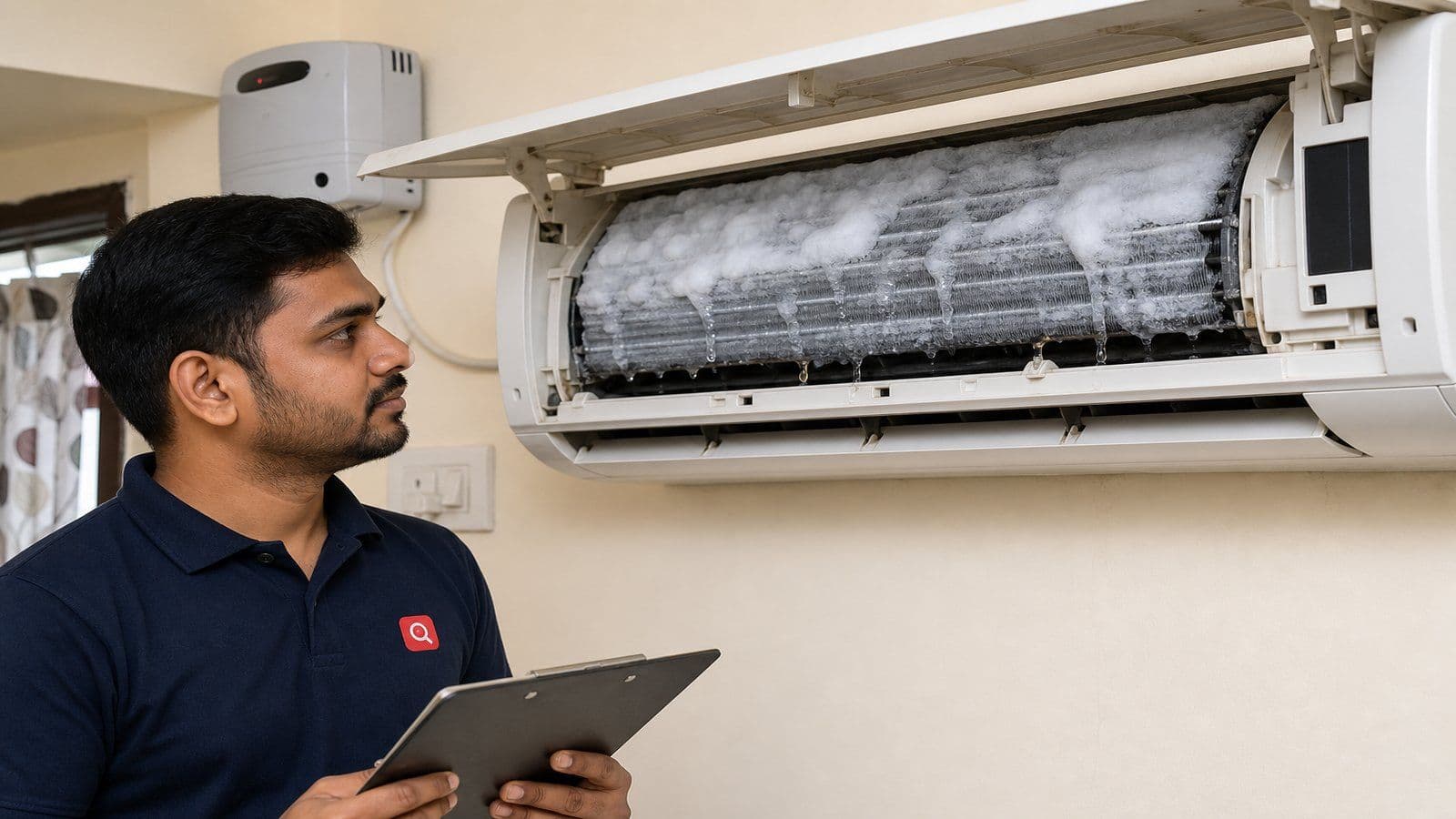
Photo: Frosted evaporator coil inside an Indian split AC
Why AC Coils Freeze in the First Place
The physics is straightforward once you see it. The evaporator coil is where refrigerant absorbs heat from the room. In normal operation that coil surface sits around 5 to 8°C, which is cold enough to condense moisture from the air but warm enough that the water drips off into the drain pan. The blower wheel keeps a steady stream of warm room air flowing across the fins, replacing the chilled air and stopping the coil from getting too cold.
Things go wrong when the heat exchange equation falls out of balance. If refrigerant is low, the small amount of gas in the coil expands more than it should and drops the surface temperature below 0°C. If airflow is blocked, there is no warm air to keep the coil above freezing, so the same thing happens.
Once the coil drops below freezing, the moisture condensing on it cannot drip away fast enough. It freezes in place, traps the next layer of moisture, and within an hour you have a sheet of ice acting as an insulator. The compressor keeps running because the system thinks the room is not cooling, the coil keeps getting colder, and the ice grows thicker.
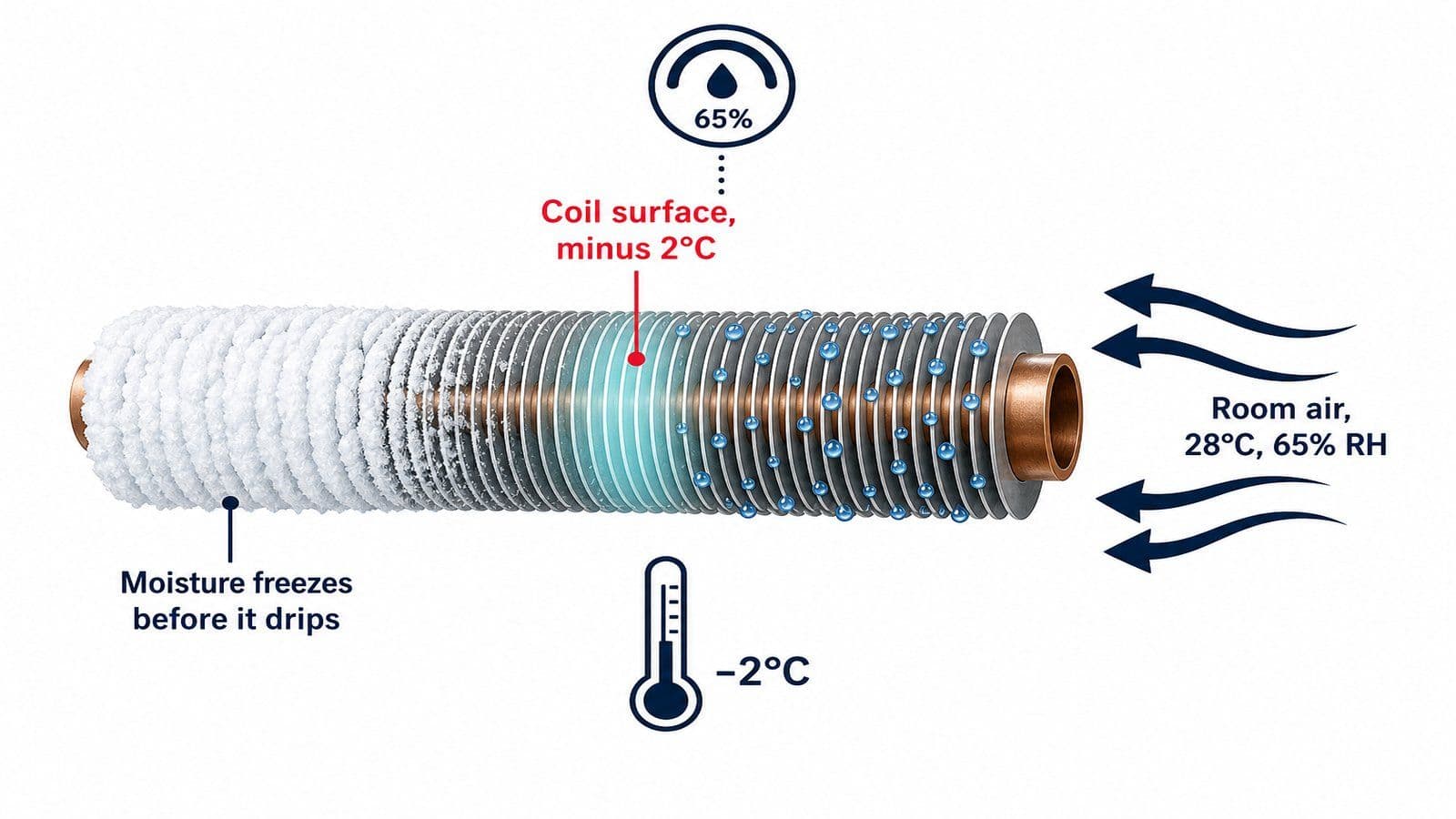
Photo: Why AC coils freeze
I tell every customer the same line. The day you see ice, switch off the unit. Every additional hour of running on ice is roughly an additional ₹400 added to your eventual repair bill, because the compressor is being slowly starved of suction pressure. We have had cases in Pune where the customer ran an iced AC for a week. The unit needed a ₹28,000 compressor swap. If they had switched off on day one, it would have been a ₹3,800 gas refill.

Five Root Causes of AC Ice Formation
Across the 2,800-plus AC repair calls our Mumbai and Pune technicians have logged, five distinct causes account for almost every ice-formation case. They are listed below in order of how often we see them.

Photo: Five root causes of AC ice formation
Low Refrigerant from a Slow Leak
This is the most common cause and the most damaging if ignored. Refrigerant in a split AC is meant to stay in a closed loop for the unit's full 10 to 12 year life. In practice, brazing joints, schrader valves and indoor coil hairpins develop pinhole leaks over time, especially in coastal cities where salt corrosion attacks copper-aluminium joints. When the refrigerant charge drops below roughly 80 percent of the factory level, the gas inside the evaporator expands too much, the surface temperature drops below freezing, and the coil ices up.
Two clues point to a refrigerant cause. First, the icing returns within a day or two even after a defrost. Second, you sometimes hear a faint hiss near the indoor unit or the outdoor service valves, which is gas escaping under pressure. Refrigerant handling in India is regulated under the Ministry of Environment, Forest and Climate Change (MoEF&CC) Ozone Depleting Substances Rules and the Kigali Amendment, so only a NSDC-certified technician with proper recovery equipment should top up or recharge gas.
Typical fix cost in 2026: ₹600 to ₹1,500 for leak detection alone using ultraviolet dye or electronic sniffer. ₹2,500 to ₹6,500 for the full leak fix plus gas refill, depending on whether the leak is in a flare joint (cheap) or on the indoor coil (expensive). See AC compressor problems and diagnosis for what a refrigerant-starved compressor sounds like before it fails.
Blocked Airflow from Dirty Filters or Vents
The second most common cause is mundane and entirely preventable. The indoor filter cakes up with dust, pet hair and biofilm over three to four months of summer use in cities like Delhi, Gurugram, Jaipur and Ahmedabad. When airflow across the coil drops below roughly 60 percent of design, the warm air that would normally keep the coil above freezing is no longer arriving. The coil cools further, condensed moisture freezes, and you have ice within an hour or two.
In cassette installations and ducted systems, the same problem shows up when the return-air vent is blocked by a curtain, a piece of furniture or, in some apartments, a child's poster taped over the grille. Undersized ducting in older buildings does the same thing more slowly.
The fix is simple. Pull the filters out, rinse under a tap with mild soap, dry in shade, slide back. Check that no furniture, curtain or appliance is within 30 centimetres of the return vent. If the icing stops, you have your answer. If it returns within a few days, you also have a refrigerant or thermostat issue layered on top.
Typical fix cost in 2026: ₹0 if you wash the filters yourself. ₹400 to ₹700 if a technician deep-cleans the filter cartridge and inspects ducts. ₹900 to ₹2,200 if the evaporator coil itself needs a chemical clean because dust has migrated past the filter.
Get quotes from verified, top-rated AC Service & Repair pros in Delhi.
Faulty Thermostat or Temperature Sensor
Modern split ACs read room temperature using a thermistor mounted near the evaporator coil and a second sensor on the indoor unit's air intake. If either sensor is loose, dislodged, or reading too low, the PCB thinks the room is still warm and keeps the compressor running long past the point it should have cycled off. The coil keeps dropping in temperature and eventually freezes over.
The clue here is that the room temperature on the remote display or your own thermometer disagrees with what the AC seems to think. If the remote shows 22°C, your room thermometer shows 19°C, and the compressor is still hammering away, the sensor is suspect. This is one of the few ice-related faults that does not return reliably. It can hide for weeks then ice up the coil on one humid afternoon when conditions line up.
For broader context on sensor-related faults, see our cluster on AC making loud noise diagnosis, where the same thermistor fault sometimes shows up as compressor short-cycling noise instead of icing.
Typical fix cost in 2026: ₹350 to ₹800 for a thermistor or sensor swap on a non-inverter unit. ₹1,800 to ₹3,500 if the PCB itself needs reflashing or replacement, which is more common on inverter splits where the sensor and PCB are integrated.
On inverter splits made after 2022, we are now seeing thermistor drift account for almost 25 percent of our intermittent ice calls. The sensor reads 3 to 4 degrees high, the PCB never throttles the compressor down, and the coil ices up only on the cooler evenings when ambient is already low. My standing rule: if your inverter AC is icing up but the filters look spotless and the gas pressure tests fine, ask the technician to clip a calibrated probe to the return air grille and compare it against the unit's own sensor reading before you spend a single rupee on refrigerant.
Dirty Evaporator Coil
Even when the filters are spotless, fine dust and aerosolised cooking oil migrate past the filter mesh and settle on the evaporator fins over two to three years of use. This dust forms an insulating layer on the coil. The refrigerant inside is still cold, but the heat from the room air cannot reach it through the dust film. The coil surface keeps falling in temperature until ice forms on the dust-coated fins.
This is the classic "I clean my filter every week but my AC still freezes" case. Cleaning the front filter is necessary but not sufficient after year three. The Bureau of Indian Standards (BIS) IS 17613 indoor air quality standard recommends professional coil cleaning every 6 to 9 months, more often in coastal zones or in homes that cook fried food daily. Skipping this is the single biggest reason a four-year-old AC starts icing up in conditions where it never used to.
A foaming biocide cleaner applied to the coil dissolves the dust film, restores heat exchange, and usually resolves the icing within one service visit. Combined with a filter wash and a drain flush, this is the standard "deep service" most ProNearMe AMC packages cover annually.
Typical fix cost in 2026: ₹900 to ₹2,200 for a full coil chemical clean. ₹2,400 to ₹3,200 a year for an AMC that includes two such services plus mid-monsoon check.
Set Point Too Cold for Too Long
The fifth cause is operational rather than mechanical. In low-humidity inland zones, mainly Delhi NCR pre-summer, Hyderabad in winter, and Pune in February, owners set the AC to 16 or 17°C and leave it running all night. The compressor never gets a chance to cycle off, the coil temperature keeps dropping, and by morning the coil has frozen even though everything else in the unit is perfectly healthy.
The fix here is to set the thermostat no lower than 24°C, which the Press Information Bureau (PIB) and BEE both recommend as the optimal residential setting for comfort, efficiency, and equipment health. Anything lower than 22°C running continuously in dry conditions is asking for ice. This is also where short cycling, weak airflow and ice formation overlap as symptoms of the same operational habit. The AC not cooling troubleshooting guide explains how all three symptoms cascade from one another.
Typical fix cost in 2026: ₹0. Just change the set point. If icing has already happened, defrost, restart at 24°C, and observe for 24 hours.
First-Aid Defrost: What To Do Before the Technician Arrives
The single most important rule when you spot ice on the coil is to stop running the unit in cooling mode. Switching off completely is fine but slow. The fastest safe defrost is to use the AC's own fan to thaw the ice in a controlled way.
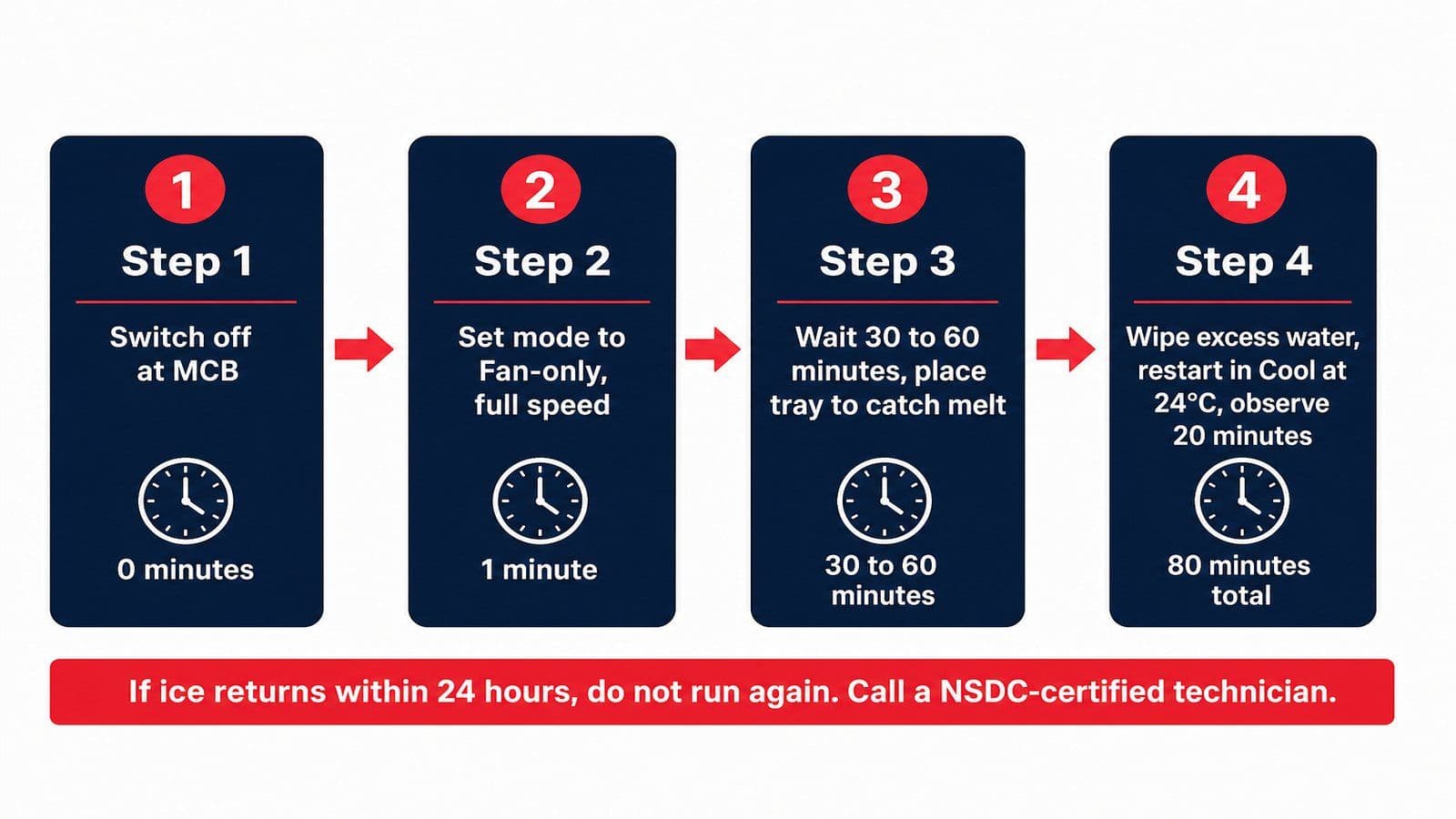
Photo: First-aid defrost process step flow
Step-by-Step Defrost
- Switch off the AC at the MCB. Do not just hit the remote. You want the compressor fully off so it cannot kick back in mid-defrost.
- After two minutes, switch the MCB back on but do not start the AC.
- Set the remote to Fan-only mode at full speed. The blower will run without the compressor, pulling warm room air across the iced coil and melting it.
- Place a wide tray, towel or old sari beneath the indoor unit to catch melt water. A thick block of ice can shed 500 to 800 millilitres of water in 30 minutes.
- Wait 30 to 60 minutes depending on how thick the ice was. Most domestic units thaw fully in under an hour.
- Wipe excess water from the front louvre and the underside of the indoor unit with a dry cloth.
- Restart in Cool mode at 24°C, full fan speed. Observe for 20 minutes.
If the unit cools normally and no ice forms again within 24 hours, the cause was probably operational, dirty filters, or a borderline thermostat issue. Wash the filters, set the thermostat above 22°C, and keep watching for a week. If ice returns within 24 hours, switch off again and book a technician within 48 hours. Continuing to run at this point starts to risk the compressor.
What Not To Do
Never chip ice off the coil with a knife, screwdriver or any sharp tool. The aluminium fins bend at the slightest pressure, and a single bent fin restricts airflow on that section of coil forever. Never pour hot water on the coil. The thermal shock can crack the copper hairpins, turning a ₹3,800 gas refill into a ₹35,000 coil replacement. Never use a hair dryer on the highest setting. Warm dryer air is fine, hot dryer air can damage the plastic drain pan and the fin coating.
What we see in field samples is that the ice itself is rarely the dangerous thing. The damage happens to the compressor in the hour after the ice has melted and the owner has restarted the AC on Cool without diagnosing the root cause. The melt water carries dust and biofilm into the drain pan, refrigerant is still low so the compressor pulls excess current, and that combination is what fails the windings. Always treat a recurring ice event as a service event, not a self-resolving glitch.
Get quotes from verified, top-rated AC Service & Repair pros in Delhi.
When Ice Means an Emergency
Three scenarios make AC ice formation an immediate emergency rather than a "book within 48 hours" issue.
The first is ice that returns within hours of a defrost while filters are clean and the set point is 24°C or higher. This points to a refrigerant pressure collapse, which puts the compressor at risk of seizure. Switch off at the MCB and call within 12 hours.
The second is ice on the outdoor copper pipe between the indoor and outdoor units, or on the outdoor coil itself. This is rare on cooling-only split ACs but happens during winter on heat-pump models where the defrost cycle has failed. It also happens when refrigerant pressure has dropped low enough that liquid refrigerant is reaching the suction line. Either way, switch off at the MCB immediately.
The third is ice combined with a burning smell, a strange humming from the compressor, or repeated MCB tripping. This combination almost always means electrical damage has already started inside the outdoor unit. For the MCB side of this, see AC tripping circuit breaker fixes. Do not reset the breaker. Call within 12 hours.
Diagnosis Questions Your Technician Will Ask
When you call a technician about an iced AC, having the answers to these five questions ready will cut diagnosis time in half and reduce the chance of overcharging.
- Is the ice only on the indoor coil, or also visible on the outdoor copper pipe or condenser?
- How often does ice return after a defrost? Within hours, within a day, or only every few weeks?
- Does the icing coincide with a specific weather pattern, mainly dry days, mainly humid days, or no pattern?
- When was the last filter wash and the last professional service?
- What thermostat setting and mode (Cool, Auto, Dry) were running when the ice was spotted?
Answers one and two narrow the cause from five possibilities down to one or two. Answer three distinguishes between humidity-driven and refrigerant-driven causes. Answers four and five rule in or out the two most common operational causes.
2026 Fix Cost Ranges in India
The cost of fixing an iced AC depends entirely on the root cause. The table and chart below show typical 2026 ranges across the cities our ProNearMe network covers. Figures exclude 18 percent GST.
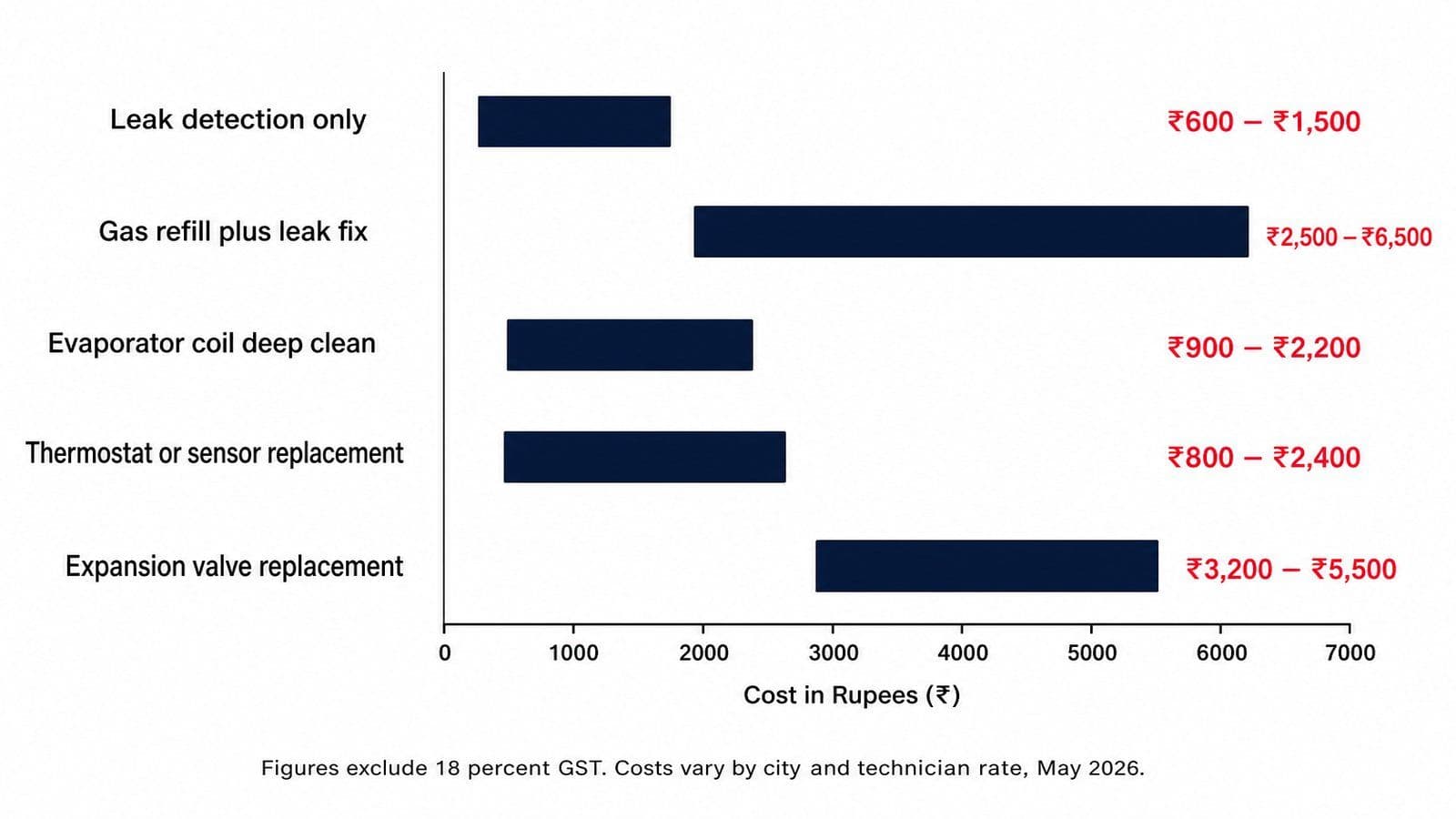
Photo: 2026 AC ice fix cost ranges
| Fix Type | Typical Range (₹) | Notes |
| Filter wash plus inspection | 400 to 700 | DIY-safe for filter alone |
| Evaporator coil chemical clean | 900 to 2,200 | Includes drain flush |
| Leak detection alone | 600 to 1,500 | UV dye or electronic sniffer |
| Gas refill plus leak fix | 2,500 to 6,500 | Flare-joint leak is cheaper |
| Thermostat or sensor swap | 800 to 2,400 | Higher on inverter PCBs |
| Expansion valve replacement | 3,200 to 5,500 | Less common, more skilled |
| Reversing valve (heat pump) | 4,500 to 8,500 | Only on hot-and-cold units |
| Compressor replacement | 18,000 to 35,000 | After prolonged ice damage |
Two patterns are worth flagging. First, owners who call within 24 hours of spotting ice pay an average of ₹3,200 to resolve the issue. Owners who wait a week or longer pay an average of ₹11,400. Second, never approve a gas refill without first asking the technician to test for a leak. A refill alone, without leak repair, will fail again within 60 to 90 days, and you will be paying for gas twice. For more on how to push back on refill quotes, see AC repair cost breakdown and AC repair vs replace decision.
Case Study: A Hyderabad Pre-Summer Ice Call
In February 2026, Mr. Karthik Reddy, an apartment owner in Madhapur, Hyderabad, called us about his three-year-old 1.5 ton inverter split AC. The unit had been cooling fine through January, but in the first week of February he noticed the room felt mildly cool but the AC seemed to be running constantly. He opened the front cover and found the evaporator coil sheathed in about half an inch of ice.
His instinct had been to keep running the unit, assuming the ice would melt as the room warmed up. Our technician arrived to find the compressor still pulling 6.8 amps when nameplate was 4.5 amps, a classic refrigerant-starved current draw. Diagnosis took 20 minutes. There was a slow leak at a flare joint on the indoor coil connection, and the refrigerant charge was down to roughly 70 percent.
The fix involved a defrost, flare joint reflare, pressure test, vacuum, and a full gas recharge. Total cost ₹4,200 excluding GST. Mr. Reddy had run the iced AC for four days. Had he waited another week, the compressor would have lost suction pressure entirely and the bill would have crossed ₹25,000. He has since signed up for a ProNearMe AMC at ₹2,800 a year, which includes a pre-summer chemical clean and pressure check.
Conclusion
AC ice formation looks dramatic but is almost always fixable for under ₹6,500 when caught early. The trap is the wait-and-watch instinct. Owners who keep running an iced AC for a week or longer turn a routine refrigerant top-up into a compressor replacement that costs five to ten times more. The pattern is consistent across the 2,800-plus repair calls our network has logged. Spot ice, switch off, defrost on fan-only, restart and observe. If ice returns within 24 hours, do not run again. Call a NSDC-certified technician within 12 to 48 hours depending on whether outdoor pipe ice is involved.
Two prevention habits stop most ice events from happening in the first place. Wash the indoor filters every two to four weeks during summer in dusty cities, every three to four weeks in coastal cities and during monsoon. Book a professional service in February or March before peak summer, which catches the slow refrigerant loss and the coil dust build-up that account for nearly 70 percent of all ice formation cases. Owners who follow both habits report 80 percent fewer ice-related calls in our annual customer survey.
Disclaimer
All cost ranges in this guide are typical residential figures for May 2026 across the cities our ProNearMe network centre serves, and exclude GST, which is currently 18 percent on most AC service and parts in India. Actual costs vary by city, brand of replacement part, and the specific technician's labour rate. We strongly recommend hiring only NSDC-certified or OEM-trained technicians for any refrigerant handling, electrical work or PCB diagnosis. Refrigerant handling without proper recovery equipment is a violation of the Ozone Depleting Substances Rules under MoEF&CC. ProNearMe does not endorse any specific AC brand and the guidance in this article applies across all manufacturers.
Sources & References
- Bureau of Energy Efficiency Air Conditioner Energy Efficiency Standards and Labelling Programme
- Bureau of Indian Standards IS 17613 Indoor Air Quality Standard
- Ministry of Environment, Forest and Climate Change Ozone Depleting Substances Rules and Kigali Amendment Implementation
- Press Information Bureau Advisory on Energy Efficient Air Conditioning
- National Skill Development Corporation HVAC Technician Qualification Pack
- Indian Society of Heating, Refrigerating and Air Conditioning Engineers Residential HVAC Guidelines
- Central Electricity Authority Wiring and Safety Regulations for Domestic Installations
- Ministry of Power Energy Conservation Building Code Residential Annex
Amit worked as an AC technician for 6 years in Ahmedabad before transitioning to technical writing. He holds a diploma in Refrigeration and Air Conditioning from ITI Ahmedabad and understands the difference between what AC companies promise and what actually happens on the ground. His articles break down complex technical topics into plain language that any homeowner can follow. He tests every tip he writes about in his own home first.

Dr. Verma is a mechanical engineer with 15 years of experience in HVAC systems. She completed her PhD from IIT Delhi on energy-efficient cooling solutions for Indian residential buildings. She reviews all technical content on HomePros to make sure the numbers are right, the advice is safe, and the recommendations are backed by actual engineering principles. She consults for multiple AC manufacturers on product design.