- ProNearMe verified AC technicians report that 64 percent of "gas refill" calls in our network. actually need only a top-up or no refill at all once the leak check is run.
- A sealed AC system in good install loses less than 2 percent of its charge over 10 years. Any refill requirement inside 2 years of the last refill is evidence of a leak that needs sealing, not a routine top-up.
- R32 refill on a 1.5 ton split runs ₹2,200 to ₹3,800 in 2026, around 18. percent cheaper than R410A and 25 percent cheaper than the phasing-out R22.
- DIY refrigerant handling is illegal under the MoEF&CC Ozone Depleting Substances Rules and the Kigali Amendment. The fine band for releasing controlled refrigerant runs ₹25,000 to ₹1 lakh.
- A genuine refill bill must list the refrigerant grade, the weight added in grams, and. 18 percent GST as a separate line. Anything less is a flag.
AC gas refill cost is the single most overcharged line item in the Indian air conditioning service market in 2026. Most homeowners pay two to three times what the job actually warrants because the technician skips the leak-check, quotes a full refill on a top-up situation, and bundles labour into a round figure with no refrigerant weight on the invoice. The honest 2026 range for a 1.5 ton R32 split AC top-up sits between ₹800 and ₹1,500. The honest range for a full refill sits between ₹2,200 and ₹3,800. The gap between those two numbers is where most of the overbilling hides.
This guide breaks down the genuine AC gas refill cost in India by refrigerant type, tonnage and scenario. It covers the three refrigerants you will encounter in Indian homes in 2026 (R32, R410A and the phasing-out R22), the exact process an NSDC-certified technician should follow, the BIS verification steps that prove the refrigerant is genuine, and the warranty rules under the Ministry of Environment, Forest and Climate Change (MoEF&CC) Ozone Cell that decide who can legally handle the gas in the first place. Pricing reflects what the ProNearMe network logs across Mumbai, Pune, Hyderabad, Bengaluru and Delhi NCR week after week through 2026.

Get quotes from verified, top-rated AC Service & Repair pros in Delhi.
Why Gas Refill Is The Most Overcharged AC Service Line

Photo: ProNearMe AC technician at outdoor unit with manifold gauges and R32 cylinder on a digital scale
The economics of refrigerant work create the conditions for overbilling. The component itself, refrigerant, is invisible. The customer cannot see how much went in or what brand it was. The pressure gauges that prove the job is done correctly are unfamiliar to most homeowners. And the symptom that prompts the call (poor cooling) has at least four other common causes (weak capacitor, dirty filter, slow blower, condenser fouling) that look almost identical from the outside.
A technician who quotes a full refill without first taking a pressure reading in front of the homeowner is following the cheapest possible workflow, not the correct one. The Bureau of Indian Standards (BIS) and the Indian Society of Heating, Refrigerating and Air Conditioning Engineers (ISHRAE) both require that any refrigerant intervention begin with a pressure-and-leak diagnostic. The Bureau of Energy Efficiency (BEE) has separately flagged refrigerant overbilling as a pattern hurting customer trust in the residential AC service market.
The Sealed-System Reality
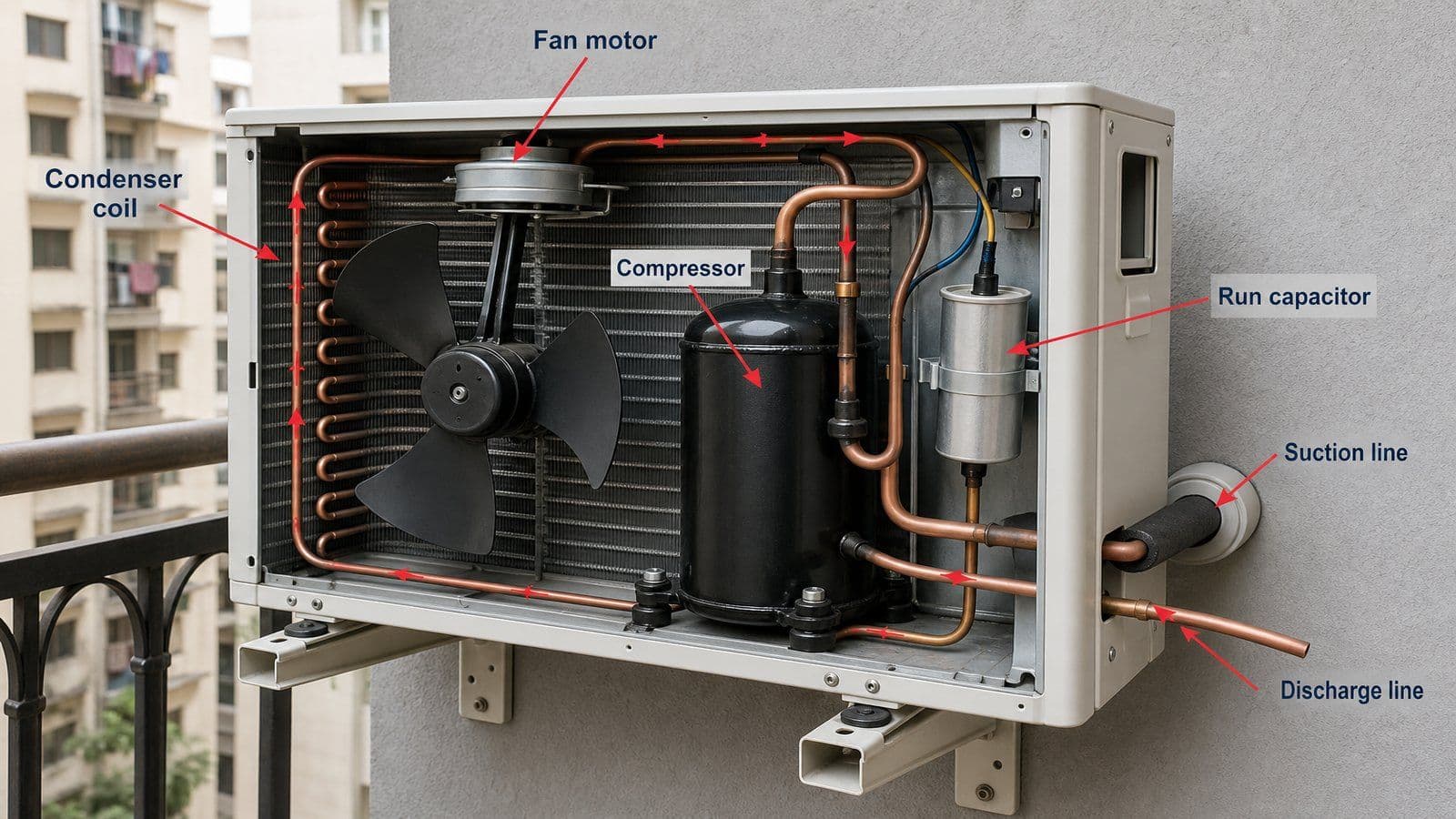
An AC is a sealed refrigeration system. The gas inside it does not get consumed the way petrol gets consumed in a car. Under normal conditions, a properly installed sealed system loses less than 2 percent of its refrigerant charge over a 10-year service life. If your unit needs refrigerant every 2 to 3 years, there is a leak. The leak might be at a flare joint, a brazed connection, a pinhole on the copper line, or inside a coil. None of those go away by adding more gas. They get worse, the compressor works harder to maintain pressure, and the next refill arrives faster than the last one.
The Press Information Bureau (PIB) has cited Consumer Affairs data showing that complaints about repeat refrigerant billing form a measurable share of household-services grievances each summer. The Jago Grahak Jago programme has explicitly warned against the "gas evaporates every 2 to 3 years" claim used by some technicians as a justification for routine refills.
Refrigerant Types In The Indian Market 2026
There are three refrigerants you will encounter in residential AC units in India in 2026. Each has a different price, a different regulatory status, and a different replacement cost.
R32
The current standard for new residential installations. R32 is a single-component HFC refrigerant with a Global Warming Potential (GWP) of around 675, significantly lower than R410A. R32 is mandatory in most BEE 5-star units launched after January 2026 because of its higher energy efficiency and lower environmental footprint. R32 cylinders sold in India must carry a BIS mark, a batch number and a registered handler ID.
R410A
A blended HFC refrigerant that became the standard between 2015 and 2022 as the industry moved off R22. R410A has zero ozone depletion potential but a high GWP of around 2,088. It is still in active use across most inverter splits from that era. R410A is also a non-azeotropic blend, which means a leak does not just reduce the charge, it changes the composition of what remains. A correct R410A refill is a full evacuation and recharge, never a top-up.
R22
A hydrochlorofluorocarbon refrigerant being phased out under the Montreal Protocol and the Kigali Amendment commitments tracked by the MoEF&CC Ozone Cell. Full phase-out for residential service is scheduled by 2030. Most R22 units in Indian homes today date from 2014 to 2018. R22 import is restricted and the supply price keeps rising. Owners of R22 units facing more than two refills in three years should run the replacement maths against continued repair.
I get a call almost every week where the homeowner says 'the last technician told me my AC needs gas every summer'. That sentence is the single biggest tell that the previous technician was either skipping the leak check or running a deliberate refill cycle. A correctly installed split AC on R32 should not need any refrigerant intervention for the first six to eight years of its life. If you are paying for refrigerant more than once in any three-year window, your AC has a leak, not a refill requirement.

AC Gas Refill Cost By Refrigerant And Tonnage In 2026
The headline pricing every homeowner wants. These ranges reflect full-refill costs in 2026 for a system that has been correctly evacuated, vacuum-pulled, and recharged to the manufacturer's nameplate specification.
| Tonnage | R32 Full Refill | R410A Full Refill | R22 Full Refill |
| 1 Ton | ₹1,800 to ₹2,800 | ₹2,400 to ₹3,500 | ₹3,200 to ₹4,500 |
| 1.5 Ton | ₹2,200 to ₹3,800 | ₹2,800 to ₹4,500 | ₹3,500 to ₹5,500 |
| 2 Ton | ₹3,000 to ₹4,500 | ₹3,800 to ₹5,500 | ₹4,500 to ₹6,800 |
These ranges include the refrigerant itself, labour for the full procedure (pressure check, evacuation, vacuum pull, recharge, post-recharge verification), and 18 percent GST. They exclude leak detection and leak repair, which are separately quoted because not every refill needs them.
If a quote comes in significantly above the upper band, ask for the itemised break-up. If it comes in significantly below the lower band, ask whether real refrigerant of the named grade is actually being used. Substitution of cheaper mixed refrigerant for the named grade is one of the documented overbilling patterns the Confederation of All India Traders has flagged in its consumer services advisories.
Get quotes from verified, top-rated AC Service & Repair pros in Delhi.
Top-Up Versus Partial Versus Full Refill
The single most important distinction in refrigerant work, and the one most often ignored on the invoice, is the difference between a top-up and a full refill. They cost very different amounts, and a top-up billed as a full refill is the most common form of refrigerant overcharging in the Indian residential market.
| Scenario | What It Means | 1.5 Ton R32 Cost |
| Top-up (under 30 percent loss) | Adds refrigerant to nameplate spec, no evacuation | ₹800 to ₹1,500 |
| Partial refill (30 to 60 percent loss) | Partial evacuation, top-up to spec | ₹1,500 to ₹2,500 |
| Full refill (over 60 percent loss, or after major repair) | Complete evacuation, vacuum pull, recharge | ₹2,200 to ₹3,800 |
| Full refill plus leak detection plus leak fix | All of above plus diagnostic and repair | ₹3,800 to ₹6,500 |
A top-up situation arises when the system has lost less than a third of its charge, the refrigerant remaining is still single-grade (only true for R32 and R22, never for R410A blends), and there is no recent service that disturbed the refrigerant circuit. A top-up takes 10 to 15 minutes. A full refill takes 45 to 75 minutes including the vacuum pull. If your technician finishes a "full refill" in 20 minutes, it was a top-up at full-refill pricing.
R410A is the exception. Because it is a blend, a leak changes the composition of the remaining gas. A correct R410A intervention is always a full evacuation and recharge, never a top-up. Any technician offering an R410A "top-up" is either using mixed refrigerant or is going to leave the system running on an out-of-spec blend that hurts cooling performance and shortens compressor life.
The Honest Refill Process
A correctly executed AC gas refill in India in 2026 follows a fixed six-step process. Asking your technician to walk you through these steps before authorising the job is the single most powerful tool a homeowner has to prevent overbilling.
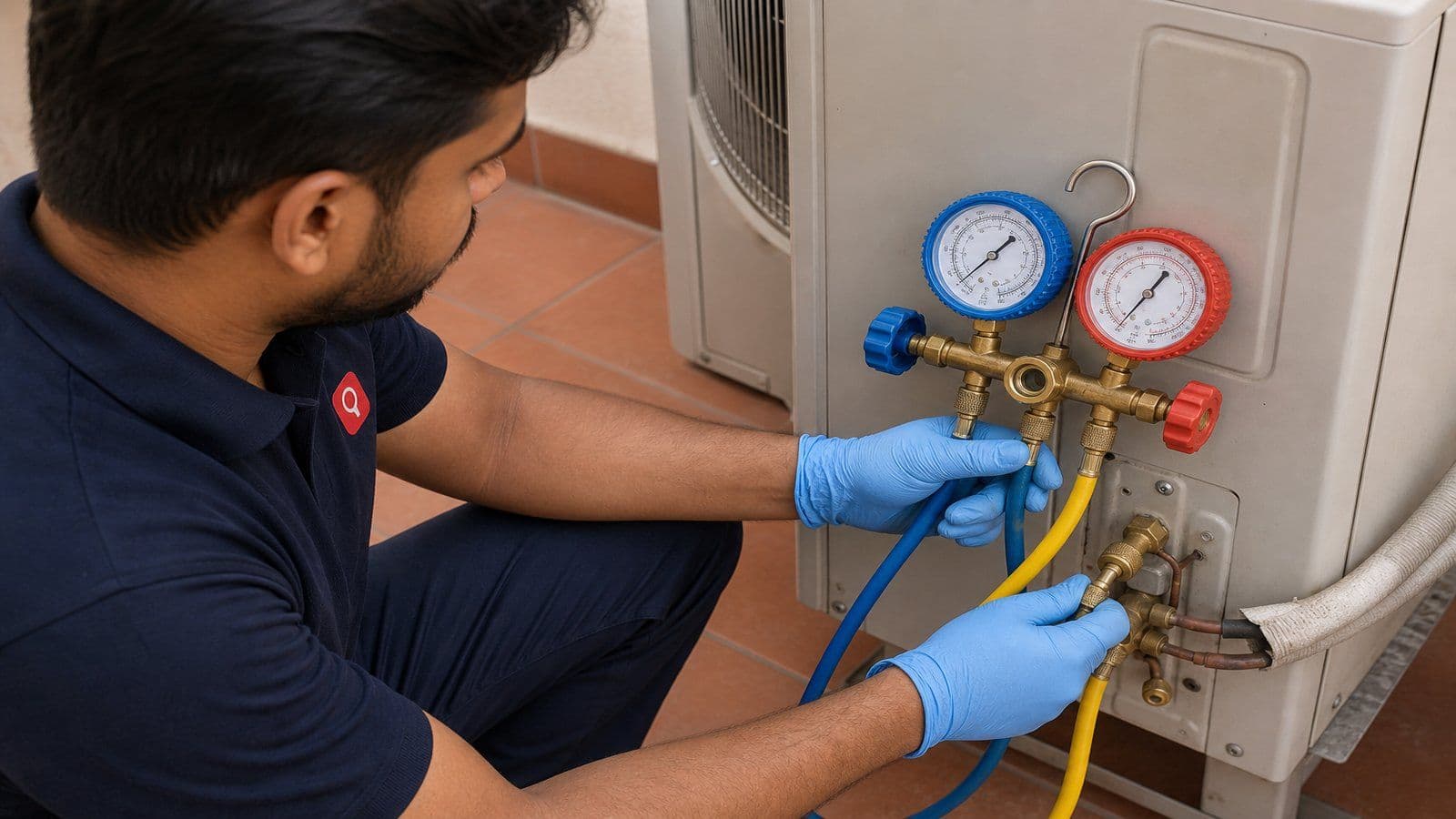
Photo: Close-up of technician's hands connecting manifold gauges to outdoor unit service valves
Step 1: Pressure Gauge Connection At Service Valves
The technician connects a twin-dial brass refrigerant manifold gauge set to the suction and discharge service valves on the outdoor unit. This takes about a minute. The gauges read the current system pressure in psi or bar. The reading should be done in front of the homeowner, with the gauge faces visible.
Step 2: Pressure Reading Against Nameplate Specification
Every split AC outdoor unit carries a nameplate showing the design pressure for the system at the rated ambient temperature. The technician compares the current reading to the nameplate. A reading within 5 to 10 percent of spec means no refrigerant intervention is needed. A reading 10 to 30 percent low usually points to a top-up. A reading more than 30 percent low points to a major loss and a leak that needs locating before any refill.
Step 3: Leak Detection First, Refill Later
If the pressure is low, the technician must locate the leak before adding any refrigerant. Three methods are in common use. An electronic leak detector (₹500 to ₹900) sniffs for traces of refrigerant near joints. UV dye testing (₹400 to ₹700) introduces a fluorescent dye and uses a UV lamp to find the trace point. Nitrogen pressure testing (₹800 to ₹1,200) is the most reliable method for slow leaks, especially leaks under 2 grams per year that the other methods sometimes miss. Soap solution test (₹100 to ₹200) is the cheapest and reliable for fast leaks at visible joints.
A technician who refuses to run any leak detection and quotes a refill straight from a low pressure reading is locking you into a repeat call.
Step 4: Leak Source Repair
Once the leak is located, the repair depends on where it sits. Flare-nut joints at the indoor or outdoor unit are the easiest fix at ₹400 to ₹900 for a re-flare and re-seal. A pinhole on the copper line on the run requires a cut, braze and pressure test at ₹800 to ₹1,800. Coil leaks (evaporator or condenser) usually require coil replacement at ₹4,500 to ₹9,000. A compressor seal leak generally means compressor replacement, in which case the refill economics change entirely.
Step 5: Evacuation, Vacuum Pull And Recharge
With the leak repaired, the system is evacuated of any remaining refrigerant (this is captured, not vented, under the MoEF&CC handler rules) and the circuit is pulled down to a deep vacuum using an electric vacuum pump. The vacuum step is non-optional. It removes moisture and non-condensable gases from the system, both of which cause damage over time. A 20 to 30 minute vacuum hold is standard for a residential split. Refrigerant is then weighed in using an electronic scale and added to the nameplate weight specification.
Step 6: Post-Recharge Verification
The technician restarts the system, reads the new operating pressure on the gauges, measures the cooling delta (the temperature difference between supply and return air, which should sit around 11 to 14 degrees Celsius on a healthy system), and provides photos of the pre-recharge and post-recharge gauge readings. A proper ProNearMe network bill includes these photos as part of the digital invoice.
Red Flags That You Are Being Overcharged
The patterns below recur week after week across the second-opinion calls our network triages.
Quoting Without A Pressure Reading
If the technician quotes any refrigerant work without first connecting the gauges and showing you the pressure reading, the quote is not based on diagnosis. It is based on the assumption that you will not push back. Ask for the gauge reading every single time.
The "Gas Evaporates Naturally" Claim
A statement like "AC gas evaporates every 2 to 3 years, this is normal" is false and is one of the Consumer Affairs Department's flagged claims under the Jago Grahak Jago programme. Refrigerant in a sealed system does not evaporate. It only leaves through a leak.
Get quotes from verified, top-rated AC Service & Repair pros in Delhi.
Refusal To Share Refrigerant Brand Or Weight
Every legitimate refill should produce an invoice line showing the refrigerant grade (R32, R410A or R22), the weight added in grams, and the per-gram or per-kilogram rate. A typical 1.5 ton split takes between 350 and 550 grams in a full refill. If the technician cannot or will not tell you how many grams went in, the refill was either smaller than billed or used a substituted refrigerant.
Mixed-Refrigerant Substitution
The most damaging form of overbilling. Some technicians fill an R410A system with cheaper R32 or a mixed blend. The two refrigerants run at different pressures and the compressor was not designed for the mismatch. The unit appears to cool initially but the compressor seal degrades over the following 12 to 18 months and the unit fails. The manufacturer warranty is voided because the refrigerant grade does not match the nameplate spec.
Per-Session Pricing Without Weight
"Gas refill, full charge, ₹3,500" is not a legitimate quote. A legitimate quote names the refrigerant grade, the weight in grams, and breaks out labour and GST. Round-figure flat-rate refills are the easiest form of overbilling to execute because there is no measurable accountability on the invoice.
In our field studies across Mumbai, Pune and Hyderabad we tracked households that had refrigerant work done over a three-year period. Households where the technician was asked to share gauge readings and refrigerant weight up front spent 41 percent less on average than households that accepted round-figure flat quotes. The information asymmetry in this single service line is the largest in the residential AC market, which is exactly why insisting on the basic measurements matters so much.
How To Verify The Refrigerant Is Genuine
Substitution of cheaper or mixed refrigerant for the named grade is the second-most-common overcharging pattern after billing a top-up as a full refill. Three checks at the time of service eliminate this risk.
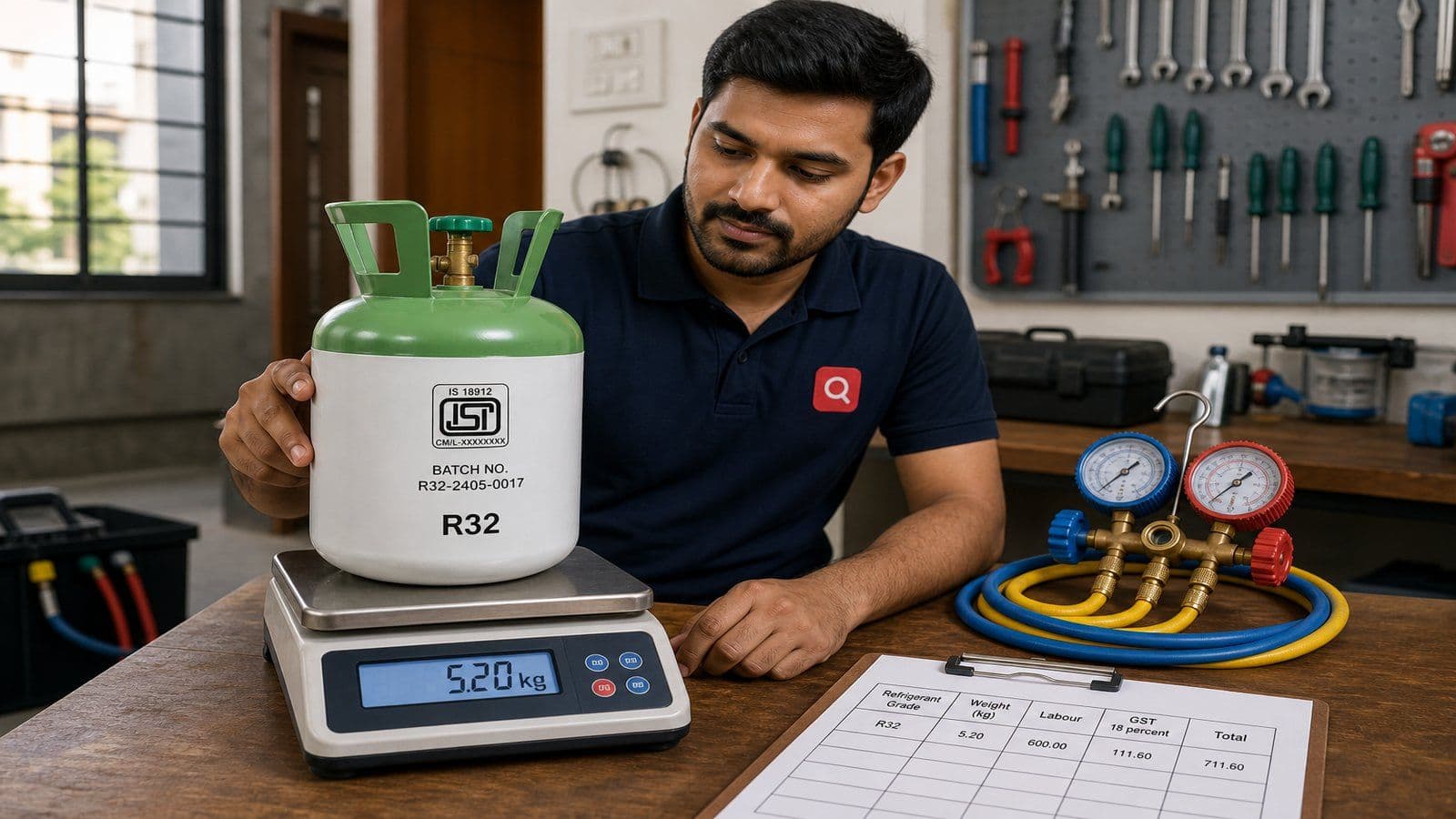
Photo: Refrigerant cylinder with BIS mark on electronic weighing scale beside manifold gauges
BIS Mark And Batch Number On The Cylinder
Every legitimate refrigerant cylinder sold in India carries a BIS mark, a batch number, the grade designation (R32 / R410A / R22) and the handler registration ID. Ask to see the cylinder before refilling starts. A photo of the cylinder label should be part of the service record. Cylinders without a BIS mark are either bootlegged imports or refilled cylinders carrying mixed gas, both common in the unverified-technician market.
Weight Scale Visible During Refill
Refrigerant is sold by weight. A genuine refill always involves an electronic weighing scale placed under the source cylinder. The scale reads in grams or kilograms. The technician shows the starting weight, dispenses refrigerant, and shows the ending weight. The difference is what went into the system. For a typical 1.5 ton R32 split, this should land in the 350 to 550 gram range. A "refill" with no scale in sight is a refill of unknown quantity.
Itemised Receipt With Refrigerant Grade, Weight And GST
The final invoice must show the refrigerant grade, the weight in kilograms, labour separately, and 18 percent GST as a separate line. A typical itemised line reads "R32 refrigerant, 0.45 kg, ₹2,800 + GST 18 percent ₹504, total ₹3,304". A scribbled round figure on plain paper is not a legal invoice for tax or warranty purposes.
Warranty Implications Of Gas Refill Work
Refrigerant work has direct warranty consequences that homeowners often discover only after a compressor failure. Two rules govern the implications under the National Skill Development Corporation (NSDC) HVAC qualification framework and the MoEF&CC handler rules.
Authorised Service Centre Versus Independent
Most BEE-rated split ACs sold since 2020 carry a 5 to 10 year compressor warranty. The warranty terms usually require that any refrigerant intervention during the warranty window be performed by an authorised service centre or by an NSDC-certified technician carrying a valid MoEF&CC handler ID. An unverified local technician handling refrigerant on a unit under warranty almost always voids the compressor coverage. Brand authorised centres charge more for the same refill (typically 30 to 60 percent more) but are non-negotiable while the warranty is active.
NSDC-Certified Independents After Warranty Expiry
Once the warranty has expired, an NSDC-certified independent technician with a valid MoEF&CC handler ID is the best value for most refill jobs. The certification number should be on the technician's ID card and on the invoice. Independent refills are legal and warranty-neutral if these credentials are valid.
DIY Refrigerant Handling Is Illegal
The Ozone Depleting Substances Rules under the Environment Protection Act make it illegal for an uncertified person to handle, release or refill controlled refrigerants. The fine band for refrigerant release runs ₹25,000 to ₹1 lakh. Beyond the legal risk, DIY refill almost always damages the compressor because the home user lacks vacuum pump and weighing scale, and overcharges or undercharges the system relative to the nameplate spec. There is no legitimate DIY refrigerant scenario in residential AC service in India.
Get quotes from verified, top-rated AC Service & Repair pros in Delhi.
How Often Should A Sealed AC System Need Refrigerant
A useful rule of thumb that cuts through most of the noise.
A sealed system in a correctly executed installation should not need a refrigerant intervention in the first 5 to 7 years. Any refill required inside 2 years of the last refill is evidence of a leak. A refill required immediately after a major service that involved disconnecting the copper pipe (relocation, dismantle, re-installation) is expected and forms part of the service cost. A refill required without any of these intervening events is a leak that needs locating.
| Scenario | Refill Reasonable? |
| AC older than 7 years, never refilled | Possible top-up reasonable |
| AC under 5 years, no service history | No, investigate leak |
| Refill required less than 2 years after the last | No, the previous refill did not seal a leak |
| Immediately after relocation or dismantling | Yes, full refill expected |
| Compressor replaced under warranty | Yes, full refill expected as part of repair |
| Cooling weak but pressure reads in spec | No, the problem is elsewhere |
A cooling complaint where the pressure gauge shows the system is in spec is never a refrigerant problem. The actual cause is usually a weak capacitor, a dirty filter, condenser fouling, a slow blower or a thermostat fault. Each of those has a fix in the ₹400 to ₹1,500 range. None of them get solved by adding refrigerant.
The biggest pattern shift I track year on year in our ProNearMe network logs is the gap between 'gas refill' service requests and 'gas refill' jobs actually completed. The request volume keeps growing because owners reach for that phrase the moment cooling weakens. The completed-job volume on legitimate refills sits at around 36 percent of requests. The rest get diagnosed and resolved as capacitor, filter, blower or condenser issues at a much lower cost. That gap is the entire story of overbilling in this market.
The Bengaluru Overbilling Case That Saved A Reader ₹5,800
Mrs. Lakshmi Iyer in Indiranagar, Bengaluru contacted our network last March after receiving a ₹6,200 "gas refill plus servicing" quote from a local technician for her 4-year-old 1.5 ton R32 split AC. The unit was cooling weakly. The local technician had spent 20 minutes on site, declared the gas was almost empty, and quoted a full refill on the spot without producing a single gauge reading.
The ProNearMe network technician who attended the second-opinion call spent the first 5 minutes connecting a manifold gauge set to the service valves with Mrs. Iyer watching. The suction pressure read 115 psi against a nameplate spec of 118 psi, well within the 5 to 10 percent normal band. The system had no refrigerant problem at all.
The actual fault was a partially blocked filter and a fouled condenser coil from a year of unattended monsoon dust and pollen. A general clean plus a deep chemical clean on the outdoor unit, total bill ₹1,400 inclusive of GST, resolved the cooling complaint completely. Two summers later the AC is still cooling correctly on the original refrigerant charge.
The original ₹6,200 quote would have added refrigerant to an already-charged system, pushing the unit above design pressure and creating exactly the kind of stress that shortens compressor life. The Consumer Affairs Department has flagged this pattern, refrigerant-over-pressure damage caused by unnecessary refills, in multiple Jago Grahak Jago advisories. Total saved against the first quote, ₹4,800. Compressor service life preserved, several years.
For more on diagnosing weak cooling before reaching for refrigerant work, see our cluster guides on the 1.5 ton AC price range in India and the broader AC total cost of ownership over 5 years in India. For the umbrella reference on residential AC pricing, see the AC price India 2026 guide.
Regional Variance In Gas Refill Cost Across India
Refill pricing is not uniform across the country. The refrigerant itself is BIS-certified and trades at similar national rates. The variance sits in labour and overhead.
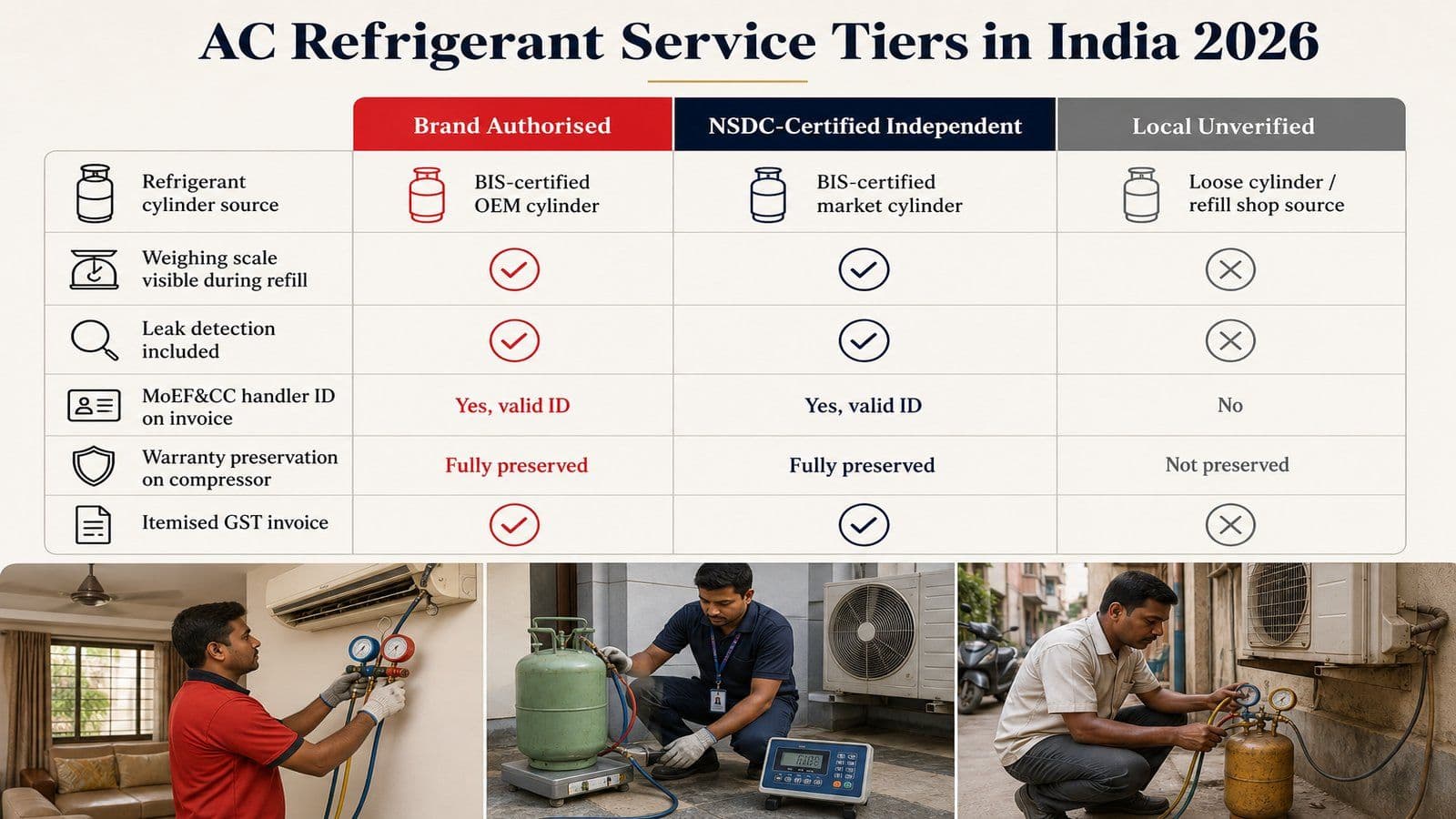
Photo: Editorial comparison chart of three AC refrigerant service tiers in India 2026
Metro Versus Tier-2 Cities
Tier-1 metros (Mumbai, Delhi NCR, Bengaluru, Hyderabad, Chennai, Kolkata, Pune) run 10 to 20 percent dearer than tier-2 cities (Jaipur, Indore, Lucknow, Coimbatore, Visakhapatnam, Bhubaneswar). Labour cost and workshop overhead drive the gap. Mumbai sits at the top of the band, followed closely by Delhi NCR.
Peak Summer Surcharge
April through June is peak demand season. Many independent technicians and most brand authorised centres add a 10 to 20 percent peak surcharge on emergency refill calls (same-day visits, after-hours, weekends). The surcharge is rarely disclosed up front. Booking the leak-check and any preventive refill work in February or early March, before the surge, sidesteps the premium entirely.
Coastal Cities
Mumbai, Chennai, Kochi, Visakhapatnam, Mangaluru and Puri carry a 5 to 10 percent premium on outdoor unit work because salt corrosion creates more flare-joint leaks and more frequent need for re-sealing. ISHRAE recommends annual anti-corrosion coating (₹1,500 to ₹3,000) on outdoor coils in these cities, which also reduces the long-term refrigerant leak rate.
When Refill Stops Making Economic Sense
For older units, particularly R22 units approaching the MoEF&CC phase-out, the maths can tip from refill to replacement.
If your AC is more than 8 years old and the leak repair plus full R22 refill quote crosses ₹5,500 to ₹6,500, run the numbers against a new R32 unit. A new BEE 3-star 1.5 ton split now starts at around ₹32,000 and runs 30 to 40 percent more efficiently than a 2015-vintage R22 unit. The combined fuel saving across two summers usually covers a meaningful chunk of the gap. The R22 phase-out also means parts and refrigerant supply for that grade will keep getting scarcer and dearer through the next four years.
For R410A units in the 5 to 8 year band, a single full refill plus leak fix in the ₹3,500 to ₹6,000 range is usually still the better economics. R410A supply is stable for the rest of this decade. The unit only stops being worth fixing when multiple major components (compressor, PCB, coil) start failing in close succession.
Conclusion
AC gas refill cost in India in 2026 is one of the most negotiable line items in residential AC service, provided the homeowner asks for the basic measurements before authorising work. A pressure gauge reading takes one minute. A leak detection scan takes 20 minutes. A weighing scale reading during refill takes another minute. Each of those single actions cuts overbilling exposure dramatically. The difference between a ₹6,200 unnecessary refill and a ₹1,400 cleaning job is sometimes just the question "what does the gauge read".
The biggest single lever for keeping refill cost honest is choosing the right technician tier. Brand authorised centres are non-negotiable while the unit is under warranty. NSDC-certified independents with a valid MoEF&CC handler ID are the best value after warranty expiry. Unverified local technicians should never handle refrigerant on a unit you care about, because the warranty risk and the substitution risk outweigh any short-term cost saving. Combined with insisting on a printed itemised GST invoice that names the refrigerant grade and the weight added, this is the formula the ProNearMe network sees working in household after household across India in 2026.
Disclaimer
All cost ranges in this guide are typical 2026 residential figures across major Indian cities and include 18 percent GST as noted. Actual costs vary by city, technician experience, refrigerant supply price and seasonal demand. We strongly recommend hiring only NSDC-certified technicians with a valid MoEF&CC handler ID for any refrigerant handling work. DIY refrigerant intervention is illegal under the Ozone Depleting Substances Rules and the Kigali Amendment commitments and voids most manufacturer warranties. ProNearMe does not endorse any specific AC brand, refrigerant supplier or service provider, and all cost ranges should be treated as guidance, not a fixed quote.
Sources & References
- Bureau of Energy Efficiency (BEE) Star Rating Programme for Room Air Conditioners
- Bureau of Indian Standards IS 1391 Room Air Conditioner Specifications
- Ministry of Environment, Forest and Climate Change Ozone Cell and Kigali Amendment Implementation
- National Skill Development Corporation HVAC Technician Qualification Pack
- Indian Society of Heating, Refrigerating and Air Conditioning Engineers Residential HVAC Guidelines
- Press Information Bureau Energy Efficient Air Conditioning Advisory
- Department of Consumer Affairs Jago Grahak Jago Consumer Awareness Programme
- Goods and Services Tax Council Rate Schedule for Services and Repairs
- Central Electricity Authority Regulations for Domestic Electrical Installations
- Ministry of Power Energy Conservation Guidelines for Air Conditioning
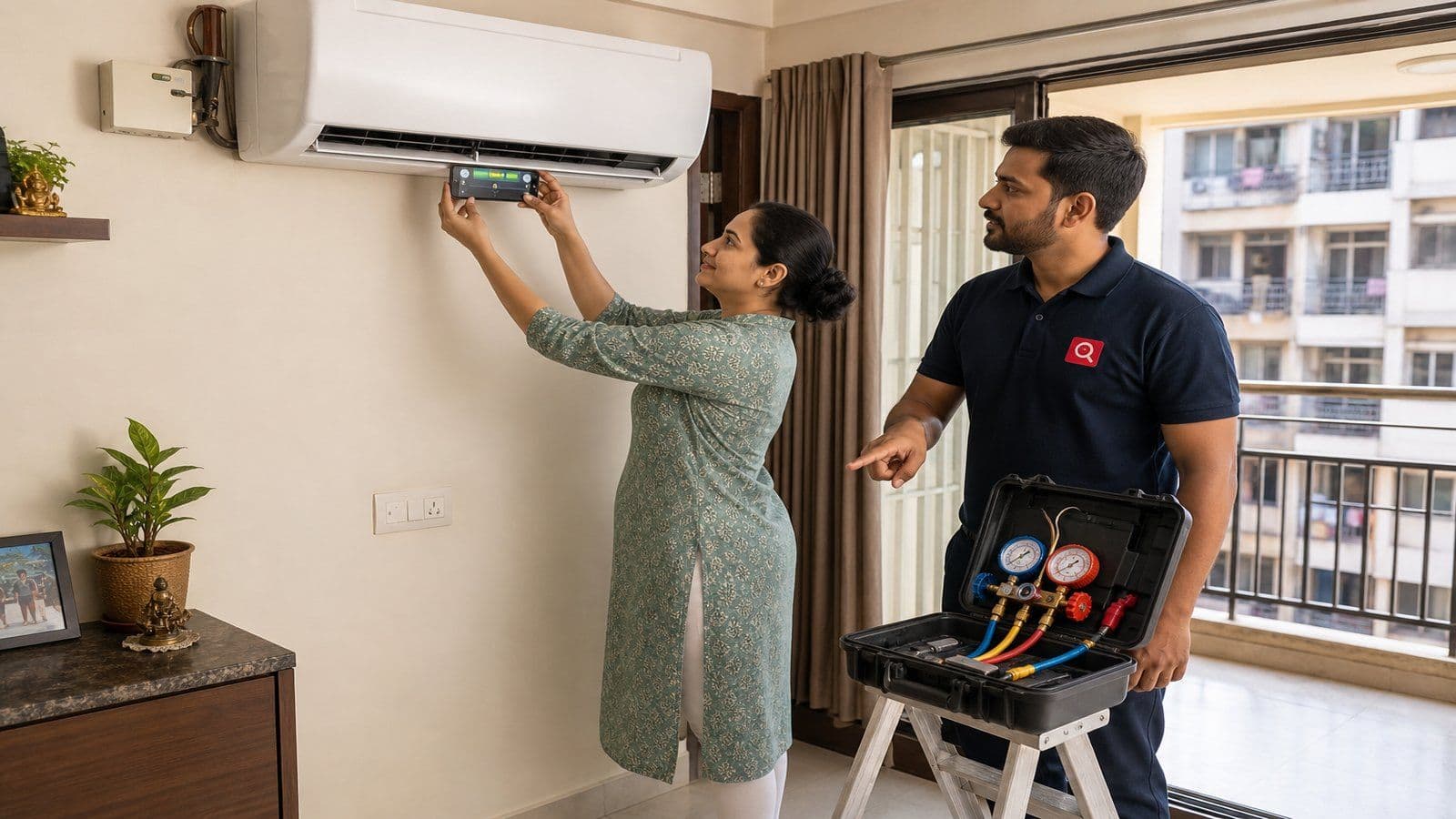
Amit worked as an AC technician for 6 years in Ahmedabad before transitioning to technical writing. He holds a diploma in Refrigeration and Air Conditioning from ITI Ahmedabad and understands the difference between what AC companies promise and what actually happens on the ground. His articles break down complex technical topics into plain language that any homeowner can follow. He tests every tip he writes about in his own home first.

Dr. Verma is a mechanical engineer with 15 years of experience in HVAC systems. She completed her PhD from IIT Delhi on energy-efficient cooling solutions for Indian residential buildings. She reviews all technical content on HomePros to make sure the numbers are right, the advice is safe, and the recommendations are backed by actual engineering principles. She consults for multiple AC manufacturers on product design.