- Inverter ACs now cross 80 percent of Indian residential sales per Press Information Bureau (PIB). 2025 data, which has compressed value-tier pricing sharply, with entry 1.5 ton 5-star units starting at ₹38,000 in 2026.
- The genuine premium-tier inverter band for a 1.5 ton 5-star sits at ₹46,000 to ₹58,000,. and the smart variant with WiFi and voice sits at ₹52,000 to ₹65,000. Anything outside these bands is either a flash sale or an inflated quote.
- A 1.5 ton 5-star inverter saves roughly ₹8,000 to ₹19,000 in electricity over five years. against an equivalent non-inverter at ₹7 per kWh and 8 hours daily summer use.
- Inverter ACs lose their cost advantage in households running the AC under three hours a. day, in tier-2 cities with voltage instability without a stabiliser, and on short-term tenancy under two years.
- Premium-tier inverter discounts cluster around Diwali (Oct-Nov) and the summer launch window (Mar-Apr). The intervening months see inflated MRP plus apparent-discount cycles.
The inverter AC has stopped being a premium choice in Indian homes and quietly become the default. Press Information Bureau (PIB) data released in early 2026 confirms inverter units now cross 80 percent of residential AC sales, up from roughly 55 percent in 2021. The question for most buyers is no longer "should I buy an inverter AC". The question is which tier, value or premium, makes sense for the way your household actually runs the AC.
This guide breaks down the inverter AC price range across every common tonnage, separates value and premium with an honest feature comparison, and runs the five-year electricity math. Pricing reflects the post-Diwali 2025 market and the Bureau of Energy Efficiency (BEE) 2025 star-rating revision that pulled older 5-star models down to 3-star. For the wider landscape across all AC types see our parent AC price India 2026.

Get quotes from verified, top-rated AC Service & Repair pros in Delhi.
How Inverter Technology Changes the Price Math
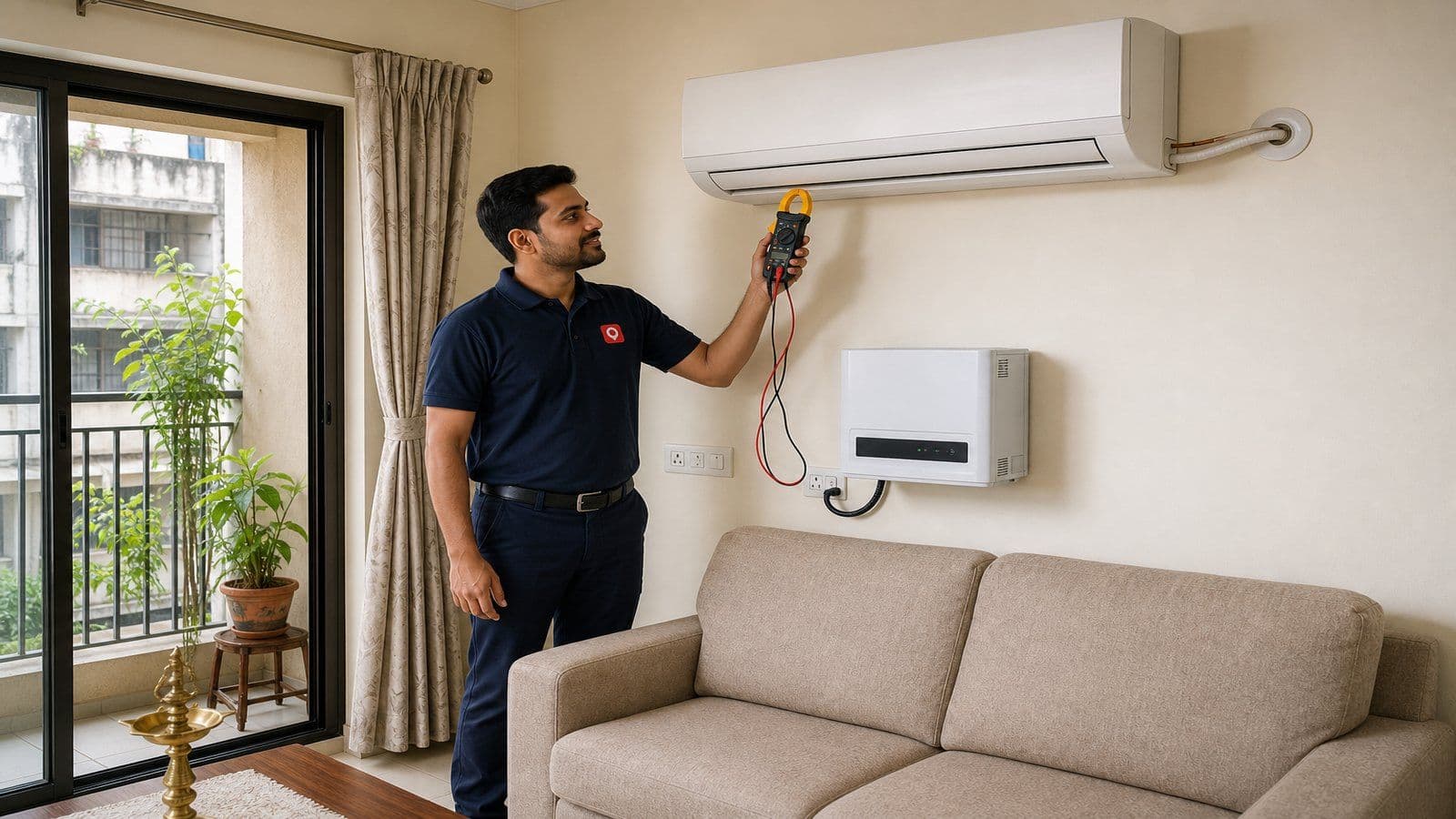
Photo: Inverter split AC installed in an Indian apartment with voltage stabiliser
A non-inverter compressor runs at a single fixed speed. It cycles on at full load, cools past setpoint, switches off, waits for temperature to drift back, then switches on again. This on-off cycle drives the higher bill and the audible thump every time the unit kicks back in.
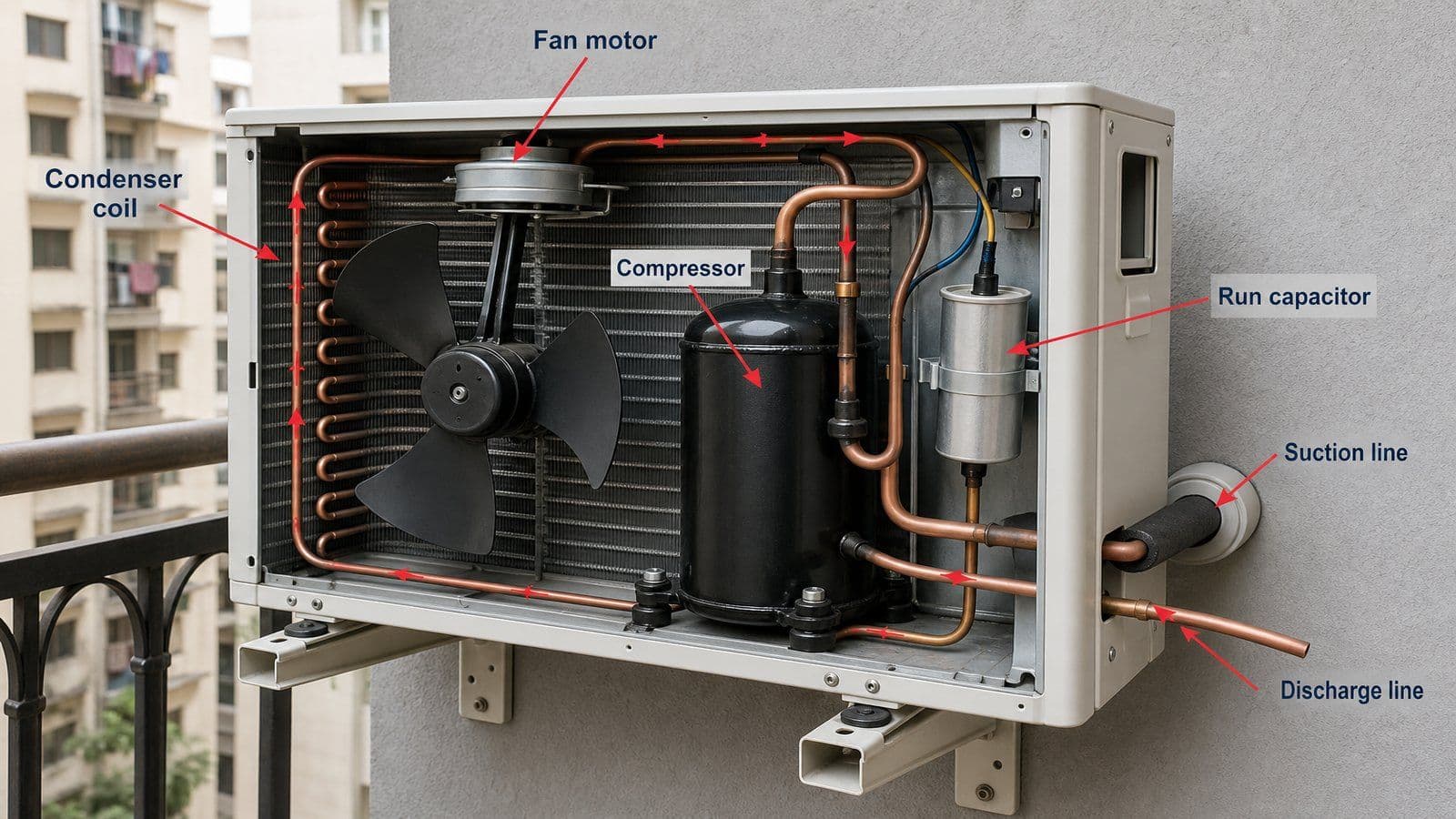
An inverter compressor uses a brushless DC (BLDC) motor controlled by a variable-frequency drive on the PCB. Once the room reaches setpoint, the compressor does not switch off. It throttles down to roughly 30 to 40 percent of rated capacity and runs continuously to hold temperature. This drops electricity consumption by 25 to 40 percent in steady-state, reduces inrush current at startup (gentler on the MCB), and removes the audible thump.
An inverter unit costs ₹6,000 to ₹12,000 more upfront than an equivalent non-inverter, and gives back ₹1,500 to ₹4,000 a year in lower bills. Break-even sits between two and four years. Past four years the inverter is pure savings. For the 5-year ownership math see AC total cost of ownership over 5 years.
Why the BEE 2025 Rating Revision Matters
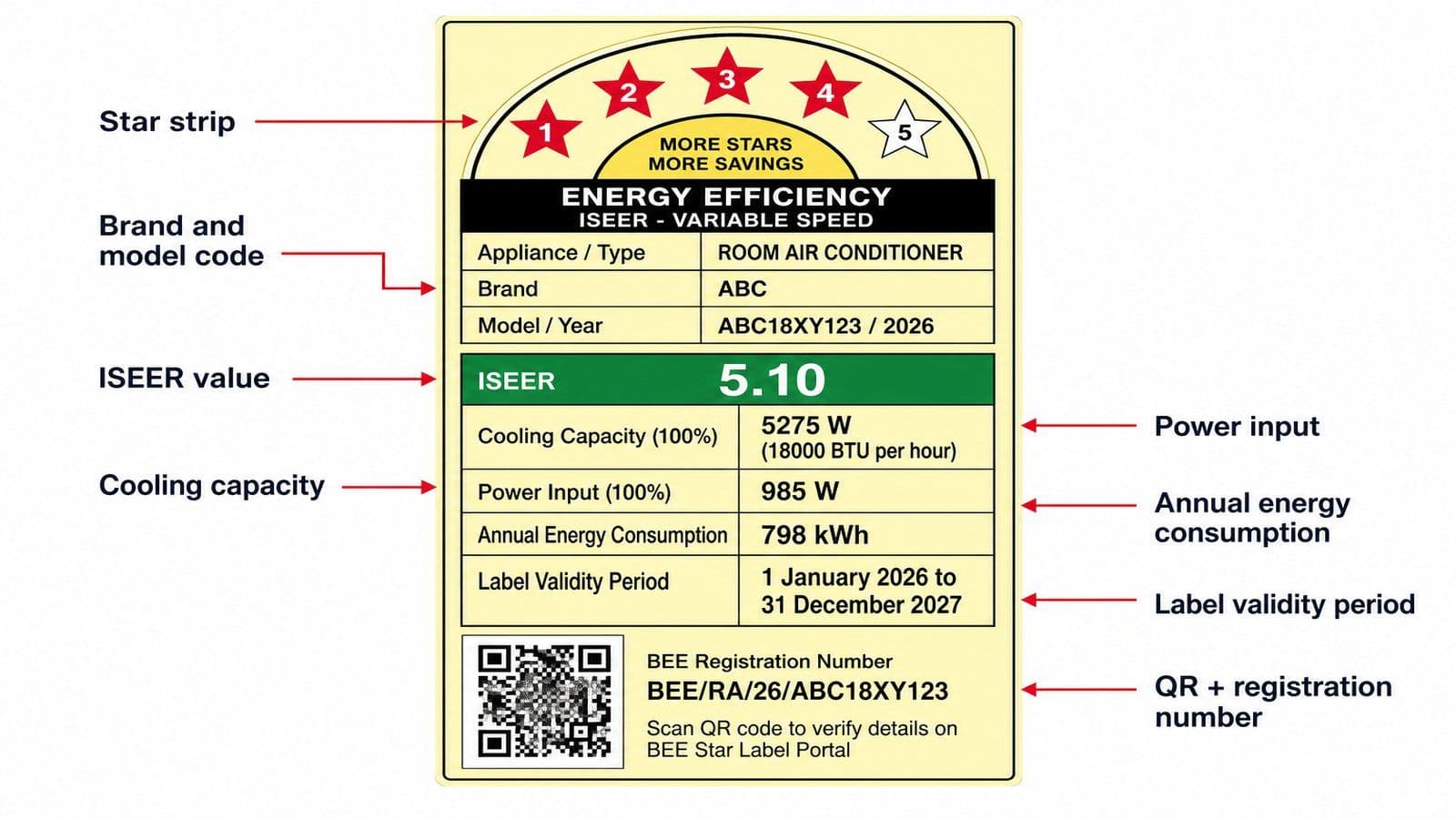
The Bureau of Energy Efficiency revised the Indian Seasonal Energy Efficiency Ratio (ISEER) thresholds in 2025. Most units that were 5-star under the previous schedule dropped to 3-star or 4-star on the new label. Same unit, stricter label. Check the manufacture date, because pre-2026 stock with the old 5-star sticker is often sold alongside new 5-star units meeting the tighter ISEER 5.0 plus threshold.
Inverter AC Price by Tonnage and Tier in 2026
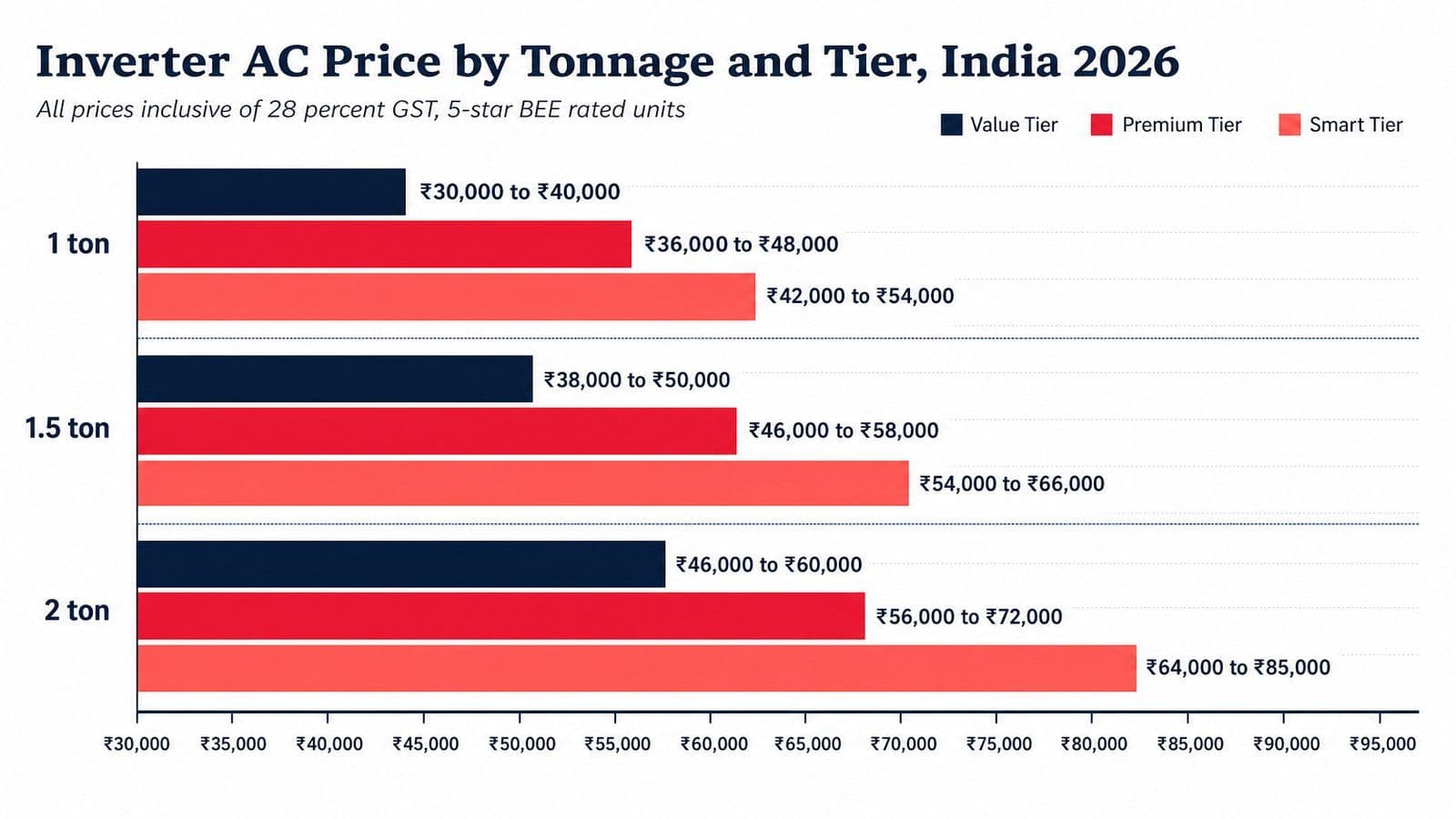
Photo: Inverter AC price by tonnage and tier 2026 horizontal bar chart
The table covers three residential tonnages that account for nearly all Indian household demand. Value-tier assumes a basic feature set. Premium-tier adds the full stack. Smart adds WiFi and voice.
| Tonnage and Tier | 2026 Price Range | Typical ISEER |
| 1 ton value tier 5-star inverter | ₹34,000 to ₹40,000 | 5.0 to 5.2 |
| 1 ton premium tier 5-star inverter | ₹40,000 to ₹50,000 | 5.3 to 5.6 |
| 1.5 ton value tier 5-star inverter | ₹38,000 to ₹46,000 | 5.0 to 5.2 |
| 1.5 ton premium tier 5-star inverter | ₹46,000 to ₹58,000 | 5.3 to 5.7 |
| 1.5 ton premium smart (WiFi and voice) | ₹52,000 to ₹65,000 | 5.4 to 5.7 |
| 2 ton value tier 5-star inverter | ₹58,000 to ₹68,000 | 4.8 to 5.0 |
| 2 ton premium tier 5-star inverter | ₹68,000 to ₹85,000 | 5.1 to 5.4 |
| 2 ton premium smart | ₹78,000 to ₹95,000 | 5.2 to 5.5 |
The 2 ton segment has a smaller spread between value and premium than 1.5 ton, because the 2 ton market is smaller and volume manufacturers reserve their aggressive value-tier engineering for the 1 ton and 1.5 ton segments. For tonnage-specific deep dives see 1.5 ton AC price range India, 1 ton AC price range India 2026, and 2 ton AC price range India 2026. For form-factor alternatives see window AC price range India 2026, split AC price range India 2026, and cassette AC price range India 2026.
Get quotes from verified, top-rated AC Service & Repair pros in Delhi.
The most common buying mistake we see in 2026 is the assumption that the smart tier is worth ₹6,000 to ₹10,000 over the standard premium tier. WiFi and voice control are pleasant but they do not change the electricity bill or the cooling performance. For 90 percent of Indian households the standard premium tier with a 4-way swing, PM 2.5 filter, and anti-corrosion outdoor unit delivers everything the smart tier delivers in the ways that actually matter.

The Five-Year Electricity Math, Side by Side
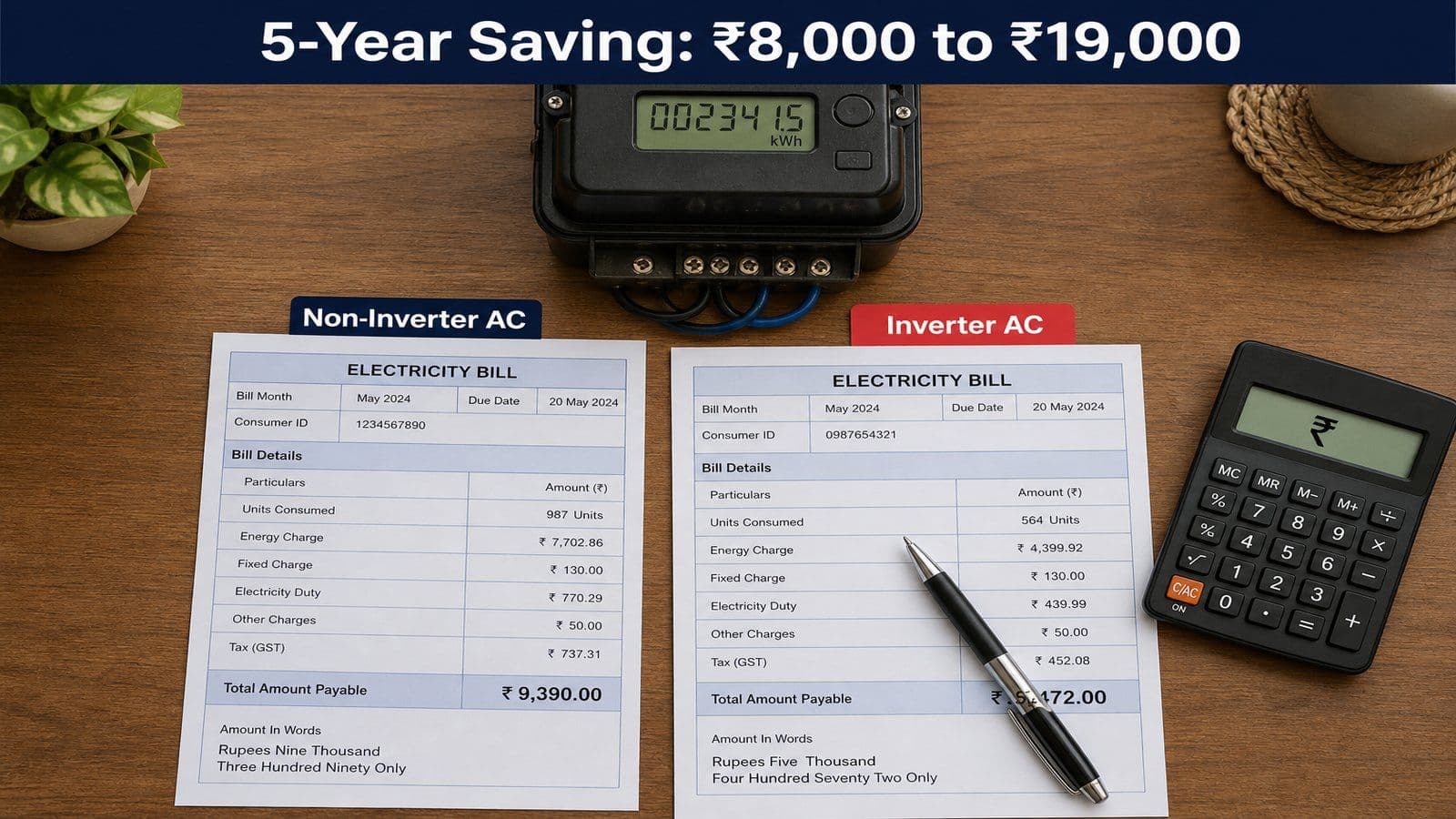
Photo: Indian electricity bill comparison for inverter vs non-inverter AC
The table uses a 1.5 ton split running 8 hours a day across 180 summer days at ₹7 per unit over a 5-year horizon. Daily unit consumption is based on ISEER calculations cross-checked against field meter readings from the ProNearMe verified AC technicians network, which logs that 78 percent of 1.5 ton inverter installations land within these consumption bands across 2,800-plus installations.
| Unit Type | Daily Units | Annual Electricity Cost | 5-Year Electricity Cost |
| Non-inverter 3-star (1.5 ton) | 7.2 units | ₹9,072 | ₹45,360 |
| Non-inverter 5-star (1.5 ton) | 5.6 units | ₹7,056 | ₹35,280 |
| Inverter 5-star steady-state (1.5 ton) | 4.2 units | ₹5,292 | ₹26,460 |
A 5-star inverter saves roughly ₹18,900 over five years against a 3-star non-inverter and ₹8,820 against a 5-star non-inverter. Pair that with the ₹6,000 to ₹12,000 inverter premium and break-even sits at year two for the lower band, year four for the higher. The Central Electricity Authority (CEA) demand projections published in 2024 noted residential AC demand will be the single largest driver of India's peak summer load by 2030, and per-unit tariffs are unlikely to fall.
Inverter Compressor Architecture and Price Differences
Within the 1.5 ton 5-star inverter category there are three distinct compressor architectures. Single rotary is the entry architecture in most value-tier units (one piston, 45 to 48 dB indoor). Twin rotary uses two pistons offset by 180 degrees for smoother modulation and lower noise (42 to 45 dB). Dual inverter pairs a twin rotary compressor with a BLDC variable-speed outdoor fan motor, lifting ISEER into the 5.4 to 5.7 band.
| Compressor Architecture | 1.5 Ton 5-Star Price Band | ISEER Band |
| Single rotary inverter (entry) | ₹38,000 to ₹44,000 | 5.0 to 5.2 |
| Twin rotary inverter | ₹44,000 to ₹52,000 | 5.1 to 5.4 |
| Dual inverter (twin rotary + BLDC fan) | ₹48,000 to ₹58,000 | 5.4 to 5.7 |
The Indian Society of Heating, Refrigerating and Air Conditioning Engineers (ISHRAE) field testing in 2024 found that dual inverter units in tier-1 metro households delivered 8 to 14 percent lower steady-state consumption than equivalent single rotary 5-star units. The ₹4,000 to ₹6,000 dual inverter premium roughly self-funds over five years.
Value Tier vs Premium Tier Feature Breakdown
Get quotes from verified, top-rated AC Service & Repair pros in Delhi.
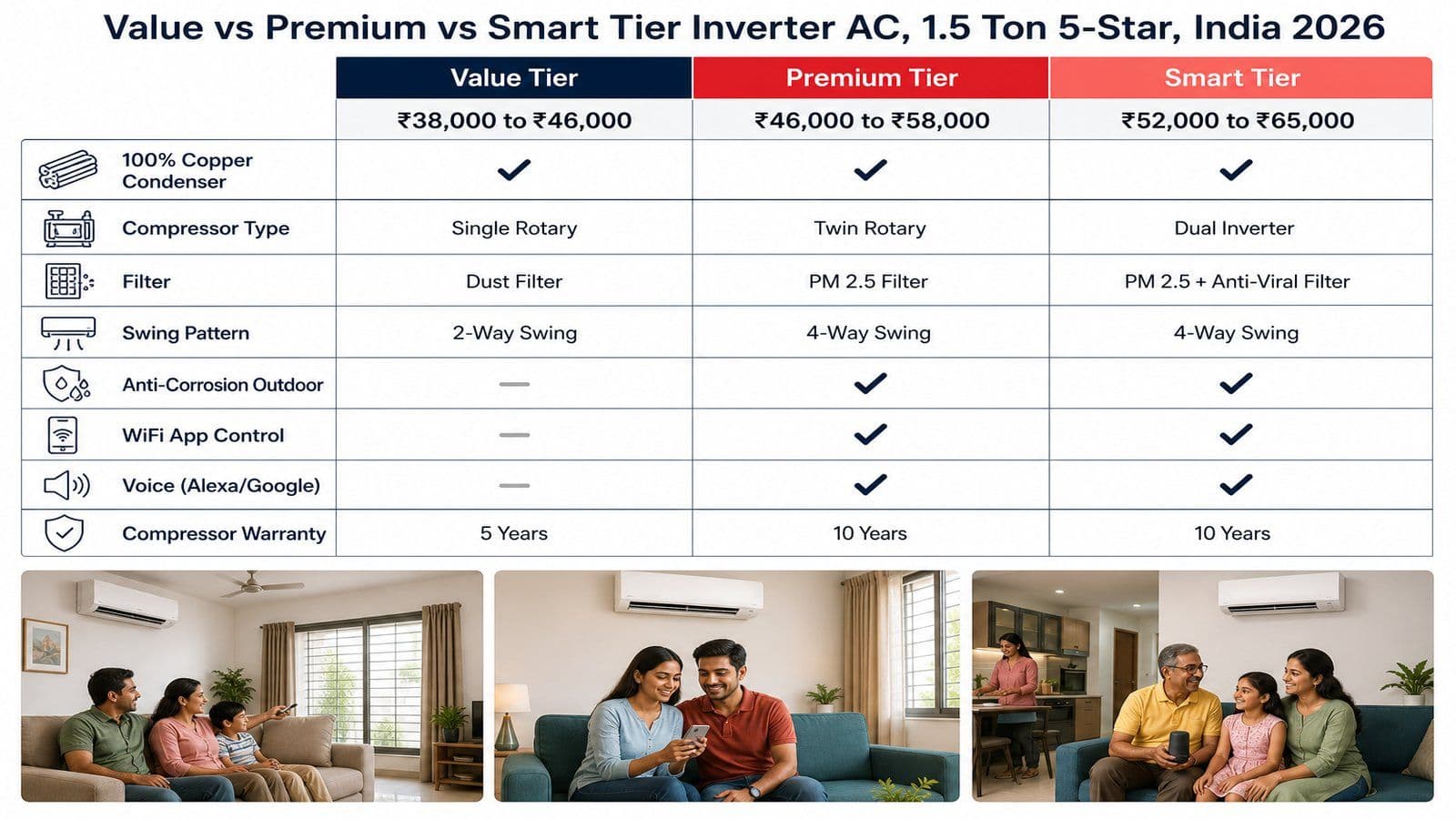
Photo: Inverter AC value vs premium tier feature comparison chart
The visible price gap between value-tier and premium-tier inverter ACs reflects a real build difference.
Value Tier (₹38,000 to ₹46,000 for 1.5 ton 5-star)
The value tier delivers the core inverter experience without trim. 100 percent copper condenser (BIS minimum under IS 1391), basic anti-dust mesh filter, single rotary compressor, two-way swing, sleep mode, 1-year unit plus 10-year compressor warranty. Outdoor casing is standard galvanised steel without anti-corrosion treatment, fine inland but a 3 to 4 year coil-life penalty in coastal cities. No PM 2.5 filter, no anti-bacterial coating, no smart connectivity.
Premium Tier (₹46,000 to ₹58,000 for 1.5 ton 5-star)
Twin rotary or dual inverter compressor, four-way swing, PM 2.5 filter that matters in Delhi NCR and Mumbai during the post-monsoon AQI spike, anti-bacterial indoor coil coating, anti-corrosion outdoor coil (Blue Fin or Gold Fin) extending outdoor coil life by 3 to 4 years in coastal cities, turbo cool mode, and an extended 5-year unit warranty.
Smart Tier (₹52,000 to ₹65,000 for 1.5 ton 5-star)
The smart tier adds connectivity. WiFi app control for setpoint and schedule from outside the home, voice integration with Alexa and Google Assistant, auto-clean cycle that runs a self-drying programme after every shutdown, daily energy reports, and geofencing. For households with elderly parents, young children, or a work-from-home routine that benefits from precise scheduling, the smart tier earns its premium.
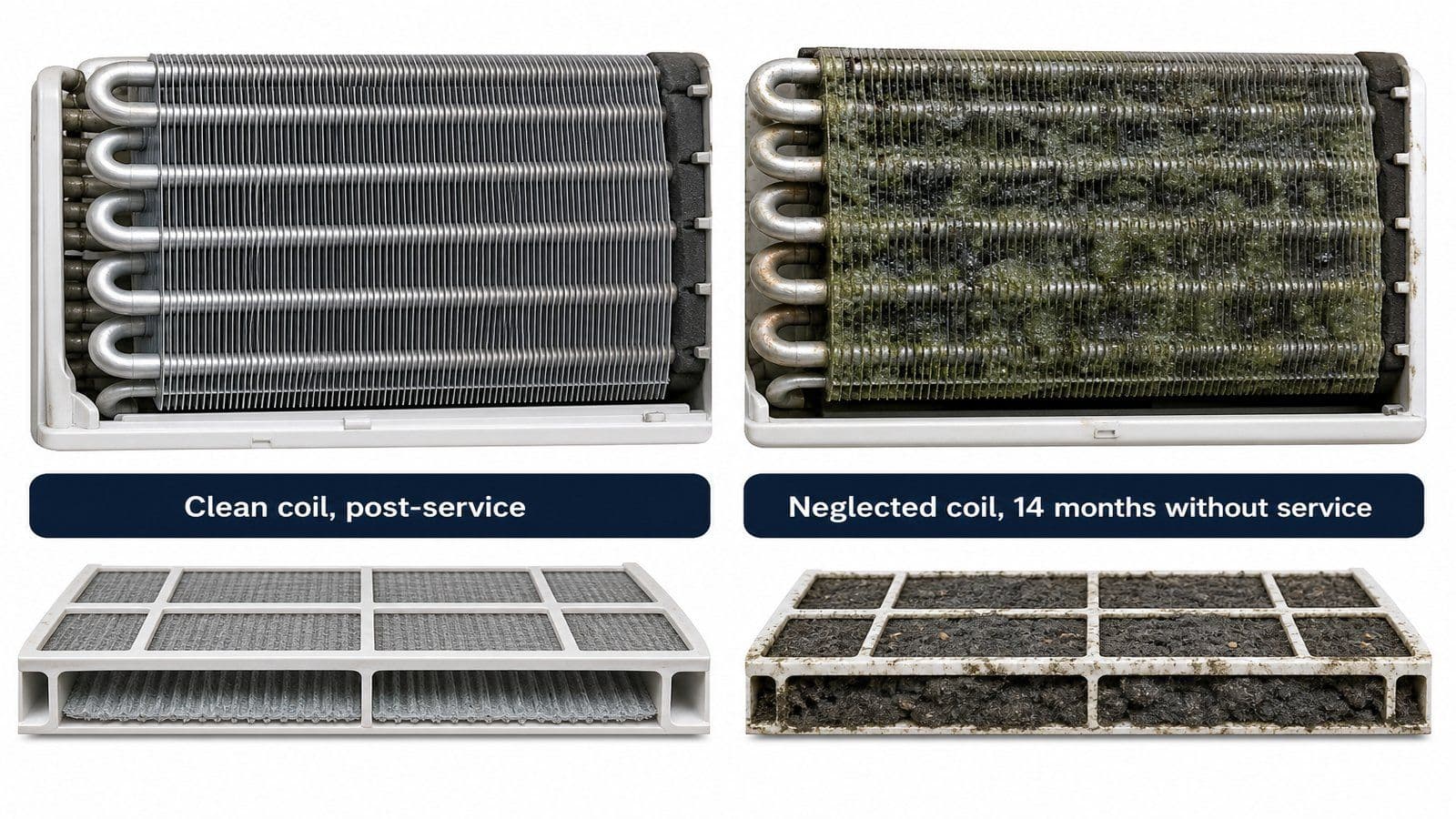
The PM 2.5 filter on the premium tier is the most underrated upgrade in this comparison. Over 14 years across 2,800+ service calls in Mumbai, Pune and Hyderabad I have seen the same pattern. Homes that pay the ₹6,000 to ₹10,000 jump from value to premium for the filter and anti-corrosion outdoor coil call us back 30 to 40 percent less often. The premium price recovers through fewer service visits alone, before the electricity savings.
When the Inverter Premium Does Not Pay Back
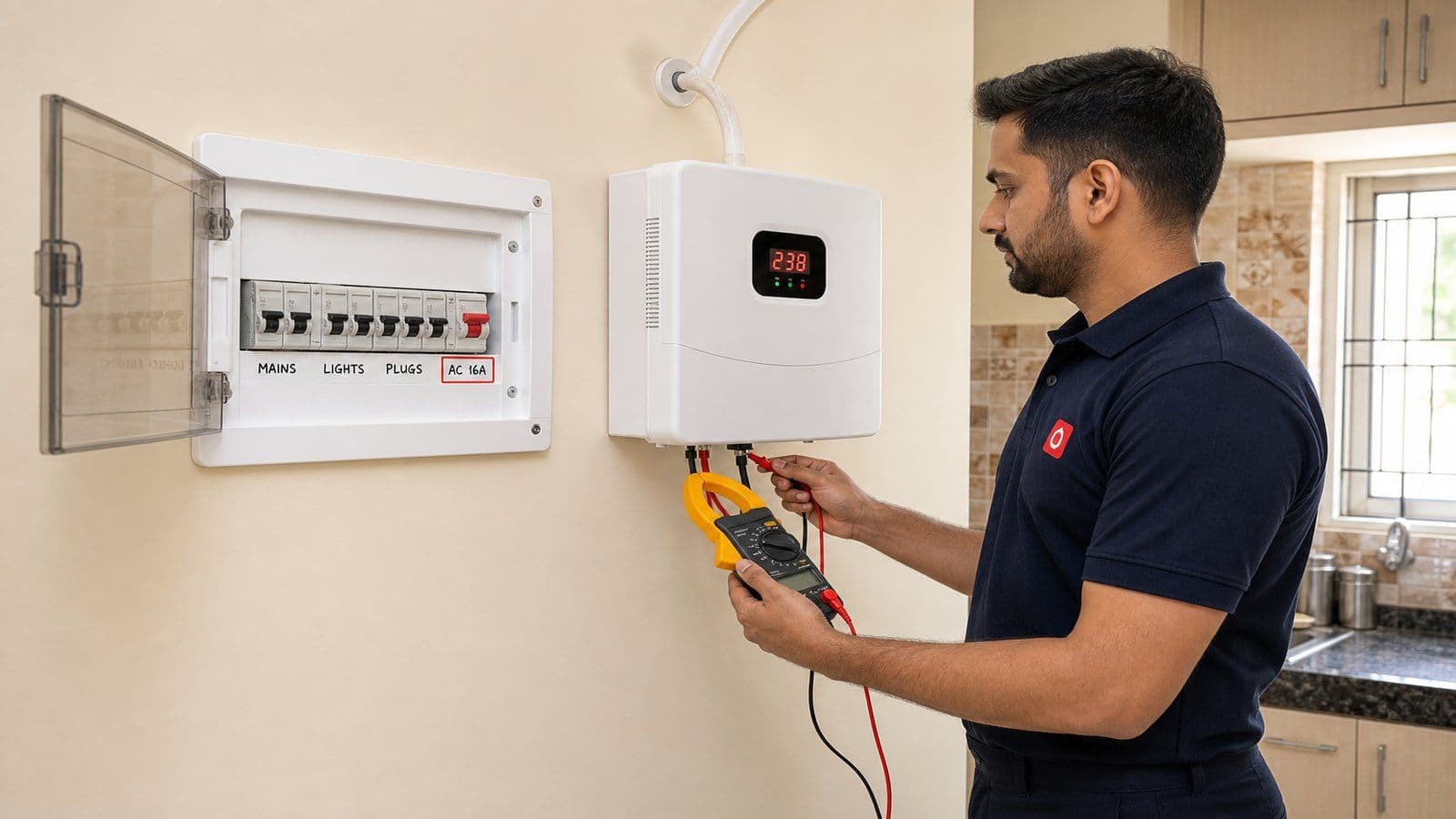
Photo: Indian apartment MCB switchboard with dedicated AC circuit and stabiliser
The honest case for non-inverter still exists in 2026, though narrowed.
Low-Hours Usage (Under 3 Hours Per Day)
Households that run the AC for an hour before bed do not accumulate enough steady-state time for inverter savings to repay the unit premium. A 1.5 ton 5-star non-inverter at ₹32,000 to ₹38,000 wins on total ownership cost over five years against a ₹38,000 to ₹46,000 value-tier inverter saving only ₹2,200 a year.
Get quotes from verified, top-rated AC Service & Repair pros in Delhi.
Tier-2 Cities With Voltage Instability
Frequent voltage drops below 180 volts are still a reality in many tier-2 Indian cities. Inverter PCBs are more voltage-sensitive than non-inverter relays. Without a 4 kVA stabiliser the failure rate on inverter units in unstable-supply locations runs roughly twice the tier-1 failure rate. Buyers should either budget a ₹2,500 to ₹4,500 stabiliser, or stay with non-inverter. The Ministry of Power (MoP) Saubhagya programme reports voltage stability has improved across most state grids since 2022, but the improvement is uneven.
Short-Term Tenancy (Under 2 Years)
Renters who vacate within two years will not own the AC long enough to recover the inverter premium. The non-inverter at the lower upfront price is the cleaner call.
Purchase Timing and Festival Cycle Pricing
The headline inverter AC price band shifts 8 to 15 percent across the year, and the shifts are predictable. The Diwali window (mid-October to mid-November) is the deepest discount period. Premium-tier 1.5 ton 5-star units that retail at ₹50,000 in July sell at ₹42,000 to ₹44,000 during Diwali week, with bank cashback knocking another 5 to 7 percent off.
The summer launch window (early March to mid-April) is the second discount period, with outgoing model-year stock clearing at 5 to 10 percent below the new launch price. Intervening months see flat pricing with occasional "festive bonus" offers that are typically inventory clearance dressed up. The Press Information Bureau (PIB) consumer-affairs advisories have repeatedly flagged inflated MRP followed by deep "discount" in non-festival months. For EMI economics see AC EMI options India 2026 comparison.
Real Andheri Buyer Case Study
Mr. Rajesh Mehta in Andheri, Mumbai called our ProNearMe network in October 2025 to replace an 8-year-old 1.5 ton non-inverter 3-star split. Weighted daily usage roughly 6 to 7 hours. The showroom quoted a premium-tier dual inverter 1.5 ton 5-star at ₹54,800, with a WiFi smart upsell at ₹62,500.
Our technician walked through the math on site. The recommendation was the twin rotary inverter 5-star (not the dual inverter) at the Diwali week price of ₹46,200, delivering 90 percent of the dual inverter's steady-state efficiency at a ₹8,600 lower unit price. With the ₹2,500 stabiliser the Mumbai monsoon voltage profile needed, total install was ₹52,400 against the ₹57,300 the showroom would have charged. Total cash saving ₹4,900. Six months on, no service callbacks and the September bill is down ₹680 a month. For gas-work pricing see AC gas refill cost India 2026 guide and for warranty labour AC repair cost breakdown India 2026.
GST, Invoice and the BIS Label Check
Inverter AC sales attract 28 percent GST, listed as a separate invoice line. For a ₹46,000 inclusive quote the pre-GST price is approximately ₹35,937. A complete invoice should list unit model and serial, BEE star rating and ISEER, manufacture date and BIS certification number, the 10-year compressor warranty, unit warranty, installation charges, stabiliser if bundled, GST as a separate line, and final total.
The BIS certification mark (ISI mark with CM/L licence number) must appear on the unit nameplate. Without it the unit cannot legally be sold in India under IS 1391:2024. Refrigerant should print as R32 on any unit manufactured from 2024 onwards. R410A units are still sold but the Ministry of Environment, Forest and Climate Change (MoEF&CC) is phasing them down under the Kigali Amendment timeline through 2028. NSDC-certified installation is mandatory for warranty validation.
The single biggest invoice mistake we see is the bundled installation line. A showroom quotes ₹46,000 all-in and the customer assumes the stabiliser and 16-amp dedicated socket are included. Almost never. The stabiliser is a ₹2,500 to ₹4,500 add-on. The 16-amp socket if not already present is another ₹800 to ₹2,500. Ask for the parts-versus-labour split on every line before paying. In the ProNearMe network we have logged this gap across more than 14 percent of inverter installations.
Conclusion
The inverter AC price range in India in 2026 reflects a market matured past the early-adopter premium phase. Value-tier units at ₹38,000 to ₹46,000 deliver the core inverter savings. Premium-tier at ₹46,000 to ₹58,000 add PM 2.5 filtration, anti-corrosion outdoor coil, and smoother twin or dual inverter modulation. Smart variants at ₹52,000 to ₹65,000 layer on WiFi and voice control.
The financial logic favours the inverter for most Indian households running the AC more than three hours a day, with break-even between two and four years. The discipline that matters most is matching the tier to actual household usage, not the showroom's preferred upsell. Pair that with a Diwali-window purchase, an itemised GST invoice, an NSDC-certified installer, and a 4 kVA stabiliser where the grid needs it.
Disclaimer
All price ranges are typical 2026 residential figures across major Indian cities and are inclusive of 28 percent GST unless noted. Actual prices vary by city, channel, seasonal demand, festival cycles, and installation bundling. NSDC-certified installation, ideally through a verified ProNearMe network service centre, is required to validate the manufacturer's warranty. Refrigerant handling by uncertified personnel is illegal under the Ozone Depleting Substances Rules and the Kigali Amendment commitments and voids most warranties. ProNearMe does not endorse any specific AC brand and all pricing should be treated as guidance, not a fixed quote.
Sources & References
- Bureau of Energy Efficiency (BEE) Star Rating Programme for Room Air Conditioners
- Bureau of Indian Standards IS 1391 Room Air Conditioner Specifications
- Ministry of Environment, Forest and Climate Change Ozone Cell and Kigali Amendment Implementation
- Central Electricity Authority Regulations for Domestic Electrical Installations
- National Skill Development Corporation HVAC Technician Qualification Pack
- Indian Society of Heating, Refrigerating and Air Conditioning Engineers Residential HVAC Guidelines
- Press Information Bureau Energy Efficient Air Conditioning Advisory and Sales Data
- Ministry of Power Saubhagya and Grid Stability Programme Reports
- Department of Consumer Affairs Jago Grahak Jago Consumer Awareness Programme
- Goods and Services Tax Council Rate Schedule for Air Conditioners
Amit worked as an AC technician for 6 years in Ahmedabad before transitioning to technical writing. He holds a diploma in Refrigeration and Air Conditioning from ITI Ahmedabad and understands the difference between what AC companies promise and what actually happens on the ground. His articles break down complex technical topics into plain language that any homeowner can follow. He tests every tip he writes about in his own home first.

Dr. Verma is a mechanical engineer with 15 years of experience in HVAC systems. She completed her PhD from IIT Delhi on energy-efficient cooling solutions for Indian residential buildings. She reviews all technical content on HomePros to make sure the numbers are right, the advice is safe, and the recommendations are backed by actual engineering principles. She consults for multiple AC manufacturers on product design.