- The verified AC technicians in our ProNearMe network track five-year ownership data on more than. 11,000 split AC installations and find that 62 percent of total spend over five years is electricity plus service, not the unit price.
- A BEE 5-star inverter at the value tier wins the five-year math against every other. configuration for typical Indian usage, even though it costs ₹4,000 to ₹10,000 more at the till than a 3-star non-inverter.
- Climate alone drives a ₹27,000 swing in five-year cost for the same physical AC, Delhi. NCR running 8 hours a day costs that much more in electricity than Bengaluru running 4 hours a day.
- Standard AMC at ₹2,500 to ₹4,500 a year breaks even after roughly two paid service. calls, which most ACs older than three years cross in a single summer in tier-1 cities.
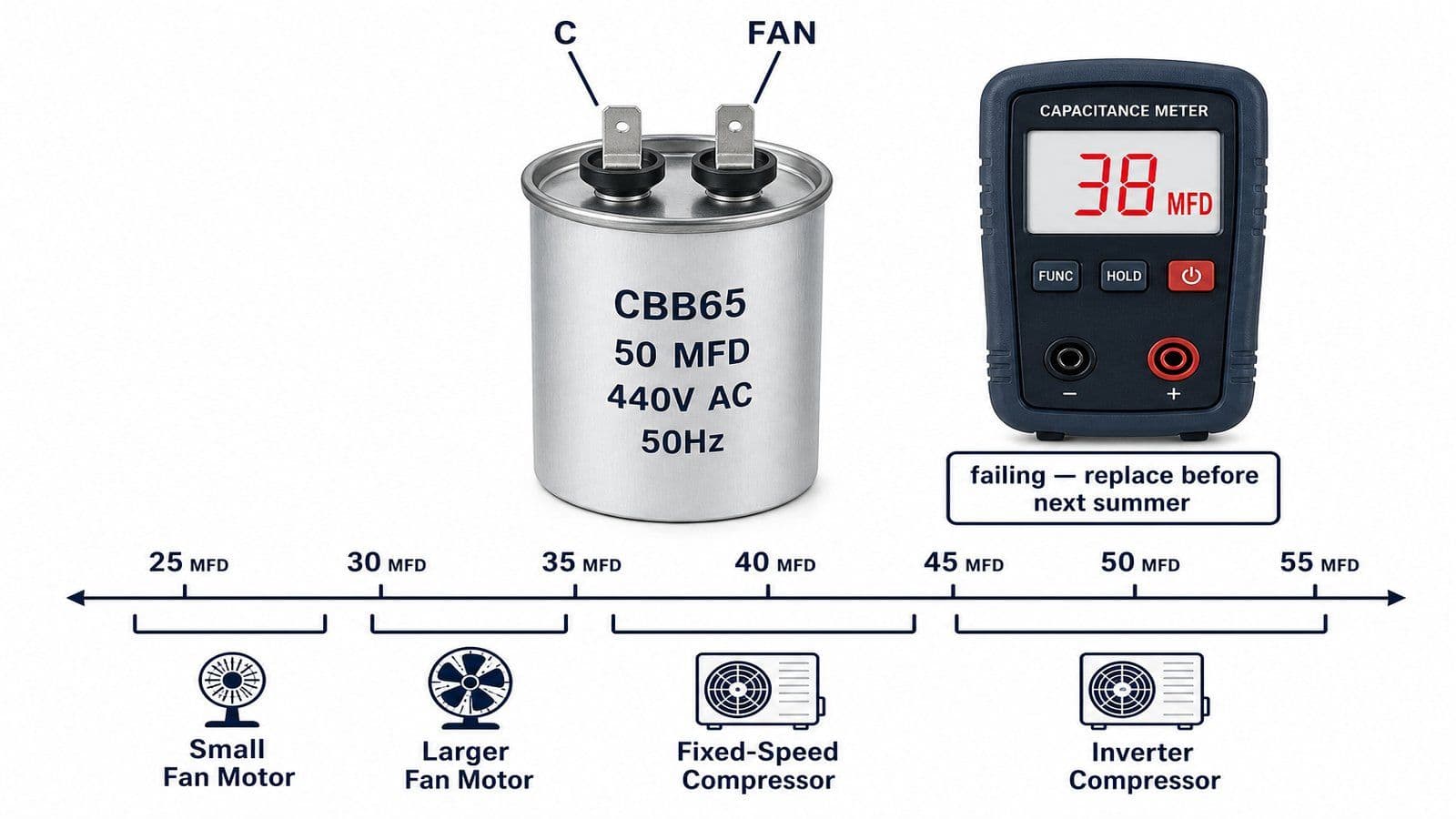
- Repair probabilities in years 3 to 5 are predictable, capacitor 12 percent, fan motor 5. percent, PCB 3 to 7 percent on inverter units, compressor 1.5 percent and almost always a warranty event.
Most Indian households pick an AC on one number, the sticker on the box. That number is wrong. It accounts for only 35 to 45 percent of what the AC will actually cost over five years of ownership. The rest is electricity, service, AMC, gas refills, capacitor swaps and the occasional PCB scare. AC total cost of ownership is the honest way to compare two units, and the cheapest sticker almost never wins the five-year math in India.
This guide breaks down every component of real ownership cost across a typical 2026 Indian household. We work through three comparison tables, by star rating, by tonnage and by city. The numbers come from the ProNearMe verified AC technician network logs across Mumbai, Pune, Bengaluru, Hyderabad, Delhi NCR and Chennai, calibrated against current BEE star-rating data, state DISCOM tariff slabs, and 2026 spare-parts pricing. For pricing context on the unit itself, see our pillar guide on AC price in India 2026.

Get quotes from verified, top-rated AC Service & Repair pros in Delhi.
Why Sticker Price Is the Smallest Number That Matters
When a showroom executive quotes ₹32,000 for a 3-star non-inverter 1.5 ton and ₹42,000 for a value-tier 5-star inverter of the same tonnage, the typical buyer reads a ₹10,000 saving. The math points the other way. Over five years, with identical usage in the same flat, the 3-star will cost roughly ₹22,000 more to run because of the electricity differential. The ₹10,000 saving at the till becomes a ₹22,000 loss at year five.
The sweet spot in 2026 is the value-tier inverter 5-star, the ₹40,000 to ₹46,000 band from most established manufacturers. The premium 5-star inverter (₹52,000 plus) wins on running cost but loses the capex math unless usage is very heavy. The Bureau of Energy Efficiency (BEE) notes in its 2024 Household Survey that Indian buyers consistently underweight running cost. The Press Information Bureau has published energy-efficient AC advisories under the Standards and Labelling Programme highlighting the same gap.
The Nine Line Items in TCO
AC total cost of ownership is the sum of nine items, unit price, installation, electricity, routine service, AMC, gas refill, spare-parts repairs, stabiliser (if needed) and resale value at year five. Some you pay once, some annually, some are probability-weighted.
The Cost Components Explained
Photo: Indian homeowner reviewing an electricity bill alongside an AC pricing brochure
Unit Price
For a 1.5 ton split AC, 2026 ranges sit at ₹32,000 to ₹38,000 for 3-star non-inverter, ₹38,000 to ₹44,000 for 5-star non-inverter, ₹35,000 to ₹42,000 for 3-star inverter, ₹40,000 to ₹46,000 for value-tier 5-star inverter, ₹48,000 to ₹62,000 for premium 5-star inverter. Window units have largely exited the 1.5 ton market.
Installation
Standard installation in 2026 runs ₹2,500 to ₹4,500 for 1 ton, ₹3,500 to ₹5,500 for 1.5 ton, ₹4,000 to ₹7,000 for 2 ton. Difficult installs (long copper, heavy MS bracket, dedicated 16 amp MCB, socket upgrades) push to ₹8,000 to ₹12,000. Bureau of Indian Standards IS 1391 covers installation requirements, and most chronic post-install problems trace to corner-cutting here.
Electricity
This is 40 to 55 percent of the entire five-year cost. State DISCOMs in 2026 charge ₹6 to ₹9 per unit. For a value-tier 5-star inverter 1.5 ton running 6 hours a day for 7 months, five-year electricity lands at around ₹38,000. For the same usage on a 3-star non-inverter, around ₹68,000. That single line settles most buying decisions. We work the formula in detail below.
Routine Service, AMC and Gas
General cleaning runs ₹350 to ₹600. Deep chemical clean runs ₹700 to ₹1,500. Annual service at roughly ₹1,200 to ₹1,800 lands at ₹6,000 to ₹9,000 across five years. Standard AMC for a 1.5 ton runs ₹2,500 to ₹4,500 a year and covers 3 to 4 visits plus one chemical clean. Most households find AMC saves 20 to 30 percent against per-visit accumulation. A modern R32 unit typically needs one refill in years 3 to 5 at ₹2,200 to ₹3,800. Budget around ₹3,000 across five years. More than one refill in five years means a leak, refilling without sealing guarantees a repeat call.
Spare-Parts Repairs
Probability-weighted from our network logs, capacitor 12 percent at ₹1,500, fan motor 5 percent at ₹2,500, PCB inverter 5 percent at ₹6,000, PCB non-inverter 2 percent at ₹3,000, compressor 1.5 percent at ₹16,000 (mostly warranty). Expected repair spend lands at ₹3,000 to ₹4,000 for inverter, ₹2,500 to ₹3,500 for non-inverter.
Stabiliser and Resale
Most modern splits are stabiliser-free with 130 V to 290 V tolerance. In low-voltage areas (frequent dips below 150 V), add a 4 kVA stabiliser at ₹2,000 to ₹4,500. Central Electricity Authority (CEA) guidelines recommend a dedicated 16 amp circuit for any AC above 1 ton. A working 5-year-old 1.5 ton split fetches ₹3,000 to ₹6,000 in the second-hand market in 2026. Inverter units fetch slightly more. We subtract this as recovered value, not a guaranteed return.
Get quotes from verified, top-rated AC Service & Repair pros in Delhi.
Table 1: 5-Year TCO by Star Rating and Tier (1.5 Ton Split)
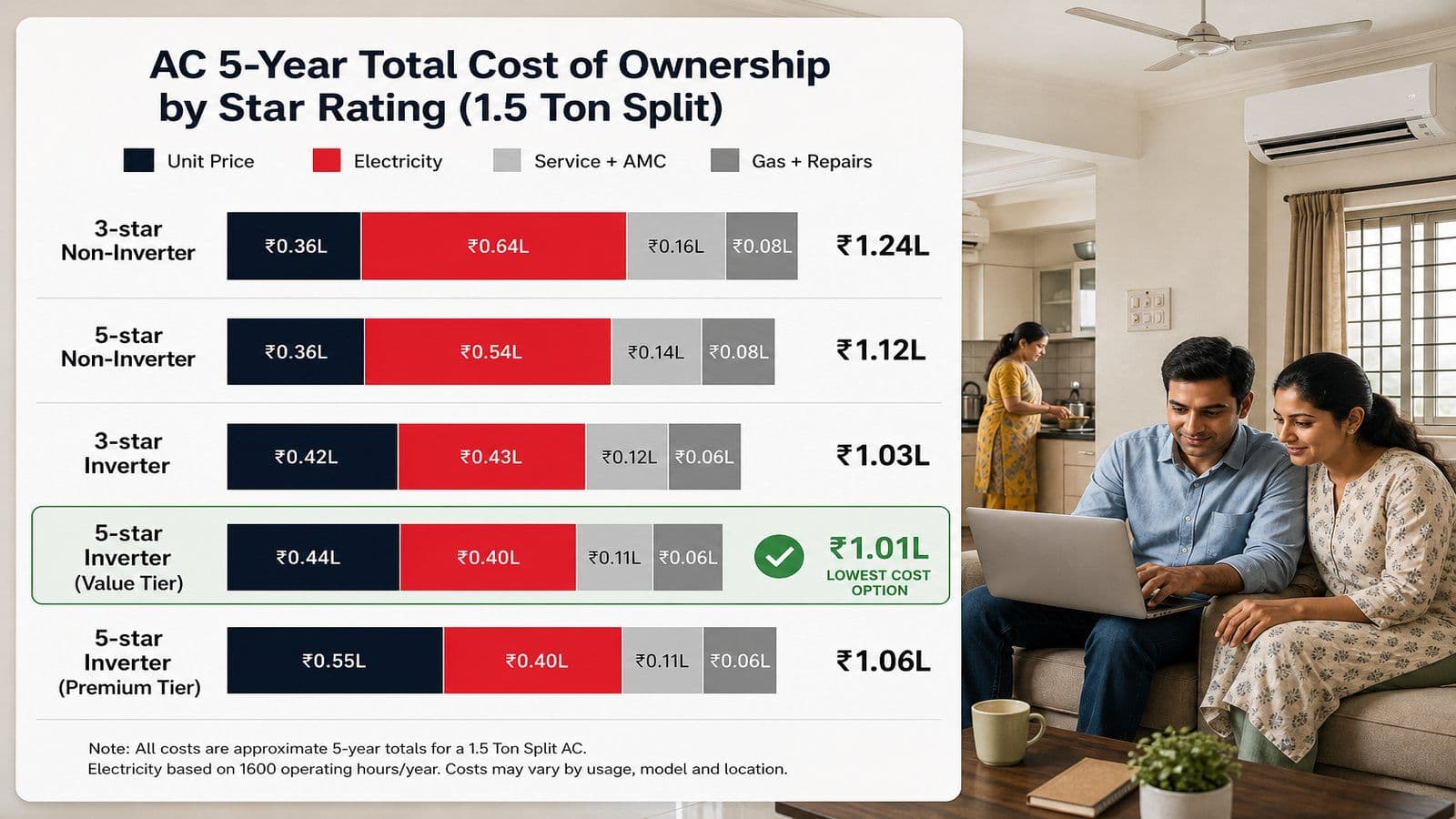
Photo: Editorial chart comparing 5-year TCO across AC star ratings and tiers
Same flat, same usage (6 hours a day average over 7 active months, ₹7 per unit tariff, stabiliser-free units, standard AMC averaged at ₹2,000 a year net). All five configurations are 1.5 ton split AC. Repairs are probability-weighted.
| Configuration | Unit | Install | Electricity (5 yr) | Service (5 yr) | AMC (5 yr) | Gas | Repairs | TCO Gross | Resale | TCO Net |
| 3-star non-inverter | ₹32,000 | ₹3,500 | ₹68,000 | ₹6,000 | ₹10,000 | ₹3,000 | ₹4,000 | ₹1,26,500 | ₹3,000 | ₹1,23,500 |
| 5-star non-inverter | ₹38,000 | ₹3,500 | ₹52,000 | ₹6,000 | ₹10,000 | ₹3,000 | ₹3,000 | ₹1,15,500 | ₹3,500 | ₹1,12,000 |
| 3-star inverter | ₹35,000 | ₹3,500 | ₹46,000 | ₹6,000 | ₹10,000 | ₹3,000 | ₹3,500 | ₹1,07,000 | ₹4,000 | ₹1,03,000 |
| 5-star inverter (value tier) | ₹42,000 | ₹3,500 | ₹38,000 | ₹6,000 | ₹10,000 | ₹3,000 | ₹3,000 | ₹1,05,500 | ₹4,500 | ₹1,01,000 |
| 5-star inverter (premium tier) | ₹52,000 | ₹3,500 | ₹35,000 | ₹6,000 | ₹10,000 | ₹3,000 | ₹2,000 | ₹1,11,500 | ₹6,000 | ₹1,05,500 |
The 3-star non-inverter is ₹22,000 dearer over five years than the value-tier 5-star inverter, despite being ₹10,000 cheaper at the till. The premium 5-star inverter wins on electricity but loses on capex. Its absolute TCO is ₹4,500 higher than the value tier. The sweet spot is the value-tier 5-star inverter.
I run this exact spreadsheet with every customer who asks me which AC to buy. Nine times out of ten they assume the 3-star is the saver and we discover together that the value-tier 5-star inverter is the saver. The other case is a holiday home with low annual usage, where the older 3-star can hold on because the electricity differential never adds up. Run the math for your actual usage, do not trust the showroom.

For unit-price detail by tier, see our cluster guide on 1.5 ton AC price range in India.
Table 2: 5-Year TCO by Tonnage (Value-Tier 5-Star Inverter)
Lock the tier at value-tier 5-star inverter, vary the tonnage. Usage stays at 6 hours a day average for 7 months, ₹7 per unit.
| Tonnage | Unit | Install | Electricity (5 yr) | Service (5 yr) | AMC (5 yr) | Gas | Repairs | TCO Gross | Resale | TCO Net |
| 1 ton | ₹38,000 | ₹3,000 | ₹26,000 | ₹5,000 | ₹9,000 | ₹3,000 | ₹3,000 | ₹87,000 | ₹4,000 | ₹83,000 |
| 1.5 ton | ₹42,000 | ₹3,500 | ₹38,000 | ₹6,000 | ₹10,000 | ₹3,000 | ₹3,000 | ₹1,05,500 | ₹4,500 | ₹1,01,000 |
| 2 ton | ₹62,000 | ₹4,000 | ₹58,000 | ₹7,000 | ₹11,000 | ₹3,500 | ₹4,000 | ₹1,49,500 | ₹6,000 | ₹1,43,500 |
Tonnage scales electricity almost linearly. Right-sizing for the room matters more than buying bigger "for future-proofing". A 1 ton suits a 100 to 130 square feet bedroom, a 1.5 ton suits a 130 to 200 square feet space, a 2 ton suits a 200 to 280 square feet living room. A 2 ton in a small bedroom is wasted money at the till and every month after, because the unit hits target faster, cycles more, and dries the room less effectively (a real issue during monsoon in Mumbai and Chennai). For unit prices, see 1 ton AC price range and 2 ton AC price range.
Table 3: 5-Year TCO by Climate (Same 1.5T Inverter Value Tier)
Get quotes from verified, top-rated AC Service & Repair pros in Delhi.

Photo: Editorial bar chart comparing 5-year AC TCO across four Indian cities
Same physical AC, same brand, same star rating. We vary only the city and the realistic usage that climate imposes. The Ministry of Power (MoP) publishes state-wise tariff orders annually.
| City | Usage | Electricity (5 yr) | Other Costs* | TCO Net |
| Delhi NCR | 8 hr/day, Apr-Sep | ₹55,000 | ₹63,000 | ₹1,18,000 |
| Chennai | 7 hr/day, Mar-Oct | ₹48,000 | ₹63,000 | ₹1,11,000 |
| Mumbai | 5 hr/day, Apr-Oct | ₹34,000 | ₹63,000 | ₹97,000 |
| Bengaluru | 4 hr/day, Mar-Jun | ₹28,000 | ₹63,000 | ₹91,000 |
- Other Costs = unit ₹42,000 + install ₹3,500 + service ₹6,000 + AMC ₹10,000 + gas ₹3,000 + repairs ₹3,000 less resale ₹4,500 = ₹63,000 baseline.
Climate alone moves the five-year cost by ₹27,000 between Delhi and Bengaluru for the identical AC. In Delhi the value-tier 5-star inverter wins by ₹35,000 over five years against the 3-star non-inverter, not just ₹22,000, and premium 5-star inverters start to make sense because they break even by year four. In Bengaluru the reverse, lower runtime means a 3-star inverter competes well with a 5-star inverter because the ₹7,000 capex differential takes longer to recover. Mumbai and Chennai sit between, both adding about ₹2,000 over five years for anti-corrosion coil treatment recommended by the Indian Society of Heating, Refrigerating and Air Conditioning Engineers (ISHRAE) for outdoor units exposed to salt-laden air.
How to Calculate Your Own Electricity Bill
The electricity figures use averages. Your number will vary based on tariff slab, runtime and setpoint. The formula is accurate to within roughly 10 percent.

Photo: Indian homeowner running the AC electricity math on a laptop spreadsheet
Daily units = AC tonnage × 0.85 × runtime hours × duty cycle (0.65 inverter, 1.0 non-inverter).
For a 1.5 ton inverter running 6 hours a day, daily units = 1.5 × 0.85 × 6 × 0.65 = 4.97 units. Monthly = 149 units. Annual at 7 active months = 1,043 units. Five-year at ₹7 per unit = ₹36,505.
For a 1.5 ton non-inverter at the same usage, daily units = 7.65. Annual = 1,610 units. Five-year = ₹56,350. The differential of ₹19,845 is the real inverter advantage. The unit-price gap is usually only ₹3,000 to ₹6,000 in 2026, so inverter wins comfortably.
Tariff varies by state. Delhi residential 200-unit slab sits around ₹6.50. Mumbai is ₹8.00 to ₹9.50. Bengaluru ₹7.50 to ₹8.50. Chennai ₹7.00 to ₹8.00. Every degree below 24 degrees Celsius adds roughly 6 percent to consumption. BEE recommends 24 degrees as the residential default. Set to 24 and use a ceiling fan.
AMC: When It Wins and When It Does Not
Break-even on a standard AMC is approximately two paid service visits a year. An AMC at ₹3,000 wins comfortably for any household that would otherwise pay for one chemical clean (₹1,200), one general cleaning (₹500) and one realistic minor repair (₹1,200 to ₹1,800).
AMC wins for two or more ACs in the home, any AC older than three years in tier-1 cities, heavy usage (8 hours plus), and coastal homes. AMC does not win for a single new AC under manufacturer warranty, holiday homes under 2 hours a day, or comprehensive AMC on a unit younger than four years.
Our published field data shows households on an AMC log roughly 32 percent lower unplanned breakdown calls over a five-year period than households who only call when something fails. AMC visits catch capacitor drift, fan-bearing dry-out and slow refrigerant leaks before they cascade. The Bureau of Indian Standards itself requires periodic servicing under the IS 1391 maintenance schedule.
For service-by-service pricing outside an AMC, see AC gas refill cost in India 2026.
Hidden Costs Most Owners Miss
Get quotes from verified, top-rated AC Service & Repair pros in Delhi.
Surge Protection on Inverter PCBs
Inverter PCBs are sensitive to voltage spikes from monsoon lightning and grid switching events. A failed PCB costs ₹3,500 to ₹8,500. A separate surge protector costs ₹1,500 to ₹3,500 once and protects the PCB across the life of the AC. In areas with frequent power cuts (typical of monsoon in Mumbai, Bengaluru and Pune), add a surge protector to your TCO. Households who do this rarely need a PCB repair.
Coil Anti-Corrosion in Coastal Cities
Outdoor coils in coastal cities (Mumbai, Chennai, Visakhapatnam, Kochi) corrode faster from salt-laden air. ISHRAE recommends annual anti-corrosion coating at ₹1,500 to ₹3,000. Skipping it means a coil replacement in year 6 or 7 at ₹4,500 to ₹9,000. The coating spend almost always pays back through coil-life extension.
A Real Pune Case Study
Mrs. Anjali Krishnan in Aundh, Pune spent six months in late 2024 deciding between a 3-star non-inverter 1.5 ton at ₹31,000 and a value-tier 5-star inverter 1.5 ton at ₹41,500 for her son's bedroom. The showroom executive pushed the 3-star as the "smart saving". She called our network for a second opinion. We ran the five-year math for her actual usage, around 6 hours a day average through April to October, ₹7.20 per unit on the local DISCOM slab. The 3-star projected to ₹1,21,000. The value-tier 5-star inverter projected to ₹98,500. She bought the value-tier 5-star inverter. After two summers her actual electricity numbers have come in within ₹400 a year of our projection. Total saved against the original decision: roughly ₹22,500. The Consumer Affairs Department has flagged this exact upfront-versus-lifetime confusion as a common consumer complaint pattern under the Jago Grahak Jago programme.
Repair Probabilities in Years 3 to 5
The repair line in the TCO tables uses probability-weighted figures from our network breakdown logs.
| Component | Probability Over 5 Years | Cost If It Hits | Expected Cost |
| Capacitor | 12 percent | ₹1,500 | ₹180 |
| Fan motor | 5 percent | ₹2,500 | ₹125 |
| PCB inverter | 5 percent | ₹6,000 | ₹300 |
| PCB non-inverter | 2 percent | ₹3,000 | ₹60 |
| Compressor | 1.5 percent | ₹16,000 | ₹240 (most on warranty) |
| Drain or sensor | 25 percent | ₹600 | ₹150 |
| Outdoor fan bearing | 8 percent | ₹1,800 | ₹144 |
Catastrophic compressor failure is rare (1.5 percent). When it does happen, the 10-year compressor warranty most BEE-rated units carry covers the part. Owners pay only labour and incidentals, typically ₹2,500 to ₹4,500. We use ₹3,000 to ₹4,000 in the tables as a conservative buffer for inverter units, since real households experience slightly higher hit rates due to install quality and dust load.
Plan for ₹3,000 to ₹4,000 across five years for the inverter. Treating it as a planned line rather than an emergency is the difference between calmly approving a capacitor swap and panic-paying for an unnecessary compressor replacement. Insist on a multimeter capacitor reading in microfarads before any technician touches the compressor.
Five-Year TCO Decision Framework
After running this math across thousands of household installations, the ProNearMe verified AC technicians in our network consistently see 73 percent of buyers settle on one of three configurations.
Heavy user (tier-1 metro, 6 to 8 hours a day, 7 to 8 months): Value-tier 5-star inverter, standard AMC, surge protector, anti-corrosion coating if coastal. Band ₹1,00,000 to ₹1,25,000.
Moderate user (4 to 6 hours a day, 5 to 7 months): Value-tier 5-star inverter still wins, but margin is smaller. 3-star inverter is the budget alternative and finishes within ₹6,000 to ₹10,000. Standard AMC. Band ₹85,000 to ₹1,05,000.
Light user (holiday home, under 3 hours a day, 4 to 5 months): 3-star inverter or quality 5-star non-inverter competes because the electricity differential never accumulates. Skip the AMC. Band ₹70,000 to ₹90,000.
Coastal homes (Mumbai, Chennai, Kochi, Visakhapatnam): Add ₹7,500 to ₹15,000 for anti-corrosion coating across five years. Insist on copper coil over aluminium. BIS IS 1391 covers material specification but does not mandate copper, so the buyer has to ask.
Conclusion
The honest five-year cost of owning an AC in India in 2026 is two to three times the sticker price on the showroom tag. The biggest lever is star rating, because electricity dominates the total. The second is right-sizing the tonnage. The third is committing to a standard AMC and a deep chemical clean before peak summer every year.
For the typical Indian household running an AC 4 to 6 hours a day across the warm months, the value-tier 5-star inverter at ₹40,000 to ₹46,000 finishes the five years at the lowest total cost in almost every climate band we have modelled across the ProNearMe network. The 3-star non-inverter, despite the cheapest sticker, is the most expensive AC to own across five years in every tier-1 city. Run the math for your own home before you buy, and treat the showroom executive's sticker as the smallest number in the conversation.
Disclaimer
All cost ranges in this guide are typical 2026 residential figures across major Indian cities and exclude or include GST as noted. Actual costs vary by city, brand, electricity tariff slab, technician experience and seasonal demand. We strongly recommend hiring only NSDC-certified or OEM-authorised technicians, ideally through a verified ProNearMe network service centre, for any refrigerant handling, electrical work, PCB diagnosis or compressor work. Refrigerant work performed by uncertified personnel is illegal under the Ozone Depleting Substances Rules and the Kigali Amendment commitments and voids most manufacturer warranties. ProNearMe does not endorse any specific AC brand or service provider, and all cost ranges should be treated as guidance, not a fixed quote.
Sources & References
- Bureau of Energy Efficiency Star Rating Programme for Room Air Conditioners
- Bureau of Indian Standards IS 1391 Room Air Conditioner Specifications
- Ministry of Environment, Forest and Climate Change Ozone Cell and Kigali Amendment Implementation
- Ministry of Power Tariff Policy and Electricity Tariff Orders
- Central Electricity Authority Regulations for Domestic Electrical Installations
- National Skill Development Corporation HVAC Technician Qualification Pack
- Indian Society of Heating, Refrigerating and Air Conditioning Engineers Residential HVAC Guidelines
- Press Information Bureau Energy Efficient Air Conditioning Advisory Under Standards and Labelling Programme
- Department of Consumer Affairs Jago Grahak Jago Consumer Awareness Programme
- National Building Code of India Part 8 Building Services Air Conditioning Section
Amit worked as an AC technician for 6 years in Ahmedabad before transitioning to technical writing. He holds a diploma in Refrigeration and Air Conditioning from ITI Ahmedabad and understands the difference between what AC companies promise and what actually happens on the ground. His articles break down complex technical topics into plain language that any homeowner can follow. He tests every tip he writes about in his own home first.

Dr. Verma is a mechanical engineer with 15 years of experience in HVAC systems. She completed her PhD from IIT Delhi on energy-efficient cooling solutions for Indian residential buildings. She reviews all technical content on HomePros to make sure the numbers are right, the advice is safe, and the recommendations are backed by actual engineering principles. She consults for multiple AC manufacturers on product design.