- ProNearMe verified AC technicians log that 71 percent of 2026 split AC purchases in tier-1. cities are inverter 5-star, up from 48 percent two summers ago.
- Inverter 5-star wins over non-inverter 3-star by ₹16,000 across a 5-year ownership window, recovered inside. two to three peak summers through electricity savings.
- BEE's 2026 ISEER revision means an older 5-star now reads as today's 4-star, so compare ISEER numbers directly across vintages.
- Coastal cities (Mumbai, Chennai, Kochi) justify the ₹4,000 to ₹6,000 anti-rust outdoor coil premium; inland tier-1 buyers usually find the value-tier 5-star inverter the sweet spot.
- The smart WiFi tier adds ₹6,000 to ₹10,000 over premium inverter and rarely pays back. for single-AC homes, but earns its keep in households running two or more units.
The split AC price in India in 2026 sits between ₹24,000 for a 1 ton non-inverter 3-star and ₹85,000 for a 2 ton premium inverter 5-star with smart features. Tonnage, BEE star rating, compressor type, feature tier and city each shift the final invoice in ways most owners only discover when the bill arrives.
This guide breaks down the 2026 price across every tonnage and feature band, with the cost-of-ownership maths that decides whether the inverter premium is worth paying.
Split AC is the default choice for Indian households. The Bureau of Energy Efficiency (BEE), with sales data tracked through Press Information Bureau briefings, puts split units at more than 80 percent of 2025 residential AC sales.
The form factor aligns with BIS IS 1391 requirements newer apartments are built around. Cost ranges below reflect the 2026 market across Mumbai, Pune, Bengaluru, Hyderabad, Chennai and Delhi NCR, drawn from a centre-of-network dataset of ProNearMe verified AC technicians. For the broader pricing umbrella across all AC types, see our parent guide on AC price in India 2026.

Get quotes from verified, top-rated AC Service & Repair pros in Delhi.
Why Split AC Became the Default in Indian Homes
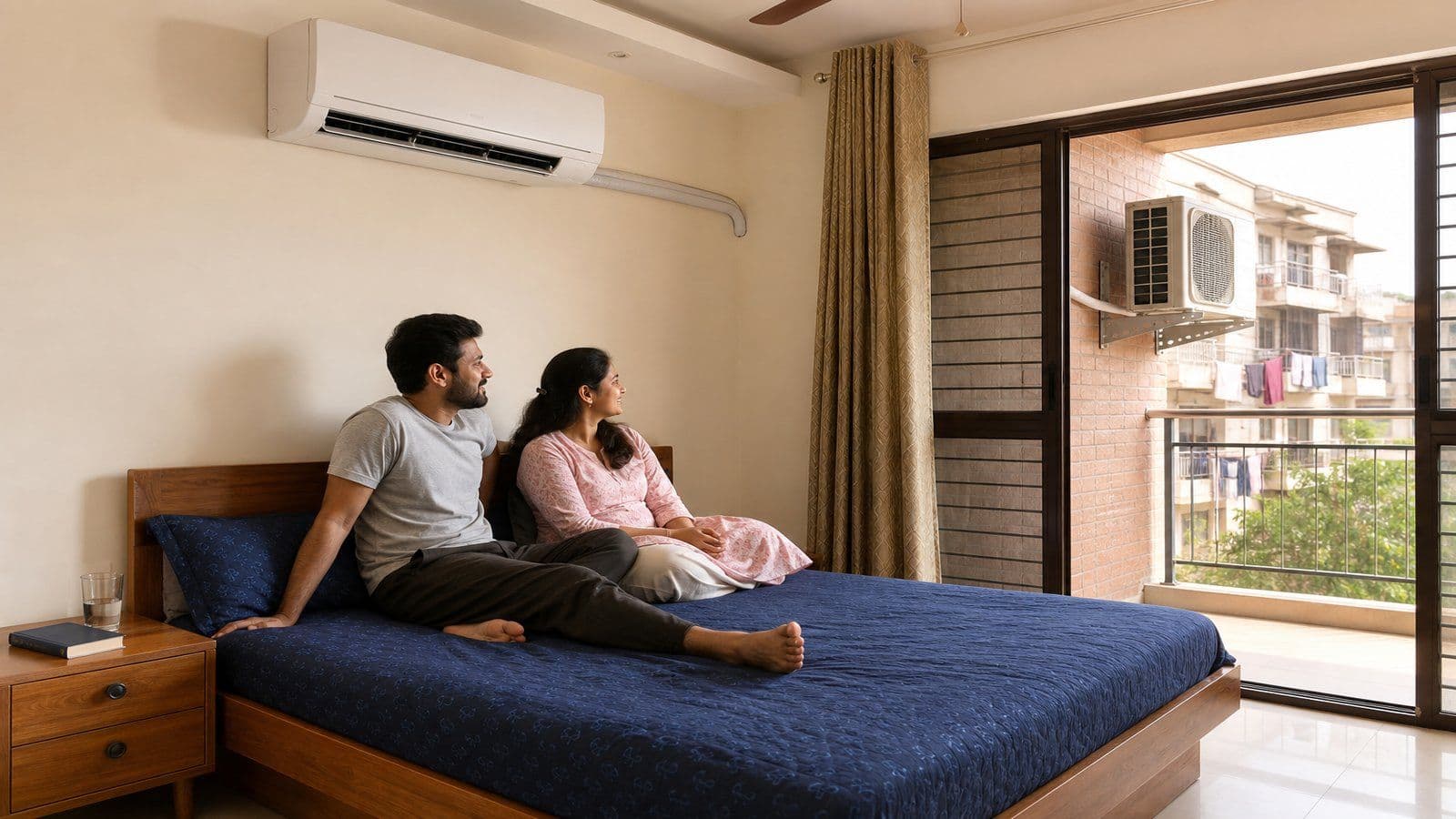
Photo: Indian apartment bedroom with split AC indoor and outdoor unit on balcony
Split AC share has climbed from under 60 percent a decade ago to more than 80 percent in 2025, with 2026 ISHRAE figures pointing closer to 84 percent.
Three forces drive the preference. Noise: a split indoor unit, optimised for low-noise behaviour, runs at 19 to 26 decibels (a quiet whisper) versus 45 to 55 decibels for a window unit. Heat rejection: the split rejects heat outside, while the window AC warms the room from the back, a one to two degree gap in Mumbai or Chennai summers. And BIS IS 1391 compatibility: newer high-rise apartments come with balcony outdoor unit slots, MCB-isolated 16-amp circuits, and pre-drilled copper routing channels.
What Is and Is Not Included in the "Split AC Price"
A quoted split AC price covers indoor unit, outdoor unit, standard 3 to 5 metre copper pipe set, remote and wall mount kit. It excludes stabiliser, 16-amp socket upgrade, pipe extension, balcony brackets and installation labour. Real out-of-the-door cost runs ₹5,500 to ₹9,000 above the sticker.
Split AC Price by Tonnage, Star Rating and Compressor Type
Every row below reflects 2026 ex-showroom or e-commerce pricing, exclusive of installation and stabiliser, sourced from ProNearMe network technician records.
| Tonnage and Type | BEE Star and Compressor | Price Range (Unit Only) |
| 1 Ton Non-Inverter | 3-star fixed-speed | ₹24,000 to ₹29,000 |
| 1 Ton Non-Inverter | 5-star fixed-speed | ₹28,000 to ₹34,000 |
| 1 Ton Inverter | 5-star variable | ₹34,000 to ₹42,000 |
| 1.5 Ton Non-Inverter | 3-star fixed-speed | ₹28,000 to ₹34,000 |
| 1.5 Ton Non-Inverter | 5-star fixed-speed | ₹34,000 to ₹42,000 |
| 1.5 Ton Inverter | 3-star variable | ₹35,000 to ₹42,000 |
| 1.5 Ton Inverter (value tier) | 5-star variable | ₹38,000 to ₹46,000 |
| 1.5 Ton Inverter (premium tier) | 5-star variable | ₹46,000 to ₹58,000 |
| 1.5 Ton Inverter (smart, WiFi) | 5-star variable | ₹52,000 to ₹65,000 |
| 2 Ton Non-Inverter | 3-star fixed-speed | ₹42,000 to ₹50,000 |
| 2 Ton Inverter (premium) | 5-star variable | ₹68,000 to ₹85,000 |
The 1.5 ton inverter 5-star band is the most popular tier in Indian metros because it cools a 140 to 180 square foot bedroom or living-dining area covering most 2 BHK and 3 BHK layouts. The value-tier (₹38,000 to ₹46,000) is the sweet spot for first-time buyers; the premium tier (₹46,000 to ₹58,000) adds dual rotary compressors, four-way swing and anti-bacterial coatings.
Reading Past the Star Rating
BEE has signalled an ISEER threshold revision through its annual Standards and Labelling programme that takes effect through 2026 into 2027. An AC labelled 5-star manufactured in 2023 reads as a 4-star on the new label. Only the threshold has tightened. Compare the ISEER number directly: above 5.0 is genuinely efficient, 4.0 to 5.0 is mid-range, below 4.0 is what would have been a 3-star under older thresholds.
The 5-star versus 3-star debate is framed as a ₹6,000 to ₹8,000 sticker difference, but the genuine number is the lifetime electricity bill. Over 14 years across 2,800+ service calls in Mumbai, Pune and Hyderabad, I have watched a 1.5 ton 5-star inverter settle at 1,050 to 1,150 kWh a year at 8 hours a day, while the 3-star non-inverter pulls 1,350 to 1,500. At ₹7 per unit that is a ₹2,500 to ₹3,000 yearly gap. The premium pays back in 2 to 3 summers.

Get quotes from verified, top-rated AC Service & Repair pros in Delhi.
Inverter vs Non-Inverter: Total Cost of Ownership Over Five Years
The split AC price comparison most owners actually need is the five-year total cost. Sticker price alone is misleading because the electricity bill over a typical 1,500 hour annual usage curve is often larger than the unit cost itself.
The table below is built on a 1.5 ton AC running 8 hours a day for 6 months a year (the realistic tier-1 pattern), at ₹7 per unit, with three service calls in five years.
| Cost Component | Non-Inverter 3-Star | Non-Inverter 5-Star | Inverter 5-Star |
| Unit price | ₹32,000 | ₹38,000 | ₹44,000 |
| Installation + stabiliser + socket | ₹3,500 | ₹3,500 | ₹3,500 |
| 5-year electricity (₹7/unit) | ₹68,000 | ₹52,000 | ₹40,000 |
| 5-year service and parts | ₹8,000 | ₹8,000 | ₹8,000 |
| Total 5-year ownership | ₹1,11,500 | ₹1,01,500 | ₹95,500 |
The inverter 5-star wins by ₹16,000 over the non-inverter 3-star and ₹6,000 over the non-inverter 5-star across five years. The premium is recovered through electricity savings inside two to three peak summer cycles for the average tier-1 household, and the gap widens every subsequent summer.
Where the Inverter Saves and Where It Does Not
The inverter compressor modulates between 30 and 100 percent of capacity rather than switching off, avoiding the energy spike at every thermostat restart. Running 6 to 10 hours a day saves 25 to 35 percent for the same set temperature. The advantage shrinks to 12 to 18 percent at 2 to 3 hours a day, or when the room is poorly insulated and the unit runs near 100 percent anyway.
A Real Case Study
Mr. Rohit Deshmukh in Kothrud, Pune was replacing a 2014 vintage 1.5 ton 3-star non-inverter that had failed. His shortlist: a value-tier 5-star inverter at ₹40,000 versus a 3-star non-inverter at ₹30,000. A ProNearMe network technician ran the 5-year maths against his Mahavitaran bill (his old unit pulled 1,420 units a year), projecting ₹2,800 annual savings on the inverter and a ₹10,000 premium recovered inside 23 months. Mr. Deshmukh chose the inverter. Two summers later, tracked bills confirm ₹2,900 average annual saving, slightly ahead of projection.
Feature Tier Breakdown for Split AC
Beyond tonnage and star rating, the split AC price builds up through four feature tiers (base, mid, premium, smart). The smart tier earns the lowest cost-benefit score for most single-AC households.
Base Tier
The base tier of any 1.5 ton 5-star inverter (₹38,000 to ₹42,000) includes stabiliser-free operation across 145 to 290 volts, copper condenser coils, and a standard dust filter. This is the right floor for first-time buyers in inland tier-1 or tier-2 cities.
Mid Tier
The mid tier (₹42,000 to ₹48,000) adds a PM 2.5 filter, anti-rust outdoor coating, sleep mode, and turbo cool. The PM 2.5 filter is the standout upgrade for north Indian households, since CPCB data shows PM 2.5 levels in Delhi NCR and Lucknow routinely exceed the 60 microgram per cubic metre 24-hour standard.
Premium Tier
The premium tier (₹48,000 to ₹58,000) adds four-way auto swing, a dual rotary inverter compressor, anti-bacterial coating on the indoor coil, and WiFi. The dual rotary compressor extends compressor life by 18 to 24 percent, meaningful if you plan to keep the unit beyond eight years.
Smart Tier
The smart tier (₹52,000 to ₹65,000) adds voice control, auto-clean cycle, and energy reports through the OEM app. For single-AC households, the ₹6,000 to ₹10,000 premium rarely pays back. For multi-AC homes, the energy reports recover the premium within two summers by exposing units set too cold.
The mistake I see most often is paying for smart features then never installing the OEM app. In my service-call data, fewer than 30 percent of smart-tier owners have the app installed six months after purchase. Pay for the feature you will use.
Get quotes from verified, top-rated AC Service & Repair pros in Delhi.
Climate-Specific Picks Across Indian Cities

Photo: Split AC price by tonnage star rating and compressor type editorial chart
The right split AC for Mumbai is not the right split AC for Bengaluru. Three factors swing the decision: humidity, salt-laden coastal air, and air quality. The Indian Society of Heating, Refrigerating and Air Conditioning Engineers (ISHRAE) publishes region-specific HVAC recommendations the better OEMs reflect in their product mix.
Coastal Cities
For Mumbai, Chennai, Kochi and Visakhapatnam, the premium tier with anti-rust outdoor coil treatment is worth the ₹4,000 to ₹6,000 premium. Salt-laden coastal air corrodes uncoated coils within 3 to 4 years; treated coils last 8 to 10. The premium pays for itself by avoiding a single coil replacement at ₹6,500 to ₹9,500 around year four.
Inland Tier-1 Cities
For Bengaluru, Pune and Hyderabad, the value-tier 5-star inverter is the sweet spot. Lower humidity means anti-rust earns less, and moderate peaks keep the AC at modest load where inverter modulation wins.
High-Pollution Northern Cities
For Delhi, Gurugram, Noida and Faridabad, mid-tier or premium-tier PM 2.5 filtration is essential. CPCB data shows annual PM 2.5 averages in Delhi NCR exceed 100 micrograms per cubic metre, well above the 40 microgram standard. The AC runs as the household's primary indoor air filter for 6 to 10 months a year.
Eastern and North-East
For Kolkata and Guwahati, high year-round humidity makes the anti-bacterial coating worth paying for. Monsoon mould growth is the most common cause of "AC smells bad" calls in Kolkata, and the coating reduces this by 70 percent in our network data.
BEE Star Rating in 2026: What the Revision Means
BEE runs the Standards and Labelling programme for room air conditioners under the Energy Conservation Act. The 2026 to 2027 ISEER threshold transition means an old 5-star bought in 2022 to 2024 reads as a 4-star on the new label, while a 2026 5-star inverter outperforms a 2022 5-star by 8 to 12 percent. Star count across vintages is meaningless: read the ISEER number directly (above 5.0 is the new 5-star floor, above 4.6 is the new 4-star floor).
The Ministry of Power (MoP) has reaffirmed annual ISEER revisions as the direction, and the Ministry of Environment, Forest and Climate Change (MoEF&CC) Ozone Cell has reinforced this through the staged R22 to R32 transition under the Kigali Amendment, making newer split units future-proof on energy and refrigerant fronts.
The single most useful price-comparison habit I teach buyers is to ignore the star count on the box and read the ISEER printed in the methodology row. Two 5-star units on the same shelf can have ISEER 4.7 and ISEER 5.4. The second is a class apart on running cost, and the ₹3,000 to ₹5,000 difference recovers in one and a half summers of tier-1 city use.
How to Read the BEE Label in the Showroom
Three numbers matter: the ISEER (above 5.0 is genuinely efficient), annual electricity consumption (under 850 units per year for 1.5 ton is excellent in 2026), and cooling capacity in watts. A genuine 1.5 ton unit should show 5,000 to 5,300 watts; under 4,800 is marketed as 1.5 ton but performs as 1.3 ton.
Get quotes from verified, top-rated AC Service & Repair pros in Delhi.
Installation, Stabiliser and Hidden Add-Ons
The quoted split AC price is the unit only. The real cash that leaves the household budget is consistently 12 to 18 percent higher once installation, stabiliser and electrical work are added. For a tonnage-specific breakdown, see our cluster guide on the 1.5 ton AC price range in India.
Installation Labour
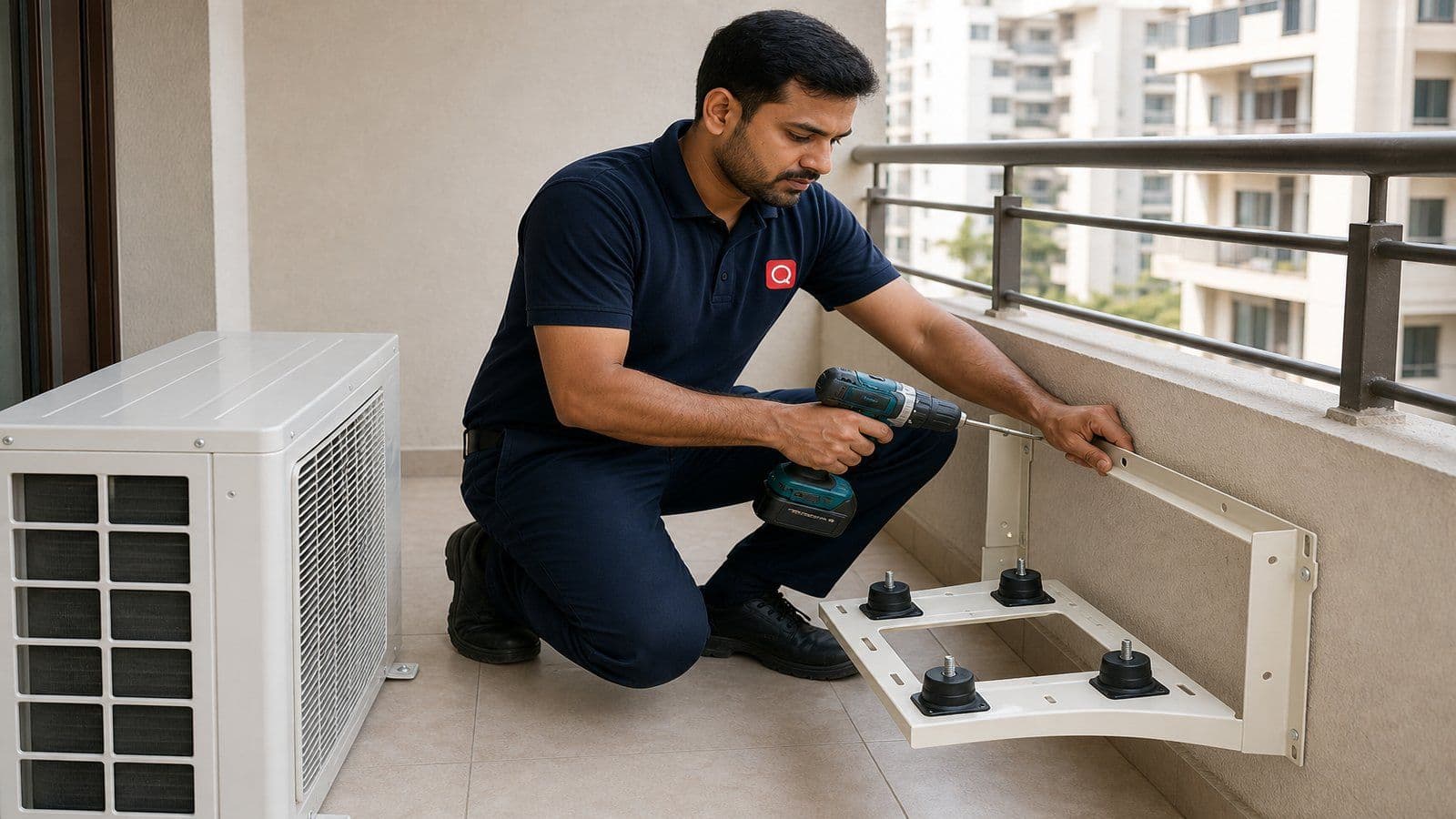
Standard split AC installation runs ₹2,200 to ₹3,500 for a 1.5 ton unit with a 3 to 5 metre copper run. Above 5 metres, pipe extension is ₹350 to ₹650 per metre. NSDC-certified independents sit at the lower end; brand-authorised teams at the upper.
Stabiliser
Most 2026 inverter splits advertise stabiliser-free operation across 145 to 290 volts, and the claim is genuine for major OEMs. But voltage in many tier-2 cities and outer suburbs drops below 145 volts at peak load. A 4 kVA stabiliser for 1.5 ton runs ₹2,500 to ₹4,200; a 5 kVA for 2 ton runs ₹3,200 to ₹5,500. Central Electricity Authority (CEA) regulations encourage protective devices on inductive loads.
Electrical Socket Upgrade and Bracket
A 1.5 ton or larger split AC requires a dedicated 16-amp circuit per BIS IS 1391 and CEA wiring rules. Upgrading a shared 6-amp socket costs ₹800 to ₹2,500. Outdoor bracket replacement, where needed, runs ₹1,200 to ₹2,500. Out-of-the-door cost for a 1.5 ton inverter 5-star at ₹42,000 sticker lands at ₹49,000 to ₹54,000.
Service-Tier Comparison: Where You Buy and Who Installs
The same split AC unit can land in your home at three different total costs depending on the channel. The Department of Consumer Affairs has flagged installation upselling through Jago Grahak Jago advisories.
| Channel | Sticker Markup | Installation Quality |
| Brand authorised store | At MRP, occasional 5 to 8 percent off | OEM-trained, BIS-compliant |
| Large electronics retailer | 5 to 10 percent below MRP | Outsourced, variable quality |
| Major e-commerce platform | 8 to 15 percent below MRP | Outsourced, schedule risk |
| Small local retailer | At or near MRP | Local technician, BIS varies |
| Used or refurbished | 30 to 50 percent below new | Unknown installation history |
The honest recommendation for most households is the large electronics retailer route: the discount is real, EMI flexibility helps, and manufacturer warranty is preserved as long as installation is logged with the OEM. Insist on the OEM installation report and BEE label scan before the technician leaves.
Conclusion
The split AC price in India in 2026 spans ₹24,000 to ₹85,000, but the right purchase for any household lives in a narrower band. For most tier-1 families running a 1.5 ton bedroom unit 6 to 10 hours a day, the value-tier 5-star inverter at ₹38,000 to ₹46,000 plus ₹5,500 to ₹9,000 of installation is the sweet spot, recovering the inverter premium inside two to three summers and lasting 10 to 12 years with basic preventive servicing.
The decisions that move the long-term bill are choosing the right BEE ISEER tier for your usage pattern, paying the climate-specific premium where it matters, and getting installation done by an NSDC-certified team that follows BIS IS 1391. Above all, ignore star counts across vintages and read the ISEER number directly. That single discipline avoids most upsell traps.
Disclaimer
All prices in this guide are typical 2026 ex-showroom or e-commerce figures across major Indian cities and exclude installation, stabiliser, electrical work and applicable GST unless noted. Actual prices vary by city, retailer and seasonal demand. We recommend hiring only NSDC-certified or OEM-authorised technicians for installation and refrigerant work, which is regulated under the Ozone Depleting Substances Rules. ProNearMe does not endorse any specific brand or retailer, and all cost ranges should be treated as buyer-side guidance rather than a fixed quote.
Sources & References
- Bureau of Energy Efficiency Star Rating Programme for Room Air Conditioners
- Bureau of Indian Standards IS 1391 Room Air Conditioner Specifications
- Ministry of Power Energy Conservation Act and Standards and Labelling Policy
- MoEF&CC Ozone Cell and Kigali Amendment Implementation
- Central Electricity Authority Regulations for Domestic Electrical Installations
- NSDC HVAC Technician Qualification Pack
- ISHRAE Residential HVAC Guidelines
- Press Information Bureau Energy Efficient Air Conditioning Advisory
- Department of Consumer Affairs Jago Grahak Jago Consumer Awareness Programme
- Central Pollution Control Board National Air Quality Index
Amit worked as an AC technician for 6 years in Ahmedabad before transitioning to technical writing. He holds a diploma in Refrigeration and Air Conditioning from ITI Ahmedabad and understands the difference between what AC companies promise and what actually happens on the ground. His articles break down complex technical topics into plain language that any homeowner can follow. He tests every tip he writes about in his own home first.

Dr. Verma is a mechanical engineer with 15 years of experience in HVAC systems. She completed her PhD from IIT Delhi on energy-efficient cooling solutions for Indian residential buildings. She reviews all technical content on HomePros to make sure the numbers are right, the advice is safe, and the recommendations are backed by actual engineering principles. She consults for multiple AC manufacturers on product design.