- The ProNearMe verified AC technicians log that 64 percent of cassette installs in 2026 cluster. between 3 ton and 4 ton 4-way units, the sweet spot for halls of 350 to 500 sq ft.
- Installation hardware (drainage pump, false-ceiling cuts, vibration isolation, condensate routing) adds 12 to 22 percent. on top of unit price, an overhead wall splits do not carry at the same scale.
- False-ceiling load capacity per BIS guidance must accommodate a suspended weight close to 125 kg. per indoor unit (unit plus structural fasteners plus drain water), which triggers structural sign-off above 50 kg.
- Commercial cassette units above 2 ton attract 28 percent GST as capital goods, while units. up to 2 ton sit at 18 percent. GST-registered buyers can claim input tax credit on both.
- A 5-year TCO for a 400 sq ft hall shows cassette and twin-split installs land. within ₹10,000 of each other, so the choice is driven by air-distribution quality and ceiling aesthetics, not headline cassette ac price alone.
A cassette AC is the format Indian commercial owners reach for the moment a brief mentions "open hall", "no floor space", "no wall space" or "even cooling for the whole room". The unit hides inside the false ceiling, drops a flush decorative grille at ceiling level, and throws cool air down in two, four or 360 degrees.
In 2026 a 2 ton 2-way cassette starts around ₹78,000 and a 5 ton 360-degree premium cassette can cross ₹2.85 lakh before installation. The cassette ac price band moves widely because the airflow pattern, tonnage, drainage hardware and ceiling-load engineering all stack on top of each other.
This guide is written for the buyer who has ruled out wall splits and now needs the real 2026 numbers for cassette units across restaurants, clinics, showrooms, offices and increasingly the premium villa segment. Pricing is drawn from the ProNearMe network's installed quotes across Mumbai, Pune and Hyderabad, cross-checked against BEE-listed commercial models. For the wider context, the parent guide AC Price India 2026: The Complete Buyer's Guide sets the full residential and commercial framing.

Get quotes from verified, top-rated AC Service & Repair pros in Delhi.
Why Commercial Buyers Pick Cassette in 2026
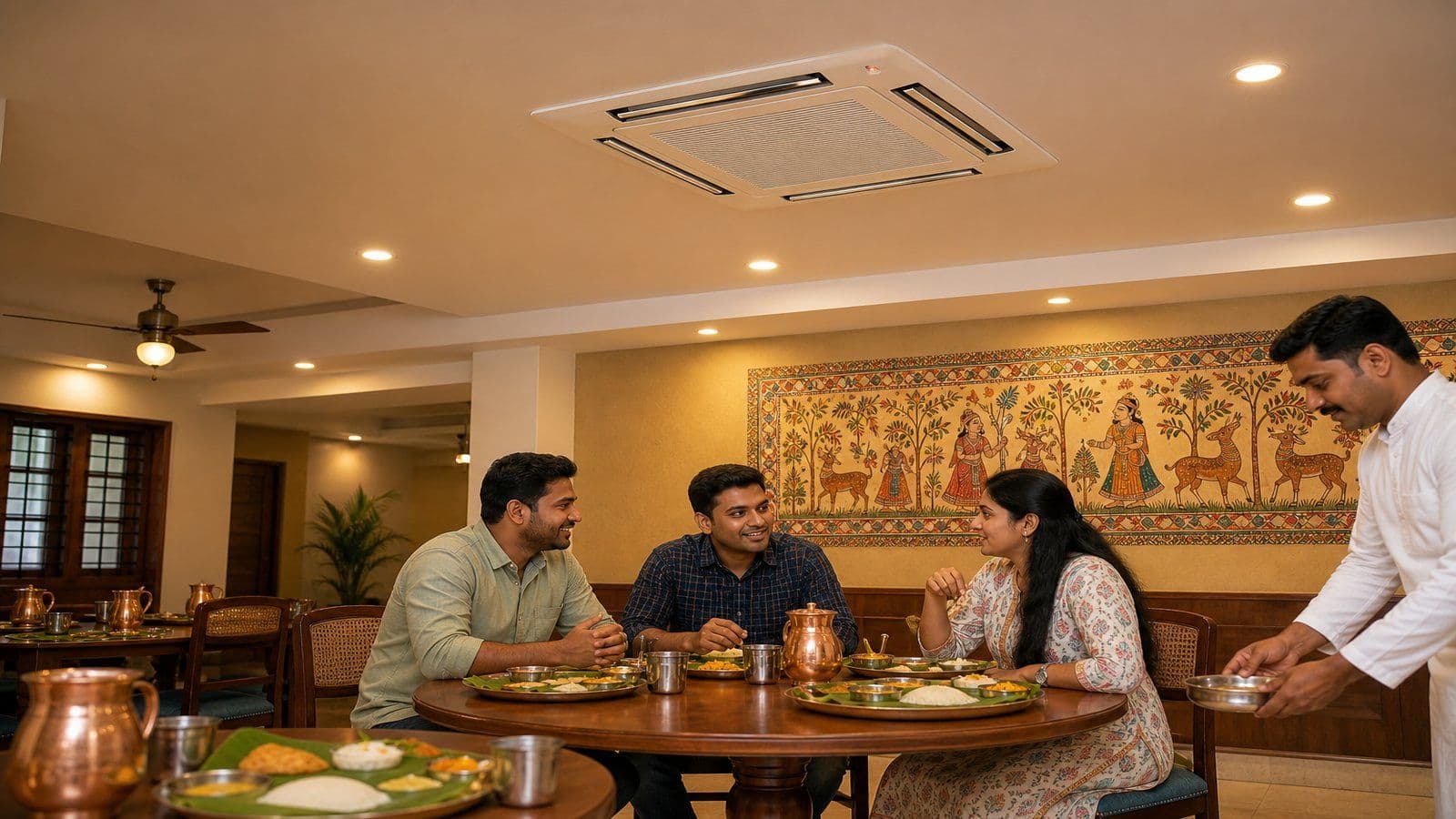
Photo: Flush 4-way ceiling cassette AC inside an Indian restaurant dining area in evening service
The cassette earns its premium in three specific scenarios. A wall split sized for the same hall throws air in one direction and creates obvious hot zones in the far corners. A ducted split requires plenum space and properly engineered duct runs, which most older Indian commercial buildings do not have. A floor-standing tower eats valuable floor area in spaces where seating density or merchandising is the entire commercial model.
Cassette wins where ceiling height is 9 to 12 feet, the false-ceiling allowance has been planned during fit-out, and the room shape is regular enough that two-way or four-way throw can blanket the floor evenly. For a 400 sq ft hall this is usually a single 4 ton 4-way unit. For 600 sq ft it is either a single 5 ton 360-degree or two 3 ton 4-way cassettes, depending on column layout.
Restaurants and Cafes
Restaurants run kitchens that push hot air into the dining area through service openings. A central 4-way cassette pulls returns evenly from the ceiling void and pushes conditioned air down to the seated zone, keeping customer comfort steady through dinner service. The ProNearMe network's restaurant installs in Hyderabad and Pune cluster at 4 ton and 5 ton tonnages for 350 to 500 cover dining rooms.
Clinics and Diagnostic Centres
Clinics need silent operation in waiting areas plus higher fresh-air exchange in procedure rooms. A 2 to 3 ton 4-way cassette with a built-in drain pump runs at 30 to 38 dB(A) at low speed, which sits well inside the National Building Code (NBC) acoustic comfort range for healthcare. Drainage routing matters because clinics cannot afford ceiling stains.
Showrooms, Offices and Premium Villas
Showrooms want even temperature across the merchandise floor and a ceiling that reads as part of the lighting plan rather than a service element. Open-plan offices and banquet halls value the absence of wall protrusions. A growing tier-1 villa segment in Hyderabad and Pune now picks cassettes for large living-dining halls with 10 feet plus ceilings where false-ceiling allowance was built in from day one.
Cassette AC Price by Airflow Pattern and Tonnage
Cassette pricing in 2026 splits along two axes: airflow pattern (2-way, 4-way, 360-degree) and tonnage (2 ton through 5 ton plus). Above 5 ton most commercial projects move to ducted VRF systems rather than single cassettes.
| Tonnage | Airflow Pattern | Indicative 2026 Price (Unit Only) |
| 2 ton | 2-way | ₹78,000 to ₹92,000 |
| 2 ton | 4-way | ₹85,000 to ₹1,05,000 |
| 3 ton | 4-way | ₹1,15,000 to ₹1,42,000 |
| 4 ton | 4-way | ₹1,55,000 to ₹1,95,000 |
| 5 ton | 360-degree | ₹2,25,000 to ₹2,85,000 |
Inverter compressor units sit at the upper end of each band. Non-inverter (fixed-speed) units sit at the lower end and are increasingly limited to budget commercial fit-outs. BEE star labelling for cassette and other commercial AC formats became more prominent after the 2022 expansion of the BEE Star Rating Programme to include light commercial categories.
The first question a commercial buyer should ask is not the headline cassette ac price. It is the airflow pattern match for the room geometry. We have replaced perfectly good 3 ton 4-way cassettes in narrow 14 by 28 feet bakery seating areas with two 2-way cassettes, because the room shape never gave two of the four directions a useful throw distance. The owner paid twice over, once for the wrong unit and once for the right one.

Get quotes from verified, top-rated AC Service & Repair pros in Delhi.
Installation Cost for Cassette AC in 2026
Installation is where cassette pricing diverges from a wall split. A wall split install in 2026 runs ₹2,500 to ₹6,000 for residential. A cassette install at the same tonnage runs three to six times higher because the false-ceiling cut, drainage pump, suspended hanger rod assembly, vibration isolation and condensate routing are all part of the same job.
| Installation Component | 2026 Cost Range |
| 2 ton install (ceiling drop, basic ducting, drain) | ₹6,000 to ₹12,000 |
| 3 to 4 ton install | ₹12,000 to ₹22,000 |
| 5 ton plus install | ₹22,000 to ₹45,000 |
| False-ceiling modification (per sq ft of cut area) | ₹150 to ₹300 |
| Drainage pump plus condensate routing | ₹3,500 to ₹7,500 |
| Vibration isolation cradle (per indoor unit) | ₹1,200 to ₹2,500 |
A typical 4 ton 4-way cassette install in a 400 sq ft restaurant lands between ₹22,000 and ₹35,000 in total installation cost, on top of the ₹1.55 lakh to ₹1.95 lakh unit price. Owners regularly under-budget the false-ceiling line because the original fit-out contractor did not leave service cutouts at the right grid positions.
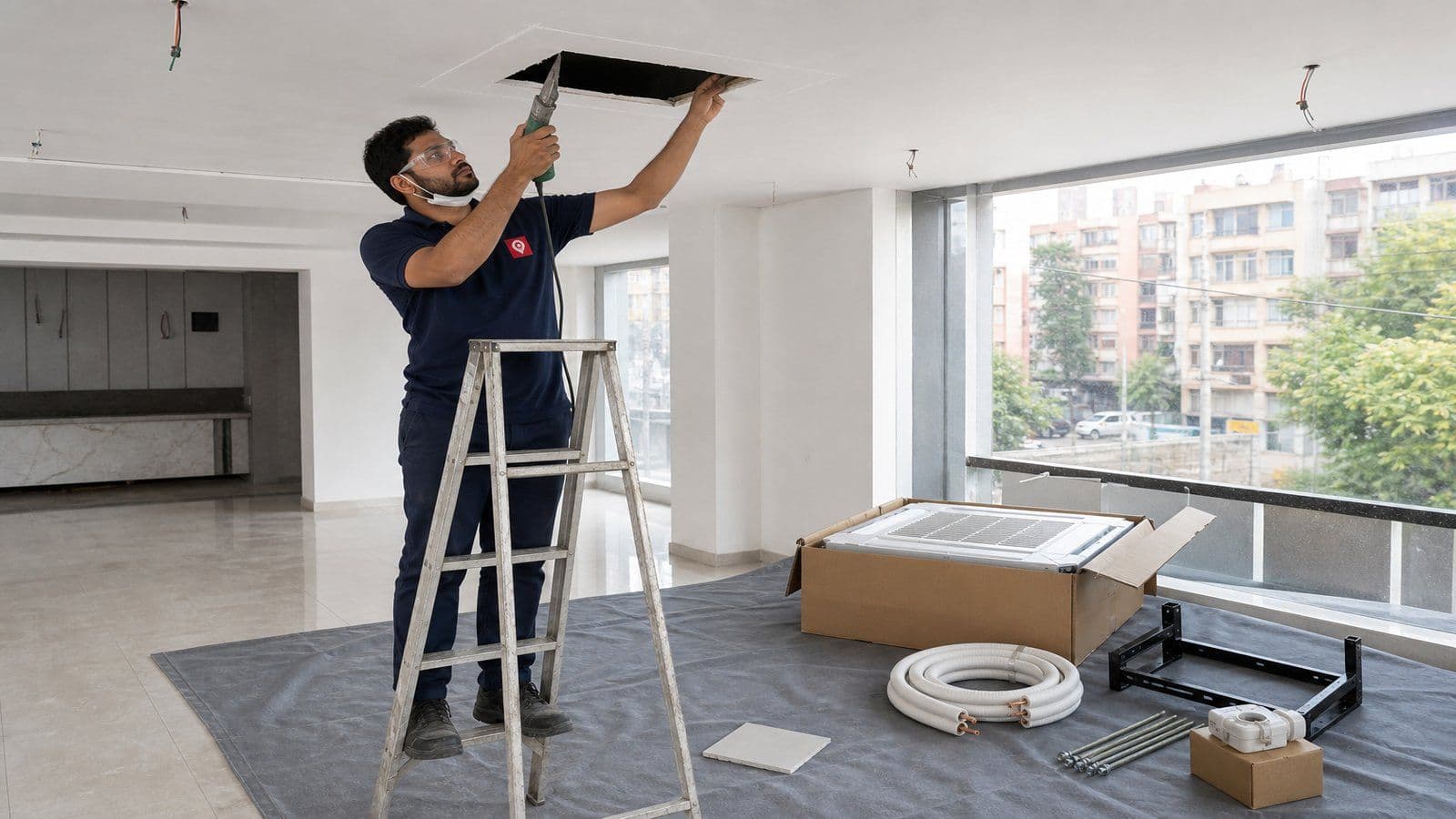
Photo: Indian installer cutting a square opening in a false ceiling for a cassette indoor unit
Drainage Pump Is Mandatory
A cassette indoor unit sits at the ceiling level, almost always below the planned condensate outlet running above the slab. Gravity drainage does not work in this geometry. A small condensate pump (8 to 12 watts, 10 metre head) is wired into the cassette body and routes drain to the building condensate stack. Skipping the pump or undersizing it is the single most common cause of cassette water leaks within the first six months.
Vibration Isolation Matters
A 4 ton cassette weighs around 60 kg empty and adds another 25 kg of drain water during peak operation. Without rubber-mounted hanger rods and a vibration isolation cradle, compressor startup transients transfer into the false-ceiling grid as a low-frequency hum that worsens over months. The ₹1,200 to ₹2,500 isolation kit is one of the cheapest insurance items on the install.
Ceiling-Load Engineering and Structural Considerations
Cassette installations have a load calculation wall splits never face. A typical 3 to 4 ton cassette presents three distinct loads to the suspended ceiling and structural slab above.
| Load Component | Indicative Mass |
| Indoor unit empty weight | 25 to 60 kg |
| Drain water at peak | 15 to 25 kg |
| Suspension hardware (rods, cradle, fasteners) | 8 to 15 kg |
| Decorative grille | 4 to 8 kg |
| Total suspended weight | 52 to 108 kg per unit |
The Bureau of Indian Standards (BIS) and NBC together cover permissible suspended loads from RCC slabs and false-ceiling grids. As a working rule, false-ceiling grids in standard Indian commercial fit-outs are designed for 25 to 35 kg per square metre of suspended load, which means a single cassette concentrating 100 kg plus over roughly 1 square metre exceeds the grid's design rating. Every cassette must therefore hang from the structural slab above via dedicated hanger rods, not from the false-ceiling channels.
True ceiling (RCC) mounting for units above 50 kg requires structural engineer sign-off per NBC compliance reviews in most municipal corporations. Older buildings from the 1990s and early 2000s sometimes have slabs with reinforcement spacing that cannot safely take additional concentrated loads without supplementary steel framing.
The Ministry of Power (MoP) and commercial-tenant regulations require mechanical equipment to respect upper-floor occupant acoustic comfort. A cassette in a ground-floor restaurant must not transfer compressor vibration through the slab into a residence above. The vibration isolation cradle plus rubber-mounted hanger rods reduce structure-borne transfer to compliant levels.
We refuse cassette jobs where the property owner has not let us inspect the false ceiling and slab above before quoting. A 4 ton cassette in the wrong ceiling can fall in six months, and we have seen it happen across older Pune commercial properties twice in the past three years. A ₹500 pre-install inspection is the cheapest underwriting any commercial AC project can buy. Over 14 years across 2,800+ service calls in Mumbai, Pune and Hyderabad I have not seen a single load-related failure on jobs where the pre-install inspection was honestly done.
Cassette Versus Split AC TCO for a 400 sq ft Hall
Owners often run a single price comparison, cassette unit cost against two split AC units, and conclude splits are cheaper. The honest 5-year TCO picture is closer than that headline. The table below models a 400 sq ft commercial hall running 12 hours a day with peak summer demand five months and shoulder demand four months.
| Cost Component | 4 Ton 4-Way Cassette | 2 × 2 Ton Splits |
| Unit cost | ₹1,70,000 | ₹1,40,000 |
| Installation cost | ₹18,000 | ₹8,000 |
| 5-year electricity (₹8.50/unit, 12 hr/day) | ₹2,40,000 | ₹2,80,000 |
| 5-year AMC (3-tier average) | ₹35,000 | ₹40,000 |
| Cassette grille refresh year 4 | ₹2,500 | n/a |
| 5-year TCO | ₹4,65,500 | ₹4,68,000 |
The cassette finishes roughly ₹2,500 cheaper across five years and delivers 360-degree distribution no twin-split layout can match. The downside is serviceability during monsoon, when ceiling-mounted units require a technician willing to work overhead from a ladder in a wet drain pan environment. AMC labour for cassettes runs 30 to 50 percent higher per visit, already reflected above.
For owners who plan to vacate the commercial space within three years, a wall split is more recoverable because uninstall and re-install costs are far lower. For owner-occupied or long-lease commercial spaces, the cassette decision is normally easy.
For deeper context, Split AC Price Range India 2026 covers the wall-split comparison, Inverter AC Price Range India 2026 covers the inverter premium that applies to cassette compressors too, and 2 Ton AC Price Range India 2026 covers the residential ceiling-load alternative for premium villas.
Get quotes from verified, top-rated AC Service & Repair pros in Delhi.
Airflow Pattern Decision Framework
The 2-way, 4-way and 360-degree decision is the single biggest determinant of whether a cassette install delivers comfortable cooling or a chronic complaint book.
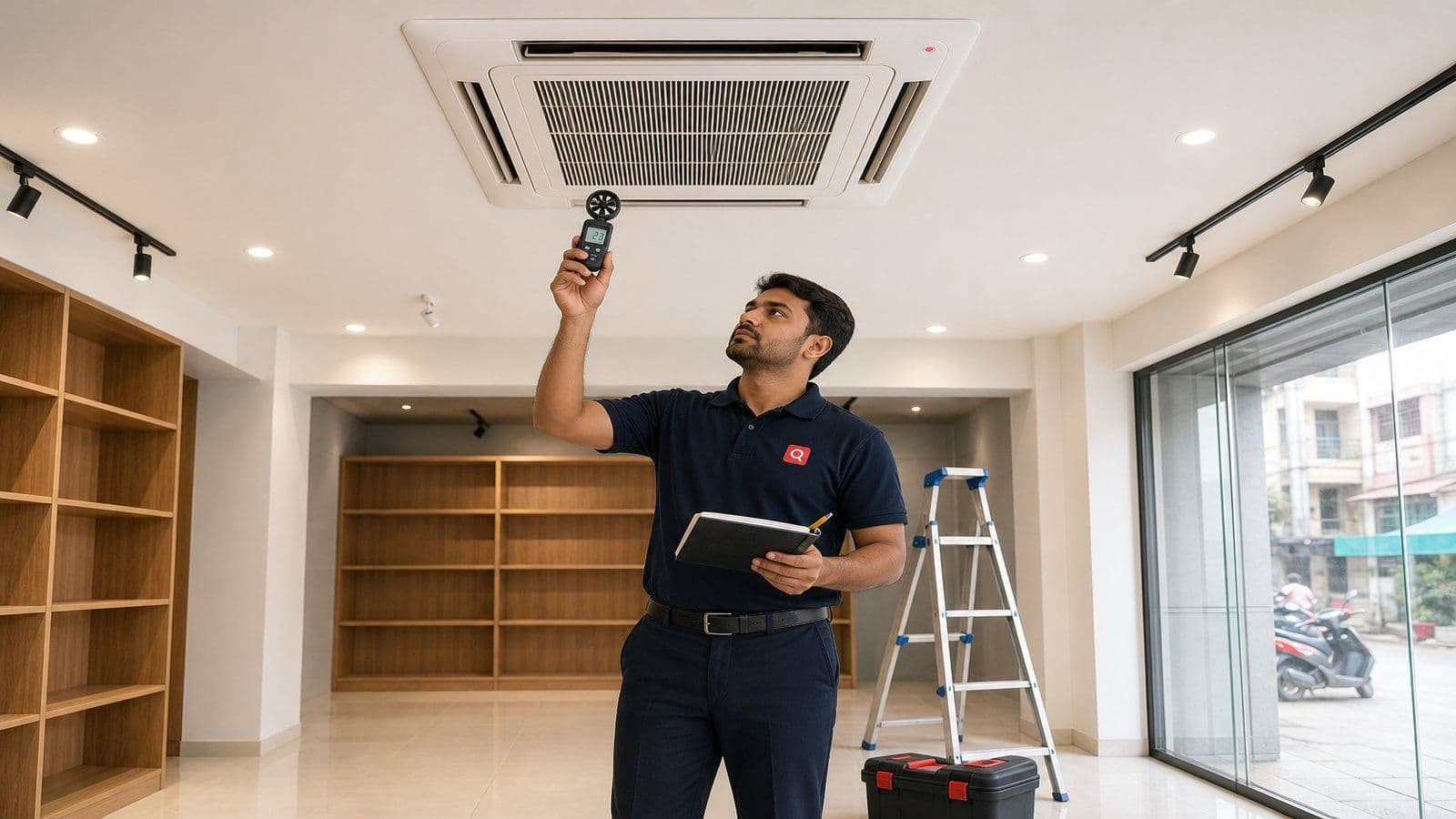
Photo: Installer measuring throw and air velocity from a newly installed 4-way cassette
When to Pick 2-Way
Narrow rectangular halls (aspect ratio greater than 2:1), corridors converted to seating, against-wall placements where two of four directions of a 4-way would throw into a wall and recirculate. A 2 ton 2-way costs 8 to 14 percent less than the equivalent 4-way and runs marginally quieter in narrow rooms.
When to Pick 4-Way
Square or near-square halls (aspect ratio under 1.5:1), centre-of-room placement, ceiling heights of 9 to 12 feet. This is the default cassette for Indian commercial spaces and accounts for around 70 percent of cassette installs the ProNearMe network handles in tier-1 cities.
When to Pick 360-Degree
Large open atria, premium retail showrooms, banquet halls with circular or oval seating plans, architecturally exposed installations where the grille is part of the visual design. The 360-degree premium adds 25 to 40 percent on top of an equivalent 4-way and is justified by air-distribution quality and aesthetics rather than energy efficiency.
Ceiling Height Floor
For ceiling heights below 8.5 feet, no cassette format works well. Throw patterns hit seated occupants directly with cold air, which becomes a comfort complaint within days. Below 8.5 feet, return to wall splits or low-static ducted systems.
GST, Capital Goods Treatment and Input Tax Credit
Commercial cassette AC purchases in 2026 sit in two GST buckets. Units above 2 ton attract 28 percent GST under the capital goods schedule. Units up to 2 ton attract the standard 18 percent. Installation labour and ancillary materials attract 18 percent uniformly.
For GST-registered businesses (most restaurants, clinics, showrooms and offices), input tax credit (ITC) is available on the full GST paid against unit, installation labour, drainage pump, electrical works and AMC, provided the supplier's invoice carries a valid GSTIN. Press Information Bureau (PIB) and Goods and Services Tax Council schedules confirm that air conditioning equipment for commercial use is not on the blocked ITC list for most service-sector applications.
A common buyer mistake is paying cash for a 5 to 10 percent "headline discount" and losing the full ITC on a ₹1.55 lakh cassette. The ITC value on the 28 percent slab is significantly larger than the cash discount, and the formal invoice is also required for AMC warranty and any future consumer-forum complaint.
Warranty, AMC and Lifecycle Cost
Cassette warranties in 2026 broadly match split patterns. Compressor warranty runs 5 to 10 years on inverter-rated commercial units. Indoor and outdoor module warranty runs 1 to 2 years. PCB warranty often sits separately at 1 year. The drainage pump is typically 6 months to 1 year and is the component most likely to need replacement first.
AMC for cassette units runs 30 to 50 percent higher per visit than wall splits, because every service requires a ladder, two technicians for safe overhead work, and drainage pump inspection on top of normal coil cleaning. The 2026 AMC pricing band is:
- 2 ton cassette: ₹4,500 to ₹7,500 per year (3 to 4 visits, basic coverage)
- 3 to 4 ton cassette: ₹6,000 to ₹12,000 per year (4 to 5 visits, comprehensive coverage)
- 5 ton plus cassette: ₹10,000 to ₹18,000 per year (5 to 6 visits, comprehensive coverage)
For owner-occupied commercial spaces, a comprehensive AMC almost always pays for itself within the first contract year because unscheduled cassette failures cause restaurant or clinic downtime that costs more than the AMC premium.
Real Pune Commercial Case Study
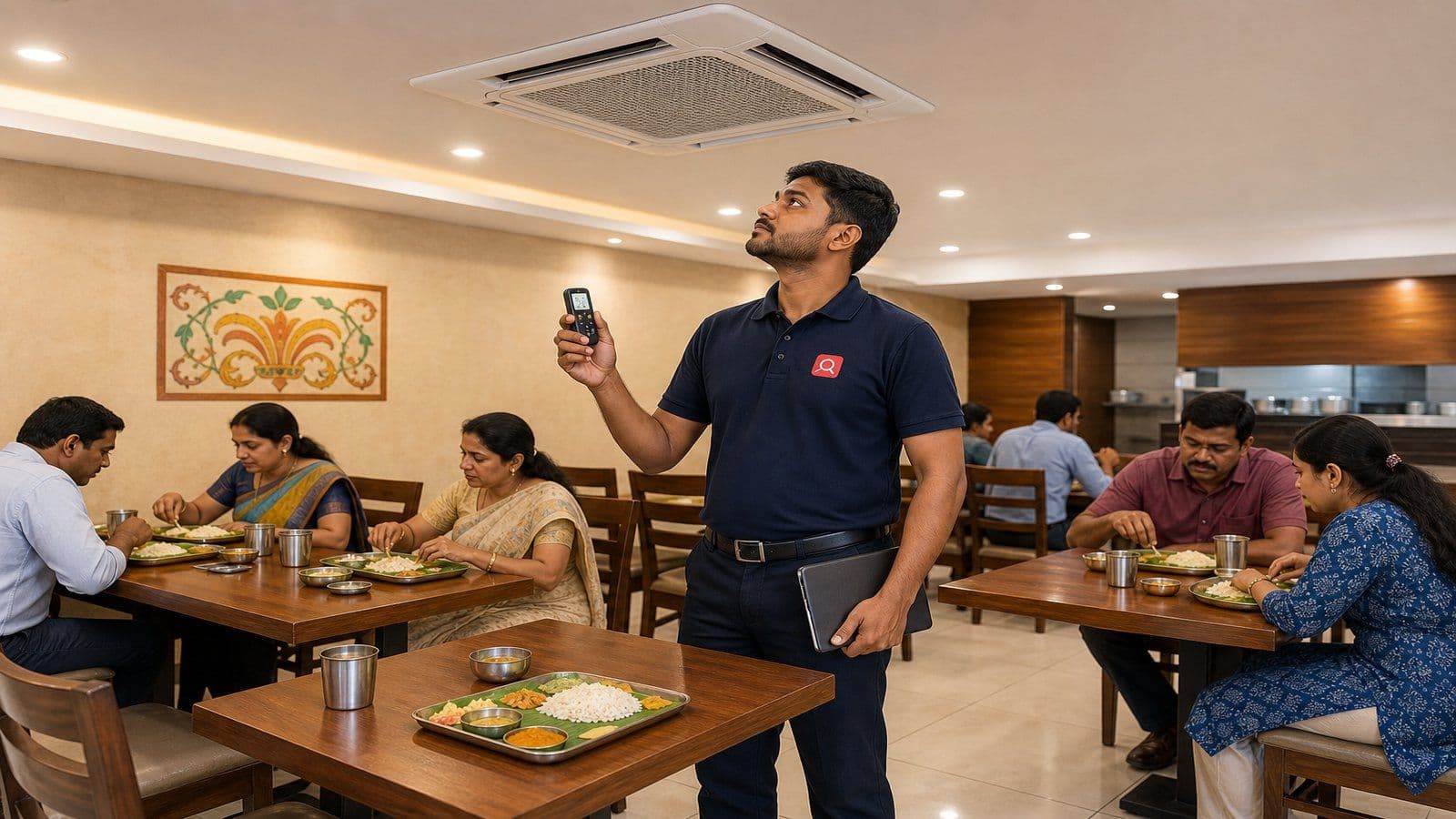
Photo: Technician inspecting a cassette AC inside a busy Indian South Indian diner in Pune
Mr. Karthik Subramanian, who runs a 38-cover South Indian diner in Aundh, Pune, called the ProNearMe network in early 2026 with a typical decision dilemma. His original 2022 fit-out used two 2 ton wall splits flanking the main dining area. The kitchen pass-through pushed enough heat into the dining room that the far back corner sat at 28 degrees Celsius even with both splits running flat out during peak lunch service. Customer comfort complaints had become a Google review pattern.
The diagnostic visit took ninety minutes including a thermal map walk-through and noise readings. The recommendation was to remove both 2 ton splits and replace them with a single 4 ton 4-way cassette centred over the dining seating. Total project cost came to ₹2,02,500: cassette unit ₹1,75,000, installation ₹19,500 (false-ceiling cut, drainage pump and vibration isolation), and an Indian Society of Heating, Refrigerating and Air Conditioning Engineers (ISHRAE) recommended anti-vibration cradle ₹2,500. The two old wall splits were resold to a residential buyer for ₹38,000, netting the project cost to ₹1,64,500.
Within four weeks the back-corner comfort complaints stopped. The Press Information Bureau cited Bureau of Energy Efficiency (BEE) data shows the new BEE 4-star inverter cassette draws 18 percent less electricity per cooled square foot than the two non-inverter splits combined, and the diner's June 2026 electricity bill came in 11 percent lower than June 2025. The case study is now part of the ProNearMe network's commercial install playbook for restaurants in similar layouts.
Get quotes from verified, top-rated AC Service & Repair pros in Delhi.
When a Cassette Loses to a Split
The cassette format is not the right answer in every commercial situation.
Ceiling Heights Under 8.5 Feet
Below 8.5 feet, throw patterns hit seated occupants directly with cold air. The unit looks oversized and airflow restricts more than the design assumes, reducing effective tonnage by 10 to 15 percent.
Single-Room Residential Use
A 2 ton 4-way cassette in a residential bedroom is acoustic and aesthetic overkill compared to a 2 ton inverter split costing ₹52,000 to ₹78,000 instead of ₹85,000 plus ₹12,000 install. Residential single-room cassette only makes sense in premium villa great rooms with 10 feet plus ceilings.
Buildings Without False-Ceiling Allowance
Older premises without false-ceiling design, or rented spaces where the landlord or housing society's Resident Welfare Association (RWA) does not permit cuts into the structural slab, cannot accept a cassette without major retrofit work that breaks the cost case.
Frequent Tenant Turnover Spaces
For commercial spaces turning over every 2 to 3 years (some startup co-working layouts, pop-up retail), the cassette's sunk install cost in false-ceiling cuts and drainage routing does not recover. Wall splits that move with the tenant are the better economic choice.
Procurement and Supplier Selection
Three sensible discipline points govern cassette procurement in 2026.
Reputable suppliers will quote with the Bureau of Indian Standards (BIS) standard mark visible on the indoor unit nameplate. Grey-market imports without BIS marking are still common in some local markets and create warranty void risk plus genuine electrical and refrigerant safety concerns.
The National Skill Development Corporation (NSDC) HVAC Technician Qualification Pack covers cassette installation as part of the commercial-tonnage scope. A reputable cassette installer team should include at least one NSDC-certified technician on the project and be willing to share the certification number. Refrigerant handling by uncertified personnel violates the Ministry of Environment, Forest and Climate Change (MoEF&CC) Ozone Depleting Substances Rules.
Any commercial cassette quote issued without a physical site survey is incomplete. The survey must cover ceiling-load capacity, false-ceiling depth, drainage routing options, electrical supply spare capacity, refrigerant pipe routing length and any vibration-sensitive occupied space above or beside the install location.
Field data the ProNearMe network has collated across commercial cassette installs in India over the last three years shows that around 71 percent of warranty failures within the first 24 months trace to drainage pump issues, vibration transfer to the false ceiling, or refrigerant handling by uncertified personnel. None of these are unit-quality problems. They are install-quality problems. BIS-marked equipment combined with NSDC-certified installation removes the bulk of this risk before it ever shows up.
For buyers spreading the project across a working-capital window, AC EMI Options India 2026 Comparison covers the credit card and consumer-loan options available for commercial AC purchases above ₹1 lakh.
Conclusion
Cassette AC is the right answer for Indian commercial spaces with ceiling height, regular room geometry and a planned false-ceiling allowance, and an increasingly sensible answer for premium villa great rooms with the same conditions. The 2026 price band runs from ₹78,000 for a 2 ton 2-way unit to ₹2.85 lakh for a 5 ton 360-degree, with installation adding 12 to 22 percent on top. The TCO comparison against twin wall splits at the same tonnage is closer than the headline suggests, which means the choice should turn on air-distribution quality, ceiling aesthetics and serviceability access, not the cassette ac price line in isolation.
Buyers who plan the false-ceiling allowance during fit-out, insist on BIS-marked indoor units, verify NSDC-certified installer teams, and get a proper site survey before the final quote almost always land a successful cassette install on the first attempt. The most common cause of cassette buyer regret is skipping the site survey and discovering after the fact that ceiling load, drainage routing or vibration isolation needed engineering attention the original quote did not budget for.
Disclaimer
All cost ranges in this guide are typical 2026 commercial figures across major Indian cities and exclude GST unless noted otherwise. Actual costs vary by city, brand, tonnage, false-ceiling complexity, drainage routing distance and seasonal demand. We strongly recommend hiring only NSDC-certified or OEM-authorised technicians for any cassette installation, refrigerant handling, electrical work or PCB diagnosis. Refrigerant handling by uncertified personnel is illegal under the Ozone Depleting Substances Rules and the MoEF&CC Kigali Amendment commitments and voids most manufacturer warranties. ProNearMe does not endorse any specific AC brand or service provider, and all cost ranges should be treated as guidance, not a fixed quote.
Sources & References
- Bureau of Energy Efficiency (BEE) Star Rating Programme for Room Air Conditioners
- Bureau of Indian Standards Catalogue for Air Conditioner Standards
- Ministry of Environment, Forest and Climate Change Ozone Cell and Kigali Amendment Implementation
- National Skill Development Corporation HVAC Technician Qualification Pack
- Indian Society of Heating, Refrigerating and Air Conditioning Engineers Publications and Guidelines
- Press Information Bureau Energy Efficient Air Conditioning Advisory
- Goods and Services Tax Council Rate Schedule for Capital Goods and Services
- Central Electricity Authority Regulations for Commercial Electrical Installations
- Ministry of Power National Energy Conservation Building Code Reference
- Department of Consumer Affairs Jago Grahak Jago Consumer Awareness Programme
Amit worked as an AC technician for 6 years in Ahmedabad before transitioning to technical writing. He holds a diploma in Refrigeration and Air Conditioning from ITI Ahmedabad and understands the difference between what AC companies promise and what actually happens on the ground. His articles break down complex technical topics into plain language that any homeowner can follow. He tests every tip he writes about in his own home first.

Dr. Verma is a mechanical engineer with 15 years of experience in HVAC systems. She completed her PhD from IIT Delhi on energy-efficient cooling solutions for Indian residential buildings. She reviews all technical content on HomePros to make sure the numbers are right, the advice is safe, and the recommendations are backed by actual engineering principles. She consults for multiple AC manufacturers on product design.