- A 5-star inverter 2 ton split between ₹58,000 and ₹68,000 (value tier) saves around ₹19,000. in electricity over five years against a 3-star non-inverter at ₹50,000, so the inverter premium pays back inside year three for any Delhi or Jaipur household running the unit eight hours daily.
- Load surveys logged by our ProNearMe verified AC technicians during pre-install site visits in 2025. show that roughly 34 percent of customers buying a 2 ton AC actually have a room small enough that 1.5 ton would have cooled adequately.
- Window 2 ton units are nearly extinct in metro showrooms; only a handful of brands still produce them, priced ₹38,000 to ₹54,000, and they suit budget halls without an outdoor wall for a split installation.
- A 2 ton AC needs a dedicated 20-amp C-curve MCB and 4 sq mm copper. wiring at minimum, and older flat wiring upgrades cost ₹2,500 to ₹5,000 on top of the AC bill.
- The sizing rule for Indian conditions is 1 ton per 120 to 140 sq ft. for east or north facing rooms, dropping to 1 ton per 100 to 110 sq ft for west facing top floor rooms in Delhi, Jaipur or Nagpur.
The 2 ton AC price in India for 2026 starts around ₹38,000 for a basic window unit and climbs past ₹95,000 for a smart inverter split with WiFi and voice control. Most households shopping for a 2 ton unit land between ₹52,000 and ₹85,000, depending on energy rating, inverter technology and feature tier. This guide walks through the realistic price bands our ProNearMe network sees across Delhi NCR, Hyderabad, Pune and Jaipur, the rooms where 2 ton makes sense, the electrical upgrades older flats need, and the five-year cost of ownership maths.
A 2 ton AC is not simply a bigger 1.5 ton. It draws more power, needs heavier copper, demands a dedicated MCB circuit in most pre-2018 Indian flats, and costs more to install because the outdoor unit is heavier. The Bureau of Energy Efficiency (BEE) flags 2 ton residential splits as one of the fastest growing categories in metros with extended peak summer, particularly Delhi NCR, Rajasthan and central India. For broader pricing context across all tonnages, see our AC price India 2026 guide.

Get quotes from verified, top-rated AC Service & Repair pros in Delhi.
Why a 2 Ton AC Makes Sense for Large Indian Rooms
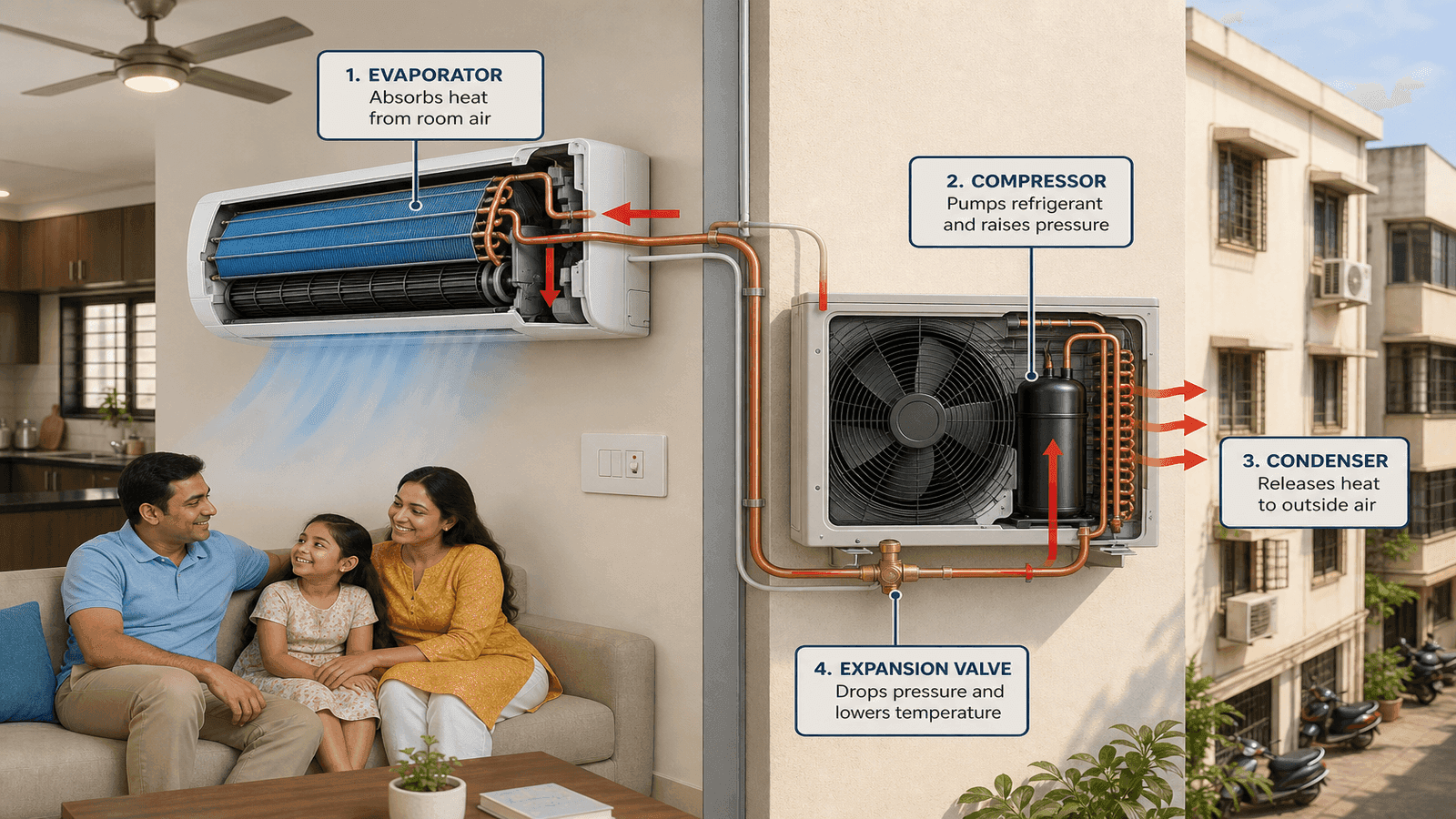
A 2 ton AC delivers roughly 24,000 BTU of cooling per hour, the workhorse capacity for rooms above 200 sq ft in Indian conditions. Whether you need 2 ton depends less on floor area alone and more on the combination of room size, sun exposure, ceiling height, occupancy and outside design temperature.

Photo: Indian family in living room hall cooled by 2 ton split AC
Room Size Brackets That Justify 2 Ton
Pre-summer site surveys across 2024 and 2025 show a consistent picture. Rooms 180 to 220 sq ft sit on the boundary, where 1.5 ton works well except in west facing top floor flats during peak May and June. Rooms 220 to 300 sq ft are the natural home for 2 ton. Rooms above 300 sq ft need either a 2 ton with ceiling fan circulation, or two-unit zoning.
Climates Where 2 Ton Is the Right Default
Delhi NCR, Jaipur, Lucknow, Indore, Nagpur, Bhopal, Ahmedabad and the Punjab Haryana belt see sustained outdoor design temperatures of 44 to 47 degrees Celsius through May and June. In these cities a west facing 200 sq ft hall behaves like a 250 sq ft room in coastal Mumbai. India Meteorological Department heatwave advisories from 2024 and 2025 confirm the trend toward longer, hotter peak summers.
Top Floor and Sun Exposed Halls
Top floor flats with concrete ceilings absorb heat through the slab through the afternoon and release it well past sunset. ISHRAE studies flag that top floor west facing rooms run 4 to 6 degrees warmer than identical ground floor rooms in the same building. A 2 ton handles this load comfortably; a 1.5 ton runs flat out for hours and still misses set temperature past midnight.
2 Ton Split AC Price Table for 2026
Split AC pricing for the 2 ton segment in 2026 spans a wide band because of the gap between value tier 5-star inverters and premium smart units.
| Category | 2 Ton Split AC Price Range (₹) |
| Non-inverter 3-star | 42,000 to 50,000 |
| Non-inverter 5-star | 50,000 to 58,000 |
| Inverter 3-star | 52,000 to 62,000 |
| Inverter 5-star (value tier) | 58,000 to 68,000 |
| Inverter 5-star (premium tier) | 68,000 to 85,000 |
| Inverter 5-star smart (WiFi and voice) | 78,000 to 95,000 |
A non-inverter 3-star is increasingly hard to find in metro showrooms; most manufacturers have pivoted to inverter only line-ups for 2 ton. The BEE star rating revision confirms current 3-star units will become 1 or 2 star under the 2027 revision.
The value tier 5-star inverter band (₹58,000 to ₹68,000) is the sweet spot for most households. This bracket buys a copper coil unit with R32 refrigerant (Ministry of Environment Forest and Climate Change (MoEF&CC) Kigali Amendment compliant), a BLDC inverter compressor, and a five to ten year compressor warranty. The premium tier adds anti-corrosion coating, four-way swing louvres and quieter operation. The smart tier adds WiFi and voice integration. For a deeper inverter versus non-inverter comparison, see our inverter AC price range India 2026 guide.
2 Ton Window AC Price Table
Window 2 ton units are a shrinking category. Only a handful of brands still produce them, primarily for budget buyers, rentals and tier-3 distribution.
Get quotes from verified, top-rated AC Service & Repair pros in Delhi.
| Category | 2 Ton Window AC Price Range (₹) |
| 3-star | 38,000 to 46,000 |
| 5-star | 46,000 to 54,000 |
A 2 ton window suits a specific situation: a budget hall in a building that does not permit external wall fittings, a rental where the landlord wants a single unit no-piping install, or a tier-2 or tier-3 buyer valuing lower upfront cost over running efficiency. Trade-off is louder operation (52 to 58 dB), bulkier appearance and weaker dehumidification. Bureau of Indian Standards (BIS) IS 1391 Part 1 covers window AC requirements. For all window AC tonnages, see our window AC price range India 2026 guide.
Five Year Total Cost of Ownership Maths
The headline price is only part of the real cost. Electricity, installation and servicing stretch across the five years most households keep an AC. The maths below assumes a 200 sq ft Delhi hall, eight hours daily run during summer and tapered winter use, grid tariff averaging ₹7.50 per unit, and AMC-grade preventive servicing.
| Cost Component | 3-Star Non-Inverter | 5-Star Inverter (value tier) |
| Unit purchase price | ₹50,000 | ₹68,000 |
| Installation (copper, brackets, labour) | ₹4,000 | ₹4,000 |
| 5-year electricity at 8 hrs daily | ₹95,000 | ₹58,000 |
| 5-year servicing and minor repairs | ₹10,000 | ₹10,000 |
| Total 5-year cost | ₹1,59,000 | ₹1,40,000 |
The inverter saves around ₹19,000 across five years despite the higher upfront price. Crossover happens between months 28 and 32 for Delhi or Jaipur households running the unit eight hours daily. For lighter four to five hour use the inverter still wins, but crossover moves out to month 40. For broader cost of ownership context, see our AC total cost of ownership 5 years India guide.
The single biggest mistake I see at 2 ton site visits is the homeowner anchoring on the showroom tag, then refusing to budget the ₹3,000 wiring upgrade most pre-2018 flats need. The AC runs on a 16-amp shared circuit, trips through May evenings when the geyser and microwave fire together, and the homeowner concludes the AC is faulty. Budget the wiring with the AC, not afterwards.

> Amit Patel, HVAC and Cooling Specialist, ProNearMe network (14 years across 2,800+ service calls in Mumbai, Pune and Hyderabad)
Electrical Considerations for a 2 Ton AC
A 2 ton AC draws roughly 9 to 12 amps at full load on an inverter unit, and 14 to 16 amps on a non-inverter at compressor start. Central Electricity Authority (CEA) domestic installation guidelines and the National Building Code (NBC) 2016 require a dedicated circuit for any appliance with sustained current draw above 10 amps. Most pre-2018 Indian flats run a 1.5 sq mm or 2.5 sq mm shared circuit through the bedroom and adjoining utility outlet, rated for a 16-amp continuous load shared across all sockets on that loop.
Wiring Upgrade Cost and Scope
Upgrading to a dedicated 20-amp C-curve MCB and 4 sq mm copper wiring runs ₹2,500 to ₹5,000 in 2026, depending on cable run distance and how much chasing through finished walls is needed. A surface conduit upgrade on an exposed wall sits at the lower end; a concealed upgrade with skim plaster repair sits at the upper end. Ministry of Power (MoP) energy conservation programmes endorse certified electrical work for any 2 ton or higher appliance.
MCB Type and Stabiliser
A 20-amp C-curve breaker is the standard. It tolerates the brief inrush current at compressor start without nuisance tripping while cutting power inside milliseconds during a genuine short circuit. Insist on a BIS-marked MCB; counterfeit MCBs are a recurring complaint pattern flagged by Press Information Bureau (PIB) and Jago Grahak Jago advisories.
Most current generation inverter 2 ton ACs from BEE-registered brands ship with built-in voltage tolerance of 145V to 290V. A separate stabiliser is worthwhile only in tier-3 deployments and old Mumbai chawls with frequent swings. A 4 KVA stabiliser costs ₹2,500 to ₹4,500 in 2026.
Get quotes from verified, top-rated AC Service & Repair pros in Delhi.
Installation Cost Difference for 2 Ton Units
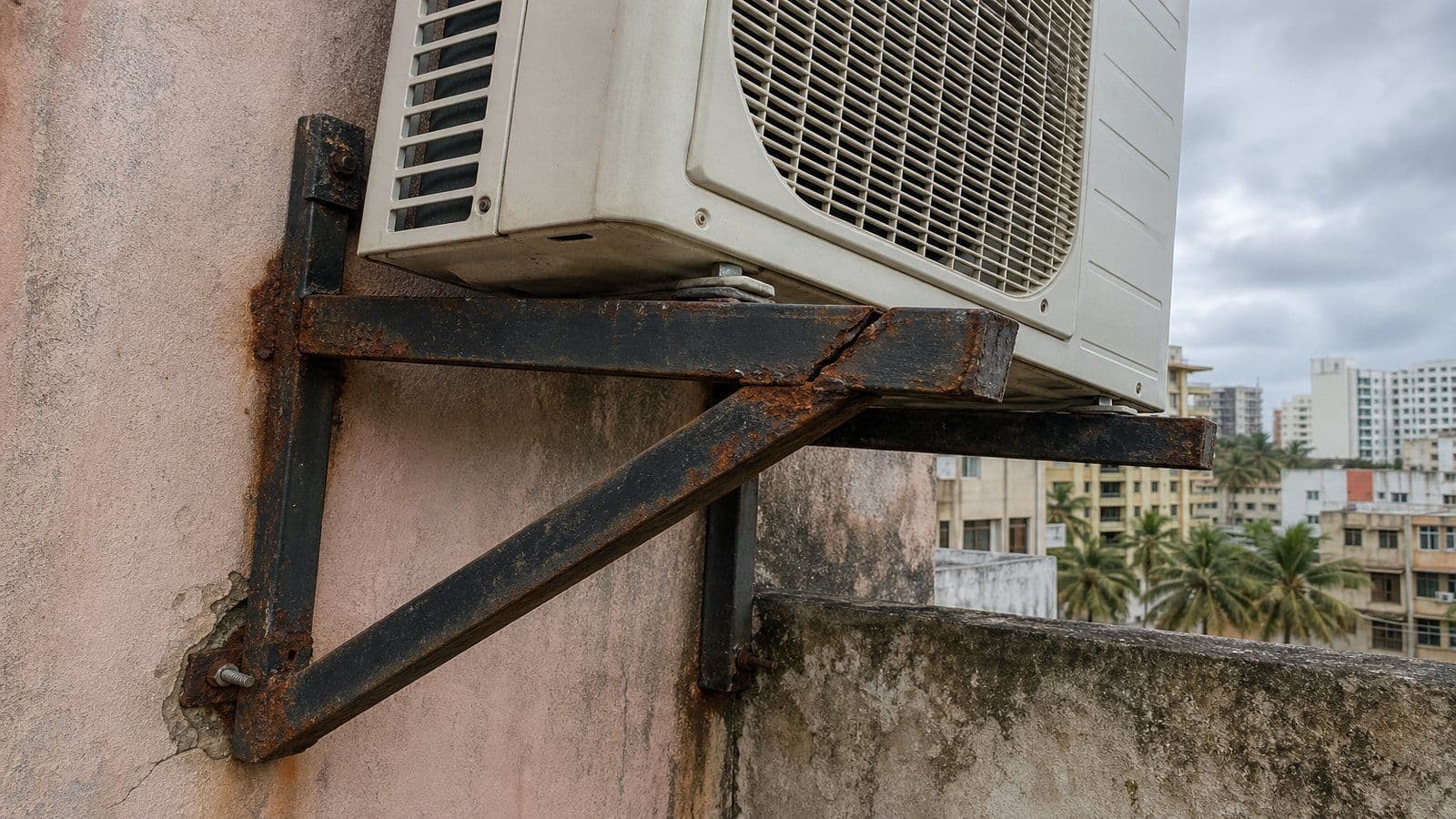
A 2 ton install runs ₹3,500 to ₹6,000 in 2026, against ₹2,000 to ₹3,500 for a 1 ton or 1.5 ton install. The 2 ton outdoor unit weighs 45 to 55 kg against 28 to 38 kg for a 1.5 ton, so mounting it above ground level needs two technicians and proper PPE. The bracket needs a wider footprint and M10 or M12 sleeve anchors into RCC instead of M8. The copper pipe pair is also thicker, around 25 percent more expensive per metre.
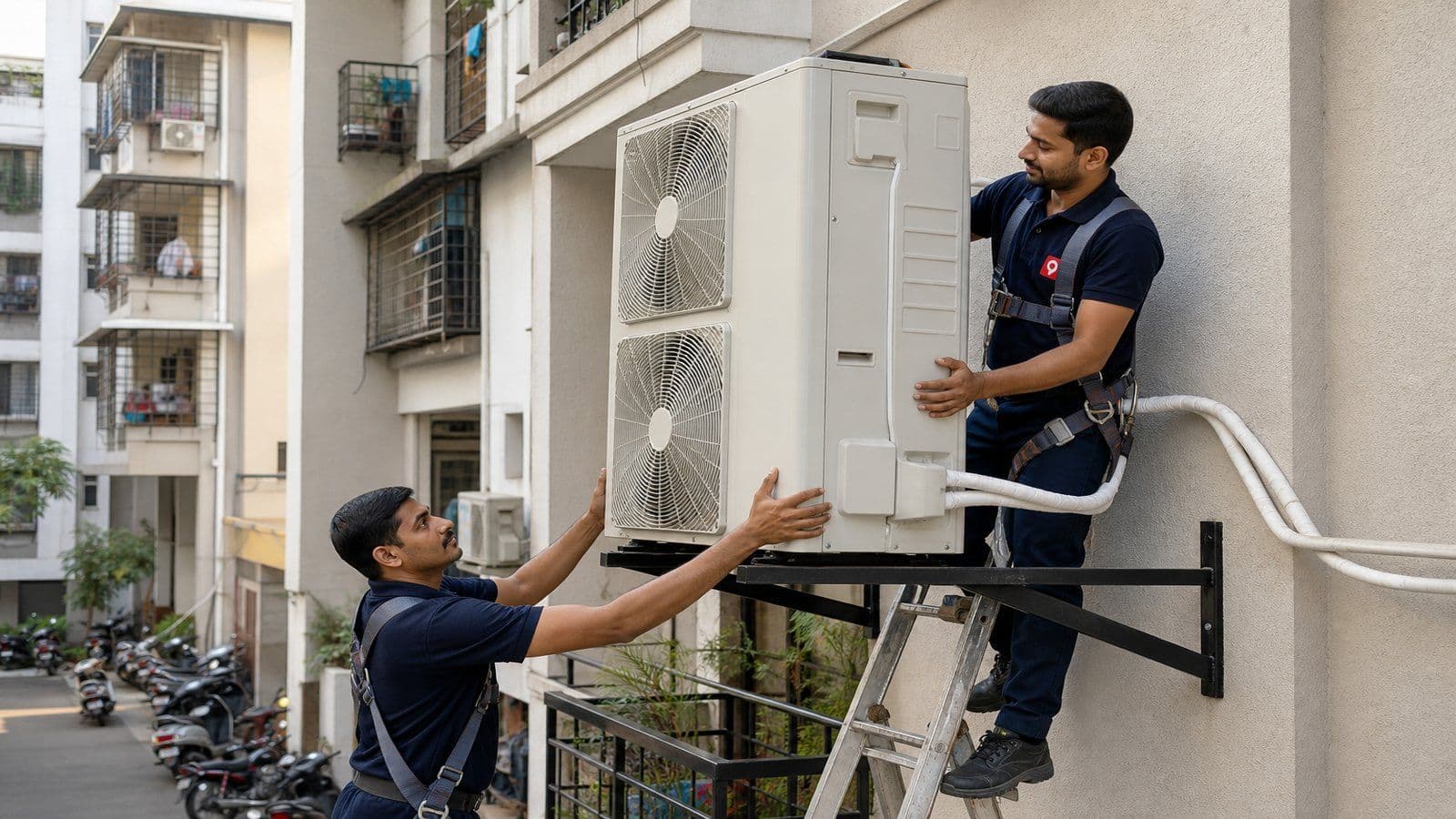
Photo: Technician mounting heavy 2 ton outdoor unit on apartment exterior wall
Single technician installs on heavy units are a recurring cause of falls flagged in National Skill Development Corporation (NSDC) HVAC technician safety modules. For bracket selection, see our AC bracket types selection guide.
Sizing Rules for Indian Conditions
Tonnage selection in Indian conditions follows a different rule than the temperate climate guidelines in OEM literature, which assume outdoor design temperatures of 32 to 35 degrees Celsius. Real Indian peak design temperatures cross 45 degrees in the northern plains; ISHRAE residential guidelines factor this in.
| Room Size | Tonnage (east or north facing) | Tonnage (west facing, top floor) |
| 100 to 140 sq ft | 1 ton | 1.5 ton |
| 140 to 180 sq ft | 1.5 ton | 1.5 ton |
| 180 to 220 sq ft | 1.5 ton | 2 ton |
| 220 to 280 sq ft | 2 ton | 2 ton |
| 280 to 320 sq ft | 2 ton | 2 ton plus circulation fan |
| Above 320 sq ft | Two-zone or cassette | Two-zone or cassette |
When Two Units Beat One Bigger Unit
Two 1.5 ton splits, one on each adjacent wall, cool a 320 sq ft hall better than a single 2.5 or 3 ton unit, because two airflow patterns shrink the temperature gradient. Cost premium is modest: two 1.5 ton 5-star inverters at ₹48,000 each total ₹96,000, against a single 2.5 ton at ₹85,000 to ₹95,000.
Cassette Alternative for Very Large Halls
A 2 ton cassette ceiling unit is the third option for halls between 280 and 400 sq ft, particularly with false ceilings. Cassette pricing sits significantly above wall mounted splits, typically ₹85,000 to ₹1,40,000. For full cassette pricing, see our cassette AC price range India 2026 guide.
Field studies in Delhi and Mumbai consistently show that occupant comfort is driven as much by air movement and humidity control as by absolute temperature. A 2 ton AC oversized for a 180 sq ft bedroom short-cycles, leaves humidity at 65 to 70 percent, and the occupant feels clammy at 24 degrees. A correctly sized 1.5 ton in the same room runs longer, drops humidity to 50 to 55 percent, and the same 24 degrees feels comfortably cool. Tonnage discipline is comfort engineering, not penny-pinching.
> Dr. Sunita Verma, Indoor Environment and Refrigeration Researcher, ProNearMe Technical Reviewer
Feature Tiers Inside the 5-Star Inverter Band
The 5-star inverter category spans a ₹37,000 gap between value and smart tier. The features driving the upper end are real but not all are necessary for every household.
Get quotes from verified, top-rated AC Service & Repair pros in Delhi.
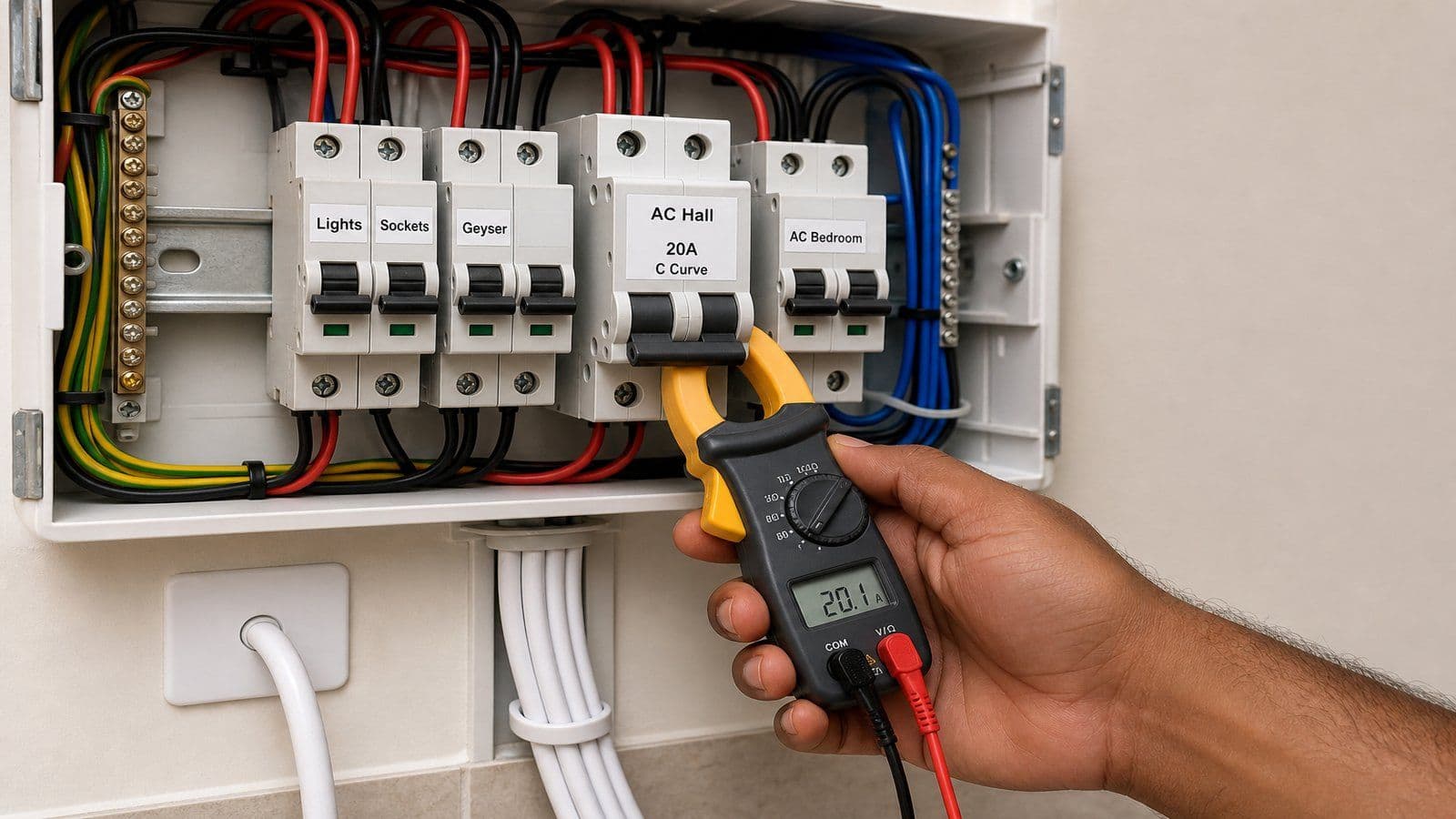
Photo: MCB distribution board with dedicated 20 amp C-curve breaker for 2 ton AC
Value Tier (₹58,000 to ₹68,000)
Copper coil indoor and outdoor with blue fin coating, R32 refrigerant, BLDC inverter compressor, BEE 5-star rated, basic dehumidification, turbo cool, sleep mode, 24-hour timer, basic IR remote. Compressor warranty 5 to 10 years, parts 1 to 2 years. This tier is everything most Indian households actually use.
Premium Tier (₹68,000 to ₹85,000)
Adds anti-corrosion coating on the outdoor coil (essential for coastal homes in Mumbai, Chennai, Visakhapatnam, Kochi), four-way swing louvres, lower indoor noise (38 to 42 dB), PM 2.5 filters, self-cleaning evaporator and ECO mode. Earns its premium in coastal cities and noise-sensitive bedrooms.
Smart Tier (₹78,000 to ₹95,000)
Adds WiFi, a manufacturer app, voice integration with home automation systems, geofencing schedules and OTA firmware updates. Cooling and energy performance is identical to the premium tier. Worth it for households genuinely using smart home automation across multiple appliances.
Real Andheri Case Study
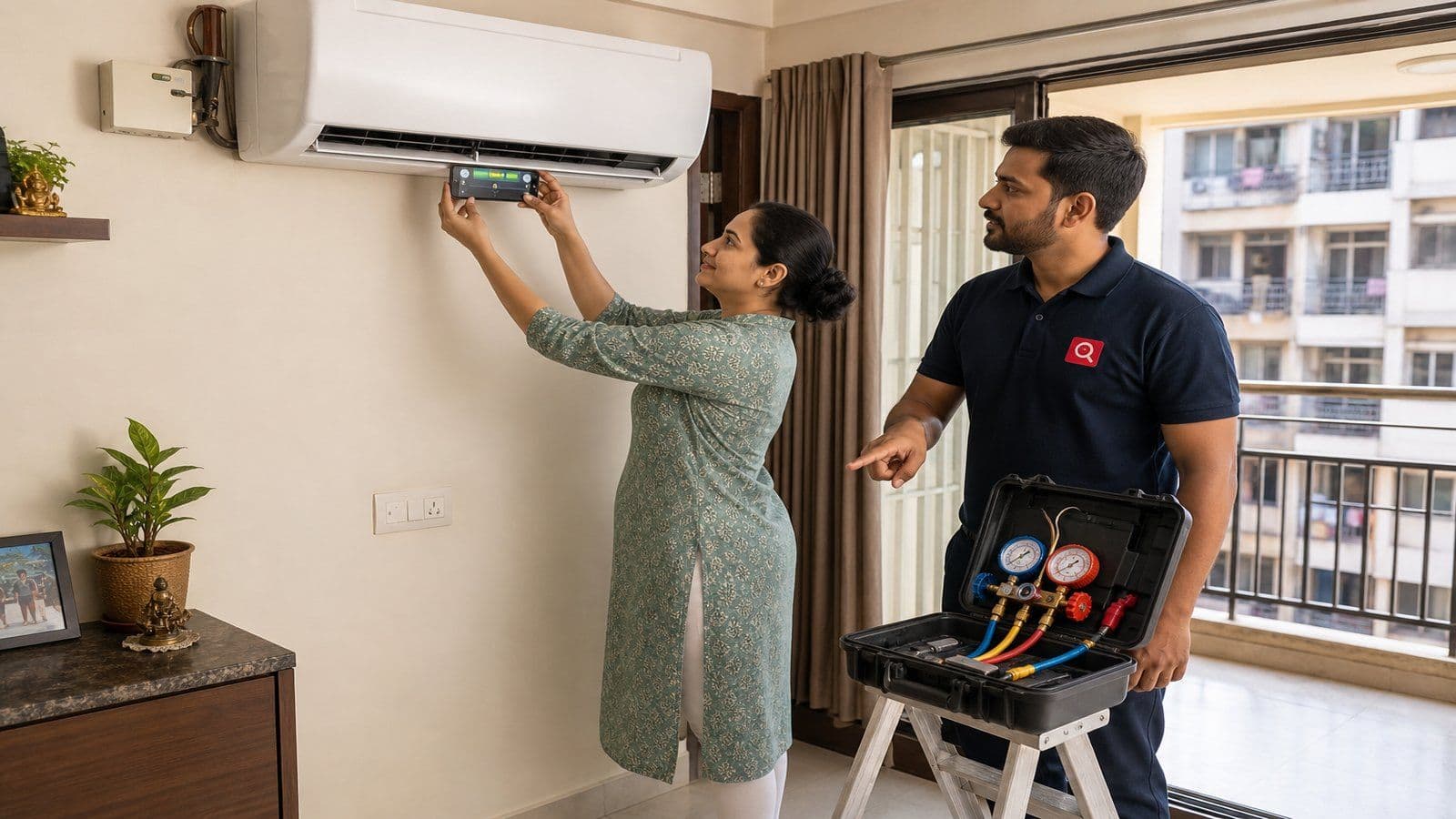
Mr. Rajesh Khanna in Andheri West, Mumbai called our ProNearMe verified AC technicians network last March for a pre-summer site visit on what he assumed would be a straight 1.5 ton replacement for his 245 sq ft west facing hall. His existing 1.5 ton non-inverter from 2017 hit only 26 degrees Celsius set temperature against a 22 degree target through May afternoons, and the electricity bill had climbed past ₹4,200 per month in peak season.
Our technician spent twenty-five minutes on site. The hall measured 245 sq ft, west facing, ninth floor, single glazed window, west wall directly sun exposed from 1 PM to 6 PM. The calculated cooling load came to 28,800 BTU per hour at peak design conditions, squarely in 2 ton territory.
The 2017 installer had quoted on floor area alone, undersizing the unit by 30 percent. We recommended a 5-star inverter 2 ton split at ₹64,000, a 20-amp MCB upgrade at ₹3,200, copper and labour at ₹4,500, and outdoor anti-corrosion coating at ₹2,200 for the coastal location. Total ₹73,900 inclusive of GST.
The new unit has now run two Mumbai summers. Set temperature 22 degrees, reached and held within twenty minutes. May 2025 electricity bill ₹3,100, down from ₹4,200 in May 2024 despite a 5 percent tariff increase. Payback on electricity savings alone, around 34 months.
For installment based purchase decisions, see our AC EMI options India 2026 comparison guide. For pricing across smaller tonnages, see our 1.5 ton AC price range India guide and the 1 ton AC price range India 2026 cluster. For split versus window decisions, see our split AC price range India 2026 guide and the AC gas refill cost India 2026 guide.
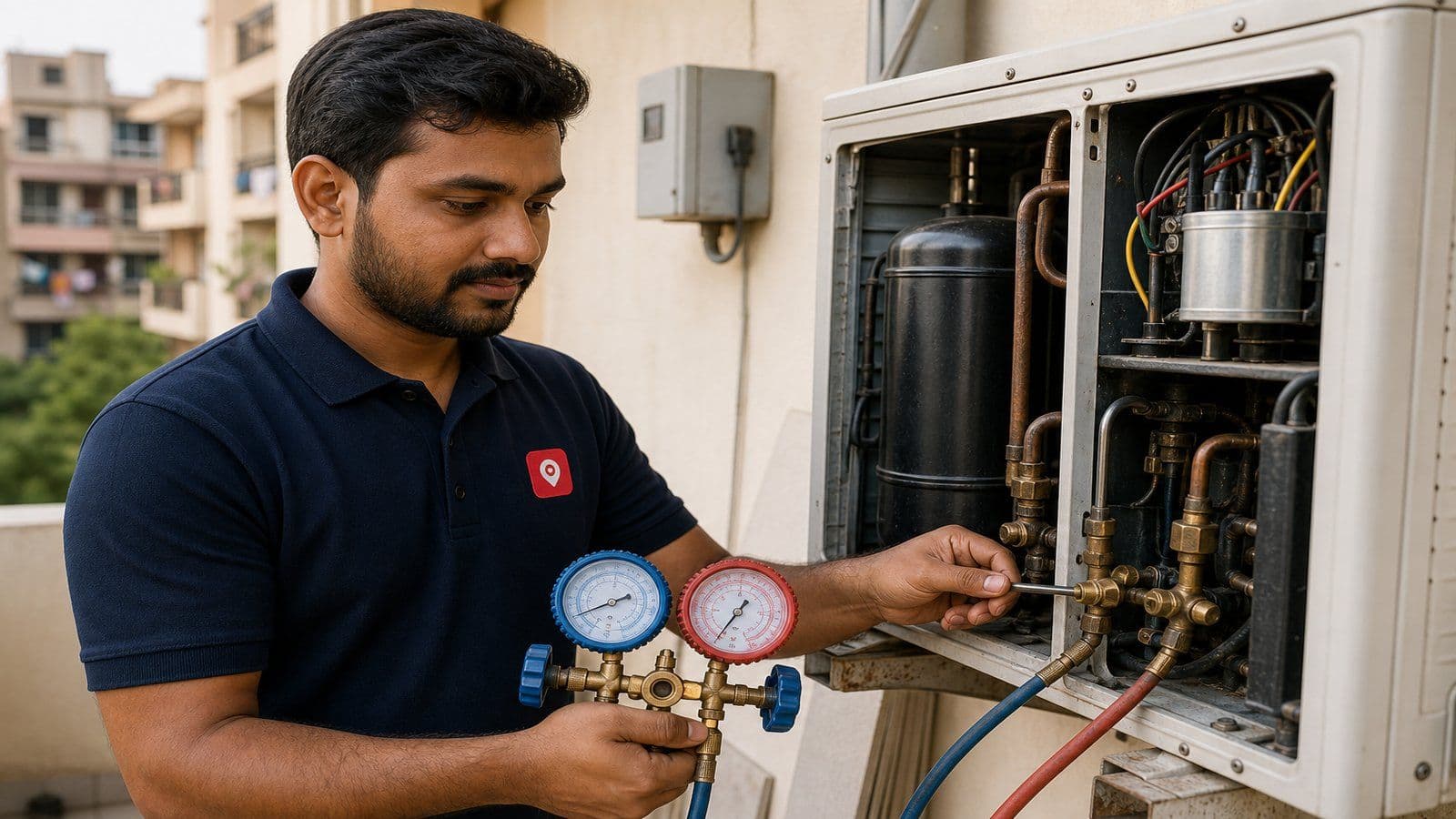
For 2 ton purchases I give every customer the same three-line rule. Check the BEE star label registry online before paying. Confirm the OEM service centre is within twenty kilometres. And insist on dealer installation through their official partner, not a freelance technician pulled in for the day. These three rules eliminate around 70 percent of the post-install problems we see.
Conclusion
A 2 ton AC purchase in 2026 is a 10-year decision that lives or dies on three things: correct tonnage sizing for the room and city, electrical readiness with a dedicated 20-amp circuit, and choosing a BEE 5-star inverter in the value tier unless a specific reason pushes you up to premium or smart. Get those right, budget ₹68,000 to ₹73,000 for unit plus install plus wiring upgrade, and the household saves ₹19,000 over five years against a cheaper 3-star non-inverter.
The mistake we see most often across the ProNearMe network is the homeowner who anchors on the ₹50,000 non-inverter showroom tag, skips the wiring upgrade and AMC, and concludes two summers later that the AC was a poor purchase. Spend the extra ₹3,000 on wiring, ₹8,000 stepping up to a 5-star inverter, and ₹4,000 on the first year's AMC. The five-year picture changes from chronic complaint to quiet reliability.
Disclaimer
All prices in this guide are typical 2026 retail figures across major Indian cities, inclusive of 28 percent GST on the AC unit and 18 percent GST on installation and servicing. Actual prices vary by city, channel, brand and seasonal demand. We recommend hiring only NSDC-certified or OEM-authorised technicians for installation, wiring upgrades and refrigerant handling. ProNearMe does not endorse any specific AC brand; the price bands above should be treated as market representative ranges, not a fixed quote.
Sources & References
- Bureau of Energy Efficiency Star Rating Programme for Room Air Conditioners
- Bureau of Indian Standards IS 1391 Part 1 Room Air Conditioners Window Type
- Bureau of Indian Standards IS 1391 Part 2 Room Air Conditioners Split Type
- Central Electricity Authority Regulations and Domestic Electrical Installation Guidelines
- Ministry of Environment Forest and Climate Change Ozone Cell and Kigali Amendment Implementation
- National Skill Development Corporation HVAC Technician Qualification Pack
- Indian Society of Heating Refrigerating and Air Conditioning Engineers Residential HVAC Guidelines
- Press Information Bureau Energy Efficient Air Conditioning Advisory
- Department of Consumer Affairs Jago Grahak Jago Consumer Awareness Programme
- National Building Code of India 2016 Bureau of Indian Standards
- Ministry of Power Energy Conservation Initiatives and Standards Labelling Programme
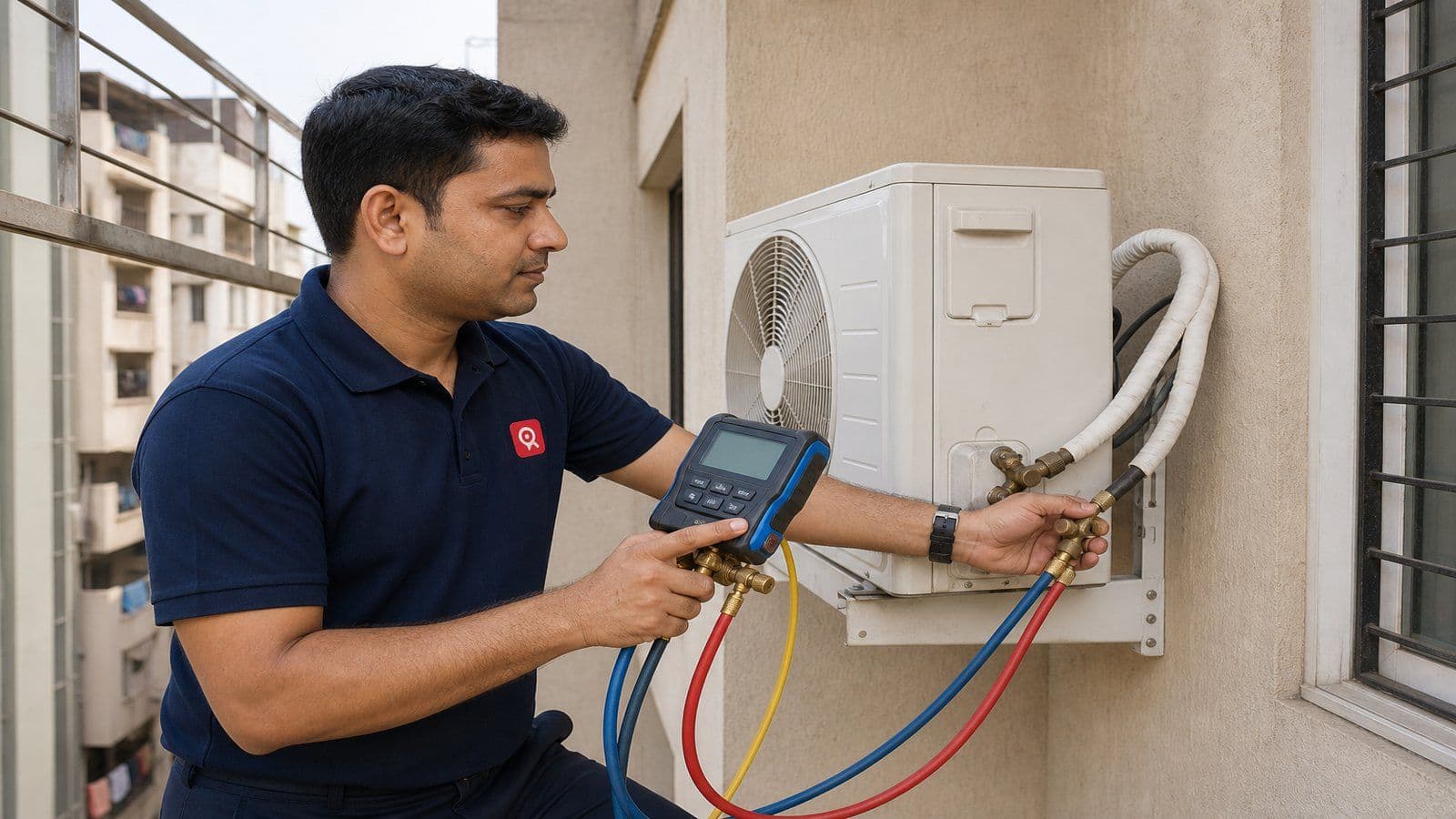
Amit worked as an AC technician for 6 years in Ahmedabad before transitioning to technical writing. He holds a diploma in Refrigeration and Air Conditioning from ITI Ahmedabad and understands the difference between what AC companies promise and what actually happens on the ground. His articles break down complex technical topics into plain language that any homeowner can follow. He tests every tip he writes about in his own home first.

Dr. Verma is a mechanical engineer with 15 years of experience in HVAC systems. She completed her PhD from IIT Delhi on energy-efficient cooling solutions for Indian residential buildings. She reviews all technical content on HomePros to make sure the numbers are right, the advice is safe, and the recommendations are backed by actual engineering principles. She consults for multiple AC manufacturers on product design.