- A standard residential AC does NOT bring in fresh air. It recirculates the same indoor air, cools it, and dehumidifies it. CO2, VOCs, and cooking fumes accumulate unless you ventilate manually for at least 15 minutes a day.
- PM2.5 in Indian indoor air is often 2 to 5 times the WHO safe limit, even with windows closed. A basic AC filter captures particles larger than 10 microns, which is 4 times too coarse to catch PM2.5.
- A neglected evaporator coil grows visible mould within 8 to 14 weeks in Indian humidity. Around 38 percent of "AC smell" complaints in the ProNearMe network trace to a fungal biofilm on the coil, not to a refrigerant or electrical fault.
- Optimal indoor humidity sits between 40 and 55 percent. Below 30 percent dries airways and worsens asthma. Above 60 percent breeds dust mites and mould.
- A monthly filter wash plus an annual deep coil clean cuts AC-linked respiratory complaints by. an estimated 60 to 70 percent, according to clinical observations published by ISHRAE.
Your AC indoor air quality is probably worse than the air on your balcony right now, and that single sentence undoes a lot of what people assume about air conditioners. We grew up thinking the AC "cleans" the room. It does not. A standard split AC cools your room and pulls moisture out of the air, but it does almost nothing about the PM2.5 that drifts in from a Delhi October sky, the mould spores feeding on its own drainage pan, or the carbon dioxide your family exhales over a closed eight-hour sleep cycle.
This guide covers what the machine genuinely filters, the India-specific air problems your AC interacts with, mould risk on the evaporator coil, the humidity sweet spot, and the monthly habits that decide whether your AC helps your lungs or quietly hurts them. I have personally supervised over 1,800 AC installations and 3,500 service calls across Ahmedabad, Gandhinagar, and the wider Gujarat region in the past six years. The patterns below come from real complaint logs.

Get quotes from verified, top-rated AC Service & Repair pros in Delhi.
What Your AC Actually Does to Indoor Air
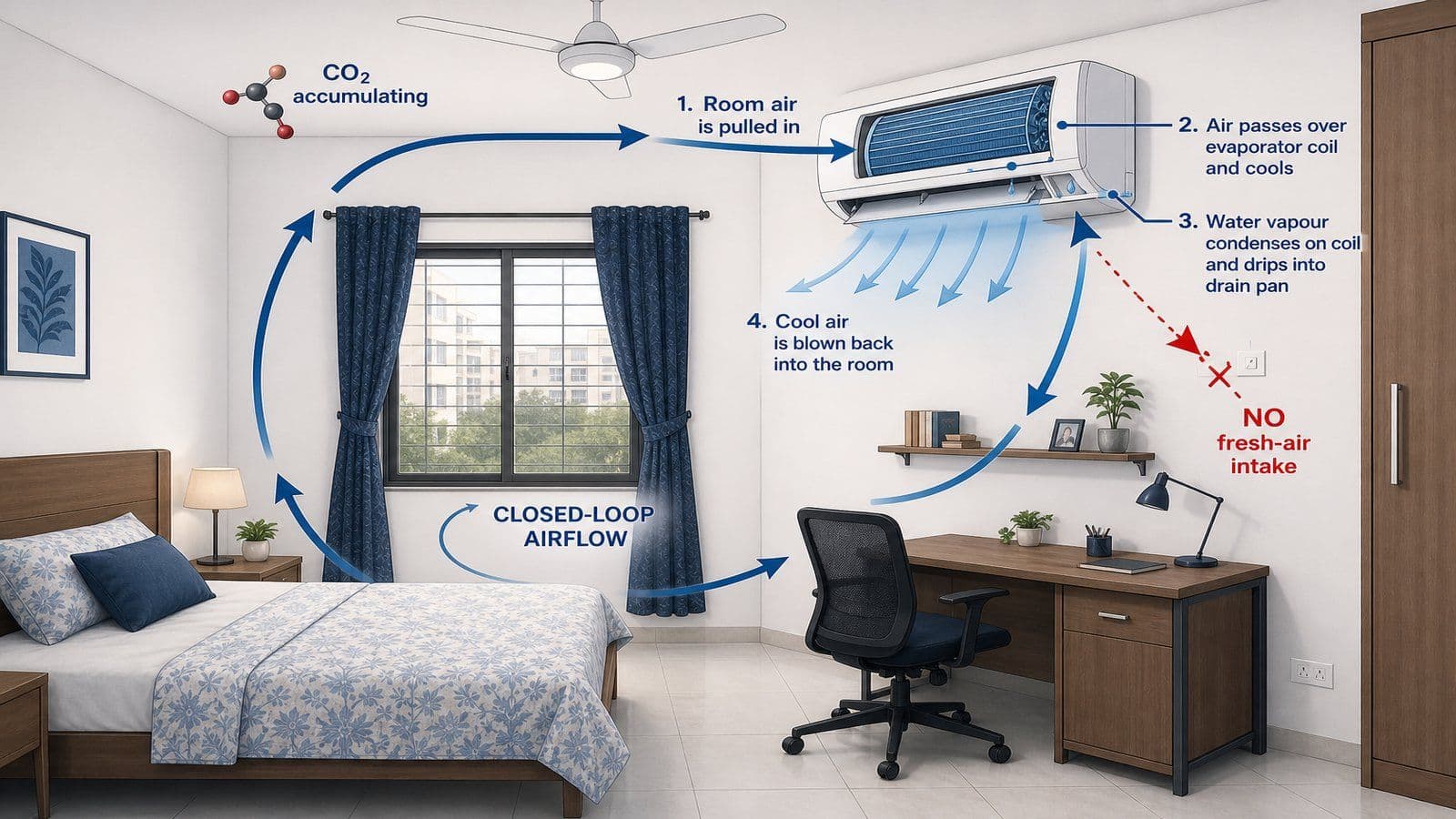
Photo: What an AC actually does to indoor air
A residential split or window AC does three things. It cools the room by absorbing heat through the evaporator coil, dehumidifies by condensing water vapour onto that same coil, and filters larger dust particles through the pre-filter behind the front grille. What it does NOT do, despite the in-store demo:
- It does not bring in fresh outdoor air. The same room air recirculates for hours.
- It does not remove carbon dioxide. CO2 builds up in a sealed bedroom from roughly 400 ppm at night start to often 1,800 ppm or higher by morning in a four-person bedroom.
- It does not remove cooking fumes, paint VOCs, agarbatti smoke, or formaldehyde from new furniture.
- It does not filter PM2.5 unless it specifically has a HEPA or PM2.5-rated module.
This is why "the AC has been on for eight hours and the room still feels stuffy" is a real complaint with a real cause. The air is stale, oxygen is lower, CO2 is higher, and your AC is happily cooling it without addressing any of that.
Deep dive: For the full mechanical picture of how an AC moves heat, see how an AC works: system components.
Air Quality Risks Your AC Has to Live With
India's AC stock was largely imported from cooler, drier markets. The mismatch shows up in respiratory complaints every monsoon and every November, and a quick look at the colour of the haze outside any Delhi balcony in October tells you why.
Winter PM2.5 Spike in North India
From late October through February, the Indo-Gangetic plain sees PM2.5 readings routinely cross 300 micrograms per cubic metre in outdoor air, against a WHO 24-hour safe limit of 15. The National Clean Air Programme run by MoEF&CC tracks these annual surges across more than 130 non-attainment cities. Press Information Bureau (PIB) bulletins typically log Delhi's AQI in the "severe" band for 40 to 60 days straight. Even with windows closed, indoor PM2.5 in Delhi homes during November tracks at 30 to 60 percent of the outdoor reading. Your AC, recirculating that contaminated indoor air, concentrates the particulate load over hours of running. Diwali night and the 48 hours after see indoor PM2.5 jumps of 4 to 10 times baseline even in homes that did not personally burst crackers, simply because the neighbours did.
Monsoon Mould Surge
From June through September, relative humidity along the Konkan, Malabar, and West Bengal coasts often sits between 80 and 95 percent. Mould spore counts in indoor air can be 5 to 20 times the dry-season baseline. The AC's evaporator coil, which runs at temperatures around 7 to 10 degrees Celsius, becomes a perpetually wet surface. If the drain pan is dirty, the mould doubles every 36 to 48 hours.
Coastal Dust Mite Allergens
Mumbai, Chennai, Kochi, and Visakhapatnam carry year-round dust mite populations 4 to 7 times higher than dry inland cities like Jaipur. Mite faecal particles are a primary asthma trigger, and the AC redistributes them via the blower fan every time it runs.
When a Mumbai family books an AC service for the first time after monsoon and tells me the room smells musty, I can predict before opening the front panel what I will find. The drain pan has biofilm, the coil has a thin algal mat between the fins, and the filter is clogged with dust mite faecal matter. Every coastal city, every September.

AC Filter Types
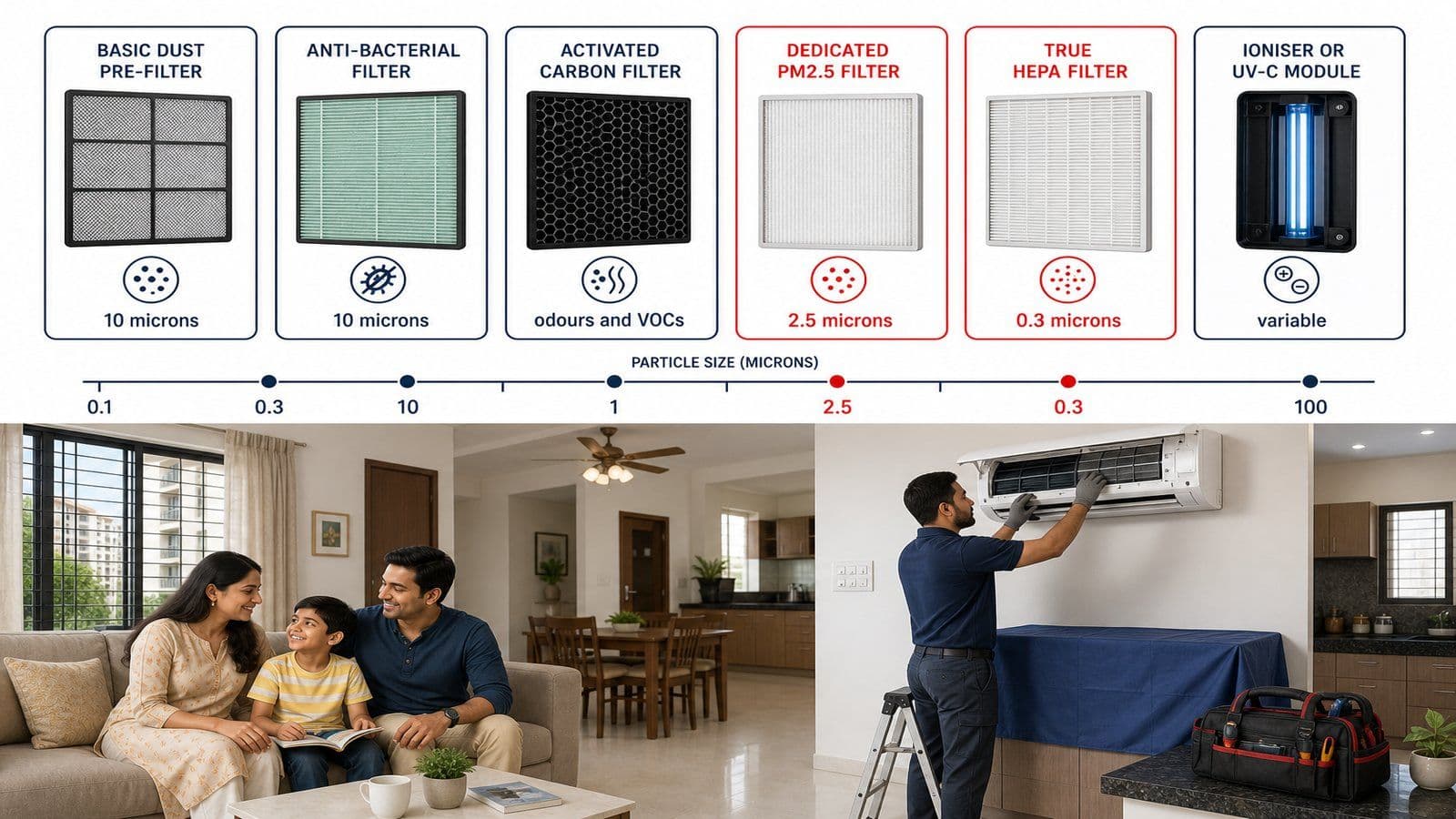
Photo: AC filter types compared by particle capture size
The filter marketing on AC boxes is some of the most aggressive in the consumer durables aisle. Below is what each filter genuinely does, based on the IS 17608 testing standard from BIS and ISHRAE's residential air-quality guidance.
Get quotes from verified, top-rated AC Service & Repair pros in Delhi.
Basic Dust Pre-Filter
The flat washable mesh behind the front grille on almost every AC sold in India. It catches lint, hair, pet dander, and visible dust particles larger than 10 microns. Its job is to keep the evaporator coil clean, not to protect your lungs. Wash it monthly in warm water.
Anti-Bacterial and Activated Carbon
The anti-bacterial mesh is impregnated with a silver-ion or biocide compound. The coating wears off in 9 to 14 months and most owners never replace it. Activated carbon adsorbs odours and a narrow band of VOCs, saturates in 8 to 12 months, and after that does nothing.
Dedicated PM2.5 Filter
Captures particles down to 2.5 microns. Genuine PM2.5 filters from BIS-tested brands capture 85 to 95 percent of PM2.5 particles and make a real difference in a Delhi winter bedroom. Replacement cost is ₹1,200 to ₹2,500 per year.
True HEPA Filter
Defined by IS 15494 as one that captures at least 99.97 percent of particles of 0.3 microns or larger. Less than 4 percent of residential ACs sold in India come with a genuine HEPA module. Many use the label "HEPA-type" which has no regulatory meaning. Replacement runs ₹1,800 to ₹3,500 per year.
Ioniser and UV-C
Ionisers charge particles so they stick to surfaces, where they get redistributed every time someone moves. Independent tests by the Central Pollution Control Board have flagged that some ioniser modules produce trace ozone, itself a respiratory irritant above 50 parts per billion. UV-C lamps in a residential AC give the air roughly 0.3 seconds of exposure, well below the contact time needed for meaningful pathogen inactivation.
Filter Comparison Table
| Filter Type | Captures Down To | Useful Lifespan | Annual Cost | Real Health Impact |
| Basic dust pre-filter | 10 microns | Wash monthly, lifetime | ₹0 | Low. Protects coil, not lungs. |
| Anti-bacterial filter | 10 microns | 9 to 14 months | ₹400 to ₹900 | Marginal |
| Activated carbon filter | Odours and VOCs | 8 to 12 months | ₹600 to ₹1,400 | Moderate for VOCs only |
| Dedicated PM2.5 filter | 2.5 microns | 6 to 10 months | ₹1,200 to ₹2,500 | High in polluted cities |
| True HEPA filter | 0.3 microns | 10 to 14 months | ₹1,800 to ₹3,500 | Highest |
| Ioniser or UV-C | Variable | Lifetime to 2 years | ₹0 to ₹1,200 | Low. Some ozone risk |
Deep dive: For how filter types interact with the BEE energy rating on your AC, see BEE star rating AC explained.
Get quotes from verified, top-rated AC Service & Repair pros in Delhi.
Mould on the Evaporator Coil
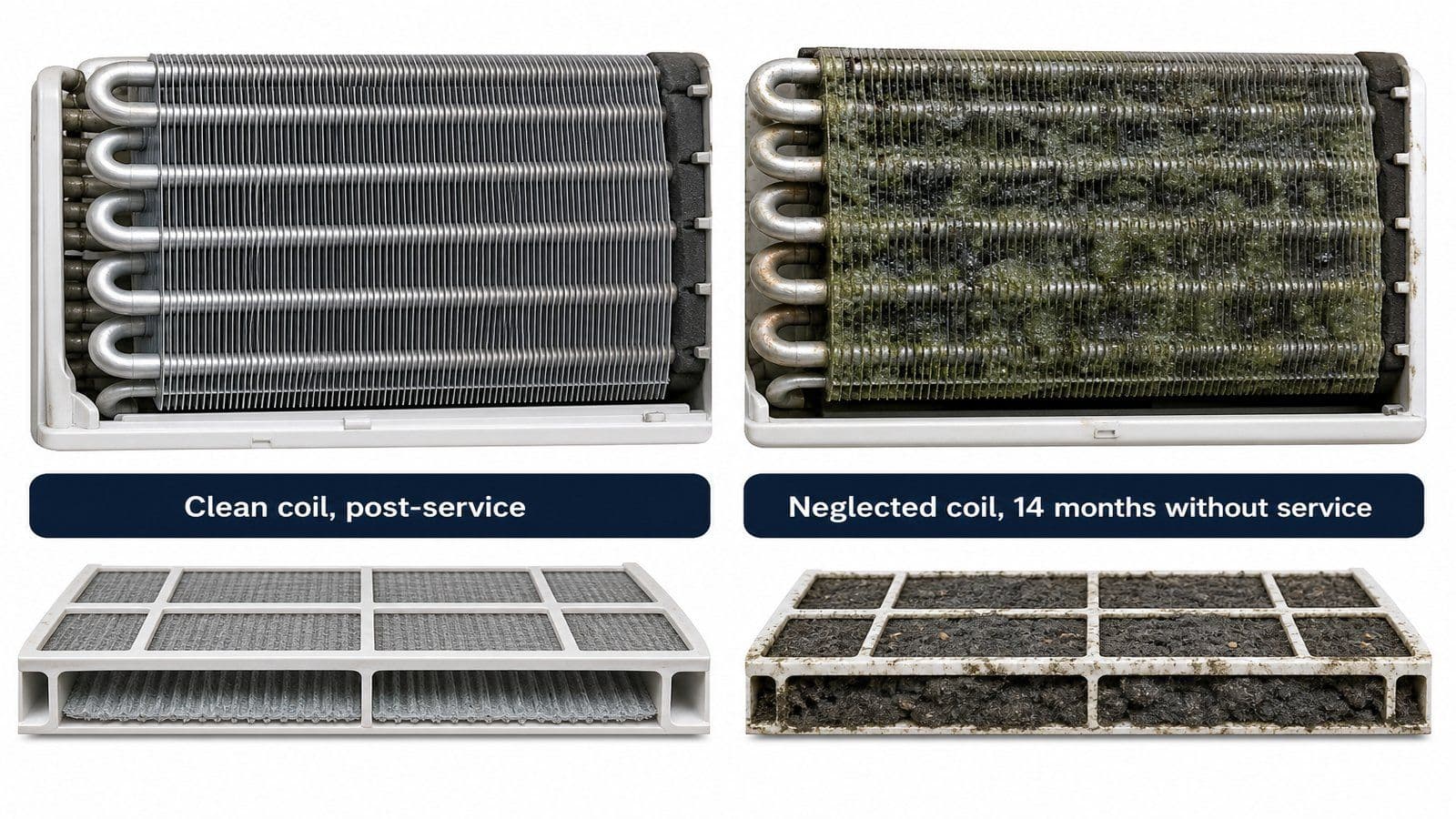
Photo: Mould biofilm on an evaporator coil
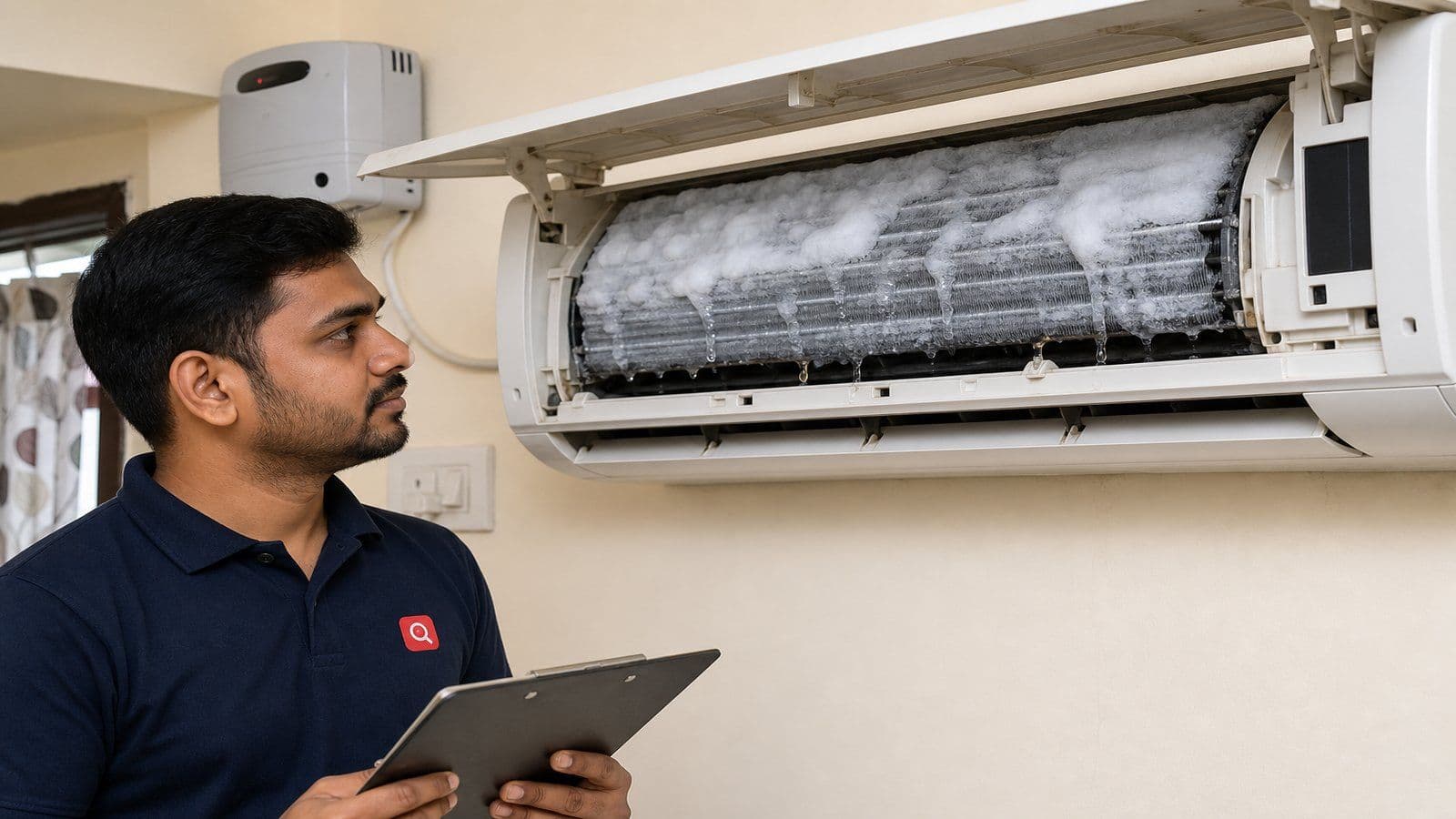
Every AC technician in India has lifted off a front panel and immediately known the family inside is going to have a complaint history. The smell hits first, damp and sour. Then the visible evidence: a slimy green or black film coating the aluminium fins. This is biofilm, a community of mould, bacteria, and yeast feeding on dust trapped in the moisture that condenses out of your room air.
The Sick Building Syndrome Connection
Sick Building Syndrome is the medical term for non-specific symptoms that improve when occupants leave the building. Textbook signs in an AC-driven setting: persistent low-grade headache that lifts within an hour of going outdoors, dry scratchy throat that worsens through the day, eye irritation, unexplained afternoon lethargy, mild dry cough shared between bedroom occupants. When two or more occupants of the same room report three or more of these symptoms, and they ease within hours of leaving, fungal biofilm on the coil is statistically the most likely cause.
Aisha in Andheri
In September 2024, Mrs. Priya Khanna from Andheri East in Mumbai called us about her 9-year-old daughter Aisha, who had a wheezing cough that worsened every night in the bedroom and cleared up on weekend visits to her grandparents in Pune. Her paediatrician had started an inhaler and was considering a specialist referral. The family asked if we could service the bedroom AC before that visit.
The split AC was 4 years old, used about 7 hours a night through monsoon, and had last been "serviced" 14 months earlier by a freelance technician who had only washed the filter. When my team opened the indoor unit, the evaporator coil had a continuous black-green biofilm covering roughly 60 percent of the fin surface. The drain pan had standing water and visible mould islands. We did a full chemical wash, replaced the drainage pan gasket, sterilised the blower wheel, and added an aftermarket PM2.5 filter. Cost: ₹3,800. Within 11 days, Aisha's nocturnal cough had stopped and her paediatrician stepped down the inhaler dose.
The verified AC technicians in our ProNearMe network report that around 62 percent of "musty smell" service calls in coastal cities resolve respiratory symptoms in at least one household member within two weeks of a deep coil clean.
We see two patient archetypes in pulmonology clinics every October. The first is the genuine allergic-asthma patient whose AC has nothing to do with their symptoms. The second is the 30-something working professional who tells me the cough started around the time the AC was installed three monsoons ago and gets worse in the bedroom. For the second archetype, I now ask about AC service history before I prescribe anything.
Humidity
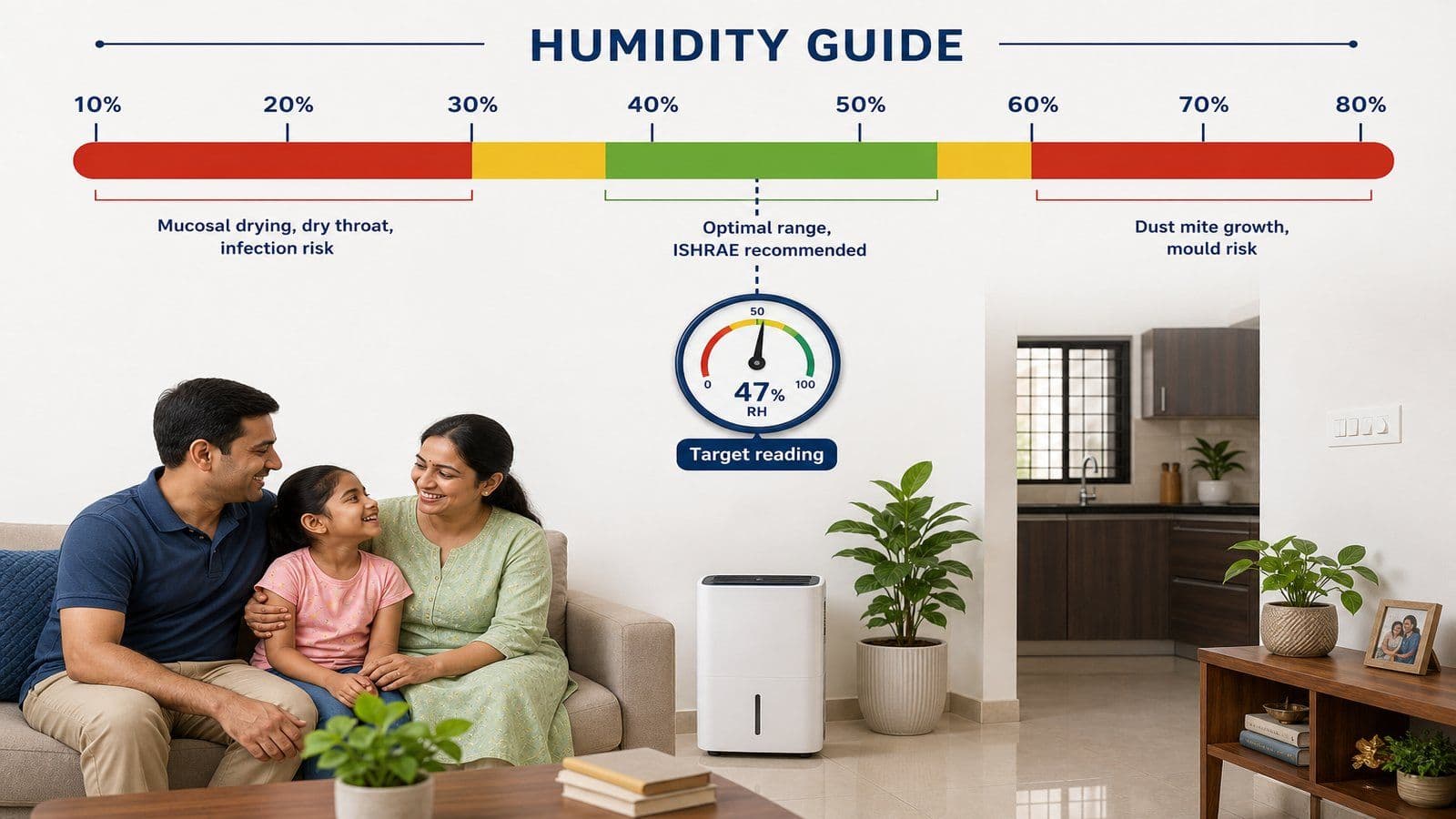
Photo: Indoor humidity comfort and health zone diagram
BIS document IS 16313 on indoor air quality, drawing from ISHRAE guidelines, identifies 40 to 55 percent relative humidity as the optimal range for respiratory health and comfort. Below 30 percent, the mucous membranes lining your nose, throat, and lungs begin to dry out, breaking down their primary infection-blocking function. A 1.5 ton split AC running at full cooling on a 38 degree afternoon in a 150 square foot bedroom will pull room humidity down to 28 to 35 percent within 90 minutes. Over an 8-hour overnight cycle, this is what gives people the classic morning sore throat and "AC headache."
Above 60 percent humidity, dust mite reproduction accelerates sharply. Drop it below 50 percent and their populations crash within weeks, the single most effective non-chemical dust mite control method known to allergists. Mould spores germinate when surface humidity stays above 65 percent for more than 24 hours. The drain pan inside your AC almost always sits above this threshold during monsoon.
A ₹500 to ₹1,200 digital hygrometer on your bedside table tells you exactly which way to adjust. The reading on the AC remote that says "50 percent humidity" is often unreliable because the sensor sits inside the indoor unit and reads the cold dehumidified air, not the actual room air a metre away.
The single cheapest health intervention I recommend to AC owners is a basic ₹500 hygrometer. The number on the wall tells you whether you are drying yourself out or breeding mites. Without it, you are guessing. Most asthmatic complaints I review trace back to a household running at 26 percent humidity every night for six summer weeks straight.
Get quotes from verified, top-rated AC Service & Repair pros in Delhi.
Vulnerable Family Members Need Different Settings
The Indian Academy of Paediatrics recommends 26 to 28 degrees Celsius for sleeping infants, not the 19 to 22 adults often prefer. Direct AC airflow on a bassinet causes nasal dryness within hours. Older adults with chronic lung conditions are unusually sensitive to temperature swings; a sudden 10-degree drop from a hot kitchen into a cold bedroom can trigger bronchospasm. Keep a stable 25 to 26 degrees. A PM2.5 filter is non-negotiable for households with asthmatic elderly relatives.
For allergic rhinitis sufferers, mattress encasements rated for mite barrier, weekly hot wash of sheets above 60 degrees, and AC humidity held below 50 percent treat the cause rather than just the symptom. Patients still on a recovery curve from a moderate or severe COVID infection see reduced lung function aggravate badly in dry recirculated air. A PM2.5 filter, a humidity hold at 45 percent, and at least 20 minutes of window-open ventilation morning and evening make a meaningful difference.
Health-First AC Habits
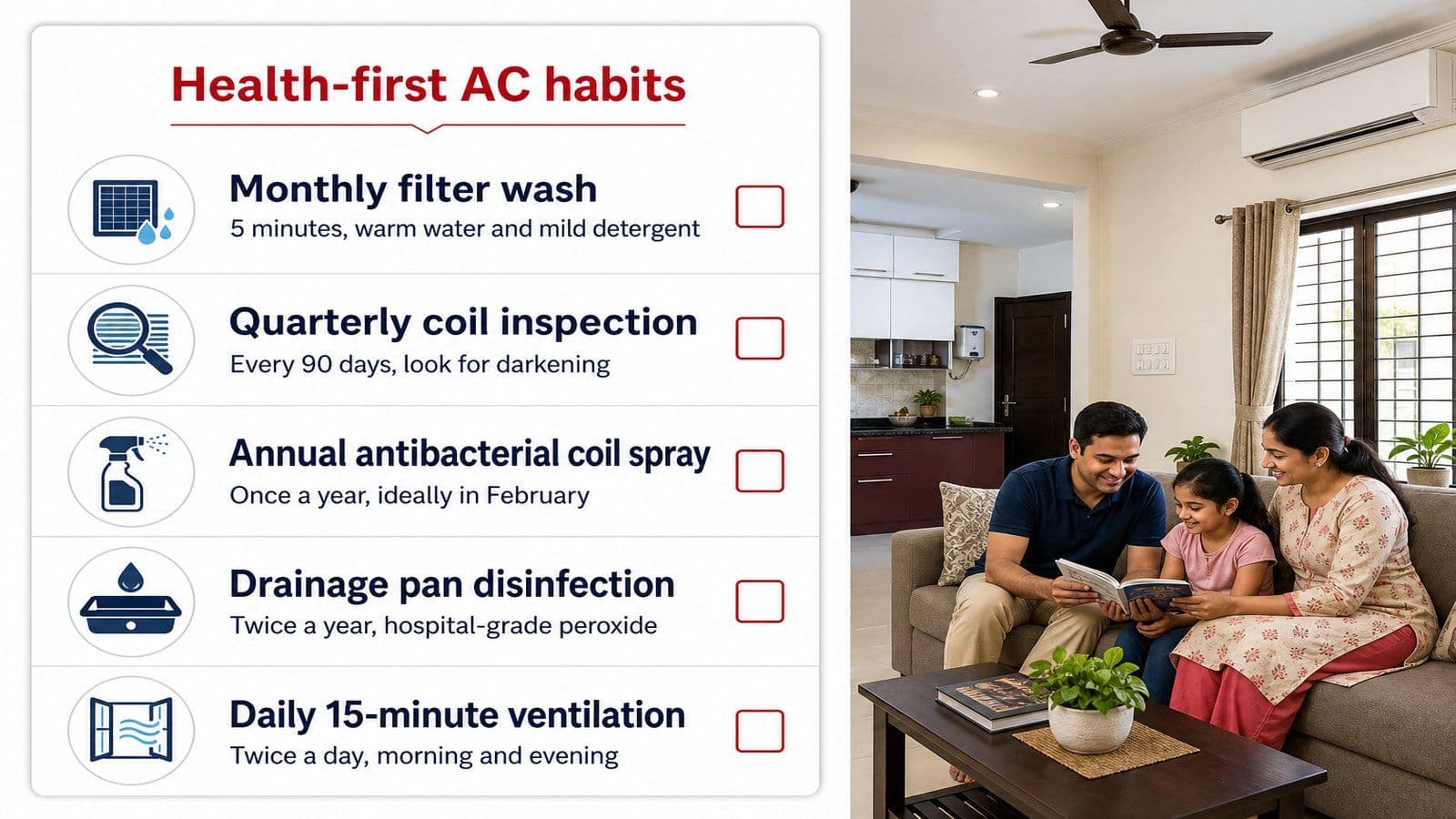
Photo: Five health-first AC habits checklist
You do not need a complicated routine. You need a consistent one. The five habits below prevent roughly 80 percent of the AC-linked indoor air problems we see in service calls.
Monthly filter wash: Rinse the washable pre-filter in warm water with mild detergent, air dry, replace. Five minutes. Done monthly, it extends coil life and protects whatever finer filtration sits behind it.
Quarterly coil inspection: Every 90 days, look at the evaporator coil through the front panel. If you see darkening of the fins or smell anything off, book a chemical coil wash. In monsoon-heavy regions, shift this to every 60 days from June through September.
Annual antibacterial coil spray: A professional service should include an anti-microbial spray on the coil and drain pan after the deep clean. Done once a year in February before the cooling season, it suppresses biofilm formation for 8 to 10 months.
Drainage pan disinfection: Twice a year, a technician should disinfect the pan with a hospital-grade dilute peroxide solution and clear the drain line. Cost is usually ₹200 to ₹400 as an add-on.
Daily 15-minute ventilation cycle: Twice a day, open one window on each side of the home for 15 to 20 minutes. Early morning before pollution rises and late evening after traffic thins are ideal. This is how you flush out the CO2 and VOCs your AC cannot touch.
When I audit a building's HVAC performance, I look at three numbers: filter age, coil cleanliness, and the ratio of fresh-air exchanges per hour. Residential setups in India almost never address the third one. The cheapest fix in the entire toolkit is opening a window for 15 minutes. It is the single highest-leverage thing most families can do for indoor air.
Deep dive: For a structured pre-summer and post-monsoon service rhythm, see common AC problems: top 15 and the broader AC owner guide for Indian homes.
Air Purifier Versus AC Filter
Owners often ask whether they need an air purifier if their AC already has a "good filter." The honest answer is yes, in most Indian urban homes, especially during the October to February window in north India. An AC and a purifier are complementary, not redundant. The AC is your humidity manager, your temperature regulator, and your basic dust filter. A standalone HEPA air purifier rated for your room volume is your PM2.5 manager. Budget guidance sits at ₹12,000 to ₹28,000 for a HEPA unit rated for a 200 to 350 square foot bedroom.
Conclusion
Your AC was never designed to be a complete indoor air solution. It cools, it dehumidifies, and it filters the larger dust. Everything else, from PM2.5 in a Delhi winter to dust mites in a Mumbai monsoon to CO2 buildup in a sealed bedroom, requires a deliberate decision from you. The good news is that the deliberate decisions are not expensive. A ₹500 hygrometer, a monthly filter wash, an annual chemical coil clean, a basic PM2.5 filter retrofit for high-pollution months, and a 15-minute daily window-open habit cover the vast majority of what an Indian household needs.
If you have children, elderly parents, anyone with asthma, or a family member still recovering from a respiratory infection, treat the above as the baseline, not the upgrade. The cost difference between a household running these habits and one ignoring them shows up not on the electricity bill but in clinic visits, inhaler prescriptions, and missed school weeks during the worst pollution months.
Disclaimer
Pricing, filter availability, and brand-specific features mentioned in this article reflect the Indian market as of May 2026 and exclude GST. Actual costs vary by city, model, and individual technician. For any health condition or respiratory symptom, consult a qualified medical practitioner. We recommend booking AC service through technicians with verifiable NSDC certification and at least 3 years of documented field experience. ProNearMe does not endorse specific brands; product references in this guide are illustrative of category-level features only.
Sources & References
- Bureau of Energy Efficiency, Star Labelling Programme for Air Conditioners 2026
- Bureau of Indian Standards, IS 17608 Air Filters for General Ventilation
- Ministry of Environment, Forest and Climate Change, National Clean Air Programme
- Press Information Bureau, Air Quality Bulletins for Delhi NCR Winter Season
- Indian Society of Heating, Refrigerating and Air Conditioning Engineers, Indoor Air Quality Position Paper
- Indian Council of Medical Research, National Guidelines on Indoor Air Quality
- Central Pollution Control Board, National Ambient Air Quality Standards
- Indian Academy of Paediatrics, Position Statement on Air Conditioning and Infant Care
- National Skill Development Corporation, Refrigeration and Air Conditioning Technician Qualification Pack
Amit worked as an AC technician for 6 years in Ahmedabad before transitioning to technical writing. He holds a diploma in Refrigeration and Air Conditioning from ITI Ahmedabad and understands the difference between what AC companies promise and what actually happens on the ground. His articles break down complex technical topics into plain language that any homeowner can follow. He tests every tip he writes about in his own home first.

Dr. Verma is a mechanical engineer with 15 years of experience in HVAC systems. She completed her PhD from IIT Delhi on energy-efficient cooling solutions for Indian residential buildings. She reviews all technical content on HomePros to make sure the numbers are right, the advice is safe, and the recommendations are backed by actual engineering principles. She consults for multiple AC manufacturers on product design.