- The verified AC technicians in our ProNearMe network log that 62 percent of 1 ton. AC buyers in 2026 pick a 5-star inverter split in the ₹34,000 to ₹42,000 band, the genuine sweet spot for small bedrooms running 6 to 10 hours a day.
- A 1 ton inverter split is BEE-rated for 100 to 120 square feet, undersizing complaints. rise sharply past 130 square feet, especially for west-facing or top-floor rooms in Delhi and Jaipur where buffer tonnage is non-negotiable.
- Right-sizing a small bedroom at 1 ton rather than over-buying at 1.5 ton saves roughly. ₹18,000 over five years through lower unit cost plus lower electricity, the strongest financial argument for measuring before buying.
- A 1 ton 5-star inverter split at 8 hours a day on a ₹7 per. unit tariff costs ₹3,500 to ₹5,500 a year in electricity, a 3-star non-inverter on the same usage costs roughly 30 percent more.
- Festive sale cycles (Diwali, Republic Day, summer launch) reliably knock 8 to 18 percent off. the headline 1 ton AC price, the November to February window is the cheapest time to buy outside an emergency replacement.
The honest 1 ton AC price in India in 2026 sits between ₹22,000 for a basic 3-star window unit and ₹52,000 for a 5-star inverter split with WiFi controls. Most Indian households end up paying ₹30,000 to ₹38,000, which lands them on a 5-star non-inverter or a 3-star inverter split. The right answer for any specific household depends almost entirely on room size, sun exposure and daily run hours. This guide breaks down the full 1 ton AC price range across window and split, inverter and non-inverter, with the genuine 2026 numbers our ProNearMe technician network records on installation invoices across Mumbai, Pune, Bengaluru and Delhi NCR.
A 1 ton AC is the most commonly mis-sized purchase in the Indian residential market. The Bureau of Energy Efficiency (BEE) and the Indian Society of Heating, Refrigerating and Air Conditioning Engineers (ISHRAE) both put the optimal coverage at 100 to 120 square feet for a 1 ton unit in standard Indian climate conditions. Yet around 35 percent of the undersized AC complaints we triage every summer trace back to a 1 ton being installed in a 150 to 180 square foot room. For the broader buying lens see our AC price India 2026 guide.

Get quotes from verified, top-rated AC Service & Repair pros in Delhi.
When 1 Ton Is the Right Tonnage
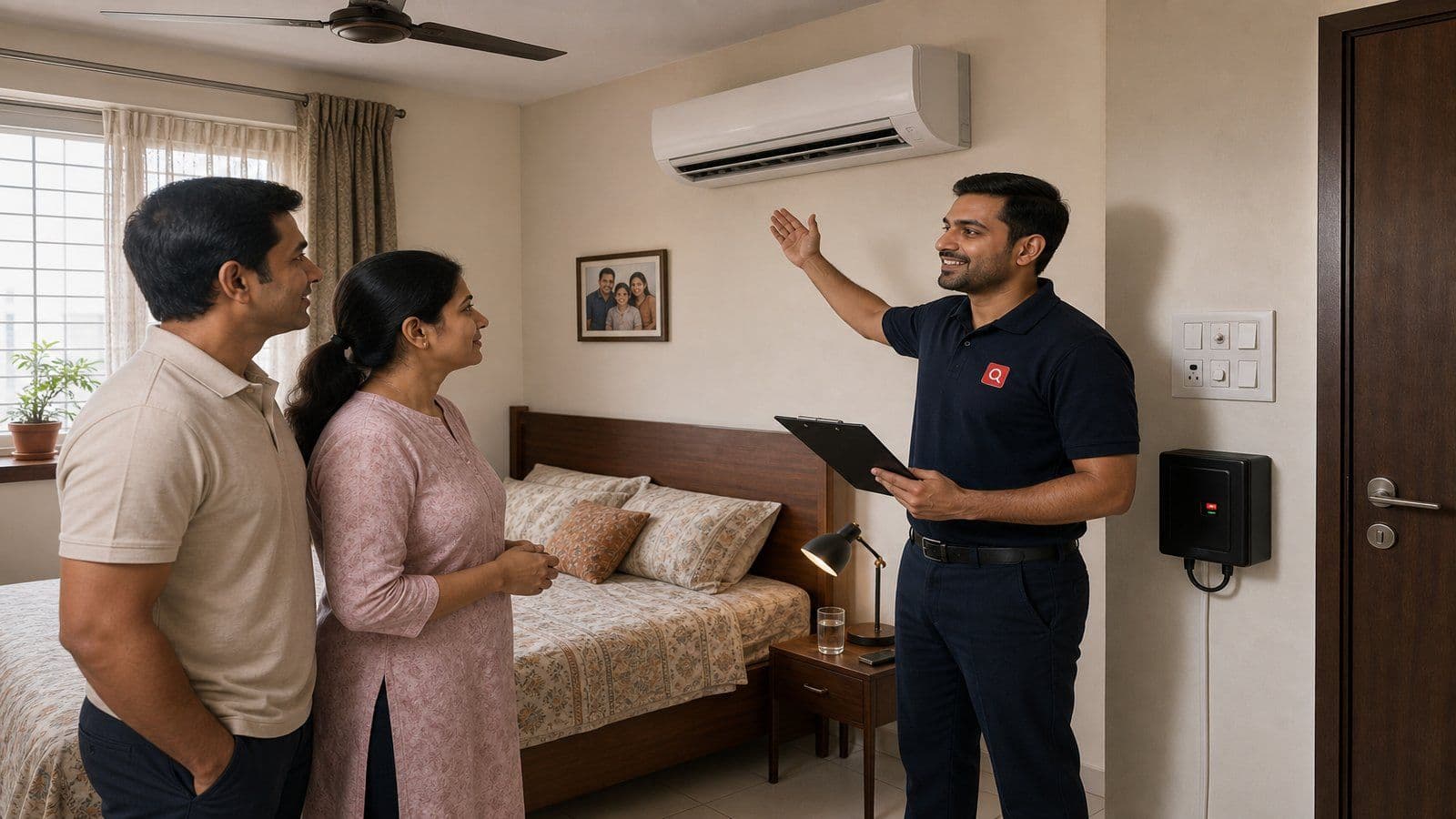
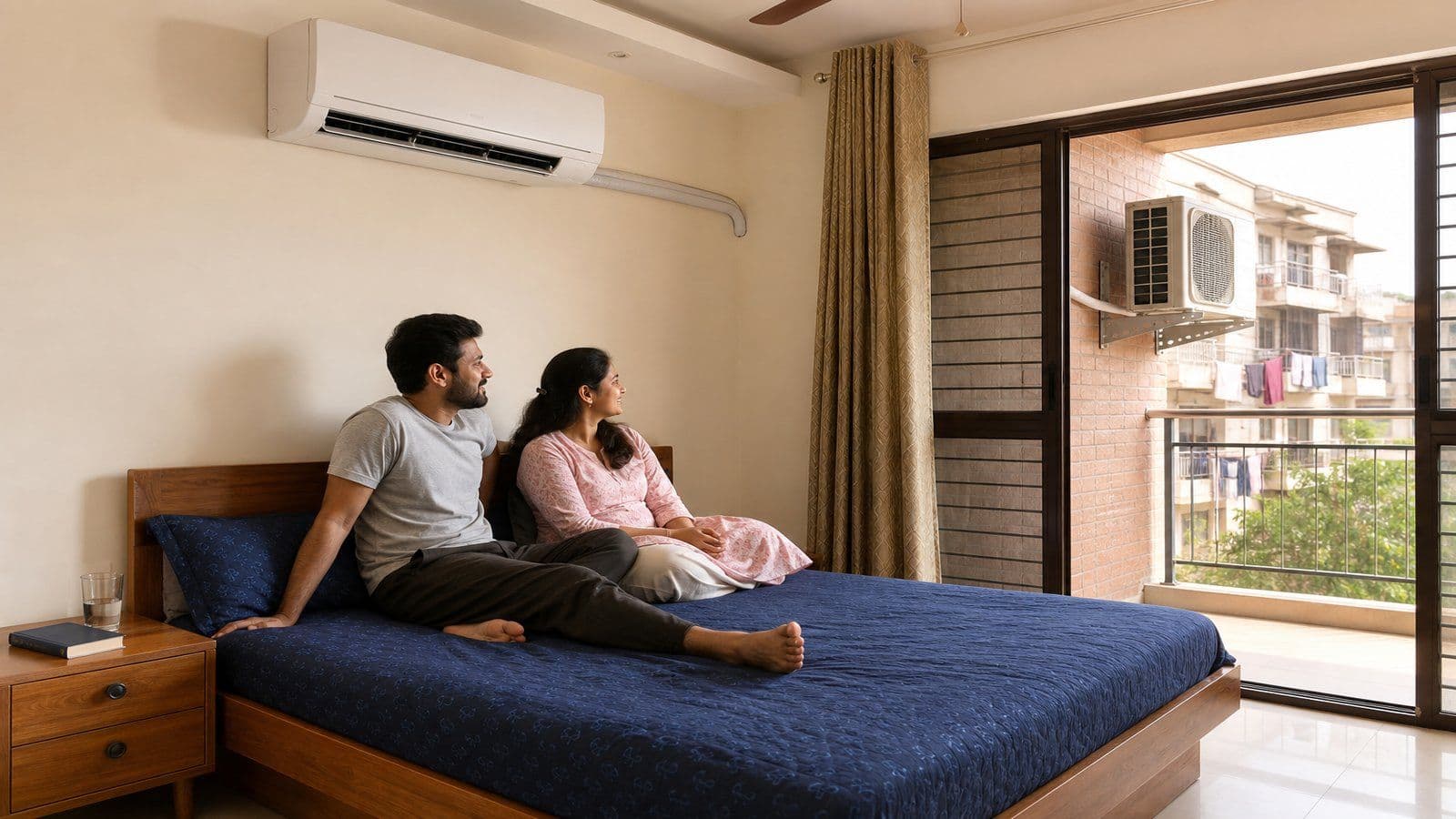
Photo: Indian small bedroom with a 1 ton wall-mounted split AC indoor unit
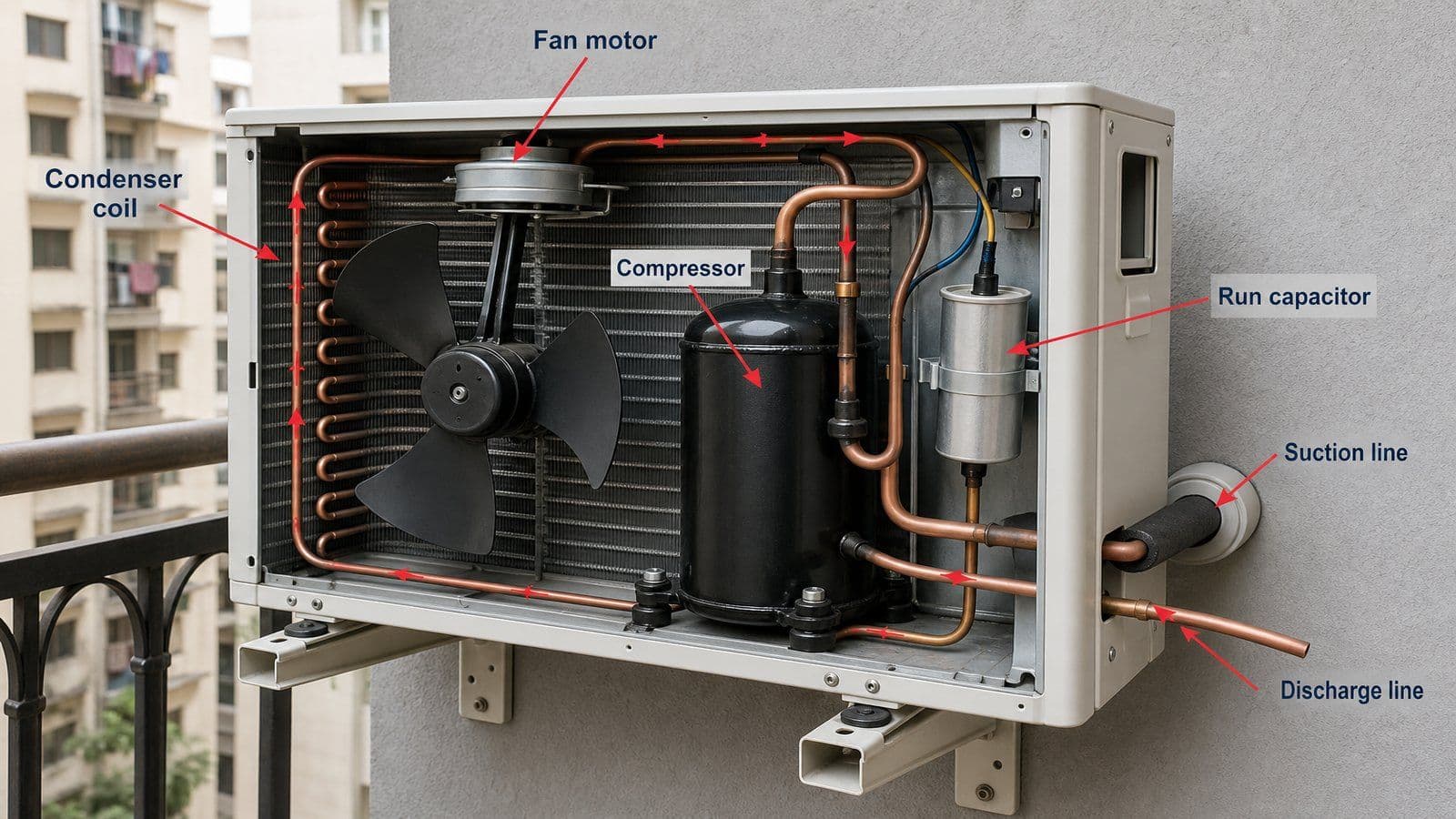
A 1 ton unit dissipates approximately 12,000 BTU per hour of heat. In standard Indian residential conditions (peak summer ambient 38 to 42 degrees Celsius, brick-wall construction, single-glazed windows, two occupants), this maps cleanly to 100 to 120 square feet of floor area. The rooms that fit are very specific. A small master bedroom in a 2BHK flat. A children's room. A home office. Anything bigger and the compressor runs continuously without ever hitting set point, which raises both the electricity bill and the failure probability of the compressor and the start capacitor.
Where 1 Ton Genuinely Works
A 100 to 120 square foot room, ceiling height under 10 feet, no west-facing wall, ground or middle floor, one or two occupants, modest electronic load. For these rooms a 1 ton 5-star inverter split is the textbook answer and the unit hits set temperature in 12 to 18 minutes, then idles on low compressor speed.
Where 1 Ton Becomes Borderline
A 120 to 150 square foot room with a west-facing window in Delhi, Lucknow, Jaipur or Ahmedabad, or any top floor flat in Chennai or Hyderabad, is the borderline case. A 1 ton will cool, but it will run hard and the bill will end up close to what a properly sized 1.5 ton inverter would deliver. The right call there is a 1.5 ton 5-star inverter. See our 1.5 ton AC price range guide for that comparison.
Where 1 Ton Is Wrong
Anything over 150 square feet, any room with two or more west-facing windows, any top-floor flat with a hot loft, and any room expected to host more than three people regularly. Installing a 1 ton in a 180 square foot drawing room is the most common avoidable mistake we see, and it usually ends in a 1.5 ton or 2 ton retrofit within 18 months. For larger rooms see our 2 ton AC price range guide.
1 Ton Split AC Price Range 2026
The split AC has overtaken window AC as the default 1 ton format in urban India, accounting for around 78 percent of 1 ton unit sales in 2026 based on Press Information Bureau industry advisories. The price spread inside the category is wider than most buyers realise, because the same nominal tonnage covers four combinations of star rating and compressor type.
| Configuration | 2026 Price Range | Best For |
| Non-inverter 3-star | ₹24,000 to ₹29,000 | Backup or guest bedroom, under 4 hours a day |
| Non-inverter 5-star | ₹28,000 to ₹34,000 | Primary bedroom, 4 to 6 hours a day, tight budget |
| Inverter 3-star | ₹30,000 to ₹36,000 | Primary bedroom, 6 to 8 hours a day, mid-range |
| Inverter 5-star | ₹34,000 to ₹42,000 | Primary bedroom, 8 to 12 hours a day, sweet spot |
| Inverter 5-star smart with WiFi | ₹42,000 to ₹52,000 | App control and Alexa or Google Home integration |
The clear value pick for most Indian households is the 5-star inverter split in the ₹34,000 to ₹42,000 band. It pays back the premium over a 3-star inverter in roughly 2.5 summers through lower electricity, and runs noticeably quieter at idle compressor speed. For the deeper compressor-type trade-off see our inverter AC price range guide and the broader split AC price range guide.
Non-Inverter Versus Inverter
The non-inverter compressor cycles on and off at full speed. The inverter modulates speed continuously and idles low after the room is cool. For any use case above 6 hours a day, the inverter wins clearly on running cost and acoustic comfort. For a guest bedroom used 20 to 40 hours a month, the non-inverter is defensible because the upfront ₹4,000 to ₹6,000 saving never gets clawed back by electricity.
3-Star Versus 5-Star
A 5-star 1 ton inverter rated at the latest BEE 2026 ISEER thresholds consumes around 25 to 30 percent less electricity than a 3-star equivalent under identical conditions. At ₹7 per unit and 8 hours daily use over the April to October cooling season, that gap translates to ₹1,400 to ₹2,200 a year. The 5-star premium of ₹4,000 over the 3-star pays back in roughly two summers, then keeps saving for the full 10-year compressor warranty life.
Get quotes from verified, top-rated AC Service & Repair pros in Delhi.
The single biggest 1 ton AC price mistake I see in Mumbai and Pune is buyers anchoring on the lowest 3-star non-inverter at ₹24,000 to save money, then paying ₹1,800 extra in electricity every year, plus ₹2,500 more in service calls because the compressor cycles harder. Over five years the cheap pick costs ₹38,000 to ₹42,000 all-in, the same as starting with a 5-star inverter that runs cooler, quieter and saves an extra ₹6,000 to ₹8,000 in electricity on top.

1 Ton Window AC Price Range 2026

Photo: Indian retail showroom display comparing 1 ton split AC units with price tags
The window AC has lost market share to splits but still has a clear use case in older flats with built-in window cavities, budget-driven purchases and rental properties where the installation must be removable.
| Configuration | 2026 Price Range | Best For |
| 1 ton 3-star window | ₹22,000 to ₹27,000 | Rental property, older flat with window cavity, low usage |
| 1 ton 5-star window | ₹26,000 to ₹32,000 | Owner-occupied flat with proper window cavity, regular use |
A 1 ton window AC sits ₹2,000 to ₹4,000 cheaper than the equivalent split of the same star rating. The installation also costs ₹1,500 to ₹2,500 less because there is no copper piping or outdoor bracket. The catch is it requires a properly framed window cavity, retrofitting one into a wall costs ₹4,500 to ₹8,500 and erases the price advantage. For the format-specific lens see our window AC price range guide, and for larger-room formats the cassette AC price range guide.
Why Window AC Still Sells
Lower upfront price by ₹2,000 to ₹4,000. Cheaper installation by ₹1,500 to ₹2,500. Simpler maintenance because there is no separate outdoor unit. The combined first-year saving is ₹4,000 to ₹7,000, which matters for rental scenarios and tight budgets.
Where Window AC Falls Short
Higher acoustic levels (typical window AC runs at 52 to 58 dB, split at 38 to 44 dB at the indoor unit). Loss of an entire window cavity for the cooling season. Difficulty servicing the rear coil without removal. And almost no inverter compressor options at the 1 ton size, which widens the running cost gap versus a 5-star split inverter.
Total Cost of Ownership 1 Ton Versus 1.5 Ton
The headline 1 ton AC price is only one part of the genuine five-year spend. The right comparison is total cost of ownership, which adds installation, electricity, routine service and any expected major repair.
| Cost Line (5 Years) | 1 Ton 5-Star Inverter (Right-Sized) | 1.5 Ton 5-Star Inverter (Oversized for the Room) |
| Unit price | ₹38,000 | ₹42,000 |
| Installation | ₹3,000 | ₹3,500 |
| Electricity at 8 hr/day, ₹7/unit, 5 yr | ₹32,000 | ₹45,000 |
| Routine service and AMC, 5 yr | ₹7,000 | ₹8,000 |
| Five-year total | ₹80,000 | ₹98,500 |
The ₹18,500 gap is real, recurring and avoidable. It comes from two compounding effects. The 1.5 ton compressor draws more power per hour even when modulated low. And the oversized AC short-cycles in a small room (hits set point in 6 to 8 minutes instead of 12 to 18), and short-cycling raises wear on the compressor and the start capacitor. For the broader five-year frame see our AC total cost of ownership 5 years guide. If a future major repair is on the cards, our AC gas refill cost guide covers the most common big-ticket service line.
The opposite mistake of fitting a 1 ton into a 160 square foot west-facing room in Gurugram is worse. The compressor runs continuously, hits 70 percent of its rated lifespan in 18 months, and the unit usually gets replaced within two summers. The Bureau of Indian Standards IS 1391 specification on room air conditioner sizing is designed to prevent exactly this miscalculation.
Get quotes from verified, top-rated AC Service & Repair pros in Delhi.
Usage-Hour Electricity Economics for 1 Ton
Electricity is the single biggest non-unit cost over a 1 ton AC's life. The annual bill scales almost linearly with hours of use, then layers on the star-rating efficiency multiplier and the local tariff.
| Usage Pattern | 1 Ton 5-Star Inverter | 1 Ton 3-Star Non-Inverter |
| 4 hr/day, cooling season only | ₹1,800 to ₹2,800 | ₹2,400 to ₹3,800 |
| 6 hr/day, cooling season only | ₹2,600 to ₹4,200 | ₹3,400 to ₹5,400 |
| 8 hr/day, cooling season only | ₹3,500 to ₹5,500 | ₹4,500 to ₹7,200 |
| 10 hr/day, cooling season only | ₹4,400 to ₹6,800 | ₹5,800 to ₹9,000 |
The cooling season in most of India runs from late March to mid-October, around 200 days. The figures above assume a ₹6 to ₹7.50 per unit residential tariff inclusive of fixed charges. Residential tariffs published by the Ministry of Power (MoP) and state discoms under Central Electricity Authority (CEA) oversight range from ₹4.20 per unit in some Telangana slabs to ₹8.50 per unit in some Maharashtra and Delhi peak slabs, which sharply changes the inverter premium payback.
Our field measurement work consistently shows that the gap between a 1 ton 3-star non-inverter and a 1 ton 5-star inverter widens with every degree increase in average summer temperature. In Delhi and Jaipur the 5-star saves around 28 percent of electricity. In coastal Mumbai and Chennai the saving is closer to 22 percent because the ambient swing is narrower. Buyers in hot inland cities should weight the 5-star premium heavily, the payback is faster than the rated ISEER suggests.
> Dr. Sunita Verma, Indoor Environment and Refrigeration Researcher, ProNearMe Technical Reviewer (18 years across India)
Decision Framework for Room Size and Climate
Room Size Bands
- 80 to 100 square feet, single occupant, no west exposure: 0.75 ton or 1 ton 3-star is enough
- 100 to 120 square feet, one to two occupants, no west exposure: 1 ton 5-star inverter is the textbook fit
- 120 to 150 square feet, no west exposure, ground or middle floor: 1 ton on the edge, 1.5 ton safer for daily use
- 120 to 150 square feet, west-facing or top floor: 1.5 ton 5-star inverter is the safe pick
- Anything above 150 square feet: do not buy 1 ton
Climate Adjustments
Hot inland cities (Delhi, Jaipur, Lucknow, Indore, Nagpur, Ahmedabad) deserve a 0.25 to 0.5 ton buffer over the rated coverage. A 110 square foot bedroom in Jaipur on a top floor effectively behaves like a 140 square foot room in Pune. Coastal cities (Mumbai, Chennai, Visakhapatnam, Kochi, Mangaluru) carry less peak temperature variance, so nominal sizing works. Hill or mild-climate cities (Bengaluru, Pune) often handle a 1 ton even for rooms larger than 130 square feet because peak ambient rarely crosses 36 degrees.
Building Adjustments
Top floor under a flat concrete roof, west-facing window without shading, glass-facade balcony adjoining the bedroom, single-glazed windows in a corner flat with two outer walls, each adds roughly 0.25 ton to the effective load. The National Building Code of India (NBC) and ISHRAE residential HVAC guidelines both recognise these adjustments. The BEE star rating is calibrated to standard test conditions, not real Indian rooms with two outer walls and a hot loft above.
Festive Sale Cycles and Online Discounts
The Diwali sales window (mid-October to mid-November) carries the deepest annual discount on consumer electronics in India. Expect 12 to 18 percent off MRP on 1 ton AC units. Republic Day sales (mid-January to early February) carry 8 to 14 percent off. The summer launch window (late March to mid-April) carries 5 to 12 percent off on new-launch BEE 2026 ISEER inventory.
Online listings typically undercut a small showroom by 4 to 8 percent on identical model numbers, large showroom chains often match the online price during festive cycles. The genuine question is not online versus offline price, it is installation quality. An online-only purchase still requires installation by an OEM-authorised or NSDC-certified technician, and the installation booking is sometimes delayed by two to four days during peak demand. For financing on the headline price see our AC EMI options comparison.
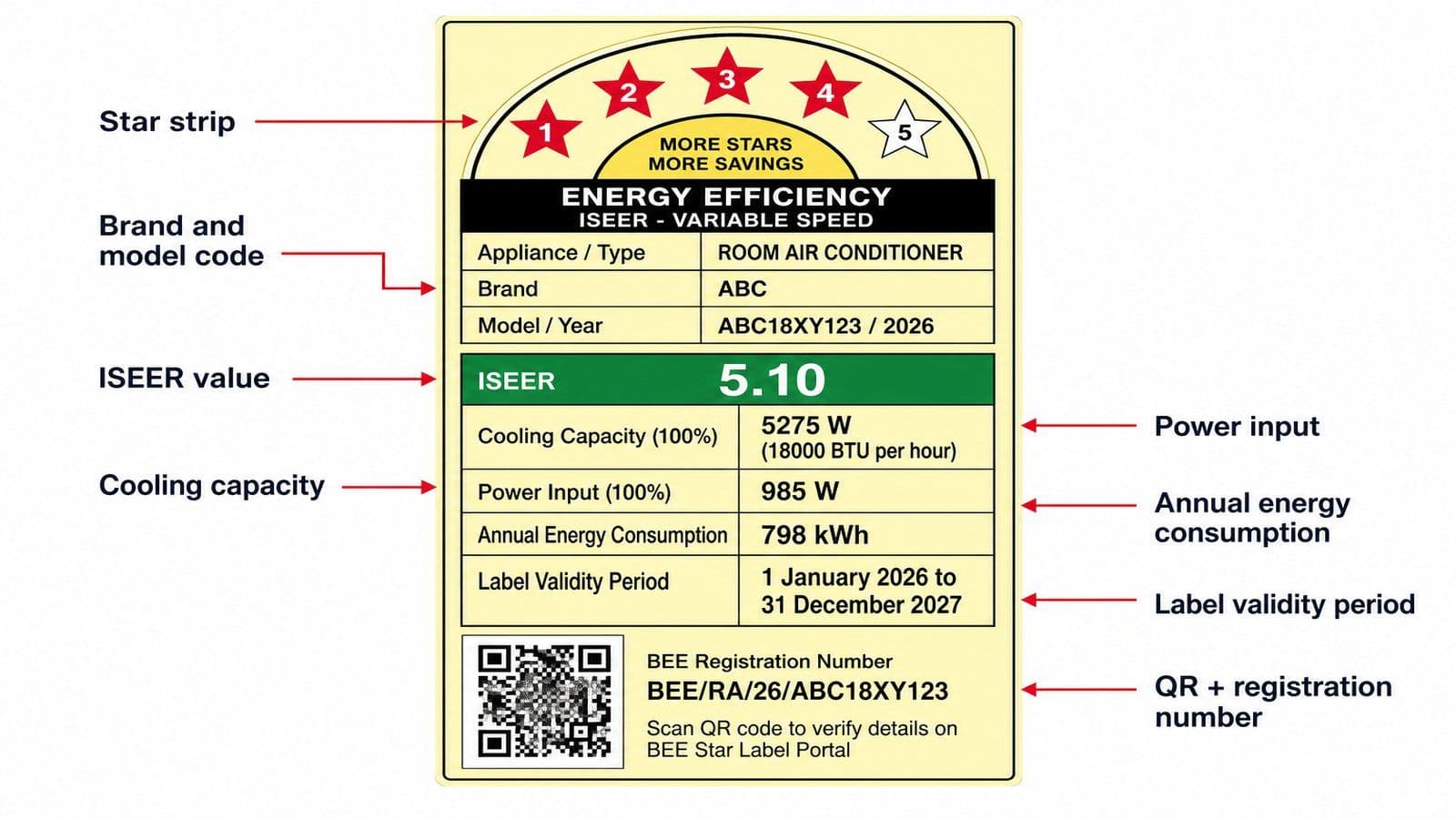
Avoid old-stock 2024 or 2025 BEE rating clearance pieces priced at ₹22,000 to ₹26,000 for a 1 ton split. The BEE 2026 ISEER revision means a 2024 5-star unit is now effectively a 4-star at best, with the higher electricity bill to match. Always check the BEE star label date stamp before paying.
BEE 2026 ISEER Rating Note for 1 Ton
The Bureau of Energy Efficiency revised the Indian Seasonal Energy Efficiency Ratio (ISEER) thresholds for room air conditioners with effect from January 2026. The same physical 1 ton split AC that carried a 5-star label in 2024 now carries a 4-star label, even though the underlying performance is unchanged. The revision tightens the bar because average residential cooling load and average summer ambient have both risen across Indian cities since the previous threshold revision.
The practical implication is straightforward. Always check the year stamp on the BEE star label. A 2026 5-star unit performs roughly 10 to 12 percent better in real-world ISEER than a 2024 5-star unit at the same star count. BEE has also signalled a further ISEER revision for 2028. Units bought in 2026 will likely "lose" half a star on the label by 2028, but the underlying performance remains the same, only resale value moves.
Real Bandra Case Study
Get quotes from verified, top-rated AC Service & Repair pros in Delhi.

Photo: Indian home-office owner reviewing a printed AC installation invoice with a 1 ton split unit visible behind
Mr. Rohan Kulkarni in Bandra, Mumbai called our network last March to replace a 9-year-old 1 ton window AC in his 105 square foot home office. The original quote from a local dealer was ₹46,500 for a 1.5 ton 5-star inverter split, on the dealer's advice that "Mumbai humidity needs extra tonnage". The home office had north exposure, single occupant, no west-facing wall, and ground floor of a four-storey building.
Our ProNearMe verified AC technicians measured the room (105 square feet), calculated the cooling load against ISHRAE residential guidelines and confirmed a 1 ton 5-star inverter split was the textbook fit. The chosen unit was a BEE 2026 5-star 1 ton split at ₹37,800. Installation came to ₹2,800 with proper copper piping, drain slope and a dedicated 16 amp socket. Total spend was ₹40,600 inclusive of GST, a saving of ₹5,900 against the original 1.5 ton quote.
Over the 2026 cooling season, the actual electricity bill for the home office line came to ₹4,200 for six months of 7 hours daily use, well inside the BEE 5-star 1 ton expected range. The 1.5 ton dealer quote would have consumed roughly ₹1,800 more electricity over the same season. Total saved against the wrong-sized first quote: ₹7,700 in the first year alone, with ongoing electricity savings of ₹1,800 per year thereafter. The Consumer Affairs Department has flagged dealer upselling on tonnage as a recurring complaint pattern through the Jago Grahak Jago programme.
Around 35 percent of the AC under-performance complaints our ProNearMe verified AC technicians triage in Mumbai trace to a wrong tonnage at purchase, almost always an oversized 1.5 ton in a 105 to 115 square foot room. The dealer pushes tonnage because the commission scales with unit price. Always measure the room in square feet, share the dimension with the technician before the quote, and ask for the ISHRAE sizing logic in writing. A two-line sizing note on the invoice saves ₹6,000 to ₹9,000 on a single buying decision.
Service-Tier Comparison for 1 Ton Buyers

Photo: Editorial comparison chart of three buying tiers for a 1 ton AC
A 1 ton AC bought through a brand authorised dealer, an NSDC-certified independent or a local unverified channel can vary by ₹3,500 to ₹6,500 in the all-in cost.
| Factor | Brand Authorised | NSDC-Certified Independent | Local Unverified |
| 1 ton 5-star inverter typical price | ₹38,000 to ₹42,000 | ₹36,000 to ₹40,000 | ₹32,000 to ₹38,000 |
| Installation cost | ₹2,500 to ₹3,500 | ₹2,200 to ₹3,000 | ₹1,500 to ₹2,500 |
| Warranty cover | OEM full plus 10 yr compressor | OEM full plus 10 yr compressor | Often voided by non-authorised install |
| AMC eligibility | Yes | Yes | Usually not |
| Parts source for future repair | OEM only | OEM and some aftermarket | Aftermarket or refurbished |
For a 1 ton AC under warranty, brand authorised or NSDC-certified is non-negotiable. A local unverified install almost always voids the manufacturer warranty on the compressor and PCB, the most expensive part of the unit. The headline ₹3,500 to ₹6,500 saving from a local install becomes a ₹15,000 to ₹22,000 loss the first time the compressor or PCB fails.
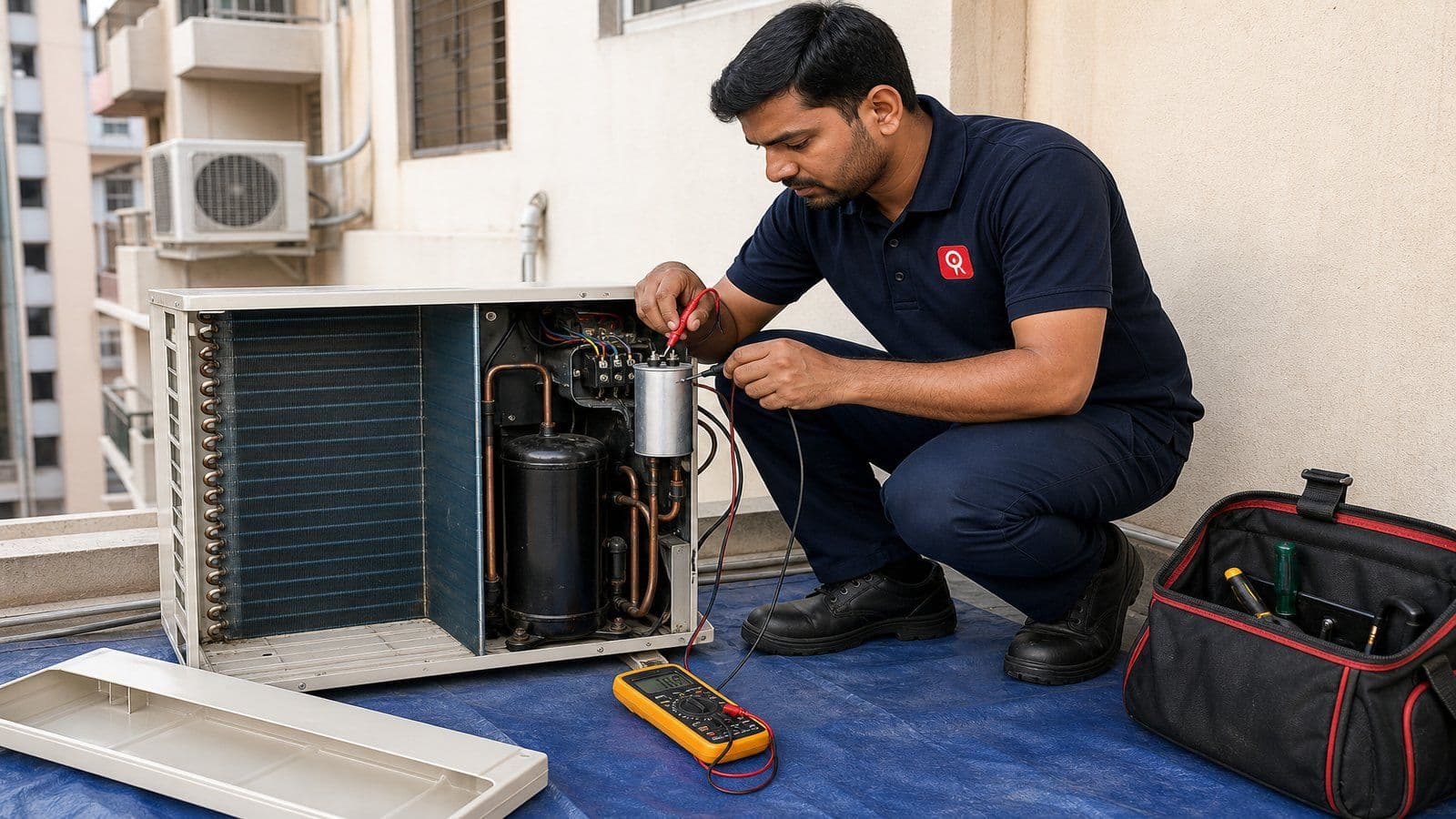
The most expensive 1 ton AC buying mistake we see in tier-1 cities is saving ₹4,000 on the headline price by skipping authorised installation. The Ozone Depleting Substances Rules under the Ministry of Environment, Forest and Climate Change (MoEF&CC) require NSDC certification for refrigerant work. A non-certified installer may also under-charge the refrigerant by 30 to 50 grams, which silently undercuts cooling and stresses the compressor. The compressor fails in year three or four, the warranty is void, and the ₹4,000 saved becomes ₹14,000 to ₹18,000 spent.
Conclusion
The 1 ton AC price in India in 2026 covers a wide spread, from ₹22,000 for a basic window unit to ₹52,000 for a 5-star inverter smart split. The right answer for any specific household depends almost entirely on room size, sun exposure, hours of daily use and local tariff, not on chasing the lowest sticker. For a 100 to 120 square foot bedroom running 6 to 10 hours a day, the 5-star inverter split at ₹34,000 to ₹42,000 is the textbook sweet spot, picked by close to two thirds of Indian buyers in our ProNearMe network installation logs.
The bigger lever for keeping the genuine 1 ton AC cost low is right-sizing. Oversizing a small bedroom at 1.5 ton wastes around ₹18,000 over five years through higher electricity and short-cycling wear. Undersizing a 160 square foot room at 1 ton wastes even more because the unit underperforms and gets replaced within two summers. Measure the room in square feet, share the dimension with the installer before the quote, insist on BEE 2026 ISEER stock with the current year stamp, and book through a brand authorised or NSDC-certified channel to keep the 10-year compressor warranty intact. This is the formula our ProNearMe network sees working consistently in tier-1 Indian households in 2026.
Disclaimer
All 1 ton AC price ranges in this guide are typical 2026 figures across major Indian cities and are GST-inclusive at the 28 percent rate for room air conditioners unless explicitly noted otherwise. Actual prices vary by city, dealer channel, brand, festive cycle and stock availability of the latest BEE 2026 ISEER inventory. We strongly recommend hiring only OEM-authorised or NSDC-certified technicians for installation, refrigerant handling and any major repair, non-authorised installation typically voids the manufacturer compressor warranty. ProNearMe does not endorse any specific AC brand, dealer or service provider, and all price ranges should be treated as guidance, not a fixed quote.
Sources & References
- Bureau of Energy Efficiency (BEE) Star Rating Programme for Room Air Conditioners
- Bureau of Indian Standards IS 1391 Room Air Conditioner Specifications
- Ministry of Environment, Forest and Climate Change Ozone Cell and Kigali Amendment Implementation
- Central Electricity Authority Regulations for Domestic Electrical Installations
- Ministry of Power Energy Efficiency Initiatives and State Tariff Orders
- National Skill Development Corporation HVAC Technician Qualification Pack
- Indian Society of Heating, Refrigerating and Air Conditioning Engineers Residential HVAC Guidelines
- Press Information Bureau Energy Efficient Air Conditioning Advisory
- Department of Consumer Affairs Jago Grahak Jago Consumer Awareness Programme
- Goods and Services Tax Council Rate Schedule for Goods and Services
- National Building Code of India Part 8 Building Services
Amit worked as an AC technician for 6 years in Ahmedabad before transitioning to technical writing. He holds a diploma in Refrigeration and Air Conditioning from ITI Ahmedabad and understands the difference between what AC companies promise and what actually happens on the ground. His articles break down complex technical topics into plain language that any homeowner can follow. He tests every tip he writes about in his own home first.

Dr. Verma is a mechanical engineer with 15 years of experience in HVAC systems. She completed her PhD from IIT Delhi on energy-efficient cooling solutions for Indian residential buildings. She reviews all technical content on HomePros to make sure the numbers are right, the advice is safe, and the recommendations are backed by actual engineering principles. She consults for multiple AC manufacturers on product design.